PRESENTED BY
 HARSH ADHIYA- 01
 KESHAV AGARWAL- 02
 NEIL GALA- 09
 ABHISHEK OZA- 20
 YATIN PRABHU-25
 DHAVAL SOLANKI-29
INTRODUCTION
 Mutual Funds Plays very important role for the growth and
development of any economy.
 They are vehicles for mobilizing the savings of investors towards
stock or securities market which is the barometer of the health
of economy.
 The Mutual fund over the years in India has shown tremendous
growth both in terms of AMC and AUM.
 Mutual fund becomes an attractive instrument of capital market
for retail and institutional investors.
 The main basic objective of mutual fund is to reduce risk and
provide return.
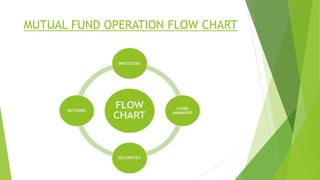
MUTUAL FUND OPERATION FLOW CHART
HISTORY OF MUTUAL FUNDS
 Phase 1- 1964-87:- In 1963, UTI was set up by Parliament under
UTI act and given a monopoly. The first equity fund was launched
in 1986.
 Phase 2- 1987-93:- It was in 1986 that the Government of India
amended banking regulations and allowed commercial banks in
the public sector to set up Mutual Funds. This led to promotion
of “SBI Mutual Fund” by State Bank of India in July 1987 followed
by Canara Bank, Indian Bank, Bank of Baroda, Bank of India,
Punjab National Bank, and GIC Mutual Fund.
CONT’D….
 Phase 3- 1993-96:-The permission was given to the private sector
funds including foreign funds management companies to enter
the Mutual Fund industry in 1993. Private funds introduced
innovative products, investment techniques and investors
servicing technology during 1994.
 Phase 4- 1996-2004:-The Mutual Fund industry witnessed robust
growth and strict regulations from SEBI after 1996. Investors'
interests were safe guarded by SEBI and the government offered
tax benefit to the investors. Various investor awareness
programmers were launched during this phase both by SEBI and
Association of Mutual Fund in India (AMFI).
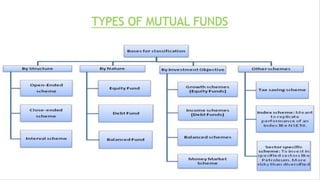
BY STRUCTURE
 Open Ended Funds:
 Close Ended Funds:
 Interval Funds:
BY NATURE
 Equity Funds:
 Debt Funds:
 Balanced Funds:
 Gilt Funds:
BY INVESTMENT OBJECTIVE
 Income Schemes:
 Growth Schemes:
 Balanced Schemes:
 Money Market Schemes:
OTHER SCHEMES
 Tax Saving:
 Sector Specific:
 Index:
 Exchange Traded Fund:
ADVANTAGES
 Portfolio Diversification:
 Professional Management:
 Low Transaction Cost:
 Liquidity:
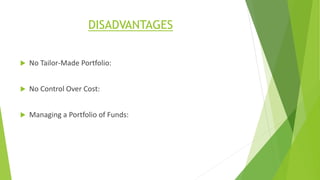
DISADVANTAGES
 No Tailor-Made Portfolio:
 No Control Over Cost:
 Managing a Portfolio of Funds:
SPONSOR
 The sponsor takes the initiative to launch and set up a mutual
fund. It can be a registered company, scheduled bank or a
financial institution.
 The sponsor establishes the mutual fund and registers the same
with SEBI.
 Sponsor appoints the Trustees, custodians and the AMC with
prior approval of SEBI and in accordance with SEBI Regulations.
 The Sponsor is not responsible or liable for any loss or shortfall
resulting from the operation of the Schemes beyond the initial
contribution made by it towards setting up of the Mutual Fund.
TRUSTEE
 The Trustees have a FIDUCIARY responsibility towards unit
holders.
 Trustee is usually a company (corporate body) or a Board of
Trustees.
 They check that the AMC’s investments are within the defined
limits, that the fund’s assets are protected, and ensure that the
unit holders get their due returns.
 Trustees receive fees for their services.
ASSET MANAGEMENT COMPANY
 The AMC is appointed by the Trustee as the Investment Manager
of the Mutual Fund.
 The AMC is required to be approved by the Securities and
Exchange Board of India (SEBI) to act as an asset management
company of the Mutual Fund.
 An AMC takes investment decisions, compensates investors
through dividends, maintains proper accounting and information
for pricing of units, calculates the NAV, and provides information
on listed schemes and secondary market unit transactions.
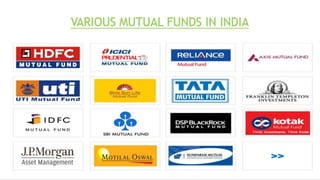
 Examples are SBI MF, ICICI Prudential, Kotak MF etc.
"There are tons of people who are late to
trends by nature and adopt a trend after it's no
longer in fashion. They exist in mutual funds.
They exist in clothes. They exist in cars. They
exist in lifestyles."
~Jim Cramer
THANK YOU

Mutual fund ppt

  • 2.
    PRESENTED BY  HARSHADHIYA- 01  KESHAV AGARWAL- 02  NEIL GALA- 09  ABHISHEK OZA- 20  YATIN PRABHU-25  DHAVAL SOLANKI-29
  • 3.
    INTRODUCTION  Mutual FundsPlays very important role for the growth and development of any economy.  They are vehicles for mobilizing the savings of investors towards stock or securities market which is the barometer of the health of economy.  The Mutual fund over the years in India has shown tremendous growth both in terms of AMC and AUM.  Mutual fund becomes an attractive instrument of capital market for retail and institutional investors.  The main basic objective of mutual fund is to reduce risk and provide return.
  • 4.
  • 5.
    HISTORY OF MUTUALFUNDS  Phase 1- 1964-87:- In 1963, UTI was set up by Parliament under UTI act and given a monopoly. The first equity fund was launched in 1986.  Phase 2- 1987-93:- It was in 1986 that the Government of India amended banking regulations and allowed commercial banks in the public sector to set up Mutual Funds. This led to promotion of “SBI Mutual Fund” by State Bank of India in July 1987 followed by Canara Bank, Indian Bank, Bank of Baroda, Bank of India, Punjab National Bank, and GIC Mutual Fund.
  • 6.
    CONT’D….  Phase 3-1993-96:-The permission was given to the private sector funds including foreign funds management companies to enter the Mutual Fund industry in 1993. Private funds introduced innovative products, investment techniques and investors servicing technology during 1994.  Phase 4- 1996-2004:-The Mutual Fund industry witnessed robust growth and strict regulations from SEBI after 1996. Investors' interests were safe guarded by SEBI and the government offered tax benefit to the investors. Various investor awareness programmers were launched during this phase both by SEBI and Association of Mutual Fund in India (AMFI).
  • 8.
    BY STRUCTURE  OpenEnded Funds:  Close Ended Funds:  Interval Funds:
  • 9.
    BY NATURE  EquityFunds:  Debt Funds:  Balanced Funds:  Gilt Funds:
  • 10.
    BY INVESTMENT OBJECTIVE Income Schemes:  Growth Schemes:  Balanced Schemes:  Money Market Schemes:
  • 11.
    OTHER SCHEMES  TaxSaving:  Sector Specific:  Index:  Exchange Traded Fund:
  • 13.
    ADVANTAGES  Portfolio Diversification: Professional Management:  Low Transaction Cost:  Liquidity:
  • 14.
    DISADVANTAGES  No Tailor-MadePortfolio:  No Control Over Cost:  Managing a Portfolio of Funds:
  • 16.
    SPONSOR  The sponsortakes the initiative to launch and set up a mutual fund. It can be a registered company, scheduled bank or a financial institution.  The sponsor establishes the mutual fund and registers the same with SEBI.  Sponsor appoints the Trustees, custodians and the AMC with prior approval of SEBI and in accordance with SEBI Regulations.  The Sponsor is not responsible or liable for any loss or shortfall resulting from the operation of the Schemes beyond the initial contribution made by it towards setting up of the Mutual Fund.
  • 17.
    TRUSTEE  The Trusteeshave a FIDUCIARY responsibility towards unit holders.  Trustee is usually a company (corporate body) or a Board of Trustees.  They check that the AMC’s investments are within the defined limits, that the fund’s assets are protected, and ensure that the unit holders get their due returns.  Trustees receive fees for their services.
  • 18.
    ASSET MANAGEMENT COMPANY The AMC is appointed by the Trustee as the Investment Manager of the Mutual Fund.  The AMC is required to be approved by the Securities and Exchange Board of India (SEBI) to act as an asset management company of the Mutual Fund.  An AMC takes investment decisions, compensates investors through dividends, maintains proper accounting and information for pricing of units, calculates the NAV, and provides information on listed schemes and secondary market unit transactions.  Examples are SBI MF, ICICI Prudential, Kotak MF etc.
  • 20.
    "There are tonsof people who are late to trends by nature and adopt a trend after it's no longer in fashion. They exist in mutual funds. They exist in clothes. They exist in cars. They exist in lifestyles." ~Jim Cramer
  • 21.