Muscles of the Shoulder
Name

Origin

Insertion

Pectoralis Major

- clavicular part - medial
anterior clavicle
- sternal part - sternal and
costal cartilages II-VI

crest of the greater
tubercle (lat. ridge of
the bicipital groove)

lateral + medial
pectorals (C5-T1)

- adducts the arm
- medially rotates the arm
- can contribute to inspiration

Pectoralis Minor

3rd - 5th ribs

coracoid process

medial pectoral (C8T1)

- lowers and rotates the scapula

Deltoid

- clavicular head - lateral
1/3 of the clavicle
- acromial head acromium
- spinal head - lower
border of the scapular
spine

deltoid tuberosity of
the humerus

axillary nerve (C5C6)

- abducts the arm
- clavicular head + 1/2 acromial fibres
flex the arm
- spinal head + 1/2 acromial fibres
extend the arm
- SWINGS the arm

Trapezius

- descending part superior nuchal line,
occipital protuberance,
nuchal ligament
- transverse part - C7-T3
(spinous processes,
supraspinous ligaments)
- ascending part - T3-T12

- descending part lateral 1/3 of
clavicle
- transverse part acromial end of
scapula, acromion,
scapular spine
- ascending part triangular portion of
scapular spine

- accessory nerve
(CN XI)
- trapezius branch
(C2-C4)

- stabilizes the scapula and shoulder
girdle
- when active, pulls scapula towards
vertebral column
- contributes to arm elevation (shrug)

Sternocleidomas - sternal head
toid
- clavicular head

- mastoid process
- superior nuchal line

- accessory nerve
(CN IX)
- cervical plexus (C1C2)

insignificant role in shoulder girdle

Latissimus Dorsi - vertebral part - T7-T12
- costal part - 10th-12th
ribs
- scapular part - inferior
angle
- thoracolumbar fascia

lesser tubercle

thoracodorsal nerve
(C6-C8)

- lowers and abducts the raised arm
- medial rotation
- forced expiration and coughing
- pull shoulders backwards and
downwards

Rhomboid Minor

Innervation

C6-C7 spines

Function

- presses the scapula on the thoracic
wall
- can retract scapula towards
vertebral column

Rhomboid Major

T1-T4 spines

medial margin of the
scapula (major
caudal to minor)

Levator
Scapulae

C1-C4 (dorsal tubercles of
transverse processes)

superior angle of the
scapula

- elevates the scapula
- rotates the inferior angle medially

Supraspinatus

supraspinatus fossa

upper facet of
greater tubercle

- holds humerus in socket
- tenses the capsule
- abducts the arm

Infraspinatus

- infraspinatus fossa
- scapular spine

Teres Minor
Teres Major

lateral border of the
scapula (minor superior to
major)

middle fossa of
greater tubercle

dorsal scapular nerve
(C4-C5)

suprascapular nerve
(C4-C6)

- reinforces the capsule of the
shoulder joint
- external rotation of the arm

lower facet of greater
tubercle

axillary nerve (C5C6)

weak lateral rotator

crest of lesser
tubercle

lower subscapular
nerve (C6-C7)

- extension of the arm toward midline
- helps in adduction

Serratus
Anterior

1st-8th ribs

entire medial margin
of scapula

long thoracic nerve
(C5-C7)

- pulls the scapula forwards
- allows lateral rotation +elevation of
the arm

Subscapularis

subscapular fossa

- lesser tubercle
- proximal crest

subscapular nerve
(C5-C8)

- strong medial rotator of the arm

(rotator cuff muscles)
Muscles of the Arm
Name

Origin

Insertion

Innervation

Function

Coracobrachialis coracoid process

medial surface of
humerus

musculocutaneous
(C6-C7)

- flexes the arm
- holds the humerus in its socket

Brachialis

anterior surface of
humerus

ulnar tuberosity, below
coronioid process

musculocutaneous
(C6-C7)

- flexes the elbow joint

Biceps Brachii

- long head supraglenoid tubercle
- short head - coracoid
process

- strong tendon - radial
tuberosity
- flattened tendon bicipital aponeurosis;
fascia of the forearm;
ulnar side

musculocutaneous
(C6-C7)

- long head - abducts the arm,
rotating medially
- short head - abducts the arm
- flexes the shoulder joint

Triceps Brachii

- long head infraglenoid tubercle
(extends between
teres major and minor)
- medial head - distal
from the radial groove,
dorsal surface of the
humerus
- lateral head - lateral
and proximal from the
radial groove

ulnar olecranon

radial (C6-C8)

- extensor of the elbow
- long head extends and adducts the
arm

Anconius

dorsal surface of lateral
epichondyle

proximal 1/4 of the
dorsal ulna

radial (C7-C8)

- assists triceps in extension

(anterior compartment)
(posterior compartment)
Superficial Anterior Forearm Muscles
Name

Origin

Pronator Teres

Insertion

Innervation

lateral surface of the
humerus

- pronates the forearm
- flexes the elbow joint

Flexor Carpi
Radialis
median nerve
Palmaris Longus

medial epichondyle of
the humerus

Function

- weak flexor and pronator of the
elbow joint
- palmar flexion of the wrist
- radial abduction

radiates into palmar
aponeurosis

- flexes the hand toward palm
- tenses the palmar aponeurosis

Flexor Digitorum
Superficialis

middle phalanges of
2nd-5th fingers

- strong flexor of the wrist and finger
joints

Flexor Carpi
Ulnaris

- pisiform bone
- hamate
- 5th metacarpal

ulnar nerve

- palmar flexion
- ulnar adduction of the hand

Deep Anterior Forearm Muscles
Name

Origin

Insertion

Pronator
Quadratus

distal ulna

distal radius

Flexor Digitorum
Profundis

proximal 2/3 of the
palmar surface of the
ulna and interosseous
membrane

base of the terminal
phalanges of the 2nd
to 5th fingers

Flexor Pollicis
Longus

- anterior surface of the
radius (distal to radial
tuberosity)
- interosseous
membrane

terminal phalanx of the
thumb

Innervation

Function
- pronation

anterior interosseous
nerve (medial 1/2 of
flexor digitorum
profundis supplied by
ulnar nerve)

flexor of wrist, midcarpal,
metacarpophalangeal,
interphalangeal joints
- flexor of terminal phalanx of thumb
- abducts terminal phalanx of thumb
in the radial direction

Lateral Forearm Muscles
Name

Origin

Insertion

Extensor Carpi
Radialis Brevis

- common head of
lateral epichondyle of
the humerus
- lateral collateral
ligament
- annular radial ligament

base of the 3rd
metacarpal

Extensor Carpi
Radialis Longus

suprachondylar ridge of
the humerus

base of the 2nd
metacarpal

Brachioradialis

suprachondylar ridge of
the humerus

radial surface of the
styloid process of the
radius

Innervation

Function
- weak flexor of the elbow joint
- brings the forearm to the midposition from ulnar adduction and
extends it

radial nerve

- weak flexor of the elbow joint
- supinator is the forearm is extended
- produces dorsiflexion and radial
abduction at the radiocarpal and
mid-carpal joints
- elbow flexor
- brings arm to mid-position between
pronation and supination
Superficial Extensor Forearm Muscles
Name

Origin

Extensor
Digitorum

Insertion

Innervation

Function

- forms the dorsal aponeurosis of
the 2nd-5th fingers
- slips of the tendons run to the
bases of the proximal
phalanges and to the capsules
of the metacarpophalangeal
joints
- intertendinous connections
deep branch of
between 3rd, 4th and 5th
the radial nerve
fingers

- extends and spreads the fingers
- strong dorsiflexor of wrist and
midcarpal joints
- ulnar adductor

Extensor Digiti
Minimi

dorsal aponeurosis of the 5th
finger

- extends the 5th digit
- helps in dorsiflexion and adduction
of the hand

Extensor Carpi
Ulnaris

base of the 5th metacarpal

- strong ulnar adductor

lateral epichondyle
of the humerus
(ulnaris also from
the ulna)

Deep Extensor Forearm Muscles
Name

Origin

Insertion

Innervation

Function

Supinator

- supinator crest of the
ulna
- lateral epicondyle of
the humerus

radius

- supinates the forearm (in every
position of flexion and extension)

Abductor
Pollicis Longus

- dorsal surface of the
ulna (distal to the
supinator crest)
- interosseous
membrane
- dorsal surface of the
radius

base of 1st metacarpal
bone

- flexes hand towards palm
- abducts it radially
- extension of the thumb

Extensor Pollicis
Brevis

radius (distal to
abductor pollicis
longus)

base of proximal phalanx of
thumb

- extends the thumb

Extensor Pollicis
Longus

dorsal surface of the
ulna

base of distal phalanx of
thumb

- extends the thumb
- at the wrist, dorsiflexes and abducts
the hand radially

Extensor Indicis

distal 1/3 of dorsal
surface of ulna

dorsal aponeurosis of index
finger (2nd finger)

- extends index finger
- participates in dorsiflexion at the
wrist and midcarpal joints

deep branch of
the radial nerve

Muscles of the upper limb

  • 1.
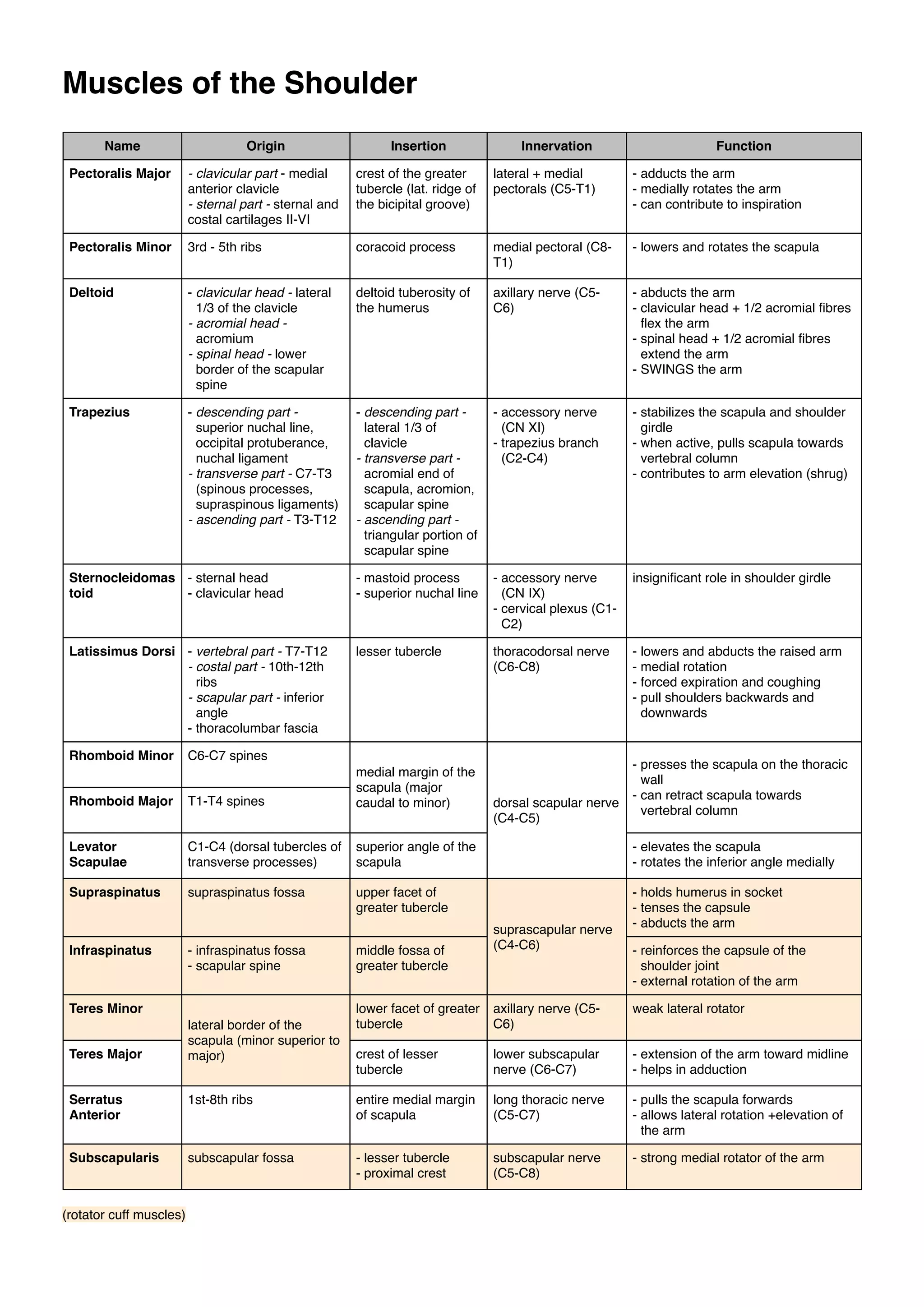
    Muscles of theShoulder Name Origin Insertion Pectoralis Major - clavicular part - medial anterior clavicle - sternal part - sternal and costal cartilages II-VI crest of the greater tubercle (lat. ridge of the bicipital groove) lateral + medial pectorals (C5-T1) - adducts the arm - medially rotates the arm - can contribute to inspiration Pectoralis Minor 3rd - 5th ribs coracoid process medial pectoral (C8T1) - lowers and rotates the scapula Deltoid - clavicular head - lateral 1/3 of the clavicle - acromial head acromium - spinal head - lower border of the scapular spine deltoid tuberosity of the humerus axillary nerve (C5C6) - abducts the arm - clavicular head + 1/2 acromial fibres flex the arm - spinal head + 1/2 acromial fibres extend the arm - SWINGS the arm Trapezius - descending part superior nuchal line, occipital protuberance, nuchal ligament - transverse part - C7-T3 (spinous processes, supraspinous ligaments) - ascending part - T3-T12 - descending part lateral 1/3 of clavicle - transverse part acromial end of scapula, acromion, scapular spine - ascending part triangular portion of scapular spine - accessory nerve (CN XI) - trapezius branch (C2-C4) - stabilizes the scapula and shoulder girdle - when active, pulls scapula towards vertebral column - contributes to arm elevation (shrug) Sternocleidomas - sternal head toid - clavicular head - mastoid process - superior nuchal line - accessory nerve (CN IX) - cervical plexus (C1C2) insignificant role in shoulder girdle Latissimus Dorsi - vertebral part - T7-T12 - costal part - 10th-12th ribs - scapular part - inferior angle - thoracolumbar fascia lesser tubercle thoracodorsal nerve (C6-C8) - lowers and abducts the raised arm - medial rotation - forced expiration and coughing - pull shoulders backwards and downwards Rhomboid Minor Innervation C6-C7 spines Function - presses the scapula on the thoracic wall - can retract scapula towards vertebral column Rhomboid Major T1-T4 spines medial margin of the scapula (major caudal to minor) Levator Scapulae C1-C4 (dorsal tubercles of transverse processes) superior angle of the scapula - elevates the scapula - rotates the inferior angle medially Supraspinatus supraspinatus fossa upper facet of greater tubercle - holds humerus in socket - tenses the capsule - abducts the arm Infraspinatus - infraspinatus fossa - scapular spine Teres Minor Teres Major lateral border of the scapula (minor superior to major) middle fossa of greater tubercle dorsal scapular nerve (C4-C5) suprascapular nerve (C4-C6) - reinforces the capsule of the shoulder joint - external rotation of the arm lower facet of greater tubercle axillary nerve (C5C6) weak lateral rotator crest of lesser tubercle lower subscapular nerve (C6-C7) - extension of the arm toward midline - helps in adduction Serratus Anterior 1st-8th ribs entire medial margin of scapula long thoracic nerve (C5-C7) - pulls the scapula forwards - allows lateral rotation +elevation of the arm Subscapularis subscapular fossa - lesser tubercle - proximal crest subscapular nerve (C5-C8) - strong medial rotator of the arm (rotator cuff muscles)
  • 2.
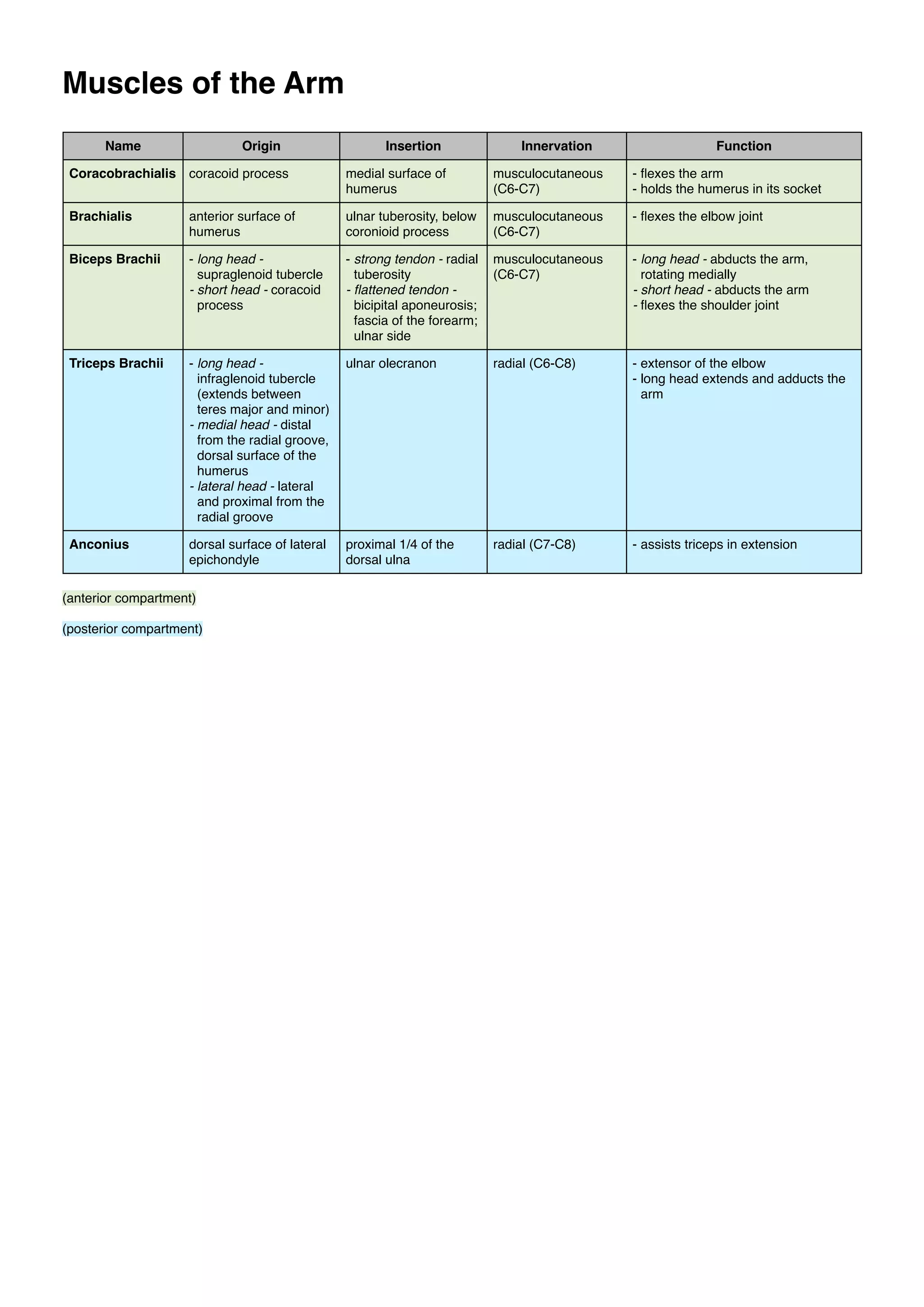
    Muscles of theArm Name Origin Insertion Innervation Function Coracobrachialis coracoid process medial surface of humerus musculocutaneous (C6-C7) - flexes the arm - holds the humerus in its socket Brachialis anterior surface of humerus ulnar tuberosity, below coronioid process musculocutaneous (C6-C7) - flexes the elbow joint Biceps Brachii - long head supraglenoid tubercle - short head - coracoid process - strong tendon - radial tuberosity - flattened tendon bicipital aponeurosis; fascia of the forearm; ulnar side musculocutaneous (C6-C7) - long head - abducts the arm, rotating medially - short head - abducts the arm - flexes the shoulder joint Triceps Brachii - long head infraglenoid tubercle (extends between teres major and minor) - medial head - distal from the radial groove, dorsal surface of the humerus - lateral head - lateral and proximal from the radial groove ulnar olecranon radial (C6-C8) - extensor of the elbow - long head extends and adducts the arm Anconius dorsal surface of lateral epichondyle proximal 1/4 of the dorsal ulna radial (C7-C8) - assists triceps in extension (anterior compartment) (posterior compartment)
  • 3.
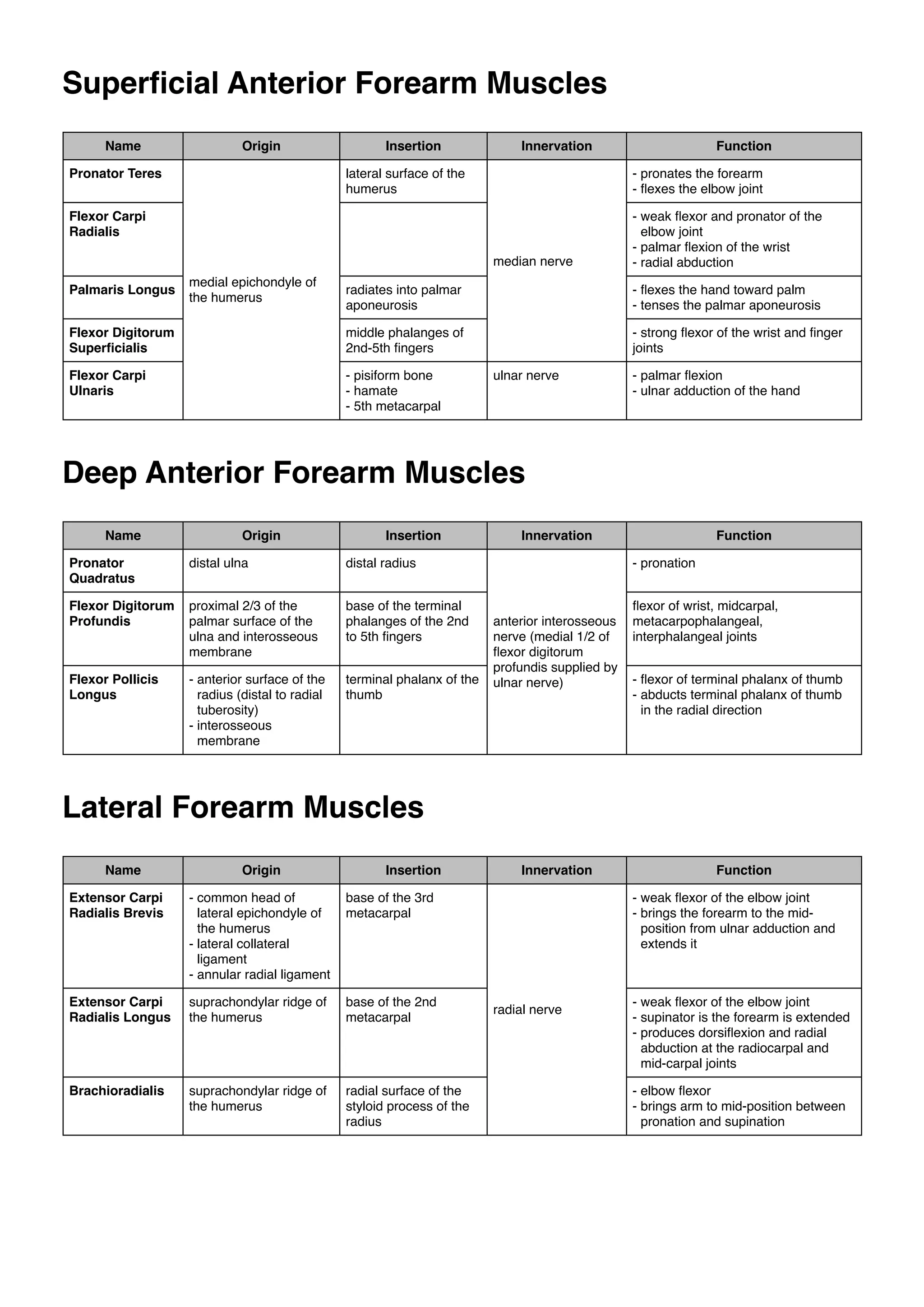
    Superficial Anterior ForearmMuscles Name Origin Pronator Teres Insertion Innervation lateral surface of the humerus - pronates the forearm - flexes the elbow joint Flexor Carpi Radialis median nerve Palmaris Longus medial epichondyle of the humerus Function - weak flexor and pronator of the elbow joint - palmar flexion of the wrist - radial abduction radiates into palmar aponeurosis - flexes the hand toward palm - tenses the palmar aponeurosis Flexor Digitorum Superficialis middle phalanges of 2nd-5th fingers - strong flexor of the wrist and finger joints Flexor Carpi Ulnaris - pisiform bone - hamate - 5th metacarpal ulnar nerve - palmar flexion - ulnar adduction of the hand Deep Anterior Forearm Muscles Name Origin Insertion Pronator Quadratus distal ulna distal radius Flexor Digitorum Profundis proximal 2/3 of the palmar surface of the ulna and interosseous membrane base of the terminal phalanges of the 2nd to 5th fingers Flexor Pollicis Longus - anterior surface of the radius (distal to radial tuberosity) - interosseous membrane terminal phalanx of the thumb Innervation Function - pronation anterior interosseous nerve (medial 1/2 of flexor digitorum profundis supplied by ulnar nerve) flexor of wrist, midcarpal, metacarpophalangeal, interphalangeal joints - flexor of terminal phalanx of thumb - abducts terminal phalanx of thumb in the radial direction Lateral Forearm Muscles Name Origin Insertion Extensor Carpi Radialis Brevis - common head of lateral epichondyle of the humerus - lateral collateral ligament - annular radial ligament base of the 3rd metacarpal Extensor Carpi Radialis Longus suprachondylar ridge of the humerus base of the 2nd metacarpal Brachioradialis suprachondylar ridge of the humerus radial surface of the styloid process of the radius Innervation Function - weak flexor of the elbow joint - brings the forearm to the midposition from ulnar adduction and extends it radial nerve - weak flexor of the elbow joint - supinator is the forearm is extended - produces dorsiflexion and radial abduction at the radiocarpal and mid-carpal joints - elbow flexor - brings arm to mid-position between pronation and supination
  • 4.
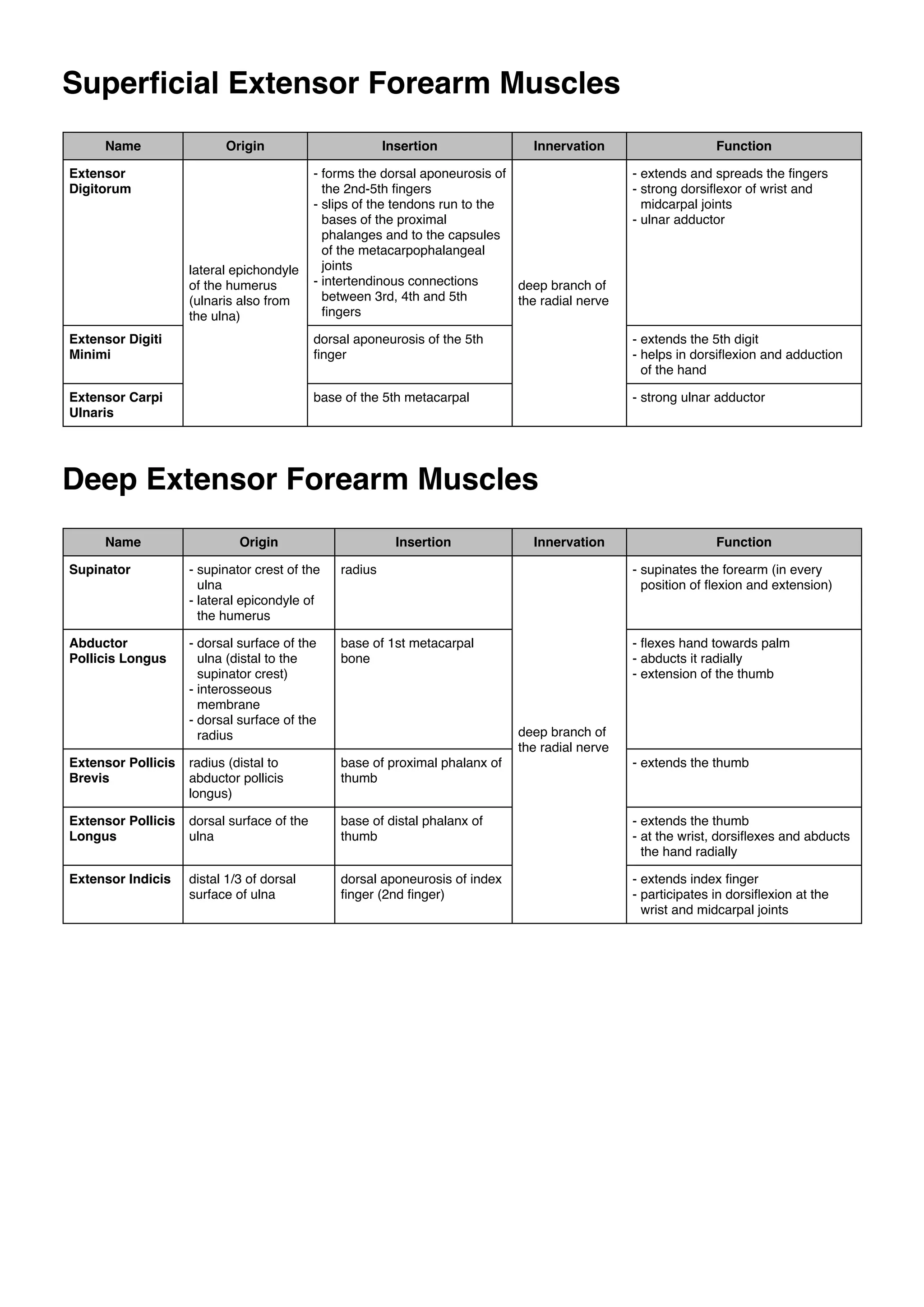
    Superficial Extensor ForearmMuscles Name Origin Extensor Digitorum Insertion Innervation Function - forms the dorsal aponeurosis of the 2nd-5th fingers - slips of the tendons run to the bases of the proximal phalanges and to the capsules of the metacarpophalangeal joints - intertendinous connections deep branch of between 3rd, 4th and 5th the radial nerve fingers - extends and spreads the fingers - strong dorsiflexor of wrist and midcarpal joints - ulnar adductor Extensor Digiti Minimi dorsal aponeurosis of the 5th finger - extends the 5th digit - helps in dorsiflexion and adduction of the hand Extensor Carpi Ulnaris base of the 5th metacarpal - strong ulnar adductor lateral epichondyle of the humerus (ulnaris also from the ulna) Deep Extensor Forearm Muscles Name Origin Insertion Innervation Function Supinator - supinator crest of the ulna - lateral epicondyle of the humerus radius - supinates the forearm (in every position of flexion and extension) Abductor Pollicis Longus - dorsal surface of the ulna (distal to the supinator crest) - interosseous membrane - dorsal surface of the radius base of 1st metacarpal bone - flexes hand towards palm - abducts it radially - extension of the thumb Extensor Pollicis Brevis radius (distal to abductor pollicis longus) base of proximal phalanx of thumb - extends the thumb Extensor Pollicis Longus dorsal surface of the ulna base of distal phalanx of thumb - extends the thumb - at the wrist, dorsiflexes and abducts the hand radially Extensor Indicis distal 1/3 of dorsal surface of ulna dorsal aponeurosis of index finger (2nd finger) - extends index finger - participates in dorsiflexion at the wrist and midcarpal joints deep branch of the radial nerve