Table of Contents:
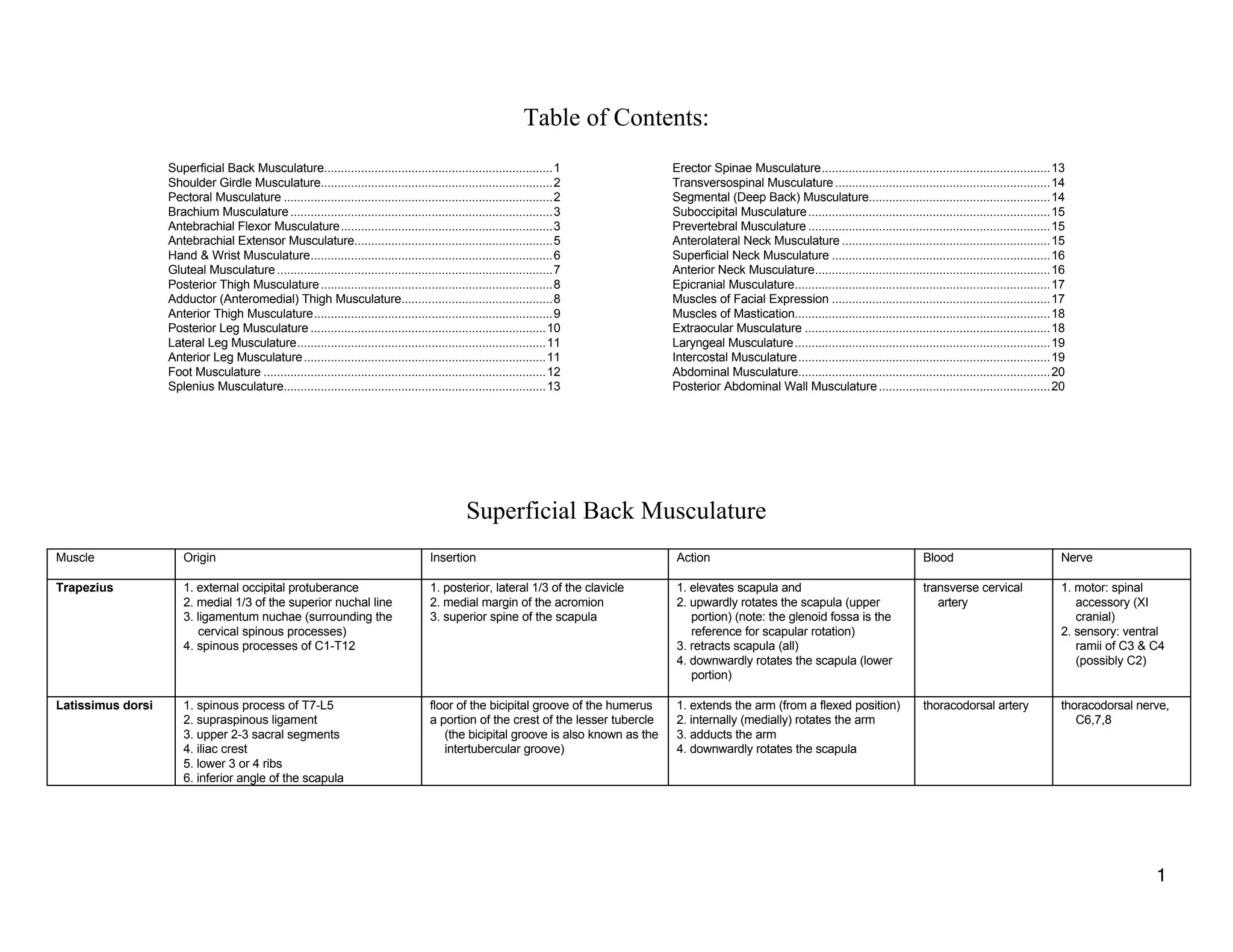
Superficial Back Musculature....................................................................1
Shoulder Girdle Musculature.....................................................................2
Pectoral Musculature ................................................................................2
Brachium Musculature..............................................................................3
Antebrachial Flexor Musculature...............................................................3
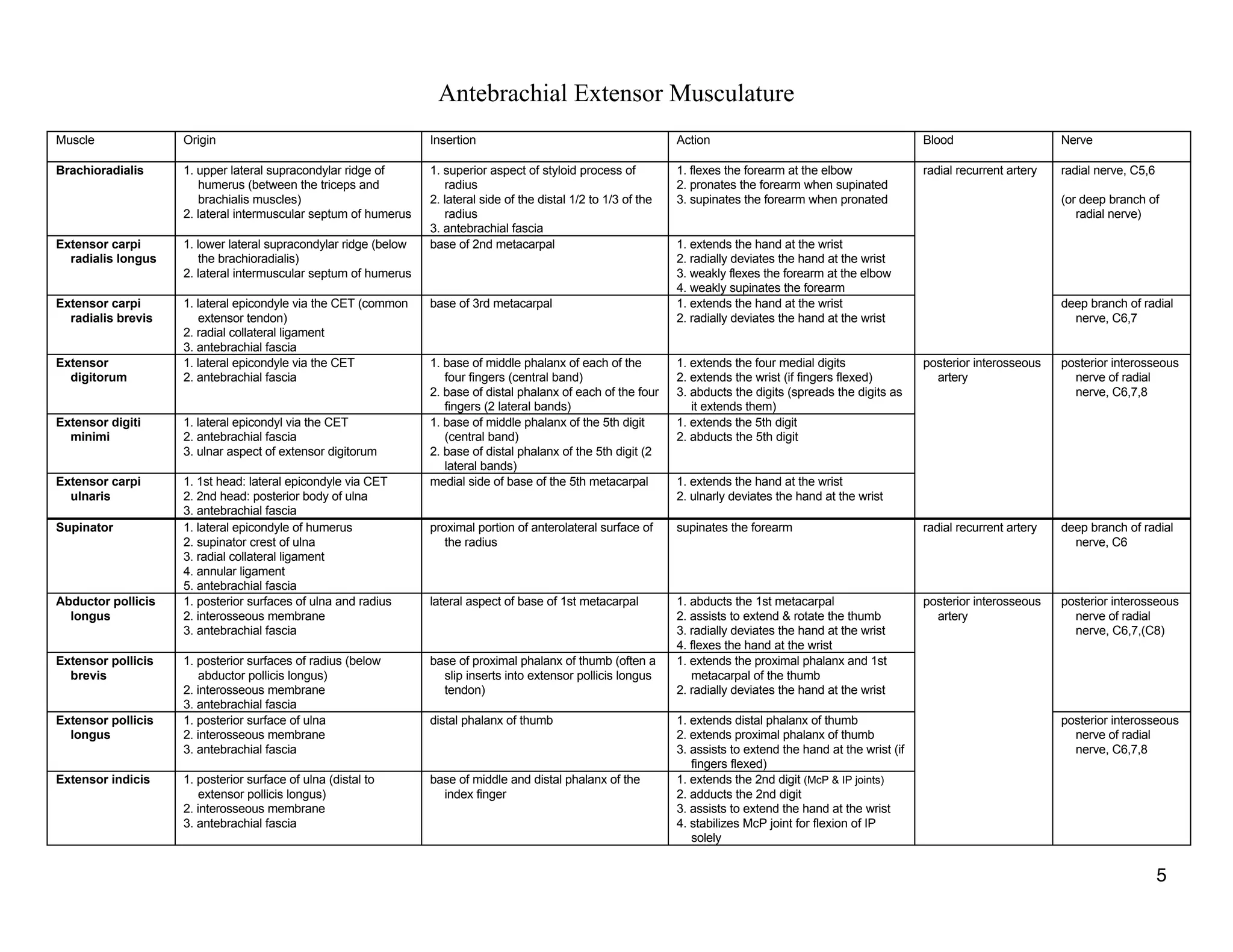
Antebrachial Extensor Musculature...........................................................5
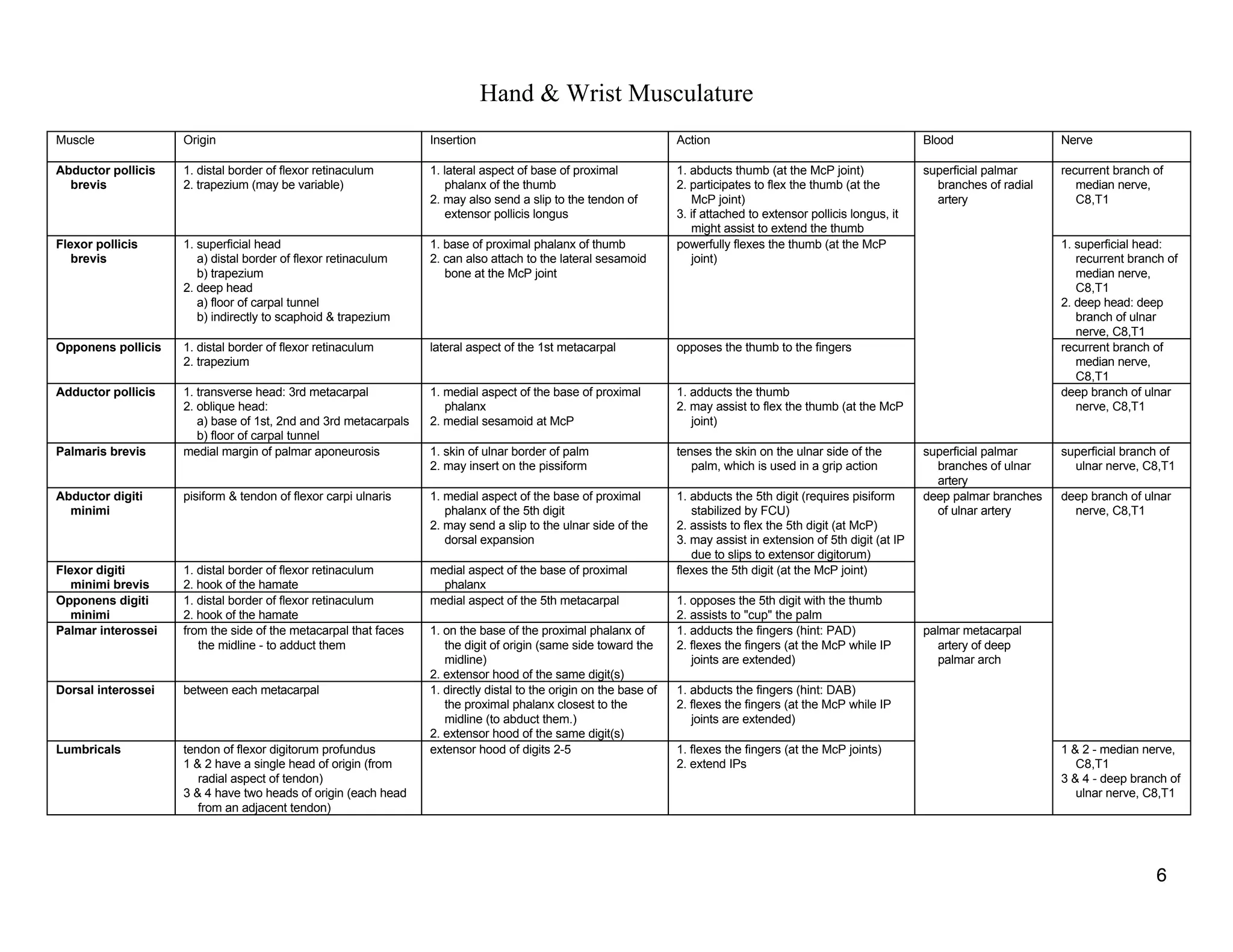
Hand & Wrist Musculature........................................................................6
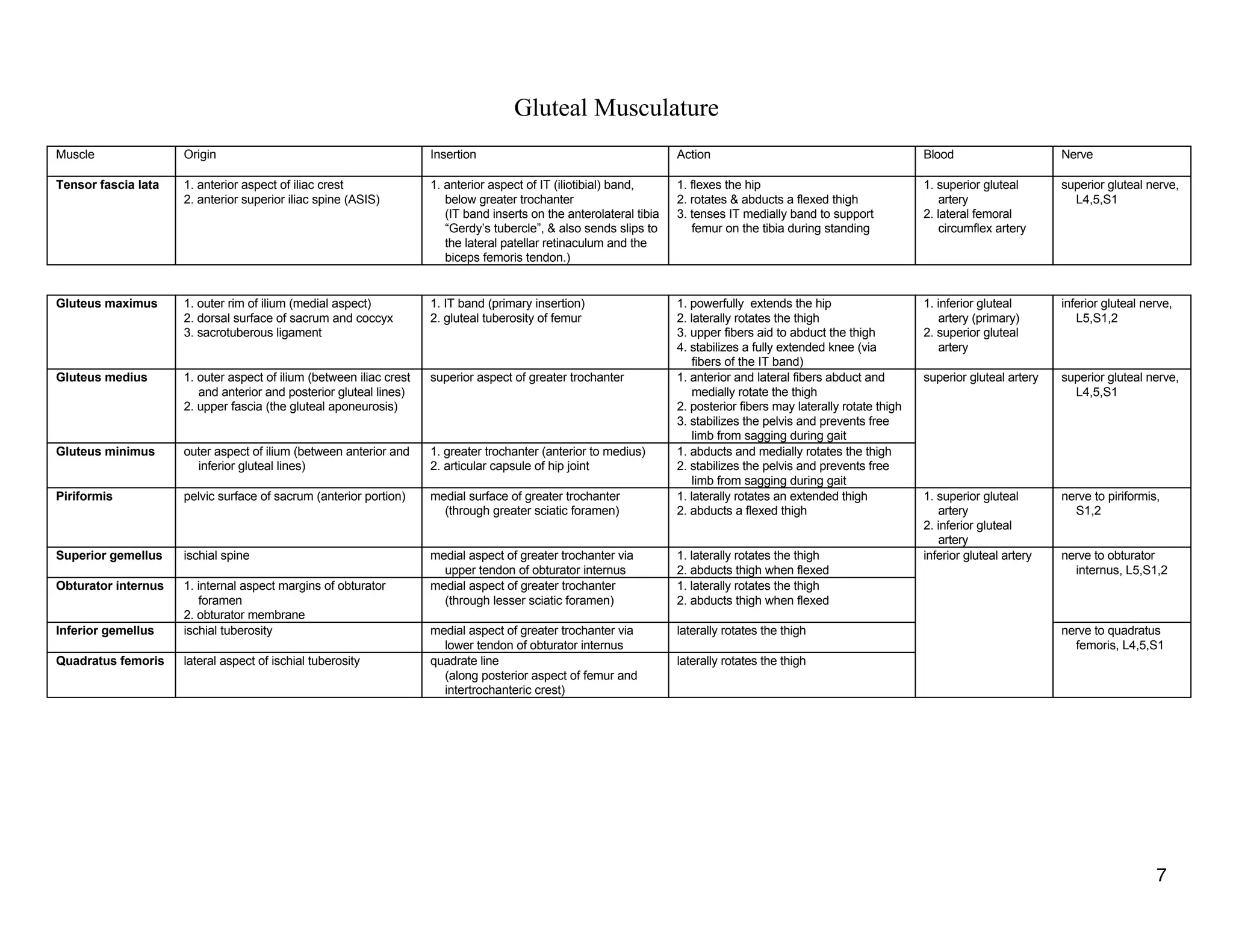
Gluteal Musculature..................................................................................7
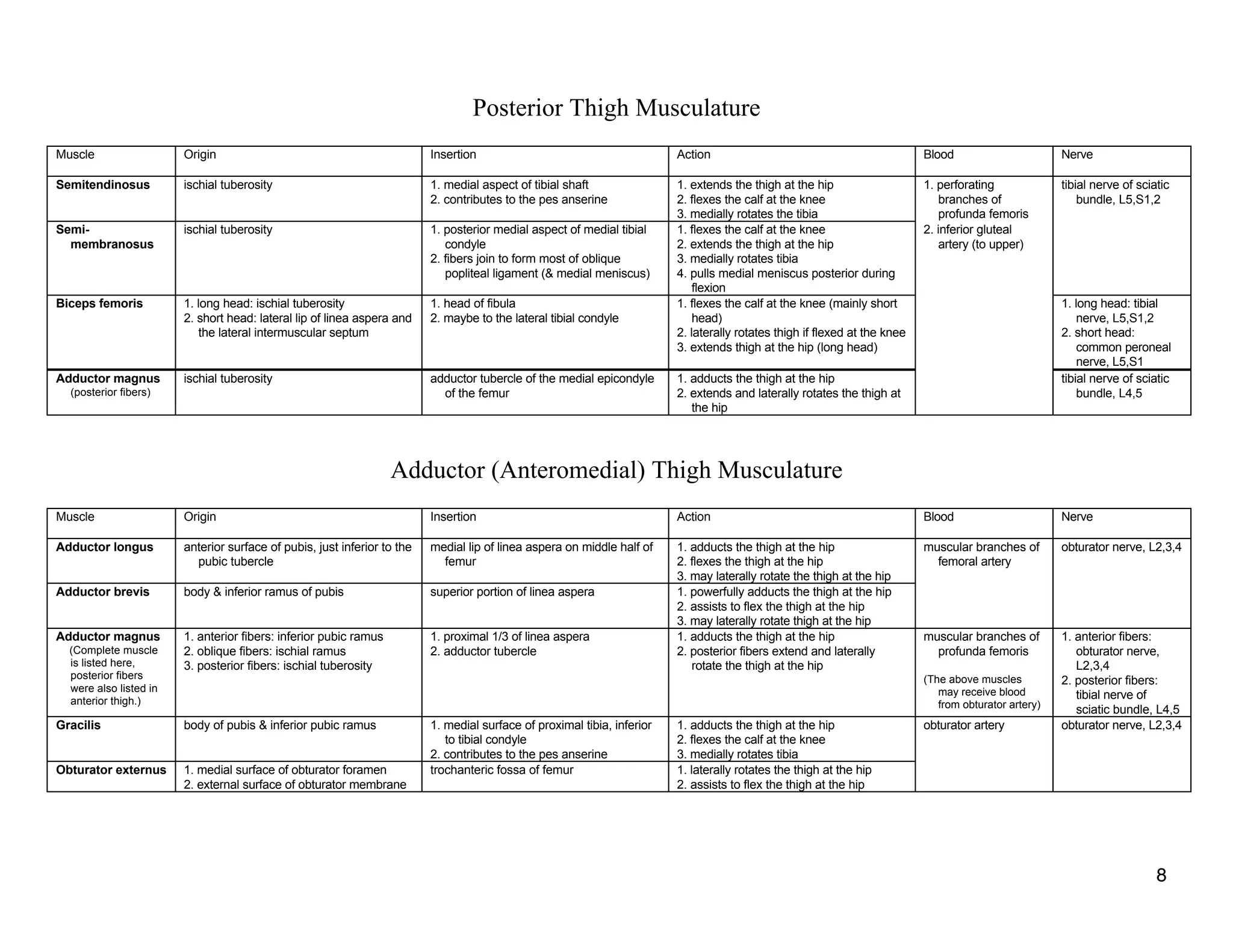
Posterior Thigh Musculature.....................................................................8
Adductor (Anteromedial) Thigh Musculature.............................................8
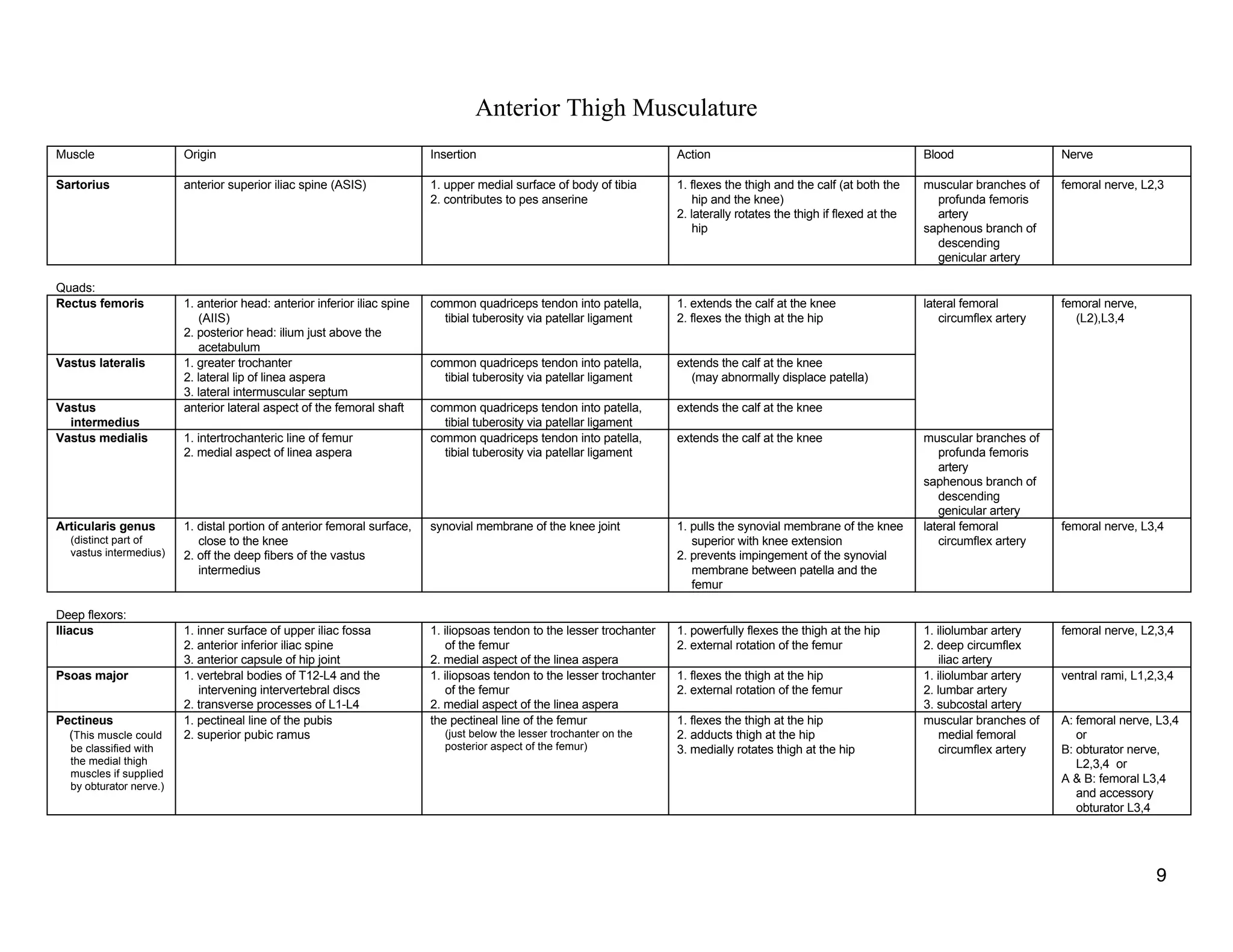
Anterior Thigh Musculature.......................................................................9
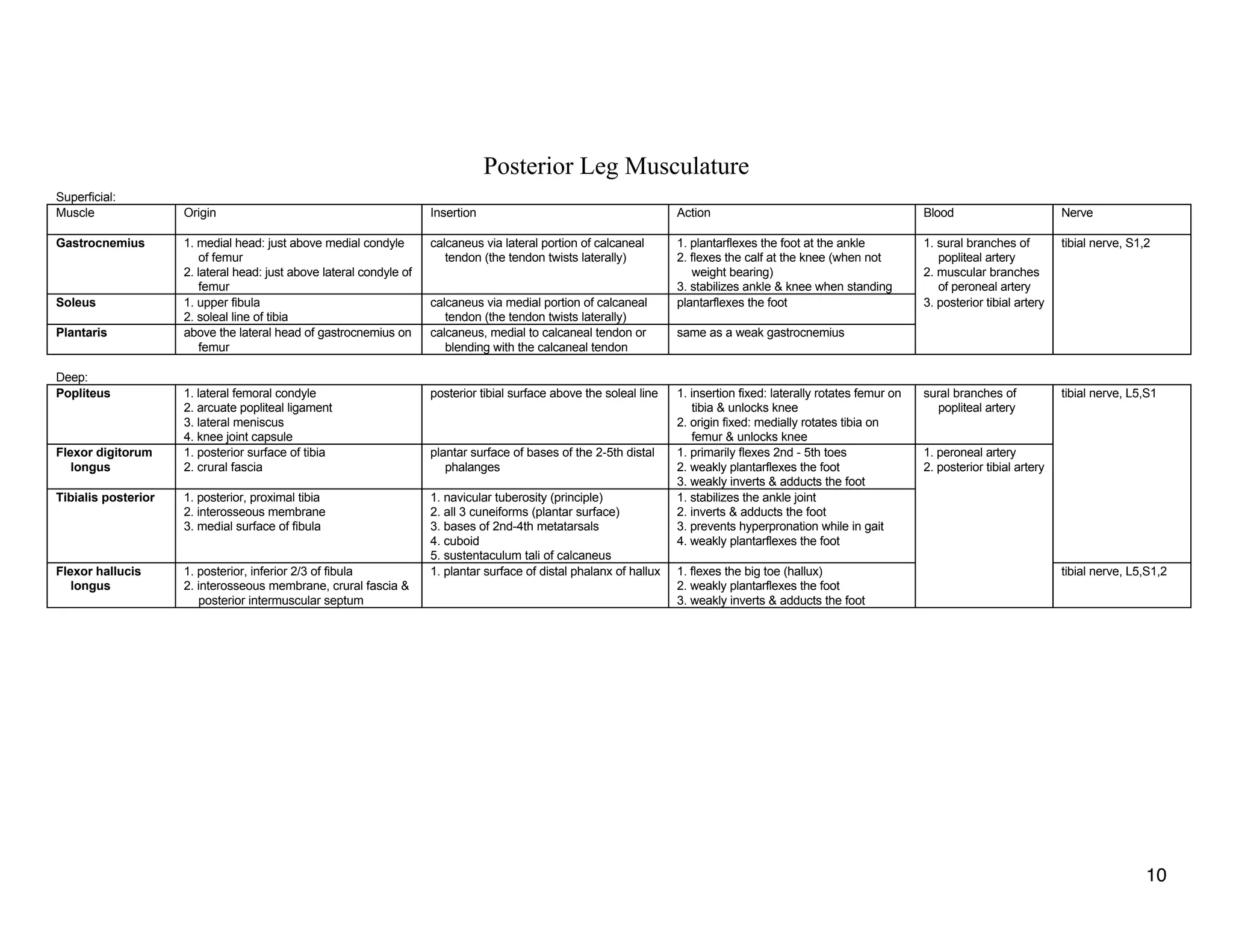
Posterior Leg Musculature ......................................................................10
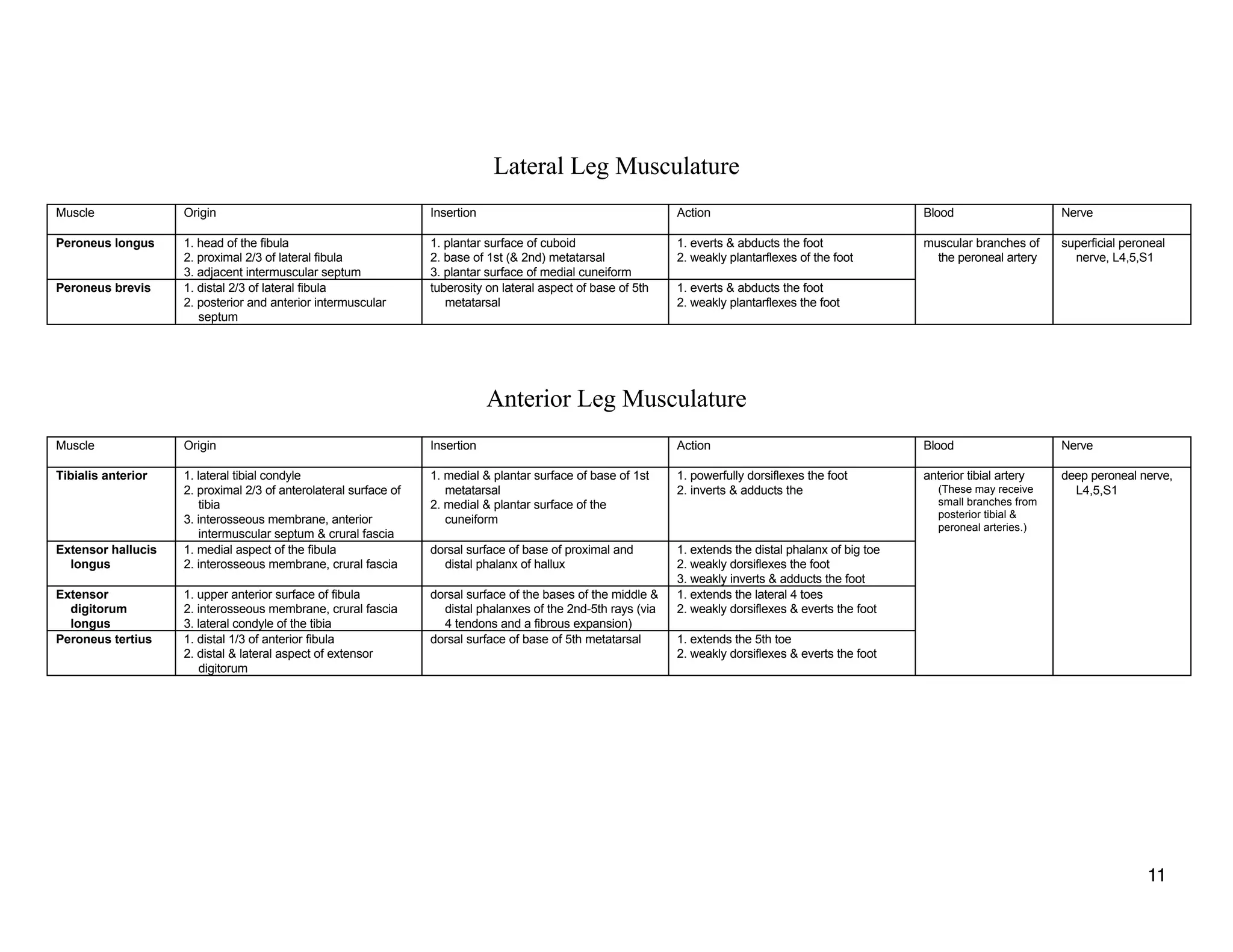
Lateral Leg Musculature..........................................................................11
Anterior Leg Musculature........................................................................11
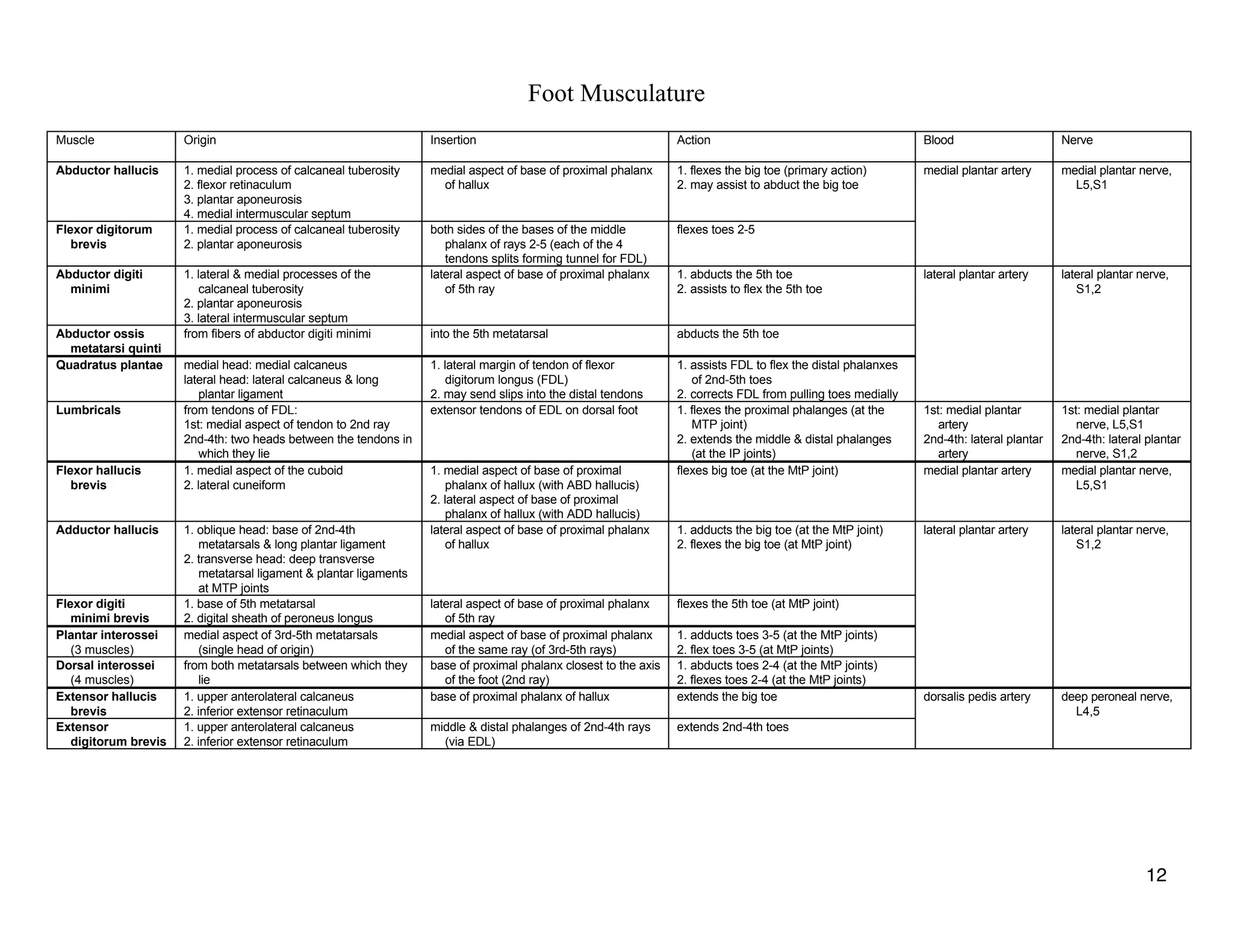
Foot Musculature ....................................................................................12
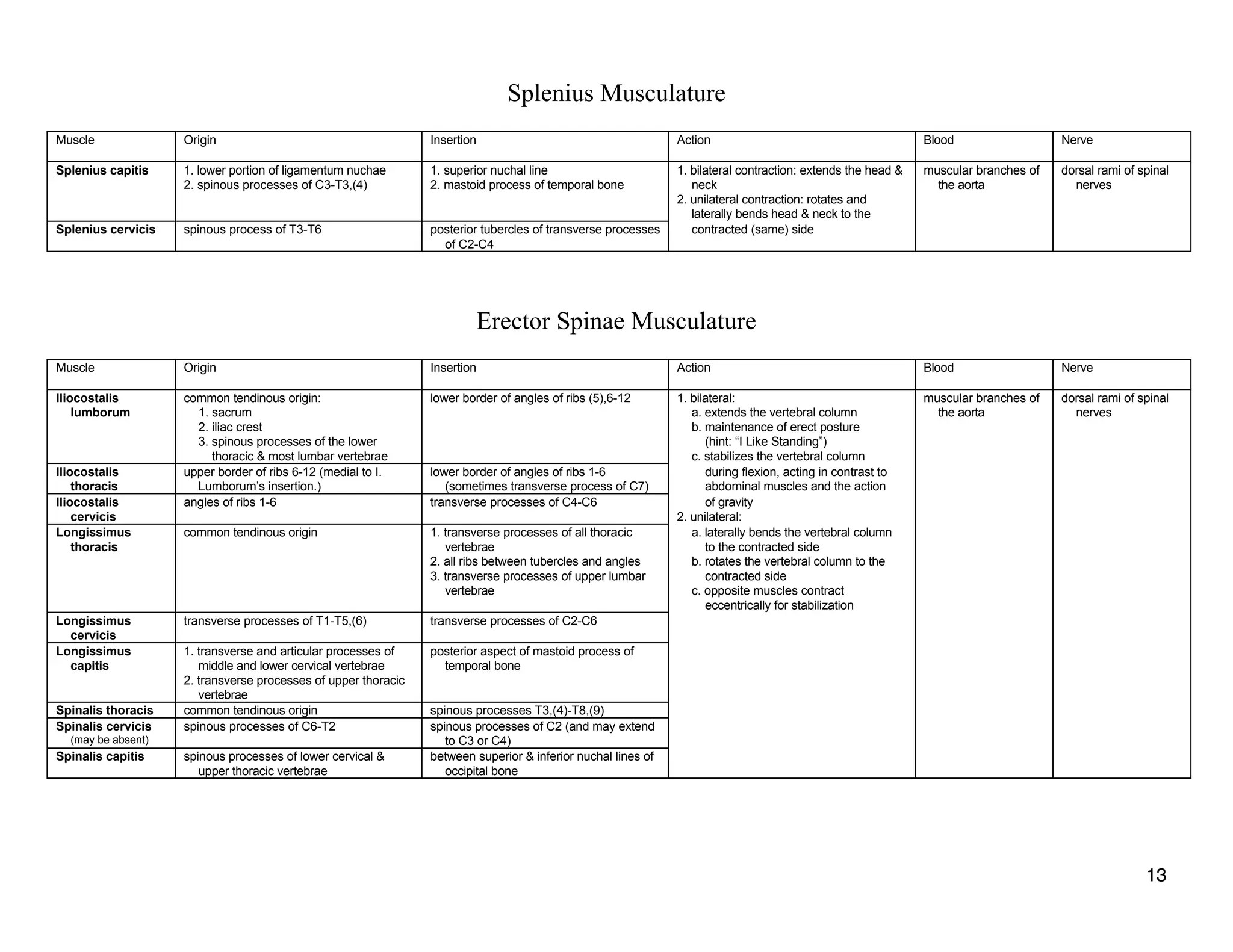
Splenius Musculature..............................................................................13
Erector Spinae Musculature....................................................................13
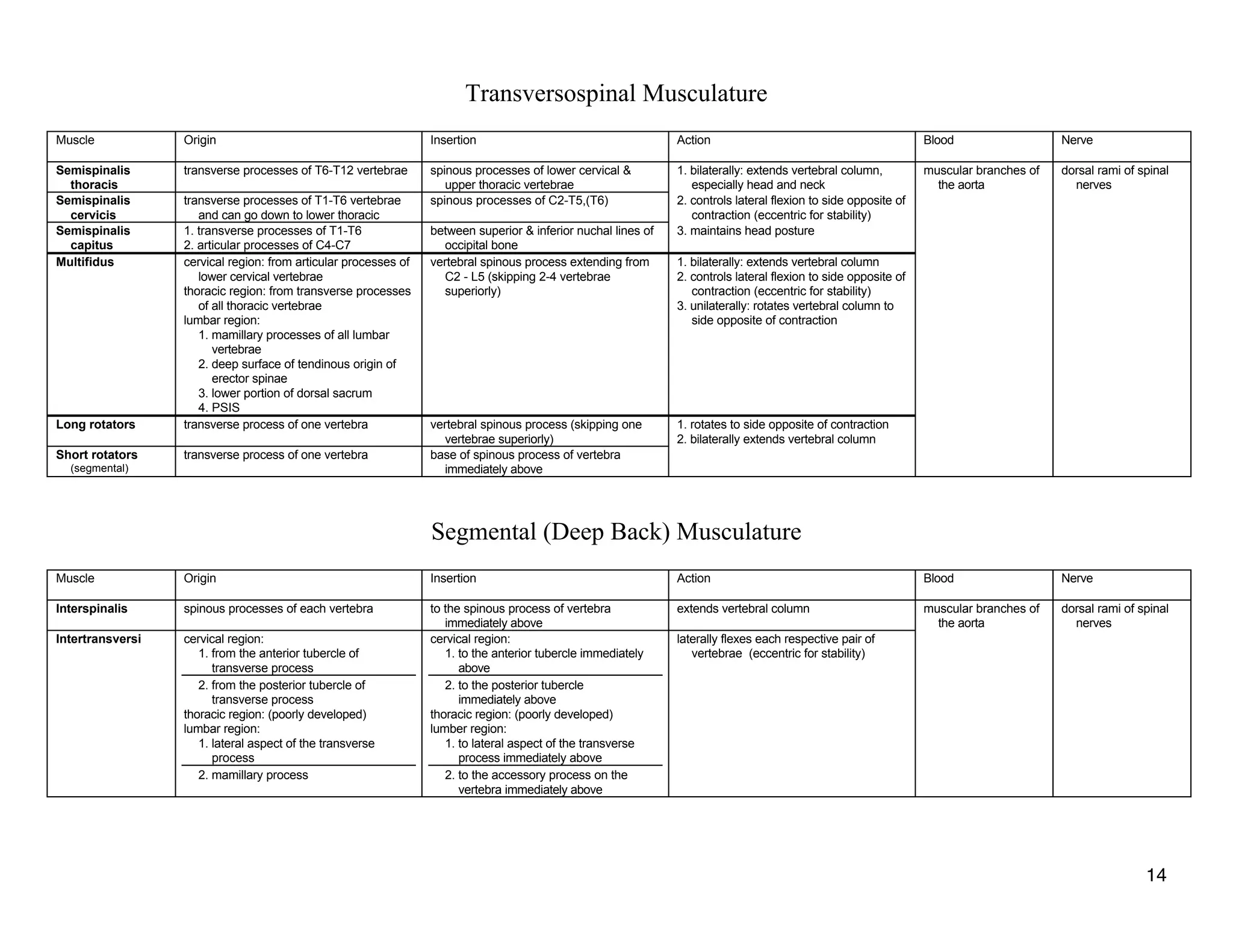
Transversospinal Musculature................................................................14
Segmental (Deep Back) Musculature......................................................14
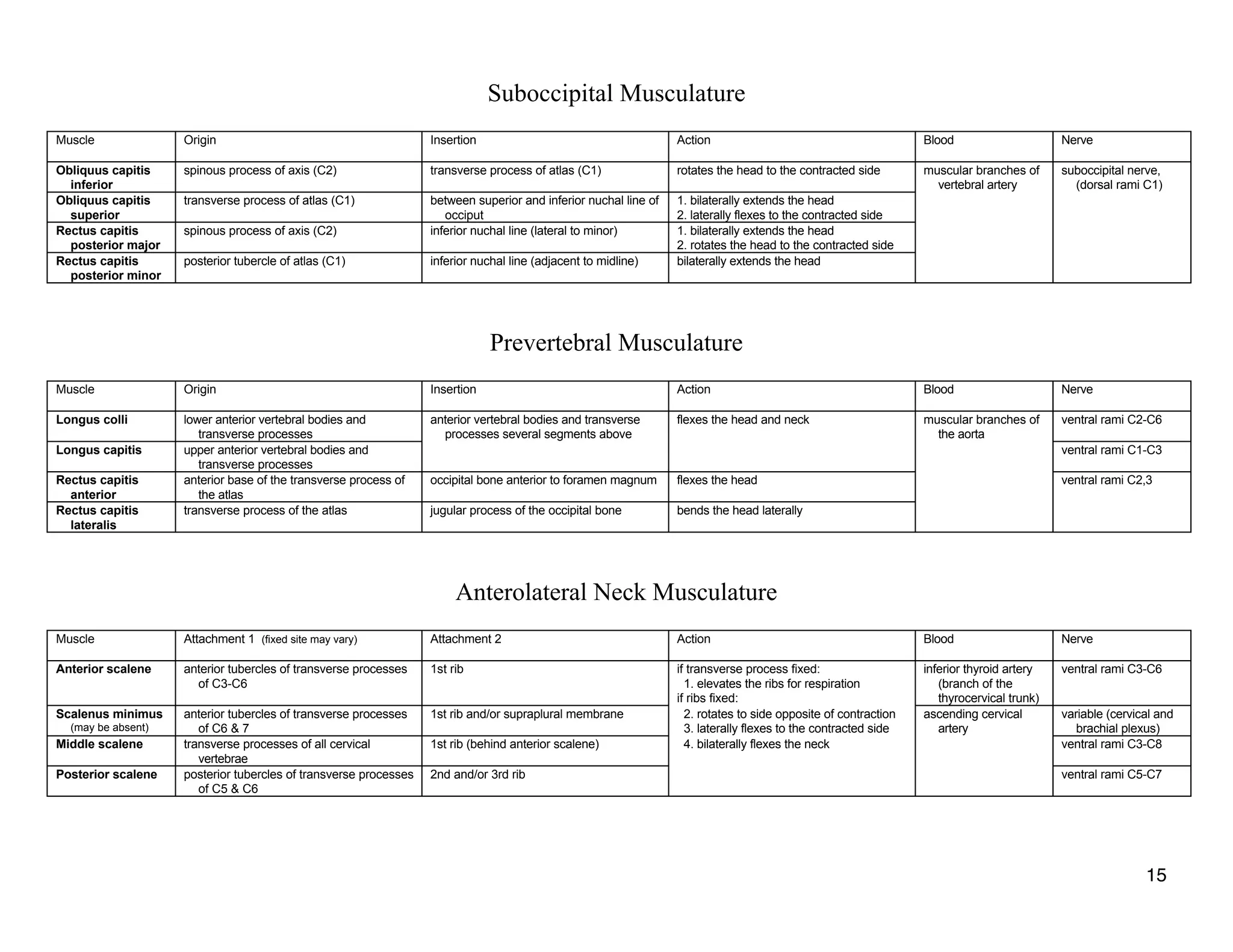
Suboccipital Musculature........................................................................15
Prevertebral Musculature ........................................................................15
Anterolateral Neck Musculature ..............................................................15
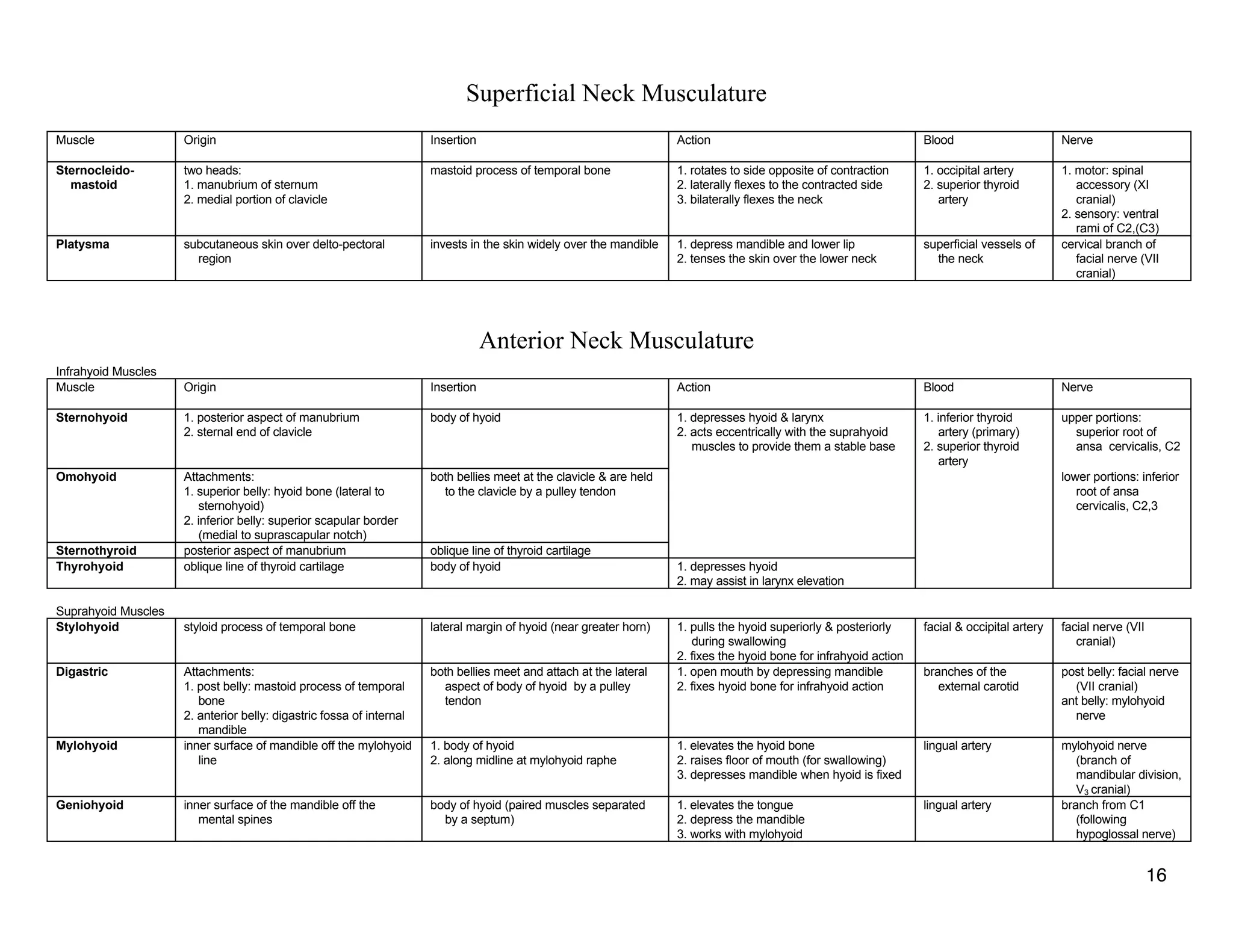
Superficial Neck Musculature .................................................................16
Anterior Neck Musculature......................................................................16
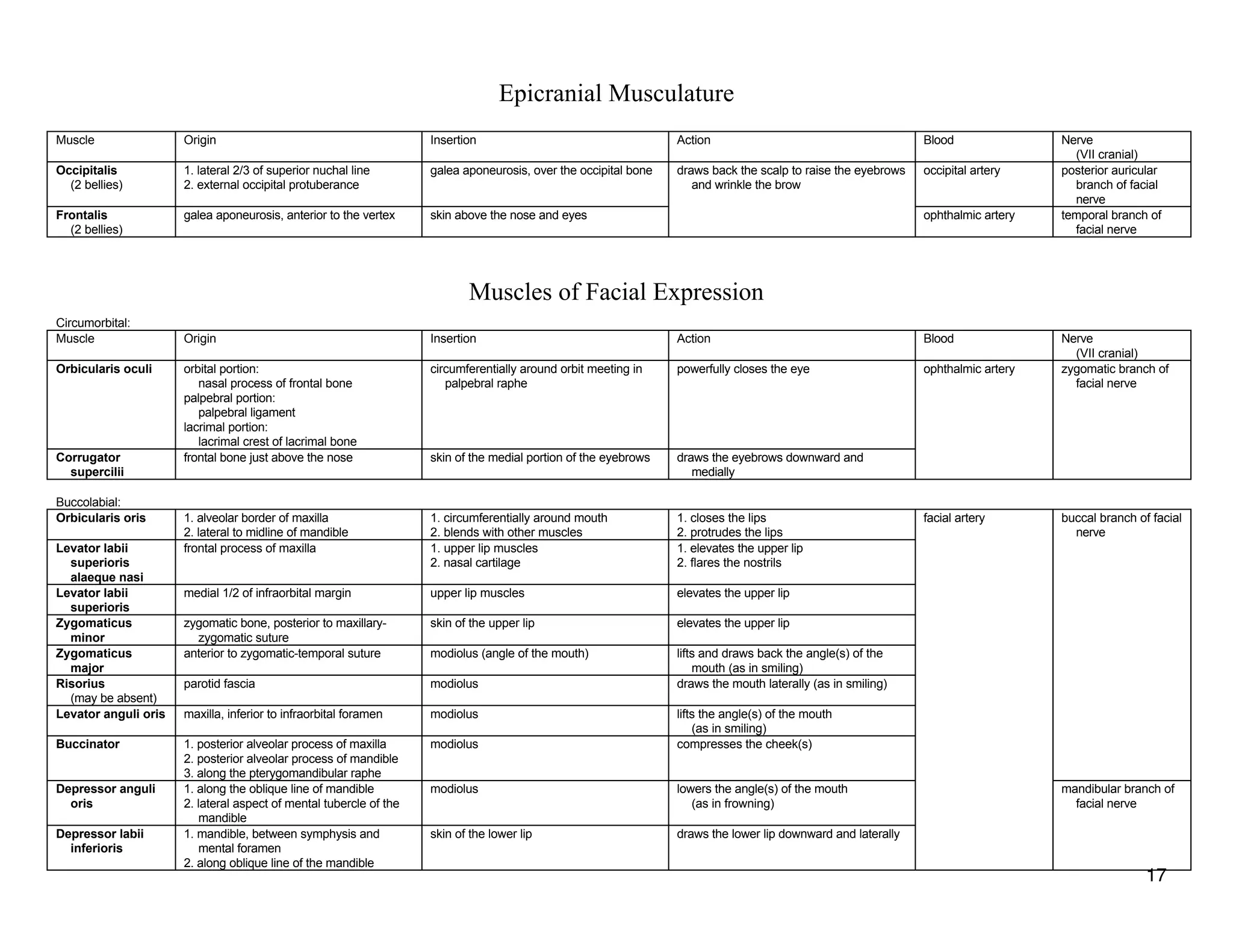
Epicranial Musculature............................................................................17
Muscles of Facial Expression .................................................................17
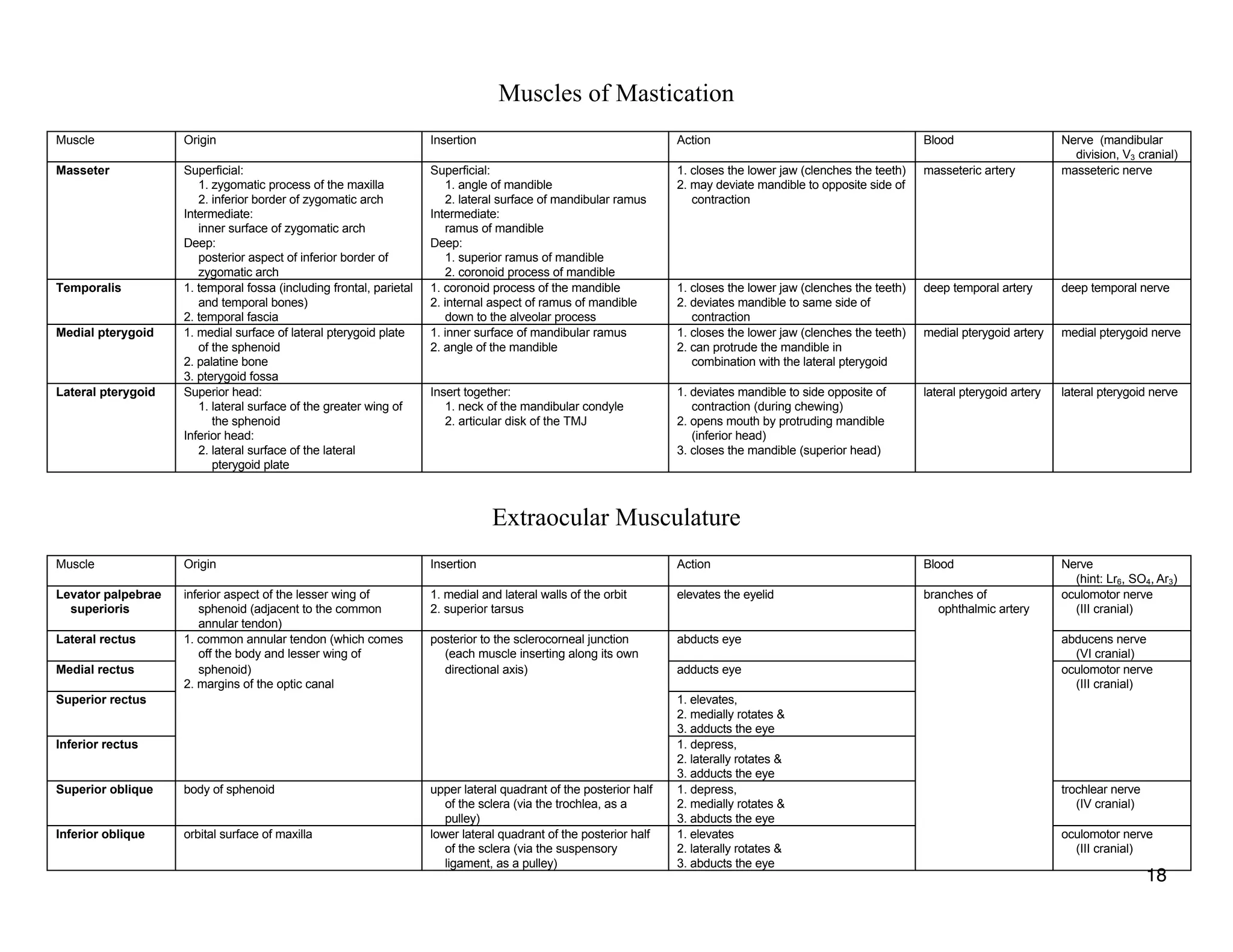
Muscles of Mastication............................................................................18
Extraocular Musculature .........................................................................18
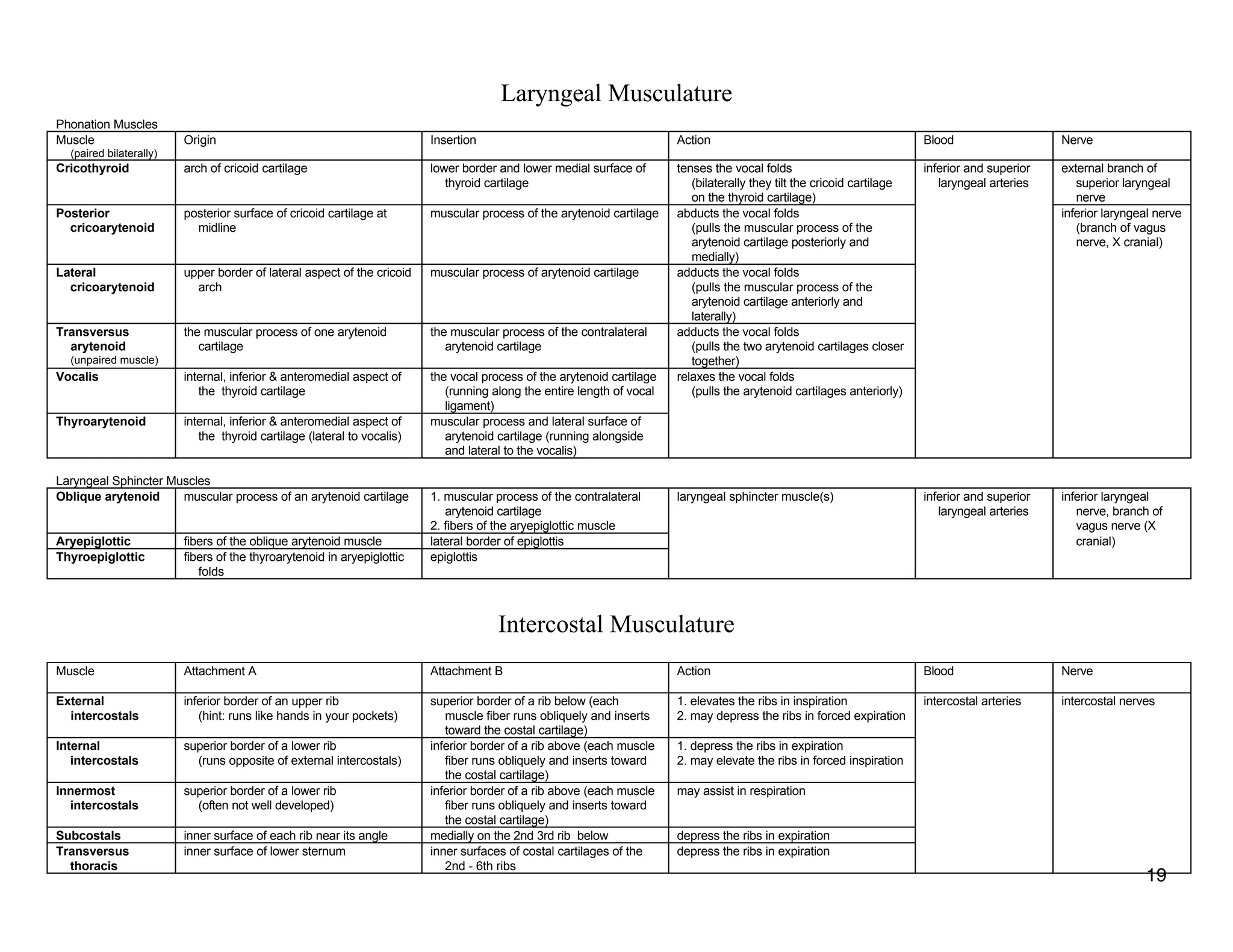
Laryngeal Musculature............................................................................19
Intercostal Musculature...........................................................................19
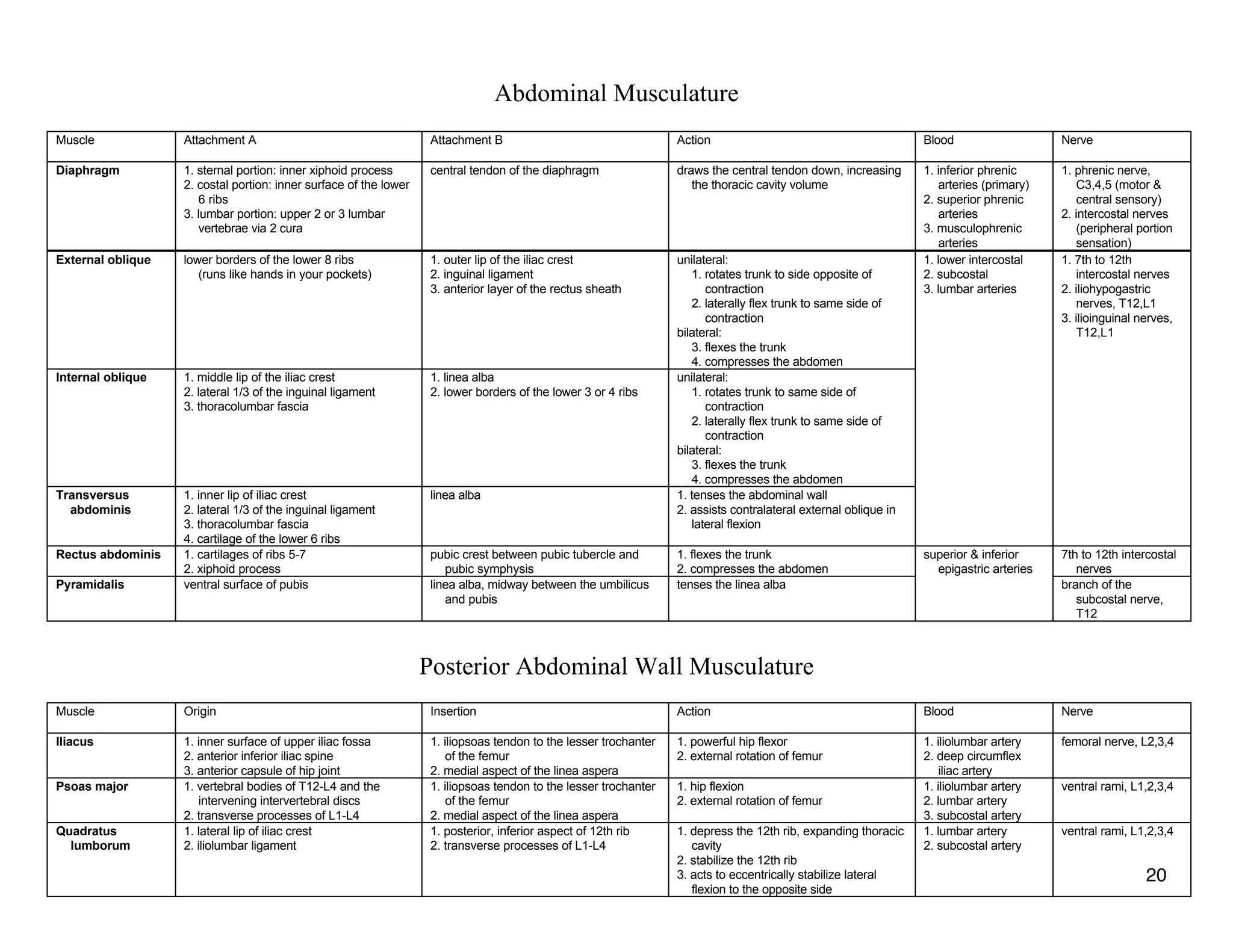
Abdominal Musculature...........................................................................20
Posterior Abdominal Wall Musculature...................................................20
Superficial Back Musculature
Muscle Origin Insertion Action Blood Nerve
Trapezius 1. external occipital protuberance
2. medial 1/3 of the superior nuchal line
3. ligamentum nuchae (surrounding the
cervical spinous processes)
4. spinous processes of C1-T12
1. posterior, lateral 1/3 of the clavicle
2. medial margin of the acromion
3. superior spine of the scapula
1. elevates scapula and
2. upwardly rotates the scapula (upper
portion) (note: the glenoid fossa is the
reference for scapular rotation)
3. retracts scapula (all)
4. downwardly rotates the scapula (lower
portion)
transverse cervical
artery
1. motor: spinal
accessory (XI
cranial)
2. sensory: ventral
ramii of C3 & C4
(possibly C2)
Latissimus dorsi 1. spinous process of T7-L5
2. supraspinous ligament
3. upper 2-3 sacral segments
4. iliac crest
5. lower 3 or 4 ribs
6. inferior angle of the scapula
floor of the bicipital groove of the humerus
a portion of the crest of the lesser tubercle
(the bicipital groove is also known as the
intertubercular groove)
1. extends the arm (from a flexed position)
2. internally (medially) rotates the arm
3. adducts the arm
4. downwardly rotates the scapula
thoracodorsal artery thoracodorsal nerve,
C6,7,8
1
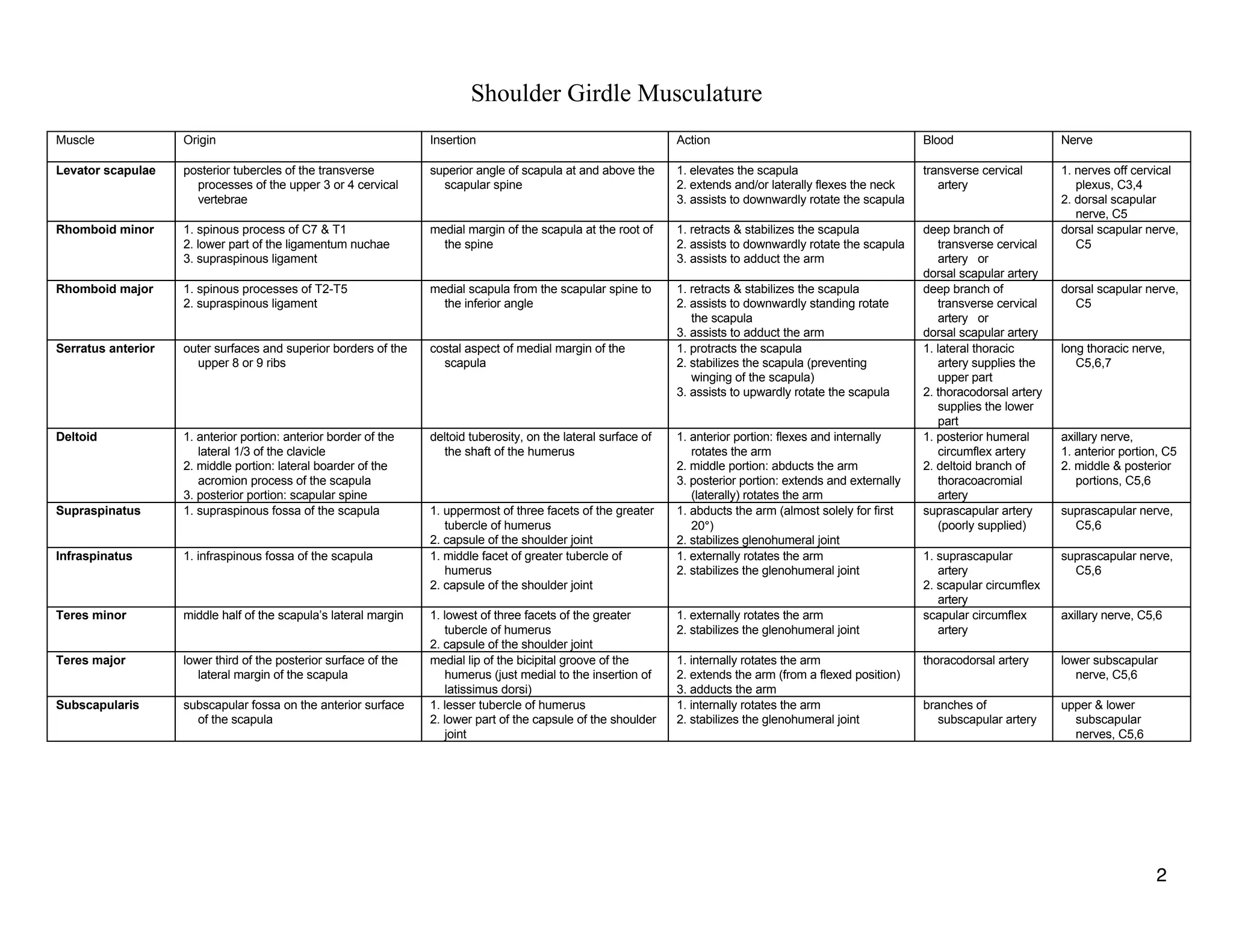
Shoulder Girdle Musculature
Muscle Origin Insertion Action Blood Nerve
Levator scapulae posterior tubercles of the transverse
processes of the upper 3 or 4 cervical
vertebrae
superior angle of scapula at and above the
scapular spine
1. elevates the scapula
2. extends and/or laterally flexes the neck
3. assists to downwardly rotate the scapula
transverse cervical
artery
1. nerves off cervical
plexus, C3,4
2. dorsal scapular
nerve, C5
Rhomboid minor 1. spinous process of C7 & T1
2. lower part of the ligamentum nuchae
3. supraspinous ligament
medial margin of the scapula at the root of
the spine
1. retracts & stabilizes the scapula
2. assists to downwardly rotate the scapula
3. assists to adduct the arm
deep branch of
transverse cervical
artery or
dorsal scapular artery
dorsal scapular nerve,
C5
Rhomboid major 1. spinous processes of T2-T5
2. supraspinous ligament
medial scapula from the scapular spine to
the inferior angle
1. retracts & stabilizes the scapula
2. assists to downwardly standing rotate
the scapula
3. assists to adduct the arm
deep branch of
transverse cervical
artery or
dorsal scapular artery
dorsal scapular nerve,
C5
Serratus anterior outer surfaces and superior borders of the
upper 8 or 9 ribs
costal aspect of medial margin of the
scapula
1. protracts the scapula
2. stabilizes the scapula (preventing
winging of the scapula)
3. assists to upwardly rotate the scapula
1. lateral thoracic
artery supplies the
upper part
2. thoracodorsal artery
supplies the lower
part
long thoracic nerve,
C5,6,7
Deltoid 1. anterior portion: anterior border of the
lateral 1/3 of the clavicle
2. middle portion: lateral boarder of the
acromion process of the scapula
3. posterior portion: scapular spine
deltoid tuberosity, on the lateral surface of
the shaft of the humerus
1. anterior portion: flexes and internally
rotates the arm
2. middle portion: abducts the arm
3. posterior portion: extends and externally
(laterally) rotates the arm
1. posterior humeral
circumflex artery
2. deltoid branch of
thoracoacromial
artery
axillary nerve,
1. anterior portion, C5
2. middle & posterior
portions, C5,6
Supraspinatus 1. supraspinous fossa of the scapula 1. uppermost of three facets of the greater
tubercle of humerus
2. capsule of the shoulder joint
1. abducts the arm (almost solely for first
20°)
2. stabilizes glenohumeral joint
suprascapular artery
(poorly supplied)
suprascapular nerve,
C5,6
Infraspinatus 1. infraspinous fossa of the scapula 1. middle facet of greater tubercle of
humerus
2. capsule of the shoulder joint
1. externally rotates the arm
2. stabilizes the glenohumeral joint
1. suprascapular
artery
2. scapular circumflex
artery
suprascapular nerve,
C5,6
Teres minor middle half of the scapula’s lateral margin 1. lowest of three facets of the greater
tubercle of humerus
2. capsule of the shoulder joint
1. externally rotates the arm
2. stabilizes the glenohumeral joint
scapular circumflex
artery
axillary nerve, C5,6
Teres major lower third of the posterior surface of the
lateral margin of the scapula
medial lip of the bicipital groove of the
humerus (just medial to the insertion of
latissimus dorsi)
1. internally rotates the arm
2. extends the arm (from a flexed position)
3. adducts the arm
thoracodorsal artery lower subscapular
nerve, C5,6
Subscapularis subscapular fossa on the anterior surface
of the scapula
1. lesser tubercle of humerus
2. lower part of the capsule of the shoulder
joint
1. internally rotates the arm
2. stabilizes the glenohumeral joint
branches of
subscapular artery
upper & lower
subscapular
nerves, C5,6
2
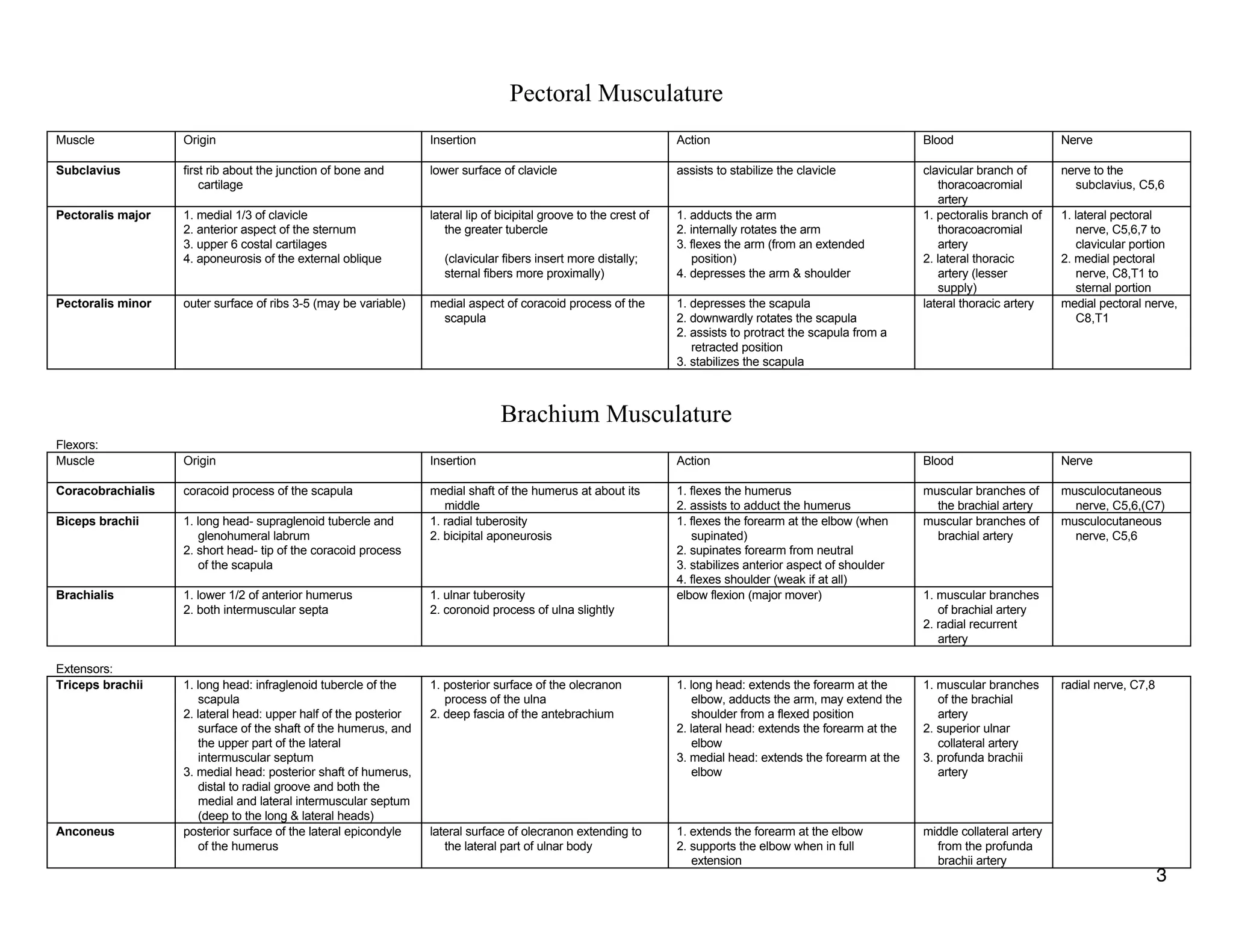
Pectoral Musculature
Muscle Origin Insertion Action Blood Nerve
Subclavius first rib about the junction of bone and
cartilage
lower surface of clavicle assists to stabilize the clavicle clavicular branch of
thoracoacromial
artery
nerve to the
subclavius, C5,6
Pectoralis major 1. medial 1/3 of clavicle
2. anterior aspect of the sternum
3. upper 6 costal cartilages
4. aponeurosis of the external oblique
lateral lip of bicipital groove to the crest of
the greater tubercle
(clavicular fibers insert more distally;
sternal fibers more proximally)
1. adducts the arm
2. internally rotates the arm
3. flexes the arm (from an extended
position)
4. depresses the arm & shoulder
1. pectoralis branch of
thoracoacromial
artery
2. lateral thoracic
artery (lesser
supply)
1. lateral pectoral
nerve, C5,6,7 to
clavicular portion
2. medial pectoral
nerve, C8,T1 to
sternal portion
Pectoralis minor outer surface of ribs 3-5 (may be variable) medial aspect of coracoid process of the
scapula
1. depresses the scapula
2. downwardly rotates the scapula
2. assists to protract the scapula from a
retracted position
3. stabilizes the scapula
lateral thoracic artery medial pectoral nerve,
C8,T1
Brachium Musculature
Flexors:
Muscle Origin Insertion Action Blood Nerve
Coracobrachialis coracoid process of the scapula medial shaft of the humerus at about its
middle
1. flexes the humerus
2. assists to adduct the humerus
muscular branches of
the brachial artery
musculocutaneous
nerve, C5,6,(C7)
Biceps brachii 1. long head- supraglenoid tubercle and
glenohumeral labrum
2. short head- tip of the coracoid process
of the scapula
1. radial tuberosity
2. bicipital aponeurosis
1. flexes the forearm at the elbow (when
supinated)
2. supinates forearm from neutral
3. stabilizes anterior aspect of shoulder
4. flexes shoulder (weak if at all)
muscular branches of
brachial artery
musculocutaneous
nerve, C5,6
Brachialis 1. lower 1/2 of anterior humerus
2. both intermuscular septa
1. ulnar tuberosity
2. coronoid process of ulna slightly
elbow flexion (major mover) 1. muscular branches
of brachial artery
2. radial recurrent
artery
Extensors:
Triceps brachii 1. long head: infraglenoid tubercle of the
scapula
2. lateral head: upper half of the posterior
surface of the shaft of the humerus, and
the upper part of the lateral
intermuscular septum
3. medial head: posterior shaft of humerus,
distal to radial groove and both the
medial and lateral intermuscular septum
(deep to the long & lateral heads)
1. posterior surface of the olecranon
process of the ulna
2. deep fascia of the antebrachium
1. long head: extends the forearm at the
elbow, adducts the arm, may extend the
shoulder from a flexed position
2. lateral head: extends the forearm at the
elbow
3. medial head: extends the forearm at the
elbow
1. muscular branches
of the brachial
artery
2. superior ulnar
collateral artery
3. profunda brachii
artery
radial nerve, C7,8
Anconeus posterior surface of the lateral epicondyle
of the humerus
lateral surface of olecranon extending to
the lateral part of ulnar body
1. extends the forearm at the elbow
2. supports the elbow when in full
extension
middle collateral artery
from the profunda
brachii artery
3
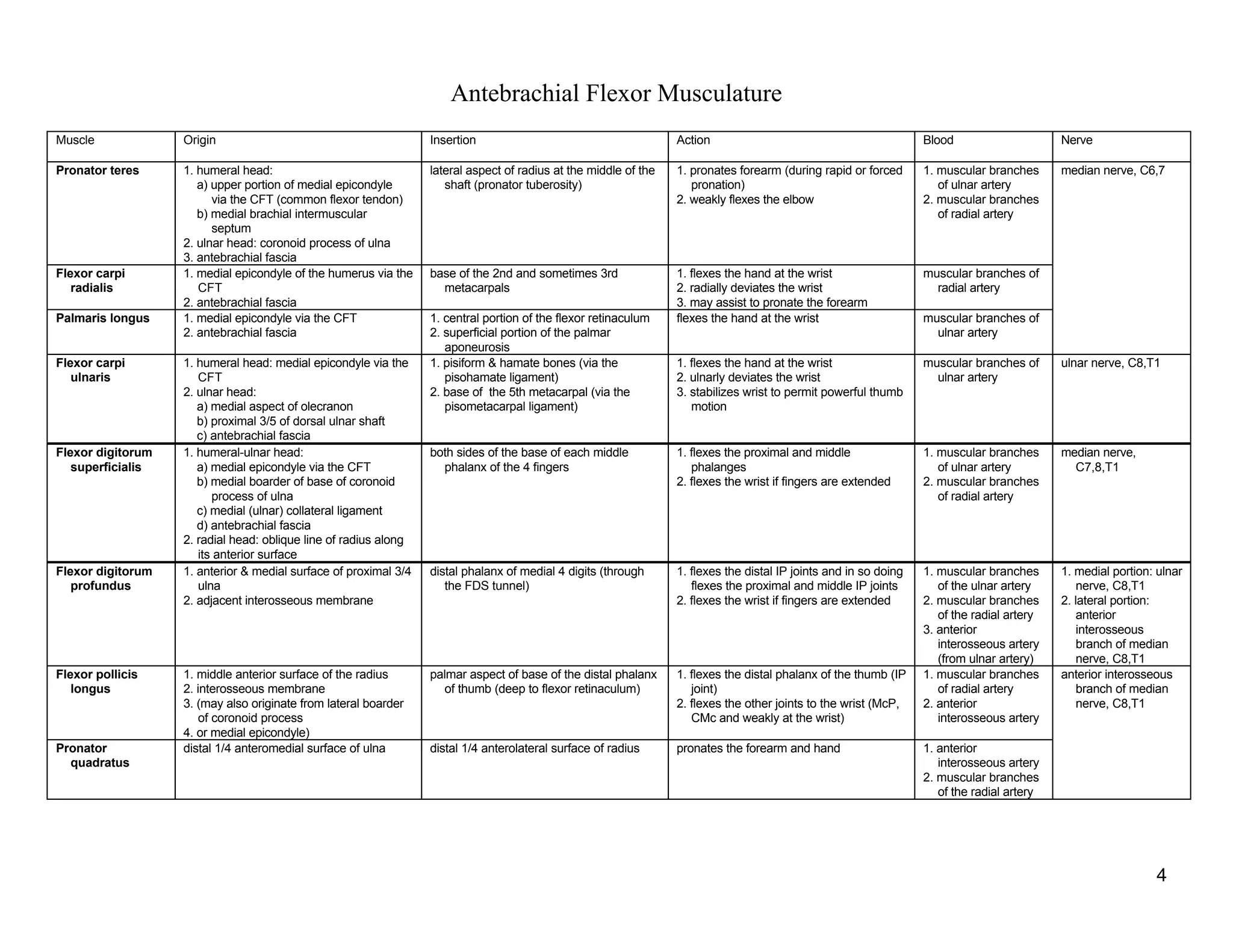
Antebrachial Flexor Musculature
Muscle Origin Insertion Action Blood Nerve
Pronator teres 1. humeral head:
a) upper portion of medial epicondyle
via the CFT (common flexor tendon)
b) medial brachial intermuscular
septum
2. ulnar head: coronoid process of ulna
3. antebrachial fascia
lateral aspect of radius at the middle of the
shaft (pronator tuberosity)
1. pronates forearm (during rapid or forced
pronation)
2. weakly flexes the elbow
1. muscular branches
of ulnar artery
2. muscular branches
of radial artery
median nerve, C6,7
Flexor carpi
radialis
1. medial epicondyle of the humerus via the
CFT
2. antebrachial fascia
base of the 2nd and sometimes 3rd
metacarpals
1. flexes the hand at the wrist
2. radially deviates the wrist
3. may assist to pronate the forearm
muscular branches of
radial artery
Palmaris longus 1. medial epicondyle via the CFT
2. antebrachial fascia
1. central portion of the flexor retinaculum
2. superficial portion of the palmar
aponeurosis
flexes the hand at the wrist muscular branches of
ulnar artery
Flexor carpi
ulnaris
1. humeral head: medial epicondyle via the
CFT
2. ulnar head:
a) medial aspect of olecranon
b) proximal 3/5 of dorsal ulnar shaft
c) antebrachial fascia
1. pisiform & hamate bones (via the
pisohamate ligament)
2. base of the 5th metacarpal (via the
pisometacarpal ligament)
1. flexes the hand at the wrist
2. ulnarly deviates the wrist
3. stabilizes wrist to permit powerful thumb
motion
muscular branches of
ulnar artery
ulnar nerve, C8,T1
Flexor digitorum
superficialis
1. humeral-ulnar head:
a) medial epicondyle via the CFT
b) medial boarder of base of coronoid
process of ulna
c) medial (ulnar) collateral ligament
d) antebrachial fascia
2. radial head: oblique line of radius along
its anterior surface
both sides of the base of each middle
phalanx of the 4 fingers
1. flexes the proximal and middle
phalanges
2. flexes the wrist if fingers are extended
1. muscular branches
of ulnar artery
2. muscular branches
of radial artery
median nerve,
C7,8,T1
Flexor digitorum
profundus
1. anterior & medial surface of proximal 3/4
ulna
2. adjacent interosseous membrane
distal phalanx of medial 4 digits (through
the FDS tunnel)
1. flexes the distal IP joints and in so doing
flexes the proximal and middle IP joints
2. flexes the wrist if fingers are extended
1. muscular branches
of the ulnar artery
2. muscular branches
of the radial artery
3. anterior
interosseous artery
(from ulnar artery)
1. medial portion: ulnar
nerve, C8,T1
2. lateral portion:
anterior
interosseous
branch of median
nerve, C8,T1
Flexor pollicis
longus
1. middle anterior surface of the radius
2. interosseous membrane
3. (may also originate from lateral boarder
of coronoid process
4. or medial epicondyle)
palmar aspect of base of the distal phalanx
of thumb (deep to flexor retinaculum)
1. flexes the distal phalanx of the thumb (IP
joint)
2. flexes the other joints to the wrist (McP,
CMc and weakly at the wrist)
1. muscular branches
of radial artery
2. anterior
interosseous artery
anterior interosseous
branch of median
nerve, C8,T1
Pronator
quadratus
distal 1/4 anteromedial surface of ulna distal 1/4 anterolateral surface of radius pronates the forearm and hand 1. anterior
interosseous artery
2. muscular branches
of the radial artery
4
Antebrachial Extensor Musculature
Muscle Origin Insertion Action Blood Nerve
Brachioradialis 1. upper lateral supracondylar ridge of
humerus (between the triceps and
brachialis muscles)
2. lateral intermuscular septum of humerus
1. superior aspect of styloid process of
radius
2. lateral side of the distal 1/2 to 1/3 of the
radius
3. antebrachial fascia
1. flexes the forearm at the elbow
2. pronates the forearm when supinated
3. supinates the forearm when pronated
radial recurrent artery radial nerve, C5,6
(or deep branch of
radial nerve)
Extensor carpi
radialis longus
1. lower lateral supracondylar ridge (below
the brachioradialis)
2. lateral intermuscular septum of humerus
base of 2nd metacarpal 1. extends the hand at the wrist
2. radially deviates the hand at the wrist
3. weakly flexes the forearm at the elbow
4. weakly supinates the forearm
Extensor carpi
radialis brevis
1. lateral epicondyle via the CET (common
extensor tendon)
2. radial collateral ligament
3. antebrachial fascia
base of 3rd metacarpal 1. extends the hand at the wrist
2. radially deviates the hand at the wrist
deep branch of radial
nerve, C6,7
Extensor
digitorum
1. lateral epicondyle via the CET
2. antebrachial fascia
1. base of middle phalanx of each of the
four fingers (central band)
2. base of distal phalanx of each of the four
fingers (2 lateral bands)
1. extends the four medial digits
2. extends the wrist (if fingers flexed)
3. abducts the digits (spreads the digits as
it extends them)
posterior interosseous
artery
posterior interosseous
nerve of radial
nerve, C6,7,8
Extensor digiti
minimi
1. lateral epicondyl via the CET
2. antebrachial fascia
3. ulnar aspect of extensor digitorum
1. base of middle phalanx of the 5th digit
(central band)
2. base of distal phalanx of the 5th digit (2
lateral bands)
1. extends the 5th digit
2. abducts the 5th digit
Extensor carpi
ulnaris
1. 1st head: lateral epicondyle via CET
2. 2nd head: posterior body of ulna
3. antebrachial fascia
medial side of base of the 5th metacarpal 1. extends the hand at the wrist
2. ulnarly deviates the hand at the wrist
Supinator 1. lateral epicondyle of humerus
2. supinator crest of ulna
3. radial collateral ligament
4. annular ligament
5. antebrachial fascia
proximal portion of anterolateral surface of
the radius
supinates the forearm radial recurrent artery deep branch of radial
nerve, C6
Abductor pollicis
longus
1. posterior surfaces of ulna and radius
2. interosseous membrane
3. antebrachial fascia
lateral aspect of base of 1st metacarpal 1. abducts the 1st metacarpal
2. assists to extend & rotate the thumb
3. radially deviates the hand at the wrist
4. flexes the hand at the wrist
posterior interosseous
artery
posterior interosseous
nerve of radial
nerve, C6,7,(C8)
Extensor pollicis
brevis
1. posterior surfaces of radius (below
abductor pollicis longus)
2. interosseous membrane
3. antebrachial fascia
base of proximal phalanx of thumb (often a
slip inserts into extensor pollicis longus
tendon)
1. extends the proximal phalanx and 1st
metacarpal of the thumb
2. radially deviates the hand at the wrist
Extensor pollicis
longus
1. posterior surface of ulna
2. interosseous membrane
3. antebrachial fascia
distal phalanx of thumb 1. extends distal phalanx of thumb
2. extends proximal phalanx of thumb
3. assists to extend the hand at the wrist (if
fingers flexed)
posterior interosseous
nerve of radial
nerve, C6,7,8
Extensor indicis 1. posterior surface of ulna (distal to
extensor pollicis longus)
2. interosseous membrane
3. antebrachial fascia
base of middle and distal phalanx of the
index finger
1. extends the 2nd digit (McP & IP joints)
2. adducts the 2nd digit
3. assists to extend the hand at the wrist
4. stabilizes McP joint for flexion of IP
solely
5
Hand & Wrist Musculature
Muscle Origin Insertion Action Blood Nerve
Abductor pollicis
brevis
1. distal border of flexor retinaculum
2. trapezium (may be variable)
1. lateral aspect of base of proximal
phalanx of the thumb
2. may also send a slip to the tendon of
extensor pollicis longus
1. abducts thumb (at the McP joint)
2. participates to flex the thumb (at the
McP joint)
3. if attached to extensor pollicis longus, it
might assist to extend the thumb
superficial palmar
branches of radial
artery
recurrent branch of
median nerve,
C8,T1
Flexor pollicis
brevis
1. superficial head
a) distal border of flexor retinaculum
b) trapezium
2. deep head
a) floor of carpal tunnel
b) indirectly to scaphoid & trapezium
1. base of proximal phalanx of thumb
2. can also attach to the lateral sesamoid
bone at the McP joint
powerfully flexes the thumb (at the McP
joint)
1. superficial head:
recurrent branch of
median nerve,
C8,T1
2. deep head: deep
branch of ulnar
nerve, C8,T1
Opponens pollicis 1. distal border of flexor retinaculum
2. trapezium
lateral aspect of the 1st metacarpal opposes the thumb to the fingers recurrent branch of
median nerve,
C8,T1
Adductor pollicis 1. transverse head: 3rd metacarpal
2. oblique head:
a) base of 1st, 2nd and 3rd metacarpals
b) floor of carpal tunnel
1. medial aspect of the base of proximal
phalanx
2. medial sesamoid at McP
1. adducts the thumb
2. may assist to flex the thumb (at the McP
joint)
deep branch of ulnar
nerve, C8,T1
Palmaris brevis medial margin of palmar aponeurosis 1. skin of ulnar border of palm
2. may insert on the pissiform
tenses the skin on the ulnar side of the
palm, which is used in a grip action
superficial palmar
branches of ulnar
artery
superficial branch of
ulnar nerve, C8,T1
Abductor digiti
minimi
pisiform & tendon of flexor carpi ulnaris 1. medial aspect of the base of proximal
phalanx of the 5th digit
2. may send a slip to the ulnar side of the
dorsal expansion
1. abducts the 5th digit (requires pisiform
stabilized by FCU)
2. assists to flex the 5th digit (at McP)
3. may assist in extension of 5th digit (at IP
due to slips to extensor digitorum)
deep palmar branches
of ulnar artery
deep branch of ulnar
nerve, C8,T1
Flexor digiti
minimi brevis
1. distal border of flexor retinaculum
2. hook of the hamate
medial aspect of the base of proximal
phalanx
flexes the 5th digit (at the McP joint)
Opponens digiti
minimi
1. distal border of flexor retinaculum
2. hook of the hamate
medial aspect of the 5th metacarpal 1. opposes the 5th digit with the thumb
2. assists to "cup" the palm
Palmar interossei from the side of the metacarpal that faces
the midline - to adduct them
1. on the base of the proximal phalanx of
the digit of origin (same side toward the
midline)
2. extensor hood of the same digit(s)
1. adducts the fingers (hint: PAD)
2. flexes the fingers (at the McP while IP
joints are extended)
palmar metacarpal
artery of deep
palmar arch
Dorsal interossei between each metacarpal 1. directly distal to the origin on the base of
the proximal phalanx closest to the
midline (to abduct them.)
2. extensor hood of the same digit(s)
1. abducts the fingers (hint: DAB)
2. flexes the fingers (at the McP while IP
joints are extended)
Lumbricals tendon of flexor digitorum profundus
1 & 2 have a single head of origin (from
radial aspect of tendon)
3 & 4 have two heads of origin (each head
from an adjacent tendon)
extensor hood of digits 2-5 1. flexes the fingers (at the McP joints)
2. extend IPs
1 & 2 - median nerve,
C8,T1
3 & 4 - deep branch of
ulnar nerve, C8,T1
6
Gluteal Musculature
Muscle Origin Insertion Action Blood Nerve
Tensor fascia lata 1. anterior aspect of iliac crest
2. anterior superior iliac spine (ASIS)
1. anterior aspect of IT (iliotibial) band,
below greater trochanter
(IT band inserts on the anterolateral tibia
“Gerdy’s tubercle”, & also sends slips to
the lateral patellar retinaculum and the
biceps femoris tendon.)
1. flexes the hip
2. rotates & abducts a flexed thigh
3. tenses IT medially band to support
femur on the tibia during standing
1. superior gluteal
artery
2. lateral femoral
circumflex artery
superior gluteal nerve,
L4,5,S1
Gluteus maximus 1. outer rim of ilium (medial aspect)
2. dorsal surface of sacrum and coccyx
3. sacrotuberous ligament
1. IT band (primary insertion)
2. gluteal tuberosity of femur
1. powerfully extends the hip
2. laterally rotates the thigh
3. upper fibers aid to abduct the thigh
4. stabilizes a fully extended knee (via
fibers of the IT band)
1. inferior gluteal
artery (primary)
2. superior gluteal
artery
inferior gluteal nerve,
L5,S1,2
Gluteus medius 1. outer aspect of ilium (between iliac crest
and anterior and posterior gluteal lines)
2. upper fascia (the gluteal aponeurosis)
superior aspect of greater trochanter 1. anterior and lateral fibers abduct and
medially rotate the thigh
2. posterior fibers may laterally rotate thigh
3. stabilizes the pelvis and prevents free
limb from sagging during gait
superior gluteal artery superior gluteal nerve,
L4,5,S1
Gluteus minimus outer aspect of ilium (between anterior and
inferior gluteal lines)
1. greater trochanter (anterior to medius)
2. articular capsule of hip joint
1. abducts and medially rotates the thigh
2. stabilizes the pelvis and prevents free
limb from sagging during gait
Piriformis pelvic surface of sacrum (anterior portion) medial surface of greater trochanter
(through greater sciatic foramen)
1. laterally rotates an extended thigh
2. abducts a flexed thigh
1. superior gluteal
artery
2. inferior gluteal
artery
nerve to piriformis,
S1,2
Superior gemellus ischial spine medial aspect of greater trochanter via
upper tendon of obturator internus
1. laterally rotates the thigh
2. abducts thigh when flexed
inferior gluteal artery nerve to obturator
internus, L5,S1,2
Obturator internus 1. internal aspect margins of obturator
foramen
2. obturator membrane
medial aspect of greater trochanter
(through lesser sciatic foramen)
1. laterally rotates the thigh
2. abducts thigh when flexed
Inferior gemellus ischial tuberosity medial aspect of greater trochanter via
lower tendon of obturator internus
laterally rotates the thigh nerve to quadratus
femoris, L4,5,S1
Quadratus femoris lateral aspect of ischial tuberosity quadrate line
(along posterior aspect of femur and
intertrochanteric crest)
laterally rotates the thigh
7
Posterior Thigh Musculature
Muscle Origin Insertion Action Blood Nerve
Semitendinosus ischial tuberosity 1. medial aspect of tibial shaft
2. contributes to the pes anserine
1. extends the thigh at the hip
2. flexes the calf at the knee
3. medially rotates the tibia
1. perforating
branches of
profunda femoris
tibial nerve of sciatic
bundle, L5,S1,2
Semi-
membranosus
ischial tuberosity 1. posterior medial aspect of medial tibial
condyle
2. fibers join to form most of oblique
popliteal ligament (& medial meniscus)
1. flexes the calf at the knee
2. extends the thigh at the hip
3. medially rotates tibia
4. pulls medial meniscus posterior during
flexion
2. inferior gluteal
artery (to upper)
Biceps femoris 1. long head: ischial tuberosity
2. short head: lateral lip of linea aspera and
the lateral intermuscular septum
1. head of fibula
2. maybe to the lateral tibial condyle
1. flexes the calf at the knee (mainly short
head)
2. laterally rotates thigh if flexed at the knee
3. extends thigh at the hip (long head)
1. long head: tibial
nerve, L5,S1,2
2. short head:
common peroneal
nerve, L5,S1
Adductor magnus
(posterior fibers)
ischial tuberosity adductor tubercle of the medial epicondyle
of the femur
1. adducts the thigh at the hip
2. extends and laterally rotates the thigh at
the hip
tibial nerve of sciatic
bundle, L4,5
Adductor (Anteromedial) Thigh Musculature
Muscle Origin Insertion Action Blood Nerve
Adductor longus anterior surface of pubis, just inferior to the
pubic tubercle
medial lip of linea aspera on middle half of
femur
1. adducts the thigh at the hip
2. flexes the thigh at the hip
3. may laterally rotate the thigh at the hip
muscular branches of
femoral artery
obturator nerve, L2,3,4
Adductor brevis body & inferior ramus of pubis superior portion of linea aspera 1. powerfully adducts the thigh at the hip
2. assists to flex the thigh at the hip
3. may laterally rotate thigh at the hip
Adductor magnus
(Complete muscle
is listed here,
posterior fibers
were also listed in
anterior thigh.)
1. anterior fibers: inferior pubic ramus
2. oblique fibers: ischial ramus
3. posterior fibers: ischial tuberosity
1. proximal 1/3 of linea aspera
2. adductor tubercle
1. adducts the thigh at the hip
2. posterior fibers extend and laterally
rotate the thigh at the hip
muscular branches of
profunda femoris
(The above muscles
may receive blood
from obturator artery)
1. anterior fibers:
obturator nerve,
L2,3,4
2. posterior fibers:
tibial nerve of
sciatic bundle, L4,5
Gracilis body of pubis & inferior pubic ramus 1. medial surface of proximal tibia, inferior
to tibial condyle
2. contributes to the pes anserine
1. adducts the thigh at the hip
2. flexes the calf at the knee
3. medially rotates tibia
obturator artery obturator nerve, L2,3,4
Obturator externus 1. medial surface of obturator foramen
2. external surface of obturator membrane
trochanteric fossa of femur 1. laterally rotates the thigh at the hip
2. assists to flex the thigh at the hip
8
Anterior Thigh Musculature
Muscle Origin Insertion Action Blood Nerve
Sartorius anterior superior iliac spine (ASIS) 1. upper medial surface of body of tibia
2. contributes to pes anserine
1. flexes the thigh and the calf (at both the
hip and the knee)
2. laterally rotates the thigh if flexed at the
hip
muscular branches of
profunda femoris
artery
saphenous branch of
descending
genicular artery
femoral nerve, L2,3
Quads:
Rectus femoris 1. anterior head: anterior inferior iliac spine
(AIIS)
2. posterior head: ilium just above the
acetabulum
common quadriceps tendon into patella,
tibial tuberosity via patellar ligament
1. extends the calf at the knee
2. flexes the thigh at the hip
lateral femoral
circumflex artery
femoral nerve,
(L2),L3,4
Vastus lateralis 1. greater trochanter
2. lateral lip of linea aspera
3. lateral intermuscular septum
common quadriceps tendon into patella,
tibial tuberosity via patellar ligament
extends the calf at the knee
(may abnormally displace patella)
Vastus
intermedius
anterior lateral aspect of the femoral shaft common quadriceps tendon into patella,
tibial tuberosity via patellar ligament
extends the calf at the knee
Vastus medialis 1. intertrochanteric line of femur
2. medial aspect of linea aspera
common quadriceps tendon into patella,
tibial tuberosity via patellar ligament
extends the calf at the knee muscular branches of
profunda femoris
artery
saphenous branch of
descending
genicular artery
Articularis genus
(distinct part of
vastus intermedius)
1. distal portion of anterior femoral surface,
close to the knee
2. off the deep fibers of the vastus
intermedius
synovial membrane of the knee joint 1. pulls the synovial membrane of the knee
superior with knee extension
2. prevents impingement of the synovial
membrane between patella and the
femur
lateral femoral
circumflex artery
femoral nerve, L3,4
Deep flexors:
Iliacus 1. inner surface of upper iliac fossa
2. anterior inferior iliac spine
3. anterior capsule of hip joint
1. iliopsoas tendon to the lesser trochanter
of the femur
2. medial aspect of the linea aspera
1. powerfully flexes the thigh at the hip
2. external rotation of the femur
1. iliolumbar artery
2. deep circumflex
iliac artery
femoral nerve, L2,3,4
Psoas major 1. vertebral bodies of T12-L4 and the
intervening intervertebral discs
2. transverse processes of L1-L4
1. iliopsoas tendon to the lesser trochanter
of the femur
2. medial aspect of the linea aspera
1. flexes the thigh at the hip
2. external rotation of the femur
1. iliolumbar artery
2. lumbar artery
3. subcostal artery
ventral rami, L1,2,3,4
Pectineus
(This muscle could
be classified with
the medial thigh
muscles if supplied
by obturator nerve.)
1. pectineal line of the pubis
2. superior pubic ramus
the pectineal line of the femur
(just below the lesser trochanter on the
posterior aspect of the femur)
1. flexes the thigh at the hip
2. adducts thigh at the hip
3. medially rotates thigh at the hip
muscular branches of
medial femoral
circumflex artery
A: femoral nerve, L3,4
or
B: obturator nerve,
L2,3,4 or
A & B: femoral L3,4
and accessory
obturator L3,4
9
Posterior Leg Musculature
Superficial:
Muscle Origin Insertion Action Blood Nerve
Gastrocnemius 1. medial head: just above medial condyle
of femur
2. lateral head: just above lateral condyle of
femur
calcaneus via lateral portion of calcaneal
tendon (the tendon twists laterally)
1. plantarflexes the foot at the ankle
2. flexes the calf at the knee (when not
weight bearing)
3. stabilizes ankle & knee when standing
1. sural branches of
popliteal artery
2. muscular branches
of peroneal artery
tibial nerve, S1,2
Soleus 1. upper fibula
2. soleal line of tibia
calcaneus via medial portion of calcaneal
tendon (the tendon twists laterally)
plantarflexes the foot 3. posterior tibial artery
Plantaris above the lateral head of gastrocnemius on
femur
calcaneus, medial to calcaneal tendon or
blending with the calcaneal tendon
same as a weak gastrocnemius
Deep:
Popliteus 1. lateral femoral condyle
2. arcuate popliteal ligament
3. lateral meniscus
4. knee joint capsule
posterior tibial surface above the soleal line 1. insertion fixed: laterally rotates femur on
tibia & unlocks knee
2. origin fixed: medially rotates tibia on
femur & unlocks knee
sural branches of
popliteal artery
tibial nerve, L5,S1
Flexor digitorum
longus
1. posterior surface of tibia
2. crural fascia
plantar surface of bases of the 2-5th distal
phalanges
1. primarily flexes 2nd - 5th toes
2. weakly plantarflexes the foot
3. weakly inverts & adducts the foot
1. peroneal artery
2. posterior tibial artery
Tibialis posterior 1. posterior, proximal tibia
2. interosseous membrane
3. medial surface of fibula
1. navicular tuberosity (principle)
2. all 3 cuneiforms (plantar surface)
3. bases of 2nd-4th metatarsals
4. cuboid
5. sustentaculum tali of calcaneus
1. stabilizes the ankle joint
2. inverts & adducts the foot
3. prevents hyperpronation while in gait
4. weakly plantarflexes the foot
Flexor hallucis
longus
1. posterior, inferior 2/3 of fibula
2. interosseous membrane, crural fascia &
posterior intermuscular septum
1. plantar surface of distal phalanx of hallux 1. flexes the big toe (hallux)
2. weakly plantarflexes the foot
3. weakly inverts & adducts the foot
tibial nerve, L5,S1,2
10
Lateral Leg Musculature
Muscle Origin Insertion Action Blood Nerve
Peroneus longus 1. head of the fibula
2. proximal 2/3 of lateral fibula
3. adjacent intermuscular septum
1. plantar surface of cuboid
2. base of 1st (& 2nd) metatarsal
3. plantar surface of medial cuneiform
1. everts & abducts the foot
2. weakly plantarflexes of the foot
muscular branches of
the peroneal artery
superficial peroneal
nerve, L4,5,S1
Peroneus brevis 1. distal 2/3 of lateral fibula
2. posterior and anterior intermuscular
septum
tuberosity on lateral aspect of base of 5th
metatarsal
1. everts & abducts the foot
2. weakly plantarflexes the foot
Anterior Leg Musculature
Muscle Origin Insertion Action Blood Nerve
Tibialis anterior 1. lateral tibial condyle
2. proximal 2/3 of anterolateral surface of
tibia
3. interosseous membrane, anterior
intermuscular septum & crural fascia
1. medial & plantar surface of base of 1st
metatarsal
2. medial & plantar surface of the
cuneiform
1. powerfully dorsiflexes the foot
2. inverts & adducts the
anterior tibial artery
(These may receive
small branches from
posterior tibial &
peroneal arteries.)
deep peroneal nerve,
L4,5,S1
Extensor hallucis
longus
1. medial aspect of the fibula
2. interosseous membrane, crural fascia
dorsal surface of base of proximal and
distal phalanx of hallux
1. extends the distal phalanx of big toe
2. weakly dorsiflexes the foot
3. weakly inverts & adducts the foot
Extensor
digitorum
longus
1. upper anterior surface of fibula
2. interosseous membrane, crural fascia
3. lateral condyle of the tibia
dorsal surface of the bases of the middle &
distal phalanxes of the 2nd-5th rays (via
4 tendons and a fibrous expansion)
1. extends the lateral 4 toes
2. weakly dorsiflexes & everts the foot
Peroneus tertius 1. distal 1/3 of anterior fibula
2. distal & lateral aspect of extensor
digitorum
dorsal surface of base of 5th metatarsal 1. extends the 5th toe
2. weakly dorsiflexes & everts the foot
11
Foot Musculature
Muscle Origin Insertion Action Blood Nerve
Abductor hallucis 1. medial process of calcaneal tuberosity
2. flexor retinaculum
3. plantar aponeurosis
4. medial intermuscular septum
medial aspect of base of proximal phalanx
of hallux
1. flexes the big toe (primary action)
2. may assist to abduct the big toe
medial plantar artery medial plantar nerve,
L5,S1
Flexor digitorum
brevis
1. medial process of calcaneal tuberosity
2. plantar aponeurosis
both sides of the bases of the middle
phalanx of rays 2-5 (each of the 4
tendons splits forming tunnel for FDL)
flexes toes 2-5
Abductor digiti
minimi
1. lateral & medial processes of the
calcaneal tuberosity
2. plantar aponeurosis
3. lateral intermuscular septum
lateral aspect of base of proximal phalanx
of 5th ray
1. abducts the 5th toe
2. assists to flex the 5th toe
lateral plantar artery lateral plantar nerve,
S1,2
Abductor ossis
metatarsi quinti
from fibers of abductor digiti minimi into the 5th metatarsal abducts the 5th toe
Quadratus plantae medial head: medial calcaneus
lateral head: lateral calcaneus & long
plantar ligament
1. lateral margin of tendon of flexor
digitorum longus (FDL)
2. may send slips into the distal tendons
1. assists FDL to flex the distal phalanxes
of 2nd-5th toes
2. corrects FDL from pulling toes medially
Lumbricals from tendons of FDL:
1st: medial aspect of tendon to 2nd ray
2nd-4th: two heads between the tendons in
which they lie
extensor tendons of EDL on dorsal foot 1. flexes the proximal phalanges (at the
MTP joint)
2. extends the middle & distal phalanges
(at the IP joints)
1st: medial plantar
artery
2nd-4th: lateral plantar
artery
1st: medial plantar
nerve, L5,S1
2nd-4th: lateral plantar
nerve, S1,2
Flexor hallucis
brevis
1. medial aspect of the cuboid
2. lateral cuneiform
1. medial aspect of base of proximal
phalanx of hallux (with ABD hallucis)
2. lateral aspect of base of proximal
phalanx of hallux (with ADD hallucis)
flexes big toe (at the MtP joint) medial plantar artery medial plantar nerve,
L5,S1
Adductor hallucis 1. oblique head: base of 2nd-4th
metatarsals & long plantar ligament
2. transverse head: deep transverse
metatarsal ligament & plantar ligaments
at MTP joints
lateral aspect of base of proximal phalanx
of hallux
1. adducts the big toe (at the MtP joint)
2. flexes the big toe (at MtP joint)
lateral plantar artery lateral plantar nerve,
S1,2
Flexor digiti
minimi brevis
1. base of 5th metatarsal
2. digital sheath of peroneus longus
lateral aspect of base of proximal phalanx
of 5th ray
flexes the 5th toe (at MtP joint)
Plantar interossei
(3 muscles)
medial aspect of 3rd-5th metatarsals
(single head of origin)
medial aspect of base of proximal phalanx
of the same ray (of 3rd-5th rays)
1. adducts toes 3-5 (at the MtP joints)
2. flex toes 3-5 (at MtP joints)
Dorsal interossei
(4 muscles)
from both metatarsals between which they
lie
base of proximal phalanx closest to the axis
of the foot (2nd ray)
1. abducts toes 2-4 (at the MtP joints)
2. flexes toes 2-4 (at the MtP joints)
Extensor hallucis
brevis
1. upper anterolateral calcaneus
2. inferior extensor retinaculum
base of proximal phalanx of hallux extends the big toe dorsalis pedis artery deep peroneal nerve,
L4,5
Extensor
digitorum brevis
1. upper anterolateral calcaneus
2. inferior extensor retinaculum
middle & distal phalanges of 2nd-4th rays
(via EDL)
extends 2nd-4th toes
12
Splenius Musculature
Muscle Origin Insertion Action Blood Nerve
Splenius capitis 1. lower portion of ligamentum nuchae
2. spinous processes of C3-T3,(4)
1. superior nuchal line
2. mastoid process of temporal bone
1. bilateral contraction: extends the head &
neck
2. unilateral contraction: rotates and
laterally bends head & neck to the
muscular branches of
the aorta
dorsal rami of spinal
nerves
Splenius cervicis spinous process of T3-T6 posterior tubercles of transverse processes
of C2-C4
contracted (same) side
Erector Spinae Musculature
Muscle Origin Insertion Action Blood Nerve
Iliocostalis
lumborum
common tendinous origin:
1. sacrum
2. iliac crest
3. spinous processes of the lower
thoracic & most lumbar vertebrae
lower border of angles of ribs (5),6-12 1. bilateral:
a. extends the vertebral column
b. maintenance of erect posture
(hint: “I Like Standing”)
c. stabilizes the vertebral column
muscular branches of
the aorta
dorsal rami of spinal
nerves
Iliocostalis
thoracis
upper border of ribs 6-12 (medial to I.
Lumborum’s insertion.)
lower border of angles of ribs 1-6
(sometimes transverse process of C7)
during flexion, acting in contrast to
abdominal muscles and the action
Iliocostalis
cervicis
angles of ribs 1-6 transverse processes of C4-C6 of gravity
2. unilateral:
Longissimus
thoracis
common tendinous origin 1. transverse processes of all thoracic
vertebrae
2. all ribs between tubercles and angles
3. transverse processes of upper lumbar
vertebrae
a. laterally bends the vertebral column
to the contracted side
b. rotates the vertebral column to the
contracted side
c. opposite muscles contract
eccentrically for stabilization
Longissimus
cervicis
transverse processes of T1-T5,(6) transverse processes of C2-C6
Longissimus
capitis
1. transverse and articular processes of
middle and lower cervical vertebrae
2. transverse processes of upper thoracic
vertebrae
posterior aspect of mastoid process of
temporal bone
Spinalis thoracis common tendinous origin spinous processes T3,(4)-T8,(9)
Spinalis cervicis
(may be absent)
spinous processes of C6-T2 spinous processes of C2 (and may extend
to C3 or C4)
Spinalis capitis spinous processes of lower cervical &
upper thoracic vertebrae
between superior & inferior nuchal lines of
occipital bone
13
Transversospinal Musculature
Muscle Origin Insertion Action Blood Nerve
Semispinalis
thoracis
transverse processes of T6-T12 vertebrae spinous processes of lower cervical &
upper thoracic vertebrae
1. bilaterally: extends vertebral column,
especially head and neck
muscular branches of
the aorta
dorsal rami of spinal
nerves
Semispinalis
cervicis
transverse processes of T1-T6 vertebrae
and can go down to lower thoracic
spinous processes of C2-T5,(T6) 2. controls lateral flexion to side opposite of
contraction (eccentric for stability)
Semispinalis
capitus
1. transverse processes of T1-T6
2. articular processes of C4-C7
between superior & inferior nuchal lines of
occipital bone
3. maintains head posture
Multifidus cervical region: from articular processes of
lower cervical vertebrae
thoracic region: from transverse processes
of all thoracic vertebrae
lumbar region:
1. mamillary processes of all lumbar
vertebrae
2. deep surface of tendinous origin of
erector spinae
3. lower portion of dorsal sacrum
4. PSIS
vertebral spinous process extending from
C2 - L5 (skipping 2-4 vertebrae
superiorly)
1. bilaterally: extends vertebral column
2. controls lateral flexion to side opposite of
contraction (eccentric for stability)
3. unilaterally: rotates vertebral column to
side opposite of contraction
Long rotators transverse process of one vertebra vertebral spinous process (skipping one
vertebrae superiorly)
1. rotates to side opposite of contraction
2. bilaterally extends vertebral column
Short rotators
(segmental)
transverse process of one vertebra base of spinous process of vertebra
immediately above
Segmental (Deep Back) Musculature
Muscle Origin Insertion Action Blood Nerve
Interspinalis spinous processes of each vertebra to the spinous process of vertebra
immediately above
extends vertebral column muscular branches of
the aorta
dorsal rami of spinal
nerves
Intertransversi cervical region:
1. from the anterior tubercle of
transverse process
2. from the posterior tubercle of
transverse process
thoracic region: (poorly developed)
lumbar region:
1. lateral aspect of the transverse
process
2. mamillary process
cervical region:
1. to the anterior tubercle immediately
above
2. to the posterior tubercle
immediately above
thoracic region: (poorly developed)
lumber region:
1. to lateral aspect of the transverse
process immediately above
2. to the accessory process on the
vertebra immediately above
laterally flexes each respective pair of
vertebrae (eccentric for stability)
14
Suboccipital Musculature
Muscle Origin Insertion Action Blood Nerve
Obliquus capitis
inferior
spinous process of axis (C2) transverse process of atlas (C1) rotates the head to the contracted side muscular branches of
vertebral artery
suboccipital nerve,
(dorsal rami C1)
Obliquus capitis
superior
transverse process of atlas (C1) between superior and inferior nuchal line of
occiput
1. bilaterally extends the head
2. laterally flexes to the contracted side
Rectus capitis
posterior major
spinous process of axis (C2) inferior nuchal line (lateral to minor) 1. bilaterally extends the head
2. rotates the head to the contracted side
Rectus capitis
posterior minor
posterior tubercle of atlas (C1) inferior nuchal line (adjacent to midline) bilaterally extends the head
Prevertebral Musculature
Muscle Origin Insertion Action Blood Nerve
Longus colli lower anterior vertebral bodies and
transverse processes
anterior vertebral bodies and transverse
processes several segments above
flexes the head and neck muscular branches of
the aorta
ventral rami C2-C6
Longus capitis upper anterior vertebral bodies and
transverse processes
ventral rami C1-C3
Rectus capitis
anterior
anterior base of the transverse process of
the atlas
occipital bone anterior to foramen magnum flexes the head ventral rami C2,3
Rectus capitis
lateralis
transverse process of the atlas jugular process of the occipital bone bends the head laterally
Anterolateral Neck Musculature
Muscle Attachment 1 (fixed site may vary) Attachment 2 Action Blood Nerve
Anterior scalene anterior tubercles of transverse processes
of C3-C6
1st rib if transverse process fixed:
1. elevates the ribs for respiration
if ribs fixed:
inferior thyroid artery
(branch of the
thyrocervical trunk)
ventral rami C3-C6
Scalenus minimus
(may be absent)
anterior tubercles of transverse processes
of C6 & 7
1st rib and/or supraplural membrane 2. rotates to side opposite of contraction
3. laterally flexes to the contracted side
ascending cervical
artery
variable (cervical and
brachial plexus)
Middle scalene transverse processes of all cervical
vertebrae
1st rib (behind anterior scalene) 4. bilaterally flexes the neck ventral rami C3-C8
Posterior scalene posterior tubercles of transverse processes
of C5 & C6
2nd and/or 3rd rib ventral rami C5-C7
15
Superficial Neck Musculature
Muscle Origin Insertion Action Blood Nerve
Sternocleido-
mastoid
two heads:
1. manubrium of sternum
2. medial portion of clavicle
mastoid process of temporal bone 1. rotates to side opposite of contraction
2. laterally flexes to the contracted side
3. bilaterally flexes the neck
1. occipital artery
2. superior thyroid
artery
1. motor: spinal
accessory (XI
cranial)
2. sensory: ventral
rami of C2,(C3)
Platysma subcutaneous skin over delto-pectoral
region
invests in the skin widely over the mandible 1. depress mandible and lower lip
2. tenses the skin over the lower neck
superficial vessels of
the neck
cervical branch of
facial nerve (VII
cranial)
Anterior Neck Musculature
Infrahyoid Muscles
Muscle Origin Insertion Action Blood Nerve
Sternohyoid 1. posterior aspect of manubrium
2. sternal end of clavicle
body of hyoid 1. depresses hyoid & larynx
2. acts eccentrically with the suprahyoid
muscles to provide them a stable base
1. inferior thyroid
artery (primary)
2. superior thyroid
artery
upper portions:
superior root of
ansa cervicalis, C2
Omohyoid Attachments:
1. superior belly: hyoid bone (lateral to
sternohyoid)
2. inferior belly: superior scapular border
(medial to suprascapular notch)
both bellies meet at the clavicle & are held
to the clavicle by a pulley tendon
lower portions: inferior
root of ansa
cervicalis, C2,3
Sternothyroid posterior aspect of manubrium oblique line of thyroid cartilage
Thyrohyoid oblique line of thyroid cartilage body of hyoid 1. depresses hyoid
2. may assist in larynx elevation
Suprahyoid Muscles
Stylohyoid styloid process of temporal bone lateral margin of hyoid (near greater horn) 1. pulls the hyoid superiorly & posteriorly
during swallowing
2. fixes the hyoid bone for infrahyoid action
facial & occipital artery facial nerve (VII
cranial)
Digastric Attachments:
1. post belly: mastoid process of temporal
bone
2. anterior belly: digastric fossa of internal
mandible
both bellies meet and attach at the lateral
aspect of body of hyoid by a pulley
tendon
1. open mouth by depressing mandible
2. fixes hyoid bone for infrahyoid action
branches of the
external carotid
post belly: facial nerve
(VII cranial)
ant belly: mylohyoid
nerve
Mylohyoid inner surface of mandible off the mylohyoid
line
1. body of hyoid
2. along midline at mylohyoid raphe
1. elevates the hyoid bone
2. raises floor of mouth (for swallowing)
3. depresses mandible when hyoid is fixed
lingual artery mylohyoid nerve
(branch of
mandibular division,
V3 cranial)
Geniohyoid inner surface of the mandible off the
mental spines
body of hyoid (paired muscles separated
by a septum)
1. elevates the tongue
2. depress the mandible
3. works with mylohyoid
lingual artery branch from C1
(following
hypoglossal nerve)
16
Epicranial Musculature
Muscle Origin Insertion Action Blood Nerve
(VII cranial)
Occipitalis
(2 bellies)
1. lateral 2/3 of superior nuchal line
2. external occipital protuberance
galea aponeurosis, over the occipital bone draws back the scalp to raise the eyebrows
and wrinkle the brow
occipital artery posterior auricular
branch of facial
nerve
Frontalis
(2 bellies)
galea aponeurosis, anterior to the vertex skin above the nose and eyes ophthalmic artery temporal branch of
facial nerve
Muscles of Facial Expression
Circumorbital:
Muscle Origin Insertion Action Blood Nerve
(VII cranial)
Orbicularis oculi orbital portion:
nasal process of frontal bone
palpebral portion:
palpebral ligament
lacrimal portion:
lacrimal crest of lacrimal bone
circumferentially around orbit meeting in
palpebral raphe
powerfully closes the eye ophthalmic artery zygomatic branch of
facial nerve
Corrugator
supercilii
frontal bone just above the nose skin of the medial portion of the eyebrows draws the eyebrows downward and
medially
Buccolabial:
Orbicularis oris 1. alveolar border of maxilla
2. lateral to midline of mandible
1. circumferentially around mouth
2. blends with other muscles
1. closes the lips
2. protrudes the lips
facial artery buccal branch of facial
nerve
Levator labii
superioris
alaeque nasi
frontal process of maxilla 1. upper lip muscles
2. nasal cartilage
1. elevates the upper lip
2. flares the nostrils
Levator labii
superioris
medial 1/2 of infraorbital margin upper lip muscles elevates the upper lip
Zygomaticus
minor
zygomatic bone, posterior to maxillary-
zygomatic suture
skin of the upper lip elevates the upper lip
Zygomaticus
major
anterior to zygomatic-temporal suture modiolus (angle of the mouth) lifts and draws back the angle(s) of the
mouth (as in smiling)
Risorius
(may be absent)
parotid fascia modiolus draws the mouth laterally (as in smiling)
Levator anguli oris maxilla, inferior to infraorbital foramen modiolus lifts the angle(s) of the mouth
(as in smiling)
Buccinator 1. posterior alveolar process of maxilla
2. posterior alveolar process of mandible
3. along the pterygomandibular raphe
modiolus compresses the cheek(s)
Depressor anguli
oris
1. along the oblique line of mandible
2. lateral aspect of mental tubercle of the
mandible
modiolus lowers the angle(s) of the mouth
(as in frowning)
mandibular branch of
facial nerve
Depressor labii
inferioris
1. mandible, between symphysis and
mental foramen
2. along oblique line of the mandible
skin of the lower lip draws the lower lip downward and laterally
17
Muscles of Mastication
Muscle Origin Insertion Action Blood Nerve (mandibular
division, V3 cranial)
Masseter Superficial:
1. zygomatic process of the maxilla
2. inferior border of zygomatic arch
Intermediate:
inner surface of zygomatic arch
Deep:
posterior aspect of inferior border of
zygomatic arch
Superficial:
1. angle of mandible
2. lateral surface of mandibular ramus
Intermediate:
ramus of mandible
Deep:
1. superior ramus of mandible
2. coronoid process of mandible
1. closes the lower jaw (clenches the teeth)
2. may deviate mandible to opposite side of
contraction
masseteric artery masseteric nerve
Temporalis 1. temporal fossa (including frontal, parietal
and temporal bones)
2. temporal fascia
1. coronoid process of the mandible
2. internal aspect of ramus of mandible
down to the alveolar process
1. closes the lower jaw (clenches the teeth)
2. deviates mandible to same side of
contraction
deep temporal artery deep temporal nerve
Medial pterygoid 1. medial surface of lateral pterygoid plate
of the sphenoid
2. palatine bone
3. pterygoid fossa
1. inner surface of mandibular ramus
2. angle of the mandible
1. closes the lower jaw (clenches the teeth)
2. can protrude the mandible in
combination with the lateral pterygoid
medial pterygoid artery medial pterygoid nerve
Lateral pterygoid Superior head:
1. lateral surface of the greater wing of
the sphenoid
Inferior head:
2. lateral surface of the lateral
pterygoid plate
Insert together:
1. neck of the mandibular condyle
2. articular disk of the TMJ
1. deviates mandible to side opposite of
contraction (during chewing)
2. opens mouth by protruding mandible
(inferior head)
3. closes the mandible (superior head)
lateral pterygoid artery lateral pterygoid nerve
Extraocular Musculature
Muscle Origin Insertion Action Blood Nerve
(hint: Lr6, SO4, Ar3)
Levator palpebrae
superioris
inferior aspect of the lesser wing of
sphenoid (adjacent to the common
annular tendon)
1. medial and lateral walls of the orbit
2. superior tarsus
elevates the eyelid branches of
ophthalmic artery
oculomotor nerve
(III cranial)
Lateral rectus 1. common annular tendon (which comes
off the body and lesser wing of
posterior to the sclerocorneal junction
(each muscle inserting along its own
abducts eye abducens nerve
(VI cranial)
Medial rectus sphenoid)
2. margins of the optic canal
directional axis) adducts eye oculomotor nerve
(III cranial)
Superior rectus 1. elevates,
2. medially rotates &
3. adducts the eye
Inferior rectus 1. depress,
2. laterally rotates &
3. adducts the eye
Superior oblique body of sphenoid upper lateral quadrant of the posterior half
of the sclera (via the trochlea, as a
pulley)
1. depress,
2. medially rotates &
3. abducts the eye
trochlear nerve
(IV cranial)
Inferior oblique orbital surface of maxilla lower lateral quadrant of the posterior half
of the sclera (via the suspensory
ligament, as a pulley)
1. elevates
2. laterally rotates &
3. abducts the eye
oculomotor nerve
(III cranial)
18
Laryngeal Musculature
Phonation Muscles
Muscle
(paired bilaterally)
Origin Insertion Action Blood Nerve
Cricothyroid arch of cricoid cartilage lower border and lower medial surface of
thyroid cartilage
tenses the vocal folds
(bilaterally they tilt the cricoid cartilage
on the thyroid cartilage)
inferior and superior
laryngeal arteries
external branch of
superior laryngeal
nerve
Posterior
cricoarytenoid
posterior surface of cricoid cartilage at
midline
muscular process of the arytenoid cartilage abducts the vocal folds
(pulls the muscular process of the
arytenoid cartilage posteriorly and
medially)
inferior laryngeal nerve
(branch of vagus
nerve, X cranial)
Lateral
cricoarytenoid
upper border of lateral aspect of the cricoid
arch
muscular process of arytenoid cartilage adducts the vocal folds
(pulls the muscular process of the
arytenoid cartilage anteriorly and
laterally)
Transversus
arytenoid
(unpaired muscle)
the muscular process of one arytenoid
cartilage
the muscular process of the contralateral
arytenoid cartilage
adducts the vocal folds
(pulls the two arytenoid cartilages closer
together)
Vocalis internal, inferior & anteromedial aspect of
the thyroid cartilage
the vocal process of the arytenoid cartilage
(running along the entire length of vocal
ligament)
relaxes the vocal folds
(pulls the arytenoid cartilages anteriorly)
Thyroarytenoid internal, inferior & anteromedial aspect of
the thyroid cartilage (lateral to vocalis)
muscular process and lateral surface of
arytenoid cartilage (running alongside
and lateral to the vocalis)
Laryngeal Sphincter Muscles
Oblique arytenoid muscular process of an arytenoid cartilage 1. muscular process of the contralateral
arytenoid cartilage
2. fibers of the aryepiglottic muscle
laryngeal sphincter muscle(s) inferior and superior
laryngeal arteries
inferior laryngeal
nerve, branch of
vagus nerve (X
Aryepiglottic fibers of the oblique arytenoid muscle lateral border of epiglottis cranial)
Thyroepiglottic fibers of the thyroarytenoid in aryepiglottic
folds
epiglottis
Intercostal Musculature
Muscle Attachment A Attachment B Action Blood Nerve
External
intercostals
inferior border of an upper rib
(hint: runs like hands in your pockets)
superior border of a rib below (each
muscle fiber runs obliquely and inserts
toward the costal cartilage)
1. elevates the ribs in inspiration
2. may depress the ribs in forced expiration
intercostal arteries intercostal nerves
Internal
intercostals
superior border of a lower rib
(runs opposite of external intercostals)
inferior border of a rib above (each muscle
fiber runs obliquely and inserts toward
the costal cartilage)
1. depress the ribs in expiration
2. may elevate the ribs in forced inspiration
Innermost
intercostals
superior border of a lower rib
(often not well developed)
inferior border of a rib above (each muscle
fiber runs obliquely and inserts toward
the costal cartilage)
may assist in respiration
Subcostals inner surface of each rib near its angle medially on the 2nd 3rd rib below depress the ribs in expiration
Transversus
thoracis
inner surface of lower sternum inner surfaces of costal cartilages of the
2nd - 6th ribs
depress the ribs in expiration
19
Abdominal Musculature
Muscle Attachment A Attachment B Action Blood Nerve
Diaphragm 1. sternal portion: inner xiphoid process
2. costal portion: inner surface of the lower
6 ribs
3. lumbar portion: upper 2 or 3 lumbar
vertebrae via 2 cura
central tendon of the diaphragm draws the central tendon down, increasing
the thoracic cavity volume
1. inferior phrenic
arteries (primary)
2. superior phrenic
arteries
3. musculophrenic
arteries
1. phrenic nerve,
C3,4,5 (motor &
central sensory)
2. intercostal nerves
(peripheral portion
sensation)
External oblique lower borders of the lower 8 ribs
(runs like hands in your pockets)
1. outer lip of the iliac crest
2. inguinal ligament
3. anterior layer of the rectus sheath
unilateral:
1. rotates trunk to side opposite of
contraction
2. laterally flex trunk to same side of
contraction
bilateral:
3. flexes the trunk
4. compresses the abdomen
1. lower intercostal
2. subcostal
3. lumbar arteries
1. 7th to 12th
intercostal nerves
2. iliohypogastric
nerves, T12,L1
3. ilioinguinal nerves,
T12,L1
Internal oblique 1. middle lip of the iliac crest
2. lateral 1/3 of the inguinal ligament
3. thoracolumbar fascia
1. linea alba
2. lower borders of the lower 3 or 4 ribs
unilateral:
1. rotates trunk to same side of
contraction
2. laterally flex trunk to same side of
contraction
bilateral:
3. flexes the trunk
4. compresses the abdomen
Transversus
abdominis
1. inner lip of iliac crest
2. lateral 1/3 of the inguinal ligament
3. thoracolumbar fascia
4. cartilage of the lower 6 ribs
linea alba 1. tenses the abdominal wall
2. assists contralateral external oblique in
lateral flexion
Rectus abdominis 1. cartilages of ribs 5-7
2. xiphoid process
pubic crest between pubic tubercle and
pubic symphysis
1. flexes the trunk
2. compresses the abdomen
superior & inferior
epigastric arteries
7th to 12th intercostal
nerves
Pyramidalis ventral surface of pubis linea alba, midway between the umbilicus
and pubis
tenses the linea alba branch of the
subcostal nerve,
T12
Posterior Abdominal Wall Musculature
Muscle Origin Insertion Action Blood Nerve
Iliacus 1. inner surface of upper iliac fossa
2. anterior inferior iliac spine
3. anterior capsule of hip joint
1. iliopsoas tendon to the lesser trochanter
of the femur
2. medial aspect of the linea aspera
1. powerful hip flexor
2. external rotation of femur
1. iliolumbar artery
2. deep circumflex
iliac artery
femoral nerve, L2,3,4
Psoas major 1. vertebral bodies of T12-L4 and the
intervening intervertebral discs
2. transverse processes of L1-L4
1. iliopsoas tendon to the lesser trochanter
of the femur
2. medial aspect of the linea aspera
1. hip flexion
2. external rotation of femur
1. iliolumbar artery
2. lumbar artery
3. subcostal artery
ventral rami, L1,2,3,4
Quadratus
lumborum
1. lateral lip of iliac crest
2. iliolumbar ligament
1. posterior, inferior aspect of 12th rib
2. transverse processes of L1-L4
1. depress the 12th rib, expanding thoracic
cavity
2. stabilize the 12th rib
3. acts to eccentrically stabilize lateral
flexion to the opposite side
1. lumbar artery
2. subcostal artery
ventral rami, L1,2,3,4
20

Muscle Attachment Table (Compartment Wise)

  • 1.
    Table of Contents: SuperficialBack Musculature....................................................................1 Shoulder Girdle Musculature.....................................................................2 Pectoral Musculature ................................................................................2 Brachium Musculature..............................................................................3 Antebrachial Flexor Musculature...............................................................3 Antebrachial Extensor Musculature...........................................................5 Hand & Wrist Musculature........................................................................6 Gluteal Musculature..................................................................................7 Posterior Thigh Musculature.....................................................................8 Adductor (Anteromedial) Thigh Musculature.............................................8 Anterior Thigh Musculature.......................................................................9 Posterior Leg Musculature ......................................................................10 Lateral Leg Musculature..........................................................................11 Anterior Leg Musculature........................................................................11 Foot Musculature ....................................................................................12 Splenius Musculature..............................................................................13 Erector Spinae Musculature....................................................................13 Transversospinal Musculature................................................................14 Segmental (Deep Back) Musculature......................................................14 Suboccipital Musculature........................................................................15 Prevertebral Musculature ........................................................................15 Anterolateral Neck Musculature ..............................................................15 Superficial Neck Musculature .................................................................16 Anterior Neck Musculature......................................................................16 Epicranial Musculature............................................................................17 Muscles of Facial Expression .................................................................17 Muscles of Mastication............................................................................18 Extraocular Musculature .........................................................................18 Laryngeal Musculature............................................................................19 Intercostal Musculature...........................................................................19 Abdominal Musculature...........................................................................20 Posterior Abdominal Wall Musculature...................................................20 Superficial Back Musculature Muscle Origin Insertion Action Blood Nerve Trapezius 1. external occipital protuberance 2. medial 1/3 of the superior nuchal line 3. ligamentum nuchae (surrounding the cervical spinous processes) 4. spinous processes of C1-T12 1. posterior, lateral 1/3 of the clavicle 2. medial margin of the acromion 3. superior spine of the scapula 1. elevates scapula and 2. upwardly rotates the scapula (upper portion) (note: the glenoid fossa is the reference for scapular rotation) 3. retracts scapula (all) 4. downwardly rotates the scapula (lower portion) transverse cervical artery 1. motor: spinal accessory (XI cranial) 2. sensory: ventral ramii of C3 & C4 (possibly C2) Latissimus dorsi 1. spinous process of T7-L5 2. supraspinous ligament 3. upper 2-3 sacral segments 4. iliac crest 5. lower 3 or 4 ribs 6. inferior angle of the scapula floor of the bicipital groove of the humerus a portion of the crest of the lesser tubercle (the bicipital groove is also known as the intertubercular groove) 1. extends the arm (from a flexed position) 2. internally (medially) rotates the arm 3. adducts the arm 4. downwardly rotates the scapula thoracodorsal artery thoracodorsal nerve, C6,7,8 1
  • 2.
    Shoulder Girdle Musculature MuscleOrigin Insertion Action Blood Nerve Levator scapulae posterior tubercles of the transverse processes of the upper 3 or 4 cervical vertebrae superior angle of scapula at and above the scapular spine 1. elevates the scapula 2. extends and/or laterally flexes the neck 3. assists to downwardly rotate the scapula transverse cervical artery 1. nerves off cervical plexus, C3,4 2. dorsal scapular nerve, C5 Rhomboid minor 1. spinous process of C7 & T1 2. lower part of the ligamentum nuchae 3. supraspinous ligament medial margin of the scapula at the root of the spine 1. retracts & stabilizes the scapula 2. assists to downwardly rotate the scapula 3. assists to adduct the arm deep branch of transverse cervical artery or dorsal scapular artery dorsal scapular nerve, C5 Rhomboid major 1. spinous processes of T2-T5 2. supraspinous ligament medial scapula from the scapular spine to the inferior angle 1. retracts & stabilizes the scapula 2. assists to downwardly standing rotate the scapula 3. assists to adduct the arm deep branch of transverse cervical artery or dorsal scapular artery dorsal scapular nerve, C5 Serratus anterior outer surfaces and superior borders of the upper 8 or 9 ribs costal aspect of medial margin of the scapula 1. protracts the scapula 2. stabilizes the scapula (preventing winging of the scapula) 3. assists to upwardly rotate the scapula 1. lateral thoracic artery supplies the upper part 2. thoracodorsal artery supplies the lower part long thoracic nerve, C5,6,7 Deltoid 1. anterior portion: anterior border of the lateral 1/3 of the clavicle 2. middle portion: lateral boarder of the acromion process of the scapula 3. posterior portion: scapular spine deltoid tuberosity, on the lateral surface of the shaft of the humerus 1. anterior portion: flexes and internally rotates the arm 2. middle portion: abducts the arm 3. posterior portion: extends and externally (laterally) rotates the arm 1. posterior humeral circumflex artery 2. deltoid branch of thoracoacromial artery axillary nerve, 1. anterior portion, C5 2. middle & posterior portions, C5,6 Supraspinatus 1. supraspinous fossa of the scapula 1. uppermost of three facets of the greater tubercle of humerus 2. capsule of the shoulder joint 1. abducts the arm (almost solely for first 20°) 2. stabilizes glenohumeral joint suprascapular artery (poorly supplied) suprascapular nerve, C5,6 Infraspinatus 1. infraspinous fossa of the scapula 1. middle facet of greater tubercle of humerus 2. capsule of the shoulder joint 1. externally rotates the arm 2. stabilizes the glenohumeral joint 1. suprascapular artery 2. scapular circumflex artery suprascapular nerve, C5,6 Teres minor middle half of the scapula’s lateral margin 1. lowest of three facets of the greater tubercle of humerus 2. capsule of the shoulder joint 1. externally rotates the arm 2. stabilizes the glenohumeral joint scapular circumflex artery axillary nerve, C5,6 Teres major lower third of the posterior surface of the lateral margin of the scapula medial lip of the bicipital groove of the humerus (just medial to the insertion of latissimus dorsi) 1. internally rotates the arm 2. extends the arm (from a flexed position) 3. adducts the arm thoracodorsal artery lower subscapular nerve, C5,6 Subscapularis subscapular fossa on the anterior surface of the scapula 1. lesser tubercle of humerus 2. lower part of the capsule of the shoulder joint 1. internally rotates the arm 2. stabilizes the glenohumeral joint branches of subscapular artery upper & lower subscapular nerves, C5,6 2
  • 3.
    Pectoral Musculature Muscle OriginInsertion Action Blood Nerve Subclavius first rib about the junction of bone and cartilage lower surface of clavicle assists to stabilize the clavicle clavicular branch of thoracoacromial artery nerve to the subclavius, C5,6 Pectoralis major 1. medial 1/3 of clavicle 2. anterior aspect of the sternum 3. upper 6 costal cartilages 4. aponeurosis of the external oblique lateral lip of bicipital groove to the crest of the greater tubercle (clavicular fibers insert more distally; sternal fibers more proximally) 1. adducts the arm 2. internally rotates the arm 3. flexes the arm (from an extended position) 4. depresses the arm & shoulder 1. pectoralis branch of thoracoacromial artery 2. lateral thoracic artery (lesser supply) 1. lateral pectoral nerve, C5,6,7 to clavicular portion 2. medial pectoral nerve, C8,T1 to sternal portion Pectoralis minor outer surface of ribs 3-5 (may be variable) medial aspect of coracoid process of the scapula 1. depresses the scapula 2. downwardly rotates the scapula 2. assists to protract the scapula from a retracted position 3. stabilizes the scapula lateral thoracic artery medial pectoral nerve, C8,T1 Brachium Musculature Flexors: Muscle Origin Insertion Action Blood Nerve Coracobrachialis coracoid process of the scapula medial shaft of the humerus at about its middle 1. flexes the humerus 2. assists to adduct the humerus muscular branches of the brachial artery musculocutaneous nerve, C5,6,(C7) Biceps brachii 1. long head- supraglenoid tubercle and glenohumeral labrum 2. short head- tip of the coracoid process of the scapula 1. radial tuberosity 2. bicipital aponeurosis 1. flexes the forearm at the elbow (when supinated) 2. supinates forearm from neutral 3. stabilizes anterior aspect of shoulder 4. flexes shoulder (weak if at all) muscular branches of brachial artery musculocutaneous nerve, C5,6 Brachialis 1. lower 1/2 of anterior humerus 2. both intermuscular septa 1. ulnar tuberosity 2. coronoid process of ulna slightly elbow flexion (major mover) 1. muscular branches of brachial artery 2. radial recurrent artery Extensors: Triceps brachii 1. long head: infraglenoid tubercle of the scapula 2. lateral head: upper half of the posterior surface of the shaft of the humerus, and the upper part of the lateral intermuscular septum 3. medial head: posterior shaft of humerus, distal to radial groove and both the medial and lateral intermuscular septum (deep to the long & lateral heads) 1. posterior surface of the olecranon process of the ulna 2. deep fascia of the antebrachium 1. long head: extends the forearm at the elbow, adducts the arm, may extend the shoulder from a flexed position 2. lateral head: extends the forearm at the elbow 3. medial head: extends the forearm at the elbow 1. muscular branches of the brachial artery 2. superior ulnar collateral artery 3. profunda brachii artery radial nerve, C7,8 Anconeus posterior surface of the lateral epicondyle of the humerus lateral surface of olecranon extending to the lateral part of ulnar body 1. extends the forearm at the elbow 2. supports the elbow when in full extension middle collateral artery from the profunda brachii artery 3
  • 4.
    Antebrachial Flexor Musculature MuscleOrigin Insertion Action Blood Nerve Pronator teres 1. humeral head: a) upper portion of medial epicondyle via the CFT (common flexor tendon) b) medial brachial intermuscular septum 2. ulnar head: coronoid process of ulna 3. antebrachial fascia lateral aspect of radius at the middle of the shaft (pronator tuberosity) 1. pronates forearm (during rapid or forced pronation) 2. weakly flexes the elbow 1. muscular branches of ulnar artery 2. muscular branches of radial artery median nerve, C6,7 Flexor carpi radialis 1. medial epicondyle of the humerus via the CFT 2. antebrachial fascia base of the 2nd and sometimes 3rd metacarpals 1. flexes the hand at the wrist 2. radially deviates the wrist 3. may assist to pronate the forearm muscular branches of radial artery Palmaris longus 1. medial epicondyle via the CFT 2. antebrachial fascia 1. central portion of the flexor retinaculum 2. superficial portion of the palmar aponeurosis flexes the hand at the wrist muscular branches of ulnar artery Flexor carpi ulnaris 1. humeral head: medial epicondyle via the CFT 2. ulnar head: a) medial aspect of olecranon b) proximal 3/5 of dorsal ulnar shaft c) antebrachial fascia 1. pisiform & hamate bones (via the pisohamate ligament) 2. base of the 5th metacarpal (via the pisometacarpal ligament) 1. flexes the hand at the wrist 2. ulnarly deviates the wrist 3. stabilizes wrist to permit powerful thumb motion muscular branches of ulnar artery ulnar nerve, C8,T1 Flexor digitorum superficialis 1. humeral-ulnar head: a) medial epicondyle via the CFT b) medial boarder of base of coronoid process of ulna c) medial (ulnar) collateral ligament d) antebrachial fascia 2. radial head: oblique line of radius along its anterior surface both sides of the base of each middle phalanx of the 4 fingers 1. flexes the proximal and middle phalanges 2. flexes the wrist if fingers are extended 1. muscular branches of ulnar artery 2. muscular branches of radial artery median nerve, C7,8,T1 Flexor digitorum profundus 1. anterior & medial surface of proximal 3/4 ulna 2. adjacent interosseous membrane distal phalanx of medial 4 digits (through the FDS tunnel) 1. flexes the distal IP joints and in so doing flexes the proximal and middle IP joints 2. flexes the wrist if fingers are extended 1. muscular branches of the ulnar artery 2. muscular branches of the radial artery 3. anterior interosseous artery (from ulnar artery) 1. medial portion: ulnar nerve, C8,T1 2. lateral portion: anterior interosseous branch of median nerve, C8,T1 Flexor pollicis longus 1. middle anterior surface of the radius 2. interosseous membrane 3. (may also originate from lateral boarder of coronoid process 4. or medial epicondyle) palmar aspect of base of the distal phalanx of thumb (deep to flexor retinaculum) 1. flexes the distal phalanx of the thumb (IP joint) 2. flexes the other joints to the wrist (McP, CMc and weakly at the wrist) 1. muscular branches of radial artery 2. anterior interosseous artery anterior interosseous branch of median nerve, C8,T1 Pronator quadratus distal 1/4 anteromedial surface of ulna distal 1/4 anterolateral surface of radius pronates the forearm and hand 1. anterior interosseous artery 2. muscular branches of the radial artery 4
  • 5.
    Antebrachial Extensor Musculature MuscleOrigin Insertion Action Blood Nerve Brachioradialis 1. upper lateral supracondylar ridge of humerus (between the triceps and brachialis muscles) 2. lateral intermuscular septum of humerus 1. superior aspect of styloid process of radius 2. lateral side of the distal 1/2 to 1/3 of the radius 3. antebrachial fascia 1. flexes the forearm at the elbow 2. pronates the forearm when supinated 3. supinates the forearm when pronated radial recurrent artery radial nerve, C5,6 (or deep branch of radial nerve) Extensor carpi radialis longus 1. lower lateral supracondylar ridge (below the brachioradialis) 2. lateral intermuscular septum of humerus base of 2nd metacarpal 1. extends the hand at the wrist 2. radially deviates the hand at the wrist 3. weakly flexes the forearm at the elbow 4. weakly supinates the forearm Extensor carpi radialis brevis 1. lateral epicondyle via the CET (common extensor tendon) 2. radial collateral ligament 3. antebrachial fascia base of 3rd metacarpal 1. extends the hand at the wrist 2. radially deviates the hand at the wrist deep branch of radial nerve, C6,7 Extensor digitorum 1. lateral epicondyle via the CET 2. antebrachial fascia 1. base of middle phalanx of each of the four fingers (central band) 2. base of distal phalanx of each of the four fingers (2 lateral bands) 1. extends the four medial digits 2. extends the wrist (if fingers flexed) 3. abducts the digits (spreads the digits as it extends them) posterior interosseous artery posterior interosseous nerve of radial nerve, C6,7,8 Extensor digiti minimi 1. lateral epicondyl via the CET 2. antebrachial fascia 3. ulnar aspect of extensor digitorum 1. base of middle phalanx of the 5th digit (central band) 2. base of distal phalanx of the 5th digit (2 lateral bands) 1. extends the 5th digit 2. abducts the 5th digit Extensor carpi ulnaris 1. 1st head: lateral epicondyle via CET 2. 2nd head: posterior body of ulna 3. antebrachial fascia medial side of base of the 5th metacarpal 1. extends the hand at the wrist 2. ulnarly deviates the hand at the wrist Supinator 1. lateral epicondyle of humerus 2. supinator crest of ulna 3. radial collateral ligament 4. annular ligament 5. antebrachial fascia proximal portion of anterolateral surface of the radius supinates the forearm radial recurrent artery deep branch of radial nerve, C6 Abductor pollicis longus 1. posterior surfaces of ulna and radius 2. interosseous membrane 3. antebrachial fascia lateral aspect of base of 1st metacarpal 1. abducts the 1st metacarpal 2. assists to extend & rotate the thumb 3. radially deviates the hand at the wrist 4. flexes the hand at the wrist posterior interosseous artery posterior interosseous nerve of radial nerve, C6,7,(C8) Extensor pollicis brevis 1. posterior surfaces of radius (below abductor pollicis longus) 2. interosseous membrane 3. antebrachial fascia base of proximal phalanx of thumb (often a slip inserts into extensor pollicis longus tendon) 1. extends the proximal phalanx and 1st metacarpal of the thumb 2. radially deviates the hand at the wrist Extensor pollicis longus 1. posterior surface of ulna 2. interosseous membrane 3. antebrachial fascia distal phalanx of thumb 1. extends distal phalanx of thumb 2. extends proximal phalanx of thumb 3. assists to extend the hand at the wrist (if fingers flexed) posterior interosseous nerve of radial nerve, C6,7,8 Extensor indicis 1. posterior surface of ulna (distal to extensor pollicis longus) 2. interosseous membrane 3. antebrachial fascia base of middle and distal phalanx of the index finger 1. extends the 2nd digit (McP & IP joints) 2. adducts the 2nd digit 3. assists to extend the hand at the wrist 4. stabilizes McP joint for flexion of IP solely 5
  • 6.
    Hand & WristMusculature Muscle Origin Insertion Action Blood Nerve Abductor pollicis brevis 1. distal border of flexor retinaculum 2. trapezium (may be variable) 1. lateral aspect of base of proximal phalanx of the thumb 2. may also send a slip to the tendon of extensor pollicis longus 1. abducts thumb (at the McP joint) 2. participates to flex the thumb (at the McP joint) 3. if attached to extensor pollicis longus, it might assist to extend the thumb superficial palmar branches of radial artery recurrent branch of median nerve, C8,T1 Flexor pollicis brevis 1. superficial head a) distal border of flexor retinaculum b) trapezium 2. deep head a) floor of carpal tunnel b) indirectly to scaphoid & trapezium 1. base of proximal phalanx of thumb 2. can also attach to the lateral sesamoid bone at the McP joint powerfully flexes the thumb (at the McP joint) 1. superficial head: recurrent branch of median nerve, C8,T1 2. deep head: deep branch of ulnar nerve, C8,T1 Opponens pollicis 1. distal border of flexor retinaculum 2. trapezium lateral aspect of the 1st metacarpal opposes the thumb to the fingers recurrent branch of median nerve, C8,T1 Adductor pollicis 1. transverse head: 3rd metacarpal 2. oblique head: a) base of 1st, 2nd and 3rd metacarpals b) floor of carpal tunnel 1. medial aspect of the base of proximal phalanx 2. medial sesamoid at McP 1. adducts the thumb 2. may assist to flex the thumb (at the McP joint) deep branch of ulnar nerve, C8,T1 Palmaris brevis medial margin of palmar aponeurosis 1. skin of ulnar border of palm 2. may insert on the pissiform tenses the skin on the ulnar side of the palm, which is used in a grip action superficial palmar branches of ulnar artery superficial branch of ulnar nerve, C8,T1 Abductor digiti minimi pisiform & tendon of flexor carpi ulnaris 1. medial aspect of the base of proximal phalanx of the 5th digit 2. may send a slip to the ulnar side of the dorsal expansion 1. abducts the 5th digit (requires pisiform stabilized by FCU) 2. assists to flex the 5th digit (at McP) 3. may assist in extension of 5th digit (at IP due to slips to extensor digitorum) deep palmar branches of ulnar artery deep branch of ulnar nerve, C8,T1 Flexor digiti minimi brevis 1. distal border of flexor retinaculum 2. hook of the hamate medial aspect of the base of proximal phalanx flexes the 5th digit (at the McP joint) Opponens digiti minimi 1. distal border of flexor retinaculum 2. hook of the hamate medial aspect of the 5th metacarpal 1. opposes the 5th digit with the thumb 2. assists to "cup" the palm Palmar interossei from the side of the metacarpal that faces the midline - to adduct them 1. on the base of the proximal phalanx of the digit of origin (same side toward the midline) 2. extensor hood of the same digit(s) 1. adducts the fingers (hint: PAD) 2. flexes the fingers (at the McP while IP joints are extended) palmar metacarpal artery of deep palmar arch Dorsal interossei between each metacarpal 1. directly distal to the origin on the base of the proximal phalanx closest to the midline (to abduct them.) 2. extensor hood of the same digit(s) 1. abducts the fingers (hint: DAB) 2. flexes the fingers (at the McP while IP joints are extended) Lumbricals tendon of flexor digitorum profundus 1 & 2 have a single head of origin (from radial aspect of tendon) 3 & 4 have two heads of origin (each head from an adjacent tendon) extensor hood of digits 2-5 1. flexes the fingers (at the McP joints) 2. extend IPs 1 & 2 - median nerve, C8,T1 3 & 4 - deep branch of ulnar nerve, C8,T1 6
  • 7.
    Gluteal Musculature Muscle OriginInsertion Action Blood Nerve Tensor fascia lata 1. anterior aspect of iliac crest 2. anterior superior iliac spine (ASIS) 1. anterior aspect of IT (iliotibial) band, below greater trochanter (IT band inserts on the anterolateral tibia “Gerdy’s tubercle”, & also sends slips to the lateral patellar retinaculum and the biceps femoris tendon.) 1. flexes the hip 2. rotates & abducts a flexed thigh 3. tenses IT medially band to support femur on the tibia during standing 1. superior gluteal artery 2. lateral femoral circumflex artery superior gluteal nerve, L4,5,S1 Gluteus maximus 1. outer rim of ilium (medial aspect) 2. dorsal surface of sacrum and coccyx 3. sacrotuberous ligament 1. IT band (primary insertion) 2. gluteal tuberosity of femur 1. powerfully extends the hip 2. laterally rotates the thigh 3. upper fibers aid to abduct the thigh 4. stabilizes a fully extended knee (via fibers of the IT band) 1. inferior gluteal artery (primary) 2. superior gluteal artery inferior gluteal nerve, L5,S1,2 Gluteus medius 1. outer aspect of ilium (between iliac crest and anterior and posterior gluteal lines) 2. upper fascia (the gluteal aponeurosis) superior aspect of greater trochanter 1. anterior and lateral fibers abduct and medially rotate the thigh 2. posterior fibers may laterally rotate thigh 3. stabilizes the pelvis and prevents free limb from sagging during gait superior gluteal artery superior gluteal nerve, L4,5,S1 Gluteus minimus outer aspect of ilium (between anterior and inferior gluteal lines) 1. greater trochanter (anterior to medius) 2. articular capsule of hip joint 1. abducts and medially rotates the thigh 2. stabilizes the pelvis and prevents free limb from sagging during gait Piriformis pelvic surface of sacrum (anterior portion) medial surface of greater trochanter (through greater sciatic foramen) 1. laterally rotates an extended thigh 2. abducts a flexed thigh 1. superior gluteal artery 2. inferior gluteal artery nerve to piriformis, S1,2 Superior gemellus ischial spine medial aspect of greater trochanter via upper tendon of obturator internus 1. laterally rotates the thigh 2. abducts thigh when flexed inferior gluteal artery nerve to obturator internus, L5,S1,2 Obturator internus 1. internal aspect margins of obturator foramen 2. obturator membrane medial aspect of greater trochanter (through lesser sciatic foramen) 1. laterally rotates the thigh 2. abducts thigh when flexed Inferior gemellus ischial tuberosity medial aspect of greater trochanter via lower tendon of obturator internus laterally rotates the thigh nerve to quadratus femoris, L4,5,S1 Quadratus femoris lateral aspect of ischial tuberosity quadrate line (along posterior aspect of femur and intertrochanteric crest) laterally rotates the thigh 7
  • 8.
    Posterior Thigh Musculature MuscleOrigin Insertion Action Blood Nerve Semitendinosus ischial tuberosity 1. medial aspect of tibial shaft 2. contributes to the pes anserine 1. extends the thigh at the hip 2. flexes the calf at the knee 3. medially rotates the tibia 1. perforating branches of profunda femoris tibial nerve of sciatic bundle, L5,S1,2 Semi- membranosus ischial tuberosity 1. posterior medial aspect of medial tibial condyle 2. fibers join to form most of oblique popliteal ligament (& medial meniscus) 1. flexes the calf at the knee 2. extends the thigh at the hip 3. medially rotates tibia 4. pulls medial meniscus posterior during flexion 2. inferior gluteal artery (to upper) Biceps femoris 1. long head: ischial tuberosity 2. short head: lateral lip of linea aspera and the lateral intermuscular septum 1. head of fibula 2. maybe to the lateral tibial condyle 1. flexes the calf at the knee (mainly short head) 2. laterally rotates thigh if flexed at the knee 3. extends thigh at the hip (long head) 1. long head: tibial nerve, L5,S1,2 2. short head: common peroneal nerve, L5,S1 Adductor magnus (posterior fibers) ischial tuberosity adductor tubercle of the medial epicondyle of the femur 1. adducts the thigh at the hip 2. extends and laterally rotates the thigh at the hip tibial nerve of sciatic bundle, L4,5 Adductor (Anteromedial) Thigh Musculature Muscle Origin Insertion Action Blood Nerve Adductor longus anterior surface of pubis, just inferior to the pubic tubercle medial lip of linea aspera on middle half of femur 1. adducts the thigh at the hip 2. flexes the thigh at the hip 3. may laterally rotate the thigh at the hip muscular branches of femoral artery obturator nerve, L2,3,4 Adductor brevis body & inferior ramus of pubis superior portion of linea aspera 1. powerfully adducts the thigh at the hip 2. assists to flex the thigh at the hip 3. may laterally rotate thigh at the hip Adductor magnus (Complete muscle is listed here, posterior fibers were also listed in anterior thigh.) 1. anterior fibers: inferior pubic ramus 2. oblique fibers: ischial ramus 3. posterior fibers: ischial tuberosity 1. proximal 1/3 of linea aspera 2. adductor tubercle 1. adducts the thigh at the hip 2. posterior fibers extend and laterally rotate the thigh at the hip muscular branches of profunda femoris (The above muscles may receive blood from obturator artery) 1. anterior fibers: obturator nerve, L2,3,4 2. posterior fibers: tibial nerve of sciatic bundle, L4,5 Gracilis body of pubis & inferior pubic ramus 1. medial surface of proximal tibia, inferior to tibial condyle 2. contributes to the pes anserine 1. adducts the thigh at the hip 2. flexes the calf at the knee 3. medially rotates tibia obturator artery obturator nerve, L2,3,4 Obturator externus 1. medial surface of obturator foramen 2. external surface of obturator membrane trochanteric fossa of femur 1. laterally rotates the thigh at the hip 2. assists to flex the thigh at the hip 8
  • 9.
    Anterior Thigh Musculature MuscleOrigin Insertion Action Blood Nerve Sartorius anterior superior iliac spine (ASIS) 1. upper medial surface of body of tibia 2. contributes to pes anserine 1. flexes the thigh and the calf (at both the hip and the knee) 2. laterally rotates the thigh if flexed at the hip muscular branches of profunda femoris artery saphenous branch of descending genicular artery femoral nerve, L2,3 Quads: Rectus femoris 1. anterior head: anterior inferior iliac spine (AIIS) 2. posterior head: ilium just above the acetabulum common quadriceps tendon into patella, tibial tuberosity via patellar ligament 1. extends the calf at the knee 2. flexes the thigh at the hip lateral femoral circumflex artery femoral nerve, (L2),L3,4 Vastus lateralis 1. greater trochanter 2. lateral lip of linea aspera 3. lateral intermuscular septum common quadriceps tendon into patella, tibial tuberosity via patellar ligament extends the calf at the knee (may abnormally displace patella) Vastus intermedius anterior lateral aspect of the femoral shaft common quadriceps tendon into patella, tibial tuberosity via patellar ligament extends the calf at the knee Vastus medialis 1. intertrochanteric line of femur 2. medial aspect of linea aspera common quadriceps tendon into patella, tibial tuberosity via patellar ligament extends the calf at the knee muscular branches of profunda femoris artery saphenous branch of descending genicular artery Articularis genus (distinct part of vastus intermedius) 1. distal portion of anterior femoral surface, close to the knee 2. off the deep fibers of the vastus intermedius synovial membrane of the knee joint 1. pulls the synovial membrane of the knee superior with knee extension 2. prevents impingement of the synovial membrane between patella and the femur lateral femoral circumflex artery femoral nerve, L3,4 Deep flexors: Iliacus 1. inner surface of upper iliac fossa 2. anterior inferior iliac spine 3. anterior capsule of hip joint 1. iliopsoas tendon to the lesser trochanter of the femur 2. medial aspect of the linea aspera 1. powerfully flexes the thigh at the hip 2. external rotation of the femur 1. iliolumbar artery 2. deep circumflex iliac artery femoral nerve, L2,3,4 Psoas major 1. vertebral bodies of T12-L4 and the intervening intervertebral discs 2. transverse processes of L1-L4 1. iliopsoas tendon to the lesser trochanter of the femur 2. medial aspect of the linea aspera 1. flexes the thigh at the hip 2. external rotation of the femur 1. iliolumbar artery 2. lumbar artery 3. subcostal artery ventral rami, L1,2,3,4 Pectineus (This muscle could be classified with the medial thigh muscles if supplied by obturator nerve.) 1. pectineal line of the pubis 2. superior pubic ramus the pectineal line of the femur (just below the lesser trochanter on the posterior aspect of the femur) 1. flexes the thigh at the hip 2. adducts thigh at the hip 3. medially rotates thigh at the hip muscular branches of medial femoral circumflex artery A: femoral nerve, L3,4 or B: obturator nerve, L2,3,4 or A & B: femoral L3,4 and accessory obturator L3,4 9
  • 10.
    Posterior Leg Musculature Superficial: MuscleOrigin Insertion Action Blood Nerve Gastrocnemius 1. medial head: just above medial condyle of femur 2. lateral head: just above lateral condyle of femur calcaneus via lateral portion of calcaneal tendon (the tendon twists laterally) 1. plantarflexes the foot at the ankle 2. flexes the calf at the knee (when not weight bearing) 3. stabilizes ankle & knee when standing 1. sural branches of popliteal artery 2. muscular branches of peroneal artery tibial nerve, S1,2 Soleus 1. upper fibula 2. soleal line of tibia calcaneus via medial portion of calcaneal tendon (the tendon twists laterally) plantarflexes the foot 3. posterior tibial artery Plantaris above the lateral head of gastrocnemius on femur calcaneus, medial to calcaneal tendon or blending with the calcaneal tendon same as a weak gastrocnemius Deep: Popliteus 1. lateral femoral condyle 2. arcuate popliteal ligament 3. lateral meniscus 4. knee joint capsule posterior tibial surface above the soleal line 1. insertion fixed: laterally rotates femur on tibia & unlocks knee 2. origin fixed: medially rotates tibia on femur & unlocks knee sural branches of popliteal artery tibial nerve, L5,S1 Flexor digitorum longus 1. posterior surface of tibia 2. crural fascia plantar surface of bases of the 2-5th distal phalanges 1. primarily flexes 2nd - 5th toes 2. weakly plantarflexes the foot 3. weakly inverts & adducts the foot 1. peroneal artery 2. posterior tibial artery Tibialis posterior 1. posterior, proximal tibia 2. interosseous membrane 3. medial surface of fibula 1. navicular tuberosity (principle) 2. all 3 cuneiforms (plantar surface) 3. bases of 2nd-4th metatarsals 4. cuboid 5. sustentaculum tali of calcaneus 1. stabilizes the ankle joint 2. inverts & adducts the foot 3. prevents hyperpronation while in gait 4. weakly plantarflexes the foot Flexor hallucis longus 1. posterior, inferior 2/3 of fibula 2. interosseous membrane, crural fascia & posterior intermuscular septum 1. plantar surface of distal phalanx of hallux 1. flexes the big toe (hallux) 2. weakly plantarflexes the foot 3. weakly inverts & adducts the foot tibial nerve, L5,S1,2 10
  • 11.
    Lateral Leg Musculature MuscleOrigin Insertion Action Blood Nerve Peroneus longus 1. head of the fibula 2. proximal 2/3 of lateral fibula 3. adjacent intermuscular septum 1. plantar surface of cuboid 2. base of 1st (& 2nd) metatarsal 3. plantar surface of medial cuneiform 1. everts & abducts the foot 2. weakly plantarflexes of the foot muscular branches of the peroneal artery superficial peroneal nerve, L4,5,S1 Peroneus brevis 1. distal 2/3 of lateral fibula 2. posterior and anterior intermuscular septum tuberosity on lateral aspect of base of 5th metatarsal 1. everts & abducts the foot 2. weakly plantarflexes the foot Anterior Leg Musculature Muscle Origin Insertion Action Blood Nerve Tibialis anterior 1. lateral tibial condyle 2. proximal 2/3 of anterolateral surface of tibia 3. interosseous membrane, anterior intermuscular septum & crural fascia 1. medial & plantar surface of base of 1st metatarsal 2. medial & plantar surface of the cuneiform 1. powerfully dorsiflexes the foot 2. inverts & adducts the anterior tibial artery (These may receive small branches from posterior tibial & peroneal arteries.) deep peroneal nerve, L4,5,S1 Extensor hallucis longus 1. medial aspect of the fibula 2. interosseous membrane, crural fascia dorsal surface of base of proximal and distal phalanx of hallux 1. extends the distal phalanx of big toe 2. weakly dorsiflexes the foot 3. weakly inverts & adducts the foot Extensor digitorum longus 1. upper anterior surface of fibula 2. interosseous membrane, crural fascia 3. lateral condyle of the tibia dorsal surface of the bases of the middle & distal phalanxes of the 2nd-5th rays (via 4 tendons and a fibrous expansion) 1. extends the lateral 4 toes 2. weakly dorsiflexes & everts the foot Peroneus tertius 1. distal 1/3 of anterior fibula 2. distal & lateral aspect of extensor digitorum dorsal surface of base of 5th metatarsal 1. extends the 5th toe 2. weakly dorsiflexes & everts the foot 11
  • 12.
    Foot Musculature Muscle OriginInsertion Action Blood Nerve Abductor hallucis 1. medial process of calcaneal tuberosity 2. flexor retinaculum 3. plantar aponeurosis 4. medial intermuscular septum medial aspect of base of proximal phalanx of hallux 1. flexes the big toe (primary action) 2. may assist to abduct the big toe medial plantar artery medial plantar nerve, L5,S1 Flexor digitorum brevis 1. medial process of calcaneal tuberosity 2. plantar aponeurosis both sides of the bases of the middle phalanx of rays 2-5 (each of the 4 tendons splits forming tunnel for FDL) flexes toes 2-5 Abductor digiti minimi 1. lateral & medial processes of the calcaneal tuberosity 2. plantar aponeurosis 3. lateral intermuscular septum lateral aspect of base of proximal phalanx of 5th ray 1. abducts the 5th toe 2. assists to flex the 5th toe lateral plantar artery lateral plantar nerve, S1,2 Abductor ossis metatarsi quinti from fibers of abductor digiti minimi into the 5th metatarsal abducts the 5th toe Quadratus plantae medial head: medial calcaneus lateral head: lateral calcaneus & long plantar ligament 1. lateral margin of tendon of flexor digitorum longus (FDL) 2. may send slips into the distal tendons 1. assists FDL to flex the distal phalanxes of 2nd-5th toes 2. corrects FDL from pulling toes medially Lumbricals from tendons of FDL: 1st: medial aspect of tendon to 2nd ray 2nd-4th: two heads between the tendons in which they lie extensor tendons of EDL on dorsal foot 1. flexes the proximal phalanges (at the MTP joint) 2. extends the middle & distal phalanges (at the IP joints) 1st: medial plantar artery 2nd-4th: lateral plantar artery 1st: medial plantar nerve, L5,S1 2nd-4th: lateral plantar nerve, S1,2 Flexor hallucis brevis 1. medial aspect of the cuboid 2. lateral cuneiform 1. medial aspect of base of proximal phalanx of hallux (with ABD hallucis) 2. lateral aspect of base of proximal phalanx of hallux (with ADD hallucis) flexes big toe (at the MtP joint) medial plantar artery medial plantar nerve, L5,S1 Adductor hallucis 1. oblique head: base of 2nd-4th metatarsals & long plantar ligament 2. transverse head: deep transverse metatarsal ligament & plantar ligaments at MTP joints lateral aspect of base of proximal phalanx of hallux 1. adducts the big toe (at the MtP joint) 2. flexes the big toe (at MtP joint) lateral plantar artery lateral plantar nerve, S1,2 Flexor digiti minimi brevis 1. base of 5th metatarsal 2. digital sheath of peroneus longus lateral aspect of base of proximal phalanx of 5th ray flexes the 5th toe (at MtP joint) Plantar interossei (3 muscles) medial aspect of 3rd-5th metatarsals (single head of origin) medial aspect of base of proximal phalanx of the same ray (of 3rd-5th rays) 1. adducts toes 3-5 (at the MtP joints) 2. flex toes 3-5 (at MtP joints) Dorsal interossei (4 muscles) from both metatarsals between which they lie base of proximal phalanx closest to the axis of the foot (2nd ray) 1. abducts toes 2-4 (at the MtP joints) 2. flexes toes 2-4 (at the MtP joints) Extensor hallucis brevis 1. upper anterolateral calcaneus 2. inferior extensor retinaculum base of proximal phalanx of hallux extends the big toe dorsalis pedis artery deep peroneal nerve, L4,5 Extensor digitorum brevis 1. upper anterolateral calcaneus 2. inferior extensor retinaculum middle & distal phalanges of 2nd-4th rays (via EDL) extends 2nd-4th toes 12
  • 13.
    Splenius Musculature Muscle OriginInsertion Action Blood Nerve Splenius capitis 1. lower portion of ligamentum nuchae 2. spinous processes of C3-T3,(4) 1. superior nuchal line 2. mastoid process of temporal bone 1. bilateral contraction: extends the head & neck 2. unilateral contraction: rotates and laterally bends head & neck to the muscular branches of the aorta dorsal rami of spinal nerves Splenius cervicis spinous process of T3-T6 posterior tubercles of transverse processes of C2-C4 contracted (same) side Erector Spinae Musculature Muscle Origin Insertion Action Blood Nerve Iliocostalis lumborum common tendinous origin: 1. sacrum 2. iliac crest 3. spinous processes of the lower thoracic & most lumbar vertebrae lower border of angles of ribs (5),6-12 1. bilateral: a. extends the vertebral column b. maintenance of erect posture (hint: “I Like Standing”) c. stabilizes the vertebral column muscular branches of the aorta dorsal rami of spinal nerves Iliocostalis thoracis upper border of ribs 6-12 (medial to I. Lumborum’s insertion.) lower border of angles of ribs 1-6 (sometimes transverse process of C7) during flexion, acting in contrast to abdominal muscles and the action Iliocostalis cervicis angles of ribs 1-6 transverse processes of C4-C6 of gravity 2. unilateral: Longissimus thoracis common tendinous origin 1. transverse processes of all thoracic vertebrae 2. all ribs between tubercles and angles 3. transverse processes of upper lumbar vertebrae a. laterally bends the vertebral column to the contracted side b. rotates the vertebral column to the contracted side c. opposite muscles contract eccentrically for stabilization Longissimus cervicis transverse processes of T1-T5,(6) transverse processes of C2-C6 Longissimus capitis 1. transverse and articular processes of middle and lower cervical vertebrae 2. transverse processes of upper thoracic vertebrae posterior aspect of mastoid process of temporal bone Spinalis thoracis common tendinous origin spinous processes T3,(4)-T8,(9) Spinalis cervicis (may be absent) spinous processes of C6-T2 spinous processes of C2 (and may extend to C3 or C4) Spinalis capitis spinous processes of lower cervical & upper thoracic vertebrae between superior & inferior nuchal lines of occipital bone 13
  • 14.
    Transversospinal Musculature Muscle OriginInsertion Action Blood Nerve Semispinalis thoracis transverse processes of T6-T12 vertebrae spinous processes of lower cervical & upper thoracic vertebrae 1. bilaterally: extends vertebral column, especially head and neck muscular branches of the aorta dorsal rami of spinal nerves Semispinalis cervicis transverse processes of T1-T6 vertebrae and can go down to lower thoracic spinous processes of C2-T5,(T6) 2. controls lateral flexion to side opposite of contraction (eccentric for stability) Semispinalis capitus 1. transverse processes of T1-T6 2. articular processes of C4-C7 between superior & inferior nuchal lines of occipital bone 3. maintains head posture Multifidus cervical region: from articular processes of lower cervical vertebrae thoracic region: from transverse processes of all thoracic vertebrae lumbar region: 1. mamillary processes of all lumbar vertebrae 2. deep surface of tendinous origin of erector spinae 3. lower portion of dorsal sacrum 4. PSIS vertebral spinous process extending from C2 - L5 (skipping 2-4 vertebrae superiorly) 1. bilaterally: extends vertebral column 2. controls lateral flexion to side opposite of contraction (eccentric for stability) 3. unilaterally: rotates vertebral column to side opposite of contraction Long rotators transverse process of one vertebra vertebral spinous process (skipping one vertebrae superiorly) 1. rotates to side opposite of contraction 2. bilaterally extends vertebral column Short rotators (segmental) transverse process of one vertebra base of spinous process of vertebra immediately above Segmental (Deep Back) Musculature Muscle Origin Insertion Action Blood Nerve Interspinalis spinous processes of each vertebra to the spinous process of vertebra immediately above extends vertebral column muscular branches of the aorta dorsal rami of spinal nerves Intertransversi cervical region: 1. from the anterior tubercle of transverse process 2. from the posterior tubercle of transverse process thoracic region: (poorly developed) lumbar region: 1. lateral aspect of the transverse process 2. mamillary process cervical region: 1. to the anterior tubercle immediately above 2. to the posterior tubercle immediately above thoracic region: (poorly developed) lumber region: 1. to lateral aspect of the transverse process immediately above 2. to the accessory process on the vertebra immediately above laterally flexes each respective pair of vertebrae (eccentric for stability) 14
  • 15.
    Suboccipital Musculature Muscle OriginInsertion Action Blood Nerve Obliquus capitis inferior spinous process of axis (C2) transverse process of atlas (C1) rotates the head to the contracted side muscular branches of vertebral artery suboccipital nerve, (dorsal rami C1) Obliquus capitis superior transverse process of atlas (C1) between superior and inferior nuchal line of occiput 1. bilaterally extends the head 2. laterally flexes to the contracted side Rectus capitis posterior major spinous process of axis (C2) inferior nuchal line (lateral to minor) 1. bilaterally extends the head 2. rotates the head to the contracted side Rectus capitis posterior minor posterior tubercle of atlas (C1) inferior nuchal line (adjacent to midline) bilaterally extends the head Prevertebral Musculature Muscle Origin Insertion Action Blood Nerve Longus colli lower anterior vertebral bodies and transverse processes anterior vertebral bodies and transverse processes several segments above flexes the head and neck muscular branches of the aorta ventral rami C2-C6 Longus capitis upper anterior vertebral bodies and transverse processes ventral rami C1-C3 Rectus capitis anterior anterior base of the transverse process of the atlas occipital bone anterior to foramen magnum flexes the head ventral rami C2,3 Rectus capitis lateralis transverse process of the atlas jugular process of the occipital bone bends the head laterally Anterolateral Neck Musculature Muscle Attachment 1 (fixed site may vary) Attachment 2 Action Blood Nerve Anterior scalene anterior tubercles of transverse processes of C3-C6 1st rib if transverse process fixed: 1. elevates the ribs for respiration if ribs fixed: inferior thyroid artery (branch of the thyrocervical trunk) ventral rami C3-C6 Scalenus minimus (may be absent) anterior tubercles of transverse processes of C6 & 7 1st rib and/or supraplural membrane 2. rotates to side opposite of contraction 3. laterally flexes to the contracted side ascending cervical artery variable (cervical and brachial plexus) Middle scalene transverse processes of all cervical vertebrae 1st rib (behind anterior scalene) 4. bilaterally flexes the neck ventral rami C3-C8 Posterior scalene posterior tubercles of transverse processes of C5 & C6 2nd and/or 3rd rib ventral rami C5-C7 15
  • 16.
    Superficial Neck Musculature MuscleOrigin Insertion Action Blood Nerve Sternocleido- mastoid two heads: 1. manubrium of sternum 2. medial portion of clavicle mastoid process of temporal bone 1. rotates to side opposite of contraction 2. laterally flexes to the contracted side 3. bilaterally flexes the neck 1. occipital artery 2. superior thyroid artery 1. motor: spinal accessory (XI cranial) 2. sensory: ventral rami of C2,(C3) Platysma subcutaneous skin over delto-pectoral region invests in the skin widely over the mandible 1. depress mandible and lower lip 2. tenses the skin over the lower neck superficial vessels of the neck cervical branch of facial nerve (VII cranial) Anterior Neck Musculature Infrahyoid Muscles Muscle Origin Insertion Action Blood Nerve Sternohyoid 1. posterior aspect of manubrium 2. sternal end of clavicle body of hyoid 1. depresses hyoid & larynx 2. acts eccentrically with the suprahyoid muscles to provide them a stable base 1. inferior thyroid artery (primary) 2. superior thyroid artery upper portions: superior root of ansa cervicalis, C2 Omohyoid Attachments: 1. superior belly: hyoid bone (lateral to sternohyoid) 2. inferior belly: superior scapular border (medial to suprascapular notch) both bellies meet at the clavicle & are held to the clavicle by a pulley tendon lower portions: inferior root of ansa cervicalis, C2,3 Sternothyroid posterior aspect of manubrium oblique line of thyroid cartilage Thyrohyoid oblique line of thyroid cartilage body of hyoid 1. depresses hyoid 2. may assist in larynx elevation Suprahyoid Muscles Stylohyoid styloid process of temporal bone lateral margin of hyoid (near greater horn) 1. pulls the hyoid superiorly & posteriorly during swallowing 2. fixes the hyoid bone for infrahyoid action facial & occipital artery facial nerve (VII cranial) Digastric Attachments: 1. post belly: mastoid process of temporal bone 2. anterior belly: digastric fossa of internal mandible both bellies meet and attach at the lateral aspect of body of hyoid by a pulley tendon 1. open mouth by depressing mandible 2. fixes hyoid bone for infrahyoid action branches of the external carotid post belly: facial nerve (VII cranial) ant belly: mylohyoid nerve Mylohyoid inner surface of mandible off the mylohyoid line 1. body of hyoid 2. along midline at mylohyoid raphe 1. elevates the hyoid bone 2. raises floor of mouth (for swallowing) 3. depresses mandible when hyoid is fixed lingual artery mylohyoid nerve (branch of mandibular division, V3 cranial) Geniohyoid inner surface of the mandible off the mental spines body of hyoid (paired muscles separated by a septum) 1. elevates the tongue 2. depress the mandible 3. works with mylohyoid lingual artery branch from C1 (following hypoglossal nerve) 16
  • 17.
    Epicranial Musculature Muscle OriginInsertion Action Blood Nerve (VII cranial) Occipitalis (2 bellies) 1. lateral 2/3 of superior nuchal line 2. external occipital protuberance galea aponeurosis, over the occipital bone draws back the scalp to raise the eyebrows and wrinkle the brow occipital artery posterior auricular branch of facial nerve Frontalis (2 bellies) galea aponeurosis, anterior to the vertex skin above the nose and eyes ophthalmic artery temporal branch of facial nerve Muscles of Facial Expression Circumorbital: Muscle Origin Insertion Action Blood Nerve (VII cranial) Orbicularis oculi orbital portion: nasal process of frontal bone palpebral portion: palpebral ligament lacrimal portion: lacrimal crest of lacrimal bone circumferentially around orbit meeting in palpebral raphe powerfully closes the eye ophthalmic artery zygomatic branch of facial nerve Corrugator supercilii frontal bone just above the nose skin of the medial portion of the eyebrows draws the eyebrows downward and medially Buccolabial: Orbicularis oris 1. alveolar border of maxilla 2. lateral to midline of mandible 1. circumferentially around mouth 2. blends with other muscles 1. closes the lips 2. protrudes the lips facial artery buccal branch of facial nerve Levator labii superioris alaeque nasi frontal process of maxilla 1. upper lip muscles 2. nasal cartilage 1. elevates the upper lip 2. flares the nostrils Levator labii superioris medial 1/2 of infraorbital margin upper lip muscles elevates the upper lip Zygomaticus minor zygomatic bone, posterior to maxillary- zygomatic suture skin of the upper lip elevates the upper lip Zygomaticus major anterior to zygomatic-temporal suture modiolus (angle of the mouth) lifts and draws back the angle(s) of the mouth (as in smiling) Risorius (may be absent) parotid fascia modiolus draws the mouth laterally (as in smiling) Levator anguli oris maxilla, inferior to infraorbital foramen modiolus lifts the angle(s) of the mouth (as in smiling) Buccinator 1. posterior alveolar process of maxilla 2. posterior alveolar process of mandible 3. along the pterygomandibular raphe modiolus compresses the cheek(s) Depressor anguli oris 1. along the oblique line of mandible 2. lateral aspect of mental tubercle of the mandible modiolus lowers the angle(s) of the mouth (as in frowning) mandibular branch of facial nerve Depressor labii inferioris 1. mandible, between symphysis and mental foramen 2. along oblique line of the mandible skin of the lower lip draws the lower lip downward and laterally 17
  • 18.
    Muscles of Mastication MuscleOrigin Insertion Action Blood Nerve (mandibular division, V3 cranial) Masseter Superficial: 1. zygomatic process of the maxilla 2. inferior border of zygomatic arch Intermediate: inner surface of zygomatic arch Deep: posterior aspect of inferior border of zygomatic arch Superficial: 1. angle of mandible 2. lateral surface of mandibular ramus Intermediate: ramus of mandible Deep: 1. superior ramus of mandible 2. coronoid process of mandible 1. closes the lower jaw (clenches the teeth) 2. may deviate mandible to opposite side of contraction masseteric artery masseteric nerve Temporalis 1. temporal fossa (including frontal, parietal and temporal bones) 2. temporal fascia 1. coronoid process of the mandible 2. internal aspect of ramus of mandible down to the alveolar process 1. closes the lower jaw (clenches the teeth) 2. deviates mandible to same side of contraction deep temporal artery deep temporal nerve Medial pterygoid 1. medial surface of lateral pterygoid plate of the sphenoid 2. palatine bone 3. pterygoid fossa 1. inner surface of mandibular ramus 2. angle of the mandible 1. closes the lower jaw (clenches the teeth) 2. can protrude the mandible in combination with the lateral pterygoid medial pterygoid artery medial pterygoid nerve Lateral pterygoid Superior head: 1. lateral surface of the greater wing of the sphenoid Inferior head: 2. lateral surface of the lateral pterygoid plate Insert together: 1. neck of the mandibular condyle 2. articular disk of the TMJ 1. deviates mandible to side opposite of contraction (during chewing) 2. opens mouth by protruding mandible (inferior head) 3. closes the mandible (superior head) lateral pterygoid artery lateral pterygoid nerve Extraocular Musculature Muscle Origin Insertion Action Blood Nerve (hint: Lr6, SO4, Ar3) Levator palpebrae superioris inferior aspect of the lesser wing of sphenoid (adjacent to the common annular tendon) 1. medial and lateral walls of the orbit 2. superior tarsus elevates the eyelid branches of ophthalmic artery oculomotor nerve (III cranial) Lateral rectus 1. common annular tendon (which comes off the body and lesser wing of posterior to the sclerocorneal junction (each muscle inserting along its own abducts eye abducens nerve (VI cranial) Medial rectus sphenoid) 2. margins of the optic canal directional axis) adducts eye oculomotor nerve (III cranial) Superior rectus 1. elevates, 2. medially rotates & 3. adducts the eye Inferior rectus 1. depress, 2. laterally rotates & 3. adducts the eye Superior oblique body of sphenoid upper lateral quadrant of the posterior half of the sclera (via the trochlea, as a pulley) 1. depress, 2. medially rotates & 3. abducts the eye trochlear nerve (IV cranial) Inferior oblique orbital surface of maxilla lower lateral quadrant of the posterior half of the sclera (via the suspensory ligament, as a pulley) 1. elevates 2. laterally rotates & 3. abducts the eye oculomotor nerve (III cranial) 18
  • 19.
    Laryngeal Musculature Phonation Muscles Muscle (pairedbilaterally) Origin Insertion Action Blood Nerve Cricothyroid arch of cricoid cartilage lower border and lower medial surface of thyroid cartilage tenses the vocal folds (bilaterally they tilt the cricoid cartilage on the thyroid cartilage) inferior and superior laryngeal arteries external branch of superior laryngeal nerve Posterior cricoarytenoid posterior surface of cricoid cartilage at midline muscular process of the arytenoid cartilage abducts the vocal folds (pulls the muscular process of the arytenoid cartilage posteriorly and medially) inferior laryngeal nerve (branch of vagus nerve, X cranial) Lateral cricoarytenoid upper border of lateral aspect of the cricoid arch muscular process of arytenoid cartilage adducts the vocal folds (pulls the muscular process of the arytenoid cartilage anteriorly and laterally) Transversus arytenoid (unpaired muscle) the muscular process of one arytenoid cartilage the muscular process of the contralateral arytenoid cartilage adducts the vocal folds (pulls the two arytenoid cartilages closer together) Vocalis internal, inferior & anteromedial aspect of the thyroid cartilage the vocal process of the arytenoid cartilage (running along the entire length of vocal ligament) relaxes the vocal folds (pulls the arytenoid cartilages anteriorly) Thyroarytenoid internal, inferior & anteromedial aspect of the thyroid cartilage (lateral to vocalis) muscular process and lateral surface of arytenoid cartilage (running alongside and lateral to the vocalis) Laryngeal Sphincter Muscles Oblique arytenoid muscular process of an arytenoid cartilage 1. muscular process of the contralateral arytenoid cartilage 2. fibers of the aryepiglottic muscle laryngeal sphincter muscle(s) inferior and superior laryngeal arteries inferior laryngeal nerve, branch of vagus nerve (X Aryepiglottic fibers of the oblique arytenoid muscle lateral border of epiglottis cranial) Thyroepiglottic fibers of the thyroarytenoid in aryepiglottic folds epiglottis Intercostal Musculature Muscle Attachment A Attachment B Action Blood Nerve External intercostals inferior border of an upper rib (hint: runs like hands in your pockets) superior border of a rib below (each muscle fiber runs obliquely and inserts toward the costal cartilage) 1. elevates the ribs in inspiration 2. may depress the ribs in forced expiration intercostal arteries intercostal nerves Internal intercostals superior border of a lower rib (runs opposite of external intercostals) inferior border of a rib above (each muscle fiber runs obliquely and inserts toward the costal cartilage) 1. depress the ribs in expiration 2. may elevate the ribs in forced inspiration Innermost intercostals superior border of a lower rib (often not well developed) inferior border of a rib above (each muscle fiber runs obliquely and inserts toward the costal cartilage) may assist in respiration Subcostals inner surface of each rib near its angle medially on the 2nd 3rd rib below depress the ribs in expiration Transversus thoracis inner surface of lower sternum inner surfaces of costal cartilages of the 2nd - 6th ribs depress the ribs in expiration 19
  • 20.
    Abdominal Musculature Muscle AttachmentA Attachment B Action Blood Nerve Diaphragm 1. sternal portion: inner xiphoid process 2. costal portion: inner surface of the lower 6 ribs 3. lumbar portion: upper 2 or 3 lumbar vertebrae via 2 cura central tendon of the diaphragm draws the central tendon down, increasing the thoracic cavity volume 1. inferior phrenic arteries (primary) 2. superior phrenic arteries 3. musculophrenic arteries 1. phrenic nerve, C3,4,5 (motor & central sensory) 2. intercostal nerves (peripheral portion sensation) External oblique lower borders of the lower 8 ribs (runs like hands in your pockets) 1. outer lip of the iliac crest 2. inguinal ligament 3. anterior layer of the rectus sheath unilateral: 1. rotates trunk to side opposite of contraction 2. laterally flex trunk to same side of contraction bilateral: 3. flexes the trunk 4. compresses the abdomen 1. lower intercostal 2. subcostal 3. lumbar arteries 1. 7th to 12th intercostal nerves 2. iliohypogastric nerves, T12,L1 3. ilioinguinal nerves, T12,L1 Internal oblique 1. middle lip of the iliac crest 2. lateral 1/3 of the inguinal ligament 3. thoracolumbar fascia 1. linea alba 2. lower borders of the lower 3 or 4 ribs unilateral: 1. rotates trunk to same side of contraction 2. laterally flex trunk to same side of contraction bilateral: 3. flexes the trunk 4. compresses the abdomen Transversus abdominis 1. inner lip of iliac crest 2. lateral 1/3 of the inguinal ligament 3. thoracolumbar fascia 4. cartilage of the lower 6 ribs linea alba 1. tenses the abdominal wall 2. assists contralateral external oblique in lateral flexion Rectus abdominis 1. cartilages of ribs 5-7 2. xiphoid process pubic crest between pubic tubercle and pubic symphysis 1. flexes the trunk 2. compresses the abdomen superior & inferior epigastric arteries 7th to 12th intercostal nerves Pyramidalis ventral surface of pubis linea alba, midway between the umbilicus and pubis tenses the linea alba branch of the subcostal nerve, T12 Posterior Abdominal Wall Musculature Muscle Origin Insertion Action Blood Nerve Iliacus 1. inner surface of upper iliac fossa 2. anterior inferior iliac spine 3. anterior capsule of hip joint 1. iliopsoas tendon to the lesser trochanter of the femur 2. medial aspect of the linea aspera 1. powerful hip flexor 2. external rotation of femur 1. iliolumbar artery 2. deep circumflex iliac artery femoral nerve, L2,3,4 Psoas major 1. vertebral bodies of T12-L4 and the intervening intervertebral discs 2. transverse processes of L1-L4 1. iliopsoas tendon to the lesser trochanter of the femur 2. medial aspect of the linea aspera 1. hip flexion 2. external rotation of femur 1. iliolumbar artery 2. lumbar artery 3. subcostal artery ventral rami, L1,2,3,4 Quadratus lumborum 1. lateral lip of iliac crest 2. iliolumbar ligament 1. posterior, inferior aspect of 12th rib 2. transverse processes of L1-L4 1. depress the 12th rib, expanding thoracic cavity 2. stabilize the 12th rib 3. acts to eccentrically stabilize lateral flexion to the opposite side 1. lumbar artery 2. subcostal artery ventral rami, L1,2,3,4 20