MUSCLES IN HUMAN BODY
PRODUCED BY
ELHAM EZAT
INTRODUCTION
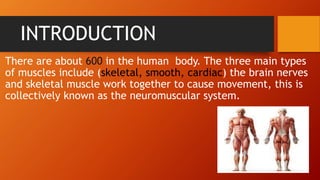
There are about 600 in the human body. The three main types
of muscles include (skeletal, smooth, cardiac) the brain nerves
and skeletal muscle work together to cause movement, this is
collectively known as the neuromuscular system.
SKELETAL MUSCLE
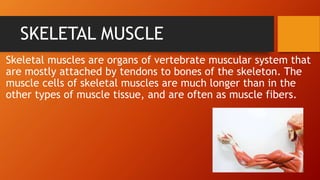
Skeletal muscles are organs of vertebrate muscular system that
are mostly attached by tendons to bones of the skeleton. The
muscle cells of skeletal muscles are much longer than in the
other types of muscle tissue, and are often as muscle fibers.
SKELETAL MUSCLE FUNCTION
Skeletal muscle enable humans to move and perform daily
activities. They play an essential role in respiratory mechanics
and help in maintaining posture and balance. They also protect
the vital organs in the body.
SKELETAL MUSCLE INFORMATION
• Skeletal muscles comprise 30 to 40% of your total mass and
its voluntary muscle that you can control your body
movement. Example for skeletal muscle your shoulder
muscles, hamstring muscle and abdominal muscles are all
examples of skeletal muscle.
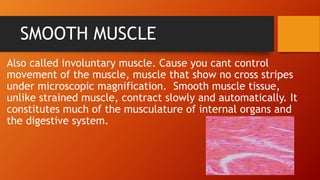
SMOOTH MUSCLE
Also called involuntary muscle. Cause you cant control
movement of the muscle, muscle that show no cross stripes
under microscopic magnification. Smooth muscle tissue,
unlike strained muscle, contract slowly and automatically. It
constitutes much of the musculature of internal organs and
the digestive system.
SMOOTH MUSCLE LOCATION
Smooth muscle is a type of tissue found in the walls of hollows
organs, such as intestines, uterus and stomach. You can also
find smooth muscle in the walls of passageways, including
arteries and veins of cardiovascular system.
SMOOTH MUSCLE FUNCTION
Smooth muscle cells are quite heterogeneous, depending on
the organs system in which they serve their function. Their
major role is to control the diameter, wall movement, and
wall stiffness of hollow organs like the vascular, bronchial
gastrointestinal or urogenital system as well as the uterus.
EXAMPLE OF SMOOTH MUSCLE FUNCTION
Smooth muscle move food through the digestive tract folds in
the stomach and small intestine, which are made of smooth
muscle help the body better absorb nutrients.
CARDIAC MUSCLE
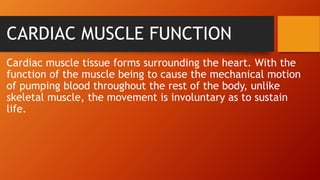
Cardiac muscle is an involuntary striated muscle tissue found
only in the heart and is responsible for the ability of the heart
to pump blood.
CARDIAC MUSCLE FUNCTION
Cardiac muscle tissue forms surrounding the heart. With the
function of the muscle being to cause the mechanical motion
of pumping blood throughout the rest of the body, unlike
skeletal muscle, the movement is involuntary as to sustain
life.
10 INTERESTING FACTS ABOUT MUSCLES
• The largest muscle in the body is gluteus maximus
• The smallest muscle in the body are in your inner ear
• The strongest muscle based on its size is the masseter
• Muscles are attached to bones by tendons
• Muscles make up about 40% of your total body weight
CONTINUE
• The hardest working muscle in the body is the heart
• Some of your busient muscles are those controlling eye
movement
• Most of the heat produced in your body comes from muscles
contraction
• Muscles usually works in pairs
• Muscles cant push, they can only pull
END
REFERENCES
• https://www.betterhealth.vic.gov.au
• https://en.m.Wikipedia.org
• https://www.ncbi.nlm.nih.gov
• https://www.Britannica.com
• https://www.scienedirect.com
• https://www.healthline.com

Muscles in human body

  • 1.
    MUSCLES IN HUMANBODY PRODUCED BY ELHAM EZAT
  • 2.
    INTRODUCTION There are about600 in the human body. The three main types of muscles include (skeletal, smooth, cardiac) the brain nerves and skeletal muscle work together to cause movement, this is collectively known as the neuromuscular system.
  • 3.
    SKELETAL MUSCLE Skeletal musclesare organs of vertebrate muscular system that are mostly attached by tendons to bones of the skeleton. The muscle cells of skeletal muscles are much longer than in the other types of muscle tissue, and are often as muscle fibers.
  • 4.
    SKELETAL MUSCLE FUNCTION Skeletalmuscle enable humans to move and perform daily activities. They play an essential role in respiratory mechanics and help in maintaining posture and balance. They also protect the vital organs in the body.
  • 5.
    SKELETAL MUSCLE INFORMATION •Skeletal muscles comprise 30 to 40% of your total mass and its voluntary muscle that you can control your body movement. Example for skeletal muscle your shoulder muscles, hamstring muscle and abdominal muscles are all examples of skeletal muscle.
  • 6.
    SMOOTH MUSCLE Also calledinvoluntary muscle. Cause you cant control movement of the muscle, muscle that show no cross stripes under microscopic magnification. Smooth muscle tissue, unlike strained muscle, contract slowly and automatically. It constitutes much of the musculature of internal organs and the digestive system.
  • 7.
    SMOOTH MUSCLE LOCATION Smoothmuscle is a type of tissue found in the walls of hollows organs, such as intestines, uterus and stomach. You can also find smooth muscle in the walls of passageways, including arteries and veins of cardiovascular system.
  • 8.
    SMOOTH MUSCLE FUNCTION Smoothmuscle cells are quite heterogeneous, depending on the organs system in which they serve their function. Their major role is to control the diameter, wall movement, and wall stiffness of hollow organs like the vascular, bronchial gastrointestinal or urogenital system as well as the uterus.
  • 9.
    EXAMPLE OF SMOOTHMUSCLE FUNCTION Smooth muscle move food through the digestive tract folds in the stomach and small intestine, which are made of smooth muscle help the body better absorb nutrients.
  • 10.
    CARDIAC MUSCLE Cardiac muscleis an involuntary striated muscle tissue found only in the heart and is responsible for the ability of the heart to pump blood.
  • 11.
    CARDIAC MUSCLE FUNCTION Cardiacmuscle tissue forms surrounding the heart. With the function of the muscle being to cause the mechanical motion of pumping blood throughout the rest of the body, unlike skeletal muscle, the movement is involuntary as to sustain life.
  • 12.
    10 INTERESTING FACTSABOUT MUSCLES • The largest muscle in the body is gluteus maximus • The smallest muscle in the body are in your inner ear • The strongest muscle based on its size is the masseter • Muscles are attached to bones by tendons • Muscles make up about 40% of your total body weight
  • 13.
    CONTINUE • The hardestworking muscle in the body is the heart • Some of your busient muscles are those controlling eye movement • Most of the heat produced in your body comes from muscles contraction • Muscles usually works in pairs • Muscles cant push, they can only pull
  • 14.
  • 15.
    REFERENCES • https://www.betterhealth.vic.gov.au • https://en.m.Wikipedia.org •https://www.ncbi.nlm.nih.gov • https://www.Britannica.com • https://www.scienedirect.com • https://www.healthline.com