TYPES OF GERMS
PRODUCED BY
ELHAM EZAT
TYPES OF GERMS
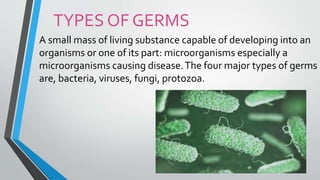
A small mass of living substance capable of developing into an
organisms or one of its part: microorganisms especially a
microorganisms causing disease.The four major types of germs
are, bacteria, viruses, fungi, protozoa.
Now lets talk about all types of germs
with details
bacteria, viruses, fungi, protozoa.
BACTERIA: what is bacteria
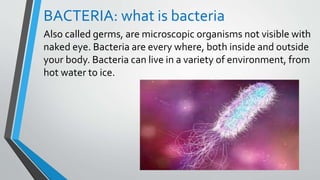
Also called germs, are microscopic organisms not visible with
naked eye. Bacteria are every where, both inside and outside
your body. Bacteria can live in a variety of environment, from
hot water to ice.
FOURTYPES OF BACTERIA
-Coccus form: these are a spherical bacteria.
-Bacillus form: these are rod_shaped bacteria.
-Spirilla form: these are spiral shaped bacteria that occur
singly.
-Vbrio bacteria: these are common shaped bacteria.
DISEASES CAUSED BY BACTERIA
Bacteria cause many common infection such as pneumonia,
wound infection, bloodstream infection and sexually
transmitted disease like gonorrhea and have also been
responsible for several major diseases epidemics.
HOWTREAT DISEASES CAUSED BY
BACTERIA
Most bacteria infection can be effectively treated by
antibiotics.They either kill bacteria or stop them multiplying.
This helps the body immune system to fight the bacteria.
Your doctor choice of antibiotics will be depend the bacteria
that is causing the infection.
EXTRA INFORMATION
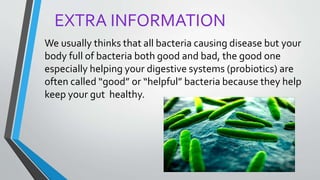
We usually thinks that all bacteria causing disease but your
body full of bacteria both good and bad, the good one
especially helping your digestive systems (probiotics) are
often called “good” or “helpful” bacteria because they help
keep your gut healthy.
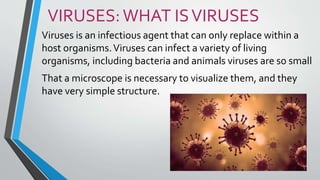
VIRUSES:WHAT ISVIRUSES
Viruses is an infectious agent that can only replace within a
host organisms.Viruses can infect a variety of living
organisms, including bacteria and animals viruses are so small
That a microscope is necessary to visualize them, and they
have very simple structure.
WHO INVENTEDVIRUSES
A meaning of “agent” that causes infectious disease is first
recorded in 1728 long before the discovery of viruses by
(Dimitri ivanovsky) in 1892
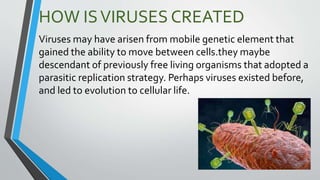
HOW ISVIRUSES CREATED
Viruses may have arisen from mobile genetic element that
gained the ability to move between cells.they maybe
descendant of previously free living organisms that adopted a
parasitic replication strategy. Perhaps viruses existed before,
and led to evolution to cellular life.
DISEASE CAUSED BYVIRUSES
There are 219 virus species that are known to be able to infect
human e;x (ckickenpox, influenza, meales, HIV, ect…)
HOWTREAT DISEASE CAUSED BYVIRUSES
For most viral infection, treatment can only help with
symptoms while you wait for your immune system to fight of
the virus. Antibiotics do not work for viral infection , there are
antiviral medicines to treat some viral infection.Vaccine can
helps prevent you from getting many viral diseases.
FUNGI:WHAT IS FUNGI
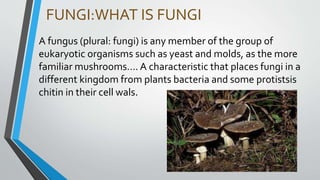
A fungus (plural: fungi) is any member of the group of
eukaryotic organisms such as yeast and molds, as the more
familiar mushrooms…. A characteristic that places fungi in a
different kingdom from plants bacteria and some protistsis
chitin in their cell wals.
DISEASE CAUSED BY FUNGI
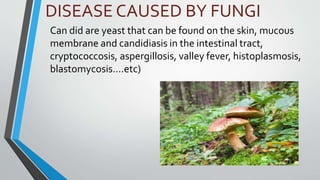
Can did are yeast that can be found on the skin, mucous
membrane and candidiasis in the intestinal tract,
cryptococcosis, aspergillosis, valley fever, histoplasmosis,
blastomycosis….etc)
HOWTREAT DISEASE CUSED BY FUNGI
Antifungal medicines are used to treat fungal infections,
which most commonly affect your skin, hair and nails.You
can get some antifungal medicines from pharmacy without
needing a GP prescription.
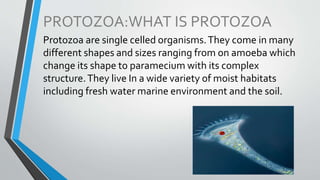
PROTOZOA:WHAT IS PROTOZOA
Protozoa are single celled organisms.They come in many
different shapes and sizes ranging from on amoeba which
change its shape to paramecium with its complex
structure.They live In a wide variety of moist habitats
including fresh water marine environment and the soil.
TYPES OF PROTOZOA
-Sporozoa(intracellular parasites)
-flagellates(with tail like structure that flap around to move
them)
-amoeba(which more using temperature cell body projections
called pseudopods)
-ciliates(which move by beating multiple hair like structure
called cilia).
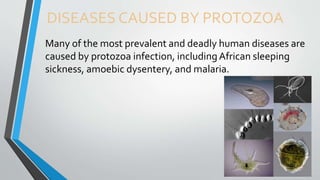
DISEASES CAUSED BY PROTOZOA
Many of the most prevalent and deadly human diseases are
caused by protozoa infection, includingAfrican sleeping
sickness, amoebic dysentery, and malaria.
How treat diseases caused by protozoa
Commonly used antiprotozoals include metronidazole,
tinidazole and nifuratel. Metronidazole the most common
treatment for trichomoniasis and giardiasis.
Healthy habit to prevent getting germsand
infection diseases
-handle, prepare food safely
-wash hand often
-clean&disinfect commonly used surfaces
-caugh&sneeze your sleeve
-don’t share personal item
-get vaccinated
-avoid touching wild animals.
REFERENCES
https://www.healthdirect.gov.au
https://www.webmd.com
https://www.nature.com
https://www.nhs.uk
https://microbiologysociaty.org

Types of germs

  • 1.
  • 2.
    TYPES OF GERMS Asmall mass of living substance capable of developing into an organisms or one of its part: microorganisms especially a microorganisms causing disease.The four major types of germs are, bacteria, viruses, fungi, protozoa.
  • 3.
    Now lets talkabout all types of germs with details bacteria, viruses, fungi, protozoa.
  • 4.
    BACTERIA: what isbacteria Also called germs, are microscopic organisms not visible with naked eye. Bacteria are every where, both inside and outside your body. Bacteria can live in a variety of environment, from hot water to ice.
  • 5.
    FOURTYPES OF BACTERIA -Coccusform: these are a spherical bacteria. -Bacillus form: these are rod_shaped bacteria. -Spirilla form: these are spiral shaped bacteria that occur singly. -Vbrio bacteria: these are common shaped bacteria.
  • 6.
    DISEASES CAUSED BYBACTERIA Bacteria cause many common infection such as pneumonia, wound infection, bloodstream infection and sexually transmitted disease like gonorrhea and have also been responsible for several major diseases epidemics.
  • 7.
    HOWTREAT DISEASES CAUSEDBY BACTERIA Most bacteria infection can be effectively treated by antibiotics.They either kill bacteria or stop them multiplying. This helps the body immune system to fight the bacteria. Your doctor choice of antibiotics will be depend the bacteria that is causing the infection.
  • 8.
    EXTRA INFORMATION We usuallythinks that all bacteria causing disease but your body full of bacteria both good and bad, the good one especially helping your digestive systems (probiotics) are often called “good” or “helpful” bacteria because they help keep your gut healthy.
  • 9.
    VIRUSES:WHAT ISVIRUSES Viruses isan infectious agent that can only replace within a host organisms.Viruses can infect a variety of living organisms, including bacteria and animals viruses are so small That a microscope is necessary to visualize them, and they have very simple structure.
  • 10.
    WHO INVENTEDVIRUSES A meaningof “agent” that causes infectious disease is first recorded in 1728 long before the discovery of viruses by (Dimitri ivanovsky) in 1892
  • 11.
    HOW ISVIRUSES CREATED Virusesmay have arisen from mobile genetic element that gained the ability to move between cells.they maybe descendant of previously free living organisms that adopted a parasitic replication strategy. Perhaps viruses existed before, and led to evolution to cellular life.
  • 12.
    DISEASE CAUSED BYVIRUSES Thereare 219 virus species that are known to be able to infect human e;x (ckickenpox, influenza, meales, HIV, ect…)
  • 13.
    HOWTREAT DISEASE CAUSEDBYVIRUSES For most viral infection, treatment can only help with symptoms while you wait for your immune system to fight of the virus. Antibiotics do not work for viral infection , there are antiviral medicines to treat some viral infection.Vaccine can helps prevent you from getting many viral diseases.
  • 14.
    FUNGI:WHAT IS FUNGI Afungus (plural: fungi) is any member of the group of eukaryotic organisms such as yeast and molds, as the more familiar mushrooms…. A characteristic that places fungi in a different kingdom from plants bacteria and some protistsis chitin in their cell wals.
  • 15.
    DISEASE CAUSED BYFUNGI Can did are yeast that can be found on the skin, mucous membrane and candidiasis in the intestinal tract, cryptococcosis, aspergillosis, valley fever, histoplasmosis, blastomycosis….etc)
  • 16.
    HOWTREAT DISEASE CUSEDBY FUNGI Antifungal medicines are used to treat fungal infections, which most commonly affect your skin, hair and nails.You can get some antifungal medicines from pharmacy without needing a GP prescription.
  • 17.
    PROTOZOA:WHAT IS PROTOZOA Protozoaare single celled organisms.They come in many different shapes and sizes ranging from on amoeba which change its shape to paramecium with its complex structure.They live In a wide variety of moist habitats including fresh water marine environment and the soil.
  • 18.
    TYPES OF PROTOZOA -Sporozoa(intracellularparasites) -flagellates(with tail like structure that flap around to move them) -amoeba(which more using temperature cell body projections called pseudopods) -ciliates(which move by beating multiple hair like structure called cilia).
  • 19.
    DISEASES CAUSED BYPROTOZOA Many of the most prevalent and deadly human diseases are caused by protozoa infection, includingAfrican sleeping sickness, amoebic dysentery, and malaria.
  • 20.
    How treat diseasescaused by protozoa Commonly used antiprotozoals include metronidazole, tinidazole and nifuratel. Metronidazole the most common treatment for trichomoniasis and giardiasis.
  • 21.
    Healthy habit toprevent getting germsand infection diseases -handle, prepare food safely -wash hand often -clean&disinfect commonly used surfaces -caugh&sneeze your sleeve -don’t share personal item -get vaccinated -avoid touching wild animals.
  • 22.