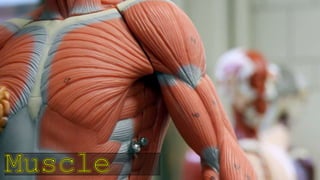
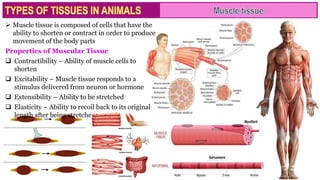

 Muscle tissue is composed of cells that have the
ability to shorten or contract in order to produce
movement of the body parts
Properties of Muscular Tissue
 Contractibility – Ability of muscle cells to
shorten
 Excitability – Muscle tissue responds to a
stimulus delivered from neuron or hormone
 Extensibility – Ability to be stretched
 Elasticity – Ability to recoil back to its original
length after being stretched
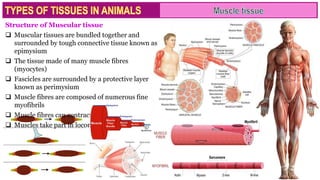
Structure of Muscular tissue
 Muscular tissues are bundled together and
surrounded by tough connective tissue known as
epimysium
 The tissue made of many muscle fibres
(myocytes)
 Fascicles are surrounded by a protective layer
known as perimysium
 Muscle fibres are composed of numerous fine
myofibrils
 Muscle fibres can contract and relax
 Muscles take part in locomotion and movements
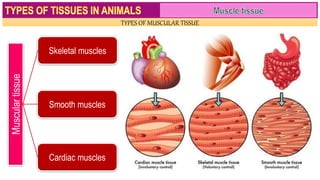
TYPES OF MUSCULAR TISSUE
Muscular
tissue
Skeletal muscles
Smooth muscles
Cardiac muscles
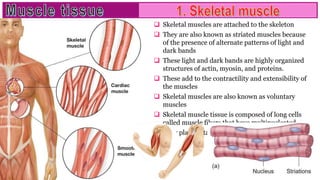
 Skeletal muscles are attached to the skeleton
 They are also known as striated muscles because
of the presence of alternate patterns of light and
dark bands
 These light and dark bands are highly organized
structures of actin, myosin, and proteins.
 These add to the contractility and extensibility of
the muscles
 Skeletal muscles are also known as voluntary
muscles
 Skeletal muscle tissue is composed of long cells
called muscle fibers that have multinucleated
 They play a vital role in everyday activities
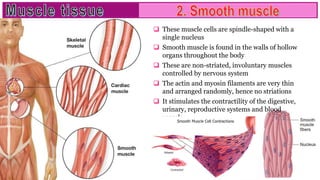
 These muscle cells are spindle-shaped with a
single nucleus
 Smooth muscle is found in the walls of hollow
organs throughout the body
 These are non-striated, involuntary muscles
controlled by nervous system
 The actin and myosin filaments are very thin
and arranged randomly, hence no striations
 It stimulates the contractility of the digestive,
urinary, reproductive systems and blood
vessels
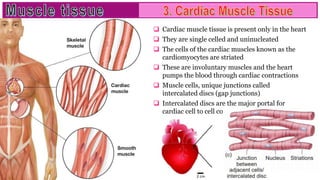
 Cardiac muscle tissue is present only in the heart
 They are single celled and uninucleated
 The cells of the cardiac muscles known as the
cardiomyocytes are striated
 These are involuntary muscles and the heart
pumps the blood through cardiac contractions
 Muscle cells, unique junctions called
intercalated discs (gap junctions)
 Intercalated discs are the major portal for
cardiac cell to cell communication
100% Free Study Materials
 Free Biology Study
Materials
 Easy to understood
 Download as PDF
 Clear Explanations
 High Quality Content
Visit & Get Latest
Study Materials
www.rajusbiology.com

Muscle Tissue Types and Functions.pptx

  • 2.
     Muscle tissueis composed of cells that have the ability to shorten or contract in order to produce movement of the body parts Properties of Muscular Tissue  Contractibility – Ability of muscle cells to shorten  Excitability – Muscle tissue responds to a stimulus delivered from neuron or hormone  Extensibility – Ability to be stretched  Elasticity – Ability to recoil back to its original length after being stretched
  • 3.
    Structure of Musculartissue  Muscular tissues are bundled together and surrounded by tough connective tissue known as epimysium  The tissue made of many muscle fibres (myocytes)  Fascicles are surrounded by a protective layer known as perimysium  Muscle fibres are composed of numerous fine myofibrils  Muscle fibres can contract and relax  Muscles take part in locomotion and movements
  • 4.
    TYPES OF MUSCULARTISSUE Muscular tissue Skeletal muscles Smooth muscles Cardiac muscles
  • 5.
     Skeletal musclesare attached to the skeleton  They are also known as striated muscles because of the presence of alternate patterns of light and dark bands  These light and dark bands are highly organized structures of actin, myosin, and proteins.  These add to the contractility and extensibility of the muscles  Skeletal muscles are also known as voluntary muscles  Skeletal muscle tissue is composed of long cells called muscle fibers that have multinucleated  They play a vital role in everyday activities
  • 6.
     These musclecells are spindle-shaped with a single nucleus  Smooth muscle is found in the walls of hollow organs throughout the body  These are non-striated, involuntary muscles controlled by nervous system  The actin and myosin filaments are very thin and arranged randomly, hence no striations  It stimulates the contractility of the digestive, urinary, reproductive systems and blood vessels
  • 7.
     Cardiac muscletissue is present only in the heart  They are single celled and uninucleated  The cells of the cardiac muscles known as the cardiomyocytes are striated  These are involuntary muscles and the heart pumps the blood through cardiac contractions  Muscle cells, unique junctions called intercalated discs (gap junctions)  Intercalated discs are the major portal for cardiac cell to cell communication
  • 8.
    100% Free StudyMaterials  Free Biology Study Materials  Easy to understood  Download as PDF  Clear Explanations  High Quality Content Visit & Get Latest Study Materials www.rajusbiology.com