Muscles and Their Types
What Are Muscles?
Skeletal Muscle: Cardiac Muscle
Involuntary, found only in the
heart, striated.
Smooth Muscle
Involuntary, found in organs, non-
striated.
Muscles are soft tissues responsible
for generating force and movement.
Voluntary, attached to bones,
striated appearance.
Functions of Muscles:
 1. Movement: Muscles contract to move bones and body parts.
 2. Posture: Help maintain body posture and alignment.
 3. Stability: Stabilize joints and prevent unwanted movement.
 4. Heat Production: Generate heat through contractions, regulating
body temperature.
 5. Circulation: Cardiac muscles pump blood, while smooth muscles
help move blood and fluids in vessels.
 6. Breathing: Muscles like the diaphragm control respiration.
 7. Protection: Provide a layer of protection for internal organs.
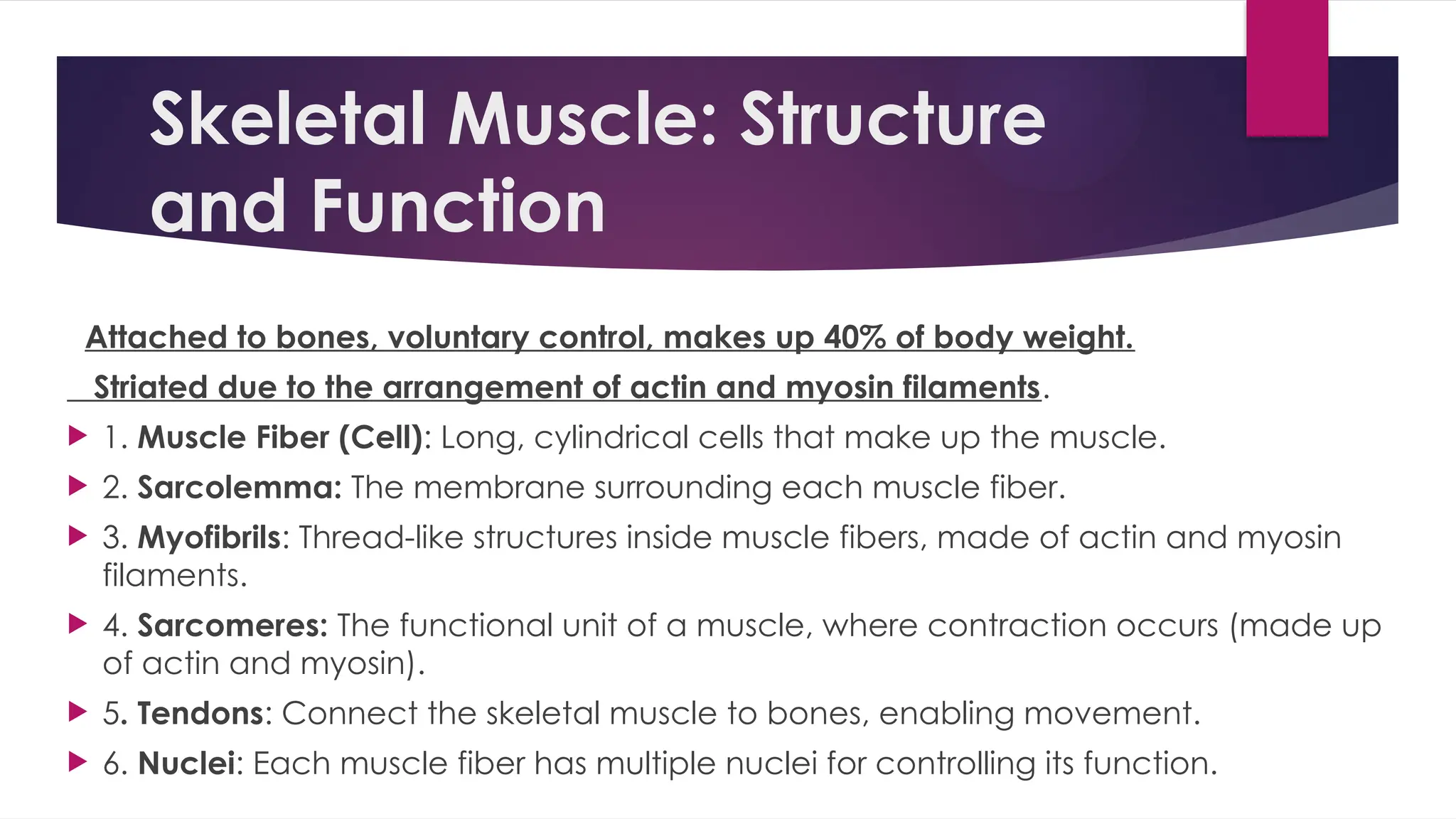
Skeletal Muscle: Structure
and Function
Attached to bones, voluntary control, makes up 40% of body weight.
Striated due to the arrangement of actin and myosin filaments.
 1. Muscle Fiber (Cell): Long, cylindrical cells that make up the muscle.
 2. Sarcolemma: The membrane surrounding each muscle fiber.
 3. Myofibrils: Thread-like structures inside muscle fibers, made of actin and myosin
filaments.
 4. Sarcomeres: The functional unit of a muscle, where contraction occurs (made up
of actin and myosin).
 5. Tendons: Connect the skeletal muscle to bones, enabling movement.
 6. Nuclei: Each muscle fiber has multiple nuclei for controlling its function.

muscles and its types. pptx

  • 1.
  • 2.
    What Are Muscles? SkeletalMuscle: Cardiac Muscle Involuntary, found only in the heart, striated. Smooth Muscle Involuntary, found in organs, non- striated. Muscles are soft tissues responsible for generating force and movement. Voluntary, attached to bones, striated appearance.
  • 3.
    Functions of Muscles: 1. Movement: Muscles contract to move bones and body parts.  2. Posture: Help maintain body posture and alignment.  3. Stability: Stabilize joints and prevent unwanted movement.  4. Heat Production: Generate heat through contractions, regulating body temperature.  5. Circulation: Cardiac muscles pump blood, while smooth muscles help move blood and fluids in vessels.  6. Breathing: Muscles like the diaphragm control respiration.  7. Protection: Provide a layer of protection for internal organs.
  • 4.
    Skeletal Muscle: Structure andFunction Attached to bones, voluntary control, makes up 40% of body weight. Striated due to the arrangement of actin and myosin filaments.  1. Muscle Fiber (Cell): Long, cylindrical cells that make up the muscle.  2. Sarcolemma: The membrane surrounding each muscle fiber.  3. Myofibrils: Thread-like structures inside muscle fibers, made of actin and myosin filaments.  4. Sarcomeres: The functional unit of a muscle, where contraction occurs (made up of actin and myosin).  5. Tendons: Connect the skeletal muscle to bones, enabling movement.  6. Nuclei: Each muscle fiber has multiple nuclei for controlling its function.