Muscular System
• Function
– Locomotion
– Posture
– Protection
– Heat production
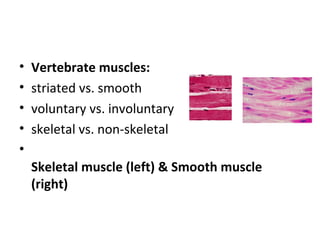
• Vertebrate muscles:
• striated vs. smooth
• voluntary vs. involuntary
• skeletal vs. non-skeletal
•
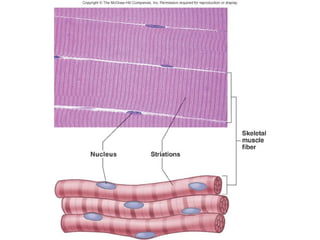
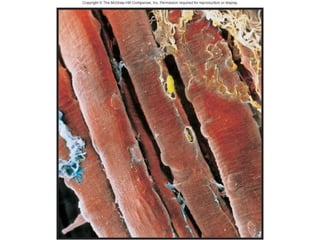
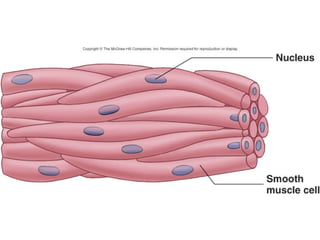
Skeletal muscle (left) & Smooth muscle
(right)
Muscle Classification
• Skeletal Muscle
– Attached to skeleton
– Striated
– Muscle fiber = Muscle cell
• Multinucleate
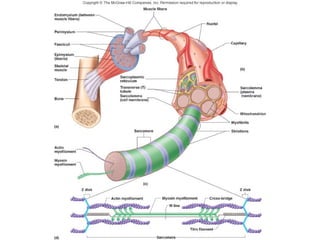
• Myofibrils are striated cylinders within myofiber
• Non-skeletal muscle = muscles not attached to the
skeleton; most are smooth & involuntary
• 1 - Skeletal, striated, voluntary muscles
– axial
• body wall & tail
• hypobranchial & tongue
• extrinsic eyeball muscles
– appendicular
– branchiomeric (homologous to the branchial/
pharyngeal muscles from fishes to mammals,
striated muscles, innervated by cranial nerves)
– integumentary
• 2 - Non-skeletal, smooth, chiefly
involuntary muscles
–muscles of tubes, vessels, & hollow
organs
–intrinsic eyeball muscles
–erectors of feathers & hair
• 3 - Cardiac muscle
• 4 - Electric organs
• Skeletal muscles have muscular & tendinous
portions:
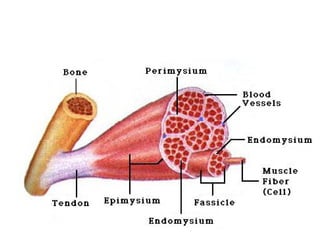
• Muscle - consists of skeletal muscle cells
(which, in turn, consist of myofibrils and
myofilaments)
• Tendons - extensions of a muscle's tough
connective tissue sheath (fascia & epimysium)
that anchor a muscle to its origin & insertion
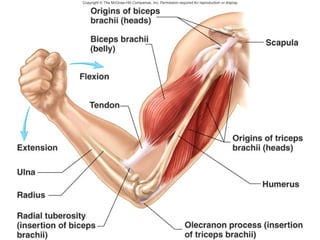
–Origin = site of attachment that is
relatively fixed
–Insertion = site of attachment that is
normally displaced by contraction of
the muscle
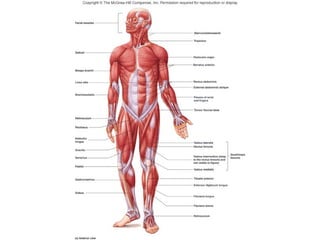
•Names of skeletal muscles are based on:
•direction of fibers (e.g., oblique(
•location or position (e.g., superficial(
•number of divisions (e.g., triceps(
•shape (e.g., deltoid(
•origin and/or insertion (e.g., iliocostalis(
•action (e.g., levator scapulae(
•size (e.g., major(
•or some combination of these
Skeletal Muscle
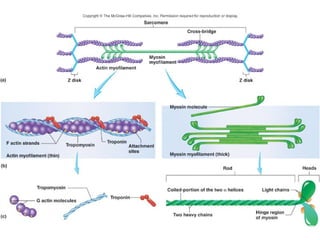
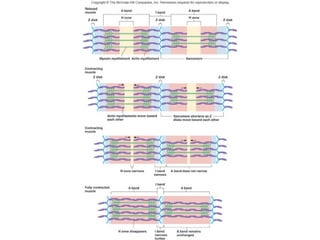
• Myofilaments are proteins that result in
contraction within the myofibrils
–Actin – thin & has a receptor site for myosin
–Myosin – thick & has a receptor site for
actin and ATP
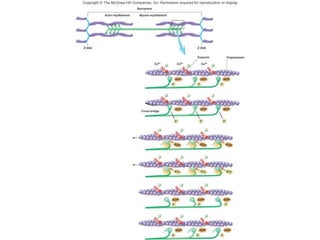
–Contraction – Myosin heads attach to actin
and with ATP perform a Power Stroke
Skeletal Muscle
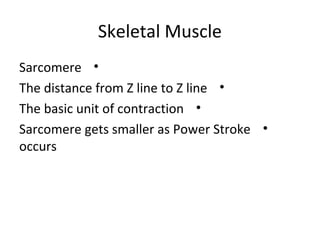
•Sarcomere
•The distance from Z line to Z line
•The basic unit of contraction
•Sarcomere gets smaller as Power Stroke
occurs
Key Points
• Why is the sarcomere the functional unit of
contraction?
• Why does the power stroke result in
contraction?
• What would happen to contraction if you ran
out of ATP?
Motor Neurons
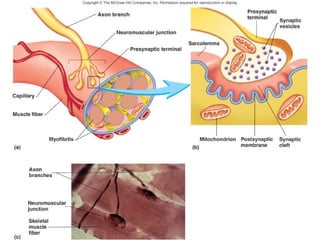
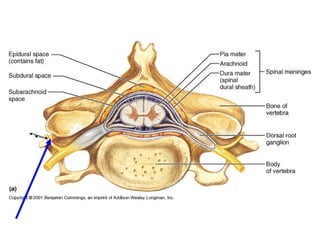
• Skeletal muscle cannot contract without
stimulation from a motor neuron
• Motor Unit = The motor neuron plus the
myofiber(s) it innervates
Key Points
• Why would a spinal cord injury result in
paralysis?
Somatic Muscles
• All of the body’s skeletal muscles except the
branchiomeric muscles
• Voluntary
• Body wall & Appendage muscles
– Trunk and Tail
– Hypobranchial
– Tongue
– Extrinsic Eyeball
Somatic Muscles
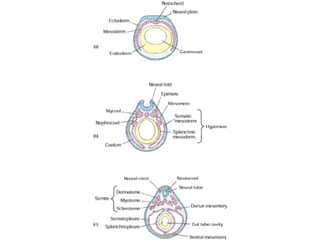
• Myotome derivatives primarily
• Some from hypomere
Key Points
• What is a myotome?
Somatic Muscles
• Orient the body in the environment
Somatic Muscles
• Red Fibers
– More blood supply for aerobic metabolism
– Myoglobin for oxygen storage
– Fatigue resistant
– Fish for cruising long distances, tetrapods for
posture
Somatic Muscles
• White fibers
– Less blood supply; geared for anaerobic
metabolism
– Fatiguable
– Fish for spurts of swimming
– Tetrapods for sprints
Key Points
• Why is the breast meat of the goose dark, but
the breast meat of the chicken is white?
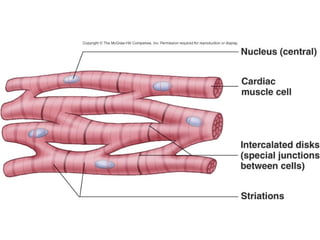
Cardiac Muscle
• Striated with intercalated disks
• Involuntary
• Lateral plate mesoderm (hypomere) in origin
Smooth Muscle
• Involuntary
• Lateral plate mesoderm in origin
• Regulates internal environment
• Innervated by Autonomic Nervous System
• Found in the wall of tubes and hollow organs
• Intrinsic Eye muscles
• Erectors of feathers and hairs
Key Points
• Besides those mentioned, give a specific
example of where might you find smooth
muscle?
Gross features of skeletal muscle
• Origin, insertion
• Tendon
• Aponeurosis
• Fascia
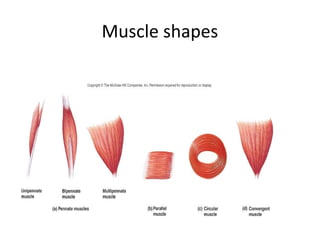
Muscle shapes
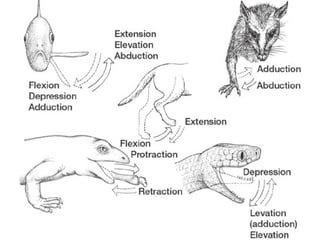
Skeletal Muscle Actions
• Flex/Extend
• Adduct/Abduct
• Levator/Depressor
• Protract/Retract
• Constrictor/Dilator
• Rotator
Skeletal Muscle Actions
• Supinator/Pronator
• Tensor (taut)
Skeletal Muscle Actions
• Agonist – primary mover
• Antagonist – opposes primary mover
• Synergist – helps primary mover
Development & Phylogeny
• Position
• Embryology
• Nerve supply
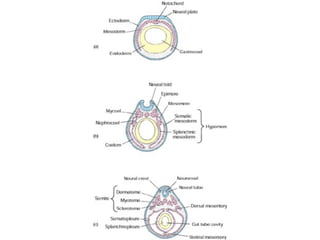
Development
• Dorsal Mesoderm – Epimere – Somite
–Myotome
–Sclerotome & Dermatome
• Lateral plate Mesoderm – Hypomere
–Somatic – body wall muscles
–Splanchnic – smooth muscle of viscera
AXIAL MUSCLES
• Trunk
• Tail
• Hypobranchial
• Tongue
• Extrinsic Eye
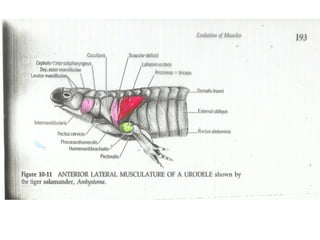
• Axial Muscles:
• include the skeletal muscles of the trunk & tail
• extend forward beneath the pharynx as
hypobranchial muscles & muscles of the tongue
• are present in orbits as extrinsic eyeball muscles
(check slide 27 in this powerpoint presentation)
• are metameric (most evident in fish and aquatic
amphibians where the axial muscles are used in
locomotion; in other tetrapods, metamerism is
obscured due to presence of paired appendages
responsible for locomotion on land)
• are segmental because of their embryonic origin;
arise from segmental mesodermal somites
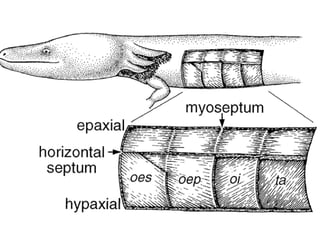
•Trunk & tail muscles of fish:
•Axial musculature consists of a series
of segments (myomeres) separated by
myosepta
–Myosepta serve as origins & insertions
for segmented muscles
•Myomeres are divided into dorsal &
ventral masses by a horizontal septum
that extends between the transverse
processes of the vertebrae
•Epaxials = above the septum
•Hypaxials = below the septum
• Trunk & tail muscles of tetrapods
• Tetrapods, like fish, have epaxial & hypaxial masses, & these
retain some evidence of metamerism even in the highest
tetrapods.
• Modifications:
• 1 - epaxials are elongated bundles that extend through many
body segments & that are located below the expanded
appendicular muscles required to operate the limbs
• 2 - hypaxials of the abdomen have no myosepta & form broad
sheets of muscle
• 3 - hypaxials are oriented into oblique, rectus, & transverse
bundles
• Epaxials of tetrapods:
• lie along vertebral column dorsal to transverse
processes & lateral to neural arches
• extend from base of the skull to tip of the tail
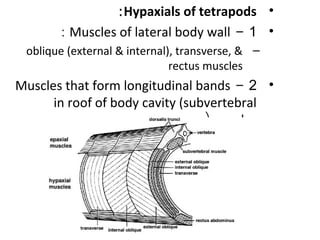
•Hypaxials of tetrapods:
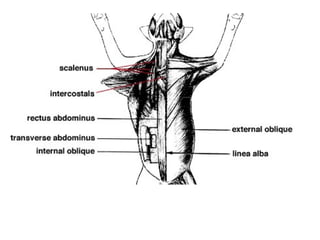
•1-Muscles of lateral body wall:
–oblique (external & internal), transverse, &
rectus muscles
•2-Muscles that form longitudinal bands
in roof of body cavity (subvertebral
muscles(
Rectus muscles:
•weakly developed in most fish; 'stronger'
in tetrapods
•support ventral body wall & aid in arching
the back
•in mammals - rectus abdominis (typically
extends from the anterior end of the
sternum to the pelvic girdle)
Appendicular muscles - move fins or
limbs
•Extrinsic - originate on axial skeleton or
fascia or trunk & insert on girdles or limbs
•Intrinsic - originate on girdle or proximal
skeletal elements of appendage & insert on
more distal elements
Branchiomeric muscles:
1 - associated with the pharyngeal
arches
2 - series of skeletal & smooth
muscles
3 - adductors, constrictors, & levators
operate jaws plus successive gill
arches
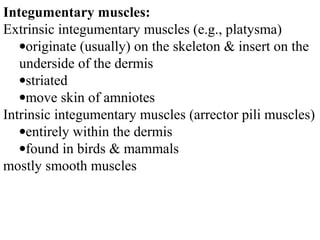
Integumentary muscles:
Extrinsic integumentary muscles (e.g., platysma)
•originate (usually) on the skeleton & insert on the
underside of the dermis
•striated
•move skin of amniotes
Intrinsic integumentary muscles (arrector pili muscles)
•entirely within the dermis
•found in birds & mammals
mostly smooth muscles
Axial Muscles
•Metamerism as in myomeres
Axial Muscles
•Agnathans
•Simple
•Segments (myomeres(
•Myotome derivatives
Axial Muscles – Jawed Fish
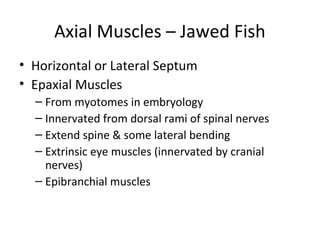
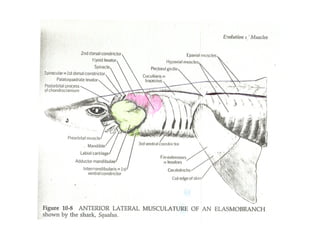
• Horizontal or Lateral Septum
• Epaxial Muscles
– From myotomes in embryology
– Innervated from dorsal rami of spinal nerves
– Extend spine & some lateral bending
– Extrinsic eye muscles (innervated by cranial
nerves)
– Epibranchial muscles
Axial Muscles – Jawed Fish
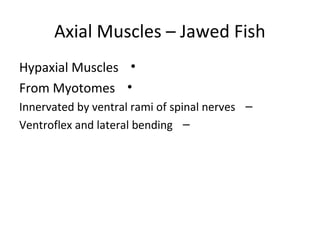
•Hypaxial Muscles
•From Myotomes
–Innervated by ventral rami of spinal nerves
–Ventroflex and lateral bending
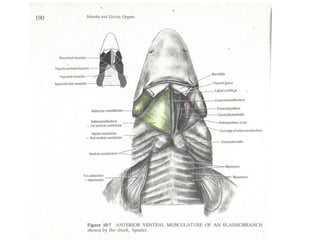
Hypaxial Muscles – Jawed fish
•Hypobranchial muscles
•Located on floor of pharynx, pectoral girdle to
jaw
•Are hypaxial muscles that migrated forward
•Function in respiration & feeding
•E.g. Coracomandibularis, Coracohyoid
Axial Muscles - Tetrapods
•Epaxial trunk muscles
•Dorsal muscles from skull to tail
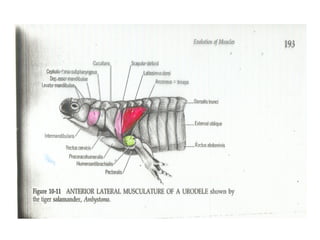
•Dorsalis trunci in amphibians
•Longissimus – long dominant spine extensor in
amniotes
•Iliocostalis – most lateral epaxial spine muscle
important in reptiles
Epaxial Muscles
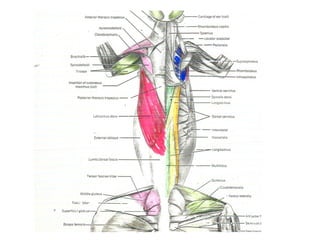
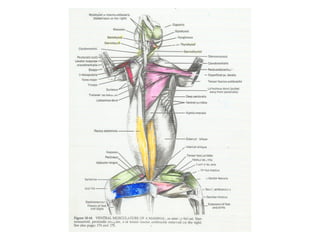
•See Vertebrate Muscles page
Epaxial Muscles in Tetrapods
• Trends
• Decreased except in neck
• Fewer myosepta
Axial Muscles - Tetrapods
• Hypaxial Muscles
• Tend to form sling-like sheets
• Lateral muscles support & compress body wall
• Obliques
• Transversus
• Intercostals in amniotes only
Hypaxial Muscles - Tetrapods
• Rectus abdominis – ventroflexes and
compresses abdomen
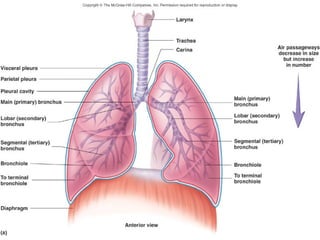
• Diaphragm – unique to mammals for
breathing
Hypaxial Muscles in tetrapods
•See Vertebrate Muscles page
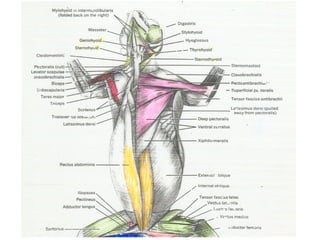
Hypobranchial and Tongue Muscles -
tetrapods
• Function – stabilizes hyoid and larynx
• E.g. geniohyoid, sternohyoid, sternothyroid,
thyrohyoid
Hypobranchial & Tongue muscles in
tetrapods
•Tongue muscles
•Lingu-; Gloss-
•Anchors to hyoid
•E.g. lingualis, styloglossus
Hypobranchial & Tongue muscles in
Tetrapods
• See Vertebrate Muscles page
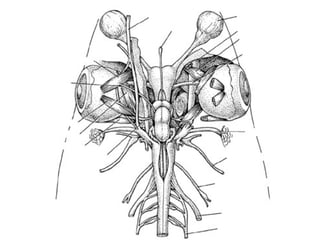
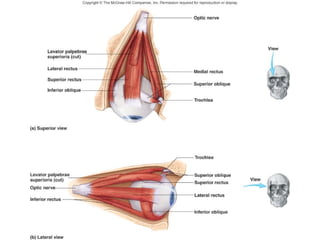
Extrinsic Eye muscles in tetrapods
• Voluntary
• Obliques – rotates eye along its transverse
axis
• Rectus – up, down, left, right
• Retractor in some
Extrinsic Eye muscles
• See Vertebrate Muscles Page

Muscle tissue 1 2 (comparative vertebrate anatomy)

  • 1.
    Muscular System • Function –Locomotion – Posture – Protection – Heat production
  • 2.
    • Vertebrate muscles: •striated vs. smooth • voluntary vs. involuntary • skeletal vs. non-skeletal • Skeletal muscle (left) & Smooth muscle (right)
  • 3.
    Muscle Classification • SkeletalMuscle – Attached to skeleton – Striated – Muscle fiber = Muscle cell • Multinucleate • Myofibrils are striated cylinders within myofiber • Non-skeletal muscle = muscles not attached to the skeleton; most are smooth & involuntary
  • 4.
    • 1 -Skeletal, striated, voluntary muscles – axial • body wall & tail • hypobranchial & tongue • extrinsic eyeball muscles – appendicular – branchiomeric (homologous to the branchial/ pharyngeal muscles from fishes to mammals, striated muscles, innervated by cranial nerves) – integumentary
  • 5.
    • 2 -Non-skeletal, smooth, chiefly involuntary muscles –muscles of tubes, vessels, & hollow organs –intrinsic eyeball muscles –erectors of feathers & hair • 3 - Cardiac muscle • 4 - Electric organs
  • 6.
    • Skeletal muscleshave muscular & tendinous portions: • Muscle - consists of skeletal muscle cells (which, in turn, consist of myofibrils and myofilaments) • Tendons - extensions of a muscle's tough connective tissue sheath (fascia & epimysium) that anchor a muscle to its origin & insertion
  • 8.
    –Origin = siteof attachment that is relatively fixed –Insertion = site of attachment that is normally displaced by contraction of the muscle
  • 9.
    •Names of skeletalmuscles are based on: •direction of fibers (e.g., oblique( •location or position (e.g., superficial( •number of divisions (e.g., triceps( •shape (e.g., deltoid( •origin and/or insertion (e.g., iliocostalis( •action (e.g., levator scapulae( •size (e.g., major( •or some combination of these
  • 13.
    Skeletal Muscle • Myofilamentsare proteins that result in contraction within the myofibrils –Actin – thin & has a receptor site for myosin –Myosin – thick & has a receptor site for actin and ATP –Contraction – Myosin heads attach to actin and with ATP perform a Power Stroke
  • 17.
    Skeletal Muscle •Sarcomere •The distancefrom Z line to Z line •The basic unit of contraction •Sarcomere gets smaller as Power Stroke occurs
  • 18.
    Key Points • Whyis the sarcomere the functional unit of contraction? • Why does the power stroke result in contraction? • What would happen to contraction if you ran out of ATP?
  • 19.
    Motor Neurons • Skeletalmuscle cannot contract without stimulation from a motor neuron • Motor Unit = The motor neuron plus the myofiber(s) it innervates
  • 21.
    Key Points • Whywould a spinal cord injury result in paralysis?
  • 22.
    Somatic Muscles • Allof the body’s skeletal muscles except the branchiomeric muscles • Voluntary • Body wall & Appendage muscles – Trunk and Tail – Hypobranchial – Tongue – Extrinsic Eyeball
  • 23.
    Somatic Muscles • Myotomederivatives primarily • Some from hypomere
  • 24.
    Key Points • Whatis a myotome?
  • 26.
    Somatic Muscles • Orientthe body in the environment
  • 27.
    Somatic Muscles • RedFibers – More blood supply for aerobic metabolism – Myoglobin for oxygen storage – Fatigue resistant – Fish for cruising long distances, tetrapods for posture
  • 28.
    Somatic Muscles • Whitefibers – Less blood supply; geared for anaerobic metabolism – Fatiguable – Fish for spurts of swimming – Tetrapods for sprints
  • 29.
    Key Points • Whyis the breast meat of the goose dark, but the breast meat of the chicken is white?
  • 30.
    Cardiac Muscle • Striatedwith intercalated disks • Involuntary • Lateral plate mesoderm (hypomere) in origin
  • 32.
    Smooth Muscle • Involuntary •Lateral plate mesoderm in origin • Regulates internal environment • Innervated by Autonomic Nervous System • Found in the wall of tubes and hollow organs • Intrinsic Eye muscles • Erectors of feathers and hairs
  • 34.
    Key Points • Besidesthose mentioned, give a specific example of where might you find smooth muscle?
  • 35.
    Gross features ofskeletal muscle • Origin, insertion • Tendon • Aponeurosis • Fascia
  • 38.
  • 39.
    Skeletal Muscle Actions •Flex/Extend • Adduct/Abduct • Levator/Depressor • Protract/Retract • Constrictor/Dilator • Rotator
  • 41.
    Skeletal Muscle Actions •Supinator/Pronator • Tensor (taut)
  • 42.
    Skeletal Muscle Actions •Agonist – primary mover • Antagonist – opposes primary mover • Synergist – helps primary mover
  • 43.
    Development & Phylogeny •Position • Embryology • Nerve supply
  • 44.
    Development • Dorsal Mesoderm– Epimere – Somite –Myotome –Sclerotome & Dermatome • Lateral plate Mesoderm – Hypomere –Somatic – body wall muscles –Splanchnic – smooth muscle of viscera
  • 46.
    AXIAL MUSCLES • Trunk •Tail • Hypobranchial • Tongue • Extrinsic Eye
  • 47.
    • Axial Muscles: •include the skeletal muscles of the trunk & tail • extend forward beneath the pharynx as hypobranchial muscles & muscles of the tongue • are present in orbits as extrinsic eyeball muscles (check slide 27 in this powerpoint presentation) • are metameric (most evident in fish and aquatic amphibians where the axial muscles are used in locomotion; in other tetrapods, metamerism is obscured due to presence of paired appendages responsible for locomotion on land) • are segmental because of their embryonic origin; arise from segmental mesodermal somites
  • 49.
    •Trunk & tailmuscles of fish: •Axial musculature consists of a series of segments (myomeres) separated by myosepta –Myosepta serve as origins & insertions for segmented muscles •Myomeres are divided into dorsal & ventral masses by a horizontal septum that extends between the transverse processes of the vertebrae
  • 50.
    •Epaxials = abovethe septum •Hypaxials = below the septum
  • 51.
    • Trunk &tail muscles of tetrapods • Tetrapods, like fish, have epaxial & hypaxial masses, & these retain some evidence of metamerism even in the highest tetrapods. • Modifications: • 1 - epaxials are elongated bundles that extend through many body segments & that are located below the expanded appendicular muscles required to operate the limbs • 2 - hypaxials of the abdomen have no myosepta & form broad sheets of muscle • 3 - hypaxials are oriented into oblique, rectus, & transverse bundles
  • 52.
    • Epaxials oftetrapods: • lie along vertebral column dorsal to transverse processes & lateral to neural arches • extend from base of the skull to tip of the tail
  • 53.
    •Hypaxials of tetrapods: •1-Musclesof lateral body wall: –oblique (external & internal), transverse, & rectus muscles •2-Muscles that form longitudinal bands in roof of body cavity (subvertebral muscles(
  • 55.
    Rectus muscles: •weakly developedin most fish; 'stronger' in tetrapods •support ventral body wall & aid in arching the back •in mammals - rectus abdominis (typically extends from the anterior end of the sternum to the pelvic girdle)
  • 57.
    Appendicular muscles -move fins or limbs •Extrinsic - originate on axial skeleton or fascia or trunk & insert on girdles or limbs •Intrinsic - originate on girdle or proximal skeletal elements of appendage & insert on more distal elements
  • 58.
    Branchiomeric muscles: 1 -associated with the pharyngeal arches 2 - series of skeletal & smooth muscles 3 - adductors, constrictors, & levators operate jaws plus successive gill arches
  • 59.
    Integumentary muscles: Extrinsic integumentarymuscles (e.g., platysma) •originate (usually) on the skeleton & insert on the underside of the dermis •striated •move skin of amniotes Intrinsic integumentary muscles (arrector pili muscles) •entirely within the dermis •found in birds & mammals mostly smooth muscles
  • 60.
  • 62.
  • 63.
    Axial Muscles –Jawed Fish • Horizontal or Lateral Septum • Epaxial Muscles – From myotomes in embryology – Innervated from dorsal rami of spinal nerves – Extend spine & some lateral bending – Extrinsic eye muscles (innervated by cranial nerves) – Epibranchial muscles
  • 66.
    Axial Muscles –Jawed Fish •Hypaxial Muscles •From Myotomes –Innervated by ventral rami of spinal nerves –Ventroflex and lateral bending
  • 68.
    Hypaxial Muscles –Jawed fish •Hypobranchial muscles •Located on floor of pharynx, pectoral girdle to jaw •Are hypaxial muscles that migrated forward •Function in respiration & feeding •E.g. Coracomandibularis, Coracohyoid
  • 70.
    Axial Muscles -Tetrapods •Epaxial trunk muscles •Dorsal muscles from skull to tail •Dorsalis trunci in amphibians •Longissimus – long dominant spine extensor in amniotes •Iliocostalis – most lateral epaxial spine muscle important in reptiles
  • 73.
  • 74.
    Epaxial Muscles inTetrapods • Trends • Decreased except in neck • Fewer myosepta
  • 75.
    Axial Muscles -Tetrapods • Hypaxial Muscles • Tend to form sling-like sheets • Lateral muscles support & compress body wall • Obliques • Transversus • Intercostals in amniotes only
  • 77.
    Hypaxial Muscles -Tetrapods • Rectus abdominis – ventroflexes and compresses abdomen • Diaphragm – unique to mammals for breathing
  • 79.
    Hypaxial Muscles intetrapods •See Vertebrate Muscles page
  • 80.
    Hypobranchial and TongueMuscles - tetrapods • Function – stabilizes hyoid and larynx • E.g. geniohyoid, sternohyoid, sternothyroid, thyrohyoid
  • 82.
    Hypobranchial & Tonguemuscles in tetrapods •Tongue muscles •Lingu-; Gloss- •Anchors to hyoid •E.g. lingualis, styloglossus
  • 83.
    Hypobranchial & Tonguemuscles in Tetrapods • See Vertebrate Muscles page
  • 84.
    Extrinsic Eye musclesin tetrapods • Voluntary • Obliques – rotates eye along its transverse axis • Rectus – up, down, left, right • Retractor in some
  • 86.
    Extrinsic Eye muscles •See Vertebrate Muscles Page