Introduction to Decentralized Sanitation
Systems and Fecal Sludge Management / FSM
Value Chain
MANAGEMENT OF URBAN WATER
SUPPLY AND SEWERAGE SYSTEM
Er. Sudarshan Bhandari
Outline of Presentation
• Global Scenario
• Sanitation System
• Access to Urban Sanitation and Challenges
• Faecal sludge Management
• Way Forward
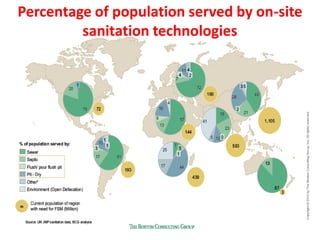
Percentage of population served by on-site
sanitation technologies
Global Scenario
• 2.7 billion people – onsite sanitation technologies
and Expected to grow to 5 billion (2030 A.D.)
• Typically no management system in place to deal
with septage and pit latrine sludge
• Dumped directly into Urban Environment-significant
health & environment implications
• A global platform for discussion created in 2011- FSM
conferences in Durban, Hanoi, Chennai, Kathmandu
• 1 USD spent on WASH improvement gives return 5-
46 USD depending on intervention.
• Sewer systems and FSM can be complementary.
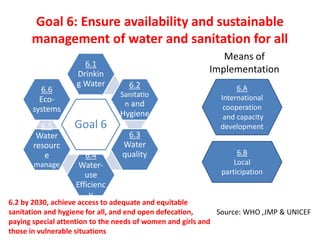
Goal 6: Ensure availability and sustainable
management of water and sanitation for all
Goal 6
6.1
Drinkin
g Water 6.2
Sanitatio
n and
Hygiene
6.3
Water
quality6.4
Water-
use
Efficienc
y
6.5
Water
resourc
e
manage
ment
6.6
Eco-
systems
6.A
International
cooperation
and capacity
development
6.B
Local
participation
Means of
Implementation
Source: WHO ,JMP & UNICEF
6.2 by 2030, achieve access to adequate and equitable
sanitation and hygiene for all, and end open defecation,
paying special attention to the needs of women and girls and
those in vulnerable situations
Sanitation System
• Onsite Sanitation System
• Offsite sanitation System
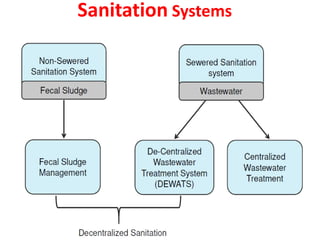
Sanitation Systems
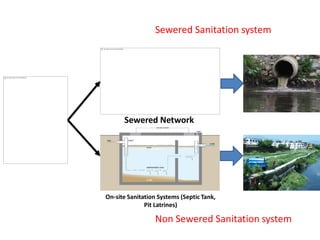
Sewered Network
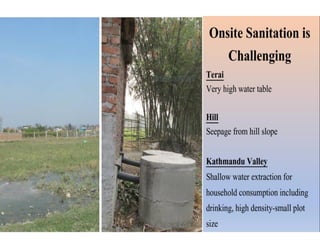
On-site Sanitation Systems (Septic Tank,
Pit Latrines)
Sewered Sanitation system
Non Sewered Sanitation system
Sanitation System
• Centralized Sanitation System
• Decentralized Sanitation System
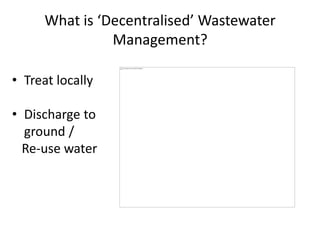
What is ‘Decentralised’ Wastewater
Management?
• Treat locally
• Discharge to
ground /
Re-use water
Decentralized wastewater system
Decentralized wastewater systems - collect, treat, and reuse
or dispose of w/w at or near its point of generation.
Treat wastewater from individual buildings, clusters, small
community.
Unlike centralized urban wastewater treatment systems,
decentralized systems treat wastewater close to the source,
typically using small pipes for collecting small volumes of
domestic wastewater.
Most cost-effective option esp in rural areas
and hilly terrain.
Cost-effectiveness depends on a number of
factors like population size and density,
topography, distance to an existing centralized
system
Decentralized wastewater system
(Contd..)
Often more affordable for small communities
Achieves high removal rates for most pollutants
Reduces infiltration and ex-filtration
All sewage captured and treated
Pipes one-sixth the size of conventional pipes because
they do not have to accommodate stormwater
No pump stations, no outfalls
Water used locally
Advantages of Decentralized
Wastewater Treatment
Disadvantages of Decentralized
Wastewater Treatment
Potential threat to ground water quality
Requires greater awareness and participation
of homeowners
Funding challenges
Fragmented regulatory structur
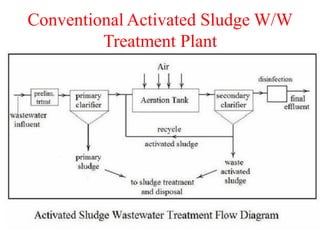
Conventional Activated Sludge W/W
Treatment Plant
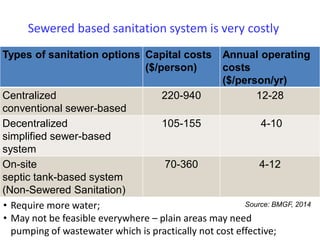
Sewered based sanitation system is very costly
Types of sanitation options Capital costs
($/person)
Annual operating
costs
($/person/yr)
Centralized
conventional sewer-based
220-940 12-28
Decentralized
simplified sewer-based
system
105-155 4-10
On-site
septic tank-based system
(Non-Sewered Sanitation)
70-360 4-12
Source: BMGF, 2014• Require more water;
• May not be feasible everywhere – plain areas may need
pumping of wastewater which is practically not cost effective;
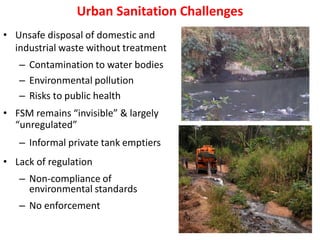
Urban Sanitation Challenges
• Unsafe disposal of domestic and
industrial waste without treatment
– Contamination to water bodies
– Environmental pollution
– Risks to public health
• FSM remains “invisible” & largely
“unregulated”
– Informal private tank emptiers
• Lack of regulation
– Non-compliance of
environmental standards
– No enforcement
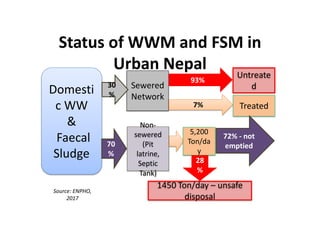
Status of WWM and FSM in
Urban Nepal
Domesti
c WW
&
Faecal
Sludge
Sewered
Network
Non-
sewered
(Pit
latrine,
Septic
Tank)
30
%
93%
Untreate
d
70
%
Treated7%
5,200
Ton/da
y
72% - not
emptied
28
%
1450 Ton/day – unsafe
disposal
Source: ENPHO,
2017
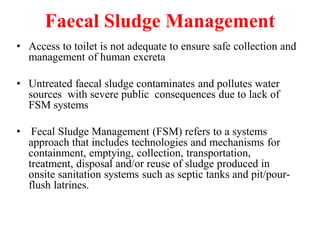
Faecal Sludge Management
• Access to toilet is not adequate to ensure safe collection and
management of human excreta
• Untreated faecal sludge contaminates and pollutes water
sources with severe public consequences due to lack of
FSM systems
• Fecal Sludge Management (FSM) refers to a systems
approach that includes technologies and mechanisms for
containment, emptying, collection, transportation,
treatment, disposal and/or reuse of sludge produced in
onsite sanitation systems such as septic tanks and pit/pour-
flush latrines.
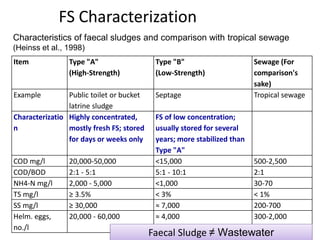
FS Characterization
Item Type "A"
(High-Strength)
Type "B"
(Low-Strength)
Sewage (For
comparison's
sake)
Example Public toilet or bucket
latrine sludge
Septage Tropical sewage
Characterizatio
n
Highly concentrated,
mostly fresh FS; stored
for days or weeks only
FS of low concentration;
usually stored for several
years; more stabilized than
Type "A"
COD mg/l 20,000-50,000 <15,000 500-2,500
COD/BOD 2:1 - 5:1 5:1 - 10:1 2:1
NH4-N mg/l 2,000 - 5,000 <1,000 30-70
TS mg/l ≥ 3.5% < 3% < 1%
SS mg/l ≥ 30,000 ≈ 7,000 200-700
Helm. eggs,
no./l
20,000 - 60,000 ≈ 4,000 300-2,000
Characteristics of faecal sludges and comparison with tropical sewage
(Heinss et al., 1998)
Faecal Sludge ≠ Wastewater
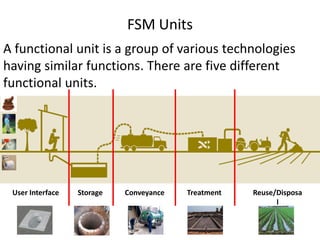
FSM Units
User Interface Storage Conveyance Treatment Reuse/Disposa
l
A functional unit is a group of various technologies
having similar functions. There are five different
functional units.
©eawag
o Dry Toilet
o Urine Diverting
Dry Toilet (UDDT)
o Urinal
o Pour Flush Toilet
o Cistern Flush
Toilet
o Urine Diverting
Flush Toilet
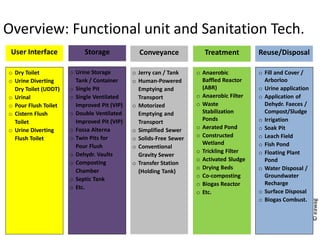
User Interface
o Urine Storage
Tank / Container
o Single Pit
o Single Ventilated
Improved Pit (VIP)
o Double Ventilated
Improved Pit (VIP)
o Fossa Alterna
o Twin Pits for
Pour Flush
o Dehydr. Vaults
o Composting
Chamber
o Septic Tank
o Etc.
Storage
o Jerry can / Tank
o Human-Powered
Emptying and
Transport
o Motorized
Emptying and
Transport
o Simplified Sewer
o Solids-Free Sewer
o Conventional
Gravity Sewer
o Transfer Station
(Holding Tank)
Conveyance
o Anaerobic
Baffled Reactor
(ABR)
o Anaerobic Filter
o Waste
Stabilization
Ponds
o Aerated Pond
o Constructed
Wetland
o Trickling Filter
o Activated Sludge
o Drying Beds
o Co-composting
o Biogas Reactor
o Etc.
Treatment
o Fill and Cover /
Arborloo
o Urine application
o Application of
Dehydr. Faeces /
Compost/Sludge
o Irrigation
o Soak Pit
o Leach Field
o Fish Pond
o Floating Plant
Pond
o Water Disposal /
Groundwater
Recharge
o Surface Disposal
o Biogas Combust.
Reuse/Disposal
Overview: Functional unit and Sanitation Tech.
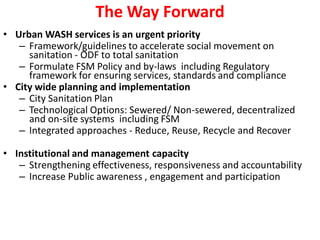
The Way Forward
• Urban WASH services is an urgent priority
– Framework/guidelines to accelerate social movement on
sanitation - ODF to total sanitation
– Formulate FSM Policy and by-laws including Regulatory
framework for ensuring services, standards and compliance
• City wide planning and implementation
– City Sanitation Plan
– Technological Options: Sewered/ Non-sewered, decentralized
and on-site systems including FSM
– Integrated approaches - Reduce, Reuse, Recycle and Recover
• Institutional and management capacity
– Strengthening effectiveness, responsiveness and accountability
– Increase Public awareness , engagement and participation
FSM Video
• https://youtu.be/8eYjpfe5nPU
& Environmental Sanitation

Faecal sludge management

  • 1.
    Introduction to DecentralizedSanitation Systems and Fecal Sludge Management / FSM Value Chain MANAGEMENT OF URBAN WATER SUPPLY AND SEWERAGE SYSTEM Er. Sudarshan Bhandari
  • 2.
    Outline of Presentation •Global Scenario • Sanitation System • Access to Urban Sanitation and Challenges • Faecal sludge Management • Way Forward
  • 3.
    Percentage of populationserved by on-site sanitation technologies
  • 4.
    Global Scenario • 2.7billion people – onsite sanitation technologies and Expected to grow to 5 billion (2030 A.D.) • Typically no management system in place to deal with septage and pit latrine sludge • Dumped directly into Urban Environment-significant health & environment implications • A global platform for discussion created in 2011- FSM conferences in Durban, Hanoi, Chennai, Kathmandu • 1 USD spent on WASH improvement gives return 5- 46 USD depending on intervention. • Sewer systems and FSM can be complementary.
  • 5.
    Goal 6: Ensureavailability and sustainable management of water and sanitation for all Goal 6 6.1 Drinkin g Water 6.2 Sanitatio n and Hygiene 6.3 Water quality6.4 Water- use Efficienc y 6.5 Water resourc e manage ment 6.6 Eco- systems 6.A International cooperation and capacity development 6.B Local participation Means of Implementation Source: WHO ,JMP & UNICEF 6.2 by 2030, achieve access to adequate and equitable sanitation and hygiene for all, and end open defecation, paying special attention to the needs of women and girls and those in vulnerable situations
  • 6.
    Sanitation System • OnsiteSanitation System • Offsite sanitation System
  • 8.
  • 9.
    Sewered Network On-site SanitationSystems (Septic Tank, Pit Latrines) Sewered Sanitation system Non Sewered Sanitation system
  • 10.
    Sanitation System • CentralizedSanitation System • Decentralized Sanitation System
  • 11.
    What is ‘Decentralised’Wastewater Management? • Treat locally • Discharge to ground / Re-use water
  • 12.
    Decentralized wastewater system Decentralizedwastewater systems - collect, treat, and reuse or dispose of w/w at or near its point of generation. Treat wastewater from individual buildings, clusters, small community. Unlike centralized urban wastewater treatment systems, decentralized systems treat wastewater close to the source, typically using small pipes for collecting small volumes of domestic wastewater.
  • 13.
    Most cost-effective optionesp in rural areas and hilly terrain. Cost-effectiveness depends on a number of factors like population size and density, topography, distance to an existing centralized system Decentralized wastewater system (Contd..)
  • 14.
    Often more affordablefor small communities Achieves high removal rates for most pollutants Reduces infiltration and ex-filtration All sewage captured and treated Pipes one-sixth the size of conventional pipes because they do not have to accommodate stormwater No pump stations, no outfalls Water used locally Advantages of Decentralized Wastewater Treatment
  • 15.
    Disadvantages of Decentralized WastewaterTreatment Potential threat to ground water quality Requires greater awareness and participation of homeowners Funding challenges Fragmented regulatory structur
  • 16.
    Conventional Activated SludgeW/W Treatment Plant
  • 17.
    Sewered based sanitationsystem is very costly Types of sanitation options Capital costs ($/person) Annual operating costs ($/person/yr) Centralized conventional sewer-based 220-940 12-28 Decentralized simplified sewer-based system 105-155 4-10 On-site septic tank-based system (Non-Sewered Sanitation) 70-360 4-12 Source: BMGF, 2014• Require more water; • May not be feasible everywhere – plain areas may need pumping of wastewater which is practically not cost effective;
  • 18.
    Urban Sanitation Challenges •Unsafe disposal of domestic and industrial waste without treatment – Contamination to water bodies – Environmental pollution – Risks to public health • FSM remains “invisible” & largely “unregulated” – Informal private tank emptiers • Lack of regulation – Non-compliance of environmental standards – No enforcement
  • 19.
    Status of WWMand FSM in Urban Nepal Domesti c WW & Faecal Sludge Sewered Network Non- sewered (Pit latrine, Septic Tank) 30 % 93% Untreate d 70 % Treated7% 5,200 Ton/da y 72% - not emptied 28 % 1450 Ton/day – unsafe disposal Source: ENPHO, 2017
  • 20.
    Faecal Sludge Management •Access to toilet is not adequate to ensure safe collection and management of human excreta • Untreated faecal sludge contaminates and pollutes water sources with severe public consequences due to lack of FSM systems • Fecal Sludge Management (FSM) refers to a systems approach that includes technologies and mechanisms for containment, emptying, collection, transportation, treatment, disposal and/or reuse of sludge produced in onsite sanitation systems such as septic tanks and pit/pour- flush latrines.
  • 21.
    FS Characterization Item Type"A" (High-Strength) Type "B" (Low-Strength) Sewage (For comparison's sake) Example Public toilet or bucket latrine sludge Septage Tropical sewage Characterizatio n Highly concentrated, mostly fresh FS; stored for days or weeks only FS of low concentration; usually stored for several years; more stabilized than Type "A" COD mg/l 20,000-50,000 <15,000 500-2,500 COD/BOD 2:1 - 5:1 5:1 - 10:1 2:1 NH4-N mg/l 2,000 - 5,000 <1,000 30-70 TS mg/l ≥ 3.5% < 3% < 1% SS mg/l ≥ 30,000 ≈ 7,000 200-700 Helm. eggs, no./l 20,000 - 60,000 ≈ 4,000 300-2,000 Characteristics of faecal sludges and comparison with tropical sewage (Heinss et al., 1998) Faecal Sludge ≠ Wastewater
  • 22.
    FSM Units User InterfaceStorage Conveyance Treatment Reuse/Disposa l A functional unit is a group of various technologies having similar functions. There are five different functional units.
  • 23.
    ©eawag o Dry Toilet oUrine Diverting Dry Toilet (UDDT) o Urinal o Pour Flush Toilet o Cistern Flush Toilet o Urine Diverting Flush Toilet User Interface o Urine Storage Tank / Container o Single Pit o Single Ventilated Improved Pit (VIP) o Double Ventilated Improved Pit (VIP) o Fossa Alterna o Twin Pits for Pour Flush o Dehydr. Vaults o Composting Chamber o Septic Tank o Etc. Storage o Jerry can / Tank o Human-Powered Emptying and Transport o Motorized Emptying and Transport o Simplified Sewer o Solids-Free Sewer o Conventional Gravity Sewer o Transfer Station (Holding Tank) Conveyance o Anaerobic Baffled Reactor (ABR) o Anaerobic Filter o Waste Stabilization Ponds o Aerated Pond o Constructed Wetland o Trickling Filter o Activated Sludge o Drying Beds o Co-composting o Biogas Reactor o Etc. Treatment o Fill and Cover / Arborloo o Urine application o Application of Dehydr. Faeces / Compost/Sludge o Irrigation o Soak Pit o Leach Field o Fish Pond o Floating Plant Pond o Water Disposal / Groundwater Recharge o Surface Disposal o Biogas Combust. Reuse/Disposal Overview: Functional unit and Sanitation Tech.
  • 24.
    The Way Forward •Urban WASH services is an urgent priority – Framework/guidelines to accelerate social movement on sanitation - ODF to total sanitation – Formulate FSM Policy and by-laws including Regulatory framework for ensuring services, standards and compliance • City wide planning and implementation – City Sanitation Plan – Technological Options: Sewered/ Non-sewered, decentralized and on-site systems including FSM – Integrated approaches - Reduce, Reuse, Recycle and Recover • Institutional and management capacity – Strengthening effectiveness, responsiveness and accountability – Increase Public awareness , engagement and participation
  • 25.
  • 26.