ARC WELDING
ELECTRIC ARC WELDING
The welding (fusion) in which the electric arc is
produced to give heat for the purpose of
joining two surfaces is called electric arc
welding.
The joining by fusing of two or more pieces of
metal together by using the heat produced
from an electric arc .
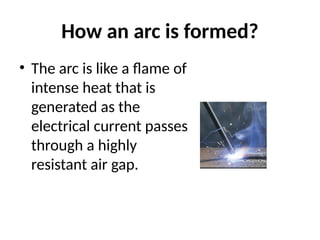
How an arc is formed?
• The arc is like a flame of
intense heat that is
generated as the
electrical current passes
through a highly
resistant air gap.
ELECTRIC ARC WELDING
Principle of Arc
• A suitable gap is kept between the work and
electrode
• A high current is passed through the circuit.
• The electric energy is converted into heat energy,
producing a temperature of 3000°C to 4000°C.
• This heat melts the edges to be welded and
molten pool is formed.
• On solidification the welding joint is obtained
Types of Electrodes
1. Bare electrodes
2. Coated electrodes
Arc Welding Electrodes
• The choice of electrode for SMAW depends on
a number of factors, including
1. The weld material
2. Welding position and
3. The desired weld properties.
Coated Electrodes
• The electrode is coated in a metal mixture
called flux, which gives off gases as it
decomposes to prevent
1. Weld contamination
2. Introduces deoxidizers to purify the weld
3. Causes weld-protecting slag to form
4. Improves the arc stability, and
5. Provides alloying elements to improve the weld
quality.
Electrode Coating
• Electrode coatings can consist of a number of different compounds, including
rutile, calcium fluoride, cellulose, and iron powder.
• Rutile electrodes, coated with 25%–45% TiO2, are characterized by ease of
use and good appearance of the resulting weld. However, they create welds
with high hydrogen content, encouraging embrittlement and cracking.
• Electrodes containing calcium fluoride (CaF2), sometimes known as basic or
low-hydrogen electrodes, are hygroscopic and must be stored in dry
conditions. They produce strong welds, but with a coarse and convex-shaped
joint surface.
• Electrodes coated with cellulose, especially when combined with rutile,
provide deep weld penetration, but because of their high moisture content,
special procedures must be used to prevent excessive risk of cracking.
• Finally, iron powder is a common coating additive, as it improves the
productivity of the electrode, sometimes as much as doubling the yield.
Functions of electrode (flux) covering
• Provides the gaseous shield to protect the
molten metal from air.
– Cellulose-type electrode (C6H10O5)x , providing
gas mixture of H2, CO, H2O and CO2.
– Limestone-type electrode (CaCO3) – low in
hydrogen and it is used for welding metals that are
susceptible to hydrogen cracking such as high-
strength steels.
Functions of electrode (flux) covering
• Deoxidation - Provide deoxidizers and fluxing agent to
deoxidize and cleanse the weld metal. The solid slag
also protects the weld metal from oxidation.
• Arc stabilization - Provide arc stabilizers which are
compounds such as potassium oxalate and lithium
carbonate. They readily decompose into ions in an
arc, which increase electrical conductivity.
• Metal addition - Provide alloying elements (for
composition control) and metal powder (increase
deposition rate) to the weld pool.
Types of Electrodes
Electrodes can be divided into three groups—
1. Fast-fill electrodes,
Fast-fill electrodes are designed to melt quickly so that
the welding speed can be maximized
2. Fast-freeze electrodes,
fast-freeze electrodes supply filler metal that solidifies
quickly, making welding in a variety of positions possible
by preventing the weld pool from shifting significantly
before solidifying. and
3. Intermediate electrodes go by the name "fill-freeze" or
"fast-follow" electrodes.
Arc Welding Power Supplies
• The current for arc welder can be supplied by
line current or by an alternator/generator.
– The amount of heat is determined by the current flow (amps)
– The ease of starting and harshness of the arc is determined by the electrical
potential (volts).
• Welding current adjustments can include:
– Amperage
– Voltage
– Polarity
Amperage Output
• The maximum output of the power supply
determines the thickness of metal that can be
welded before joint beveling is required.
• 185 to 225 amps is a common size.
• For an individual weld, the optimum output
amperage is determined by
– thickness of the metal
– type of joint and
– type of electrode
Alternating Current
• Alternating current: The type of current where
the flow of electrons reverses direction
(polarity) at regular intervals.
• Recommended for general purpose electrodes
and flat position.
Direct Current
• Direct current: The type of current where the flow of electrons
(polarity) is in one direction.
• Controlling the polarity allows the welder to influence the location
of the heat.
• When the electrode is positive (+) DCRP, it will be slightly hotter
than the base metal.
• When the base metal is positive (+), DCSP, the base metal will be
slightly hotter than the electrode.
• DC is required for GMAW
• It is frequently used for SMAW
A.C/D.C CURRENT COMPARISON
1. A.C. welding machine is cheaper, small in size, light in weight and simple to
operate.
2. Maintenance of A.C. welding machine is easier and more economical, because
there is no moving parts in it.
3. Heat generated is equal at both the poles, so it does not require changing of
polarity.
4. D.C. welding machine is suitable for welding all types of metals by changing the
polarity. A.C. welding machine is not suitable for welding all metals particularly non-
ferrous metals and alloys.
6. In DC, starting of the arc is easier comparatively.
7. In A.C, bare electrode cannot be used. Only specially designed coated electrodes
can be used. Both coated and bare electrode can be used in D.C. welding machine.
9. A.C. welding machine is not suitable for welding of sheet metals due to difficulty in
starting the arc.
10. The problem of arc-blow can be easily controlled in A.C, while it is difficult in D.C.
11. Voltage drop in A.C. is less, hence, can be used at a large distances from the
power supply.
12. Less electric energy consumption per kg of metal deposited (3 to 4 kWh.).
13. A.C. Welding machine has high efficiency (0.8 to 0.85).
14. A.C. Welding machine has lower operating cost.
POLARITY
For Arc welding purpose work metal is made one terminal and the electrode is made
another, and thus arc constitutes in between them in the external circuit.
Since electrons always flow from negative terminal to positive terminal of any external
circuit, so based on the connection made, two cases are possible:
1. Electrode is connected with negative terminal of the power source; whereas, base
metals are connected with positive terminal- STRAIGHT POLARITY
2. Base metals are connected with the negative terminal of the power source; whereas,
electrode is connected with positive terminal- REVERSE POLARITY
Therefore, arc welding can be carried out in any of the following three polarities.
Direct Current Straight Polarity—occurs when electrode is made negative and base
plates are made positive. Thus electrons flow from electrode tip to base plates.
Direct Current Reverse Polarity—occurs when electrode is made positive and base
plates are made negative. Thus electrons flow from base plates to electrode.
Alternating Current Polarity—if power source provides AC current then above two
cases will occur one after another in every cycle. In one half of the cycle, electrode will
be negative (so base plates will be positive) and in the next half, electrode will be
positive (so base plate will be negative). Number of cycles per second depends on
frequency of supply. For example, with a 60Hz supply, 60 cycles occur in every second.
Advantages of reverse polarity in arc welding
• Better arc cleaning action so less chance of inclusion defects.
• High volume deposition rate for consumable electrode, so faster welding.
• Better performance for welding thin plates. It reduces distortion level, residual
stress, complete cutting, etc.
• Suitable for joining metals with low melting points, such as copper and
aluminum.
Disadvantages of reverse polarity in arc welding
• Shorter electrode life for non-consumable electrodes.
• Higher level of reinforcement if speed is not adjusted properly. (electrode
content in weld joint high)
• Insufficient melting and incomplete penetration.
• Cannot fuse properly thick plates or metals having high melting point.
Advantages of straight polarity in arc welding
• Sufficient fusion of base metals and thus proper penetration can be
achieved.
• Less chance of tungsten inclusion (with TIG welding) and also low
reinforcement.
• Better choice for welding metals with high melting point, such as
titanium, stainless steel, etc.
• Thick plates can also be joined properly.
Disadvantages of straight polarity in arc welding
• No arc cleaning action so chances of inclusion defects.
• High distortion level.
• High residual stress generation at welded components.
• Broader heat affected zone (HAZ).
• Lower productivity due to lower deposition rate.
• Not suitable for welding thin plates.

Various types arc welding power source.pptx

  • 1.
  • 2.
    ELECTRIC ARC WELDING Thewelding (fusion) in which the electric arc is produced to give heat for the purpose of joining two surfaces is called electric arc welding. The joining by fusing of two or more pieces of metal together by using the heat produced from an electric arc .
  • 3.
    How an arcis formed? • The arc is like a flame of intense heat that is generated as the electrical current passes through a highly resistant air gap.
  • 4.
  • 5.
    Principle of Arc •A suitable gap is kept between the work and electrode • A high current is passed through the circuit. • The electric energy is converted into heat energy, producing a temperature of 3000°C to 4000°C. • This heat melts the edges to be welded and molten pool is formed. • On solidification the welding joint is obtained
  • 6.
    Types of Electrodes 1.Bare electrodes 2. Coated electrodes
  • 7.
    Arc Welding Electrodes •The choice of electrode for SMAW depends on a number of factors, including 1. The weld material 2. Welding position and 3. The desired weld properties.
  • 8.
    Coated Electrodes • Theelectrode is coated in a metal mixture called flux, which gives off gases as it decomposes to prevent 1. Weld contamination 2. Introduces deoxidizers to purify the weld 3. Causes weld-protecting slag to form 4. Improves the arc stability, and 5. Provides alloying elements to improve the weld quality.
  • 9.
    Electrode Coating • Electrodecoatings can consist of a number of different compounds, including rutile, calcium fluoride, cellulose, and iron powder. • Rutile electrodes, coated with 25%–45% TiO2, are characterized by ease of use and good appearance of the resulting weld. However, they create welds with high hydrogen content, encouraging embrittlement and cracking. • Electrodes containing calcium fluoride (CaF2), sometimes known as basic or low-hydrogen electrodes, are hygroscopic and must be stored in dry conditions. They produce strong welds, but with a coarse and convex-shaped joint surface. • Electrodes coated with cellulose, especially when combined with rutile, provide deep weld penetration, but because of their high moisture content, special procedures must be used to prevent excessive risk of cracking. • Finally, iron powder is a common coating additive, as it improves the productivity of the electrode, sometimes as much as doubling the yield.
  • 10.
    Functions of electrode(flux) covering • Provides the gaseous shield to protect the molten metal from air. – Cellulose-type electrode (C6H10O5)x , providing gas mixture of H2, CO, H2O and CO2. – Limestone-type electrode (CaCO3) – low in hydrogen and it is used for welding metals that are susceptible to hydrogen cracking such as high- strength steels.
  • 11.
    Functions of electrode(flux) covering • Deoxidation - Provide deoxidizers and fluxing agent to deoxidize and cleanse the weld metal. The solid slag also protects the weld metal from oxidation. • Arc stabilization - Provide arc stabilizers which are compounds such as potassium oxalate and lithium carbonate. They readily decompose into ions in an arc, which increase electrical conductivity. • Metal addition - Provide alloying elements (for composition control) and metal powder (increase deposition rate) to the weld pool.
  • 12.
    Types of Electrodes Electrodescan be divided into three groups— 1. Fast-fill electrodes, Fast-fill electrodes are designed to melt quickly so that the welding speed can be maximized 2. Fast-freeze electrodes, fast-freeze electrodes supply filler metal that solidifies quickly, making welding in a variety of positions possible by preventing the weld pool from shifting significantly before solidifying. and 3. Intermediate electrodes go by the name "fill-freeze" or "fast-follow" electrodes.
  • 13.
    Arc Welding PowerSupplies • The current for arc welder can be supplied by line current or by an alternator/generator. – The amount of heat is determined by the current flow (amps) – The ease of starting and harshness of the arc is determined by the electrical potential (volts). • Welding current adjustments can include: – Amperage – Voltage – Polarity
  • 14.
    Amperage Output • Themaximum output of the power supply determines the thickness of metal that can be welded before joint beveling is required. • 185 to 225 amps is a common size. • For an individual weld, the optimum output amperage is determined by – thickness of the metal – type of joint and – type of electrode
  • 15.
    Alternating Current • Alternatingcurrent: The type of current where the flow of electrons reverses direction (polarity) at regular intervals. • Recommended for general purpose electrodes and flat position.
  • 16.
    Direct Current • Directcurrent: The type of current where the flow of electrons (polarity) is in one direction. • Controlling the polarity allows the welder to influence the location of the heat. • When the electrode is positive (+) DCRP, it will be slightly hotter than the base metal. • When the base metal is positive (+), DCSP, the base metal will be slightly hotter than the electrode. • DC is required for GMAW • It is frequently used for SMAW
  • 17.
    A.C/D.C CURRENT COMPARISON 1.A.C. welding machine is cheaper, small in size, light in weight and simple to operate. 2. Maintenance of A.C. welding machine is easier and more economical, because there is no moving parts in it. 3. Heat generated is equal at both the poles, so it does not require changing of polarity. 4. D.C. welding machine is suitable for welding all types of metals by changing the polarity. A.C. welding machine is not suitable for welding all metals particularly non- ferrous metals and alloys. 6. In DC, starting of the arc is easier comparatively. 7. In A.C, bare electrode cannot be used. Only specially designed coated electrodes can be used. Both coated and bare electrode can be used in D.C. welding machine. 9. A.C. welding machine is not suitable for welding of sheet metals due to difficulty in starting the arc. 10. The problem of arc-blow can be easily controlled in A.C, while it is difficult in D.C. 11. Voltage drop in A.C. is less, hence, can be used at a large distances from the power supply. 12. Less electric energy consumption per kg of metal deposited (3 to 4 kWh.). 13. A.C. Welding machine has high efficiency (0.8 to 0.85). 14. A.C. Welding machine has lower operating cost.
  • 18.
    POLARITY For Arc weldingpurpose work metal is made one terminal and the electrode is made another, and thus arc constitutes in between them in the external circuit. Since electrons always flow from negative terminal to positive terminal of any external circuit, so based on the connection made, two cases are possible: 1. Electrode is connected with negative terminal of the power source; whereas, base metals are connected with positive terminal- STRAIGHT POLARITY 2. Base metals are connected with the negative terminal of the power source; whereas, electrode is connected with positive terminal- REVERSE POLARITY
  • 19.
    Therefore, arc weldingcan be carried out in any of the following three polarities. Direct Current Straight Polarity—occurs when electrode is made negative and base plates are made positive. Thus electrons flow from electrode tip to base plates. Direct Current Reverse Polarity—occurs when electrode is made positive and base plates are made negative. Thus electrons flow from base plates to electrode. Alternating Current Polarity—if power source provides AC current then above two cases will occur one after another in every cycle. In one half of the cycle, electrode will be negative (so base plates will be positive) and in the next half, electrode will be positive (so base plate will be negative). Number of cycles per second depends on frequency of supply. For example, with a 60Hz supply, 60 cycles occur in every second.
  • 20.
    Advantages of reversepolarity in arc welding • Better arc cleaning action so less chance of inclusion defects. • High volume deposition rate for consumable electrode, so faster welding. • Better performance for welding thin plates. It reduces distortion level, residual stress, complete cutting, etc. • Suitable for joining metals with low melting points, such as copper and aluminum. Disadvantages of reverse polarity in arc welding • Shorter electrode life for non-consumable electrodes. • Higher level of reinforcement if speed is not adjusted properly. (electrode content in weld joint high) • Insufficient melting and incomplete penetration. • Cannot fuse properly thick plates or metals having high melting point.
  • 21.
    Advantages of straightpolarity in arc welding • Sufficient fusion of base metals and thus proper penetration can be achieved. • Less chance of tungsten inclusion (with TIG welding) and also low reinforcement. • Better choice for welding metals with high melting point, such as titanium, stainless steel, etc. • Thick plates can also be joined properly. Disadvantages of straight polarity in arc welding • No arc cleaning action so chances of inclusion defects. • High distortion level. • High residual stress generation at welded components. • Broader heat affected zone (HAZ). • Lower productivity due to lower deposition rate. • Not suitable for welding thin plates.