HYDRO POWER
INTRODUCTION
1) One of the most widely used renewable source of energy for generating
electricity on large scale basis is hydropower
2) The power obtained from river or ocean water is called as hydropower
3) Hydropower is the renewable source of energy since water is available in
large quantities from rain, rivers, and oceans and this is will be available for
unlimited time to come
PRINCIPLE OF HYDRO POWER PLANT
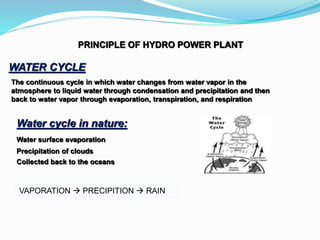
WATER CYCLE
Water cycle in nature:
Water surface evaporation
Precipitation of clouds
Collected back to the oceans
VAPORATION  PRECIPITION  RAIN
The continuous cycle in which water changes from water vapor in the
atmosphere to liquid water through condensation and precipitation and then
back to water vapor through evaporation, transpiration, and respiration
COMPONENT AND WORKING OF HYDRO POWER PLANT
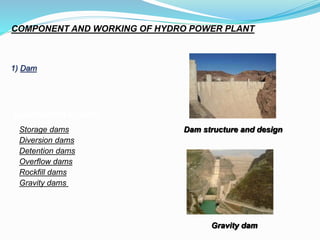
1) Dam
Classification of dams
Storage dams
Diversion dams
Detention dams
Overflow dams
Rockfill dams
Gravity dams
Gravity dam
Dam structure and design
Storage dams
To impound water
Purpose - Irrigation
- Flood control
- Power generation
Diversion dams
For diversion
To provide sufficient pressure
Detention dams
To Minimize the effect of sudden floods
To trap sediment
Overflow dams
They carry water discharge over their crests
Rockfill dams
Rock instead of earth
Embankment dams hold back water by the force of gravity acting upon
their mass
Gravity dams
Most gravity dams are made from concrete, a mixture of port land cement,
water, and aggregates
They are much thicker at the base than the top
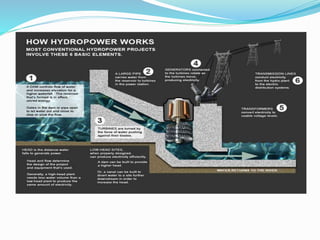
2) Water reservoir
Place behind the dam
Height of water
Potential energy
3) Intake or control gates
Gates inside of the dam.
Inlet gates
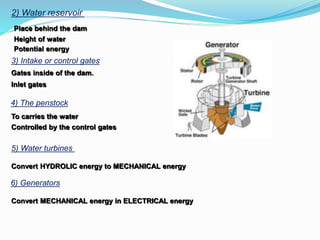
4) The penstock
To carries the water
Controlled by the control gates
5) Water turbines
Convert HYDROLIC energy to MECHANICAL energy
6) Generators
Convert MECHANICAL energy in ELECTRICAL energy
7) Transformer
Converts the alternating current to high voltage current.
Two coils: the supply coil and the outlet coil.
Voltage required for various applications is 110V or 230V.
Numbers of turns in outlet coil are double of supply coil, the voltage
produced is also double.
8) Tailrace
Pipeline to drain the water
The potential energy of water in the tailrace has been used to generate
electricity
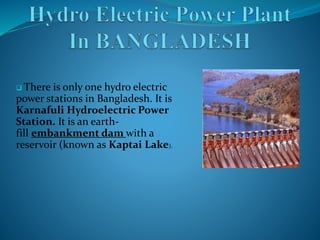
 There is only one hydro electric
power stations in Bangladesh. It is
Karnafuli Hydroelectric Power
Station. It is an earth-
fill embankment dam with a
reservoir (known as Kaptai Lake).
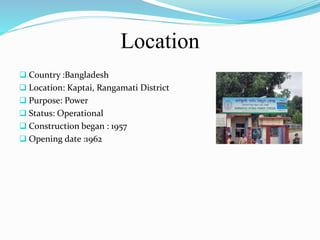
Location
 Country :Bangladesh
 Location: Kaptai, Rangamati District
 Purpose: Power
 Status: Operational
 Construction began : 1957
 Opening date :1962
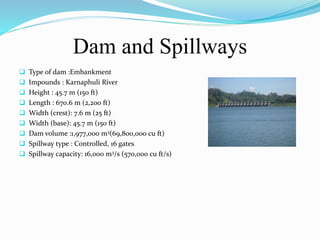
Dam and Spillways
 Type of dam :Embankment
 Impounds : Karnaphuli River
 Height : 45.7 m (150 ft)
 Length : 670.6 m (2,200 ft)
 Width (crest): 7.6 m (25 ft)
 Width (base): 45.7 m (150 ft)
 Dam volume :1,977,000 m3(69,800,000 cu ft)
 Spillway type : Controlled, 16 gates
 Spillway capacity: 16,000 m3/s (570,000 cu ft/s)
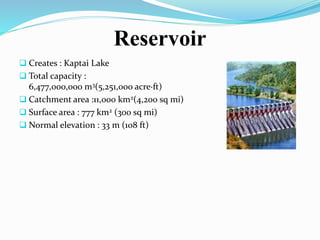
Reservoir
 Creates : Kaptai Lake
 Total capacity :
6,477,000,000 m3(5,251,000 acre·ft)
 Catchment area :11,000 km2(4,200 sq mi)
 Surface area : 777 km2 (300 sq mi)
 Normal elevation : 33 m (108 ft)
Power station
 Commission date : 1962, 1982, 1988
 Turbines : 2 x 40 MW (54,000 hp), 3 x 50 MW (67,000 hp) Kaplan-type
 Installed capacity : 230 MW (310,000 hp)
Advantages
 Flexibility
 Low cost/high value power
 Suitability for industrial applications
 Reduced CO2 emissions
 Other uses of the reservoir
Disadvantages
 Ecosystem damage and loss of land
 Water loss by evaporation
 Siltation and flow shortage
 Methane emissions (from reservoirs)
 Relocation
 Failure risks
THANK YOU

Hydro Electric Power Plant

  • 2.
    HYDRO POWER INTRODUCTION 1) Oneof the most widely used renewable source of energy for generating electricity on large scale basis is hydropower 2) The power obtained from river or ocean water is called as hydropower 3) Hydropower is the renewable source of energy since water is available in large quantities from rain, rivers, and oceans and this is will be available for unlimited time to come
  • 3.
    PRINCIPLE OF HYDROPOWER PLANT WATER CYCLE Water cycle in nature: Water surface evaporation Precipitation of clouds Collected back to the oceans VAPORATION  PRECIPITION  RAIN The continuous cycle in which water changes from water vapor in the atmosphere to liquid water through condensation and precipitation and then back to water vapor through evaporation, transpiration, and respiration
  • 4.
    COMPONENT AND WORKINGOF HYDRO POWER PLANT 1) Dam Classification of dams Storage dams Diversion dams Detention dams Overflow dams Rockfill dams Gravity dams Gravity dam Dam structure and design
  • 5.
    Storage dams To impoundwater Purpose - Irrigation - Flood control - Power generation Diversion dams For diversion To provide sufficient pressure Detention dams To Minimize the effect of sudden floods To trap sediment Overflow dams They carry water discharge over their crests Rockfill dams Rock instead of earth Embankment dams hold back water by the force of gravity acting upon their mass Gravity dams Most gravity dams are made from concrete, a mixture of port land cement, water, and aggregates They are much thicker at the base than the top
  • 6.
    2) Water reservoir Placebehind the dam Height of water Potential energy 3) Intake or control gates Gates inside of the dam. Inlet gates 4) The penstock To carries the water Controlled by the control gates 5) Water turbines Convert HYDROLIC energy to MECHANICAL energy 6) Generators Convert MECHANICAL energy in ELECTRICAL energy
  • 7.
    7) Transformer Converts thealternating current to high voltage current. Two coils: the supply coil and the outlet coil. Voltage required for various applications is 110V or 230V. Numbers of turns in outlet coil are double of supply coil, the voltage produced is also double. 8) Tailrace Pipeline to drain the water The potential energy of water in the tailrace has been used to generate electricity
  • 9.
     There isonly one hydro electric power stations in Bangladesh. It is Karnafuli Hydroelectric Power Station. It is an earth- fill embankment dam with a reservoir (known as Kaptai Lake).
  • 10.
    Location  Country :Bangladesh Location: Kaptai, Rangamati District  Purpose: Power  Status: Operational  Construction began : 1957  Opening date :1962
  • 11.
    Dam and Spillways Type of dam :Embankment  Impounds : Karnaphuli River  Height : 45.7 m (150 ft)  Length : 670.6 m (2,200 ft)  Width (crest): 7.6 m (25 ft)  Width (base): 45.7 m (150 ft)  Dam volume :1,977,000 m3(69,800,000 cu ft)  Spillway type : Controlled, 16 gates  Spillway capacity: 16,000 m3/s (570,000 cu ft/s)
  • 12.
    Reservoir  Creates :Kaptai Lake  Total capacity : 6,477,000,000 m3(5,251,000 acre·ft)  Catchment area :11,000 km2(4,200 sq mi)  Surface area : 777 km2 (300 sq mi)  Normal elevation : 33 m (108 ft)
  • 13.
    Power station  Commissiondate : 1962, 1982, 1988  Turbines : 2 x 40 MW (54,000 hp), 3 x 50 MW (67,000 hp) Kaplan-type  Installed capacity : 230 MW (310,000 hp)
  • 14.
    Advantages  Flexibility  Lowcost/high value power  Suitability for industrial applications  Reduced CO2 emissions  Other uses of the reservoir
  • 15.
    Disadvantages  Ecosystem damageand loss of land  Water loss by evaporation  Siltation and flow shortage  Methane emissions (from reservoirs)  Relocation  Failure risks
  • 16.