Leslie	
  S.	
  Wolfe,	
  Ph.D.	
  
Abhinav	
  A.	
  Shukla,	
  Ph.D.	
  
Process	
  Development	
  
KBI	
  Biopharma,	
  Durham,	
  NC	
  
• Background	
  
•  Mixed	
  Mode	
  Chromatography	
  
•  Mobile	
  Phase	
  Modulators	
  
• CharacterizaGon	
  of	
  Protein	
  Binding	
  	
  
•  Linear	
  salt	
  gradient	
  eluGon	
  studies	
  
•  log	
  k 	
  vs.	
  log	
  salt	
  concentraGon	
  plots	
  
• Enhancing	
  purificaGon	
  through	
  modulator	
  washes	
  
•  During	
  Capture	
  step	
  
•  During	
  Polishing	
  step	
  
•  Process	
  impact	
  
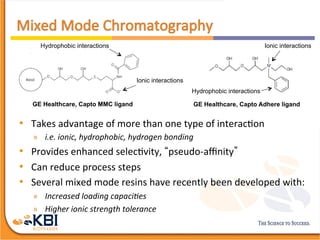
•  Takes	
  advantage	
  of	
  more	
  than	
  one	
  type	
  of	
  interacGon	
  	
  
»  i.e.	
  ionic,	
  hydrophobic,	
  hydrogen	
  bonding	
  
•  Provides	
  enhanced	
  selecGvity,	
   pseudo-­‐affinity 	
  
•  Can	
  reduce	
  process	
  steps	
  
•  Several	
  mixed	
  mode	
  resins	
  have	
  recently	
  been	
  developed	
  with:	
  
»  Increased	
  loading	
  capaci4es	
  
»  Higher	
  ionic	
  strength	
  tolerance	
  
GE Healthcare, Capto MMC ligand
Ionic interactions
Hydrophobic interactions
GE Healthcare, Capto Adhere ligand
Ionic interactions
•  Mobile	
  phase	
  modulators:	
  addiGves	
  incorporated	
  into	
  process	
  buffers	
  to	
  
alter	
  protein-­‐ligand	
  interacGons	
  
•  Modulators	
  can	
  enhance	
  resin	
  selecGvity	
  and	
  eluate	
  purity	
  when	
  
incorporated	
  into	
  load,	
  wash	
  and/or	
  eluGon	
  process	
  steps	
  
•  AddiGon	
  of	
  a	
  combinaGon	
  of	
  modulators	
  can	
  further	
  improve	
  selecGvity	
  
Modulator	
   Modulator	
  Effect	
  
MgCl2,	
  NaSCN,	
  KI	
   Decrease	
  hydrophobic	
  interacGons	
  
Ethanol,	
  Methanol,	
  Isopropanol	
   Decrease	
  hydrophobic	
  interacGons	
  (used	
  in	
  low	
  concentraGons)	
  
Urea	
   Weakens	
  hydrogen	
  bonding,	
  denaturant	
  
Glycerol	
   Weakens	
  hydrophobic	
  interacGons	
  
Ethylene	
  Glycol	
   Weakens	
  hydrophobic	
  interacGons	
  and	
  hydrogen	
  bonding	
  
Arginine	
  
	
  Weakens	
  hydrophobic	
  interacGons,	
  induces	
  protein	
  unfolding,	
  
disrupts	
  electrostaGc	
  interacGons	
  
Ammonium	
  Sulfate	
   	
  Strengthens	
  hydrophobic	
  interacGons	
  
• Background	
  
•  Mixed	
  Mode	
  Chromatography	
  
•  Mobile	
  Phase	
  Modulators	
  
• Characteriza2on	
  of	
  Protein	
  Binding	
  	
  
•  Linear	
  salt	
  gradient	
  elu2on	
  studies	
  
•  log	
  k 	
  vs.	
  log	
  salt	
  concentraGon	
  plots	
  
• Enhancing	
  purificaGon	
  through	
  modulator	
  washes	
  
•  During	
  Capture	
  step	
  
•  During	
  Polishing	
  step	
  
•  Process	
  impact	
  
•  Resin:	
  Capto	
  MMC	
  
•  Modulator	
  added	
  to	
  equilibraGon,	
  wash	
  and	
  eluGon	
  buffers	
  
•  Products	
  eluted	
  with	
  a	
  linear	
  NaCl	
  gradient	
  
•  Model	
  proteins:	
  
•  RNase	
  (pI	
  8.9)	
  
•  Lysozyme	
  (pI	
  9.6)	
  
•  mAb1	
  
•  mAb2	
  
•  mAb3	
  
•  mAb4	


•  Mobile	
  phase	
  modifiers:	
  
•  Ethylene	
  glycol	
  
•  Urea	
  
•  Arginine	
  
•  Sodium	
  Thiocyanate	
  
•  Ammonium	
  sulfate	


357 312
221 249 202
0
No
modulator
5% ethylene
glycol
50mM
arginine
50mM
sodium
thiocyanate
1M urea 1M
ammonium
sulfate
Elution[NaCl](mM)
RNase
2,217 1,862 1,766 1,981
1,248
2,500
No
modulator
5% ethylene
glycol
50mM
arginine
50mM
sodium
thiocyanate
1M urea 1M
ammonium
sulfate
Elution[NaCl](mM)
Lysozyme
∞
1,482 1,602
847 962 916
1,800
No
modulator
5% ethylene
glycol
50mM
arginine
50mM
sodium
thiocyanate
1M urea 1M
ammonium
sulfate
Elution[NaCl](mM)
mAb4
∞
300 296
198 136
235
400
No
modulator
5% ethylene
glycol
50mM
arginine
50mM
sodium
thiocyanate
1M urea 1M
ammonium
sulfate
Elution[NaCl](mM)
mAb3
∞
314 304
209
132
237
400
No
modulator
5% ethylene
glycol
50mM
arginine
50mM
sodium
thiocyanate
1M urea 1M
ammonium
sulfate
Elution[NaCl](mM)
mAb2
∞
1,219 1,145 824 795 809
2,500
No
modulator
5% ethylene
glycol
50mM
arginine
50mM
sodium
thiocyanate
1M urea 1M
ammonium
sulfate
Elution[NaCl](mM)
mAb1
∞
∞ = target protein did not elute during NaCl gradient
•  AnGbodies	
  behave	
  differently	
  
•  In	
  absence	
  of	
  modulator	
  
»  mAb2,	
  mAb3	
  –	
  low	
  salt	
  (~300mM)	
  
»  mAb1,	
  mAb4	
  –	
  high	
  salt	
  (~1.5M)	
  
•  Modulator	
  with	
  largest	
  effect	
  
»  mAb1,	
  mAb2,	
  mAb3	
  –	
  sodium	
  thiocyanate	
  
»  mAb4	
  –	
  arginine	
  	
  
•  Lysozyme	
  requires	
  highest	
  NaCl	
  for	
  eluGon	
  
•  RNase	
  does	
  not	
  bind	
  in	
  the	
  presence	
  of	
  1M	
  (NH4)2SO4	
  
•  All	
  other	
  proteins	
  tested	
  irreversibly	
  bind	
  in	
  1M	
  (NH4)2SO4	
  
•  As	
  pH	
  approaches	
  pI,	
  retenGon	
  decreases	
  
•  Lysozyme	
  does	
  not	
  elute	
  in	
  absence	
  of	
  modulator	
  at	
  pH	
  6.0	
  
•  AnGbodies	
  behave	
  more	
  similarly	
  as	
  pH	
  approaches	
  pI	
  
• Background	
  
•  Mixed	
  Mode	
  Chromatography	
  
•  Mobile	
  Phase	
  Modulators	
  
• Characteriza2on	
  of	
  Protein	
  Binding	
  	
  
•  Linear	
  salt	
  gradient	
  eluGon	
  studies	
  
•  log	
  k 	
  vs.	
  log	
  salt	
  concentra2on	
  plots	
  
• Enhancing	
  purificaGon	
  through	
  modulator	
  washes	
  
•  During	
  Capture	
  step	
  
•  During	
  Polishing	
  step	
  
•  Process	
  impact	
  
•  Protein	
  retenGon	
  under	
  linear	
  loading	
  condiGons	
  is	
  dependent	
  on	
  the	
  
thermodynamics	
  of	
  the	
  interacGon	
  between	
  the	
  protein	
  and	
  the	
  staGonary	
  
phase	
  
log K = (- ΔG°es / 2.3RT) + (-ΔG°hΦ / 2.3RT)
∆Ges = Gibbs free energies for retention by electrostatic interactions
∆GhΦ = Gibbs free energies for retention by hydrophobic interactions
T = the absolute temperature
R = the universal gas constant
k’ = ΦK
Retention factor (k’) relates to K by,
where Φ is the ratio of stationary and mobile phase volumes
•  This	
  relaGonship	
  was	
  further	
  described	
  by	
  Melander	
  et.	
  al	
  to	
  describe	
  the	
  
dependency	
  of	
  the	
  linear	
  retenGon	
  factor	
  on	
  a	
  mixed	
  mode	
  sorbent	
  as	
  a	
  
funcGon	
  of	
  salt	
  concentraGon	
  as:	
  
log k’ = A – Blog(csalt) + C(csalt)
where csalt is the mobile phase salt concentration in molar units and A, B and C are constants
The	
  retenGon	
  factor	
  under	
  isocraGc	
  condiGons	
  is	
  represented	
  by:	
  
k’ = tr – tm /tm	
  
tm	
  =	
  Gme	
  for	
  mobile	
  phase	
  to	
  pass	
  through	
  column	
  
tr	
  =	
  target	
  protein	
  retenGon	
  Gme	


Melander, W.; El Rassi, Z.; Horvath, Cs. Journal of Chromatography, 469, 3-27, 1989.
•  This	
  relaGonship	
  was	
  further	
  described	
  by	
  Melander	
  et.	
  al	
  to	
  describe	
  the	
  
dependency	
  of	
  the	
  linear	
  retenGon	
  factor	
  on	
  a	
  mixed	
  mode	
  sorbent	
  as	
  a	
  
funcGon	
  of	
  salt	
  concentraGon	
  as:	
  
log k’ = A – Blog(csalt) + C(csalt)
where csalt is the mobile phase salt concentration in molar units and A, B and C are constants
The	
  retenGon	
  factor	
  under	
  isocraGc	
  condiGons	
  is	
  represented	
  by:	
  
k’ = tr – tm /tm	
  
tm	
  =	
  Gme	
  for	
  mobile	
  phase	
  to	
  pass	
  through	
  column	
  
tr	
  =	
  target	
  retenGon	
  Gme	


Melander, W.; El Rassi, Z.; Horvath, Cs. Journal of Chromatography, 469, 3-27, 1989.
•  ElectrostaGc	
  interacGons	
  predominate:	
  a	
  linear	
  relaGonship	
  is	
  
expected	
  between	
  log	
  k’ vs	
  log[NaCl]	
  
•  Hydrophobic	
  interacGons	
  predominate:	
  a	
  linear	
  relaGonship	
  is	
  
expected	
  unGl	
  a	
  minimum	
  is	
  reached	
  at	
  which	
  point	
  further	
  
increases	
  in	
  salt	
  result	
  in	
  increased	
  retenGon	
  
•  RetenGon	
  factors	
  (k )	
  were	
  determined	
  for	
  	
  
»  mAb1	
  
»  RNase	
  
»  Lysozyme	
  
•  Mobile	
  phase	
  modulators	
  tested	
  
»  No	
  modulator	
  
»  1M	
  Urea	
  
»  50mM	
  Arginine	
  
»  5%	
  Ethylene	
  Glycol	
  
•  RNase
»  electrostatic interactions
»  No effect from urea or ethylene glycol
•  Lysozyme
»  hydrophobic and electrostatic interactions
»  urea has largest effect
•  mAb1
»  driven by electrostatic interactions, hydrophobic contribution
»  Urea and arginine have the largest effect
	
  
-0.20
0.00
0.20
0.40
0.60
0.80
1.00
1.20
1.40
2.10 2.30 2.50 2.70
Logk'
Log [NaCl]
mAb1
All experiments performed at pH 7.0
-0.40
-0.20
0.00
0.20
0.40
0.60
0.80
1.00
1.20
1.40
1.60
1.50 2.00 2.50
Logk'
Log [NaCl]
RNase
0.00
0.20
0.40
0.60
0.80
1.00
1.20
1.40
2.60 3.10 3.60Logk'
Log [NaCl]
Lysozyme
¿ baseline
˜ 1M urea
¢ 5% ethylene glycol
p 50mM arginine
• Background	
  
•  Mixed	
  Mode	
  Chromatography	
  
•  Mobile	
  Phase	
  Modulators	
  
• CharacterizaGon	
  of	
  Protein	
  Binding	
  	
  
•  Linear	
  salt	
  gradient	
  eluGon	
  studies	
  
•  log	
  k 	
  vs.	
  log	
  salt	
  concentraGon	
  plots	
  
• Enhancing	
  purifica2on	
  through	
  modulator	
  washes	
  
•  During	
  Capture	
  step	
  
•  During	
  Polishing	
  step	
  
•  Process	
  impact	
  
• IncorporaGon	
  of	
  modulators	
  into	
  process	
  can	
  help	
  
increase	
  selecGvity	
  and	
  purity	
  of	
  product	
  
• CombinaGons	
  of	
  modulators	
  can	
  further	
  enhance	
  
process	
  step	
  
• Goal:	
  UGlize	
  mobile	
  phase	
  modulators	
  to	
  decrease	
  
HCP	
  levels	
  during	
  Capto	
  MMC	
  process	
  step	
  for	
  
anGbody	
  purificaGon	
  
•  Case	
  Study:	
  	
  
»  Target	
  molecule:	
  E.	
  coli	
  derived	
  
recombinant	
  protein	
  
»  Process	
  step:	
  Phenyl	
  Sepharose	
  FF	
  
»  Ini4al	
  product	
  yield:	
  88.8%	


»  Result:	
  	
  
Individual	
  modulators	
  showed	
  some	
  
selecGvity	
  enhancement	
  but	
  also	
  
product	
  loss	
  
A	
  combinaGon	
  of	
  urea,	
  sodium	
  thiocyanate	
  
and	
  glycerol	
  in	
  the	
  wash	
  step	
  increased	
  
product	
  purity	
  to	
  >95%	
  
Shukla AA, et al., 2002. Biotechnol Prog 18: 556–564.
• Background	
  
•  Mixed	
  Mode	
  Chromatography	
  
•  Mobile	
  Phase	
  Modulators	
  
• CharacterizaGon	
  of	
  Protein	
  Binding	
  	
  
•  Linear	
  salt	
  gradient	
  eluGon	
  studies	
  
•  log	
  k 	
  vs.	
  log	
  salt	
  concentraGon	
  plots	
  
• Enhancing	
  purifica2on	
  through	
  modulator	
  washes	
  
•  During	
  Capture	
  step	
  
•  During	
  Polishing	
  step	
  
•  Process	
  impact	
  
0.50	
  
0.70	
  
0.90	
  
1.10	
  
1.30	
  
1.50	
  
0.0%	
   10.0%	
   20.0%	
   30.0%	
   40.0%	
   50.0%	
   60.0%	
   70.0%	
   80.0%	
   90.0%	
   100.0%	
  
Normalized	
  HCP	
  
Recovery	
  
HCP	
  vs.	
  Recovery	
  aFer	
  Intermediate	
  Wash	
  for	
  Capto	
  MMC	
  Capture	
  
baseline
• Background	
  
•  Mixed	
  Mode	
  Chromatography	
  
•  Mobile	
  Phase	
  Modulators	
  
• CharacterizaGon	
  of	
  Protein	
  Binding	
  	
  
•  Linear	
  salt	
  gradient	
  eluGon	
  studies	
  
•  log	
  k 	
  vs.	
  log	
  salt	
  concentraGon	
  plots	
  
• Enhancing	
  purifica2on	
  through	
  modulator	
  washes	
  
•  During	
  Capture	
  step	
  
•  During	
  Polishing	
  step	
  
•  Process	
  impact	
  
0.40	
  
0.50	
  
0.60	
  
0.70	
  
0.80	
  
0.90	
  
1.00	
  
1.10	
  
0.0%	
   10.0%	
   20.0%	
   30.0%	
   40.0%	
   50.0%	
   60.0%	
   70.0%	
   80.0%	
   90.0%	
   100.0%	
  
Normalized	
  HCP	
  
Recovery	
  
HCP	
  vs.	
  Recovery	
  aFer	
  Intermediate	
  Wash	
  for	
  Capto	
  MMC	
  Polishing	
  
baseline
• Background	
  
•  Mixed	
  Mode	
  Chromatography	
  
•  Mobile	
  Phase	
  Modulators	
  
• CharacterizaGon	
  of	
  Protein	
  Binding	
  	
  
•  Linear	
  salt	
  gradient	
  eluGon	
  studies	
  
•  log	
  k 	
  vs.	
  log	
  salt	
  concentraGon	
  plots	
  
• Enhancing	
  purifica2on	
  through	
  modulator	
  washes	
  
•  During	
  Capture	
  step	
  
•  During	
  Polishing	
  step	
  
•  Process	
  impact	
  
•  Inclusion	
  of	
  an	
  intermediate	
  
wash	
  using	
  Tris,	
  0.1M	
  NaCl,	
  
50mM	
  arginine,	
  5%	
  ethylene	
  
glycol,	
  pH	
  7.0	
  resulted	
  in	
  2-­‐
fold	
  lower	
  HCP	
  levels	
  when	
  
compared	
  to	
  process	
  where	
  a	
  
modulator	
  was	
  not	
  uGlized	
  
•  In	
  depth	
  studies	
  have	
  afforded	
  us	
  an	
  understanding	
  of	
  how	
  
modulators	
  affect	
  different	
  molecules	
  
•  Despite	
  similar	
  class	
  of	
  molecules,	
  anGbodies	
  behave	
  differently	
  with	
  Capto	
  
MMC	
  ligand	
  
•  We	
  have	
  uGlized	
  mixed	
  mode	
  chromatography	
  to	
  improve	
  
product	
  purity	
  and	
  maintain	
  process	
  step	
  yield	
  
•  IncorporaGon	
  of	
  a	
  process	
  step	
  uGlizing	
  a	
  modulator	
  wash	


  can	
  
improve	
  overall	
  process	
  HCP	
  clearance	
  
•  At	
  KBI	
  Biopharma	
  we	
  have	
  developed	
  several	
  downstream	


  processes	
  
and	
  manufactured	
  biopharmaceuGcal	
  products	
  where	


modulator	
  washes	
  on	
  a	
  mixed	
  mode	
  resin	
  have	
  significantly	


contributed	
  to	
  process	
  HCP	
  clearance	
  
»  Effec4ve	
  for	
  both	
  molecules	
  derived	
  from	
  mammalian	
  and	
  microbial	


cell	
  culture	
  processes	
  
Pre-Clinical Phase I Phase II Phase III
FIH Process
•  Deliver clinical process
quickly
•  Platform process
•  Clinical Supply
Submission &
Approval
Lifecycle
management
Commercial Process
•  Deliver manufacturing process for
registrational trials and market
•  Design keeping large-scale manufacturing
in mind
•  Improve productivity, efficiency, robustness,
manufacturability, COGs
•  Analytical characterization and method
development
Process Characterization and Validation
•  Develop IPC strategy through understanding of process inputs and
outputs (design space)
•  Scale-down characterization and validation studies
•  Large-scale process validation to demonstrate process consistency
•  BLA preparation
•  Supporting documents for licensure inspections
•  Post-commercial process improvements (CI)
•  Post-commercial process monitoring
FIH process Commercial process
Gottschalk U., Konstantinov K., Shukla A. Nature Biotechnology, 30(6), 489-491, 2012
Process
Development
Process
Validation
Process Monitoring
&
Improvement
BLA
&
PAI
Manufacturing
for
Tox
Clinical
Manufacturing
Commercial
Process
Development
Process
Characterization
Protein: protein interactions
Protein:resininteractions
Modulator washes can augment protein:protein interactions
and/or protein:resin interactions
•  Mixed	
  mode	
  chromatography	
  is	
  advantageous	
  because	
  of	
  
its	
  increased	
  selecGvity	
  by	
  exploiGng	
  mulGple	
  chemical	
  
properGes	
  of	
  target	
  protein	
  
•  Abhinav	
  Shukla,	
  Ph.D.	
  
•  Sigma	
  Mostafa,	
  Ph.D.	
  
•  Cartney	
  Barringer	
  
•  KBI	
  Process	
  Development	
  Team	
  
Work available online ahead of print in Journal of Chromatography A
Wolfe, et al., J. Chromatogr. A (2014), http://dx.doi.org/10.1016/j.chroma.2014.02.086

Multimodal Chromatography

  • 1.
    Leslie  S.  Wolfe,  Ph.D.   Abhinav  A.  Shukla,  Ph.D.   Process  Development   KBI  Biopharma,  Durham,  NC  
  • 2.
    • Background   •  Mixed  Mode  Chromatography   •  Mobile  Phase  Modulators   • CharacterizaGon  of  Protein  Binding     •  Linear  salt  gradient  eluGon  studies   •  log  k  vs.  log  salt  concentraGon  plots   • Enhancing  purificaGon  through  modulator  washes   •  During  Capture  step   •  During  Polishing  step   •  Process  impact  
  • 3.
    •  Takes  advantage  of  more  than  one  type  of  interacGon     »  i.e.  ionic,  hydrophobic,  hydrogen  bonding   •  Provides  enhanced  selecGvity,   pseudo-­‐affinity   •  Can  reduce  process  steps   •  Several  mixed  mode  resins  have  recently  been  developed  with:   »  Increased  loading  capaci4es   »  Higher  ionic  strength  tolerance   GE Healthcare, Capto MMC ligand Ionic interactions Hydrophobic interactions Hydrophobic interactions GE Healthcare, Capto Adhere ligand Ionic interactions
  • 4.
    •  Mobile  phase  modulators:  addiGves  incorporated  into  process  buffers  to   alter  protein-­‐ligand  interacGons   •  Modulators  can  enhance  resin  selecGvity  and  eluate  purity  when   incorporated  into  load,  wash  and/or  eluGon  process  steps   •  AddiGon  of  a  combinaGon  of  modulators  can  further  improve  selecGvity   Modulator   Modulator  Effect   MgCl2,  NaSCN,  KI   Decrease  hydrophobic  interacGons   Ethanol,  Methanol,  Isopropanol   Decrease  hydrophobic  interacGons  (used  in  low  concentraGons)   Urea   Weakens  hydrogen  bonding,  denaturant   Glycerol   Weakens  hydrophobic  interacGons   Ethylene  Glycol   Weakens  hydrophobic  interacGons  and  hydrogen  bonding   Arginine    Weakens  hydrophobic  interacGons,  induces  protein  unfolding,   disrupts  electrostaGc  interacGons   Ammonium  Sulfate    Strengthens  hydrophobic  interacGons  
  • 5.
    • Background   •  Mixed  Mode  Chromatography   •  Mobile  Phase  Modulators   • Characteriza2on  of  Protein  Binding     •  Linear  salt  gradient  elu2on  studies   •  log  k  vs.  log  salt  concentraGon  plots   • Enhancing  purificaGon  through  modulator  washes   •  During  Capture  step   •  During  Polishing  step   •  Process  impact  
  • 6.
    •  Resin:  Capto  MMC   •  Modulator  added  to  equilibraGon,  wash  and  eluGon  buffers   •  Products  eluted  with  a  linear  NaCl  gradient   •  Model  proteins:   •  RNase  (pI  8.9)   •  Lysozyme  (pI  9.6)   •  mAb1   •  mAb2   •  mAb3   •  mAb4         •  Mobile  phase  modifiers:   •  Ethylene  glycol   •  Urea   •  Arginine   •  Sodium  Thiocyanate   •  Ammonium  sulfate    
  • 7.
    357 312 221 249202 0 No modulator 5% ethylene glycol 50mM arginine 50mM sodium thiocyanate 1M urea 1M ammonium sulfate Elution[NaCl](mM) RNase 2,217 1,862 1,766 1,981 1,248 2,500 No modulator 5% ethylene glycol 50mM arginine 50mM sodium thiocyanate 1M urea 1M ammonium sulfate Elution[NaCl](mM) Lysozyme ∞ 1,482 1,602 847 962 916 1,800 No modulator 5% ethylene glycol 50mM arginine 50mM sodium thiocyanate 1M urea 1M ammonium sulfate Elution[NaCl](mM) mAb4 ∞ 300 296 198 136 235 400 No modulator 5% ethylene glycol 50mM arginine 50mM sodium thiocyanate 1M urea 1M ammonium sulfate Elution[NaCl](mM) mAb3 ∞ 314 304 209 132 237 400 No modulator 5% ethylene glycol 50mM arginine 50mM sodium thiocyanate 1M urea 1M ammonium sulfate Elution[NaCl](mM) mAb2 ∞ 1,219 1,145 824 795 809 2,500 No modulator 5% ethylene glycol 50mM arginine 50mM sodium thiocyanate 1M urea 1M ammonium sulfate Elution[NaCl](mM) mAb1 ∞ ∞ = target protein did not elute during NaCl gradient
  • 8.
    •  AnGbodies  behave  differently   •  In  absence  of  modulator   »  mAb2,  mAb3  –  low  salt  (~300mM)   »  mAb1,  mAb4  –  high  salt  (~1.5M)   •  Modulator  with  largest  effect   »  mAb1,  mAb2,  mAb3  –  sodium  thiocyanate   »  mAb4  –  arginine     •  Lysozyme  requires  highest  NaCl  for  eluGon   •  RNase  does  not  bind  in  the  presence  of  1M  (NH4)2SO4   •  All  other  proteins  tested  irreversibly  bind  in  1M  (NH4)2SO4  
  • 10.
    •  As  pH  approaches  pI,  retenGon  decreases   •  Lysozyme  does  not  elute  in  absence  of  modulator  at  pH  6.0   •  AnGbodies  behave  more  similarly  as  pH  approaches  pI  
  • 11.
    • Background   •  Mixed  Mode  Chromatography   •  Mobile  Phase  Modulators   • Characteriza2on  of  Protein  Binding     •  Linear  salt  gradient  eluGon  studies   •  log  k  vs.  log  salt  concentra2on  plots   • Enhancing  purificaGon  through  modulator  washes   •  During  Capture  step   •  During  Polishing  step   •  Process  impact  
  • 12.
    •  Protein  retenGon  under  linear  loading  condiGons  is  dependent  on  the   thermodynamics  of  the  interacGon  between  the  protein  and  the  staGonary   phase   log K = (- ΔG°es / 2.3RT) + (-ΔG°hΦ / 2.3RT) ∆Ges = Gibbs free energies for retention by electrostatic interactions ∆GhΦ = Gibbs free energies for retention by hydrophobic interactions T = the absolute temperature R = the universal gas constant k’ = ΦK Retention factor (k’) relates to K by, where Φ is the ratio of stationary and mobile phase volumes
  • 13.
    •  This  relaGonship  was  further  described  by  Melander  et.  al  to  describe  the   dependency  of  the  linear  retenGon  factor  on  a  mixed  mode  sorbent  as  a   funcGon  of  salt  concentraGon  as:   log k’ = A – Blog(csalt) + C(csalt) where csalt is the mobile phase salt concentration in molar units and A, B and C are constants The  retenGon  factor  under  isocraGc  condiGons  is  represented  by:   k’ = tr – tm /tm   tm  =  Gme  for  mobile  phase  to  pass  through  column   tr  =  target  protein  retenGon  Gme     Melander, W.; El Rassi, Z.; Horvath, Cs. Journal of Chromatography, 469, 3-27, 1989.
  • 14.
    •  This  relaGonship  was  further  described  by  Melander  et.  al  to  describe  the   dependency  of  the  linear  retenGon  factor  on  a  mixed  mode  sorbent  as  a   funcGon  of  salt  concentraGon  as:   log k’ = A – Blog(csalt) + C(csalt) where csalt is the mobile phase salt concentration in molar units and A, B and C are constants The  retenGon  factor  under  isocraGc  condiGons  is  represented  by:   k’ = tr – tm /tm   tm  =  Gme  for  mobile  phase  to  pass  through  column   tr  =  target  retenGon  Gme     Melander, W.; El Rassi, Z.; Horvath, Cs. Journal of Chromatography, 469, 3-27, 1989. •  ElectrostaGc  interacGons  predominate:  a  linear  relaGonship  is   expected  between  log  k’ vs  log[NaCl]   •  Hydrophobic  interacGons  predominate:  a  linear  relaGonship  is   expected  unGl  a  minimum  is  reached  at  which  point  further   increases  in  salt  result  in  increased  retenGon  
  • 15.
    •  RetenGon  factors  (k )  were  determined  for     »  mAb1   »  RNase   »  Lysozyme   •  Mobile  phase  modulators  tested   »  No  modulator   »  1M  Urea   »  50mM  Arginine   »  5%  Ethylene  Glycol  
  • 16.
    •  RNase »  electrostaticinteractions »  No effect from urea or ethylene glycol •  Lysozyme »  hydrophobic and electrostatic interactions »  urea has largest effect •  mAb1 »  driven by electrostatic interactions, hydrophobic contribution »  Urea and arginine have the largest effect   -0.20 0.00 0.20 0.40 0.60 0.80 1.00 1.20 1.40 2.10 2.30 2.50 2.70 Logk' Log [NaCl] mAb1 All experiments performed at pH 7.0 -0.40 -0.20 0.00 0.20 0.40 0.60 0.80 1.00 1.20 1.40 1.60 1.50 2.00 2.50 Logk' Log [NaCl] RNase 0.00 0.20 0.40 0.60 0.80 1.00 1.20 1.40 2.60 3.10 3.60Logk' Log [NaCl] Lysozyme ¿ baseline ˜ 1M urea ¢ 5% ethylene glycol p 50mM arginine
  • 17.
    • Background   •  Mixed  Mode  Chromatography   •  Mobile  Phase  Modulators   • CharacterizaGon  of  Protein  Binding     •  Linear  salt  gradient  eluGon  studies   •  log  k  vs.  log  salt  concentraGon  plots   • Enhancing  purifica2on  through  modulator  washes   •  During  Capture  step   •  During  Polishing  step   •  Process  impact  
  • 18.
    • IncorporaGon  of  modulators  into  process  can  help   increase  selecGvity  and  purity  of  product   • CombinaGons  of  modulators  can  further  enhance   process  step   • Goal:  UGlize  mobile  phase  modulators  to  decrease   HCP  levels  during  Capto  MMC  process  step  for   anGbody  purificaGon  
  • 19.
    •  Case  Study:     »  Target  molecule:  E.  coli  derived   recombinant  protein   »  Process  step:  Phenyl  Sepharose  FF   »  Ini4al  product  yield:  88.8%     »  Result:     Individual  modulators  showed  some   selecGvity  enhancement  but  also   product  loss   A  combinaGon  of  urea,  sodium  thiocyanate   and  glycerol  in  the  wash  step  increased   product  purity  to  >95%   Shukla AA, et al., 2002. Biotechnol Prog 18: 556–564.
  • 20.
    • Background   •  Mixed  Mode  Chromatography   •  Mobile  Phase  Modulators   • CharacterizaGon  of  Protein  Binding     •  Linear  salt  gradient  eluGon  studies   •  log  k  vs.  log  salt  concentraGon  plots   • Enhancing  purifica2on  through  modulator  washes   •  During  Capture  step   •  During  Polishing  step   •  Process  impact  
  • 21.
    0.50   0.70   0.90   1.10   1.30   1.50   0.0%   10.0%   20.0%   30.0%   40.0%   50.0%   60.0%   70.0%   80.0%   90.0%   100.0%   Normalized  HCP   Recovery   HCP  vs.  Recovery  aFer  Intermediate  Wash  for  Capto  MMC  Capture   baseline
  • 22.
    • Background   •  Mixed  Mode  Chromatography   •  Mobile  Phase  Modulators   • CharacterizaGon  of  Protein  Binding     •  Linear  salt  gradient  eluGon  studies   •  log  k  vs.  log  salt  concentraGon  plots   • Enhancing  purifica2on  through  modulator  washes   •  During  Capture  step   •  During  Polishing  step   •  Process  impact  
  • 23.
    0.40   0.50   0.60   0.70   0.80   0.90   1.00   1.10   0.0%   10.0%   20.0%   30.0%   40.0%   50.0%   60.0%   70.0%   80.0%   90.0%   100.0%   Normalized  HCP   Recovery   HCP  vs.  Recovery  aFer  Intermediate  Wash  for  Capto  MMC  Polishing   baseline
  • 24.
    • Background   •  Mixed  Mode  Chromatography   •  Mobile  Phase  Modulators   • CharacterizaGon  of  Protein  Binding     •  Linear  salt  gradient  eluGon  studies   •  log  k  vs.  log  salt  concentraGon  plots   • Enhancing  purifica2on  through  modulator  washes   •  During  Capture  step   •  During  Polishing  step   •  Process  impact  
  • 25.
    •  Inclusion  of  an  intermediate   wash  using  Tris,  0.1M  NaCl,   50mM  arginine,  5%  ethylene   glycol,  pH  7.0  resulted  in  2-­‐ fold  lower  HCP  levels  when   compared  to  process  where  a   modulator  was  not  uGlized  
  • 26.
    •  In  depth  studies  have  afforded  us  an  understanding  of  how   modulators  affect  different  molecules   •  Despite  similar  class  of  molecules,  anGbodies  behave  differently  with  Capto   MMC  ligand   •  We  have  uGlized  mixed  mode  chromatography  to  improve   product  purity  and  maintain  process  step  yield   •  IncorporaGon  of  a  process  step  uGlizing  a  modulator  wash                                                          can   improve  overall  process  HCP  clearance   •  At  KBI  Biopharma  we  have  developed  several  downstream                        processes   and  manufactured  biopharmaceuGcal  products  where                                                       modulator  washes  on  a  mixed  mode  resin  have  significantly                               contributed  to  process  HCP  clearance   »  Effec4ve  for  both  molecules  derived  from  mammalian  and  microbial                                                               cell  culture  processes  
  • 27.
    Pre-Clinical Phase IPhase II Phase III FIH Process •  Deliver clinical process quickly •  Platform process •  Clinical Supply Submission & Approval Lifecycle management Commercial Process •  Deliver manufacturing process for registrational trials and market •  Design keeping large-scale manufacturing in mind •  Improve productivity, efficiency, robustness, manufacturability, COGs •  Analytical characterization and method development Process Characterization and Validation •  Develop IPC strategy through understanding of process inputs and outputs (design space) •  Scale-down characterization and validation studies •  Large-scale process validation to demonstrate process consistency •  BLA preparation •  Supporting documents for licensure inspections •  Post-commercial process improvements (CI) •  Post-commercial process monitoring FIH process Commercial process Gottschalk U., Konstantinov K., Shukla A. Nature Biotechnology, 30(6), 489-491, 2012 Process Development Process Validation Process Monitoring & Improvement BLA & PAI Manufacturing for Tox Clinical Manufacturing Commercial Process Development Process Characterization
  • 28.
    Protein: protein interactions Protein:resininteractions Modulatorwashes can augment protein:protein interactions and/or protein:resin interactions •  Mixed  mode  chromatography  is  advantageous  because  of   its  increased  selecGvity  by  exploiGng  mulGple  chemical   properGes  of  target  protein  
  • 29.
    •  Abhinav  Shukla,  Ph.D.   •  Sigma  Mostafa,  Ph.D.   •  Cartney  Barringer   •  KBI  Process  Development  Team   Work available online ahead of print in Journal of Chromatography A Wolfe, et al., J. Chromatogr. A (2014), http://dx.doi.org/10.1016/j.chroma.2014.02.086