Confidential
Speed to GMP:
Moving from Rapid Process
Development to High
Throughput Tech Transfer
Niket Bubna
Presented at
257th ACS National Meeting 2019
Orlando, FL
2
Confidential
Who We Are
Background
How we Tech Transfer?
Tech Transfer Case Studies
Conclusions
Outline
Confidential
4
Who We Are
• Analytical & Formulation Services, Microbial, Mammalian & Cell Therapy CDMO
• CDMO services first offered in 2004
• Acquired by JSR Corp in 2015
• Highly experienced Executive & Management Teams
• Excellent Track Record & Client Satisfaction
KBI Biopharma’s mission is to accelerate the development of innovative discoveries into life-
changing biological products & expand global access of medicines to patients in need
Confidential
5
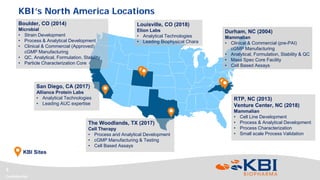
Durham, NC (2004)
Mammalian
• Clinical & Commercial (pre-PAI)
cGMP Manufacturing
• Analytical, Formulation, Stability & QC
• Mass Spec Core Facility
• Cell Based Assays
Boulder, CO (2014)
Microbial
• Strain Development
• Process & Analytical Development
• Clinical & Commercial (Approved)
cGMP Manufacturing
• QC, Analytical, Formulation, Stability
• Particle Characterization Core
RTP, NC (2013)
Venture Center, NC (2018)
Mammalian
• Cell Line Development
• Process & Analytical Development
• Process Characterization
• Small scale Process Validation
The Woodlands, TX (2017)
Cell Therapy
• Process and Analytical Development
• cGMP Manufacturing & Testing
• Cell Based Assays
San Diego, CA (2017)
Alliance Protein Labs
• Analytical Technologies
• Leading AUC expertise
KBI Sites
KBI’s North America Locations
March 2018
Louisville, CO (2018)
Elion Labs
• Analytical Technologies
• Leading Biophysical Chara
Confidential
6
SelexisKBI
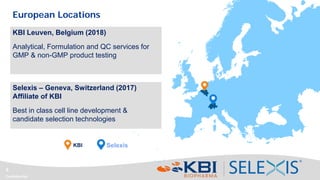
Selexis – Geneva, Switzerland (2017)
Affiliate of KBI
Best in class cell line development &
candidate selection technologies
KBI Leuven, Belgium (2018)
Analytical, Formulation and QC services for
GMP & non-GMP product testing
European Locations
Confidential
7
Rapid process development and manufacturing approach for faster IND
submission is often being used for biologics
• What role does KBI play in enabling faster delivery of products to the clinic?
• What strategies are employed for rapid process development?
• Can manufacturing readiness be accelerated?
Speed to GMP/IND
Confidential
8
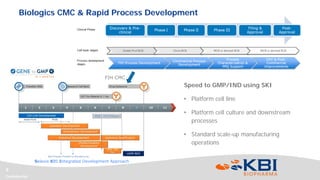
Biologics CMC & Rapid Process Development
FIH CMC
Speed to GMP/IND using SKI
• Platform cell line
• Platform cell culture and downstream
processes
• Standard scale-up manufacturing
operations
Selexis KBI Integrated Development Approach
Confidential
9
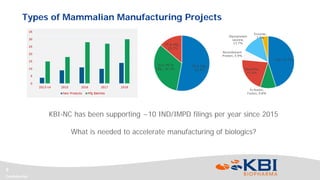
KBI-NC has been supporting ~10 IND/IMPD filings per year since 2015
What is needed to accelerate manufacturing of biologics?
Types of Mammalian Manufacturing Projects
mAb, 45.1%
Fc-fusion,
Fusion, 9.8%
Bispecific,
21.6%
Recombinant
Protein, 5.9%
Glycoprotein
vaccine,
13.7%
Enzyme,
3.9%
Confidential
10
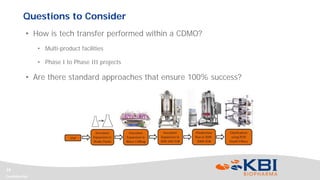
Questions to Consider
• How is tech transfer performed within a CDMO?
• Multi-product facilities
• Phase I to Phase III projects
• Are there standard approaches that ensure 100% success?
Confidential
11
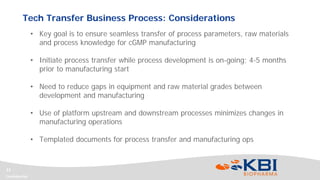
• Key goal is to ensure seamless transfer of process parameters, raw materials
and process knowledge for cGMP manufacturing
• Initiate process transfer while process development is on-going; 4-5 months
prior to manufacturing start
• Need to reduce gaps in equipment and raw material grades between
development and manufacturing
• Use of platform upstream and downstream processes minimizes changes in
manufacturing operations
• Templated documents for process transfer and manufacturing ops
Tech Transfer Business Process: Considerations
Confidential
12
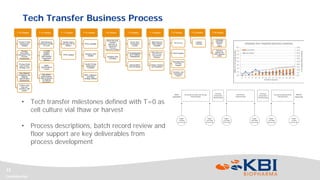
• Tech transfer milestones defined with T=0 as
cell culture vial thaw or harvest
• Process descriptions, batch record review and
floor support are key deliverables from
process development
Tech Transfer Business Process
Confidential
13
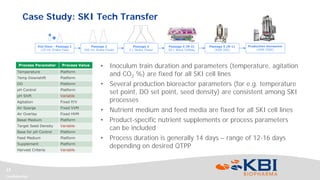
Case Study: SKI Tech Transfer
Passage 4 (N-2)
50 L Wave Cellbag
Passage 3
5 L Shake Flasks
Passage 2
500 mL Shake Flasks
Production bioreactor
(XDR-2000)
Passage 5 (N-1)
(XDR-200)
Vial thaw - Passage 1
125 mL Shake Flask
Process Parameter Process Value
Temperature Platform
Temp Downshift Platform
DO Platform
pH Control Platform
pH Shift Variable
Agitation Fixed P/V
Air Sparge Fixed VVM
Air Overlay Fixed HVM
Basal Medium Platform
Target Seed Density Variable
Base for pH Control Platform
Feed Medium Platform
Supplement Platform
Harvest Criteria Variable
• Inoculum train duration and parameters (temperature, agitation
and CO2 %) are fixed for all SKI cell lines
• Several production bioreactor parameters (for e.g. temperature
set point, DO set point, seed density) are consistent among SKI
processes
• Nutrient medium and feed media are fixed for all SKI cell lines
• Product-specific nutrient supplements or process parameters
can be included
• Process duration is generally 14 days – range of 12-16 days
depending on desired QTPP
Confidential
14
SKI Tech Transfer
0 2 4 6 8 10 12 14 16
Viability
VCC
Days
200 L PD Run VCC 1000 L cGMP VCC
200 L PD Run Viability 1000 L cGMP Viability
0 2 4 6 8 10 12 14 16
pCO2
pH
Days
200 L PD Run pH 1000 L cGMP pH
200 L PD Run pCO2 1000 L cGMP pCO2
ProATiter
Days
200 L PD Run 1000 L cGMP
0 2 4 6 8 10 12 14 16
Lactate
Glucose
Days
200 L PD Run Glc 1000 L GMP Glc
200 L PD Run Lac 1000 L GMP Lac
0 2 4 6 8 10 12 14 16
Ammonia
Glutamine
Days
200 L PD Run Gln 1000 L GMP Gln
200 L PD Run Amm 1000 L GMP Amm
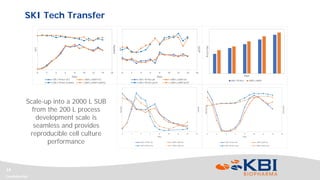
Scale-up into a 2000 L SUB
from the 200 L process
development scale is
seamless and provides
reproducible cell culture
performance
Confidential
15
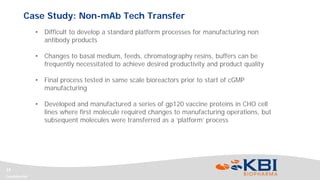
• Difficult to develop a standard platform processes for manufacturing non
antibody products
• Changes to basal medium, feeds, chromatography resins, buffers can be
frequently necessitated to achieve desired productivity and product quality
• Final process tested in same scale bioreactors prior to start of cGMP
manufacturing
• Developed and manufactured a series of gp120 vaccine proteins in CHO cell
lines where first molecule required changes to manufacturing operations, but
subsequent molecules were transferred as a ‘platform’ process
Case Study: Non-mAb Tech Transfer
Confidential
16
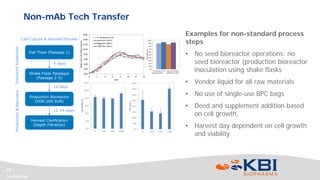
Examples for non-standard process
steps
• No seed bioreactor operations: no
seed bioreactor (production bioreactor
inoculation using shake flasks
• Vendor liquid for all raw materials
• No use of single-use BPC bags
• Deed and supplement addition based
on cell growth,
• Harvest day dependent on cell growth
and viability
Non-mAb Tech Transfer
Production Bioreactor
(XDR-200 SUB)
Harvest Clarification
(Depth Filtration)
Vial Thaw (Passage 1)
InoculumExpansionProduction&Recovery
4 days
12-14 days
Shake Flask Passages
(Passage 2-5)
14 days
Cell Culture & Harvest Process
Confidential
17
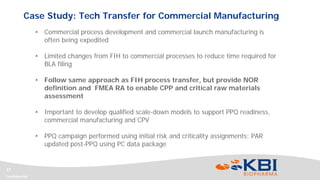
• Commercial process development and commercial launch manufacturing is
often being expedited
• Limited changes from FIH to commercial processes to reduce time required for
BLA filing
• Follow same approach as FIH process transfer, but provide NOR
definition and FMEA RA to enable CPP and critical raw materials
assessment
• Important to develop qualified scale-down models to support PPQ readiness,
commercial manufacturing and CPV
• PPQ campaign performed using initial risk and criticality assignments; PAR
updated post-PPQ using PC data package
Case Study: Tech Transfer for Commercial Manufacturing
Confidential
18
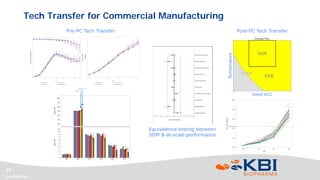
Tech Transfer for Commercial Manufacturing
PAR
Equivalence testing between
SDM & at-scale performance
Post-PC Tech Transfer
cGMP n=10
SDM n=5
Pre-PC Tech Transfer
0 2 4 6 8 10 12 14 16
Day
ambr250 (n=3) 3 L Scale (n=9)
200 L PD (n=3) 2000 L cGMP (n=10)
6 8 10 12 14 16
Day
ambr250 (n=3) 3 L Scale (n=9)
200 L PD (n=3) 2000 L cGMP (n=10)
Confidential
19
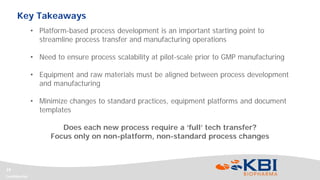
• Platform-based process development is an important starting point to
streamline process transfer and manufacturing operations
• Need to ensure process scalability at pilot-scale prior to GMP manufacturing
• Equipment and raw materials must be aligned between process development
and manufacturing
• Minimize changes to standard practices, equipment platforms and document
templates
Does each new process require a ‘full’ tech transfer?
Focus only on non-platform, non-standard process changes
Key Takeaways
Confidential
Questions?
Visit us at http://www.kbibiopharma.com

Speed to GMP: Moving from Rapid Process Development to High Throughput Tech Transfer

  • 1.
    Confidential Speed to GMP: Movingfrom Rapid Process Development to High Throughput Tech Transfer Niket Bubna Presented at 257th ACS National Meeting 2019 Orlando, FL
  • 2.
    2 Confidential Who We Are Background Howwe Tech Transfer? Tech Transfer Case Studies Conclusions Outline
  • 3.
    Confidential 4 Who We Are •Analytical & Formulation Services, Microbial, Mammalian & Cell Therapy CDMO • CDMO services first offered in 2004 • Acquired by JSR Corp in 2015 • Highly experienced Executive & Management Teams • Excellent Track Record & Client Satisfaction KBI Biopharma’s mission is to accelerate the development of innovative discoveries into life- changing biological products & expand global access of medicines to patients in need
  • 4.
    Confidential 5 Durham, NC (2004) Mammalian •Clinical & Commercial (pre-PAI) cGMP Manufacturing • Analytical, Formulation, Stability & QC • Mass Spec Core Facility • Cell Based Assays Boulder, CO (2014) Microbial • Strain Development • Process & Analytical Development • Clinical & Commercial (Approved) cGMP Manufacturing • QC, Analytical, Formulation, Stability • Particle Characterization Core RTP, NC (2013) Venture Center, NC (2018) Mammalian • Cell Line Development • Process & Analytical Development • Process Characterization • Small scale Process Validation The Woodlands, TX (2017) Cell Therapy • Process and Analytical Development • cGMP Manufacturing & Testing • Cell Based Assays San Diego, CA (2017) Alliance Protein Labs • Analytical Technologies • Leading AUC expertise KBI Sites KBI’s North America Locations March 2018 Louisville, CO (2018) Elion Labs • Analytical Technologies • Leading Biophysical Chara
  • 5.
    Confidential 6 SelexisKBI Selexis – Geneva,Switzerland (2017) Affiliate of KBI Best in class cell line development & candidate selection technologies KBI Leuven, Belgium (2018) Analytical, Formulation and QC services for GMP & non-GMP product testing European Locations
  • 6.
    Confidential 7 Rapid process developmentand manufacturing approach for faster IND submission is often being used for biologics • What role does KBI play in enabling faster delivery of products to the clinic? • What strategies are employed for rapid process development? • Can manufacturing readiness be accelerated? Speed to GMP/IND
  • 7.
    Confidential 8 Biologics CMC &Rapid Process Development FIH CMC Speed to GMP/IND using SKI • Platform cell line • Platform cell culture and downstream processes • Standard scale-up manufacturing operations Selexis KBI Integrated Development Approach
  • 8.
    Confidential 9 KBI-NC has beensupporting ~10 IND/IMPD filings per year since 2015 What is needed to accelerate manufacturing of biologics? Types of Mammalian Manufacturing Projects mAb, 45.1% Fc-fusion, Fusion, 9.8% Bispecific, 21.6% Recombinant Protein, 5.9% Glycoprotein vaccine, 13.7% Enzyme, 3.9%
  • 9.
    Confidential 10 Questions to Consider •How is tech transfer performed within a CDMO? • Multi-product facilities • Phase I to Phase III projects • Are there standard approaches that ensure 100% success?
  • 10.
    Confidential 11 • Key goalis to ensure seamless transfer of process parameters, raw materials and process knowledge for cGMP manufacturing • Initiate process transfer while process development is on-going; 4-5 months prior to manufacturing start • Need to reduce gaps in equipment and raw material grades between development and manufacturing • Use of platform upstream and downstream processes minimizes changes in manufacturing operations • Templated documents for process transfer and manufacturing ops Tech Transfer Business Process: Considerations
  • 11.
    Confidential 12 • Tech transfermilestones defined with T=0 as cell culture vial thaw or harvest • Process descriptions, batch record review and floor support are key deliverables from process development Tech Transfer Business Process
  • 12.
    Confidential 13 Case Study: SKITech Transfer Passage 4 (N-2) 50 L Wave Cellbag Passage 3 5 L Shake Flasks Passage 2 500 mL Shake Flasks Production bioreactor (XDR-2000) Passage 5 (N-1) (XDR-200) Vial thaw - Passage 1 125 mL Shake Flask Process Parameter Process Value Temperature Platform Temp Downshift Platform DO Platform pH Control Platform pH Shift Variable Agitation Fixed P/V Air Sparge Fixed VVM Air Overlay Fixed HVM Basal Medium Platform Target Seed Density Variable Base for pH Control Platform Feed Medium Platform Supplement Platform Harvest Criteria Variable • Inoculum train duration and parameters (temperature, agitation and CO2 %) are fixed for all SKI cell lines • Several production bioreactor parameters (for e.g. temperature set point, DO set point, seed density) are consistent among SKI processes • Nutrient medium and feed media are fixed for all SKI cell lines • Product-specific nutrient supplements or process parameters can be included • Process duration is generally 14 days – range of 12-16 days depending on desired QTPP
  • 13.
    Confidential 14 SKI Tech Transfer 02 4 6 8 10 12 14 16 Viability VCC Days 200 L PD Run VCC 1000 L cGMP VCC 200 L PD Run Viability 1000 L cGMP Viability 0 2 4 6 8 10 12 14 16 pCO2 pH Days 200 L PD Run pH 1000 L cGMP pH 200 L PD Run pCO2 1000 L cGMP pCO2 ProATiter Days 200 L PD Run 1000 L cGMP 0 2 4 6 8 10 12 14 16 Lactate Glucose Days 200 L PD Run Glc 1000 L GMP Glc 200 L PD Run Lac 1000 L GMP Lac 0 2 4 6 8 10 12 14 16 Ammonia Glutamine Days 200 L PD Run Gln 1000 L GMP Gln 200 L PD Run Amm 1000 L GMP Amm Scale-up into a 2000 L SUB from the 200 L process development scale is seamless and provides reproducible cell culture performance
  • 14.
    Confidential 15 • Difficult todevelop a standard platform processes for manufacturing non antibody products • Changes to basal medium, feeds, chromatography resins, buffers can be frequently necessitated to achieve desired productivity and product quality • Final process tested in same scale bioreactors prior to start of cGMP manufacturing • Developed and manufactured a series of gp120 vaccine proteins in CHO cell lines where first molecule required changes to manufacturing operations, but subsequent molecules were transferred as a ‘platform’ process Case Study: Non-mAb Tech Transfer
  • 15.
    Confidential 16 Examples for non-standardprocess steps • No seed bioreactor operations: no seed bioreactor (production bioreactor inoculation using shake flasks • Vendor liquid for all raw materials • No use of single-use BPC bags • Deed and supplement addition based on cell growth, • Harvest day dependent on cell growth and viability Non-mAb Tech Transfer Production Bioreactor (XDR-200 SUB) Harvest Clarification (Depth Filtration) Vial Thaw (Passage 1) InoculumExpansionProduction&Recovery 4 days 12-14 days Shake Flask Passages (Passage 2-5) 14 days Cell Culture & Harvest Process
  • 16.
    Confidential 17 • Commercial processdevelopment and commercial launch manufacturing is often being expedited • Limited changes from FIH to commercial processes to reduce time required for BLA filing • Follow same approach as FIH process transfer, but provide NOR definition and FMEA RA to enable CPP and critical raw materials assessment • Important to develop qualified scale-down models to support PPQ readiness, commercial manufacturing and CPV • PPQ campaign performed using initial risk and criticality assignments; PAR updated post-PPQ using PC data package Case Study: Tech Transfer for Commercial Manufacturing
  • 17.
    Confidential 18 Tech Transfer forCommercial Manufacturing PAR Equivalence testing between SDM & at-scale performance Post-PC Tech Transfer cGMP n=10 SDM n=5 Pre-PC Tech Transfer 0 2 4 6 8 10 12 14 16 Day ambr250 (n=3) 3 L Scale (n=9) 200 L PD (n=3) 2000 L cGMP (n=10) 6 8 10 12 14 16 Day ambr250 (n=3) 3 L Scale (n=9) 200 L PD (n=3) 2000 L cGMP (n=10)
  • 18.
    Confidential 19 • Platform-based processdevelopment is an important starting point to streamline process transfer and manufacturing operations • Need to ensure process scalability at pilot-scale prior to GMP manufacturing • Equipment and raw materials must be aligned between process development and manufacturing • Minimize changes to standard practices, equipment platforms and document templates Does each new process require a ‘full’ tech transfer? Focus only on non-platform, non-standard process changes Key Takeaways
  • 19.
    Confidential Questions? Visit us athttp://www.kbibiopharma.com