

Platforms for mAb
commercialization
Abhinav A. Shukla, Ph.D.
Senior Vice President
Development & Manufacturing
KBI Biopharma, Durham NC
BPI West, San Francisco, February 27 – March 2, 2017
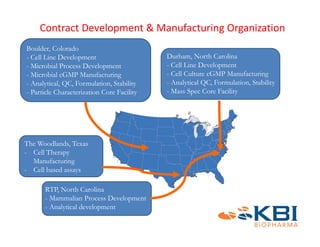
Durham, North Carolina
- Cell Line Development
- Cell Culture cGMP Manufacturing
- Analytical QC, Formulation, Stability
- Mass Spec Core Facility
RTP, North Carolina
- Mammalian Process Development
- Analytical development
Boulder, Colorado
- Cell Line Development
- Microbial Process Development
- Microbial cGMP Manufacturing
- Analytical, QC, Formulation, Stability
- Particle Characterization Core Facility
The Woodlands, Texas
- Cell Therapy
Manufacturing
- Cell based assays
Contract Development & Manufacturing Organization
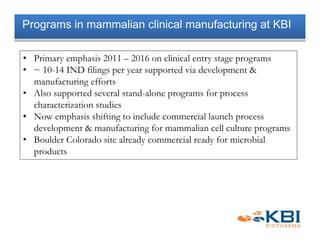
Programs in mammalian clinical manufacturing at KBI
• Primary emphasis 2011 – 2016 on clinical entry stage programs
• ~ 10-14 IND filings per year supported via development &
manufacturing efforts
• Also supported several stand-alone programs for process
characterization studies
• Now emphasis shifting to include commercial launch process
development & manufacturing for mammalian cell culture programs
• Boulder Colorado site already commercial ready for microbial
products
KBI Biopharma
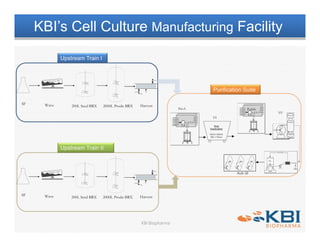
Upstream Train I
Upstream Train II
ProA
VI
Polish
VF
Bulk fill
KBI’s Cell Culture Manufacturing Facility
Purification Suite
2000L Prodn BRX200L Seed BRXWaveSF Harvest
3/9/20175 |
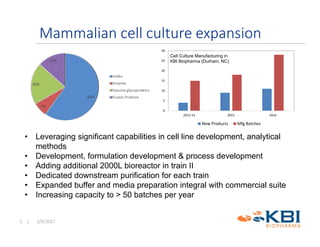
Mammalian cell culture expansion
• Leveraging significant capabilities in cell line development, analytical
methods
• Development, formulation development & process development
• Adding additional 2000L bioreactor in train II
• Dedicated downstream purification for each train
• Expanded buffer and media preparation integral with commercial suite
• Increasing capacity to > 50 batches per year
0
5
10
15
20
25
30
2013‐14 2015 2016
New Products Mfg Batches
Cell Culture Manufacturing in
KBI Biopharma (Durham, NC)
6
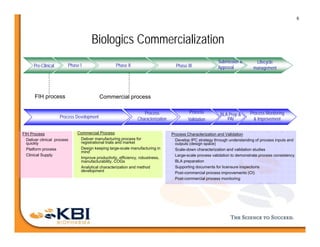
Biologics Commercialization
Pre-Clinical Phase I Phase II Phase III
Process Development
Process
Characterization
Process
Validation
Process Monitoring
& Improvement
FIH Process
• Deliver clinical process
quickly
• Platform process
• Clinical Supply
Submission &
Approval
Lifecycle
management
BLA Prep &
PAI
Commercial Process
• Deliver manufacturing process for
registrational trials and market
• Design keeping large-scale manufacturing in
mind
• Improve productivity, efficiency, robustness,
manufacturability, COGs
• Analytical characterization and method
development
Process Characterization and Validation
• Develop IPC strategy through understanding of process inputs and
outputs (design space)
• Scale-down characterization and validation studies
• Large-scale process validation to demonstrate process consistency
• BLA preparation
• Supporting documents for licensure inspections
• Post-commercial process improvements (CI)
• Post-commercial process monitoring
FIH process Commercial process
7
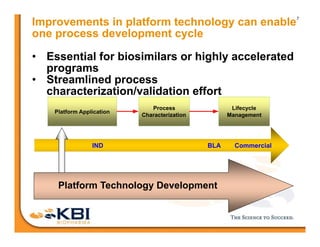
Improvements in platform technology can enable
one process development cycle
• Essential for biosimilars or highly accelerated
programs
• Streamlined process
characterization/validation effort
Process
Characterization
Lifecycle
Management
Platform Application
IND BLA Commercial
Platform Technology Development
8
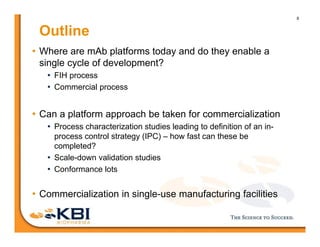
Outline
• Where are mAb platforms today and do they enable a
single cycle of development?
• FIH process
• Commercial process
• Can a platform approach be taken for commercialization
• Process characterization studies leading to definition of an in-
process control strategy (IPC) – how fast can these be
completed?
• Scale-down validation studies
• Conformance lots
• Commercialization in single-use manufacturing facilities
9
Investments in fundamental
understanding of bioprocesses
• Robust platforms can only be developed if there is a
strong understanding of the science of developing
bioprocesses
• Multimodal chromatography
• Platforms for non-mAbs (HIV vaccine proteins)
• Improved Protein A resins
• Creates the ability to react quickly if an “unusual”
observation is made
• All process decisions need to be made keeping large-
scale production in mind
10
0
50
100
150
200
250
300
350
400
450
500
0.0% 20.0% 40.0% 60.0% 80.0% 100.0%
HCP (ppm)
Recovery
Capto MMC HCP Clearance
25mM Tris pH 7.0 (baseline)
25mM Tris pH 7.0, 5% ethylene glycol
25mM Tris pH 7.0, 50mM arginine
25mM Tris pH 7.0, 50mM NaSCN
25mM Tris pH 7.0, 1M urea
25mM Tris pH 7.0, 1M ammonium sulfate
25mM Tris pH 7.0, 0.1M NaCl
25mM Tris pH 7.0, 0.5M ammonium sulfate
25mM Tris pH 7.0, 0.1M NaCl, 1M urea
Washes that
disrupt
protein-protein
interactions
Conventional washes
log k’ = A – Blog(csalt) + C(csalt) k’ = (tr – tm )/tm
Wolfe, L., Barringer, C., Mostafa, S., Shukla, A.
Multimodal chromatography: characterization of protein binding
and selectivity enhancement through mobile phase modulators,
Journal of Chromatography A, 1340, 151-156, 2014.
Multimodal chromatography
11
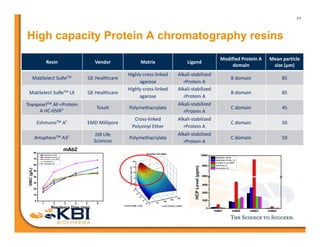
High capacity Protein A chromatography resins
Resin Vendor Matrix Ligand
Modified Protein A 
domain
Mean particle
size (µm)
MabSelect SuReTM GE Healthcare
Highly cross‐linked 
agarose
Alkali‐stabilized 
rProtein A
B domain 85
MabSelect SuReTM LX GE Healthcare
Highly cross‐linked 
agarose
Alkali‐stabilized 
rProtein A 
B domain 85
ToyopearlTM AF‐rProtein
A HC‐650F† Tosoh Polymethacrylate
Alkali‐stabilized 
rProtein A 
C domain 45
EshmunoTM A† EMD Millipore
Cross‐linked
Polyvinyl Ether
Alkali‐stabilized 
rProtein A 
C domain 50
AmsphereTM A3† JSR Life 
Sciences
Polymethacrylate
Alkali‐stabilized 
rProtein A
C domain 50
1 2 3 4 5 6
0
10
20
30
40
50
60
70
80
mAb2
DBC(g/L)
Residence Time (min)
MabSelect SuRe
MabSelect SuRe LX
rProtein A HC-650F
Eshmuno A
Amsphere A3
mAb1 mAb2 mAb3 mAb4
0
1000
2000
3000
8000
9000
10000
HCPLevel(ppm)
MabSelec SuRe
MabSelect SuRe LX
rProtein A HC-650F
Eshmuno A
Amsphere A3
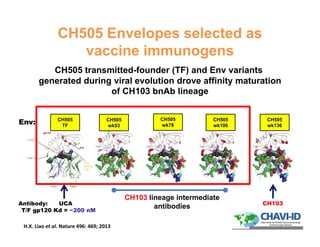
CH505 Envelopes selected as
vaccine immunogens
CH505 transmitted-founder (TF) and Env variants
generated during viral evolution drove affinity maturation
of CH103 bnAb lineage
Antibody: UCA
T/F gp120 Kd = ~200 nM
Env:
CH103
CH505
wk53
CH505
wk78
CH505
wk100
CH103 lineage intermediate
antibodies
CH505
TF
CH505
wk136
12
H.X. Liao et al. Nature 496: 469; 2013
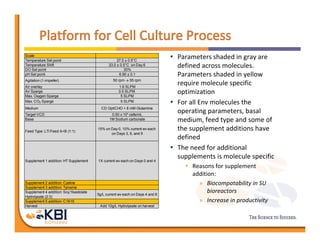
• Parameters shaded in gray are 
defined across molecules. 
Parameters shaded in yellow 
require molecule specific 
optimization
• For all Env molecules the 
operating parameters, basal 
medium, feed type and some of 
the supplement additions have 
defined
• The need for additional 
supplements is molecule specific
• Reasons for supplement 
addition:
» Biocompatability in SU 
bioreactors
» Increase in productivity
Scale
Temperature Set point 37.0 ± 0.5°C
Temperature Shift 33.0 ± 0.5°C on Day 6
DO Set point 30%
pH Set point 6.90 ± 0.1
Agitation (1-impeller) 50 rpm → 55 rpm
Air overlay 1.6 SLPM
Air Sparge 0.5 SLPM
Max. Oxygen Sparge 5 SLPM
Max. CO2 Sparge 5 SLPM
Medium CD OptiCHO + 8 mM Glutamine
Target VCD 0.50 x 10⁶
cells/mL
Base 1M Sodium carbonate
Feed Type: LTI Feed A+B (1:1)
15% on Day 0, 10% current wv each
on Days 3, 6, and 9
Supplement 1 addition: HT Supplement 1X current wv each on Days 0 and 4
Supplement 2 addition: Cystine
Supplement 3 addition: Tyrosine
Supplement 4 addition: Soy:Yeastolate
Hydrolysate (2:3)
5g/L current wv each on Days 4 and 8
Supplement 5 addition: C1615
Harvest Add 10g/L Hydrolysate on harvest
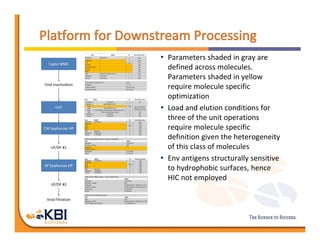
• Parameters shaded in gray are 
defined across molecules. 
Parameters shaded in yellow 
require molecule specific 
optimization
• Load and elution conditions for 
three of the unit operations 
require molecule specific 
definition given the heterogeneity 
of this class of molecules
• Env antigens structurally sensitive 
to hydrophobic surfaces, hence 
HIC not employed
1
10
100
1000
10000
100000
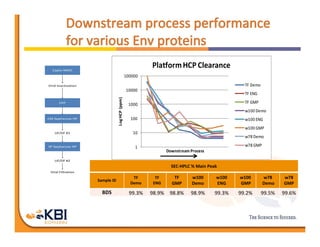
Log HCP (ppm)
Downstream Process
Platform HCP Clearance
TF Demo
TF ENG
TF GMP
w100 Demo
w100 ENG
w100 GMP
w78 Demo
w78 GMP
SEC‐HPLC % Main Peak
Sample ID
TF 
Demo
TF 
ENG
TF 
GMP
w100 
Demo
w100 
ENG
w100
GMP
w78
Demo
w78 
GMP
BDS 99.3% 98.9% 98.8% 98.9% 99.3% 99.2% 99.5% 99.6%
16
MAB PLATFORMS
17
Next generation mAb platforms
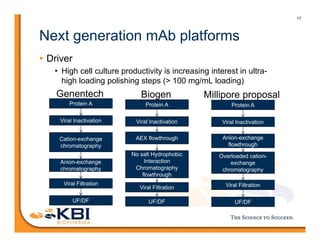
• Driver
• High cell culture productivity is increasing interest in ultra-
high loading polishing steps (> 100 mg/mL loading)
Genentech Biogen Millipore proposal
Protein A
Viral Inactivation
Cation-exchange
chromatography
Anion-exchange
chromatography
Viral Filtration
UF/DF
Protein A
Viral Inactivation
AEX flowthrough
No salt Hydrophobic
Interaction
Chromatography
flowthrough
Viral Filtration
UF/DF
Protein A
Viral Inactivation
Anion-exchange
flowthrough
Overloaded cation-
exchange
chromatography
Viral Filtration
UF/DF
18
Which platform should I use?
19
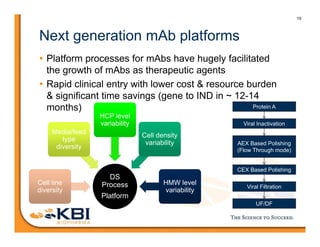
Next generation mAb platforms
• Platform processes for mAbs have hugely facilitated
the growth of mAbs as therapeutic agents
• Rapid clinical entry with lower cost & resource burden
& significant time savings (gene to IND in ~ 12-14
months)
DS
Process
Platform
DS
Process
Platform
Cell line
diversity
Cell line
diversity
Media/feed
type
diversity
Media/feed
type
diversity
HCP level
variability
HCP level
variability
Cell density
variability
Cell density
variability
HMW level
variability
HMW level
variability
Protein A
Viral Inactivation
AEX Based Polishing
(Flow Through mode)
CEX Based Polishing
Viral Filtration
UF/DF
20
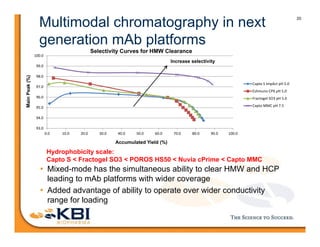
Multimodal chromatography in next
generation mAb platforms
• Mixed-mode has the simultaneous ability to clear HMW and HCP
leading to mAb platforms with wider coverage
• Added advantage of ability to operate over wider conductivity
range for loading
93.0
94.0
95.0
96.0
97.0
98.0
99.0
100.0
0.0 10.0 20.0 30.0 40.0 50.0 60.0 70.0 80.0 90.0 100.0
Capto S ImpAct pH 5.0
Eshmuno CPX pH 5.0
Fractogel SO3 pH 5.0
Capto MMC pH 7.5
Selectivity Curves for HMW Clearance
MainPeak(%)
Increase selectivity
Accumulated Yield (%)
Hydrophobicity scale:
Capto S < Fractogel SO3 < POROS HS50 < Nuvia cPrime < Capto MMC
21
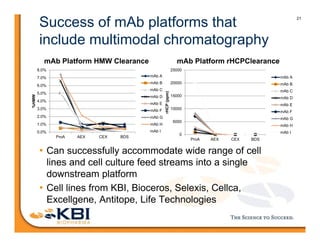
Success of mAb platforms that
include multimodal chromatography
• Can successfully accommodate wide range of cell
lines and cell culture feed streams into a single
downstream platform
• Cell lines from KBI, Bioceros, Selexis, Cellca,
Excellgene, Antitope, Life Technologies
0.0%
1.0%
2.0%
3.0%
4.0%
5.0%
6.0%
7.0%
8.0%
ProA AEX CEX BDS
%HMW
mAb Platform HMW Clearance
mAb A
mAb B
mAb C
mAb D
mAb E
mAb F
mAb G
mAb H
mAb I
0
5000
10000
15000
20000
25000
ProA AEX CEX BDS
rHCP(ppm)
mAb Platform rHCPClearance
mAb A
mAb B
mAb C
mAb D
mAb E
mAb F
mAb G
mAb H
mAb I
22
MAPPING PROCESS DESIGN
SPACE (PROCESS
CHARACTERIZATION AND
SCALE-DOWN VALIDATION)
23
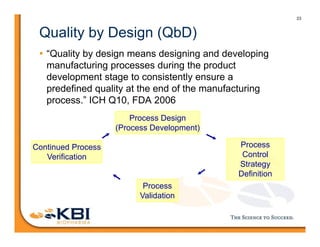
Quality by Design (QbD)
• “Quality by design means designing and developing
manufacturing processes during the product
development stage to consistently ensure a
predefined quality at the end of the manufacturing
process.” ICH Q10, FDA 2006
Process Design
(Process Development)
Process
Control
Strategy
Definition
Process
Validation
Continued Process
Verification
24
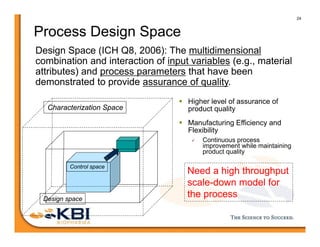
Process Design Space
 Higher level of assurance of
product quality
 Manufacturing Efficiency and
Flexibility
 Continuous process
improvement while maintaining
product quality
Characterization Space
Design space
Control space
Design Space (ICH Q8, 2006): The multidimensional
combination and interaction of input variables (e.g., material
attributes) and process parameters that have been
demonstrated to provide assurance of quality.
Need a high throughput
scale-down model for
the process
25
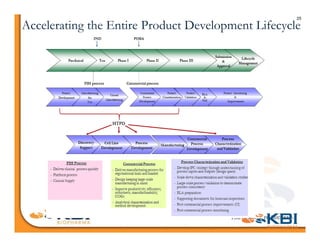
Accelerating the Entire Product Development Lifecycle
26
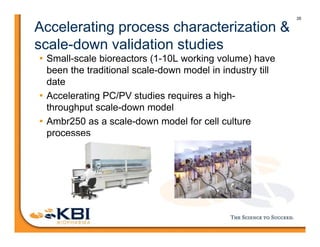
Accelerating process characterization &
scale-down validation studies
• Small-scale bioreactors (1-10L working volume) have
been the traditional scale-down model in industry till
date
• Accelerating PC/PV studies requires a high-
throughput scale-down model
• Ambr250 as a scale-down model for cell culture
processes
27
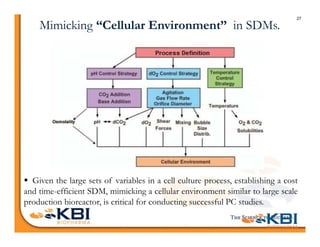
Mimicking “Cellular Environment” in SDMs.
 Given the large sets of variables in a cell culture process, establishing a cost
and time-efficient SDM, mimicking a cellular environment similar to large scale
production bioreactor, is critical for conducting successful PC studies.
28
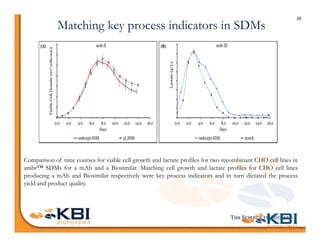
Matching key process indicators in SDMs
Comparison of time courses for viable cell growth and lactate profiles for two recombinant CHO cell lines in
ambr™ SDMs for a mAb and a Biosimilar. Matching cell growth and lactate profiles for CHO cell lines
producing a mAb and Biosimilar respectively were key process indicators and in turn dictated the process
yield and product quality.
29
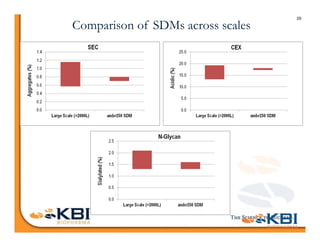
Comparison of SDMs across scales
30
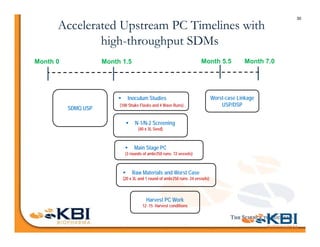
Accelerated Upstream PC Timelines with
high-throughput SDMs
Month 1.5
SDMQ USP
Month 5.5
 N-1/N-2 Screening
(40 x 3L Seed)
Harvest PC Work
12 -15 Harvest conditions
Month 0
 Raw Materials and Worst Case
(20 x 3L and 1 round of ambr250 runs: 24 vessels)
 Main Stage PC
(3 rounds of ambr250 runs: 72 vessels)
 Inoculum Studies
(100 Shake Flasks and 4 Wave Runs)
Worst-case Linkage
USP/DSP
Month 7.0
31
Scale-Down Process Validation Studies
• Scale-down validation studies in addition to large-
scale process validation (conformance lots)
• Probe extremes in the process and demonstrate them
to be acceptable
• Examples
• Reprocessing validation – combine hold times with process
conditions that create the greatest stress on the protein
• Intermediate hold times – combine hold times and
demonstrate releasable drug substance
• Viral clearance studies
• Impurity clearance studies
32
Conclusions
• Robust scientific understanding is a pre-requisite for
developing robust platforms that can make single cycle
development possible
• Highly generic and manufacturing friendly mAb platforms
have been designed (gene to IND in 12-14 months)
• Process characterization & scale-down validation studies
can be accelerated (6-9 months) by using high throughput
cell culture platforms as the scale-down model
• Single-use manufacturing is now a viable commercial
launch platform (long term may combine single use
manufacturing & higher productivity continuous
manufacturing)
33
mAb platforms
SU manufacturing
High through process development tools
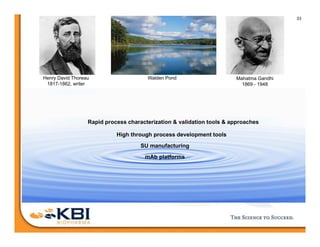
Rapid process characterization & validation tools & approaches
Henry David Thoreau
1817-1862, writer
Walden Pond Mahatma Gandhi
1869 - 1948
34

Platforms for mAb Commercialization

  • 1.
    Platforms for mAb commercialization AbhinavA. Shukla, Ph.D. Senior Vice President Development & Manufacturing KBI Biopharma, Durham NC BPI West, San Francisco, February 27 – March 2, 2017
  • 2.
    Durham, North Carolina -Cell Line Development - Cell Culture cGMP Manufacturing - Analytical QC, Formulation, Stability - Mass Spec Core Facility RTP, North Carolina - Mammalian Process Development - Analytical development Boulder, Colorado - Cell Line Development - Microbial Process Development - Microbial cGMP Manufacturing - Analytical, QC, Formulation, Stability - Particle Characterization Core Facility The Woodlands, Texas - Cell Therapy Manufacturing - Cell based assays Contract Development & Manufacturing Organization
  • 3.
    Programs in mammalianclinical manufacturing at KBI • Primary emphasis 2011 – 2016 on clinical entry stage programs • ~ 10-14 IND filings per year supported via development & manufacturing efforts • Also supported several stand-alone programs for process characterization studies • Now emphasis shifting to include commercial launch process development & manufacturing for mammalian cell culture programs • Boulder Colorado site already commercial ready for microbial products
  • 4.
    KBI Biopharma Upstream Train I UpstreamTrain II ProA VI Polish VF Bulk fill KBI’s Cell Culture Manufacturing Facility Purification Suite 2000L Prodn BRX200L Seed BRXWaveSF Harvest 2000L Prodn BRX200L Seed BRXWaveSF Harvest
  • 5.
    3/9/20175 | Mammalian cell culture expansion • Leveragingsignificant capabilities in cell line development, analytical methods • Development, formulation development & process development • Adding additional 2000L bioreactor in train II • Dedicated downstream purification for each train • Expanded buffer and media preparation integral with commercial suite • Increasing capacity to > 50 batches per year 0 5 10 15 20 25 30 2013‐14 2015 2016 New Products Mfg Batches Cell Culture Manufacturing in KBI Biopharma (Durham, NC)
  • 6.
    6 Biologics Commercialization Pre-Clinical PhaseI Phase II Phase III Process Development Process Characterization Process Validation Process Monitoring & Improvement FIH Process • Deliver clinical process quickly • Platform process • Clinical Supply Submission & Approval Lifecycle management BLA Prep & PAI Commercial Process • Deliver manufacturing process for registrational trials and market • Design keeping large-scale manufacturing in mind • Improve productivity, efficiency, robustness, manufacturability, COGs • Analytical characterization and method development Process Characterization and Validation • Develop IPC strategy through understanding of process inputs and outputs (design space) • Scale-down characterization and validation studies • Large-scale process validation to demonstrate process consistency • BLA preparation • Supporting documents for licensure inspections • Post-commercial process improvements (CI) • Post-commercial process monitoring FIH process Commercial process
  • 7.
    7 Improvements in platformtechnology can enable one process development cycle • Essential for biosimilars or highly accelerated programs • Streamlined process characterization/validation effort Process Characterization Lifecycle Management Platform Application IND BLA Commercial Platform Technology Development
  • 8.
    8 Outline • Where aremAb platforms today and do they enable a single cycle of development? • FIH process • Commercial process • Can a platform approach be taken for commercialization • Process characterization studies leading to definition of an in- process control strategy (IPC) – how fast can these be completed? • Scale-down validation studies • Conformance lots • Commercialization in single-use manufacturing facilities
  • 9.
    9 Investments in fundamental understandingof bioprocesses • Robust platforms can only be developed if there is a strong understanding of the science of developing bioprocesses • Multimodal chromatography • Platforms for non-mAbs (HIV vaccine proteins) • Improved Protein A resins • Creates the ability to react quickly if an “unusual” observation is made • All process decisions need to be made keeping large- scale production in mind
  • 10.
    10 0 50 100 150 200 250 300 350 400 450 500 0.0% 20.0% 40.0%60.0% 80.0% 100.0% HCP (ppm) Recovery Capto MMC HCP Clearance 25mM Tris pH 7.0 (baseline) 25mM Tris pH 7.0, 5% ethylene glycol 25mM Tris pH 7.0, 50mM arginine 25mM Tris pH 7.0, 50mM NaSCN 25mM Tris pH 7.0, 1M urea 25mM Tris pH 7.0, 1M ammonium sulfate 25mM Tris pH 7.0, 0.1M NaCl 25mM Tris pH 7.0, 0.5M ammonium sulfate 25mM Tris pH 7.0, 0.1M NaCl, 1M urea Washes that disrupt protein-protein interactions Conventional washes log k’ = A – Blog(csalt) + C(csalt) k’ = (tr – tm )/tm Wolfe, L., Barringer, C., Mostafa, S., Shukla, A. Multimodal chromatography: characterization of protein binding and selectivity enhancement through mobile phase modulators, Journal of Chromatography A, 1340, 151-156, 2014. Multimodal chromatography
  • 11.
    11 High capacity ProteinA chromatography resins Resin Vendor Matrix Ligand Modified Protein A  domain Mean particle size (µm) MabSelect SuReTM GE Healthcare Highly cross‐linked  agarose Alkali‐stabilized  rProtein A B domain 85 MabSelect SuReTM LX GE Healthcare Highly cross‐linked  agarose Alkali‐stabilized  rProtein A  B domain 85 ToyopearlTM AF‐rProtein A HC‐650F† Tosoh Polymethacrylate Alkali‐stabilized  rProtein A  C domain 45 EshmunoTM A† EMD Millipore Cross‐linked Polyvinyl Ether Alkali‐stabilized  rProtein A  C domain 50 AmsphereTM A3† JSR Life  Sciences Polymethacrylate Alkali‐stabilized  rProtein A C domain 50 1 2 3 4 5 6 0 10 20 30 40 50 60 70 80 mAb2 DBC(g/L) Residence Time (min) MabSelect SuRe MabSelect SuRe LX rProtein A HC-650F Eshmuno A Amsphere A3 mAb1 mAb2 mAb3 mAb4 0 1000 2000 3000 8000 9000 10000 HCPLevel(ppm) MabSelec SuRe MabSelect SuRe LX rProtein A HC-650F Eshmuno A Amsphere A3
  • 12.
    CH505 Envelopes selectedas vaccine immunogens CH505 transmitted-founder (TF) and Env variants generated during viral evolution drove affinity maturation of CH103 bnAb lineage Antibody: UCA T/F gp120 Kd = ~200 nM Env: CH103 CH505 wk53 CH505 wk78 CH505 wk100 CH103 lineage intermediate antibodies CH505 TF CH505 wk136 12 H.X. Liao et al. Nature 496: 469; 2013
  • 13.
    • Parameters shaded in gray are  defined across molecules.  Parameters shaded in yellow  require molecule specific  optimization • For all Envmolecules the  operating parameters, basal  medium, feed type and some of  the supplement additions have  defined • The need for additional  supplements is molecule specific • Reasons for supplement  addition: » Biocompatability in SU  bioreactors » Increase in productivity Scale Temperature Set point 37.0 ± 0.5°C Temperature Shift 33.0 ± 0.5°C on Day 6 DO Set point 30% pH Set point 6.90 ± 0.1 Agitation (1-impeller) 50 rpm → 55 rpm Air overlay 1.6 SLPM Air Sparge 0.5 SLPM Max. Oxygen Sparge 5 SLPM Max. CO2 Sparge 5 SLPM Medium CD OptiCHO + 8 mM Glutamine Target VCD 0.50 x 10⁶ cells/mL Base 1M Sodium carbonate Feed Type: LTI Feed A+B (1:1) 15% on Day 0, 10% current wv each on Days 3, 6, and 9 Supplement 1 addition: HT Supplement 1X current wv each on Days 0 and 4 Supplement 2 addition: Cystine Supplement 3 addition: Tyrosine Supplement 4 addition: Soy:Yeastolate Hydrolysate (2:3) 5g/L current wv each on Days 4 and 8 Supplement 5 addition: C1615 Harvest Add 10g/L Hydrolysate on harvest
  • 14.
  • 15.
  • 16.
  • 17.
    17 Next generation mAbplatforms • Driver • High cell culture productivity is increasing interest in ultra- high loading polishing steps (> 100 mg/mL loading) Genentech Biogen Millipore proposal Protein A Viral Inactivation Cation-exchange chromatography Anion-exchange chromatography Viral Filtration UF/DF Protein A Viral Inactivation AEX flowthrough No salt Hydrophobic Interaction Chromatography flowthrough Viral Filtration UF/DF Protein A Viral Inactivation Anion-exchange flowthrough Overloaded cation- exchange chromatography Viral Filtration UF/DF
  • 18.
  • 19.
    19 Next generation mAbplatforms • Platform processes for mAbs have hugely facilitated the growth of mAbs as therapeutic agents • Rapid clinical entry with lower cost & resource burden & significant time savings (gene to IND in ~ 12-14 months) DS Process Platform DS Process Platform Cell line diversity Cell line diversity Media/feed type diversity Media/feed type diversity HCP level variability HCP level variability Cell density variability Cell density variability HMW level variability HMW level variability Protein A Viral Inactivation AEX Based Polishing (Flow Through mode) CEX Based Polishing Viral Filtration UF/DF
  • 20.
    20 Multimodal chromatography innext generation mAb platforms • Mixed-mode has the simultaneous ability to clear HMW and HCP leading to mAb platforms with wider coverage • Added advantage of ability to operate over wider conductivity range for loading 93.0 94.0 95.0 96.0 97.0 98.0 99.0 100.0 0.0 10.0 20.0 30.0 40.0 50.0 60.0 70.0 80.0 90.0 100.0 Capto S ImpAct pH 5.0 Eshmuno CPX pH 5.0 Fractogel SO3 pH 5.0 Capto MMC pH 7.5 Selectivity Curves for HMW Clearance MainPeak(%) Increase selectivity Accumulated Yield (%) Hydrophobicity scale: Capto S < Fractogel SO3 < POROS HS50 < Nuvia cPrime < Capto MMC
  • 21.
    21 Success of mAbplatforms that include multimodal chromatography • Can successfully accommodate wide range of cell lines and cell culture feed streams into a single downstream platform • Cell lines from KBI, Bioceros, Selexis, Cellca, Excellgene, Antitope, Life Technologies 0.0% 1.0% 2.0% 3.0% 4.0% 5.0% 6.0% 7.0% 8.0% ProA AEX CEX BDS %HMW mAb Platform HMW Clearance mAb A mAb B mAb C mAb D mAb E mAb F mAb G mAb H mAb I 0 5000 10000 15000 20000 25000 ProA AEX CEX BDS rHCP(ppm) mAb Platform rHCPClearance mAb A mAb B mAb C mAb D mAb E mAb F mAb G mAb H mAb I
  • 22.
    22 MAPPING PROCESS DESIGN SPACE(PROCESS CHARACTERIZATION AND SCALE-DOWN VALIDATION)
  • 23.
    23 Quality by Design(QbD) • “Quality by design means designing and developing manufacturing processes during the product development stage to consistently ensure a predefined quality at the end of the manufacturing process.” ICH Q10, FDA 2006 Process Design (Process Development) Process Control Strategy Definition Process Validation Continued Process Verification
  • 24.
    24 Process Design Space Higher level of assurance of product quality  Manufacturing Efficiency and Flexibility  Continuous process improvement while maintaining product quality Characterization Space Design space Control space Design Space (ICH Q8, 2006): The multidimensional combination and interaction of input variables (e.g., material attributes) and process parameters that have been demonstrated to provide assurance of quality. Need a high throughput scale-down model for the process
  • 25.
    25 Accelerating the EntireProduct Development Lifecycle
  • 26.
    26 Accelerating process characterization& scale-down validation studies • Small-scale bioreactors (1-10L working volume) have been the traditional scale-down model in industry till date • Accelerating PC/PV studies requires a high- throughput scale-down model • Ambr250 as a scale-down model for cell culture processes
  • 27.
    27 Mimicking “Cellular Environment”in SDMs.  Given the large sets of variables in a cell culture process, establishing a cost and time-efficient SDM, mimicking a cellular environment similar to large scale production bioreactor, is critical for conducting successful PC studies.
  • 28.
    28 Matching key processindicators in SDMs Comparison of time courses for viable cell growth and lactate profiles for two recombinant CHO cell lines in ambr™ SDMs for a mAb and a Biosimilar. Matching cell growth and lactate profiles for CHO cell lines producing a mAb and Biosimilar respectively were key process indicators and in turn dictated the process yield and product quality.
  • 29.
    29 Comparison of SDMsacross scales
  • 30.
    30 Accelerated Upstream PCTimelines with high-throughput SDMs Month 1.5 SDMQ USP Month 5.5  N-1/N-2 Screening (40 x 3L Seed) Harvest PC Work 12 -15 Harvest conditions Month 0  Raw Materials and Worst Case (20 x 3L and 1 round of ambr250 runs: 24 vessels)  Main Stage PC (3 rounds of ambr250 runs: 72 vessels)  Inoculum Studies (100 Shake Flasks and 4 Wave Runs) Worst-case Linkage USP/DSP Month 7.0
  • 31.
    31 Scale-Down Process ValidationStudies • Scale-down validation studies in addition to large- scale process validation (conformance lots) • Probe extremes in the process and demonstrate them to be acceptable • Examples • Reprocessing validation – combine hold times with process conditions that create the greatest stress on the protein • Intermediate hold times – combine hold times and demonstrate releasable drug substance • Viral clearance studies • Impurity clearance studies
  • 32.
    32 Conclusions • Robust scientificunderstanding is a pre-requisite for developing robust platforms that can make single cycle development possible • Highly generic and manufacturing friendly mAb platforms have been designed (gene to IND in 12-14 months) • Process characterization & scale-down validation studies can be accelerated (6-9 months) by using high throughput cell culture platforms as the scale-down model • Single-use manufacturing is now a viable commercial launch platform (long term may combine single use manufacturing & higher productivity continuous manufacturing)
  • 33.
    33 mAb platforms SU manufacturing Highthrough process development tools Rapid process characterization & validation tools & approaches Henry David Thoreau 1817-1862, writer Walden Pond Mahatma Gandhi 1869 - 1948
  • 34.