HIV Vaccines Process
Development &
Manufacturing – pitfalls
& possibilities
Abhinav A. Shukla, Ph.D.
Senior Vice President
Development & Manufacturing
KBI Biopharma, Durham NC
HIV Vaccine Manufacturing Workshop – July 19th & 20th, 2017
2
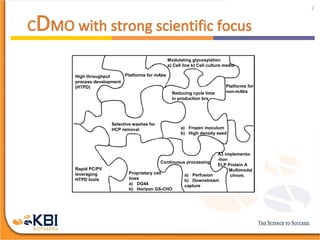
High throughput
process development
(HTPD)
Modulating glycosylation
a) Cell line b) Cell culture media
Platforms for mAbs
Platforms for
non-mAbsReducing cycle time
in production brx
a) Frozen inoculum
b) High density seed
Selective washes for
HCP removal
Rapid PC/PV
leveraging
HTPD tools
Proprietary cell
lines
a) DG44
b) Horizon GS-CHO
Continuous processing
a) Perfusion
b) Downstream
capture
A3 implementa-
-tion
ELP Protein A
Multimodal
chrom.
3
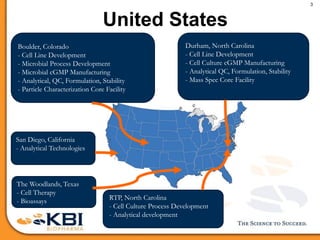
Durham, North Carolina
- Cell Line Development
- Cell Culture cGMP Manufacturing
- Analytical QC, Formulation, Stability
- Mass Spec Core Facility
RTP, North Carolina
- Cell Culture Process Development
- Analytical development
Boulder, Colorado
- Cell Line Development
- Microbial Process Development
- Microbial cGMP Manufacturing
- Analytical, QC, Formulation, Stability
- Particle Characterization Core Facility
The Woodlands, Texas
- Cell Therapy
- Bioassays
San Diego, California
- Analytical Technologies
United States
4
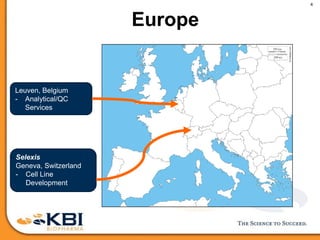
Durham, North Carolina
- Cell Line Development
- Cell Culture cGMP Manufacturing
- Analytical QC, Formulation, Stability
- Mass Spec Core Facility
RTP, North Carolina
- Cell Culture Process Development
- Analytical development
Selexis
Geneva, Switzerland
- Cell Line
Development
Leuven, Belgium
- Analytical/QC
Services
Europe
Programs in mammalian clinical manufacturing at KBI
• Primary emphasis 2011 – 2016 on clinical entry stage programs
• Strong emphasis on science &
• ~ 10-14 IND filings per year supported via development &
manufacturing efforts
• Also supported several stand-alone programs for late-stage process
characterization studies
• Manufacturing capacity ~ 30 batches per year
New areas for KBI
• Acquisition of Selexis to integrate leading high yielding cell line
technology into KBI
• Expansion of train II in manufacturing to boost manufacturing
capacity to > 50 batches per year
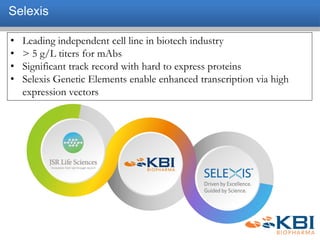
Selexis
• Leading independent cell line in biotech industry
• > 5 g/L titers for mAbs
• Significant track record with hard to express proteins
• Selexis Genetic Elements enable enhanced transcription via high
expression vectors
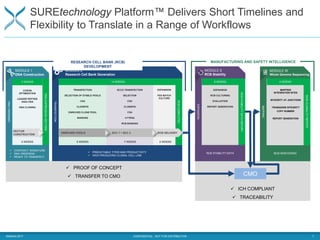
SUREtechnology Platform™ Delivers Short Timelines and
Flexibility to Translate in a Range of Workflows
7
RCB STABILITY DATA
8 WEEKS
RCBSTABILITYDATAREPORT
EXPANSION
RCB CULTURING
EVALUATION
REPORT GENERATION
EXPANSION
MODULE S
RCB Stability
MCB BARCODING
4 WEEKS
MCBCLONALITYREPORT
MAPPING
INTEGRATION SITES
INTEGRITY AT JUNCTIONS
TRANSGENE INTEGRITY
COPY NUMBER
REPORT GENERATION
MAPPING
MODULE W
Whole Genome Sequencing
MANUFACTURING AND SAFETY INTELLIGENCE
 ICH COMPLIANT
 TRACEABILITY
CMO
DNAORDERING
DNAEXPRESSIONVECTORS
 CONTRACT SIGNATURE
 DNA ORDERING
 READY TO TRANSFECT
 PREDICTABLE TITER AND PRODUCTIVITY
 HIGH PRODUCING CLONAL CELL LINE
3 WEEKS
3 WEEKS
5 WEEKS
RCBCOMPLETED
7 WEEKS 2 WEEKS
14 WEEKS
TRANSFECTION
MODULE 1
DNA Construction
MODULE 2
Research Cell Bank Generation
CODON
OPTIMIZATION
LEADER PEPTIDE
ANALYSIS
DNA CLONING
TRANSFECTION
SELECTION OF STABLE POOLS
CSA
CLONEPIX
ENRICHED CLONE POOL
BANKING
SCCO TRANSFECTION
SELECTION
CSA
CLONEPIX
CSA
CYTENA
RCB BANKING
EXPANSION
FED BATCH
CULTURE
RESEARCH CELL BANK (RCB)
DEVELOPMENT
RCB DELIVERYSCC 1 + SCC 2
VECTOR
CONSTRUCTION
ENRICHED POOLS
 PROOF OF CONCEPT
 TRANSFER TO CMO
©Selexis 2017 CONFIDENTIAL - NOT FOR DISTRIBUTION
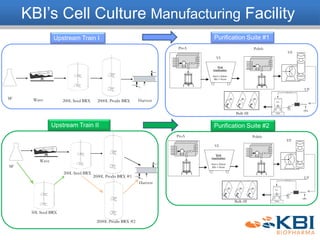
Upstream Train I
Upstream Train II
BPC BPC BPC
ProA
VI
Polish
VF
Bulk fill
KBI’s Cell Culture Manufacturing Facility
Purification Suite #1
2000L Prodn BRX200L Seed BRXWaveSF Harvest
2000L Prodn BRX #1
200L Seed BRX
Wave
SF
Harvest
50L Seed BRX
2000L Prodn BRX #2
Purification Suite #2
BPC BPC BPC
ProA
VI
Polish
VF
Bulk fill
UF
UF
9
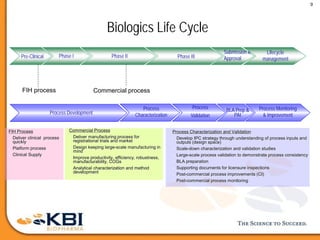
Biologics Life Cycle
Pre-Clinical Phase I Phase II Phase III
Process Development
Process
Characterization
Process
Validation
Process Monitoring
& Improvement
FIH Process
• Deliver clinical process
quickly
• Platform process
• Clinical Supply
Submission &
Approval
Lifecycle
management
BLA Prep &
PAI
Commercial Process
• Deliver manufacturing process for
registrational trials and market
• Design keeping large-scale manufacturing in
mind
• Improve productivity, efficiency, robustness,
manufacturability, COGs
• Analytical characterization and method
development
Process Characterization and Validation
• Develop IPC strategy through understanding of process inputs and
outputs (design space)
• Scale-down characterization and validation studies
• Large-scale process validation to demonstrate process consistency
• BLA preparation
• Supporting documents for licensure inspections
• Post-commercial process improvements (CI)
• Post-commercial process monitoring
FIH process Commercial process
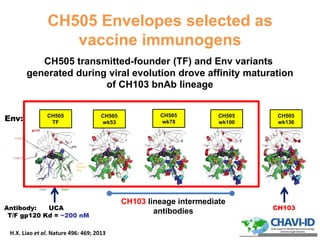
CH505 Envelopes selected as
vaccine immunogens
CH505 transmitted-founder (TF) and Env variants
generated during viral evolution drove affinity maturation
of CH103 bnAb lineage
Antibody: UCA
T/F gp120 Kd = ~200 nM
Env:
CH103
CH505
wk53
CH505
wk78
CH505
wk100
CH103 lineage intermediate
antibodies
CH505
TF
CH505
wk136
10
H.X. Liao et al. Nature 496: 469; 2013
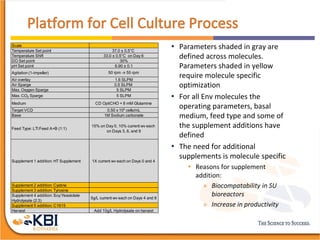
• Parameters shaded in gray are
defined across molecules.
Parameters shaded in yellow
require molecule specific
optimization
• For all Env molecules the
operating parameters, basal
medium, feed type and some of
the supplement additions have
defined
• The need for additional
supplements is molecule specific
• Reasons for supplement
addition:
» Biocompatability in SU
bioreactors
» Increase in productivity
Scale
Temperature Set point 37.0 ± 0.5°C
Temperature Shift 33.0 ± 0.5°C on Day 6
DO Set point 30%
pH Set point 6.90 ± 0.1
Agitation (1-impeller) 50 rpm → 55 rpm
Air overlay 1.6 SLPM
Air Sparge 0.5 SLPM
Max. Oxygen Sparge 5 SLPM
Max. CO2 Sparge 5 SLPM
Medium CD OptiCHO + 8 mM Glutamine
Target VCD 0.50 x 10⁶
cells/mL
Base 1M Sodium carbonate
Feed Type: LTI Feed A+B (1:1)
15% on Day 0, 10% current wv each
on Days 3, 6, and 9
Supplement 1 addition: HT Supplement 1X current wv each on Days 0 and 4
Supplement 2 addition: Cystine
Supplement 3 addition: Tyrosine
Supplement 4 addition: Soy:Yeastolate
Hydrolysate (2:3)
5g/L current wv each on Days 4 and 8
Supplement 5 addition: C1615
Harvest Add 10g/L Hydrolysate on harvest
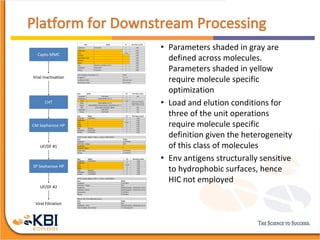
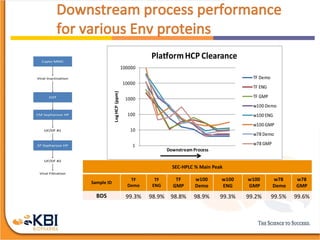
• Parameters shaded in gray are
defined across molecules.
Parameters shaded in yellow
require molecule specific
optimization
• Load and elution conditions for
three of the unit operations
require molecule specific
definition given the heterogeneity
of this class of molecules
• Env antigens structurally sensitive
to hydrophobic surfaces, hence
HIC not employed
1
10
100
1000
10000
100000
LogHCP(ppm)
Downstream Process
PlatformHCP Clearance
TF Demo
TF ENG
TF GMP
w100 Demo
w100 ENG
w100 GMP
w78 Demo
w78 GMP
SEC-HPLC % Main Peak
Sample ID
TF
Demo
TF
ENG
TF
GMP
w100
Demo
w100
ENG
w100
GMP
w78
Demo
w78
GMP
BDS 99.3% 98.9% 98.8% 98.9% 99.3% 99.2% 99.5% 99.6%
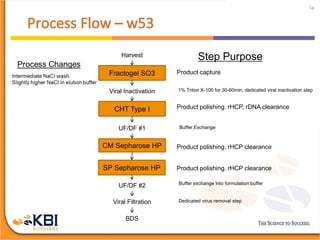
14
Fractogel SO3
CHT Type I
CM Sepharose HP
UF/DF #2
Viral Filtration
SP Sepharose HP
UF/DF #1
Harvest
Viral Inactivation
BDS
Product capture
Product polishing. rHCP, rDNA clearance
Product polishing. rHCP clearance
1% Triton X-100 for 30-60min, dedicated viral inactivation step
Dedicated virus removal step
Step Purpose
Buffer Exchange
Buffer exchange into formulation buffer
UV 1_280 UV 2_254 Cond Conc B pH Fraction Injection Run Log
950900850800750700650600550500450400
120
110
100
90
80
70
60
50
40
30
20
10
55
50
45
40
35
30
25
20
15
10
5
4.A.2
^^^^^
6.A.4
^
6.A.2
^
5.C.5
^
5.C.3
^
5.C.1
^
5.B.4
^
5.B.2
^
5.A.5
^
5.A.3
^
5.A.1
^
3.C.4
^
3.C.2
^
3.B.5
^
3.B.3
^
3.B.1
^
3.A.4
^
3.A.2
^
2.C.5
^
2.C.3
^
2.C.1
^
2.B.4
^
2.B.2
^
2.A.5
^
2.A.3
^
2.A.1
^
1.C.4
^
1.C.2
^
1.B.5
^
1.B.3
^
1.B.1
^
1.A.4
^
1.A.2
^^^^
4.A.1
^^
HolduntilConditionOccurredAirse...>
Datacollectionsettingsadjustedfo...>
End_Block(Issued)(Processing)(...>
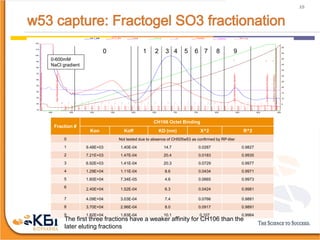
0 1 2 3 4 5 6 7 8 9
0-600mM
NaCl gradient
Fraction #
CH106 Octet Binding
Kon Koff KD (nm) X^2 R^2
0 Not tested due to absence of CH505w53 as confirmed by RP-titer
1 9.48E+03 1.40E-04 14.7 0.0287 0.9827
2 7.21E+03 1.47E-04 20.4 0.0183 0.9935
3 6.92E+03 1.41E-04 20.3 0.0729 0.9977
4 1.29E+04 1.11E-04 8.6 0.0434 0.9971
5 1.60E+04 7.34E-05 4.6 0.0665 0.9973
6
2.40E+04 1.52E-04 6.3 0.0424 0.9981
7 4.09E+04 3.03E-04 7.4 0.0766 0.9881
8 3.70E+04 2.96E-04 8.0 0.0917 0.9891
9 1.82E+04 1.83E-04 10.1 0.107 0.9964
The first three fractions have a weaker affinity for CH106 than the
later eluting fractions
15
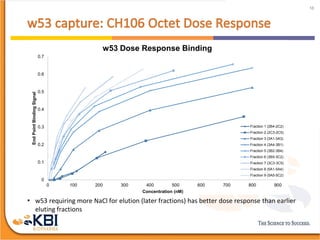
• w53 requiring more NaCl for elution (later fractions) has better dose response than earlier
eluting fractions
0
0.1
0.2
0.3
0.4
0.5
0.6
0.7
0 100 200 300 400 500 600 700 800 900
EndPointBindingSignal
Concentration (nM)
w53 Dose Response Binding
Fraction 1 (2B4-2C2)
Fraction 2 (2C3-2C5)
Fraction 3 (3A1-3A3)
Fraction 4 (3A4-3B1)
Fraction 5 (3B2-3B4)
Fraction 6 (3B5-3C2)
Fraction 7 (3C3-3C5)
Fraction 8 (5A1-5A4)
Fraction 9 (5A5-5C2)
16
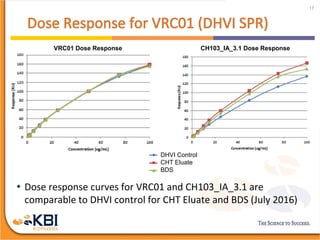
• Dose response curves for VRC01 and CH103_IA_3.1 are
comparable to DHVI control for CHT Eluate and BDS (July 2016)
17
DHVI Control
CHT Eluate
BDS
VRC01 Dose Response CH103_IA_3.1 Dose Response
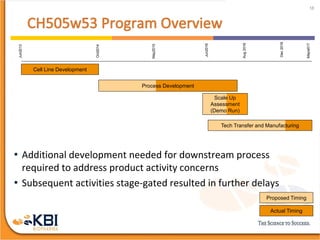
Cell Line Development
Jun2013
Aug2016
Oct2014
18
Jun2016
Mayw017
Scale Up
Assessment
(Demo Run)
May2015
Process Development
Proposed Timing
Actual Timing
• Additional development needed for downstream process
required to address product activity concerns
• Subsequent activities stage-gated resulted in further delays
Tech Transfer and Manufacturing
Dec2016
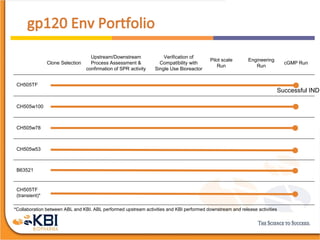
CH505TF
CH505w100
CH505w78
CH505w53
B63521
Clone Selection
Upstream/Downstream
Process Assessment &
confirmation of SPR activity
Verification of
Compatibility with
Single Use Bioreactor
Pilot scale
Run
Engineering
Run
cGMP Run
CH505TF
(transient)*
*Collaboration between ABL and KBI. ABL performed upstream activities and KBI performed downstream and release activities
Successful IND
• Project delayed due to lack of adequate antigenicity
• Change of capture step from Capto MMC to Fractogel SO3
enabled capture of more appropriately glycosylated
species
• ForteBio Octet (BLI) binding used as a rapid
troubleshooting tool for guiding downstream process
alterations
• Significantly higher throughput than SPR (Surface Plasmon
Resonance)
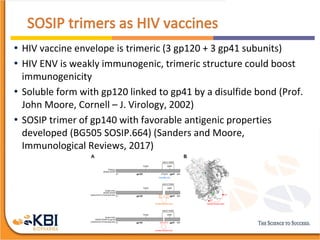
• HIV vaccine envelope is trimeric (3 gp120 + 3 gp41 subunits)
• HIV ENV is weakly immunogenic, trimeric structure could boost
immunogenicity
• Soluble form with gp120 linked to gp41 by a disulfide bond (Prof.
John Moore, Cornell – J. Virology, 2002)
• SOSIP trimer of gp140 with favorable antigenic properties
developed (BG505 SOSIP.664) (Sanders and Moore,
Immunological Reviews, 2017)
• Molecule exists as a non-covalent trimer of covalently
associated heterodimer, gp120 and gp41, approaching 700
kDa in size – exceeding the size traditionally encountered
in bioprocessing
• Process utilized several unit operations typically not
considered scalable (custom affinity chromatography and
size exclusion chromatography), but were considered key
to success of the program
• Due to the custom nature and long lead time for many of
the manufacturing materials and equipment, process
delays were encountered
• Devising a robust viral clearance strategy
23
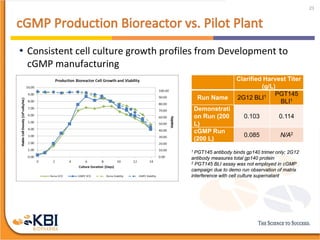
• Consistent cell culture growth profiles from Development to
cGMP manufacturing
Clarified Harvest Titer
(g/L)
Run Name 2G12 BLI1 PGT145
BLI1
Demonstrati
on Run (200
L)
0.103 0.114
cGMP Run
(200 L)
0.085 N/A2
1 PGT145 antibody binds gp140 trimer only; 2G12
antibody measures total gp140 protein
2 PGT145 BLI assay was not employed in cGMP
campaign due to demo run observation of matrix
interference with cell culture supernatant
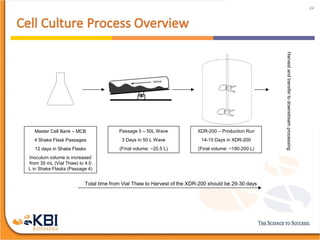
24
Master Cell Bank – MCB
4 Shake Flask Passages
12 days in Shake Flasks
Inoculum volume is increased
from 35 mL (Vial Thaw) to 4.0
L in Shake Flasks (Passage 4)
XDR-200 – Production Run
14-15 Days in XDR-200
(Final volume: ~190-200 L)
Passage 5 – 50L Wave
3 Days in 50 L Wave
(Final volume: ~20.5 L)
Total time from Vial Thaw to Harvest of the XDR-200 should be 29-30 days
Harvestandtransfertodownstreamprocessing
Harvest
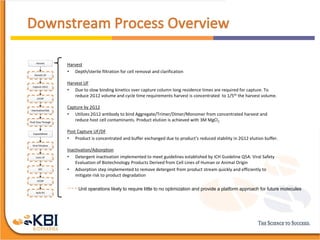
• Depth/sterile filtration for cell removal and clarification
Harvest UF
• Due to slow binding kinetics over capture column long residence times are required for capture. To
reduce 2G12 volume and cycle time requirements harvest is concentrated to 1/5th the harvest volume.
Capture by 2G12
• Utilizes 2G12 antibody to bind Aggregate/Trimer/Dimer/Monomer from concentrated harvest and
reduce host cell contaminants. Product elution is achieved with 3M MgCl2
Post Capture UF/DF
• Product is concentrated and buffer exchanged due to product’s reduced stability in 2G12 elution buffer.
Inactivation/Adsorption
• Detergent inactivation implemented to meet guidelines established by ICH Guideline Q5A: Viral Safety
Evaluation of Biotechnology Products Derived from Cell Lines of Human or Animal Origin
• Adsorption step implemented to remove detergent from product stream quickly and efficiently to
mitigate risk to product degradation
Harvest
Harvest UF
Capture 2G12
UF/DF
Inactivation/Ads
ProA Flow Through
CaptoAdhere
Viral Filtration
Conc UF
SEC
UF/DF
Bulk Fill
Unit operations likely to require little to no optimization and provide a platform approach for future molecules
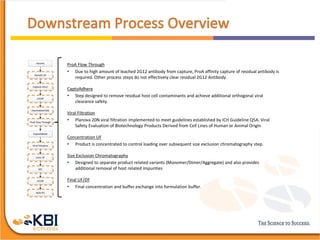
ProA Flow Through
• Due to high amount of leached 2G12 antibody from capture, ProA affinity capture of residual antibody is
required. Other process steps do not effectively clear residual 2G12 Antibody.
CaptoAdhere
• Step designed to remove residual host cell contaminants and achieve additional orthogonal viral
clearance safety.
Viral Filtration
• Planova 20N viral filtration implemented to meet guidelines established by ICH Guideline Q5A: Viral
Safety Evaluation of Biotechnology Products Derived from Cell Lines of Human or Animal Origin
Concentration UF
• Product is concentrated to control loading over subsequent size exclusion chromatography step.
Size Exclusion Chromatography
• Designed to separate product related variants (Monomer/Dimer/Aggregate) and also provides
additional removal of host related impurities
Final UF/DF
• Final concentration and buffer exchange into formulation buffer.
Harvest
Harvest UF
Capture 2G12
UF/DF
Inactivation/Ads
ProA Flow Through
CaptoAdhere
Viral Filtration
Conc UF
SEC
UF/DF
Bulk Fill
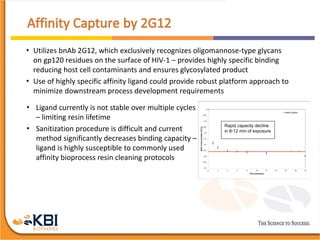
• Utilizes bnAb 2G12, which exclusively recognizes oligomannose-type glycans
on gp120 residues on the surface of HIV-1 – provides highly specific binding
reducing host cell contaminants and ensures glycosylated product
• Use of highly specific affinity ligand could provide robust platform approach to
minimize downstream process development requirements
• Ligand currently is not stable over multiple cycles
– limiting resin lifetime
• Sanitization procedure is difficult and current
method significantly decreases binding capacity –
ligand is highly susceptible to commonly used
affinity bioprocess resin cleaning protocols
Rapid capacity decline
in 8-12 min of exposure
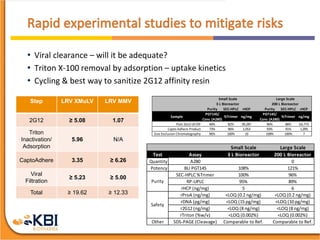
• Viral clearance – will it be adequate?
• Triton X-100 removal by adsorption – uptake kinetics
• Cycling & best way to sanitize 2G12 affinity resin
Step LRV XMuLV LRV MMV
2G12 ≥ 5.08 1.07
Triton
Inactivation/
Adsorption
5.96 N/A
CaptoAdhere 3.35 ≥ 6.26
Viral
Filtration
≥ 5.23 ≥ 5.00
Total ≥ 19.62 ≥ 12.33
Purity SEC-HPLC rHCP Purity SEC-HPLC rHCP
Sample
PGT145/
Conc (A280)
%Trimer ng/mg
PGT145/
Conc (A280)
%Trimer ng/mg
Post 2G12 UF/DF 40% 82% 39,287 96% 88% 63,773
Capto Adhere Product 73% 96% 1,053 93% 91% 1,095
Size Exclusion Chromatography 96% 100% 10 108% 100% 7
Small Scale Large Scale
3 L Bioreactor 200 L Bioreactor
Small Scale Large Scale
Test Assay 3 L Bioreactor 200 L Bioreactor
Quantity A280 0
Potency BLI PGT145 108% 121%
SEC-HPLC %Trimer 100% 96%
RP-UPLC 95% 89%
rHCP (ng/mg) 5 6
rProA (ng/mg) <LOQ (0.2 ng/mg) <LOQ (0.2 ng/mg)
rDNA (pg/mg) <LOQ (15 pg/mg) <LOQ (10 pg/mg)
r2G12 (ng/mg) <LOQ (8 ng/mg) <LOQ (8 ng/mg)
rTriton (%w/v) <LOQ (0.002%) <LOQ (0.002%)
Other SDS-PAGE (Cleavage) Comparable to Ref. Comparable to Ref.
Purity
Safety
Sep2015
200L Scale Up Assessment
(Demo Run)
Tech Transfer and Manufacturing
Sep2016
Jul2016
29
Nov2016
Apr2017
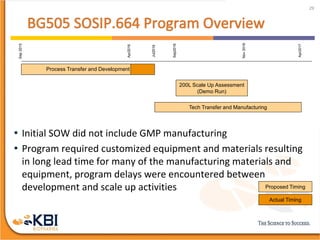
• Initial SOW did not include GMP manufacturing
• Program required customized equipment and materials resulting
in long lead time for many of the manufacturing materials and
equipment, program delays were encountered between
development and scale up activities Proposed Timing
Actual Timing
Process Transfer and Development
Apr2016
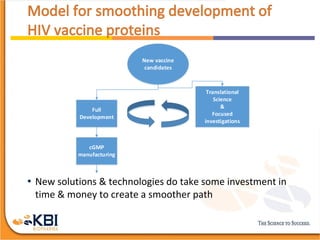
• New solutions & technologies do take some investment in
time & money to create a smoother path
Full
Development
New vaccine
candidates
cGMP
manufacturing
Translational
Science
&
Focused
investigations
31
Conclusions
• Process, analytical and formulation development for a
novel type of proteins cannot be taken for granted
• Requires significant scientific ability and focus
• Unique match with KBI’s scientific and technical
capabilities
• KBI increasing depth in cell line development & boosting
manufacturing capacity
• Timelines, budgets and expectations need to reflect the
development hurdles that can arise with a novel set of
complex biologics
• True partnership & collaboration needed

HIV Vaccines Process Development & Manufacturing - Pitfalls & Possibilities

  • 1.
    HIV Vaccines Process Development& Manufacturing – pitfalls & possibilities Abhinav A. Shukla, Ph.D. Senior Vice President Development & Manufacturing KBI Biopharma, Durham NC HIV Vaccine Manufacturing Workshop – July 19th & 20th, 2017
  • 2.
    2 High throughput process development (HTPD) Modulatingglycosylation a) Cell line b) Cell culture media Platforms for mAbs Platforms for non-mAbsReducing cycle time in production brx a) Frozen inoculum b) High density seed Selective washes for HCP removal Rapid PC/PV leveraging HTPD tools Proprietary cell lines a) DG44 b) Horizon GS-CHO Continuous processing a) Perfusion b) Downstream capture A3 implementa- -tion ELP Protein A Multimodal chrom.
  • 3.
    3 Durham, North Carolina -Cell Line Development - Cell Culture cGMP Manufacturing - Analytical QC, Formulation, Stability - Mass Spec Core Facility RTP, North Carolina - Cell Culture Process Development - Analytical development Boulder, Colorado - Cell Line Development - Microbial Process Development - Microbial cGMP Manufacturing - Analytical, QC, Formulation, Stability - Particle Characterization Core Facility The Woodlands, Texas - Cell Therapy - Bioassays San Diego, California - Analytical Technologies United States
  • 4.
    4 Durham, North Carolina -Cell Line Development - Cell Culture cGMP Manufacturing - Analytical QC, Formulation, Stability - Mass Spec Core Facility RTP, North Carolina - Cell Culture Process Development - Analytical development Selexis Geneva, Switzerland - Cell Line Development Leuven, Belgium - Analytical/QC Services Europe
  • 5.
    Programs in mammalianclinical manufacturing at KBI • Primary emphasis 2011 – 2016 on clinical entry stage programs • Strong emphasis on science & • ~ 10-14 IND filings per year supported via development & manufacturing efforts • Also supported several stand-alone programs for late-stage process characterization studies • Manufacturing capacity ~ 30 batches per year New areas for KBI • Acquisition of Selexis to integrate leading high yielding cell line technology into KBI • Expansion of train II in manufacturing to boost manufacturing capacity to > 50 batches per year
  • 6.
    Selexis • Leading independentcell line in biotech industry • > 5 g/L titers for mAbs • Significant track record with hard to express proteins • Selexis Genetic Elements enable enhanced transcription via high expression vectors
  • 7.
    SUREtechnology Platform™ DeliversShort Timelines and Flexibility to Translate in a Range of Workflows 7 RCB STABILITY DATA 8 WEEKS RCBSTABILITYDATAREPORT EXPANSION RCB CULTURING EVALUATION REPORT GENERATION EXPANSION MODULE S RCB Stability MCB BARCODING 4 WEEKS MCBCLONALITYREPORT MAPPING INTEGRATION SITES INTEGRITY AT JUNCTIONS TRANSGENE INTEGRITY COPY NUMBER REPORT GENERATION MAPPING MODULE W Whole Genome Sequencing MANUFACTURING AND SAFETY INTELLIGENCE  ICH COMPLIANT  TRACEABILITY CMO DNAORDERING DNAEXPRESSIONVECTORS  CONTRACT SIGNATURE  DNA ORDERING  READY TO TRANSFECT  PREDICTABLE TITER AND PRODUCTIVITY  HIGH PRODUCING CLONAL CELL LINE 3 WEEKS 3 WEEKS 5 WEEKS RCBCOMPLETED 7 WEEKS 2 WEEKS 14 WEEKS TRANSFECTION MODULE 1 DNA Construction MODULE 2 Research Cell Bank Generation CODON OPTIMIZATION LEADER PEPTIDE ANALYSIS DNA CLONING TRANSFECTION SELECTION OF STABLE POOLS CSA CLONEPIX ENRICHED CLONE POOL BANKING SCCO TRANSFECTION SELECTION CSA CLONEPIX CSA CYTENA RCB BANKING EXPANSION FED BATCH CULTURE RESEARCH CELL BANK (RCB) DEVELOPMENT RCB DELIVERYSCC 1 + SCC 2 VECTOR CONSTRUCTION ENRICHED POOLS  PROOF OF CONCEPT  TRANSFER TO CMO ©Selexis 2017 CONFIDENTIAL - NOT FOR DISTRIBUTION
  • 8.
    Upstream Train I UpstreamTrain II BPC BPC BPC ProA VI Polish VF Bulk fill KBI’s Cell Culture Manufacturing Facility Purification Suite #1 2000L Prodn BRX200L Seed BRXWaveSF Harvest 2000L Prodn BRX #1 200L Seed BRX Wave SF Harvest 50L Seed BRX 2000L Prodn BRX #2 Purification Suite #2 BPC BPC BPC ProA VI Polish VF Bulk fill UF UF
  • 9.
    9 Biologics Life Cycle Pre-ClinicalPhase I Phase II Phase III Process Development Process Characterization Process Validation Process Monitoring & Improvement FIH Process • Deliver clinical process quickly • Platform process • Clinical Supply Submission & Approval Lifecycle management BLA Prep & PAI Commercial Process • Deliver manufacturing process for registrational trials and market • Design keeping large-scale manufacturing in mind • Improve productivity, efficiency, robustness, manufacturability, COGs • Analytical characterization and method development Process Characterization and Validation • Develop IPC strategy through understanding of process inputs and outputs (design space) • Scale-down characterization and validation studies • Large-scale process validation to demonstrate process consistency • BLA preparation • Supporting documents for licensure inspections • Post-commercial process improvements (CI) • Post-commercial process monitoring FIH process Commercial process
  • 10.
    CH505 Envelopes selectedas vaccine immunogens CH505 transmitted-founder (TF) and Env variants generated during viral evolution drove affinity maturation of CH103 bnAb lineage Antibody: UCA T/F gp120 Kd = ~200 nM Env: CH103 CH505 wk53 CH505 wk78 CH505 wk100 CH103 lineage intermediate antibodies CH505 TF CH505 wk136 10 H.X. Liao et al. Nature 496: 469; 2013
  • 11.
    • Parameters shadedin gray are defined across molecules. Parameters shaded in yellow require molecule specific optimization • For all Env molecules the operating parameters, basal medium, feed type and some of the supplement additions have defined • The need for additional supplements is molecule specific • Reasons for supplement addition: » Biocompatability in SU bioreactors » Increase in productivity Scale Temperature Set point 37.0 ± 0.5°C Temperature Shift 33.0 ± 0.5°C on Day 6 DO Set point 30% pH Set point 6.90 ± 0.1 Agitation (1-impeller) 50 rpm → 55 rpm Air overlay 1.6 SLPM Air Sparge 0.5 SLPM Max. Oxygen Sparge 5 SLPM Max. CO2 Sparge 5 SLPM Medium CD OptiCHO + 8 mM Glutamine Target VCD 0.50 x 10⁶ cells/mL Base 1M Sodium carbonate Feed Type: LTI Feed A+B (1:1) 15% on Day 0, 10% current wv each on Days 3, 6, and 9 Supplement 1 addition: HT Supplement 1X current wv each on Days 0 and 4 Supplement 2 addition: Cystine Supplement 3 addition: Tyrosine Supplement 4 addition: Soy:Yeastolate Hydrolysate (2:3) 5g/L current wv each on Days 4 and 8 Supplement 5 addition: C1615 Harvest Add 10g/L Hydrolysate on harvest
  • 12.
    • Parameters shadedin gray are defined across molecules. Parameters shaded in yellow require molecule specific optimization • Load and elution conditions for three of the unit operations require molecule specific definition given the heterogeneity of this class of molecules • Env antigens structurally sensitive to hydrophobic surfaces, hence HIC not employed
  • 13.
    1 10 100 1000 10000 100000 LogHCP(ppm) Downstream Process PlatformHCP Clearance TFDemo TF ENG TF GMP w100 Demo w100 ENG w100 GMP w78 Demo w78 GMP SEC-HPLC % Main Peak Sample ID TF Demo TF ENG TF GMP w100 Demo w100 ENG w100 GMP w78 Demo w78 GMP BDS 99.3% 98.9% 98.8% 98.9% 99.3% 99.2% 99.5% 99.6%
  • 14.
    14 Fractogel SO3 CHT TypeI CM Sepharose HP UF/DF #2 Viral Filtration SP Sepharose HP UF/DF #1 Harvest Viral Inactivation BDS Product capture Product polishing. rHCP, rDNA clearance Product polishing. rHCP clearance Product polishing. rHCP clearance 1% Triton X-100 for 30-60min, dedicated viral inactivation step Dedicated virus removal step Step Purpose Buffer Exchange Buffer exchange into formulation buffer
  • 15.
    UV 1_280 UV2_254 Cond Conc B pH Fraction Injection Run Log 950900850800750700650600550500450400 120 110 100 90 80 70 60 50 40 30 20 10 55 50 45 40 35 30 25 20 15 10 5 4.A.2 ^^^^^ 6.A.4 ^ 6.A.2 ^ 5.C.5 ^ 5.C.3 ^ 5.C.1 ^ 5.B.4 ^ 5.B.2 ^ 5.A.5 ^ 5.A.3 ^ 5.A.1 ^ 3.C.4 ^ 3.C.2 ^ 3.B.5 ^ 3.B.3 ^ 3.B.1 ^ 3.A.4 ^ 3.A.2 ^ 2.C.5 ^ 2.C.3 ^ 2.C.1 ^ 2.B.4 ^ 2.B.2 ^ 2.A.5 ^ 2.A.3 ^ 2.A.1 ^ 1.C.4 ^ 1.C.2 ^ 1.B.5 ^ 1.B.3 ^ 1.B.1 ^ 1.A.4 ^ 1.A.2 ^^^^ 4.A.1 ^^ HolduntilConditionOccurredAirse...> Datacollectionsettingsadjustedfo...> Datacollectionsettingsadjustedfo...> End_Block(Issued)(Processing)(...> End_Block(Issued)(Processing)(...> 0 1 2 3 4 5 6 7 8 9 0-600mM NaCl gradient Fraction # CH106 Octet Binding Kon Koff KD (nm) X^2 R^2 0 Not tested due to absence of CH505w53 as confirmed by RP-titer 1 9.48E+03 1.40E-04 14.7 0.0287 0.9827 2 7.21E+03 1.47E-04 20.4 0.0183 0.9935 3 6.92E+03 1.41E-04 20.3 0.0729 0.9977 4 1.29E+04 1.11E-04 8.6 0.0434 0.9971 5 1.60E+04 7.34E-05 4.6 0.0665 0.9973 6 2.40E+04 1.52E-04 6.3 0.0424 0.9981 7 4.09E+04 3.03E-04 7.4 0.0766 0.9881 8 3.70E+04 2.96E-04 8.0 0.0917 0.9891 9 1.82E+04 1.83E-04 10.1 0.107 0.9964 The first three fractions have a weaker affinity for CH106 than the later eluting fractions 15
  • 16.
    • w53 requiringmore NaCl for elution (later fractions) has better dose response than earlier eluting fractions 0 0.1 0.2 0.3 0.4 0.5 0.6 0.7 0 100 200 300 400 500 600 700 800 900 EndPointBindingSignal Concentration (nM) w53 Dose Response Binding Fraction 1 (2B4-2C2) Fraction 2 (2C3-2C5) Fraction 3 (3A1-3A3) Fraction 4 (3A4-3B1) Fraction 5 (3B2-3B4) Fraction 6 (3B5-3C2) Fraction 7 (3C3-3C5) Fraction 8 (5A1-5A4) Fraction 9 (5A5-5C2) 16
  • 17.
    • Dose responsecurves for VRC01 and CH103_IA_3.1 are comparable to DHVI control for CHT Eluate and BDS (July 2016) 17 DHVI Control CHT Eluate BDS VRC01 Dose Response CH103_IA_3.1 Dose Response
  • 18.
    Cell Line Development Jun2013 Aug2016 Oct2014 18 Jun2016 Mayw017 ScaleUp Assessment (Demo Run) May2015 Process Development Proposed Timing Actual Timing • Additional development needed for downstream process required to address product activity concerns • Subsequent activities stage-gated resulted in further delays Tech Transfer and Manufacturing Dec2016
  • 19.
    CH505TF CH505w100 CH505w78 CH505w53 B63521 Clone Selection Upstream/Downstream Process Assessment& confirmation of SPR activity Verification of Compatibility with Single Use Bioreactor Pilot scale Run Engineering Run cGMP Run CH505TF (transient)* *Collaboration between ABL and KBI. ABL performed upstream activities and KBI performed downstream and release activities Successful IND
  • 20.
    • Project delayeddue to lack of adequate antigenicity • Change of capture step from Capto MMC to Fractogel SO3 enabled capture of more appropriately glycosylated species • ForteBio Octet (BLI) binding used as a rapid troubleshooting tool for guiding downstream process alterations • Significantly higher throughput than SPR (Surface Plasmon Resonance)
  • 21.
    • HIV vaccineenvelope is trimeric (3 gp120 + 3 gp41 subunits) • HIV ENV is weakly immunogenic, trimeric structure could boost immunogenicity • Soluble form with gp120 linked to gp41 by a disulfide bond (Prof. John Moore, Cornell – J. Virology, 2002) • SOSIP trimer of gp140 with favorable antigenic properties developed (BG505 SOSIP.664) (Sanders and Moore, Immunological Reviews, 2017)
  • 22.
    • Molecule existsas a non-covalent trimer of covalently associated heterodimer, gp120 and gp41, approaching 700 kDa in size – exceeding the size traditionally encountered in bioprocessing • Process utilized several unit operations typically not considered scalable (custom affinity chromatography and size exclusion chromatography), but were considered key to success of the program • Due to the custom nature and long lead time for many of the manufacturing materials and equipment, process delays were encountered • Devising a robust viral clearance strategy
  • 23.
    23 • Consistent cellculture growth profiles from Development to cGMP manufacturing Clarified Harvest Titer (g/L) Run Name 2G12 BLI1 PGT145 BLI1 Demonstrati on Run (200 L) 0.103 0.114 cGMP Run (200 L) 0.085 N/A2 1 PGT145 antibody binds gp140 trimer only; 2G12 antibody measures total gp140 protein 2 PGT145 BLI assay was not employed in cGMP campaign due to demo run observation of matrix interference with cell culture supernatant
  • 24.
    24 Master Cell Bank– MCB 4 Shake Flask Passages 12 days in Shake Flasks Inoculum volume is increased from 35 mL (Vial Thaw) to 4.0 L in Shake Flasks (Passage 4) XDR-200 – Production Run 14-15 Days in XDR-200 (Final volume: ~190-200 L) Passage 5 – 50L Wave 3 Days in 50 L Wave (Final volume: ~20.5 L) Total time from Vial Thaw to Harvest of the XDR-200 should be 29-30 days Harvestandtransfertodownstreamprocessing
  • 25.
    Harvest • Depth/sterile filtrationfor cell removal and clarification Harvest UF • Due to slow binding kinetics over capture column long residence times are required for capture. To reduce 2G12 volume and cycle time requirements harvest is concentrated to 1/5th the harvest volume. Capture by 2G12 • Utilizes 2G12 antibody to bind Aggregate/Trimer/Dimer/Monomer from concentrated harvest and reduce host cell contaminants. Product elution is achieved with 3M MgCl2 Post Capture UF/DF • Product is concentrated and buffer exchanged due to product’s reduced stability in 2G12 elution buffer. Inactivation/Adsorption • Detergent inactivation implemented to meet guidelines established by ICH Guideline Q5A: Viral Safety Evaluation of Biotechnology Products Derived from Cell Lines of Human or Animal Origin • Adsorption step implemented to remove detergent from product stream quickly and efficiently to mitigate risk to product degradation Harvest Harvest UF Capture 2G12 UF/DF Inactivation/Ads ProA Flow Through CaptoAdhere Viral Filtration Conc UF SEC UF/DF Bulk Fill Unit operations likely to require little to no optimization and provide a platform approach for future molecules
  • 26.
    ProA Flow Through •Due to high amount of leached 2G12 antibody from capture, ProA affinity capture of residual antibody is required. Other process steps do not effectively clear residual 2G12 Antibody. CaptoAdhere • Step designed to remove residual host cell contaminants and achieve additional orthogonal viral clearance safety. Viral Filtration • Planova 20N viral filtration implemented to meet guidelines established by ICH Guideline Q5A: Viral Safety Evaluation of Biotechnology Products Derived from Cell Lines of Human or Animal Origin Concentration UF • Product is concentrated to control loading over subsequent size exclusion chromatography step. Size Exclusion Chromatography • Designed to separate product related variants (Monomer/Dimer/Aggregate) and also provides additional removal of host related impurities Final UF/DF • Final concentration and buffer exchange into formulation buffer. Harvest Harvest UF Capture 2G12 UF/DF Inactivation/Ads ProA Flow Through CaptoAdhere Viral Filtration Conc UF SEC UF/DF Bulk Fill
  • 27.
    • Utilizes bnAb2G12, which exclusively recognizes oligomannose-type glycans on gp120 residues on the surface of HIV-1 – provides highly specific binding reducing host cell contaminants and ensures glycosylated product • Use of highly specific affinity ligand could provide robust platform approach to minimize downstream process development requirements • Ligand currently is not stable over multiple cycles – limiting resin lifetime • Sanitization procedure is difficult and current method significantly decreases binding capacity – ligand is highly susceptible to commonly used affinity bioprocess resin cleaning protocols Rapid capacity decline in 8-12 min of exposure
  • 28.
    • Viral clearance– will it be adequate? • Triton X-100 removal by adsorption – uptake kinetics • Cycling & best way to sanitize 2G12 affinity resin Step LRV XMuLV LRV MMV 2G12 ≥ 5.08 1.07 Triton Inactivation/ Adsorption 5.96 N/A CaptoAdhere 3.35 ≥ 6.26 Viral Filtration ≥ 5.23 ≥ 5.00 Total ≥ 19.62 ≥ 12.33 Purity SEC-HPLC rHCP Purity SEC-HPLC rHCP Sample PGT145/ Conc (A280) %Trimer ng/mg PGT145/ Conc (A280) %Trimer ng/mg Post 2G12 UF/DF 40% 82% 39,287 96% 88% 63,773 Capto Adhere Product 73% 96% 1,053 93% 91% 1,095 Size Exclusion Chromatography 96% 100% 10 108% 100% 7 Small Scale Large Scale 3 L Bioreactor 200 L Bioreactor Small Scale Large Scale Test Assay 3 L Bioreactor 200 L Bioreactor Quantity A280 0 Potency BLI PGT145 108% 121% SEC-HPLC %Trimer 100% 96% RP-UPLC 95% 89% rHCP (ng/mg) 5 6 rProA (ng/mg) <LOQ (0.2 ng/mg) <LOQ (0.2 ng/mg) rDNA (pg/mg) <LOQ (15 pg/mg) <LOQ (10 pg/mg) r2G12 (ng/mg) <LOQ (8 ng/mg) <LOQ (8 ng/mg) rTriton (%w/v) <LOQ (0.002%) <LOQ (0.002%) Other SDS-PAGE (Cleavage) Comparable to Ref. Comparable to Ref. Purity Safety
  • 29.
    Sep2015 200L Scale UpAssessment (Demo Run) Tech Transfer and Manufacturing Sep2016 Jul2016 29 Nov2016 Apr2017 • Initial SOW did not include GMP manufacturing • Program required customized equipment and materials resulting in long lead time for many of the manufacturing materials and equipment, program delays were encountered between development and scale up activities Proposed Timing Actual Timing Process Transfer and Development Apr2016
  • 30.
    • New solutions& technologies do take some investment in time & money to create a smoother path Full Development New vaccine candidates cGMP manufacturing Translational Science & Focused investigations
  • 31.
    31 Conclusions • Process, analyticaland formulation development for a novel type of proteins cannot be taken for granted • Requires significant scientific ability and focus • Unique match with KBI’s scientific and technical capabilities • KBI increasing depth in cell line development & boosting manufacturing capacity • Timelines, budgets and expectations need to reflect the development hurdles that can arise with a novel set of complex biologics • True partnership & collaboration needed