
Confidential
High-throughput and
automated process
development for
accelerated
biotherapeutic
manufacturing
Derek Ryan, Ph.D.
Senior Scientist, Analytical Development
KBI Biopharma, Inc.
Confidential
2
KBI Biopharma’s mission is to accelerate the development of
innovative discoveries into life-changing biological products
& expand global access of medicines to patients in need
KBI Mission Statement
Confidential
3
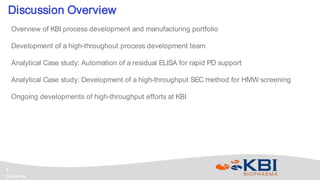
Discussion Overview
Overview of KBI process development and manufacturing portfolio
Development of a high-throughout process development team
Analytical Case study: Automation of a residual ELISA for rapid PD support
Analytical Case study: Development of a high-throughput SEC method for HMW screening
Ongoing developments of high-throughput efforts at KBI
Confidential
4
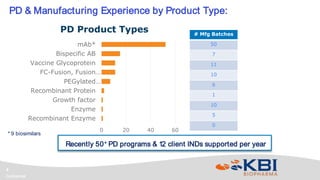
PD & Manufacturing Experience by Product Type:
* 9 biosimilars
Recently 50+ PD programs & 12 client INDs supported per year
# Mfg Batches
50
7
11
10
6
1
10
5
0
0 20 40 60
Recombinant Enzyme
Enzyme
Growth factor
Recombinant Protein
PEGylated…
FC-Fusion, Fusion…
Vaccine Glycoprotein
Bispecific AB
mAb*
PD Product Types
Confidential
5
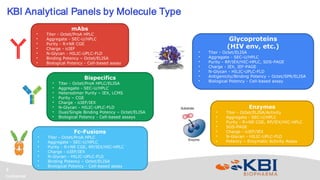
KBI Analytical Panels by Molecule Type
mAbs
• Titer - Octet/ProA HPLC
• Aggregate - SEC-U/HPLC
• Purity - R+NR CGE
• Charge - icIEF
• N-Glycan - HILIC-UPLC-FLD
• Binding Potency – Octet/ELISA
• Biological Potency - Cell-based assay
Fc-Fusions
• Titer - Octet/ProA HPLC
• Aggregate - SEC-U/HPLC
• Purity - R+NR CGE, RP/IEX/HIC-HPLC
• Charge - icIEF/IEX
• N-Glycan - HILIC-UPLC-FLD
• Binding Potency – Octet/ELISA
• Biological Potency - Cell-based assay
Bispecifics
• Titer - Octet/ProA HPLC/ELISA
• Aggregate - SEC-U/HPLC
• Heterodimer Purity – IEX, LCMS
• Purity – CGE
• Charge - icIEF/IEX
• N-Glycan - HILIC-UPLC-FLD
• Dual/Single Binding Potency – Octet/ELISA
• Biological Potency - Cell-based assays
Glycoproteins
(HIV env, etc.)
• Titer - Octet/ELISA
• Aggregate - SEC-U/HPLC
• Purity - RP/IEX/HIC-HPLC, SDS-PAGE
• Charge - IEX, IEF-PAGE
• N-Glycan - HILIC-UPLC-FLD
• Antigenicity/Binding Potency – Octet/SPR/ELISA
• Biological Potency - Cell-based assay
Enzymes
• Titer - Octet/ELISA/Activity
• Aggregate - SEC-U/HPLC
• Purity - R+NR CGE, RP/IEX/HIC-HPLC
• SDS-PAGE
• Charge - icIEF/IEX
• N-Glycan - HILIC-UPLC-FLD
• Potency – Enzymatic Activity Assay
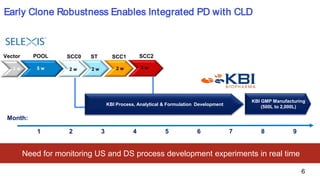
6
5 w
POOL
3 w
Vector
2 w
SCC0
2 w
ST
2 w
SCC1
3 w
SCC2
Early Clone Robustness Enables Integrated PD with CLD
Need for monitoring US and DS process development experiments in real time
KBI Process, Analytical & Formulation Development
KBI GMP Manufacturing
(500L to 2,000L)
Month:
1 2 3 4 5 6 7 8 9
Confidential
7
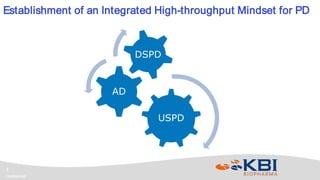
Establishment of an Integrated High-throughput Mindset for PD
USPD
AD
DSPD
Confidential
8
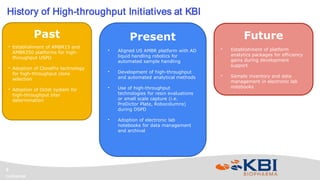
History of High-throughput Initiatives at KBI
Present
• Aligned US AMBR platform with AD
liquid handling robotics for
automated sample handling
• Development of high-throughput
and automated analytical methods
• Use of high-throughput
technologies for resin evaluations
or small scale capture (i.e.
PreDictor Plate, Robocolumns)
during DSPD
• Adoption of electronic lab
notebooks for data management
and archival
Future
• Establishment of platform
analytics packages for efficiency
gains during development
support
• Sample inventory and data
management in electronic lab
notebooks
Past
• Establishment of AMBR15 and
AMBR250 platforms for high-
throughput USPD
• Adoption of ClonePix technology
for high-throughput clone
selection
• Adoption of Octet system for
high-throughput titer
determination
Confidential
9
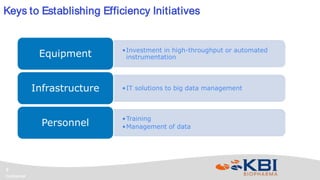
Keys to Establishing Efficiency Initiatives
•Investment in high-throughput or automated
instrumentationEquipment
•IT solutions to big data managementInfrastructure
•Training
•Management of dataPersonnel
Confidential
10
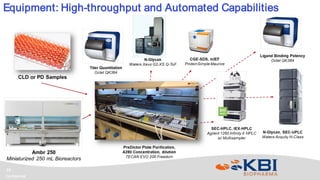
Equipment: High-throughput and Automated Capabilities
Confidential
11
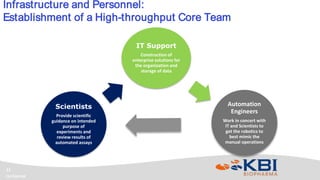
Infrastructure and Personnel:
Establishment of a High-throughput Core Team
IT Support
Construction of
enterprise solutions for
the organization and
storage of data
Automation
Engineers
Work in concert with
IT and Scientists to
get the robotics to
best mimic the
manual operations
Scientists
Provide scientific
guidance on intended
purpose of
experiments and
review results of
automated assays
Confidential
12
As more development programs are onboarded for upstream
and downstream process development an increase in
submission to AD for PQ occurs
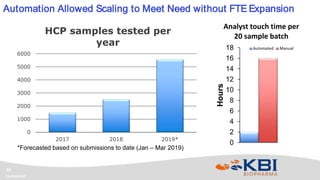
Automation of assay decreases FTE effort and data TAT
Potential improvement in data quality by reducing %CV
Allow for more assays to be setup in parallel by fewer FTE
Case Study: Automation of residual host cell protein ELISA
Confidential
13
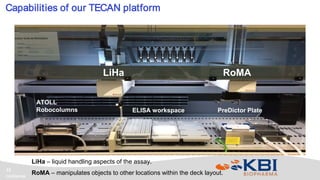
Capabilities of our TECAN platform
LiHa – liquid handling aspects of the assay.
RoMA – manipulates objects to other locations within the deck layout.
RoMALiHa
PreDictor Plate
ATOLL
Robocolumns ELISA workspace
Confidential
14
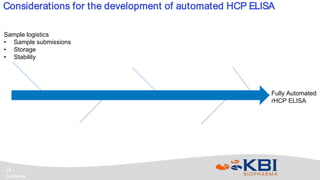
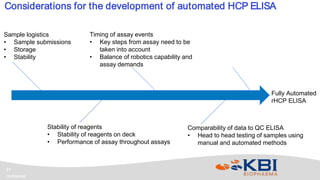
Considerations for the development of automated HCP ELISA
Fully Automated
rHCP ELISA
Sample logistics
• Sample submissions
• Storage
• Stability
Confidential
15
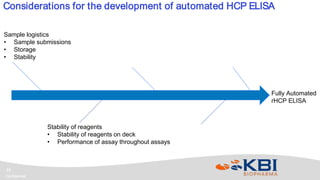
Considerations for the development of automated HCP ELISA
Fully Automated
rHCP ELISA
Sample logistics
• Sample submissions
• Storage
• Stability
Stability of reagents
• Stability of reagents on deck
• Performance of assay throughout assays
Confidential
16
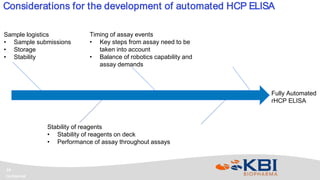
Considerations for the development of automated HCP ELISA
Fully Automated
rHCP ELISA
Sample logistics
• Sample submissions
• Storage
• Stability
Stability of reagents
• Stability of reagents on deck
• Performance of assay throughout assays
Timing of assay events
• Key steps from assay need to be
taken into account
• Balance of robotics capability and
assay demands
Confidential
17
Considerations for the development of automated HCP ELISA
Fully Automated
rHCP ELISA
Sample logistics
• Sample submissions
• Storage
• Stability
Stability of reagents
• Stability of reagents on deck
• Performance of assay throughout assays
Timing of assay events
• Key steps from assay need to be
taken into account
• Balance of robotics capability and
assay demands
Comparability of data to QC ELISA
• Head to head testing of samples using
manual and automated methods
Confidential
18
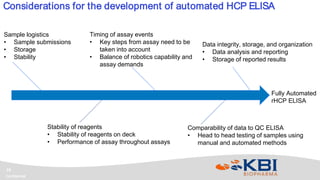
Considerations for the development of automated HCP ELISA
Fully Automated
rHCP ELISA
Sample logistics
• Sample submissions
• Storage
• Stability
Stability of reagents
• Stability of reagents on deck
• Performance of assay throughout assays
Timing of assay events
• Key steps from assay need to be
taken into account
• Balance of robotics capability and
assay demands
Comparability of data to QC ELISA
• Head to head testing of samples using
manual and automated methods
Data integrity, storage, and organization
• Data analysis and reporting
• Storage of reported results
Confidential
19
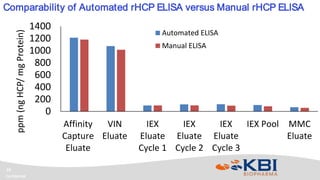
Comparability of Automated rHCP ELISA versus Manual rHCP ELISA
0
200
400
600
800
1000
1200
1400
Affinity
Capture
Eluate
VIN
Eluate
IEX
Eluate
Cycle 1
IEX
Eluate
Cycle 2
IEX
Eluate
Cycle 3
IEX Pool MMC
Eluate
ppm(ngHCP/mgProtein)
Automated ELISA
Manual ELISA
Confidential
20
Automation Allowed Scaling to Meet Need without FTE Expansion
0
2
4
6
8
10
12
14
16
18
Hours
Analyst touch time per
20 sample batch
Automated Manual
0
1000
2000
3000
4000
5000
6000
2017 2018 2019*
HCP samples tested per
year
*Forecasted based on submissions to date (Jan – Mar 2019)
Confidential
21
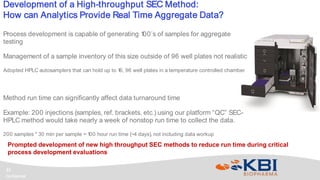
Process development is capable of generating 100’s of samples for aggregate
testing
Management of a sample inventory of this size outside of 96 well plates not realistic
Adopted HPLC autosamplers that can hold up to 16, 96 well plates in a temperature controlled chamber
Method run time can significantly affect data turnaround time
Example: 200 injections (samples, ref. brackets, etc.) using our platform “QC” SEC-
HPLC method would take nearly a week of nonstop run time to collect the data.
200 samples * 30 min per sample = 100 hour run time (~4 days), not including data workup
Development of a High-throughput SEC Method:
How can Analytics Provide Real Time Aggregate Data?
Prompted development of new high throughput SEC methods to reduce run time during critical
process development evaluations
Confidential
22
Acq Method Set: UPSW3000 3_INS3624
AU
0.00
0.05
0.10
0.15
0.20
0.25
0.30
Acq Method Set: UPSW3000 4_INS3624
AU
0.00
0.05
0.10
0.15
0.20
0.25
0.30
Acq Method Set: UPSW3000_INS3624
AU
0.00
0.05
0.10
0.15
0.20
0.25
0.30
Minutes
0.20 0.40 0.60 0.80 1.00 1.20 1.40 1.60 1.80 2.00 2.20 2.40 2.60 2.80 3.00 3.20 3.40 3.60 3.80 4.00 4.20 4.40 4.60 4.80 5.00 5.20 5.40 5.60 5.80 6.00 6.20 6.40 6.60 6.80 7.00 7.20 7.40 7.60 7.80 8.00 8.20 8.40 8.60 8.80 9.00 9.20 9.40 9.60 9.80 10.00
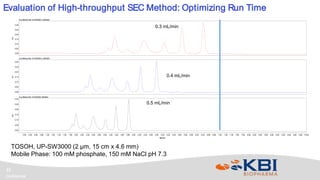
Evaluation of High-throughput SEC Method: Optimizing Run Time
0.3 mL/min
0.4 mL/min
0.5 mL/min
TOSOH, UP-SW3000 (2 µm, 15 cm x 4.6 mm)
Mobile Phase: 100 mM phosphate, 150 mM NaCl pH 7.3
Confidential
23
3.037
Main-3.420
4.178
4.982
AU
0.000
0.005
0.010
0.015
0.020
0.025
0.030
0.035
Minutes
1.80 2.00 2.20 2.40 2.60 2.80 3.00 3.20 3.40 3.60 3.80 4.00 4.20 4.40 4.60 4.80 5.00 5.20 5.40 5.60 5.80 6.00
12.855
13.584
Main-15.695
19.549
AU
-0.002
0.000
0.002
0.004
0.006
0.008
0.010
0.012
0.014
0.016
0.018
0.020
Minutes
11.00 12.00 13.00 14.00 15.00 16.00 17.00 18.00 19.00 20.00 21.00 22.00 23.00 24.00
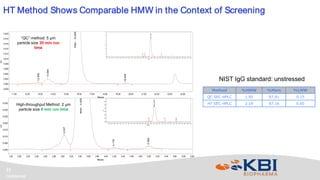
HT Method Shows Comparable HMW in the Context of Screening
“QC” method: 5 µm
particle size 30 min run
time
High-throughput Method: 2 µm
particle size 6 min run time
Method %HMW %Main %LMW
QC SEC-HPLC 1.95 97.91 0.15
HT SEC-HPLC 2.19 97.16 0.65
NIST IgG standard: unstressed
12.855
13.584
Main-15.695
19.549
AU
0.00
0.02
0.04
0.06
0.08
0.10
0.12
0.14
0.16
0.18
Minutes
0.00 1.00 2.00 3.00 4.00 5.00 6.00 7.00 8.00 9.00 10.00 11.00 12.00 13.00 14.00 15.00 16.00 17.00 18.00 19.00 20.00 21.00 22.00 23.00 24.00 25.00 26.00 27.00 28.00 29.00 30.00
3.037
Main-3.420
4.178
4.982
AU
0.00
0.10
0.20
0.30
0.40
0.50
0.60
Minutes
0.20 0.40 0.60 0.80 1.00 1.20 1.40 1.60 1.80 2.00 2.20 2.40 2.60 2.80 3.00 3.20 3.40 3.60 3.80 4.00 4.20 4.40 4.60 4.80 5.00 5.20 5.40 5.60 5.80 6.00
Confidential
24
3.037
Main-3.420
4.178
4.982
AU
0.000
0.005
0.010
0.015
0.020
0.025
0.030
0.035
Minutes
1.80 2.00 2.20 2.40 2.60 2.80 3.00 3.20 3.40 3.60 3.80 4.00 4.20 4.40 4.60 4.80 5.00 5.20 5.40 5.60 5.80 6.00
12.855
13.584
Main-15.695
19.549
AU
-0.002
0.000
0.002
0.004
0.006
0.008
0.010
0.012
0.014
0.016
0.018
0.020
Minutes
11.00 12.00 13.00 14.00 15.00 16.00 17.00 18.00 19.00 20.00 21.00 22.00 23.00 24.00
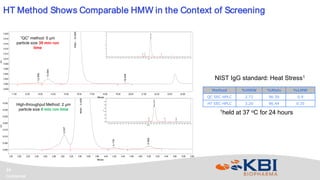
“QC” method: 5 µm
particle size 30 min run
time
High-throughput Method: 2 µm
particle size 6 min run time
Method %HMW %Main %LMW
QC SEC-HPLC 2.72 96.39 0.9
HT SEC-HPLC 3.20 96.44 0.35
NIST IgG standard: Heat Stress1
12.855
13.584
Main-15.695
19.549
AU
0.00
0.02
0.04
0.06
0.08
0.10
0.12
0.14
0.16
0.18
Minutes
0.00 1.00 2.00 3.00 4.00 5.00 6.00 7.00 8.00 9.00 10.00 11.00 12.00 13.00 14.00 15.00 16.00 17.00 18.00 19.00 20.00 21.00 22.00 23.00 24.00 25.00 26.00 27.00 28.00 29.00 30.00
3.037
Main-3.420
4.178
4.982
AU
0.00
0.10
0.20
0.30
0.40
0.50
0.60
Minutes
0.20 0.40 0.60 0.80 1.00 1.20 1.40 1.60 1.80 2.00 2.20 2.40 2.60 2.80 3.00 3.20 3.40 3.60 3.80 4.00 4.20 4.40 4.60 4.80 5.00 5.20 5.40 5.60 5.80 6.00
1held at 37 oC for 24 hours
HT Method Shows Comparable HMW in the Context of Screening
Confidential
25
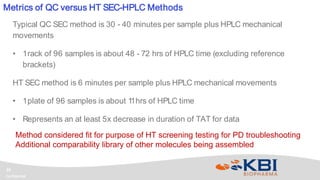
Typical QC SEC method is 30 - 40 minutes per sample plus HPLC mechanical
movements
• 1rack of 96 samples is about 48 - 72 hrs of HPLC time (excluding reference
brackets)
HT SEC method is 6 minutes per sample plus HPLC mechanical movements
• 1plate of 96 samples is about 11hrs of HPLC time
• Represents an at least 5x decrease in duration of TAT for data
Metrics of QC versus HT SEC-HPLC Methods
Method considered fit for purpose of HT screening testing for PD troubleshooting
Additional comparability library of other molecules being assembled
Confidential
26
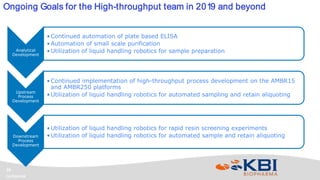
Ongoing Goals for the High-throughput team in 2019 and beyond
Analytical
Development
•Continued automation of plate based ELISA
•Automation of small scale purification
•Utilization of liquid handling robotics for sample preparation
Upstream
Process
Development
•Continued implementation of high-throughput process development on the AMBR15
and AMBR250 platforms
•Utilization of liquid handling robotics for automated sampling and retain aliquoting
Downstream
Process
Development
•Utilization of liquid handling robotics for rapid resin screening experiments
•Utilization of liquid handling robotics for automated sample and retain aliquoting
Confidential
27
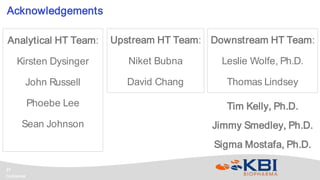
Analytical HT Team:
Kirsten Dysinger
John Russell
Phoebe Lee
Sean Johnson
Acknowledgements
Tim Kelly, Ph.D.
Jimmy Smedley, Ph.D.
Sigma Mostafa, Ph.D.
Upstream HT Team:
Niket Bubna
David Chang
Downstream HT Team:
Leslie Wolfe, Ph.D.
Thomas Lindsey
Confidential
Questions?

High-throughput and Automated Process Development for Accelerated Biotherapeutic Manufacturing

  • 1.
    Confidential High-throughput and automated process developmentfor accelerated biotherapeutic manufacturing Derek Ryan, Ph.D. Senior Scientist, Analytical Development KBI Biopharma, Inc.
  • 2.
    Confidential 2 KBI Biopharma’s missionis to accelerate the development of innovative discoveries into life-changing biological products & expand global access of medicines to patients in need KBI Mission Statement
  • 3.
    Confidential 3 Discussion Overview Overview ofKBI process development and manufacturing portfolio Development of a high-throughout process development team Analytical Case study: Automation of a residual ELISA for rapid PD support Analytical Case study: Development of a high-throughput SEC method for HMW screening Ongoing developments of high-throughput efforts at KBI
  • 4.
    Confidential 4 PD & ManufacturingExperience by Product Type: * 9 biosimilars Recently 50+ PD programs & 12 client INDs supported per year # Mfg Batches 50 7 11 10 6 1 10 5 0 0 20 40 60 Recombinant Enzyme Enzyme Growth factor Recombinant Protein PEGylated… FC-Fusion, Fusion… Vaccine Glycoprotein Bispecific AB mAb* PD Product Types
  • 5.
    Confidential 5 KBI Analytical Panelsby Molecule Type mAbs • Titer - Octet/ProA HPLC • Aggregate - SEC-U/HPLC • Purity - R+NR CGE • Charge - icIEF • N-Glycan - HILIC-UPLC-FLD • Binding Potency – Octet/ELISA • Biological Potency - Cell-based assay Fc-Fusions • Titer - Octet/ProA HPLC • Aggregate - SEC-U/HPLC • Purity - R+NR CGE, RP/IEX/HIC-HPLC • Charge - icIEF/IEX • N-Glycan - HILIC-UPLC-FLD • Binding Potency – Octet/ELISA • Biological Potency - Cell-based assay Bispecifics • Titer - Octet/ProA HPLC/ELISA • Aggregate - SEC-U/HPLC • Heterodimer Purity – IEX, LCMS • Purity – CGE • Charge - icIEF/IEX • N-Glycan - HILIC-UPLC-FLD • Dual/Single Binding Potency – Octet/ELISA • Biological Potency - Cell-based assays Glycoproteins (HIV env, etc.) • Titer - Octet/ELISA • Aggregate - SEC-U/HPLC • Purity - RP/IEX/HIC-HPLC, SDS-PAGE • Charge - IEX, IEF-PAGE • N-Glycan - HILIC-UPLC-FLD • Antigenicity/Binding Potency – Octet/SPR/ELISA • Biological Potency - Cell-based assay Enzymes • Titer - Octet/ELISA/Activity • Aggregate - SEC-U/HPLC • Purity - R+NR CGE, RP/IEX/HIC-HPLC • SDS-PAGE • Charge - icIEF/IEX • N-Glycan - HILIC-UPLC-FLD • Potency – Enzymatic Activity Assay
  • 6.
    6 5 w POOL 3 w Vector 2w SCC0 2 w ST 2 w SCC1 3 w SCC2 Early Clone Robustness Enables Integrated PD with CLD Need for monitoring US and DS process development experiments in real time KBI Process, Analytical & Formulation Development KBI GMP Manufacturing (500L to 2,000L) Month: 1 2 3 4 5 6 7 8 9
  • 7.
    Confidential 7 Establishment of anIntegrated High-throughput Mindset for PD USPD AD DSPD
  • 8.
    Confidential 8 History of High-throughputInitiatives at KBI Present • Aligned US AMBR platform with AD liquid handling robotics for automated sample handling • Development of high-throughput and automated analytical methods • Use of high-throughput technologies for resin evaluations or small scale capture (i.e. PreDictor Plate, Robocolumns) during DSPD • Adoption of electronic lab notebooks for data management and archival Future • Establishment of platform analytics packages for efficiency gains during development support • Sample inventory and data management in electronic lab notebooks Past • Establishment of AMBR15 and AMBR250 platforms for high- throughput USPD • Adoption of ClonePix technology for high-throughput clone selection • Adoption of Octet system for high-throughput titer determination
  • 9.
    Confidential 9 Keys to EstablishingEfficiency Initiatives •Investment in high-throughput or automated instrumentationEquipment •IT solutions to big data managementInfrastructure •Training •Management of dataPersonnel
  • 10.
  • 11.
    Confidential 11 Infrastructure and Personnel: Establishmentof a High-throughput Core Team IT Support Construction of enterprise solutions for the organization and storage of data Automation Engineers Work in concert with IT and Scientists to get the robotics to best mimic the manual operations Scientists Provide scientific guidance on intended purpose of experiments and review results of automated assays
  • 12.
    Confidential 12 As more developmentprograms are onboarded for upstream and downstream process development an increase in submission to AD for PQ occurs Automation of assay decreases FTE effort and data TAT Potential improvement in data quality by reducing %CV Allow for more assays to be setup in parallel by fewer FTE Case Study: Automation of residual host cell protein ELISA
  • 13.
    Confidential 13 Capabilities of ourTECAN platform LiHa – liquid handling aspects of the assay. RoMA – manipulates objects to other locations within the deck layout. RoMALiHa PreDictor Plate ATOLL Robocolumns ELISA workspace
  • 14.
    Confidential 14 Considerations for thedevelopment of automated HCP ELISA Fully Automated rHCP ELISA Sample logistics • Sample submissions • Storage • Stability
  • 15.
    Confidential 15 Considerations for thedevelopment of automated HCP ELISA Fully Automated rHCP ELISA Sample logistics • Sample submissions • Storage • Stability Stability of reagents • Stability of reagents on deck • Performance of assay throughout assays
  • 16.
    Confidential 16 Considerations for thedevelopment of automated HCP ELISA Fully Automated rHCP ELISA Sample logistics • Sample submissions • Storage • Stability Stability of reagents • Stability of reagents on deck • Performance of assay throughout assays Timing of assay events • Key steps from assay need to be taken into account • Balance of robotics capability and assay demands
  • 17.
    Confidential 17 Considerations for thedevelopment of automated HCP ELISA Fully Automated rHCP ELISA Sample logistics • Sample submissions • Storage • Stability Stability of reagents • Stability of reagents on deck • Performance of assay throughout assays Timing of assay events • Key steps from assay need to be taken into account • Balance of robotics capability and assay demands Comparability of data to QC ELISA • Head to head testing of samples using manual and automated methods
  • 18.
    Confidential 18 Considerations for thedevelopment of automated HCP ELISA Fully Automated rHCP ELISA Sample logistics • Sample submissions • Storage • Stability Stability of reagents • Stability of reagents on deck • Performance of assay throughout assays Timing of assay events • Key steps from assay need to be taken into account • Balance of robotics capability and assay demands Comparability of data to QC ELISA • Head to head testing of samples using manual and automated methods Data integrity, storage, and organization • Data analysis and reporting • Storage of reported results
  • 19.
    Confidential 19 Comparability of AutomatedrHCP ELISA versus Manual rHCP ELISA 0 200 400 600 800 1000 1200 1400 Affinity Capture Eluate VIN Eluate IEX Eluate Cycle 1 IEX Eluate Cycle 2 IEX Eluate Cycle 3 IEX Pool MMC Eluate ppm(ngHCP/mgProtein) Automated ELISA Manual ELISA
  • 20.
    Confidential 20 Automation Allowed Scalingto Meet Need without FTE Expansion 0 2 4 6 8 10 12 14 16 18 Hours Analyst touch time per 20 sample batch Automated Manual 0 1000 2000 3000 4000 5000 6000 2017 2018 2019* HCP samples tested per year *Forecasted based on submissions to date (Jan – Mar 2019)
  • 21.
    Confidential 21 Process development iscapable of generating 100’s of samples for aggregate testing Management of a sample inventory of this size outside of 96 well plates not realistic Adopted HPLC autosamplers that can hold up to 16, 96 well plates in a temperature controlled chamber Method run time can significantly affect data turnaround time Example: 200 injections (samples, ref. brackets, etc.) using our platform “QC” SEC- HPLC method would take nearly a week of nonstop run time to collect the data. 200 samples * 30 min per sample = 100 hour run time (~4 days), not including data workup Development of a High-throughput SEC Method: How can Analytics Provide Real Time Aggregate Data? Prompted development of new high throughput SEC methods to reduce run time during critical process development evaluations
  • 22.
    Confidential 22 Acq Method Set:UPSW3000 3_INS3624 AU 0.00 0.05 0.10 0.15 0.20 0.25 0.30 Acq Method Set: UPSW3000 4_INS3624 AU 0.00 0.05 0.10 0.15 0.20 0.25 0.30 Acq Method Set: UPSW3000_INS3624 AU 0.00 0.05 0.10 0.15 0.20 0.25 0.30 Minutes 0.20 0.40 0.60 0.80 1.00 1.20 1.40 1.60 1.80 2.00 2.20 2.40 2.60 2.80 3.00 3.20 3.40 3.60 3.80 4.00 4.20 4.40 4.60 4.80 5.00 5.20 5.40 5.60 5.80 6.00 6.20 6.40 6.60 6.80 7.00 7.20 7.40 7.60 7.80 8.00 8.20 8.40 8.60 8.80 9.00 9.20 9.40 9.60 9.80 10.00 Evaluation of High-throughput SEC Method: Optimizing Run Time 0.3 mL/min 0.4 mL/min 0.5 mL/min TOSOH, UP-SW3000 (2 µm, 15 cm x 4.6 mm) Mobile Phase: 100 mM phosphate, 150 mM NaCl pH 7.3
  • 23.
    Confidential 23 3.037 Main-3.420 4.178 4.982 AU 0.000 0.005 0.010 0.015 0.020 0.025 0.030 0.035 Minutes 1.80 2.00 2.202.40 2.60 2.80 3.00 3.20 3.40 3.60 3.80 4.00 4.20 4.40 4.60 4.80 5.00 5.20 5.40 5.60 5.80 6.00 12.855 13.584 Main-15.695 19.549 AU -0.002 0.000 0.002 0.004 0.006 0.008 0.010 0.012 0.014 0.016 0.018 0.020 Minutes 11.00 12.00 13.00 14.00 15.00 16.00 17.00 18.00 19.00 20.00 21.00 22.00 23.00 24.00 HT Method Shows Comparable HMW in the Context of Screening “QC” method: 5 µm particle size 30 min run time High-throughput Method: 2 µm particle size 6 min run time Method %HMW %Main %LMW QC SEC-HPLC 1.95 97.91 0.15 HT SEC-HPLC 2.19 97.16 0.65 NIST IgG standard: unstressed 12.855 13.584 Main-15.695 19.549 AU 0.00 0.02 0.04 0.06 0.08 0.10 0.12 0.14 0.16 0.18 Minutes 0.00 1.00 2.00 3.00 4.00 5.00 6.00 7.00 8.00 9.00 10.00 11.00 12.00 13.00 14.00 15.00 16.00 17.00 18.00 19.00 20.00 21.00 22.00 23.00 24.00 25.00 26.00 27.00 28.00 29.00 30.00 3.037 Main-3.420 4.178 4.982 AU 0.00 0.10 0.20 0.30 0.40 0.50 0.60 Minutes 0.20 0.40 0.60 0.80 1.00 1.20 1.40 1.60 1.80 2.00 2.20 2.40 2.60 2.80 3.00 3.20 3.40 3.60 3.80 4.00 4.20 4.40 4.60 4.80 5.00 5.20 5.40 5.60 5.80 6.00
  • 24.
    Confidential 24 3.037 Main-3.420 4.178 4.982 AU 0.000 0.005 0.010 0.015 0.020 0.025 0.030 0.035 Minutes 1.80 2.00 2.202.40 2.60 2.80 3.00 3.20 3.40 3.60 3.80 4.00 4.20 4.40 4.60 4.80 5.00 5.20 5.40 5.60 5.80 6.00 12.855 13.584 Main-15.695 19.549 AU -0.002 0.000 0.002 0.004 0.006 0.008 0.010 0.012 0.014 0.016 0.018 0.020 Minutes 11.00 12.00 13.00 14.00 15.00 16.00 17.00 18.00 19.00 20.00 21.00 22.00 23.00 24.00 “QC” method: 5 µm particle size 30 min run time High-throughput Method: 2 µm particle size 6 min run time Method %HMW %Main %LMW QC SEC-HPLC 2.72 96.39 0.9 HT SEC-HPLC 3.20 96.44 0.35 NIST IgG standard: Heat Stress1 12.855 13.584 Main-15.695 19.549 AU 0.00 0.02 0.04 0.06 0.08 0.10 0.12 0.14 0.16 0.18 Minutes 0.00 1.00 2.00 3.00 4.00 5.00 6.00 7.00 8.00 9.00 10.00 11.00 12.00 13.00 14.00 15.00 16.00 17.00 18.00 19.00 20.00 21.00 22.00 23.00 24.00 25.00 26.00 27.00 28.00 29.00 30.00 3.037 Main-3.420 4.178 4.982 AU 0.00 0.10 0.20 0.30 0.40 0.50 0.60 Minutes 0.20 0.40 0.60 0.80 1.00 1.20 1.40 1.60 1.80 2.00 2.20 2.40 2.60 2.80 3.00 3.20 3.40 3.60 3.80 4.00 4.20 4.40 4.60 4.80 5.00 5.20 5.40 5.60 5.80 6.00 1held at 37 oC for 24 hours HT Method Shows Comparable HMW in the Context of Screening
  • 25.
    Confidential 25 Typical QC SECmethod is 30 - 40 minutes per sample plus HPLC mechanical movements • 1rack of 96 samples is about 48 - 72 hrs of HPLC time (excluding reference brackets) HT SEC method is 6 minutes per sample plus HPLC mechanical movements • 1plate of 96 samples is about 11hrs of HPLC time • Represents an at least 5x decrease in duration of TAT for data Metrics of QC versus HT SEC-HPLC Methods Method considered fit for purpose of HT screening testing for PD troubleshooting Additional comparability library of other molecules being assembled
  • 26.
    Confidential 26 Ongoing Goals forthe High-throughput team in 2019 and beyond Analytical Development •Continued automation of plate based ELISA •Automation of small scale purification •Utilization of liquid handling robotics for sample preparation Upstream Process Development •Continued implementation of high-throughput process development on the AMBR15 and AMBR250 platforms •Utilization of liquid handling robotics for automated sampling and retain aliquoting Downstream Process Development •Utilization of liquid handling robotics for rapid resin screening experiments •Utilization of liquid handling robotics for automated sample and retain aliquoting
  • 27.
    Confidential 27 Analytical HT Team: KirstenDysinger John Russell Phoebe Lee Sean Johnson Acknowledgements Tim Kelly, Ph.D. Jimmy Smedley, Ph.D. Sigma Mostafa, Ph.D. Upstream HT Team: Niket Bubna David Chang Downstream HT Team: Leslie Wolfe, Ph.D. Thomas Lindsey
  • 28.