FUNDAMENTALS OF LOSSY
VIDEO COMPRESSION
by
ANJU NARAYANAN
Roll No:M17402
M. Tech. in Signal Processing and Embedded Systems
Department of Electronics & Communication Engineering
Govt. College of Engineering Kannur
on
5th November 2018
Introduction to Digital Video
 Video is a stream of data composed of discrete frames,
containing both audio and pictures.
 Continuous motion produced at a frame rate of 15 fps or
higher.
 With digital video, four factors have to be kept in mind.
 Frame rate
 Colour Resolution
 Spatial Resolution
 Image Quality
11/19/2018 FUNDAMENTALS OF LOSSY VIDEO COMPRESSION 2
Frame Rate
 In motion pictures, television, and in
computer video displays, frame rate is number of frames or
images that are projected or displayed per second.
 A higher frame rate, more images are shown in same amount
of time and it will reduce motion blur from fast moving
images and will give you better quality crisp video.
11/19/2018 FUNDAMENTALS OF LOSSY VIDEO COMPRESSION 3
Colour Resolution
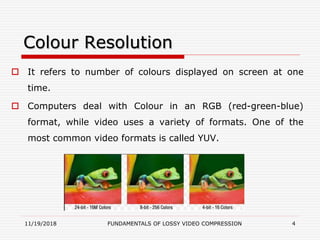
 It refers to number of colours displayed on screen at one
time.
 Computers deal with Colour in an RGB (red-green-blue)
format, while video uses a variety of formats. One of the
most common video formats is called YUV.
11/19/2018 FUNDAMENTALS OF LOSSY VIDEO COMPRESSION 4
Spatial Resolution
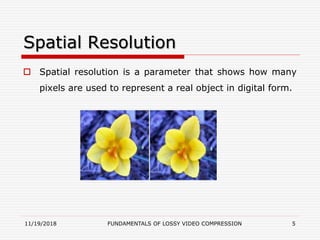
 Spatial resolution is a parameter that shows how many
pixels are used to represent a real object in digital form.
11/19/2018 FUNDAMENTALS OF LOSSY VIDEO COMPRESSION 5
Reasons to compress
 Goal of video compression is to massively reduce
amount of data required to store digital video file, while
retaining the quality of original video.
 Reduce File Size.
 Save disk space.
 Increase transfer speed at a given data rate .
 Allow real-time transfer at a given data rate.
11/19/2018 FUNDAMENTALS OF LOSSY VIDEO COMPRESSION 6
Lossless vs. Lossy Compression
 In lossless compression, data is not altered or lost in the
process of compression or decompression.
 Run-Length Encoding
 Dynamic Pattern Substitution - Lampel-Ziv Encoding
 Huffman Encoding
 Lossy compression is used for compressing audio, pictures,
video.
 JPEG
 MPEG
 H.261 (Px64) Video Coding Algorithm
11/19/2018 FUNDAMENTALS OF LOSSY VIDEO COMPRESSION 7
Lossy compression
 Does not promise that the data received is exactly the
same as the data sent.
 Removes information that it cannot later restore
(Hopefully, no one will notice.)
 Reduce file size by considerably greater amounts than
loss-less compressions but lose both information and
quality.
11/19/2018 FUNDAMENTALS OF LOSSY VIDEO COMPRESSION 8
MPEG (Moving Picture Expert
Group)
 MPEG was set standard for Audio and Video compression
and transmission.
 MPEG-1 is a standard for lossy compression of video and
audio.
 It is designed to compress VHS-quality raw digital video
and CD audio down to 1.5 Mbit/s without excessive
quality loss.
11/19/2018 FUNDAMENTALS OF LOSSY VIDEO COMPRESSION 9
MPEG(contd…)
 MPEG-1 has become the most widely compatible lossy
audio/video format in world.
 It is used in a large number of products and technologies.
 The best-known part of the MPEG-1 standard is the MP3
audio format .
11/19/2018 FUNDAMENTALS OF LOSSY VIDEO COMPRESSION 10
MPEG-2
 It was designed for coding interlaced images at
transmission rates above 4 million bits per second.
 MPEG 2 can be used on HD-DVD and blue ray disc.
 It handles 5 audio channels.
 Covers wider range of frame sizes (HDTV).
 MPEG-2 can compress 2 hours video into a few GHz.
 MPEG-2 is used for digital TV broadcast and DVD.
 An MPEG-2 is designed to offer higher quality than
MPEG-1.
11/19/2018 FUNDAMENTALS OF LOSSY VIDEO COMPRESSION 11
MPEG-3
 Designed to handle HDTV signal in range 20 to 40
Mbits/sec.
 HDTV-resolution is 1920* 1080*30 Hz
 But MPEG-2 was fully capable of handling HDTV so MPEG
-3 is no longer mentioned.
11/19/2018 FUNDAMENTALS OF LOSSY VIDEO COMPRESSION 12
MPEG-4
 MPEG-4 is a collection of methods defining compression of
audio and visual (AV) digital data.
 MPEG-4 absorbs many of features of MPEG-1 and MPEG-2
 MPEG-4 files are smaller than JPEG.
 so they transmit video and images over narrower
bandwidth and can mix video with text graphics and 2D
and 3D animation layers.
 Helps end users with wide range of interaction with
animated objects.
11/19/2018 FUNDAMENTALS OF LOSSY VIDEO COMPRESSION 13
MPEG-7
 MPEG-7 is a content representation standard for
information search.
 It is also titled Multimedia Content Description Interface.
 It will define the manner in which audio-visual materials
can be coded and classified so the materials can be
easily located using search engines.
 Provide a fast and efficient searching, filtering and
content identification method.
11/19/2018 FUNDAMENTALS OF LOSSY VIDEO COMPRESSION 14
Still Image Compression - JPEG
 Defined by Joint Photographic Experts Group
 Released as an ISO standard for still color and gray-scale
images.
 Provides four modes of operation:
 Sequential (each pixel is traversed only once)
 progressive (image gets progressively sharper)
 Hierarchical (image compressed to multiple resolutions)
 lossless (full detail at selected resolution)
11/19/2018 FUNDAMENTALS OF LOSSY VIDEO COMPRESSION 15
H.261 (Px64)
 H.261 was designed for data rates which are multiples of
 64Kbit/s, and is sometimes called p x 64Kbit/s (p is in
the range 1-30).
 These data rates suit ISDN lines.
 Intended for videophone and video conferencing
systems.
11/19/2018 FUNDAMENTALS OF LOSSY VIDEO COMPRESSION 16
H.263 Standard
 The development of modems allowing transmission in
the range of 28-33 kbps paved the way for the
 development of an
 improved version of H.261
 • It was designed for low bitrate
 communication , however this
 limitationhas now been removed
 • It is expected that H.263 will replace H.261
11/19/2018 FUNDAMENTALS OF LOSSY VIDEO COMPRESSION 17
THANKS
11/19/2018 18FUNDAMENTALS OF LOSSY VIDEO COMPRESSION

Multimedia lossy compression

  • 1.
    FUNDAMENTALS OF LOSSY VIDEOCOMPRESSION by ANJU NARAYANAN Roll No:M17402 M. Tech. in Signal Processing and Embedded Systems Department of Electronics & Communication Engineering Govt. College of Engineering Kannur on 5th November 2018
  • 2.
    Introduction to DigitalVideo  Video is a stream of data composed of discrete frames, containing both audio and pictures.  Continuous motion produced at a frame rate of 15 fps or higher.  With digital video, four factors have to be kept in mind.  Frame rate  Colour Resolution  Spatial Resolution  Image Quality 11/19/2018 FUNDAMENTALS OF LOSSY VIDEO COMPRESSION 2
  • 3.
    Frame Rate  Inmotion pictures, television, and in computer video displays, frame rate is number of frames or images that are projected or displayed per second.  A higher frame rate, more images are shown in same amount of time and it will reduce motion blur from fast moving images and will give you better quality crisp video. 11/19/2018 FUNDAMENTALS OF LOSSY VIDEO COMPRESSION 3
  • 4.
    Colour Resolution  Itrefers to number of colours displayed on screen at one time.  Computers deal with Colour in an RGB (red-green-blue) format, while video uses a variety of formats. One of the most common video formats is called YUV. 11/19/2018 FUNDAMENTALS OF LOSSY VIDEO COMPRESSION 4
  • 5.
    Spatial Resolution  Spatialresolution is a parameter that shows how many pixels are used to represent a real object in digital form. 11/19/2018 FUNDAMENTALS OF LOSSY VIDEO COMPRESSION 5
  • 6.
    Reasons to compress Goal of video compression is to massively reduce amount of data required to store digital video file, while retaining the quality of original video.  Reduce File Size.  Save disk space.  Increase transfer speed at a given data rate .  Allow real-time transfer at a given data rate. 11/19/2018 FUNDAMENTALS OF LOSSY VIDEO COMPRESSION 6
  • 7.
    Lossless vs. LossyCompression  In lossless compression, data is not altered or lost in the process of compression or decompression.  Run-Length Encoding  Dynamic Pattern Substitution - Lampel-Ziv Encoding  Huffman Encoding  Lossy compression is used for compressing audio, pictures, video.  JPEG  MPEG  H.261 (Px64) Video Coding Algorithm 11/19/2018 FUNDAMENTALS OF LOSSY VIDEO COMPRESSION 7
  • 8.
    Lossy compression  Doesnot promise that the data received is exactly the same as the data sent.  Removes information that it cannot later restore (Hopefully, no one will notice.)  Reduce file size by considerably greater amounts than loss-less compressions but lose both information and quality. 11/19/2018 FUNDAMENTALS OF LOSSY VIDEO COMPRESSION 8
  • 9.
    MPEG (Moving PictureExpert Group)  MPEG was set standard for Audio and Video compression and transmission.  MPEG-1 is a standard for lossy compression of video and audio.  It is designed to compress VHS-quality raw digital video and CD audio down to 1.5 Mbit/s without excessive quality loss. 11/19/2018 FUNDAMENTALS OF LOSSY VIDEO COMPRESSION 9
  • 10.
    MPEG(contd…)  MPEG-1 hasbecome the most widely compatible lossy audio/video format in world.  It is used in a large number of products and technologies.  The best-known part of the MPEG-1 standard is the MP3 audio format . 11/19/2018 FUNDAMENTALS OF LOSSY VIDEO COMPRESSION 10
  • 11.
    MPEG-2  It wasdesigned for coding interlaced images at transmission rates above 4 million bits per second.  MPEG 2 can be used on HD-DVD and blue ray disc.  It handles 5 audio channels.  Covers wider range of frame sizes (HDTV).  MPEG-2 can compress 2 hours video into a few GHz.  MPEG-2 is used for digital TV broadcast and DVD.  An MPEG-2 is designed to offer higher quality than MPEG-1. 11/19/2018 FUNDAMENTALS OF LOSSY VIDEO COMPRESSION 11
  • 12.
    MPEG-3  Designed tohandle HDTV signal in range 20 to 40 Mbits/sec.  HDTV-resolution is 1920* 1080*30 Hz  But MPEG-2 was fully capable of handling HDTV so MPEG -3 is no longer mentioned. 11/19/2018 FUNDAMENTALS OF LOSSY VIDEO COMPRESSION 12
  • 13.
    MPEG-4  MPEG-4 isa collection of methods defining compression of audio and visual (AV) digital data.  MPEG-4 absorbs many of features of MPEG-1 and MPEG-2  MPEG-4 files are smaller than JPEG.  so they transmit video and images over narrower bandwidth and can mix video with text graphics and 2D and 3D animation layers.  Helps end users with wide range of interaction with animated objects. 11/19/2018 FUNDAMENTALS OF LOSSY VIDEO COMPRESSION 13
  • 14.
    MPEG-7  MPEG-7 isa content representation standard for information search.  It is also titled Multimedia Content Description Interface.  It will define the manner in which audio-visual materials can be coded and classified so the materials can be easily located using search engines.  Provide a fast and efficient searching, filtering and content identification method. 11/19/2018 FUNDAMENTALS OF LOSSY VIDEO COMPRESSION 14
  • 15.
    Still Image Compression- JPEG  Defined by Joint Photographic Experts Group  Released as an ISO standard for still color and gray-scale images.  Provides four modes of operation:  Sequential (each pixel is traversed only once)  progressive (image gets progressively sharper)  Hierarchical (image compressed to multiple resolutions)  lossless (full detail at selected resolution) 11/19/2018 FUNDAMENTALS OF LOSSY VIDEO COMPRESSION 15
  • 16.
    H.261 (Px64)  H.261was designed for data rates which are multiples of  64Kbit/s, and is sometimes called p x 64Kbit/s (p is in the range 1-30).  These data rates suit ISDN lines.  Intended for videophone and video conferencing systems. 11/19/2018 FUNDAMENTALS OF LOSSY VIDEO COMPRESSION 16
  • 17.
    H.263 Standard  Thedevelopment of modems allowing transmission in the range of 28-33 kbps paved the way for the  development of an  improved version of H.261  • It was designed for low bitrate  communication , however this  limitationhas now been removed  • It is expected that H.263 will replace H.261 11/19/2018 FUNDAMENTALS OF LOSSY VIDEO COMPRESSION 17
  • 18.
    THANKS 11/19/2018 18FUNDAMENTALS OFLOSSY VIDEO COMPRESSION