





MulteFire: Reliable
Wireless for
Industrial IoT
Yoshioki Chika
Board Member, MulteFire
Alliance
Senior Director, SoftBank
• Extend the LTE ecosystem to Industrial IoT and Enterprise applications
• Leverage existing 3GPP technology
• Utilize available unlicensed spectrum bands globally
• Enable new vertical markets and use cases
• Deliver robust wireless connectivity for industrial IoT
applications
• Support various verticals, such as hospitality, healthcare,
mining, oil & gas, etc.
• Allow anyone to create, install and operate their own
private wireless network
• Complement existing wireless infrastructure
• Not a replacement technology
• Delivering MulteFire: Cellular-based technology for Industrial IoT
Private Wireless Opportunity
for Industrial IoT
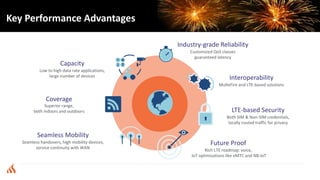
LTE-based Security
Both SIM & Non-SIM credentials,
locally routed traffic for privacy
Seamless Mobility
Seamless handovers, high mobility devices,
service continuity with WAN
Industry-grade Reliability
Customized QoS classes
guaranteed latency
Capacity
Low to high data rate applications,
large number of devices
Future Proof
Rich LTE roadmap: voice,
IoT optimizations like eMTC and NB-IoT
Coverage
Superior range,
both indoors and outdoors
Interoperability
MulteFire and LTE-based solutions
Key Performance Advantages
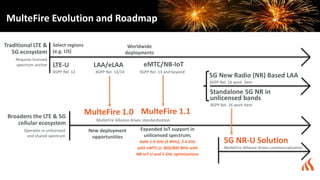
Traditional LTE &
5G ecosystem
Requires licensed
spectrum anchor
Broadens the LTE & 5G
cellular ecosystem
Operates in unlicensed
and shared spectrum
Select regions
(e.g. US)
Worldwide
deployments
New deployment
opportunities
LTE-U LAA/eLAA eMTC/NB-IoT
3GPP Rel. 12 3GPP Rel. 13/14 3GPP Rel. 13 and beyond
MulteFire Alliance drives standardization
MulteFire 1.0 MulteFire 1.1
Expanded IoT support in
unlicensed spectrum;
Adds 1.9 GHz (5 MHz), 2.4 GHz
with eMTC-U, 800/900 MHz with
NB-IoT-U and 5 GHz optimizations
5G New Radio (NR) Based LAA
3GPP Rel. 16 work item
Standalone 5G NR in
unlicensed bands
3GPP Rel. 16 work item
5G NR-U Solution
MulteFire Alliance drives commercialization
MulteFire Evolution and Roadmap
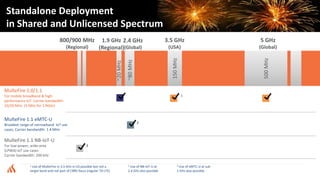
MulteFire 1.0/1.1
For mobile broadband & high-
performance IoT. Carrier bandwidth:
10/20 MHz (5 MHz for 1.9GHz)
MulteFire 1.1 eMTC-U
Broadest range of narrowband IoT use
cases, Carrier bandwidth: 1.4 MHz
MulteFire 1.1 NB-IoT-U
For low-power, wide-area
(LPWA) IoT use cases
Carrier bandwidth: 200 kHz
150MHz
500MHz
3.5 GHz
(USA)
5 GHz
(Global)
800/900 MHz
(Regional)
2.4 GHz
(Global)
~80MHz
1.9 GHz
(Regional)
~20MHz
1 Use of MulteFire in 3.5 GHz in US possible but not a
target band and not part of CBRS focus (regular TD LTE)
2 Use of NB-IoT-U at
2.4 GHz also possible
1
2
3
3 Use of eMTC-U at sub
1 GHz also possible
Standalone Deployment
in Shared and Unlicensed Spectrum
• Specification is publicly available
to download since April 2018
• Supports neutral host and private
LTE deployment models
• First products built to Release 1.0
spec are available
• MulteFire 1.0 trials for private
networks are currently underway
• Certification program under
development
MulteFire Release 1.0 Traction
Announcing Release 1.1 Completion
Introducing MulteFire Release 1.1
• Added Additional Spectrum Bands Focusing on IoT – 1.9 GHz in Japan
• Including MulteFire 1.9 GHz (for the unlicensed part in 3GPP defined Band 39), also
known as sXGP in Japan, which is ready for commercial deployment in Japan with
support from the XGP Forum and an ecosystem of TD-LTE devices in place that support
Band 39 today
• Enhanced Broadband Services in the Global 5 GHz Unlicensed Band
• Delivering more robust mobility, faster uplink data transmissions, improved downlink
coverage, and adds SON capabilities
• Expanded IoT Services with Low Power Wide Area Support
• 800/900 MHz with NB-IOT-U and 2.4 GHz with eMTC-U support
MulteFire
Release 1.1
Adds Support
for 1.9 GHz
Band
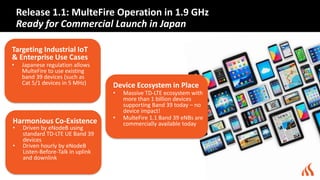
Release 1.1: MulteFire Operation in 1.9 GHz
Ready for Commercial Launch in Japan
Harmonious Co-Existence
• Driven by eNodeB using
standard TD-LTE UE Band 39
devices
• Driven hourly by eNodeB
Listen-Before-Talk in uplink
and downlink
Device Ecosystem in Place
• Massive TD-LTE ecosystem with
more than 1 billion devices
supporting Band 39 today – no
device impact!
• MulteFire 1.1 Band 39 eNBs are
commercially available today
Targeting Industrial IoT
& Enterprise Use Cases
• Japanese regulation allows
MulteFire to use existing
band 39 devices (such as
Cat 5/1 devices in 5 MHz)
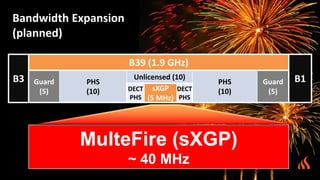
Bandwidth Expansion
(planned)
B3
B39 (1.9 GHz)
B1Guard
(5)
PHS
(10)
Unlicensed (10)
PHS
(10)
Guard
(5)DECT
PHS
sXGP
(5 MHz)
DECT
PHS
MulteFire (sXGP)
~ 40 MHz
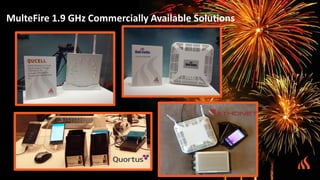
MulteFire 1.9 GHz Commercially Available Solutions
Release 1.1
MulteFire Operation in 2.4 GHz
Unlicensed Band – eMTC-U
• Supports medium data rate
applications – ~1MB/s
• Adapts eMTC for unlicensed bands
• Delivers robust wireless
connectivity between devices up
to several hundred meters
• Enables applications such as
factory automation, asset
management, or surveillance
monitoring for private networks
Release 1.1
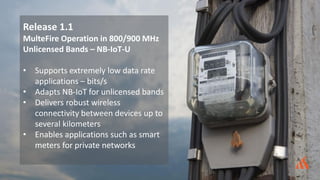
MulteFire Operation in 800/900 MHz
Unlicensed Bands – NB-IoT-U
• Supports extremely low data rate
applications – bits/s
• Adapts NB-IoT for unlicensed bands
• Delivers robust wireless
connectivity between devices up to
several kilometers
• Enables applications such as smart
meters for private networks
Private IoT Networks with MulteFire
• Company Controlled – Closed,
independent network, no
obligation to MNOs
• Optimized – Tuned for coverage,
capacity, application, and
latency requirements
• Flexible Deployment and Secure
– unlicensed spectrum,
managed services, built-in LTE
security
• Local Coverage
• Customized Services
Looking Ahead
5G NR Standalone Operation
in Unlicensed Spectrum
Active Support of 3GPP 5G NR-U
Standalone Standardization for Release 16
• Support 3GPP standardization efforts via our
overlapping membership
• Ready to support additional standardization
within the MulteFire Alliance Technical
Specification Group as needed and take on
tasks that fall outside of 3GPP Scope
Enabling an Interoperable Ecosystem
• Promote 5G NR standalone operation in
unlicensed spectrum
• Foster new 5G NR-U use cases and new
business models
• Support the deployment of 5G NR-U for private
networks, such as industrial IoT verticals
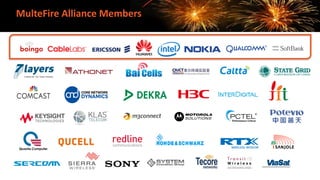
MulteFire Alliance Members
Independent, international member-
driven consortium – 3GPP/ETSI style org
with IPR policy and working procedures
Goal to develop technology standards
that will be widely adopted in global
standards
Voluntary call for membership – Join Us
Membership information at
www.MulteFire.org/join
About the MulteFire Alliance
• MulteFire enables Industrial IoT and Enterprises to easily
deploy their own private networks
• MulteFire is ready for commercial deployment in Japan
• Leverage one technology solution for multiple global
locations – repeatable process
• Complements existing wireless solutions with
harmonious co-existence
• Meets Industrial IoT and Enterprise requirements for
robust wireless connectivity with path to 5G NR-U
Summary
www.MulteFire.org

MulteFire: Reliable Wireless for Industrial IoT

  • 1.
    MulteFire: Reliable Wireless for IndustrialIoT Yoshioki Chika Board Member, MulteFire Alliance Senior Director, SoftBank
  • 2.
    • Extend theLTE ecosystem to Industrial IoT and Enterprise applications • Leverage existing 3GPP technology • Utilize available unlicensed spectrum bands globally • Enable new vertical markets and use cases • Deliver robust wireless connectivity for industrial IoT applications • Support various verticals, such as hospitality, healthcare, mining, oil & gas, etc. • Allow anyone to create, install and operate their own private wireless network • Complement existing wireless infrastructure • Not a replacement technology • Delivering MulteFire: Cellular-based technology for Industrial IoT Private Wireless Opportunity for Industrial IoT
  • 3.
    LTE-based Security Both SIM& Non-SIM credentials, locally routed traffic for privacy Seamless Mobility Seamless handovers, high mobility devices, service continuity with WAN Industry-grade Reliability Customized QoS classes guaranteed latency Capacity Low to high data rate applications, large number of devices Future Proof Rich LTE roadmap: voice, IoT optimizations like eMTC and NB-IoT Coverage Superior range, both indoors and outdoors Interoperability MulteFire and LTE-based solutions Key Performance Advantages
  • 4.
    Traditional LTE & 5Gecosystem Requires licensed spectrum anchor Broadens the LTE & 5G cellular ecosystem Operates in unlicensed and shared spectrum Select regions (e.g. US) Worldwide deployments New deployment opportunities LTE-U LAA/eLAA eMTC/NB-IoT 3GPP Rel. 12 3GPP Rel. 13/14 3GPP Rel. 13 and beyond MulteFire Alliance drives standardization MulteFire 1.0 MulteFire 1.1 Expanded IoT support in unlicensed spectrum; Adds 1.9 GHz (5 MHz), 2.4 GHz with eMTC-U, 800/900 MHz with NB-IoT-U and 5 GHz optimizations 5G New Radio (NR) Based LAA 3GPP Rel. 16 work item Standalone 5G NR in unlicensed bands 3GPP Rel. 16 work item 5G NR-U Solution MulteFire Alliance drives commercialization MulteFire Evolution and Roadmap
  • 5.
    MulteFire 1.0/1.1 For mobilebroadband & high- performance IoT. Carrier bandwidth: 10/20 MHz (5 MHz for 1.9GHz) MulteFire 1.1 eMTC-U Broadest range of narrowband IoT use cases, Carrier bandwidth: 1.4 MHz MulteFire 1.1 NB-IoT-U For low-power, wide-area (LPWA) IoT use cases Carrier bandwidth: 200 kHz 150MHz 500MHz 3.5 GHz (USA) 5 GHz (Global) 800/900 MHz (Regional) 2.4 GHz (Global) ~80MHz 1.9 GHz (Regional) ~20MHz 1 Use of MulteFire in 3.5 GHz in US possible but not a target band and not part of CBRS focus (regular TD LTE) 2 Use of NB-IoT-U at 2.4 GHz also possible 1 2 3 3 Use of eMTC-U at sub 1 GHz also possible Standalone Deployment in Shared and Unlicensed Spectrum
  • 6.
    • Specification ispublicly available to download since April 2018 • Supports neutral host and private LTE deployment models • First products built to Release 1.0 spec are available • MulteFire 1.0 trials for private networks are currently underway • Certification program under development MulteFire Release 1.0 Traction
  • 7.
    Announcing Release 1.1Completion Introducing MulteFire Release 1.1 • Added Additional Spectrum Bands Focusing on IoT – 1.9 GHz in Japan • Including MulteFire 1.9 GHz (for the unlicensed part in 3GPP defined Band 39), also known as sXGP in Japan, which is ready for commercial deployment in Japan with support from the XGP Forum and an ecosystem of TD-LTE devices in place that support Band 39 today • Enhanced Broadband Services in the Global 5 GHz Unlicensed Band • Delivering more robust mobility, faster uplink data transmissions, improved downlink coverage, and adds SON capabilities • Expanded IoT Services with Low Power Wide Area Support • 800/900 MHz with NB-IOT-U and 2.4 GHz with eMTC-U support
  • 8.
  • 9.
    Release 1.1: MulteFireOperation in 1.9 GHz Ready for Commercial Launch in Japan Harmonious Co-Existence • Driven by eNodeB using standard TD-LTE UE Band 39 devices • Driven hourly by eNodeB Listen-Before-Talk in uplink and downlink Device Ecosystem in Place • Massive TD-LTE ecosystem with more than 1 billion devices supporting Band 39 today – no device impact! • MulteFire 1.1 Band 39 eNBs are commercially available today Targeting Industrial IoT & Enterprise Use Cases • Japanese regulation allows MulteFire to use existing band 39 devices (such as Cat 5/1 devices in 5 MHz)
  • 10.
    Bandwidth Expansion (planned) B3 B39 (1.9GHz) B1Guard (5) PHS (10) Unlicensed (10) PHS (10) Guard (5)DECT PHS sXGP (5 MHz) DECT PHS MulteFire (sXGP) ~ 40 MHz
  • 11.
    MulteFire 1.9 GHzCommercially Available Solutions
  • 12.
    Release 1.1 MulteFire Operationin 2.4 GHz Unlicensed Band – eMTC-U • Supports medium data rate applications – ~1MB/s • Adapts eMTC for unlicensed bands • Delivers robust wireless connectivity between devices up to several hundred meters • Enables applications such as factory automation, asset management, or surveillance monitoring for private networks
  • 13.
    Release 1.1 MulteFire Operationin 800/900 MHz Unlicensed Bands – NB-IoT-U • Supports extremely low data rate applications – bits/s • Adapts NB-IoT for unlicensed bands • Delivers robust wireless connectivity between devices up to several kilometers • Enables applications such as smart meters for private networks
  • 14.
    Private IoT Networkswith MulteFire • Company Controlled – Closed, independent network, no obligation to MNOs • Optimized – Tuned for coverage, capacity, application, and latency requirements • Flexible Deployment and Secure – unlicensed spectrum, managed services, built-in LTE security • Local Coverage • Customized Services
  • 15.
    Looking Ahead 5G NRStandalone Operation in Unlicensed Spectrum Active Support of 3GPP 5G NR-U Standalone Standardization for Release 16 • Support 3GPP standardization efforts via our overlapping membership • Ready to support additional standardization within the MulteFire Alliance Technical Specification Group as needed and take on tasks that fall outside of 3GPP Scope Enabling an Interoperable Ecosystem • Promote 5G NR standalone operation in unlicensed spectrum • Foster new 5G NR-U use cases and new business models • Support the deployment of 5G NR-U for private networks, such as industrial IoT verticals
  • 16.
  • 17.
    Independent, international member- drivenconsortium – 3GPP/ETSI style org with IPR policy and working procedures Goal to develop technology standards that will be widely adopted in global standards Voluntary call for membership – Join Us Membership information at www.MulteFire.org/join About the MulteFire Alliance
  • 18.
    • MulteFire enablesIndustrial IoT and Enterprises to easily deploy their own private networks • MulteFire is ready for commercial deployment in Japan • Leverage one technology solution for multiple global locations – repeatable process • Complements existing wireless solutions with harmonious co-existence • Meets Industrial IoT and Enterprise requirements for robust wireless connectivity with path to 5G NR-U Summary www.MulteFire.org