CGIAR - Support to Agricultural Research for
Development of Strategic Crops in Africa (SARD-SC)
Rice value chain: Highlights of 
Achievements & Perspectives 
Mid‐Term Review 2015
5‐6 May 2015, AfricaRice, Cotonou, Benin
• SARD-SC Institutional arrangement
• Rice value chain implementation process
• Project Components & Achievements
• Lessons learnt
• Procurement
• Finance
• Perspectives: fine-tuning and proposed changes
(immediate proposed changes and possible 2nd phase
interventions)
Focus of the Presentation & Discusion
Rice Value Chain
Budget: about US$15 million over 5 years (2012 - 2016)
Funded by the African Development Bank (AfDB)
Executing Agency: International Institute of Tropical Agriculture (IITA)
Implementing Agencies: IITA (maize and cassava), ICARDA (wheat),
AfricaRice (rice)
Contractual Arrangement: IFPRI assessment of farmer organizations
and contractual arrangements
► SARD-SC Components:
 Generate agricultural technologies and innovations
 Disseminate technologies and innovations
 Capacity strengthening
 Efficient Project Management
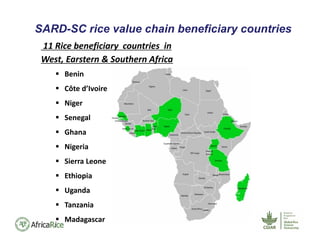
SARD-SC rice value chain beneficiary countries
11 Rice beneficiary  countries  in 
West, Earstern & Southern Africa
 Benin
 Côte d’Ivoire
 Niger
 Senegal
 Ghana
 Nigeria
 Sierra Leone
 Ethiopia
 Uganda
 Tanzania
 Madagascar
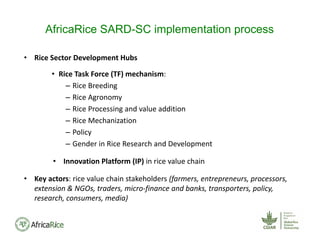
AfricaRice SARD-SC implementation process
• Rice Sector Development Hubs
• Rice Task Force (TF) mechanism:
– Rice Breeding
– Rice Agronomy
– Rice Processing and value addition
– Rice Mechanization
– Policy
– Gender in Rice Research and Development
• Innovation Platform (IP) in rice value chain
• Key actors: rice value chain stakeholders (farmers, entrepreneurs, processors, 
extension & NGOs, traders, micro‐finance and banks, transporters, policy, 
research, consumers, media)
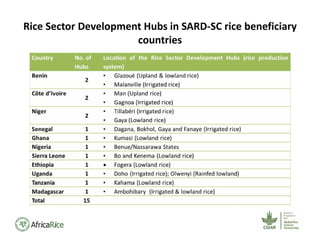
Rice Sector Development Hubs in SARD‐SC rice beneficiary 
countries 
Component I: Technology and innovation
generation
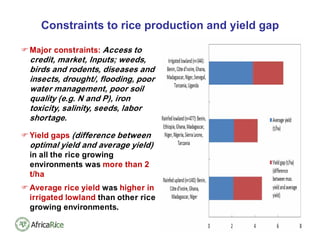
Constraints to rice production and yield gap
Major constraints: Access to
credit, market, Inputs; weeds,
birds and rodents, diseases and
insects, drought/, flooding, poor
water management, poor soil
quality (e.g. N and P), iron
toxicity, salinity, seeds, labor
shortage.
Yield gaps (difference between
optimal yield and average yield)
in all the rice growing
environments was more than 2
t/ha
Average rice yield was higher in
irrigated lowland than other rice
growing environments.
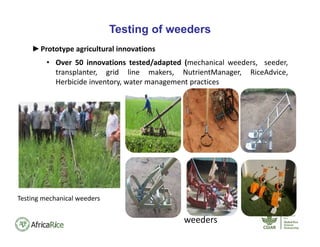
Testing of weeders
►Prototype agricultural innovations
• Over 50 innovations tested/adapted (mechanical weeders, seeder,
transplanter, grid line makers, NutrientManager, RiceAdvice,
Herbicide inventory, water management practices
Testing mechanical weeders
weeders
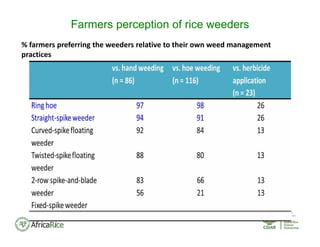
Farmers perception of rice weeders
% farmers preferring the weeders relative to their own weed management 
practices
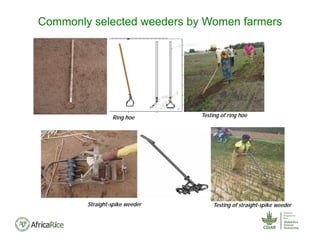
Commonly selected weeders by Women farmers
Ring hoe Testing of ring hoe
Straight-spike weeder Testing of straight-spike weeder
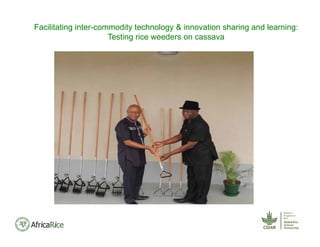
Facilitating inter-commodity technology & innovation sharing and learning:
Testing rice weeders on cassava
RiceAdvice
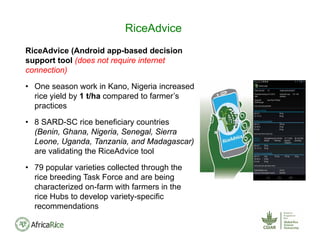
RiceAdvice (Android app-based decision
support tool (does not require internet
connection)
• One season work in Kano, Nigeria increased
rice yield by 1 t/ha compared to farmer’s
practices
• 8 SARD-SC rice beneficiary countries
(Benin, Ghana, Nigeria, Senegal, Sierra
Leone, Uganda, Tanzania, and Madagascar)
are validating the RiceAdvice tool
• 79 popular varieties collected through the
rice breeding Task Force and are being
characterized on-farm with farmers in the
rice Hubs to develop variety-specific
recommendations
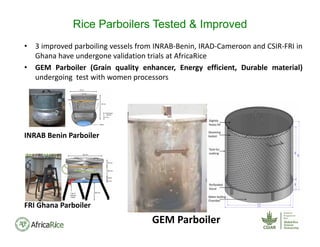
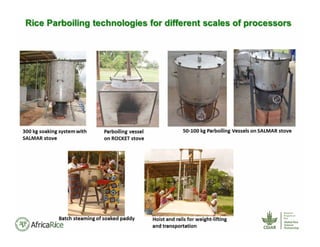
• 3 improved parboiling vessels from INRAB‐Benin, IRAD‐Cameroon and CSIR‐FRI in
Ghana have undergone validation trials at AfricaRice
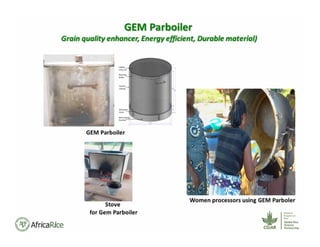
• GEM Parboiler (Grain quality enhancer, Energy efficient, Durable material)
undergoing test with women processors
INRAB Benin Parboiler
FRI Ghana Parboiler
GEM Parboiler
Rice Parboilers Tested & Improved
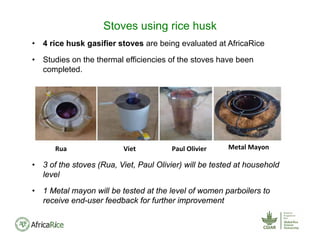
• 4 rice husk gasifier stoves are being evaluated at AfricaRice
• Studies on the thermal efficiencies of the stoves have been
completed.
• 3 of the stoves (Rua, Viet, Paul Olivier) will be tested at household
level
• 1 Metal mayon will be tested at the level of women parboilers to
receive end-user feedback for further improvement
Stoves using rice husk
Rua Viet Paul Olivier Metal Mayon
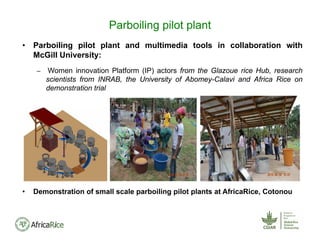
• Parboiling pilot plant and multimedia tools in collaboration with
McGill University:
– Women innovation Platform (IP) actors from the Glazoue rice Hub, research
scientists from INRAB, the University of Abomey-Calavi and Africa Rice on
demonstration trial
• Demonstration of small scale parboiling pilot plants at AfricaRice, Cotonou
Parboiling pilot plant
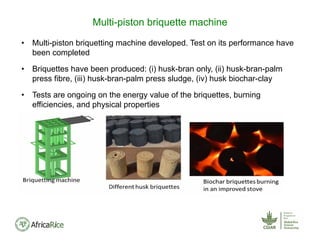
• Multi-piston briquetting machine developed. Test on its performance have
been completed
• Briquettes have been produced: (i) husk-bran only, (ii) husk-bran-palm
press fibre, (iii) husk-bran-palm press sludge, (iv) husk biochar-clay
• Tests are ongoing on the energy value of the briquettes, burning
efficiencies, and physical properties
Multi-piston briquette machine
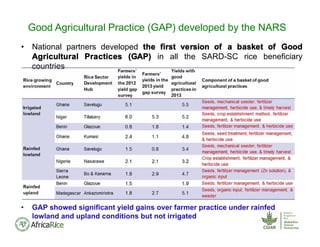
• National partners developed the first version of a basket of Good
Agricultural Practices (GAP) in all the SARD-SC rice beneficiary
countries
• GAP showed significant yield gains over farmer practice under rainfed
lowland and upland conditions but not irrigated
Good Agricultural Practice (GAP) developed by the NARS
Component II: Technology and Innovation
Dissemination
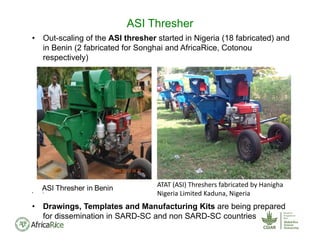
• Out-scaling of the ASI thresher started in Nigeria (18 fabricated) and
in Benin (2 fabricated for Songhai and AfricaRice, Cotonou
respectively)
• 
• Drawings, Templates and Manufacturing Kits are being prepared
for dissemination in SARD-SC and non SARD-SC countries
ASI Thresher
ATAT (ASI) Threshers fabricated by Hanigha
Nigeria Limited Kaduna, Nigeria
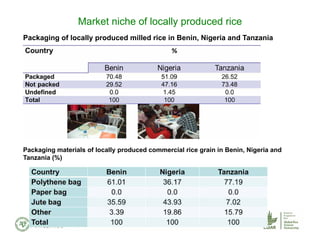
Packaging of locally produced milled rice in Benin, Nigeria and Tanzania
Packaging materials of locally produced commercial rice grain in Benin, Nigeria and
Tanzania (%)
Market niche of locally produced rice
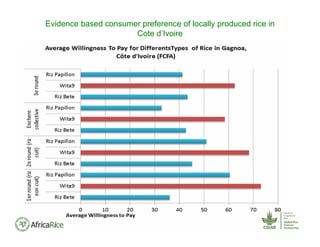
Evidence based consumer preference of locally produced rice in
Cote d’Ivoire
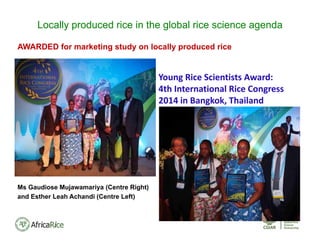
AWARDED for marketing study on locally produced rice
Ms Gaudiose Mujawamariya (Centre Right)
and Esther Leah Achandi (Centre Left)
Locally produced rice in the global rice science agenda
Young Rice Scientists Award:  
4th International Rice Congress 
2014 in Bangkok, Thailand
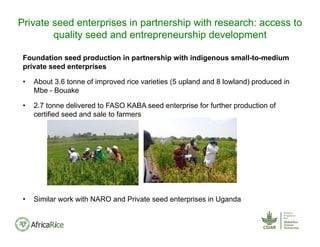
Foundation seed production in partnership with indigenous small-to-medium
private seed enterprises
• About 3.6 tonne of improved rice varieties (5 upland and 8 lowland) produced in
Mbe - Bouake
• 2.7 tonne delivered to FASO KABA seed enterprise for further production of
certified seed and sale to farmers
• Similar work with NARO and Private seed enterprises in Uganda
Private seed enterprises in partnership with research: access to
quality seed and entrepreneurship development
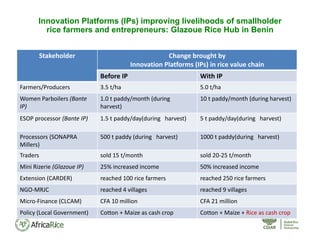
Stakeholder Change brought by 
Innovation Platforms (IPs) in rice value chain
Before IP With IP
Farmers/Producers 3.5 t/ha 5.0 t/ha
Women Parboilers (Bante
IP)
1.0 t paddy/month (during   
harvest) 
10 t paddy/month (during harvest)
ESOP processor (Bante IP) 1.5 t paddy/day(during   harvest)  5 t paddy/day(during   harvest) 
Processors (SONAPRA 
Millers)
500 t paddy (during   harvest)  1000 t paddy(during   harvest) 
Traders sold 15 t/month sold 20‐25 t/month
Mini Rizerie (Glazoue IP) 25% increased income 50% increased income
Extension (CARDER) reached 100 rice farmers reached 250 rice farmers
NGO‐MRJC reached 4 villages reached 9 villages
Micro‐Finance (CLCAM) CFA 10 million CFA 21 million
Policy (Local Government) Cotton + Maize as cash crop Cotton + Maize + Rice as cash crop
Innovation Platforms (IPs) improving livelihoods of smallholder
rice farmers and entrepreneurs: Glazoue Rice Hub in Benin
Component III: Capacity strengthening
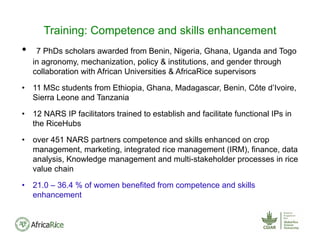
• 7 PhDs scholars awarded from Benin, Nigeria, Ghana, Uganda and Togo
in agronomy, mechanization, policy & institutions, and gender through
collaboration with African Universities & AfricaRice supervisors
• 11 MSc students from Ethiopia, Ghana, Madagascar, Benin, Côte d’Ivoire,
Sierra Leone and Tanzania
• 12 NARS IP facilitators trained to establish and facilitate functional IPs in
the RiceHubs
• over 451 NARS partners competence and skills enhanced on crop
management, marketing, integrated rice management (IRM), finance, data
analysis, Knowledge management and multi-stakeholder processes in rice
value chain
• 21.0 – 36.4 % of women benefited from competence and skills
enhancement
Training: Competence and skills enhancement
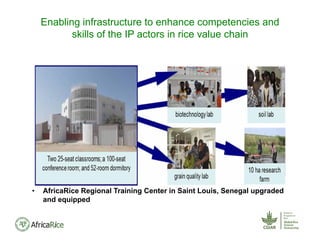
• AfricaRice Regional Training Center in Saint Louis, Senegal upgraded
and equipped
Enabling infrastructure to enhance competencies and
skills of the IP actors in rice value chain
Component IV: Efficient Project management
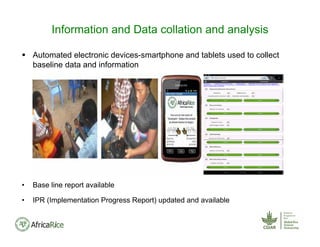
 Automated electronic devices-smartphone and tablets used to collect
baseline data and information
• Base line report available
• IPR (Implementation Progress Report) updated and available
Information and Data collation and analysis
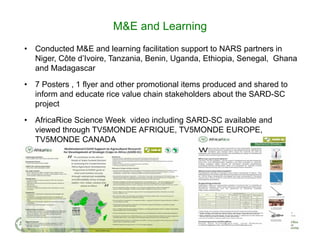
• Conducted M&E and learning facilitation support to NARS partners in
Niger, Côte d’Ivoire, Tanzania, Benin, Uganda, Ethiopia, Senegal, Ghana
and Madagascar
• 7 Posters , 1 flyer and other promotional items produced and shared to
inform and educate rice value chain stakeholders about the SARD-SC
project
• AfricaRice Science Week video including SARD-SC available and
viewed through TV5MONDE AFRIQUE, TV5MONDE EUROPE,
TV5MONDE CANADA
M&E and Learning
IFPRI assignment: Contractual arrangement and farmer organizations in rice value
chain
• Review and assess the relative performances of the different formal and informal
contractual arrangements for rice commercialization
• Identify a select number of promising formal contractual arrangements
– Secondary data generally too old
– LSMS (Living Standard Measurement Study) was not design to represent rice
situation in Nigeria. So the results from the LSMS will not be representative of each
state
• Ogun producing rice from 2000 to 2009 and Osun producing rice in 2008 and
2009. Surprising to report these two states are not producing rice in 2011
Recommendation:
• Economists and M&E specialists of the 3 Centers (IITA, ICARDA, AfricaRice) should
meet to deepen discussion on the IFPRI study and propose the way forward
• Information and data generated through the use of secondary data should be
validated with the active participation/representation of rice value chain stakeholders
• Continuing with such activity through IFPRI should be advised by the Economists
and M&E of the Centers
IFPRI study
• Increase follow-up country visits to review NARI financial justification of project
funds (SOEs & receipts) and improve project disbursement rate
• Coaching and mentoring of Innovation Platform (IP) facilitators and
practitioners to improve competencies and skills of the IP actors on starting and
facilitating functional IPs in rice value chain
• M & E and learning to assess and document the quality of interaction of the IP
actors, system performance, and transformational change brought by the IPs
• Systematic consultation, information sharing, and consensus building among
project implementing partners to improve teamwork and collective action
• AfDB mainstream project start-up phase of at least six months in project design
to enable learning-by-doing on best institutional practice by similar but
different organizations and partners in adapting to new rules, procedures, and
processes
• The duration of the current project evaluation process did not provide sufficient time
for interaction and learning among project stakeholders. In future, invest pragmatic
timelines in carrying out project evaluation in line with the widely known AfDB
practice.
Key Lessons Learnt
• Procurement methods in the PAR not consistently responsive to the needs
of suppliers / clients and thus the need to keep a heads-up and agree with
the bank on acceptable alternative procedures such a direct negotiations
and ‘Forced Accounts’
• Some degree of reluctance on the part of some suppliers and others service
providers to Bank’s terms of payments
• Bidding document administratively too heavy / demanding for suppliers to
comply and respond on a timely manner
Key Lessons Learnt
Thank you
Merci

Rice value chain: Highlights of Achievements & Perspectives

  • 1.
    CGIAR - Supportto Agricultural Research for Development of Strategic Crops in Africa (SARD-SC) Rice value chain: Highlights of  Achievements & Perspectives  Mid‐Term Review 2015 5‐6 May 2015, AfricaRice, Cotonou, Benin
  • 2.
    • SARD-SC Institutionalarrangement • Rice value chain implementation process • Project Components & Achievements • Lessons learnt • Procurement • Finance • Perspectives: fine-tuning and proposed changes (immediate proposed changes and possible 2nd phase interventions) Focus of the Presentation & Discusion
  • 3.
    Rice Value Chain Budget:about US$15 million over 5 years (2012 - 2016) Funded by the African Development Bank (AfDB) Executing Agency: International Institute of Tropical Agriculture (IITA) Implementing Agencies: IITA (maize and cassava), ICARDA (wheat), AfricaRice (rice) Contractual Arrangement: IFPRI assessment of farmer organizations and contractual arrangements ► SARD-SC Components:  Generate agricultural technologies and innovations  Disseminate technologies and innovations  Capacity strengthening  Efficient Project Management
  • 4.
    SARD-SC rice valuechain beneficiary countries 11 Rice beneficiary  countries  in  West, Earstern & Southern Africa  Benin  Côte d’Ivoire  Niger  Senegal  Ghana  Nigeria  Sierra Leone  Ethiopia  Uganda  Tanzania  Madagascar
  • 5.
    AfricaRice SARD-SC implementationprocess • Rice Sector Development Hubs • Rice Task Force (TF) mechanism: – Rice Breeding – Rice Agronomy – Rice Processing and value addition – Rice Mechanization – Policy – Gender in Rice Research and Development • Innovation Platform (IP) in rice value chain • Key actors: rice value chain stakeholders (farmers, entrepreneurs, processors,  extension & NGOs, traders, micro‐finance and banks, transporters, policy,  research, consumers, media)
  • 6.
  • 7.
    Component I: Technologyand innovation generation
  • 8.
    Constraints to riceproduction and yield gap Major constraints: Access to credit, market, Inputs; weeds, birds and rodents, diseases and insects, drought/, flooding, poor water management, poor soil quality (e.g. N and P), iron toxicity, salinity, seeds, labor shortage. Yield gaps (difference between optimal yield and average yield) in all the rice growing environments was more than 2 t/ha Average rice yield was higher in irrigated lowland than other rice growing environments.
  • 9.
    Testing of weeders ►Prototypeagricultural innovations • Over 50 innovations tested/adapted (mechanical weeders, seeder, transplanter, grid line makers, NutrientManager, RiceAdvice, Herbicide inventory, water management practices Testing mechanical weeders weeders
  • 10.
    Farmers perception ofrice weeders % farmers preferring the weeders relative to their own weed management  practices
  • 11.
    Commonly selected weedersby Women farmers Ring hoe Testing of ring hoe Straight-spike weeder Testing of straight-spike weeder
  • 12.
    Facilitating inter-commodity technology& innovation sharing and learning: Testing rice weeders on cassava
  • 13.
    RiceAdvice RiceAdvice (Android app-baseddecision support tool (does not require internet connection) • One season work in Kano, Nigeria increased rice yield by 1 t/ha compared to farmer’s practices • 8 SARD-SC rice beneficiary countries (Benin, Ghana, Nigeria, Senegal, Sierra Leone, Uganda, Tanzania, and Madagascar) are validating the RiceAdvice tool • 79 popular varieties collected through the rice breeding Task Force and are being characterized on-farm with farmers in the rice Hubs to develop variety-specific recommendations
  • 14.
    • 3 improvedparboiling vessels from INRAB‐Benin, IRAD‐Cameroon and CSIR‐FRI in Ghana have undergone validation trials at AfricaRice • GEM Parboiler (Grain quality enhancer, Energy efficient, Durable material) undergoing test with women processors INRAB Benin Parboiler FRI Ghana Parboiler GEM Parboiler Rice Parboilers Tested & Improved
  • 17.
    • 4 ricehusk gasifier stoves are being evaluated at AfricaRice • Studies on the thermal efficiencies of the stoves have been completed. • 3 of the stoves (Rua, Viet, Paul Olivier) will be tested at household level • 1 Metal mayon will be tested at the level of women parboilers to receive end-user feedback for further improvement Stoves using rice husk Rua Viet Paul Olivier Metal Mayon
  • 18.
    • Parboiling pilotplant and multimedia tools in collaboration with McGill University: – Women innovation Platform (IP) actors from the Glazoue rice Hub, research scientists from INRAB, the University of Abomey-Calavi and Africa Rice on demonstration trial • Demonstration of small scale parboiling pilot plants at AfricaRice, Cotonou Parboiling pilot plant
  • 19.
    • Multi-piston briquettingmachine developed. Test on its performance have been completed • Briquettes have been produced: (i) husk-bran only, (ii) husk-bran-palm press fibre, (iii) husk-bran-palm press sludge, (iv) husk biochar-clay • Tests are ongoing on the energy value of the briquettes, burning efficiencies, and physical properties Multi-piston briquette machine
  • 20.
    • National partnersdeveloped the first version of a basket of Good Agricultural Practices (GAP) in all the SARD-SC rice beneficiary countries • GAP showed significant yield gains over farmer practice under rainfed lowland and upland conditions but not irrigated Good Agricultural Practice (GAP) developed by the NARS
  • 21.
    Component II: Technologyand Innovation Dissemination
  • 22.
    • Out-scaling ofthe ASI thresher started in Nigeria (18 fabricated) and in Benin (2 fabricated for Songhai and AfricaRice, Cotonou respectively) • • Drawings, Templates and Manufacturing Kits are being prepared for dissemination in SARD-SC and non SARD-SC countries ASI Thresher ATAT (ASI) Threshers fabricated by Hanigha Nigeria Limited Kaduna, Nigeria
  • 23.
    Packaging of locallyproduced milled rice in Benin, Nigeria and Tanzania Packaging materials of locally produced commercial rice grain in Benin, Nigeria and Tanzania (%) Market niche of locally produced rice
  • 24.
    Evidence based consumerpreference of locally produced rice in Cote d’Ivoire
  • 25.
    AWARDED for marketingstudy on locally produced rice Ms Gaudiose Mujawamariya (Centre Right) and Esther Leah Achandi (Centre Left) Locally produced rice in the global rice science agenda Young Rice Scientists Award:   4th International Rice Congress  2014 in Bangkok, Thailand
  • 26.
    Foundation seed productionin partnership with indigenous small-to-medium private seed enterprises • About 3.6 tonne of improved rice varieties (5 upland and 8 lowland) produced in Mbe - Bouake • 2.7 tonne delivered to FASO KABA seed enterprise for further production of certified seed and sale to farmers • Similar work with NARO and Private seed enterprises in Uganda Private seed enterprises in partnership with research: access to quality seed and entrepreneurship development
  • 27.
    Stakeholder Change brought by  Innovation Platforms (IPs) in rice value chain Before IP With IP Farmers/Producers3.5 t/ha 5.0 t/ha Women Parboilers (Bante IP) 1.0 t paddy/month (during    harvest)  10 t paddy/month (during harvest) ESOP processor (Bante IP) 1.5 t paddy/day(during   harvest)  5 t paddy/day(during   harvest)  Processors (SONAPRA  Millers) 500 t paddy (during   harvest)  1000 t paddy(during   harvest)  Traders sold 15 t/month sold 20‐25 t/month Mini Rizerie (Glazoue IP) 25% increased income 50% increased income Extension (CARDER) reached 100 rice farmers reached 250 rice farmers NGO‐MRJC reached 4 villages reached 9 villages Micro‐Finance (CLCAM) CFA 10 million CFA 21 million Policy (Local Government) Cotton + Maize as cash crop Cotton + Maize + Rice as cash crop Innovation Platforms (IPs) improving livelihoods of smallholder rice farmers and entrepreneurs: Glazoue Rice Hub in Benin
  • 28.
  • 29.
    • 7 PhDsscholars awarded from Benin, Nigeria, Ghana, Uganda and Togo in agronomy, mechanization, policy & institutions, and gender through collaboration with African Universities & AfricaRice supervisors • 11 MSc students from Ethiopia, Ghana, Madagascar, Benin, Côte d’Ivoire, Sierra Leone and Tanzania • 12 NARS IP facilitators trained to establish and facilitate functional IPs in the RiceHubs • over 451 NARS partners competence and skills enhanced on crop management, marketing, integrated rice management (IRM), finance, data analysis, Knowledge management and multi-stakeholder processes in rice value chain • 21.0 – 36.4 % of women benefited from competence and skills enhancement Training: Competence and skills enhancement
  • 30.
    • AfricaRice RegionalTraining Center in Saint Louis, Senegal upgraded and equipped Enabling infrastructure to enhance competencies and skills of the IP actors in rice value chain
  • 31.
    Component IV: EfficientProject management
  • 32.
     Automated electronicdevices-smartphone and tablets used to collect baseline data and information • Base line report available • IPR (Implementation Progress Report) updated and available Information and Data collation and analysis
  • 33.
    • Conducted M&Eand learning facilitation support to NARS partners in Niger, Côte d’Ivoire, Tanzania, Benin, Uganda, Ethiopia, Senegal, Ghana and Madagascar • 7 Posters , 1 flyer and other promotional items produced and shared to inform and educate rice value chain stakeholders about the SARD-SC project • AfricaRice Science Week video including SARD-SC available and viewed through TV5MONDE AFRIQUE, TV5MONDE EUROPE, TV5MONDE CANADA M&E and Learning
  • 34.
    IFPRI assignment: Contractualarrangement and farmer organizations in rice value chain • Review and assess the relative performances of the different formal and informal contractual arrangements for rice commercialization • Identify a select number of promising formal contractual arrangements – Secondary data generally too old – LSMS (Living Standard Measurement Study) was not design to represent rice situation in Nigeria. So the results from the LSMS will not be representative of each state • Ogun producing rice from 2000 to 2009 and Osun producing rice in 2008 and 2009. Surprising to report these two states are not producing rice in 2011 Recommendation: • Economists and M&E specialists of the 3 Centers (IITA, ICARDA, AfricaRice) should meet to deepen discussion on the IFPRI study and propose the way forward • Information and data generated through the use of secondary data should be validated with the active participation/representation of rice value chain stakeholders • Continuing with such activity through IFPRI should be advised by the Economists and M&E of the Centers IFPRI study
  • 35.
    • Increase follow-upcountry visits to review NARI financial justification of project funds (SOEs & receipts) and improve project disbursement rate • Coaching and mentoring of Innovation Platform (IP) facilitators and practitioners to improve competencies and skills of the IP actors on starting and facilitating functional IPs in rice value chain • M & E and learning to assess and document the quality of interaction of the IP actors, system performance, and transformational change brought by the IPs • Systematic consultation, information sharing, and consensus building among project implementing partners to improve teamwork and collective action • AfDB mainstream project start-up phase of at least six months in project design to enable learning-by-doing on best institutional practice by similar but different organizations and partners in adapting to new rules, procedures, and processes • The duration of the current project evaluation process did not provide sufficient time for interaction and learning among project stakeholders. In future, invest pragmatic timelines in carrying out project evaluation in line with the widely known AfDB practice. Key Lessons Learnt
  • 36.
    • Procurement methodsin the PAR not consistently responsive to the needs of suppliers / clients and thus the need to keep a heads-up and agree with the bank on acceptable alternative procedures such a direct negotiations and ‘Forced Accounts’ • Some degree of reluctance on the part of some suppliers and others service providers to Bank’s terms of payments • Bidding document administratively too heavy / demanding for suppliers to comply and respond on a timely manner Key Lessons Learnt
  • 37.