AGROTECNIQUES ON RICE
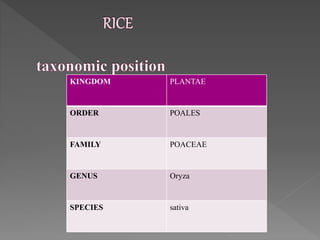
KINGDOM PLANTAE
ORDER POALES
FAMILY POACEAE
GENUS Oryza
SPECIES sativa
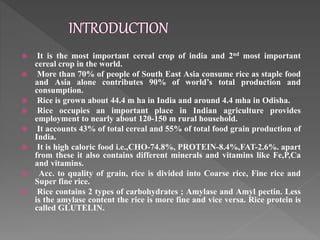
 It is the most important cereal crop of india and 2nd most important
cereal crop in the world.
 More than 70% of people of South East Asia consume rice as staple food
and Asia alone contributes 90% of world’s total production and
consumption.
 Rice is grown about 44.4 m ha in India and around 4.4 mha in Odisha.
 Rice occupies an important place in Indian agriculture provides
employment to nearly about 120-150 m rural household.
 It accounts 43% of total cereal and 55% of total food grain production of
India.
 It is high caloric food i.e.,CHO-74.8%, PROTEIN-8.4%,FAT-2.6%. apart
from these it also contains different minerals and vitamins like Fe,P,Ca
and vitamins.
 Acc. to quality of grain, rice is divided into Coarse rice, Fine rice and
Super fine rice.
 Rice contains 2 types of carbohydrates ; Amylase and Amyl pectin. Less
is the amylase content the rice is more fine and vice versa. Rice protein is
called GLUTELIN.
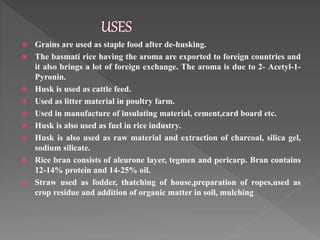
 Grains are used as staple food after de-husking.
 The basmati rice having the aroma are exported to foreign countries and
it also brings a lot of foreign exchange. The aroma is due to 2- Acetyl-1-
Pyronin.
 Husk is used as cattle feed.
 Used as litter material in poultry farm.
 Used in manufacture of insulating material, cement,card board etc.
 Husk is also used as fuel in rice industry.
 Husk is also used as raw material and extraction of charcoal, silica gel,
sodium silicate.
 Rice bran consists of aleurone layer, tegmen and pericarp. Bran contains
12-14% protein and 14-25% oil.
 Straw used as fodder, thatching of house,preparation of ropes,used as
crop residue and addition of organic matter in soil, mulching
 From Sanskrit and other literatures it is known that rice
was known in India before the present era.
 De Candolle (1886) and Watt (1862) thought that South
India is the centre of Origin of rice.
 Vavilov suggested that India and Burma should be regarded
as the centers of origin of cultivated rice.
 According to D. Chatterjee there are all together 23 species
of genus Oryza of which 21 are wild and two viz. Oryza
sativa and Oryza glaberrima are cultivated.
 Oryza sativa is grown in all rice growing areas whereas
Oryza glaberrima is confined to the West Africa only.
 Thus it might indicate that there are two centers of origin of
our cultivated rice: South-eastern Asia (India, Burma and
Thailand) and West Africa.
 Rice is mainly concentrated on tropical &sub-tropical area.
 However japonica type can be grown in temperate region.
 Leading countries in rice production are India ,china,
Bangladesh, Pakistan, Phillipines, Egypt, USA etc.
 In India the major rice growing states are WestBengal,
Bihar, UP, Panjab.TamilNadu,Odisha,CG,AP. Rice is grown
at mean sea level in Kerla to 2000mtrs above the mean sea
level i.e , in Kashmir.
 Odisha contributes around 8-10% of total rice production
in country. In India rice is grown nearly about an area of 44
Mha getting more than 100mt of total production.
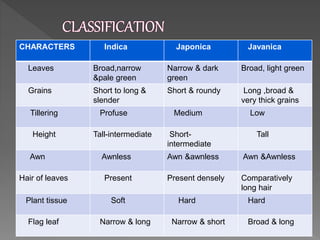
CHARACTERS Indica Japonica Javanica
Leaves Broad,narrow
&pale green
Narrow & dark
green
Broad, light green
Grains Short to long &
slender
Short & roundy Long ,broad &
very thick grains
Tillering Profuse Medium Low
Height Tall-intermediate Short-
intermediate
Tall
Awn Awnless Awn &awnless Awn &Awnless
Hair of leaves Present Present densely Comparatively
long hair
Plant tissue Soft Hard Hard
Flag leaf Narrow & long Narrow & short Broad & long
 Rice is a semi aquatic plant.It can be survive in water condition due to
arenchymatous cells . This supplies O2 for respiration .These are intercellular
cells with space.
 Rice plant is devided into root & shoot.
 SHOOT: It is the above ground level & consist of stem, leaves &inflorescence.
Stem of rice is called culm . Leaves consist of 3 parts.
Leaf sheath
Leaf blade
Auricle &ligule
 Inflorescence is raceme type/spike.
 Raceme consist of spikelets .
 Seed of rice is called caryopsis.
 ROOT : 2 types
 Embryonic root: Develops just after germination & continues up to 10-14 days.
 Adventitious root: Develops from basal node. It is 2 type-
Positively geotrophic: whitish, comparatively thick &growing down word.
Dia-geotrophic: Parallel to ground ,comparatively thinner &brownish reddish
colour. It contains a specialized cell called lysigenous tissue responsible for
absorbing dissolve O2from water.
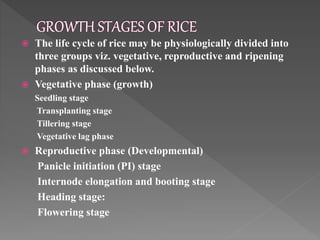
 The life cycle of rice may be physiologically divided into
three groups viz. vegetative, reproductive and ripening
phases as discussed below.
 Vegetative phase (growth)
Seedling stage
Transplanting stage
Tillering stage
Vegetative lag phase
 Reproductive phase (Developmental)
Panicle initiation (PI) stage
Internode elongation and booting stage
Heading stage:
Flowering stage
 The rice ripening is completed between 25-35
days after the crop has passed through the
following stages.
Milking stage
Dough stage
Maturing stage
 Rice is basically a tropical & sub-tropical crop. It prefers hot
& humid climate.
 However japonica type can be grown in temperate region.
It is suitable to cultivate are having high humidity &
prolonged sunshine and assured supply of water.
 Average temperature for growth of rice is 21-37oc
throughout it’s lifecycle. Tillering requires little bit higher
temperature.
 Flowering- 30-33oc
 Ripening- 20-25oc
 Rice is basically a short-day plant. But all the high yielding
varieties are day neutral. However the traditional varieties
of more than 150 days duration are short day plants. That’s
why it’s possible to cultivate rice in both seasons.
 rice can be grown in wide range of soil
including alkaline to acidic soil.
 Soil having good water retention capacity ,
good amount of clay and organic matter are
ideal for rice cultivation.
 Clay to clay loam soil are the best textured
soil for rice cultivation. Ideal pH requirement
is 5.5-6.5.
 Soil of rice has two zones-
Oxidized zone- Top 1-3mm of soil.
Reduced zone- Soil below oxidized zone.
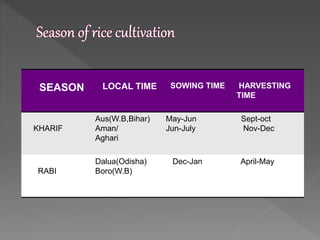
SEASON LOCAL TIME SOWING TIME HARVESTING
TIME
KHARIF
Aus(W.B,Bihar)
Aman/
Aghari
May-Jun
Jun-July
Sept-oct
Nov-Dec
RABI
Dalua(Odisha)
Boro(W.B)
Dec-Jan April-May
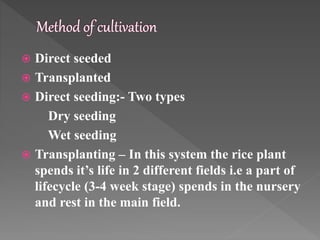
 Direct seeded
 Transplanted
 Direct seeding:- Two types
Dry seeding
Wet seeding
 Transplanting – In this system the rice plant
spends it’s life in 2 different fields i.e a part of
lifecycle (3-4 week stage) spends in the nursery
and rest in the main field.
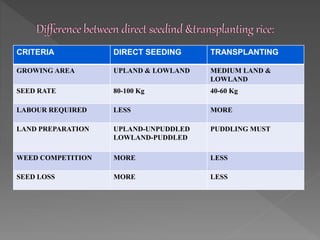
CRITERIA DIRECT SEEDING TRANSPLANTING
GROWING AREA UPLAND & LOWLAND MEDIUM LAND &
LOWLAND
SEED RATE 80-100 Kg 40-60 Kg
LABOUR REQUIRED LESS MORE
LAND PREPARATION UPLAND-UNPUDDLED
LOWLAND-PUDDLED
PUDDLING MUST
WEED COMPETITION MORE LESS
SEED LOSS MORE LESS
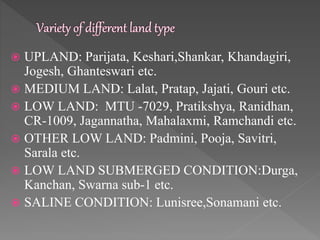
 UPLAND: Parijata, Keshari,Shankar, Khandagiri,
Jogesh, Ghanteswari etc.
 MEDIUM LAND: Lalat, Pratap, Jajati, Gouri etc.
 LOW LAND: MTU -7029, Pratikshya, Ranidhan,
CR-1009, Jagannatha, Mahalaxmi, Ramchandi etc.
 OTHER LOW LAND: Padmini, Pooja, Savitri,
Sarala etc.
 LOW LAND SUBMERGED CONDITION:Durga,
Kanchan, Swarna sub-1 etc.
 SALINE CONDITION: Lunisree,Sonamani etc.
 Dry bed
 Wet bed
 Dapog method
 Mat method
 Land preparation
 transplanting
 Addition of organic manures is one of the important cause
affecting the yield greatly.
 The FYM @5-10 tonnes/ha is to be added at the time of final
land preparation or green manuring of sunhemp
,dhaincha,cowpea should be followed.
 The management of chemical fertilizers for Odisha
condition the recommended doses of fertilizer is 80:40:40 for
kharif &125:60:60 for rabi or dalua season.
 TIME&METHOD OF APPLICATION:
 1/3 of the nitrogen with full of P&K are applied as basal at
the time of last puddling.1/3 of N is applied at the time of
tillering stage & rest at panicle initiation stage.
 If the soil is light textured ,then K may be applied in 2
equel splits. Zinc sulphate @ 25 kg/ha is applied basal in Zn
deficient soil. Zinc-sulphate solution@0.5 % may also be
spread on the foliage to rectify the Zn deficiency. However to
newtralize the acid effect @ 0.25% lime solution should be
mixed with Zinc solution before spraying .
 Objective is to increase the yield with efficient use of
available water resource.
 In rice for production of 1kg of paddy 3000-4000 ltrs water
is required .
WATER REQUIREMENT FOR DIFFERENT STAGES:
 In nursery – 1.5-2cm
 In main field –during land preparation-20-30cm & in
growth-80-120 cm
 Total water requirement of rice is 104-156 cm.
 CRITICAL STAGES OF WATER REQUIREMENT IN
RICE:
PI ,booting, heading , flowering, &grain filling .Flowering
&grain filling is most important stages.
 Rice plant suffers from weed competition and the extent of yield loss
is 10-90% depending upon the system of rice cultivation.
 The weed compete with rice crop for space ,nutrient, light . Weeds
are more aggressive in nature than crop plant &can survive under
biotic & abiotic stress condition .Weeds are called silent killer because
they do not produce any harmful symptoms.
 CONTROL MEASURES:
 Manual weeding can be taken up at 3 weeks on 20 DAT. If necessary
2nd hand weeding can be taken up at 40-45DAT.
 Herbicides can also be used . Pre emergence herbicides mean this type
of herbicides used before emergence of weed plants. E.g-
butachlor/pretilachlor @ 1 ltr a.i/ha.
 Post emergence herbicides .e.g –almix @ 20 g/ha or Bispyrivic
sodium @ 200 g/ha applied at 10-15days after transplanting, 2,4-D- @
0.6-0.9 kg a.i /ha applied at 25-30 DAT.
 Turning the crop colour from green to yellow is the general symptom
of maturity.
 At this stage, the grain starts maturing from top to bottom of the
panicle.
 About a week for heavy & 3-4 days for light soils, prior to harvest,
the water is let out completely .
 At harvest, moisture level of grain should be 20-23% for better
milling quality.
 In single cropped wet lands, either a pulse (Eg:BG/GG) or fodder
crop like pillipesara/sunhemp seed is broadcasted. Then the rice crop
is harvested by manual labour using sickles.
 The harvested sheaves are spread for 3-4 days, sundried and heaped
and directly threshed, winnowed & stored. For shattering varieties,
crop is harvested before it is fully dried.
 At the time of harvest, the bottom portion of plants and some of the
grains at the base of the earhead will be green. If it is fully riped (dead
ripe), the rice gets broken during milling.
 Hand threshing of sheaves :
against some hard surface like stone, wooden plank, a bench
etc.,This is practical when the quantity is small and also for when
it is for seed purpose.
 Cattle thresing :
It is adopted when large quantity is to be handled. First, a
threshing floor is
 prepared well by removing stubbles, compacting etc., in a circular
fashion and the sheaves are
 spread and trampling under the feet of cattle is made to go round
and round.
 Tractor threshing :
 Now a days, it is widely adopted practice. The sheaves are heaped
on the
 threshing floor in a circular fashion and the tractor goes round
and round. In advanced countries, there will be combined thresher
and winnowers
 It varies from season to season, and variety to
variety besides several other factors. While the
average yields vary from 4-5 tons/ha during
kharif. A minimum of 1 more tonne can be
expected during rabi for HYV
 SRI stands for System of Rice Intensification.
 Seed rate- 5 kg/ha
 Advantages of SRI:
❖ Saving on seed cost as the seed requirement is less
❖ Saving on water as Irrigated – Dry method is followed
❖ Cost of external inputs gets reduced as chemical fertilizers
and pesticides are used to the minimum extent.
❖ Incidence of pests and diseases is low as the soil is allowed to
dry intermittently.
❖ More healthy and tasty rice as a result of organic farming
practices.
❖ Higher yields due to profuse tillering, increased panicle
length and grain weight
❖ Seed multiplication with less quantity of parent seed.
❖ Farmers can produce their own quality seed.

PADDY.pptx

  • 1.
  • 2.
    KINGDOM PLANTAE ORDER POALES FAMILYPOACEAE GENUS Oryza SPECIES sativa
  • 3.
     It isthe most important cereal crop of india and 2nd most important cereal crop in the world.  More than 70% of people of South East Asia consume rice as staple food and Asia alone contributes 90% of world’s total production and consumption.  Rice is grown about 44.4 m ha in India and around 4.4 mha in Odisha.  Rice occupies an important place in Indian agriculture provides employment to nearly about 120-150 m rural household.  It accounts 43% of total cereal and 55% of total food grain production of India.  It is high caloric food i.e.,CHO-74.8%, PROTEIN-8.4%,FAT-2.6%. apart from these it also contains different minerals and vitamins like Fe,P,Ca and vitamins.  Acc. to quality of grain, rice is divided into Coarse rice, Fine rice and Super fine rice.  Rice contains 2 types of carbohydrates ; Amylase and Amyl pectin. Less is the amylase content the rice is more fine and vice versa. Rice protein is called GLUTELIN.
  • 4.
     Grains areused as staple food after de-husking.  The basmati rice having the aroma are exported to foreign countries and it also brings a lot of foreign exchange. The aroma is due to 2- Acetyl-1- Pyronin.  Husk is used as cattle feed.  Used as litter material in poultry farm.  Used in manufacture of insulating material, cement,card board etc.  Husk is also used as fuel in rice industry.  Husk is also used as raw material and extraction of charcoal, silica gel, sodium silicate.  Rice bran consists of aleurone layer, tegmen and pericarp. Bran contains 12-14% protein and 14-25% oil.  Straw used as fodder, thatching of house,preparation of ropes,used as crop residue and addition of organic matter in soil, mulching
  • 5.
     From Sanskritand other literatures it is known that rice was known in India before the present era.  De Candolle (1886) and Watt (1862) thought that South India is the centre of Origin of rice.  Vavilov suggested that India and Burma should be regarded as the centers of origin of cultivated rice.  According to D. Chatterjee there are all together 23 species of genus Oryza of which 21 are wild and two viz. Oryza sativa and Oryza glaberrima are cultivated.  Oryza sativa is grown in all rice growing areas whereas Oryza glaberrima is confined to the West Africa only.  Thus it might indicate that there are two centers of origin of our cultivated rice: South-eastern Asia (India, Burma and Thailand) and West Africa.
  • 6.
     Rice ismainly concentrated on tropical &sub-tropical area.  However japonica type can be grown in temperate region.  Leading countries in rice production are India ,china, Bangladesh, Pakistan, Phillipines, Egypt, USA etc.  In India the major rice growing states are WestBengal, Bihar, UP, Panjab.TamilNadu,Odisha,CG,AP. Rice is grown at mean sea level in Kerla to 2000mtrs above the mean sea level i.e , in Kashmir.  Odisha contributes around 8-10% of total rice production in country. In India rice is grown nearly about an area of 44 Mha getting more than 100mt of total production.
  • 7.
    CHARACTERS Indica JaponicaJavanica Leaves Broad,narrow &pale green Narrow & dark green Broad, light green Grains Short to long & slender Short & roundy Long ,broad & very thick grains Tillering Profuse Medium Low Height Tall-intermediate Short- intermediate Tall Awn Awnless Awn &awnless Awn &Awnless Hair of leaves Present Present densely Comparatively long hair Plant tissue Soft Hard Hard Flag leaf Narrow & long Narrow & short Broad & long
  • 8.
     Rice isa semi aquatic plant.It can be survive in water condition due to arenchymatous cells . This supplies O2 for respiration .These are intercellular cells with space.  Rice plant is devided into root & shoot.  SHOOT: It is the above ground level & consist of stem, leaves &inflorescence. Stem of rice is called culm . Leaves consist of 3 parts. Leaf sheath Leaf blade Auricle &ligule  Inflorescence is raceme type/spike.  Raceme consist of spikelets .  Seed of rice is called caryopsis.  ROOT : 2 types  Embryonic root: Develops just after germination & continues up to 10-14 days.  Adventitious root: Develops from basal node. It is 2 type- Positively geotrophic: whitish, comparatively thick &growing down word. Dia-geotrophic: Parallel to ground ,comparatively thinner &brownish reddish colour. It contains a specialized cell called lysigenous tissue responsible for absorbing dissolve O2from water.
  • 9.
     The lifecycle of rice may be physiologically divided into three groups viz. vegetative, reproductive and ripening phases as discussed below.  Vegetative phase (growth) Seedling stage Transplanting stage Tillering stage Vegetative lag phase  Reproductive phase (Developmental) Panicle initiation (PI) stage Internode elongation and booting stage Heading stage: Flowering stage
  • 10.
     The riceripening is completed between 25-35 days after the crop has passed through the following stages. Milking stage Dough stage Maturing stage
  • 11.
     Rice isbasically a tropical & sub-tropical crop. It prefers hot & humid climate.  However japonica type can be grown in temperate region. It is suitable to cultivate are having high humidity & prolonged sunshine and assured supply of water.  Average temperature for growth of rice is 21-37oc throughout it’s lifecycle. Tillering requires little bit higher temperature.  Flowering- 30-33oc  Ripening- 20-25oc  Rice is basically a short-day plant. But all the high yielding varieties are day neutral. However the traditional varieties of more than 150 days duration are short day plants. That’s why it’s possible to cultivate rice in both seasons.
  • 12.
     rice canbe grown in wide range of soil including alkaline to acidic soil.  Soil having good water retention capacity , good amount of clay and organic matter are ideal for rice cultivation.  Clay to clay loam soil are the best textured soil for rice cultivation. Ideal pH requirement is 5.5-6.5.  Soil of rice has two zones- Oxidized zone- Top 1-3mm of soil. Reduced zone- Soil below oxidized zone.
  • 13.
    SEASON LOCAL TIMESOWING TIME HARVESTING TIME KHARIF Aus(W.B,Bihar) Aman/ Aghari May-Jun Jun-July Sept-oct Nov-Dec RABI Dalua(Odisha) Boro(W.B) Dec-Jan April-May
  • 14.
     Direct seeded Transplanted  Direct seeding:- Two types Dry seeding Wet seeding  Transplanting – In this system the rice plant spends it’s life in 2 different fields i.e a part of lifecycle (3-4 week stage) spends in the nursery and rest in the main field.
  • 15.
    CRITERIA DIRECT SEEDINGTRANSPLANTING GROWING AREA UPLAND & LOWLAND MEDIUM LAND & LOWLAND SEED RATE 80-100 Kg 40-60 Kg LABOUR REQUIRED LESS MORE LAND PREPARATION UPLAND-UNPUDDLED LOWLAND-PUDDLED PUDDLING MUST WEED COMPETITION MORE LESS SEED LOSS MORE LESS
  • 16.
     UPLAND: Parijata,Keshari,Shankar, Khandagiri, Jogesh, Ghanteswari etc.  MEDIUM LAND: Lalat, Pratap, Jajati, Gouri etc.  LOW LAND: MTU -7029, Pratikshya, Ranidhan, CR-1009, Jagannatha, Mahalaxmi, Ramchandi etc.  OTHER LOW LAND: Padmini, Pooja, Savitri, Sarala etc.  LOW LAND SUBMERGED CONDITION:Durga, Kanchan, Swarna sub-1 etc.  SALINE CONDITION: Lunisree,Sonamani etc.
  • 17.
     Dry bed Wet bed  Dapog method  Mat method
  • 18.
  • 19.
     Addition oforganic manures is one of the important cause affecting the yield greatly.  The FYM @5-10 tonnes/ha is to be added at the time of final land preparation or green manuring of sunhemp ,dhaincha,cowpea should be followed.  The management of chemical fertilizers for Odisha condition the recommended doses of fertilizer is 80:40:40 for kharif &125:60:60 for rabi or dalua season.  TIME&METHOD OF APPLICATION:  1/3 of the nitrogen with full of P&K are applied as basal at the time of last puddling.1/3 of N is applied at the time of tillering stage & rest at panicle initiation stage.  If the soil is light textured ,then K may be applied in 2 equel splits. Zinc sulphate @ 25 kg/ha is applied basal in Zn deficient soil. Zinc-sulphate solution@0.5 % may also be spread on the foliage to rectify the Zn deficiency. However to newtralize the acid effect @ 0.25% lime solution should be mixed with Zinc solution before spraying .
  • 20.
     Objective isto increase the yield with efficient use of available water resource.  In rice for production of 1kg of paddy 3000-4000 ltrs water is required . WATER REQUIREMENT FOR DIFFERENT STAGES:  In nursery – 1.5-2cm  In main field –during land preparation-20-30cm & in growth-80-120 cm  Total water requirement of rice is 104-156 cm.  CRITICAL STAGES OF WATER REQUIREMENT IN RICE: PI ,booting, heading , flowering, &grain filling .Flowering &grain filling is most important stages.
  • 21.
     Rice plantsuffers from weed competition and the extent of yield loss is 10-90% depending upon the system of rice cultivation.  The weed compete with rice crop for space ,nutrient, light . Weeds are more aggressive in nature than crop plant &can survive under biotic & abiotic stress condition .Weeds are called silent killer because they do not produce any harmful symptoms.  CONTROL MEASURES:  Manual weeding can be taken up at 3 weeks on 20 DAT. If necessary 2nd hand weeding can be taken up at 40-45DAT.  Herbicides can also be used . Pre emergence herbicides mean this type of herbicides used before emergence of weed plants. E.g- butachlor/pretilachlor @ 1 ltr a.i/ha.  Post emergence herbicides .e.g –almix @ 20 g/ha or Bispyrivic sodium @ 200 g/ha applied at 10-15days after transplanting, 2,4-D- @ 0.6-0.9 kg a.i /ha applied at 25-30 DAT.
  • 22.
     Turning thecrop colour from green to yellow is the general symptom of maturity.  At this stage, the grain starts maturing from top to bottom of the panicle.  About a week for heavy & 3-4 days for light soils, prior to harvest, the water is let out completely .  At harvest, moisture level of grain should be 20-23% for better milling quality.  In single cropped wet lands, either a pulse (Eg:BG/GG) or fodder crop like pillipesara/sunhemp seed is broadcasted. Then the rice crop is harvested by manual labour using sickles.  The harvested sheaves are spread for 3-4 days, sundried and heaped and directly threshed, winnowed & stored. For shattering varieties, crop is harvested before it is fully dried.  At the time of harvest, the bottom portion of plants and some of the grains at the base of the earhead will be green. If it is fully riped (dead ripe), the rice gets broken during milling.
  • 23.
     Hand threshingof sheaves : against some hard surface like stone, wooden plank, a bench etc.,This is practical when the quantity is small and also for when it is for seed purpose.  Cattle thresing : It is adopted when large quantity is to be handled. First, a threshing floor is  prepared well by removing stubbles, compacting etc., in a circular fashion and the sheaves are  spread and trampling under the feet of cattle is made to go round and round.  Tractor threshing :  Now a days, it is widely adopted practice. The sheaves are heaped on the  threshing floor in a circular fashion and the tractor goes round and round. In advanced countries, there will be combined thresher and winnowers
  • 24.
     It variesfrom season to season, and variety to variety besides several other factors. While the average yields vary from 4-5 tons/ha during kharif. A minimum of 1 more tonne can be expected during rabi for HYV
  • 25.
     SRI standsfor System of Rice Intensification.  Seed rate- 5 kg/ha  Advantages of SRI: ❖ Saving on seed cost as the seed requirement is less ❖ Saving on water as Irrigated – Dry method is followed ❖ Cost of external inputs gets reduced as chemical fertilizers and pesticides are used to the minimum extent. ❖ Incidence of pests and diseases is low as the soil is allowed to dry intermittently. ❖ More healthy and tasty rice as a result of organic farming practices. ❖ Higher yields due to profuse tillering, increased panicle length and grain weight ❖ Seed multiplication with less quantity of parent seed. ❖ Farmers can produce their own quality seed.