




Improving Food Security through
Rice Value Chain Upgrading in Africa:
What Can We Learn from Experimental Economics?
Matty Demont
Senior Economist, Market Research and Value Chain Specialist,
International Rice Research Institute (IRRI), Los Baños, Philippines
m.demont@irri.org
Third Africa Rice Congress, Yaoundé, Cameroon, 21–24 October 2013
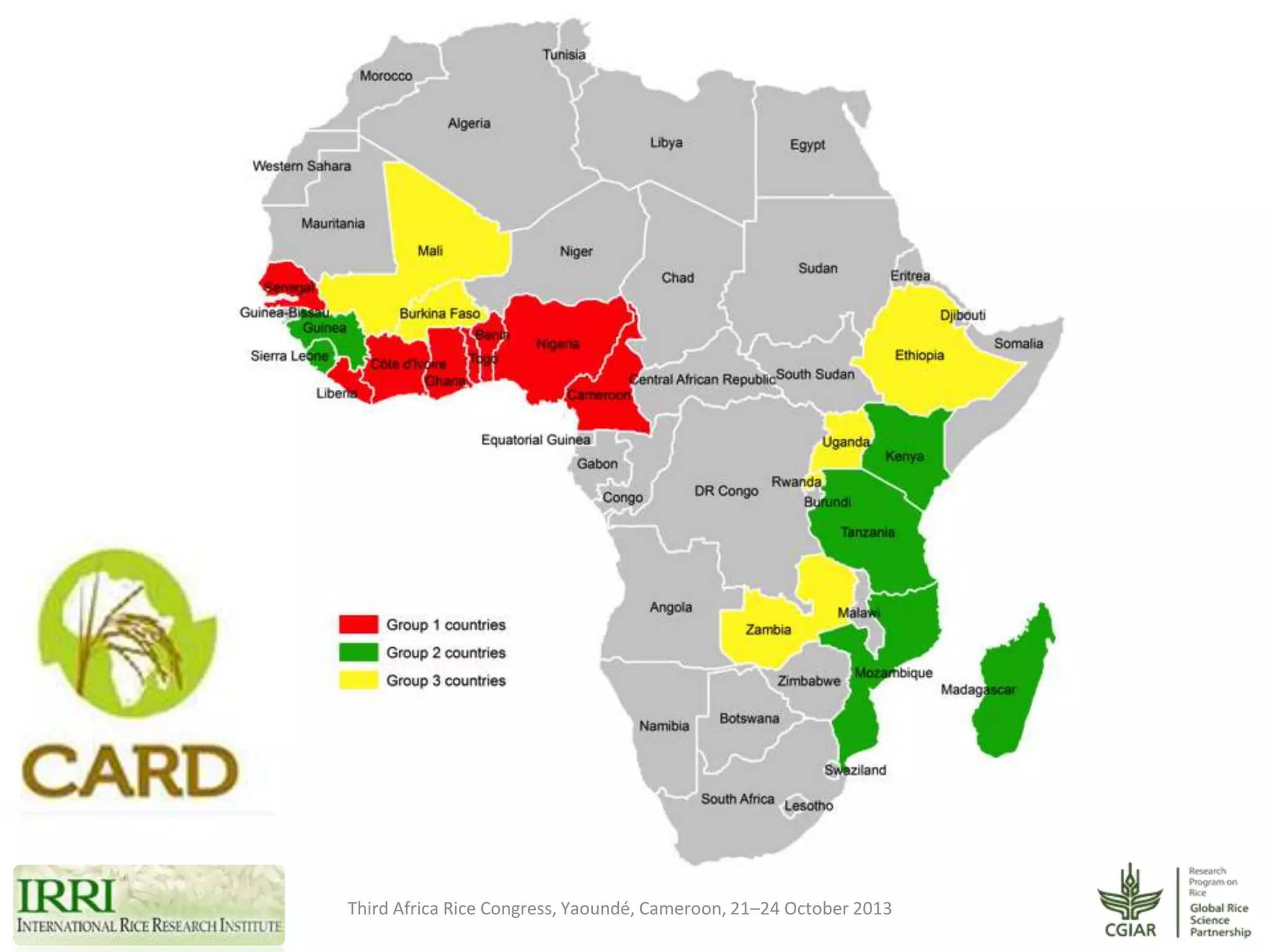
Three types of countries
• Coastal countries strongly exposed to urban
bias (Senegal, Liberia, Cote d’Ivoire, Ghana,
Togo, Benin, Nigeria, Cameroon)
• Coastal countries not yet strongly affected by
urban bias or with comparative advantage in
rice demand (Gambia, Guinea, Sierra Leone,
Kenya, Tanzania, Mozambique, Madagascar)
• Landlocked countries (Mali, Burkina Faso,
Ethiopia, Rwanda, Zambia)
Third Africa Rice Congress, Yaoundé, Cameroon, 21–24 October 2013
Observation
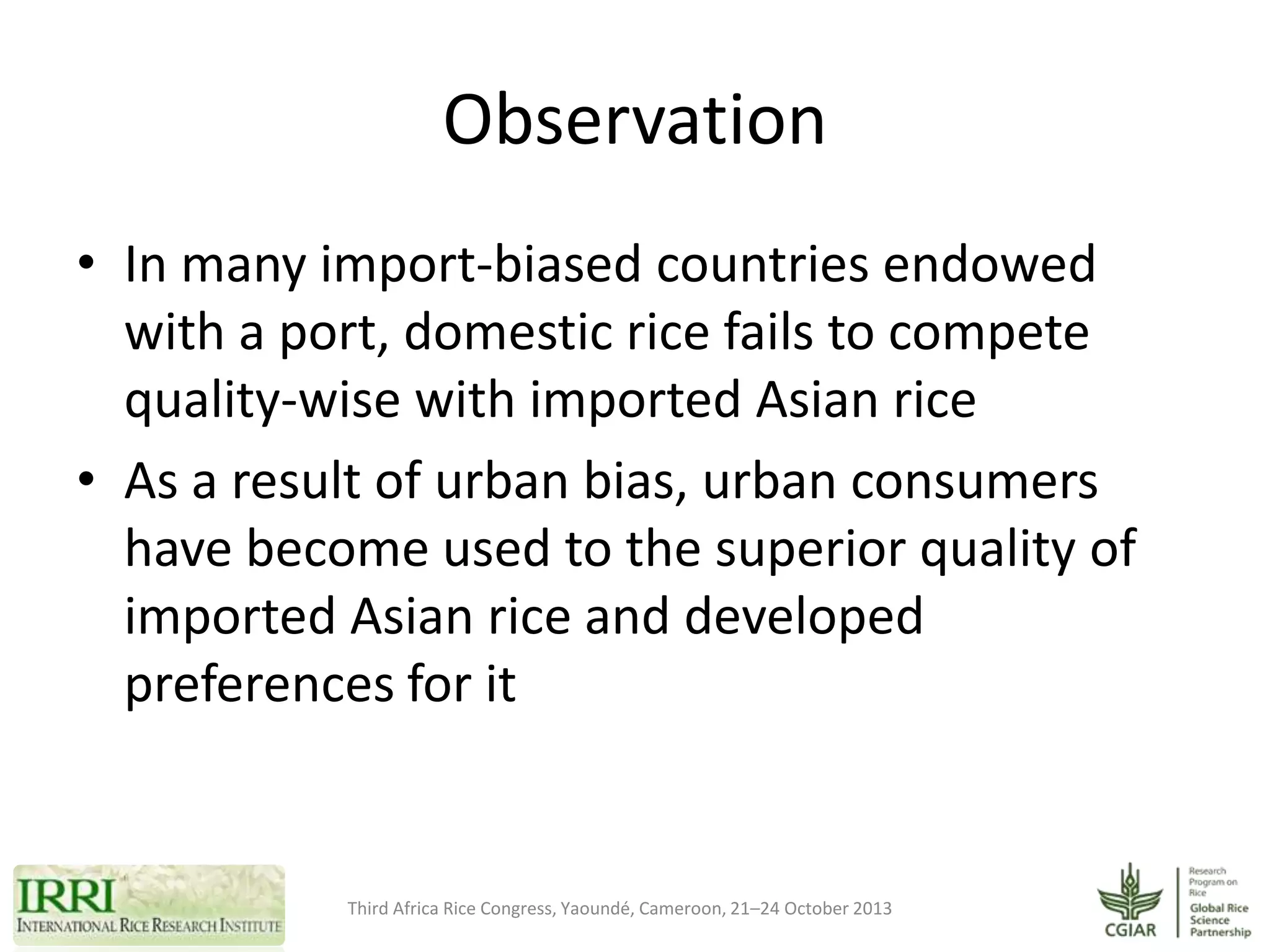
• In many import-biased countries endowed
with a port, domestic rice fails to compete
quality-wise with imported Asian rice
• As a result of urban bias, urban consumers
have become used to the superior quality of
imported Asian rice and developed
preferences for it

Third Africa Rice Congress, Yaoundé, Cameroon, 21–24 October 2013
Observation
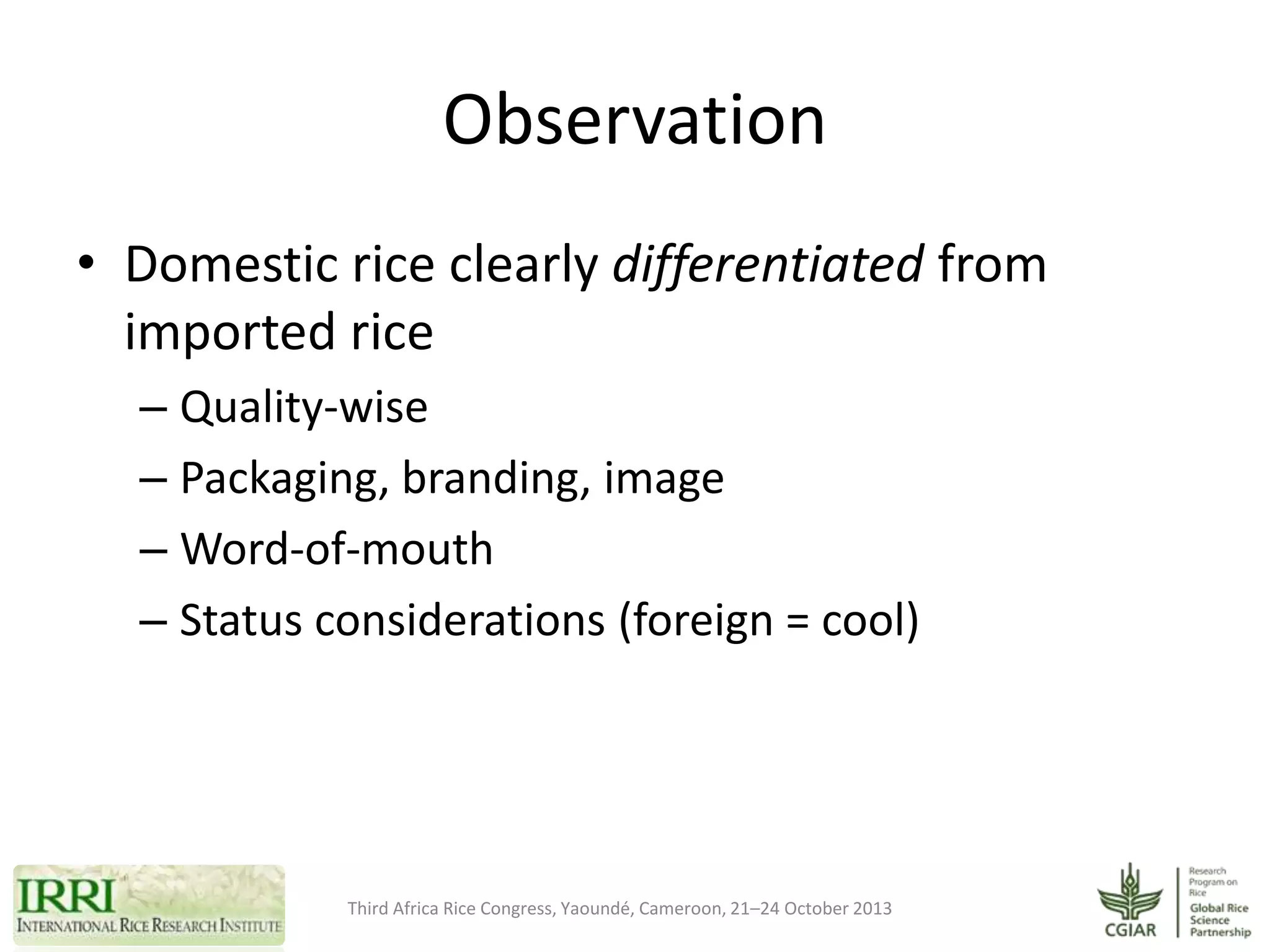
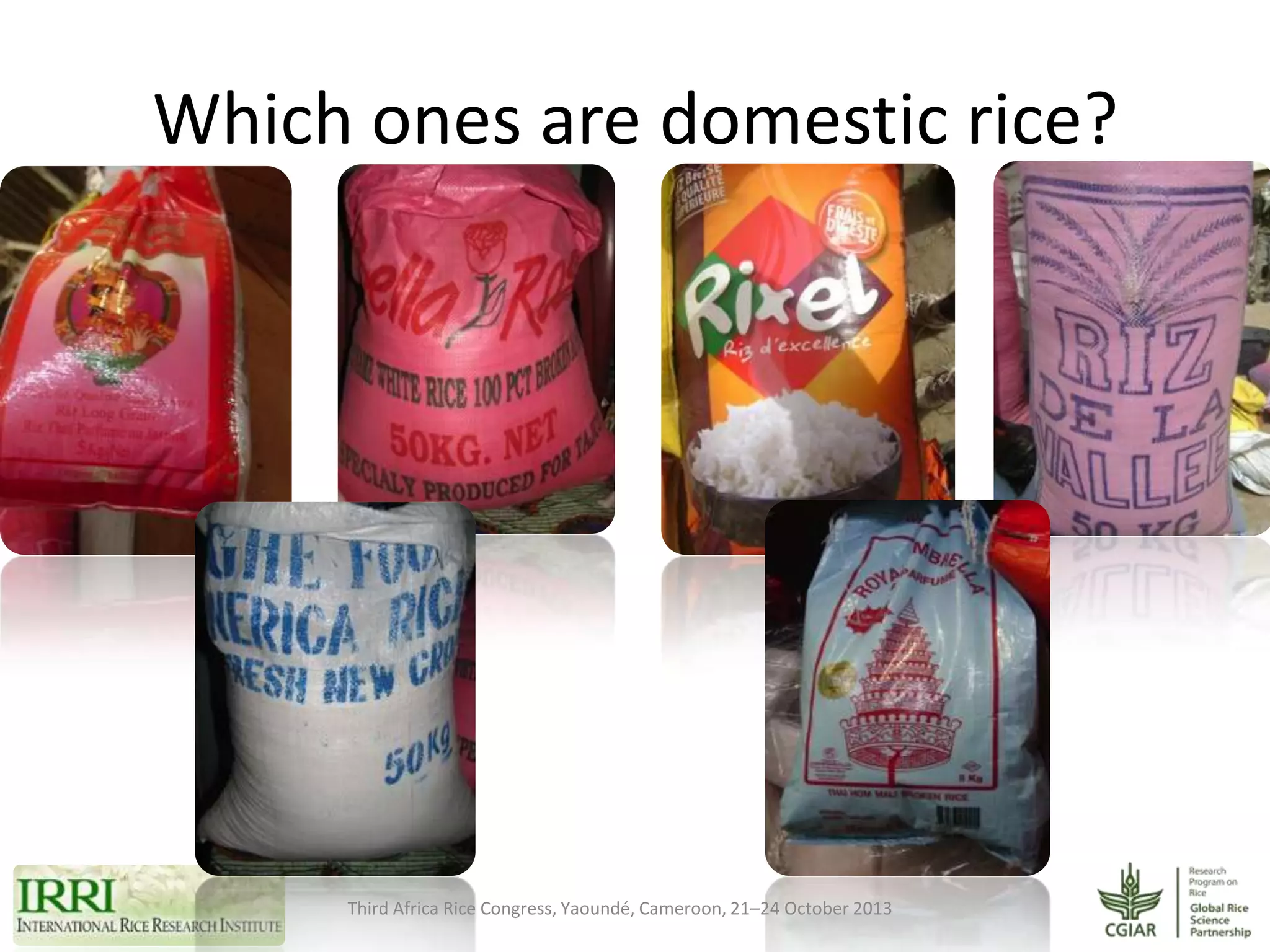
• Domestic rice clearly differentiated from
imported rice
– Quality-wise
– Packaging, branding, image
– Word-of-mouth
– Status considerations (foreign = cool)f-mouth
– Status considerations (foreign = cool)

Third Africa Rice Congress, Yaoundé, Cameroon, 21–24 October 2013
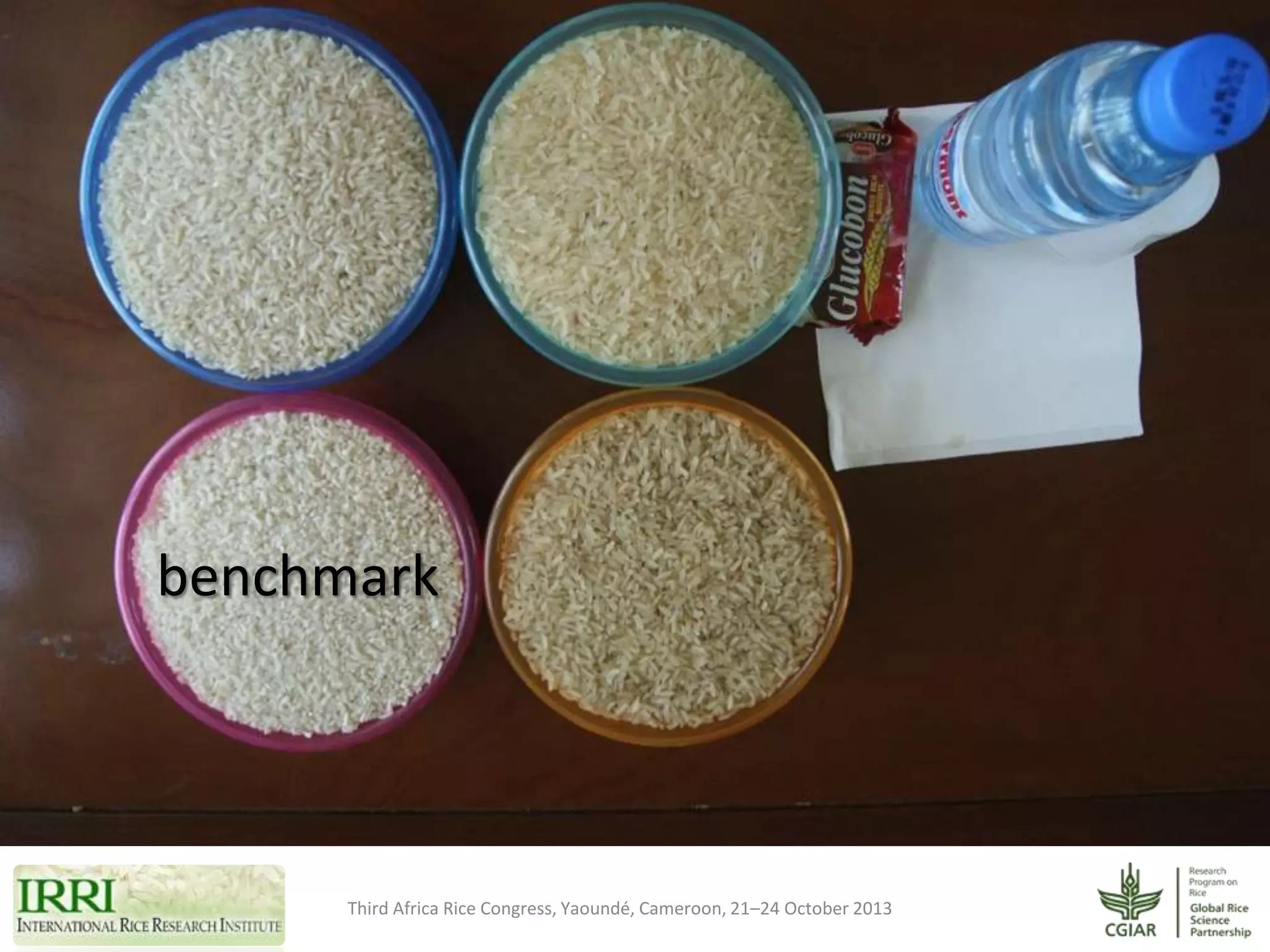
Which ones are domestic rice?

Third Africa Rice Congress, Yaoundé, Cameroon, 21–24 October 2013
Research hypothesis
• Domestic rice now not only has to compete
quantity-wise, but also quality-wise, but how?
• In the absence of strong consumer
attachment to domestic rice, best short- and
medium-term option = dedifferentiating
domestic from imported rice
– Quality-wise
– Packaging, branding, image
Third Africa Rice Congress, Yaoundé, Cameroon, 21–24 October 2013
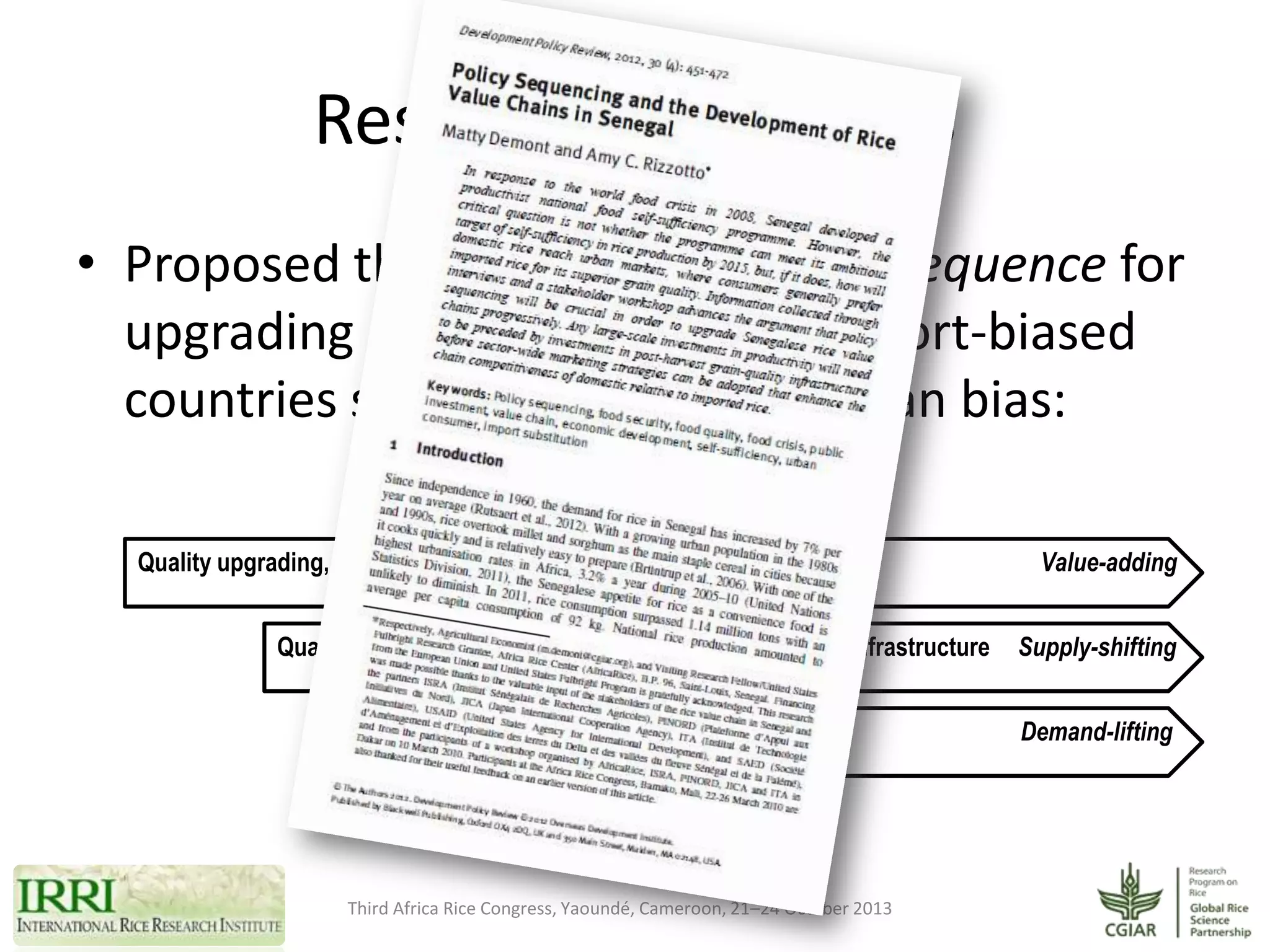
Research hypothesis
• Proposed three-stage investment sequence for
upgrading rice value chains in import-biased
countries strongly exposed to urban bias:
Quality upgrading, processing infrastructure, certification, branding, ...
Quantity increase, scaling up, aggregation and storage infrastructure
Advertizing and generic promotion

Third Africa Rice Congress, Yaoundé, Cameroon, 21–24 October 2013

Value-adding
Supply-shifting
Demand-lifting
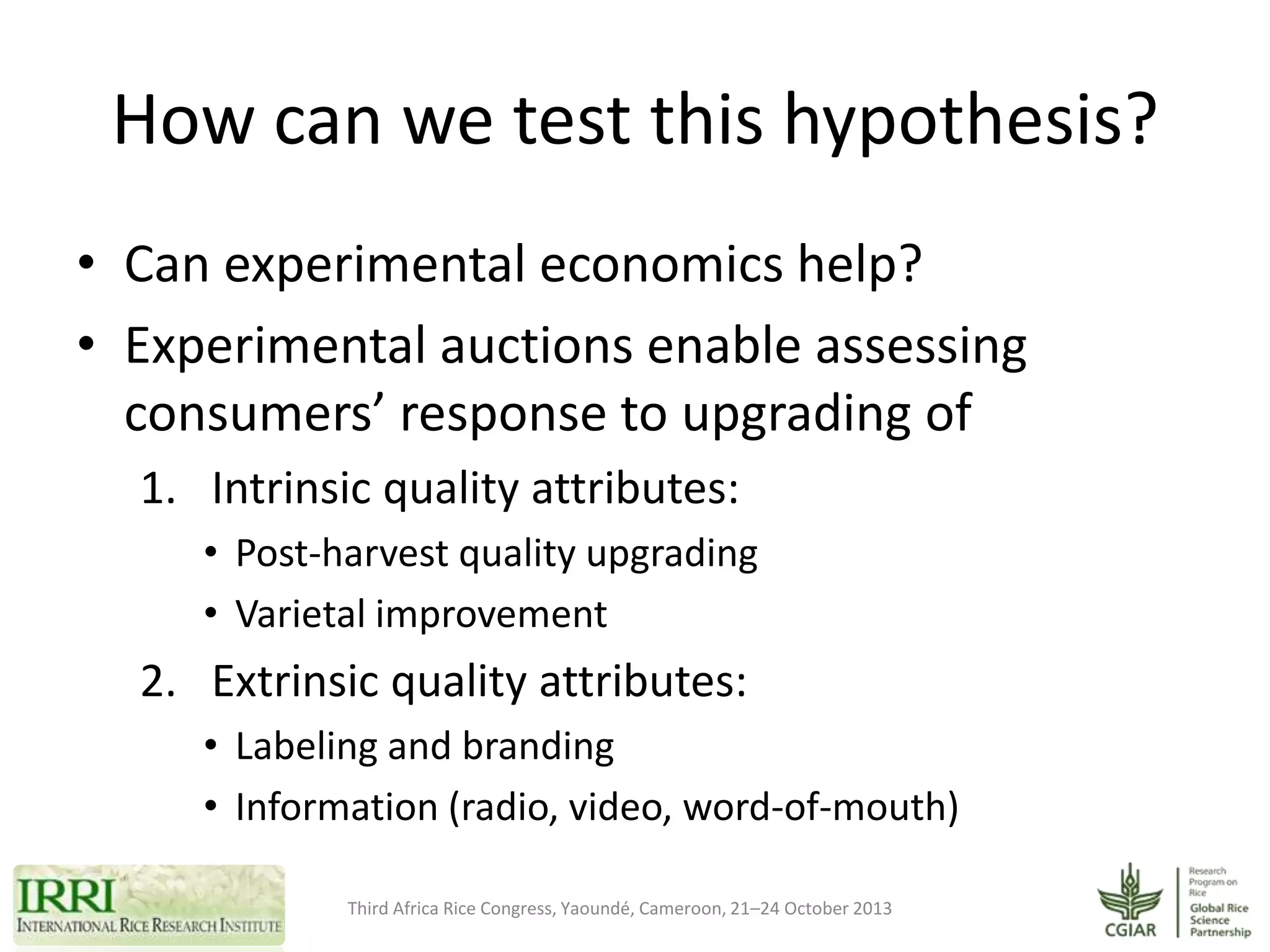
How can we test this hypothesis?
• Can experimental economics help?
• Experimental auctions enable assessing
consumers’ response to upgrading of
1. Intrinsic quality attributes:
• Post-harvest quality upgrading
• Varietal improvement

2. Extrinsic quality attributes:
• Labeling and branding
• Information (radio, video, word-of-mouth)
Third Africa Rice Congress, Yaoundé, Cameroon, 21–24 October 2013
Case studies
Mini-Symposium 4, Sub-Theme 3: Rice
processing and marketing, Hall 3, 14:30–16:00
1. M. Ndour: Branding of local rice in Senegal
2. M. Ouedraogo: Consumers’ response to local
quality rice in Burkina Faso
This presentation:
3. Dedifferentiating imported from local rice in
Cameroon
Third Africa Rice Congress, Yaoundé, Cameroon, 21–24 October 2013
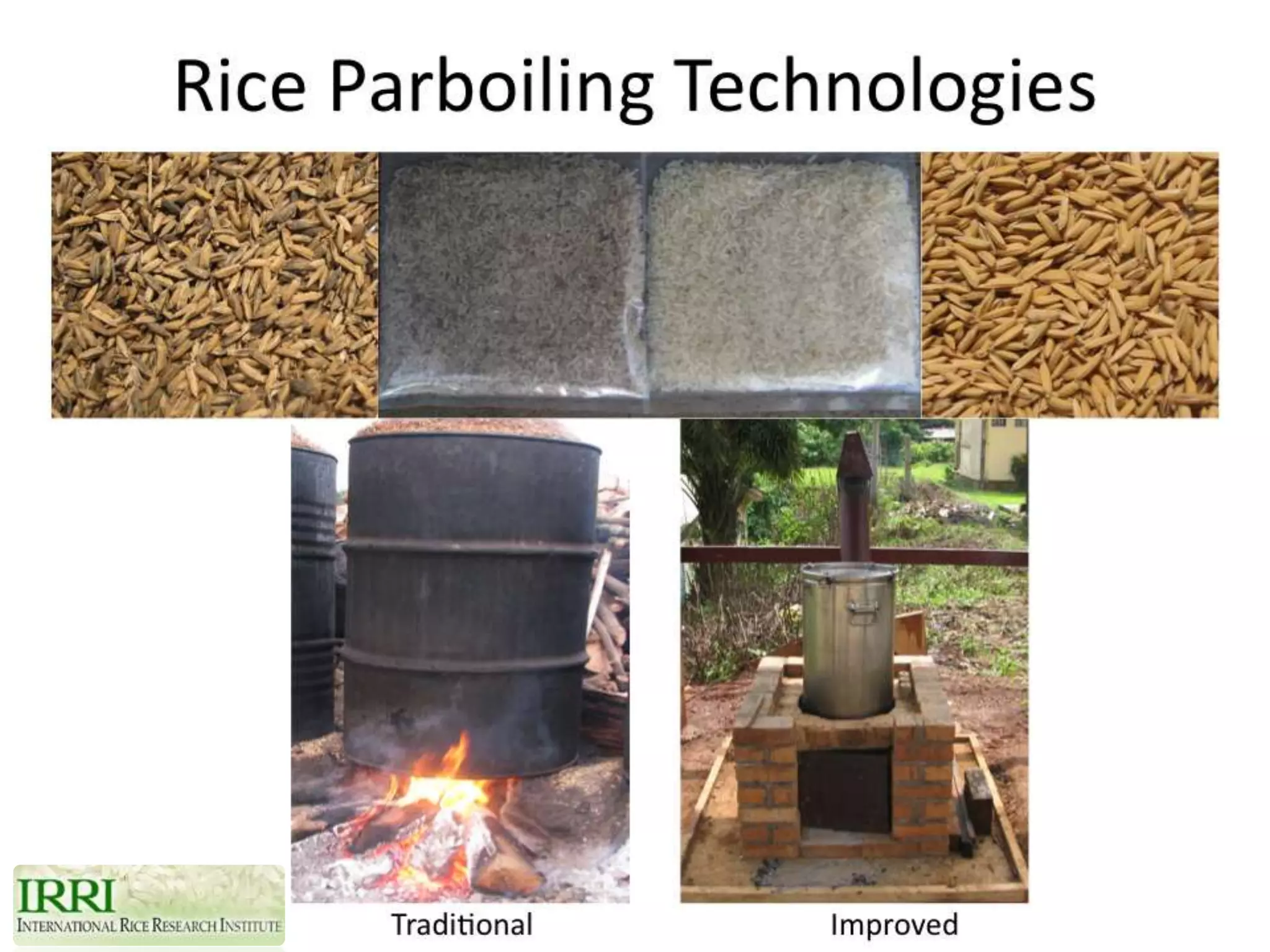
Rice quality upgrading in Cameroon
• Institute of Agric. Research for Development
(IRAD), Cameroon developed uniform steam
distributed (USD) parboiling technology
• Mimics high-grade imported rice in physical and
eating characteristics:
–
–
–
–
–

Whiter
Lower broken fracture
Fewer cracked grains
Absence of burnt grains and impurities
Higher swelling ratio during cooking
Third Africa Rice Congress, Yaoundé, Cameroon, 21–24 October 2013
Rice quality upgrading in Cameroon

IRRI Seminar, International Rice Research Institute (IRRI),
Los Baños, Laguna, Philippines, 4 April 2013
Research questions
• Do consumers perceive the IRAD rice as being
similar to imported rice?
• Are they willing to pay price premiums for it?
Relative to
– Traditionally parboiled local rice
– Improved non-parboiled local rice

• Did IRAD technology successfully qualitydedifferentiate domestic from imported rice?
Third Africa Rice Congress, Yaoundé, Cameroon, 21–24 October 2013
Targeting urban market: Yaoundé

Third Africa Rice Congress, Yaoundé, Cameroon, 21–24 October 2013
Setting up laboratory setting

Third Africa Rice Congress, Yaoundé, Cameroon, 21–24 October 2013
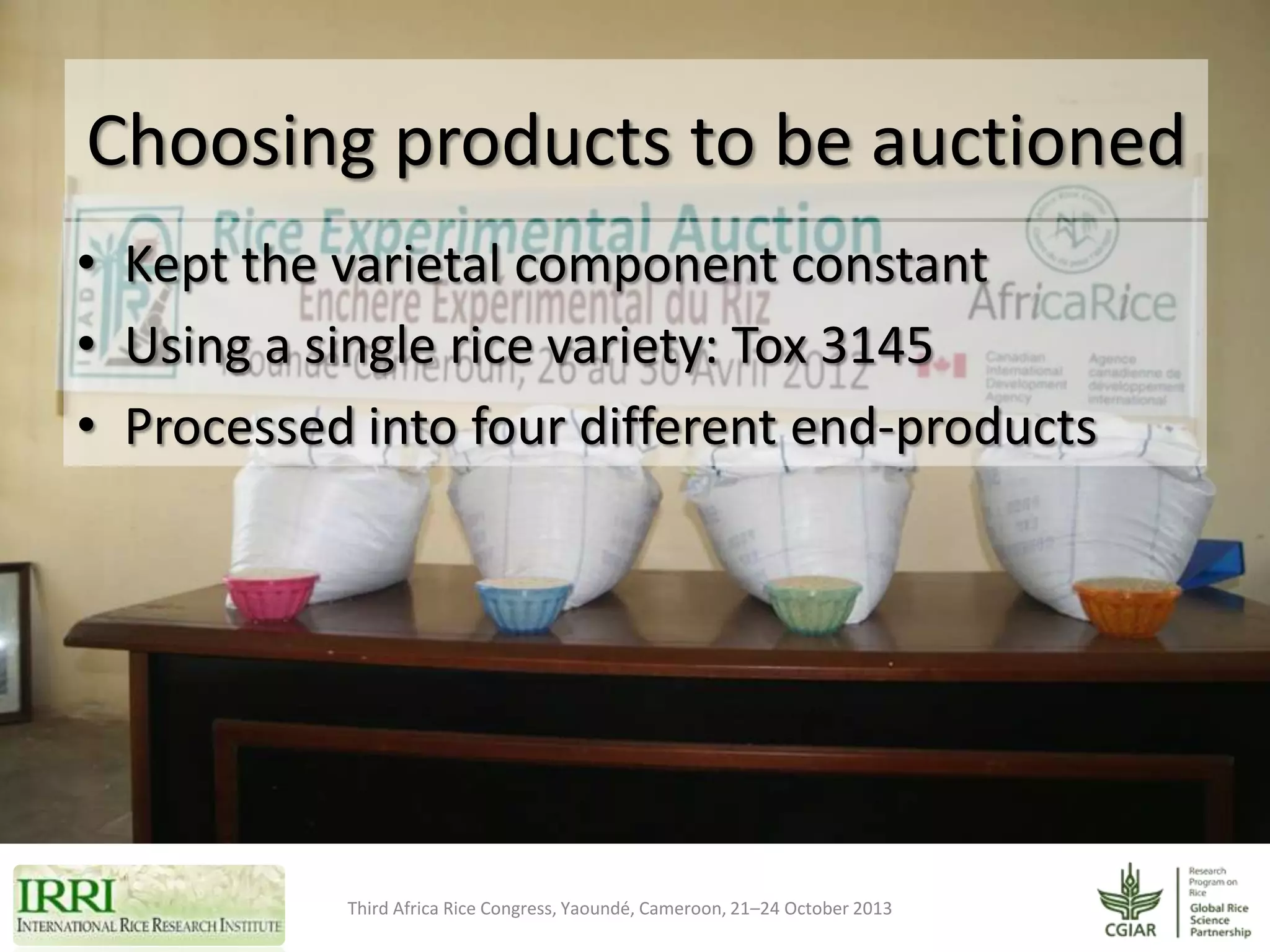
Choosing products to be auctioned
• Kept the varietal component constant
• Using a single rice variety: Tox 3145
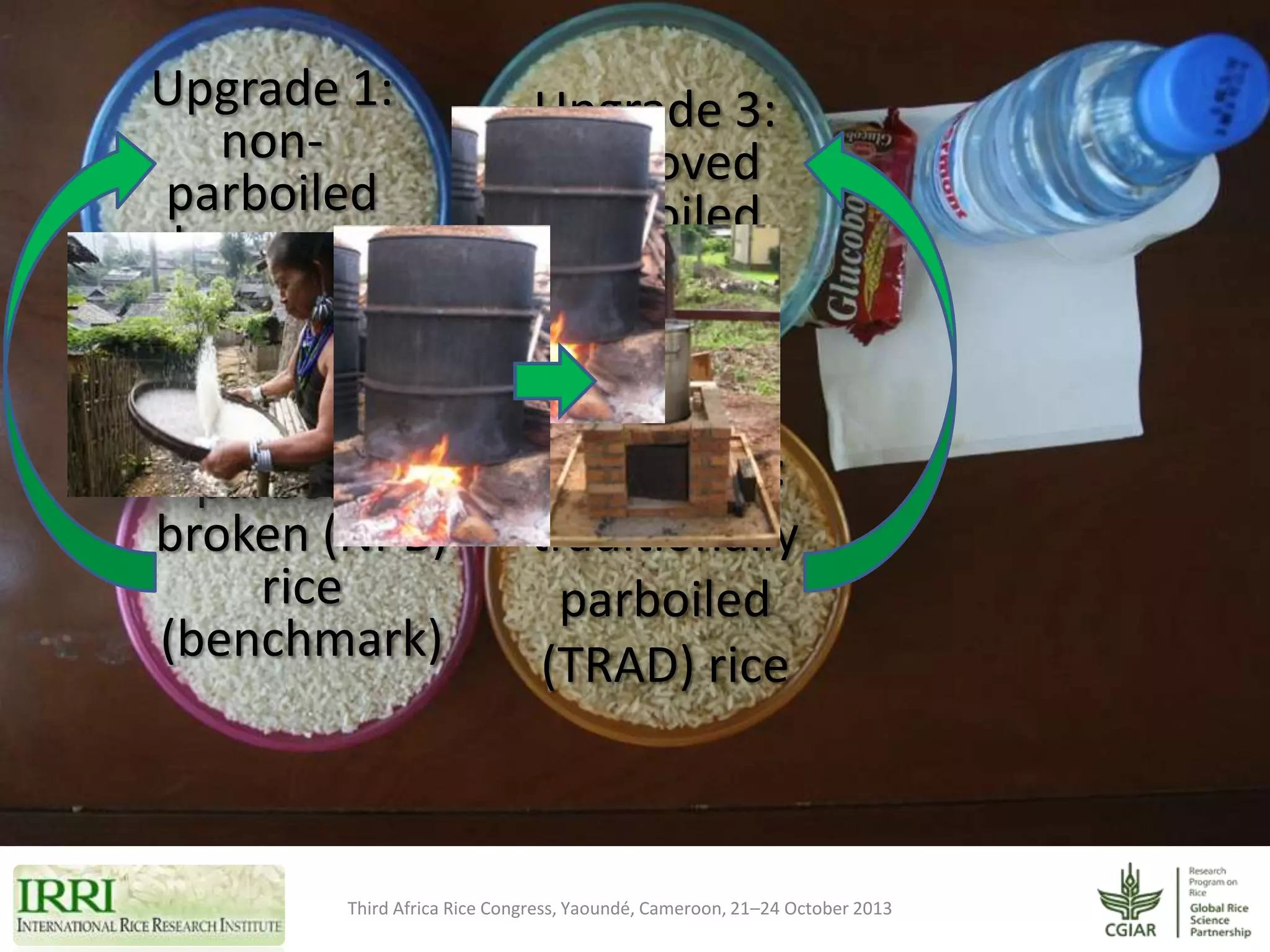
• Processed into four different end-products

Third Africa Rice Congress, Yaoundé, Cameroon, 21–24 October 2013
Upgrade 1:
nonparboiled
homogenous (NPH)
rice
nonparboiled
broken (NPB)
rice
(benchmark)

Upgrade 3:
improved
parboiled
rice (IRAD)

Upgrade 2:
traditionally
parboiled
(TRAD) rice

Third Africa Rice Congress, Yaoundé, Cameroon, 21–24 October 2013
Randomly recruit shoppers

Third Africa Rice Congress, Yaoundé, Cameroon, 21–24 October 2013
Start the experimental session

Third Africa Rice Congress, Yaoundé, Cameroon, 21–24 October 2013
Explain auction mechanism
Five principles:
1. Endow-and-upgrade
2. First price buys & pays second price
3. Real transaction (bids are binding)
4. Random drawing (1 product & 1 round)
5. Anonymous

Third Africa Rice Congress, Yaoundé, Cameroon, 21–24 October 2013
benchmark

Third Africa Rice Congress, Yaoundé, Cameroon, 21–24 October 2013
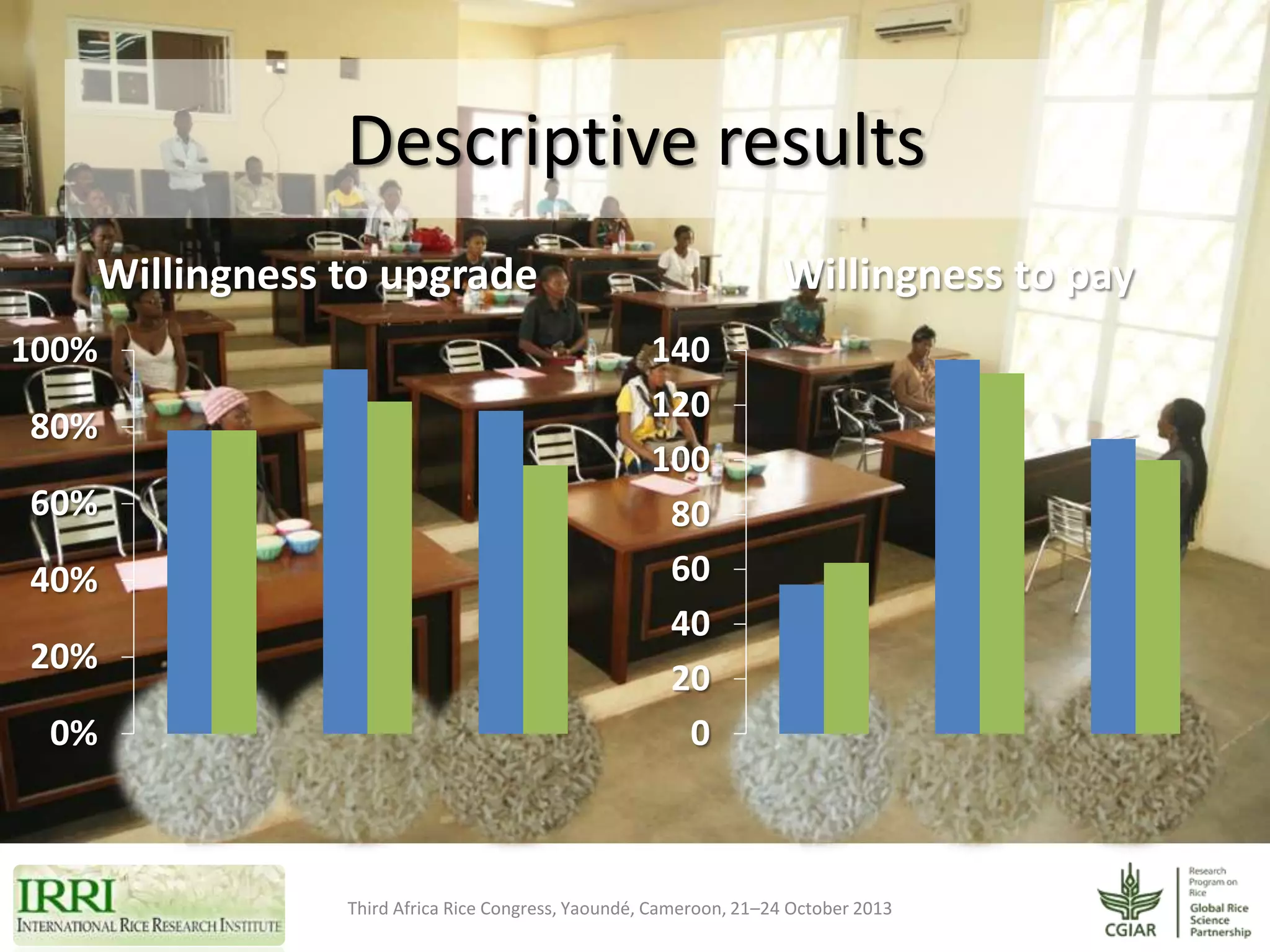
Descriptive results
Willingness to upgrade
100%
80%
60%
40%

20%
0%

Willingness to pay
140
120
100
80
60
40
20
0

Third Africa Rice Congress, Yaoundé, Cameroon, 21–24 October 2013
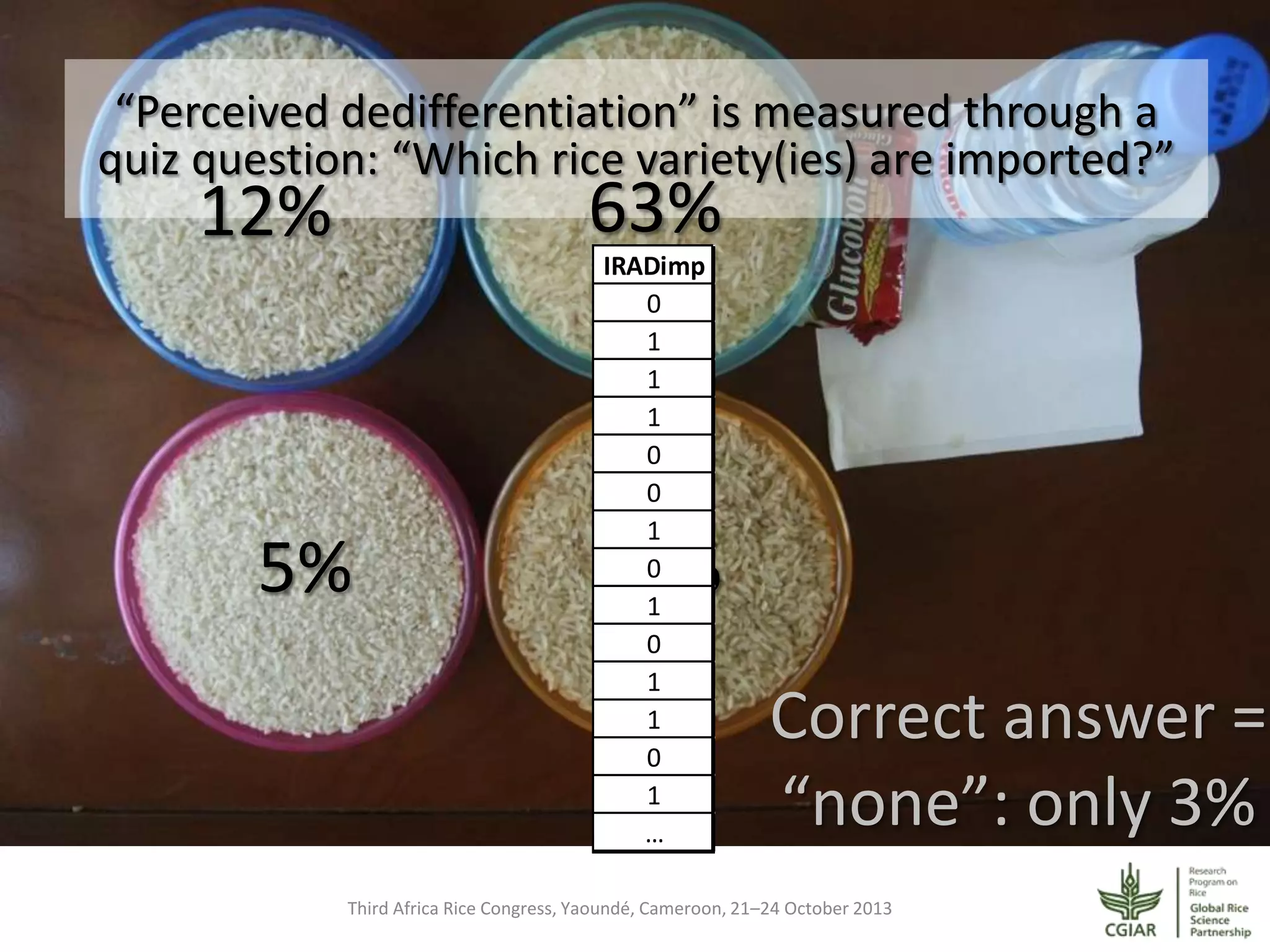
“Perceived dedifferentiation” is measured through a
quiz question: “Which rice variety(ies) are imported?”

12%

63%

5%

16%

IRADimp
0
1
1
1
0
0
1
0
1
0
1
1
0
1
…

Correct answer =
“none”: only 3%

Third Africa Rice Congress, Yaoundé, Cameroon, 21–24 October 2013
Econometric results
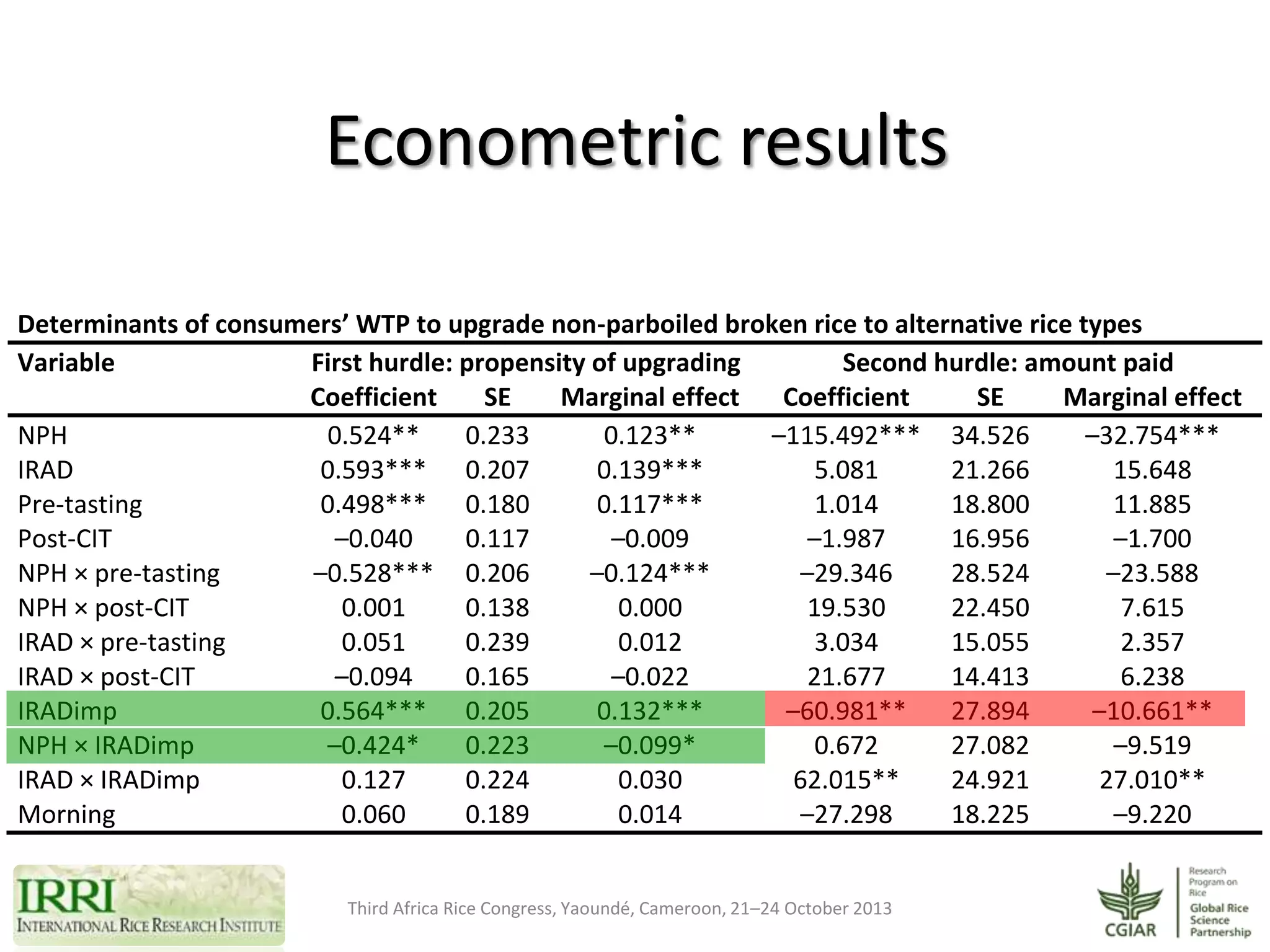
Determinants of consumers’ WTP to upgrade non-parboiled broken rice to alternative rice types
Variable
First hurdle: propensity of upgrading
Second hurdle: amount paid
Coefficient
SE
Marginal effect
Coefficient
SE
Marginal effect
NPH
0.524**
0.233
0.123**
–115.492*** 34.526
–32.754***
IRAD
0.593*** 0.207
0.139***
5.081
21.266
15.648
Pre-tasting
0.498*** 0.180
0.117***
1.014
18.800
11.885
Post-CIT
–0.040
0.117
–0.009
–1.987
16.956
–1.700
NPH × pre-tasting
–0.528*** 0.206
–0.124***
–29.346
28.524
–23.588
NPH × post-CIT
0.001
0.138
0.000
19.530
22.450
7.615
IRAD × pre-tasting
0.051
0.239
0.012
3.034
15.055
2.357
IRAD × post-CIT
–0.094
0.165
–0.022
21.677
14.413
6.238
IRADimp
0.564*** 0.205
0.132***
–60.981**
27.894
–10.661**
NPH × IRADimp
–0.424*
0.223
–0.099*
0.672
27.082
–9.519
IRAD × IRADimp
0.127
0.224
0.030
62.015**
24.921
27.010**
Morning
0.060
0.189
0.014
–27.298
18.225
–9.220
Third Africa Rice Congress, Yaoundé, Cameroon, 21–24 October 2013
Conclusion
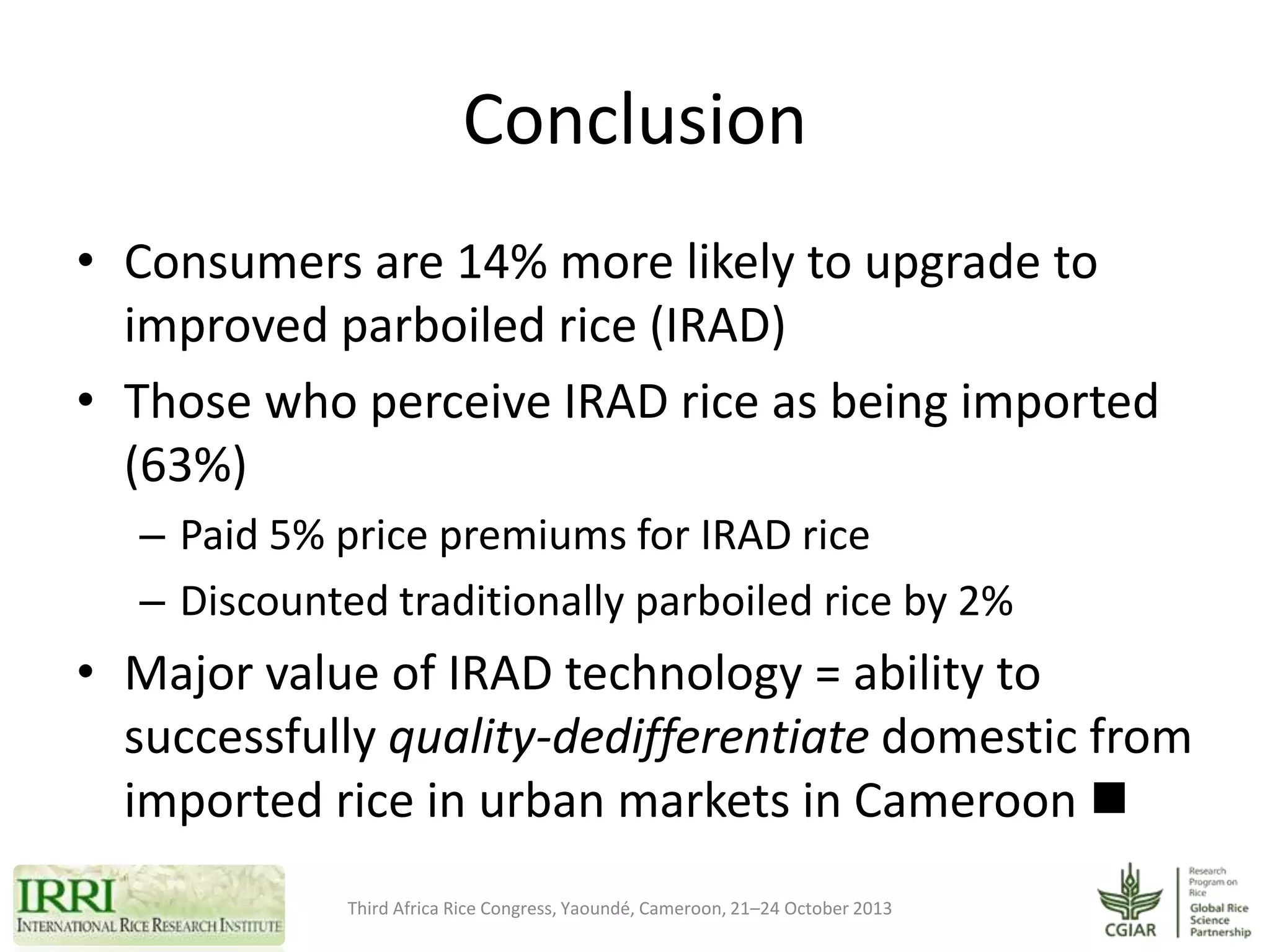
• Consumers are 14% more likely to upgrade to
improved parboiled rice (IRAD)
• Those who perceive IRAD rice as being imported
(63%)
– Paid 5% price premiums for IRAD rice
– Discounted traditionally parboiled rice by 2%

• Major value of IRAD technology = ability to
successfully quality-dedifferentiate domestic from
imported rice in urban markets in Cameroon 
Third Africa Rice Congress, Yaoundé, Cameroon, 21–24 October 2013
Thank you!
Matty Demont
Senior Economist, Market Research and Value Chain
Specialist, International Rice Research Institute (IRRI), Los
Baños, Philippines
m.demont@irri.org
Third Africa Rice Congress, Yaoundé, Cameroon, 21–24 October 2013

Th4_Improving Food Security through Rice Value Chain Upgrading in Africa:

  • 1.
    Improving Food Securitythrough Rice Value Chain Upgrading in Africa: What Can We Learn from Experimental Economics? Matty Demont Senior Economist, Market Research and Value Chain Specialist, International Rice Research Institute (IRRI), Los Baños, Philippines m.demont@irri.org Third Africa Rice Congress, Yaoundé, Cameroon, 21–24 October 2013
  • 2.
    Third Africa RiceCongress, Yaoundé, Cameroon, 21–24 October 2013
  • 3.
    Third Africa RiceCongress, Yaoundé, Cameroon, 21–24 October 2013
  • 4.
    Third Africa RiceCongress, Yaoundé, Cameroon, 21–24 October 2013
  • 5.
    Three types ofcountries • Coastal countries strongly exposed to urban bias (Senegal, Liberia, Cote d’Ivoire, Ghana, Togo, Benin, Nigeria, Cameroon) • Coastal countries not yet strongly affected by urban bias or with comparative advantage in rice demand (Gambia, Guinea, Sierra Leone, Kenya, Tanzania, Mozambique, Madagascar) • Landlocked countries (Mali, Burkina Faso, Ethiopia, Rwanda, Zambia) Third Africa Rice Congress, Yaoundé, Cameroon, 21–24 October 2013
  • 6.
    Observation • In manyimport-biased countries endowed with a port, domestic rice fails to compete quality-wise with imported Asian rice • As a result of urban bias, urban consumers have become used to the superior quality of imported Asian rice and developed preferences for it Third Africa Rice Congress, Yaoundé, Cameroon, 21–24 October 2013
  • 7.
    Observation • Domestic riceclearly differentiated from imported rice – Quality-wise – Packaging, branding, image – Word-of-mouth – Status considerations (foreign = cool)f-mouth – Status considerations (foreign = cool) Third Africa Rice Congress, Yaoundé, Cameroon, 21–24 October 2013
  • 8.
    Which ones aredomestic rice? Third Africa Rice Congress, Yaoundé, Cameroon, 21–24 October 2013
  • 9.
    Research hypothesis • Domesticrice now not only has to compete quantity-wise, but also quality-wise, but how? • In the absence of strong consumer attachment to domestic rice, best short- and medium-term option = dedifferentiating domestic from imported rice – Quality-wise – Packaging, branding, image Third Africa Rice Congress, Yaoundé, Cameroon, 21–24 October 2013
  • 10.
    Research hypothesis • Proposedthree-stage investment sequence for upgrading rice value chains in import-biased countries strongly exposed to urban bias: Quality upgrading, processing infrastructure, certification, branding, ... Quantity increase, scaling up, aggregation and storage infrastructure Advertizing and generic promotion Third Africa Rice Congress, Yaoundé, Cameroon, 21–24 October 2013 Value-adding Supply-shifting Demand-lifting
  • 11.
    How can wetest this hypothesis? • Can experimental economics help? • Experimental auctions enable assessing consumers’ response to upgrading of 1. Intrinsic quality attributes: • Post-harvest quality upgrading • Varietal improvement 2. Extrinsic quality attributes: • Labeling and branding • Information (radio, video, word-of-mouth) Third Africa Rice Congress, Yaoundé, Cameroon, 21–24 October 2013
  • 12.
    Case studies Mini-Symposium 4,Sub-Theme 3: Rice processing and marketing, Hall 3, 14:30–16:00 1. M. Ndour: Branding of local rice in Senegal 2. M. Ouedraogo: Consumers’ response to local quality rice in Burkina Faso This presentation: 3. Dedifferentiating imported from local rice in Cameroon Third Africa Rice Congress, Yaoundé, Cameroon, 21–24 October 2013
  • 13.
    Rice quality upgradingin Cameroon • Institute of Agric. Research for Development (IRAD), Cameroon developed uniform steam distributed (USD) parboiling technology • Mimics high-grade imported rice in physical and eating characteristics: – – – – – Whiter Lower broken fracture Fewer cracked grains Absence of burnt grains and impurities Higher swelling ratio during cooking Third Africa Rice Congress, Yaoundé, Cameroon, 21–24 October 2013
  • 14.
    Rice quality upgradingin Cameroon IRRI Seminar, International Rice Research Institute (IRRI), Los Baños, Laguna, Philippines, 4 April 2013
  • 15.
    Research questions • Doconsumers perceive the IRAD rice as being similar to imported rice? • Are they willing to pay price premiums for it? Relative to – Traditionally parboiled local rice – Improved non-parboiled local rice • Did IRAD technology successfully qualitydedifferentiate domestic from imported rice? Third Africa Rice Congress, Yaoundé, Cameroon, 21–24 October 2013
  • 16.
    Targeting urban market:Yaoundé Third Africa Rice Congress, Yaoundé, Cameroon, 21–24 October 2013
  • 17.
    Setting up laboratorysetting Third Africa Rice Congress, Yaoundé, Cameroon, 21–24 October 2013
  • 18.
    Choosing products tobe auctioned • Kept the varietal component constant • Using a single rice variety: Tox 3145 • Processed into four different end-products Third Africa Rice Congress, Yaoundé, Cameroon, 21–24 October 2013
  • 19.
    Upgrade 1: nonparboiled homogenous (NPH) rice nonparboiled broken(NPB) rice (benchmark) Upgrade 3: improved parboiled rice (IRAD) Upgrade 2: traditionally parboiled (TRAD) rice Third Africa Rice Congress, Yaoundé, Cameroon, 21–24 October 2013
  • 20.
    Randomly recruit shoppers ThirdAfrica Rice Congress, Yaoundé, Cameroon, 21–24 October 2013
  • 21.
    Start the experimentalsession Third Africa Rice Congress, Yaoundé, Cameroon, 21–24 October 2013
  • 22.
    Explain auction mechanism Fiveprinciples: 1. Endow-and-upgrade 2. First price buys & pays second price 3. Real transaction (bids are binding) 4. Random drawing (1 product & 1 round) 5. Anonymous Third Africa Rice Congress, Yaoundé, Cameroon, 21–24 October 2013
  • 23.
    benchmark Third Africa RiceCongress, Yaoundé, Cameroon, 21–24 October 2013
  • 24.
    Descriptive results Willingness toupgrade 100% 80% 60% 40% 20% 0% Willingness to pay 140 120 100 80 60 40 20 0 Third Africa Rice Congress, Yaoundé, Cameroon, 21–24 October 2013
  • 25.
    “Perceived dedifferentiation” ismeasured through a quiz question: “Which rice variety(ies) are imported?” 12% 63% 5% 16% IRADimp 0 1 1 1 0 0 1 0 1 0 1 1 0 1 … Correct answer = “none”: only 3% Third Africa Rice Congress, Yaoundé, Cameroon, 21–24 October 2013
  • 26.
    Econometric results Determinants ofconsumers’ WTP to upgrade non-parboiled broken rice to alternative rice types Variable First hurdle: propensity of upgrading Second hurdle: amount paid Coefficient SE Marginal effect Coefficient SE Marginal effect NPH 0.524** 0.233 0.123** –115.492*** 34.526 –32.754*** IRAD 0.593*** 0.207 0.139*** 5.081 21.266 15.648 Pre-tasting 0.498*** 0.180 0.117*** 1.014 18.800 11.885 Post-CIT –0.040 0.117 –0.009 –1.987 16.956 –1.700 NPH × pre-tasting –0.528*** 0.206 –0.124*** –29.346 28.524 –23.588 NPH × post-CIT 0.001 0.138 0.000 19.530 22.450 7.615 IRAD × pre-tasting 0.051 0.239 0.012 3.034 15.055 2.357 IRAD × post-CIT –0.094 0.165 –0.022 21.677 14.413 6.238 IRADimp 0.564*** 0.205 0.132*** –60.981** 27.894 –10.661** NPH × IRADimp –0.424* 0.223 –0.099* 0.672 27.082 –9.519 IRAD × IRADimp 0.127 0.224 0.030 62.015** 24.921 27.010** Morning 0.060 0.189 0.014 –27.298 18.225 –9.220 Third Africa Rice Congress, Yaoundé, Cameroon, 21–24 October 2013
  • 27.
    Conclusion • Consumers are14% more likely to upgrade to improved parboiled rice (IRAD) • Those who perceive IRAD rice as being imported (63%) – Paid 5% price premiums for IRAD rice – Discounted traditionally parboiled rice by 2% • Major value of IRAD technology = ability to successfully quality-dedifferentiate domestic from imported rice in urban markets in Cameroon  Third Africa Rice Congress, Yaoundé, Cameroon, 21–24 October 2013
  • 28.
    Thank you! Matty Demont SeniorEconomist, Market Research and Value Chain Specialist, International Rice Research Institute (IRRI), Los Baños, Philippines m.demont@irri.org Third Africa Rice Congress, Yaoundé, Cameroon, 21–24 October 2013