Latin America: The World’s Future Rice Bowl?  R. S. Zeigler Director General International Rice Research Institute
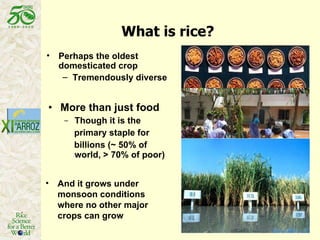
What is rice? More than just food Though it is the  primary staple for billions (~ 50% of world, > 70% of poor) Perhaps the oldest domesticated crop Tremendously diverse And it grows under monsoon conditions where no other major crops can grow
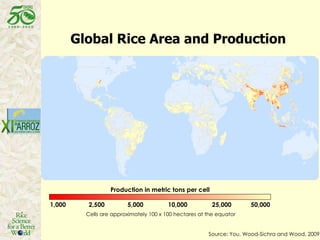
Global Rice Area and Production Source: You, Wood-Sichra and Wood, 2009 Cells are approximately 100 x 100 hectares at the equator Production in metric tons per cell 1,000  2,500  5,000  10,000  25,000  50,000
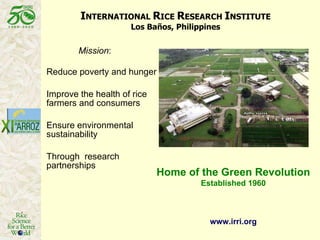
I NTERNATIONAL  R ICE  R ESEARCH  I NSTITUTE Los Baños, Philippines Mission :  Reduce poverty and hunger  Improve the health of rice farmers and consumers  Ensure environmental sustainability  Through  research partnerships Home of the Green Revolution Established 1960 www.irri.org
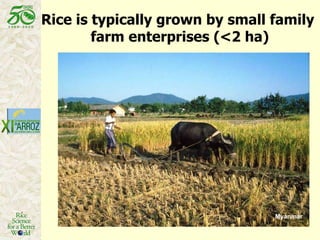
Myanmar Rice is typically grown by small family  farm enterprises (<2 ha)
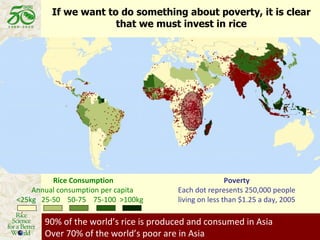
If we want to do something about poverty, it is clear that we must invest in rice 90% of the world’s rice is produced and consumed in Asia Over 70% of the world’s poor are in Asia Poverty Each dot represents 250,000 people living on less than $1.25 a day, 2005 Rice Consumption Annual consumption per capita  <25kg  25-50  50-75  75-100  >100kg
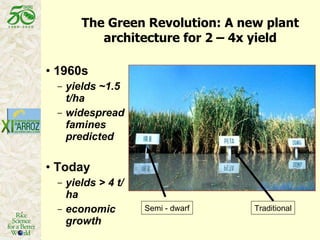
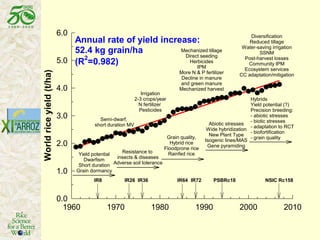
The Green Revolution: A new plant architecture for 2 – 4x yield 1960s  yields ~1.5 t/ha widespread famines predicted Today yields > 4 t/ha economic growth Traditional Semi - dwarf
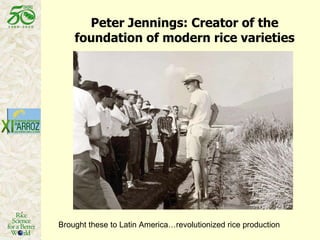
Peter Jennings: Creator of the foundation of modern rice varieties Brought these to Latin America…revolutionized rice production
 
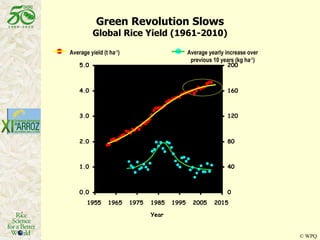
Green Revolution Slows Global Rice Yield (1961-2010) © WPQ Average yield (t ha -1 ) Average yearly increase over previous 10 years (kg ha -1 ) 0.0 1.0 2.0 3.0 4.0 5.0 1955 1965 1975 1985 1995 2005 2015 Year 0 40 80 120 160 200
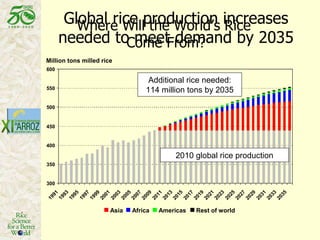
Global rice production increases needed to meet demand by 2035 Where Will the World’s Rice  Come From?
Where Will the World’s Rice Come From? Ideally from increasing productivity on existing rice lands, mostly in Asia BUT, in Asia: Land is moving out of rice Labor is moving out of rice Water is moving out of rice Major changes in production practices and increases in efficiency  Just to stay where we are Significant new rice lands may be needed
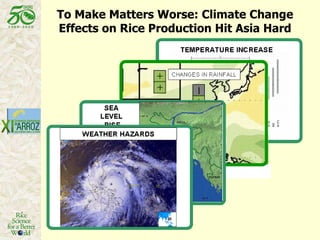
To Make Matters Worse: Climate Change Effects on Rice Production Hit Asia Hard
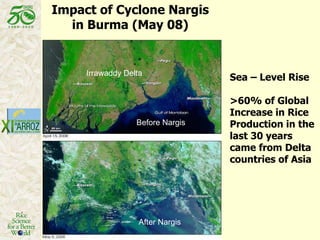
Sea – Level Rise >60% of Global Increase in Rice Production in the last 30 years came from Delta countries of Asia Impact of Cyclone Nargis in Burma (May 08) Before Nargis After Nargis Irrawaddy Delta
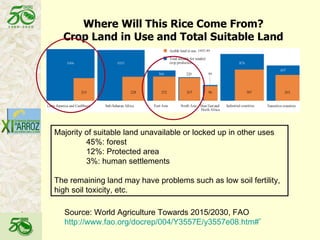
Where Will This Rice Come From? Crop Land in Use and Total Suitable Land Source: World Agriculture Towards 2015/2030, FAO  http://www.fao.org/docrep/004/Y3557E/y3557e08.htm#TopofPage Majority of suitable land unavailable or locked up in other uses 45%: forest 12%: Protected area 3%: human settlements The remaining land may have problems such as low soil fertility, high soil toxicity, etc.
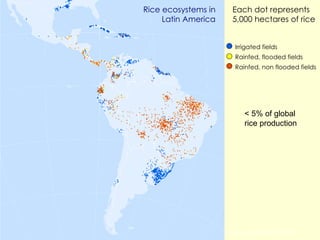
Each dot represents 5,000 hectares of rice Rice ecosystems in Latin America Irrigated fields Rainfed, flooded fields Rainfed, non flooded fields Source: Hijmans, 2008 < 5% of global rice production
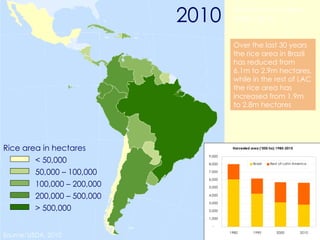
Trends in rice area: 1980 - 2010 Source: USDA, 2010 Rice area in hectares < 50,000 50,000 – 100,000 100,000 – 200,000 200,000 – 500,000 > 500,000 Over the last 30 years the rice area in Brazil has reduced from 6.1m to 2.9m hectares, while in the rest of LAC the rice area has increased from 1.9m to 2.8m hectares 1980 1990 2000 2010
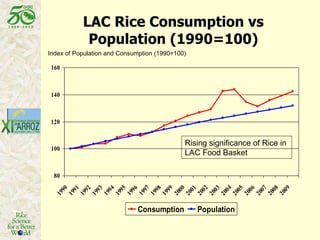
LAC Rice Consumption vs Population (1990=100) Index of Population and Consumption (1990=100) Rising significance of Rice in  LAC Food Basket
Can LAC Become the Next Rice Bowl? Biggest advantage: Endowed with plenty of land and water . Bottleneck Global market is small and unstable. As it stands right now, LAC rice is not competitive in the export market.  Although subsidies in many rice growing countries make it even look worse Inadequate infrastructure What Needs to Happen? LAC countries need to lower costs to $1,000 per hectare and improve productivity to at least 7 tonnes/ha to be able to compete in the global market (Calvert et al.) A stable global market and minimal distortions in rice trade.
From Major LAC Rice – Potential Countries Requires… Long term policy commitment to permanent expansion of rice sector Strategic vision for the development of potential rice producing lands Strategic assessments of relative investments in new irrigated and savanna/ cerrado  lands Long term commitment to research for sustainable growth in the rice sector A science – based second Green Revolution Stable policies for long term competitiveness
From the Global Community… Even handed subsidies and incentive policies Mechanism to deal with trade disruptions and protectionist practices Access to real – time information on global production and trade A rice futures market and exchange?
Science – Based New Green Revolution? Tap the revolutions in genetics, molecular biology and plant physiology Link soils biology and chemistry to better understand and manipulate sustainable nutrient supply Exploit the explosion of computation capacity and remote sensing to model systems and link process at scales from the cellular through ecosystems and regions Proactively link the political and social dimensions of agriculture to technology development
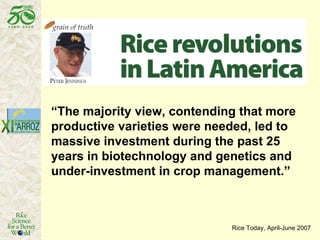
“ The majority view, contending that more productive varieties were needed, led to massive investment during the past 25 years in biotechnology and genetics and under-investment in crop management.”  Rice Today, April-June 2007
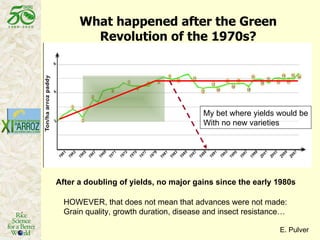
What happened after the Green Revolution of the 1970s? E. Pulver After a doubling of yields, no major gains since the early 1980s HOWEVER, that does not mean that advances were not made: Grain quality, growth duration, disease and insect resistance… My bet where yields would be With no new varieties
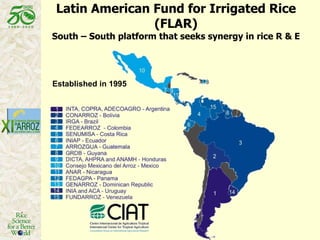
Latin American Fund for Irrigated Rice (FLAR) South – South platform that seeks synergy in rice R & E Established in 1995
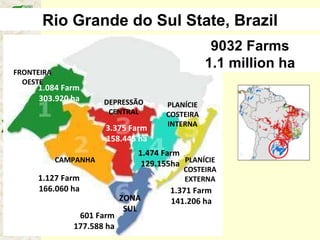
Rio Grande do Sul State, Brazil 9032 Farms 1.1 million ha FRONTEIRA OESTE PLANÍCIE COSTEIRA INTERNA ZONA SUL DEPRESSÃO CENTRAL CAMPANHA PLANÍCIE COSTEIRA EXTERNA 1.371 Farm 141.206 ha 601 Farm 177.588 ha 1.127 Farm 166.060 ha 1.084 Farm 303.920 ha 3.375 Farm 158.445 ha 1.474 Farm 129.155ha
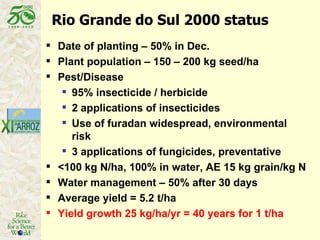
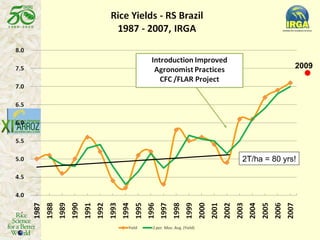
Rio Grande do Sul 2000 status Date of planting – 50% in Dec. Plant population – 150 – 200 kg seed/ha Pest/Disease  95% insecticide / herbicide 2 applications of insecticides Use of furadan widespread, environmental risk  3 applications of fungicides, preventative <100 kg N/ha, 100% in water, AE 15 kg grain/kg N Water management – 50% after 30 days Average yield = 5.2 t/ha Yield growth 25 kg/ha/yr = 40 years for 1 t/ha
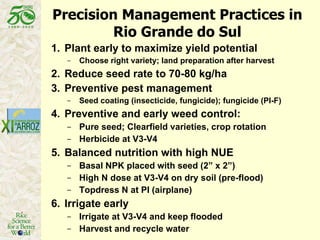
Precision Management Practices in Rio Grande do Sul Plant early to maximize yield potential Choose right variety; land preparation after harvest Reduce seed rate to 70-80 kg/ha Preventive pest management Seed coating (insecticide, fungicide); fungicide (PI-F) Preventive and early weed control: Pure seed; Clearfield varieties, crop rotation Herbicide at V3-V4 Balanced nutrition with high NUE Basal NPK placed with seed (2” x 2”) High N dose at V3-V4 on dry soil (pre-flood) Topdress N at PI (airplane) Irrigate early Irrigate at V3-V4 and keep flooded Harvest and recycle water
2009 2T/ha = 80 yrs!
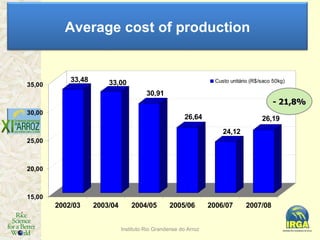
Instituto Rio Grandense do Arroz - 21,8% Average cost of production
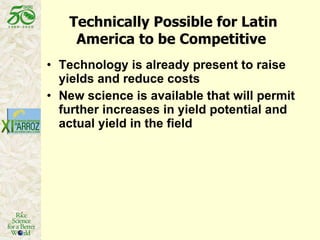
Technically Possible for Latin America to be Competitive  Technology is already present to raise yields and reduce costs New science is available that will permit further increases in yield potential and actual yield in the field
Is There the Political Will? A Look at Trends Over the Last Several Decades Suggests Not
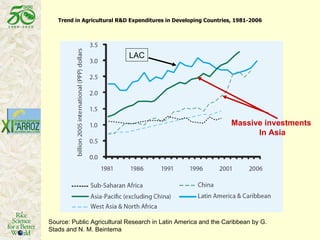
Source: Public Agricultural Research in Latin America and the Caribbean by G. Stads and N. M. Beintema Trend in Agricultural R&D Expenditures in Developing Countries, 1981-2006 LAC Massive investments  In Asia
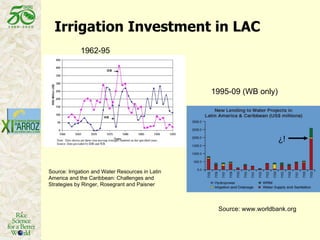
Irrigation Investment in LAC ¿ ! 1995-09 (WB only) Source: www.worldbank.org Source: Irrigation and Water Resources in Latin America and the Caribbean: Challenges and Strategies by Ringer, Rosegrant and Paisner 1962-95 (IDB+WB))
Policies & Markets Can A Major Shift in Trade of a Major Crop Happen?  It Has Before…
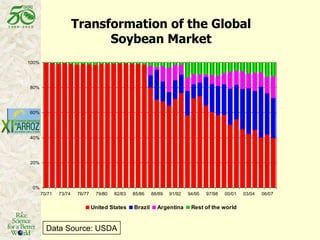
Transformation of the Global Soybean Market Data Source: USDA
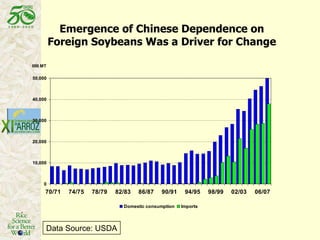
Emergence of Chinese Dependence on Foreign Soybeans Was a Driver for Change Data Source: USDA
LAC Becoming the Next Rice Bowl! Biggest advantage: Endowed with plenty of land and water . Bottleneck Global market is too small and unstable. As it stands right now, LAC rice is not competitive in the export market.  Although subsidies in many rice growing countries make it even look worse Inadequate infrastructure What Needs to Happen? LAC countries need to lower costs to $1,000 per hectare and improve productivity to at least 7 tons/ha to be able to compete in the global market (Calvert et al.) A stable global market and minimal distortions in rice trade.
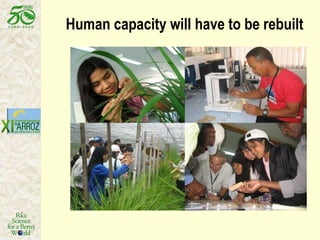
Human capacity will have to be rebuilt
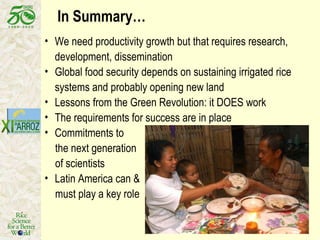
We need productivity growth but that requires research, development, dissemination  Global food security depends on sustaining irrigated rice systems  and probably opening new land Lessons from the Green Revolution: it DOES work The requirements for success are in place Commitments to the next generation of scientists Latin America can & must play a key role In Summary…
Thank you “ Since the way to feed the world is not to bring more land under cultivation, but to increase yields, science is crucial. ” The Economist “ The Silent Tsunami ”   19 April 2008
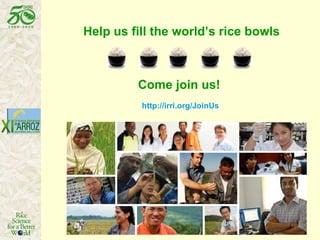
Help us fill the world’s rice bowls  Come join us! http://irri.org/JoinUs

Latin America: The World’s Future Rice Bowl?

  • 1.
    Latin America: TheWorld’s Future Rice Bowl? R. S. Zeigler Director General International Rice Research Institute
  • 2.
    What is rice?More than just food Though it is the primary staple for billions (~ 50% of world, > 70% of poor) Perhaps the oldest domesticated crop Tremendously diverse And it grows under monsoon conditions where no other major crops can grow
  • 3.
    Global Rice Areaand Production Source: You, Wood-Sichra and Wood, 2009 Cells are approximately 100 x 100 hectares at the equator Production in metric tons per cell 1,000 2,500 5,000 10,000 25,000 50,000
  • 4.
    I NTERNATIONAL R ICE R ESEARCH I NSTITUTE Los Baños, Philippines Mission : Reduce poverty and hunger Improve the health of rice farmers and consumers Ensure environmental sustainability Through research partnerships Home of the Green Revolution Established 1960 www.irri.org
  • 5.
    Myanmar Rice istypically grown by small family farm enterprises (<2 ha)
  • 6.
    If we wantto do something about poverty, it is clear that we must invest in rice 90% of the world’s rice is produced and consumed in Asia Over 70% of the world’s poor are in Asia Poverty Each dot represents 250,000 people living on less than $1.25 a day, 2005 Rice Consumption Annual consumption per capita <25kg 25-50 50-75 75-100 >100kg
  • 7.
    The Green Revolution:A new plant architecture for 2 – 4x yield 1960s yields ~1.5 t/ha widespread famines predicted Today yields > 4 t/ha economic growth Traditional Semi - dwarf
  • 8.
    Peter Jennings: Creatorof the foundation of modern rice varieties Brought these to Latin America…revolutionized rice production
  • 9.
  • 10.
    Green Revolution SlowsGlobal Rice Yield (1961-2010) © WPQ Average yield (t ha -1 ) Average yearly increase over previous 10 years (kg ha -1 ) 0.0 1.0 2.0 3.0 4.0 5.0 1955 1965 1975 1985 1995 2005 2015 Year 0 40 80 120 160 200
  • 11.
    Global rice productionincreases needed to meet demand by 2035 Where Will the World’s Rice Come From?
  • 12.
    Where Will theWorld’s Rice Come From? Ideally from increasing productivity on existing rice lands, mostly in Asia BUT, in Asia: Land is moving out of rice Labor is moving out of rice Water is moving out of rice Major changes in production practices and increases in efficiency Just to stay where we are Significant new rice lands may be needed
  • 13.
    To Make MattersWorse: Climate Change Effects on Rice Production Hit Asia Hard
  • 14.
    Sea – LevelRise >60% of Global Increase in Rice Production in the last 30 years came from Delta countries of Asia Impact of Cyclone Nargis in Burma (May 08) Before Nargis After Nargis Irrawaddy Delta
  • 15.
    Where Will ThisRice Come From? Crop Land in Use and Total Suitable Land Source: World Agriculture Towards 2015/2030, FAO http://www.fao.org/docrep/004/Y3557E/y3557e08.htm#TopofPage Majority of suitable land unavailable or locked up in other uses 45%: forest 12%: Protected area 3%: human settlements The remaining land may have problems such as low soil fertility, high soil toxicity, etc.
  • 16.
    Each dot represents5,000 hectares of rice Rice ecosystems in Latin America Irrigated fields Rainfed, flooded fields Rainfed, non flooded fields Source: Hijmans, 2008 < 5% of global rice production
  • 17.
    Trends in ricearea: 1980 - 2010 Source: USDA, 2010 Rice area in hectares < 50,000 50,000 – 100,000 100,000 – 200,000 200,000 – 500,000 > 500,000 Over the last 30 years the rice area in Brazil has reduced from 6.1m to 2.9m hectares, while in the rest of LAC the rice area has increased from 1.9m to 2.8m hectares 1980 1990 2000 2010
  • 18.
    LAC Rice Consumptionvs Population (1990=100) Index of Population and Consumption (1990=100) Rising significance of Rice in LAC Food Basket
  • 19.
    Can LAC Becomethe Next Rice Bowl? Biggest advantage: Endowed with plenty of land and water . Bottleneck Global market is small and unstable. As it stands right now, LAC rice is not competitive in the export market. Although subsidies in many rice growing countries make it even look worse Inadequate infrastructure What Needs to Happen? LAC countries need to lower costs to $1,000 per hectare and improve productivity to at least 7 tonnes/ha to be able to compete in the global market (Calvert et al.) A stable global market and minimal distortions in rice trade.
  • 20.
    From Major LACRice – Potential Countries Requires… Long term policy commitment to permanent expansion of rice sector Strategic vision for the development of potential rice producing lands Strategic assessments of relative investments in new irrigated and savanna/ cerrado lands Long term commitment to research for sustainable growth in the rice sector A science – based second Green Revolution Stable policies for long term competitiveness
  • 21.
    From the GlobalCommunity… Even handed subsidies and incentive policies Mechanism to deal with trade disruptions and protectionist practices Access to real – time information on global production and trade A rice futures market and exchange?
  • 22.
    Science – BasedNew Green Revolution? Tap the revolutions in genetics, molecular biology and plant physiology Link soils biology and chemistry to better understand and manipulate sustainable nutrient supply Exploit the explosion of computation capacity and remote sensing to model systems and link process at scales from the cellular through ecosystems and regions Proactively link the political and social dimensions of agriculture to technology development
  • 23.
    “ The majorityview, contending that more productive varieties were needed, led to massive investment during the past 25 years in biotechnology and genetics and under-investment in crop management.” Rice Today, April-June 2007
  • 24.
    What happened afterthe Green Revolution of the 1970s? E. Pulver After a doubling of yields, no major gains since the early 1980s HOWEVER, that does not mean that advances were not made: Grain quality, growth duration, disease and insect resistance… My bet where yields would be With no new varieties
  • 25.
    Latin American Fundfor Irrigated Rice (FLAR) South – South platform that seeks synergy in rice R & E Established in 1995
  • 26.
    Rio Grande doSul State, Brazil 9032 Farms 1.1 million ha FRONTEIRA OESTE PLANÍCIE COSTEIRA INTERNA ZONA SUL DEPRESSÃO CENTRAL CAMPANHA PLANÍCIE COSTEIRA EXTERNA 1.371 Farm 141.206 ha 601 Farm 177.588 ha 1.127 Farm 166.060 ha 1.084 Farm 303.920 ha 3.375 Farm 158.445 ha 1.474 Farm 129.155ha
  • 27.
    Rio Grande doSul 2000 status Date of planting – 50% in Dec. Plant population – 150 – 200 kg seed/ha Pest/Disease 95% insecticide / herbicide 2 applications of insecticides Use of furadan widespread, environmental risk 3 applications of fungicides, preventative <100 kg N/ha, 100% in water, AE 15 kg grain/kg N Water management – 50% after 30 days Average yield = 5.2 t/ha Yield growth 25 kg/ha/yr = 40 years for 1 t/ha
  • 28.
    Precision Management Practicesin Rio Grande do Sul Plant early to maximize yield potential Choose right variety; land preparation after harvest Reduce seed rate to 70-80 kg/ha Preventive pest management Seed coating (insecticide, fungicide); fungicide (PI-F) Preventive and early weed control: Pure seed; Clearfield varieties, crop rotation Herbicide at V3-V4 Balanced nutrition with high NUE Basal NPK placed with seed (2” x 2”) High N dose at V3-V4 on dry soil (pre-flood) Topdress N at PI (airplane) Irrigate early Irrigate at V3-V4 and keep flooded Harvest and recycle water
  • 29.
    2009 2T/ha =80 yrs!
  • 30.
    Instituto Rio Grandensedo Arroz - 21,8% Average cost of production
  • 31.
    Technically Possible forLatin America to be Competitive Technology is already present to raise yields and reduce costs New science is available that will permit further increases in yield potential and actual yield in the field
  • 32.
    Is There thePolitical Will? A Look at Trends Over the Last Several Decades Suggests Not
  • 33.
    Source: Public AgriculturalResearch in Latin America and the Caribbean by G. Stads and N. M. Beintema Trend in Agricultural R&D Expenditures in Developing Countries, 1981-2006 LAC Massive investments In Asia
  • 34.
    Irrigation Investment inLAC ¿ ! 1995-09 (WB only) Source: www.worldbank.org Source: Irrigation and Water Resources in Latin America and the Caribbean: Challenges and Strategies by Ringer, Rosegrant and Paisner 1962-95 (IDB+WB))
  • 35.
    Policies & MarketsCan A Major Shift in Trade of a Major Crop Happen? It Has Before…
  • 36.
    Transformation of theGlobal Soybean Market Data Source: USDA
  • 37.
    Emergence of ChineseDependence on Foreign Soybeans Was a Driver for Change Data Source: USDA
  • 38.
    LAC Becoming theNext Rice Bowl! Biggest advantage: Endowed with plenty of land and water . Bottleneck Global market is too small and unstable. As it stands right now, LAC rice is not competitive in the export market. Although subsidies in many rice growing countries make it even look worse Inadequate infrastructure What Needs to Happen? LAC countries need to lower costs to $1,000 per hectare and improve productivity to at least 7 tons/ha to be able to compete in the global market (Calvert et al.) A stable global market and minimal distortions in rice trade.
  • 39.
    Human capacity willhave to be rebuilt
  • 40.
    We need productivitygrowth but that requires research, development, dissemination Global food security depends on sustaining irrigated rice systems and probably opening new land Lessons from the Green Revolution: it DOES work The requirements for success are in place Commitments to the next generation of scientists Latin America can & must play a key role In Summary…
  • 41.
    Thank you “Since the way to feed the world is not to bring more land under cultivation, but to increase yields, science is crucial. ” The Economist “ The Silent Tsunami ” 19 April 2008
  • 42.
    Help us fillthe world’s rice bowls Come join us! http://irri.org/JoinUs