Making genetics work for Africa by increasing
genetic gains in farmers’ fields

Rate of genetic gain:

Why are we so concerned about genetic gains?

§  Annual rate of productivity increase in farmers’ fields due to
genetic improvement
§  Measured in experiments where cultivars released in
different eras are planted side by side under common
management.
§  Rate of gain is plotted against year of release
§  Should be measured on-station and on-farm
§  Genetic gains are very rarely measured, but achieving them
in farmers’ fields is why we invest in breeding

After 20 years at:

October 22, 2013

© 2012 Bill & Melinda Gates Foundation

|

2

Consistently high rates of genetic gain,
coupled with rapid turnover of new varieties,
result in:

The problem (diagnosed at the genetic gains
convening, San Diego, Jan 17-19 2013):
•  Public-sector breeding serving smallholders in the developing
world are achieving sub-optimal rates of genetic gain

§  Productivity increases leading to poverty alleviation
•  A reduced environmental footprint for agriculture

© 2012 Bill & Melinda Gates Foundation

|

October 22, 2013

© 2012 Bill & Melinda Gates Foundation

|

5

Portion of on-station gain expressed on-farm: 50%3
Overall rate of genetic gain in farmers’ fields: 0.3%

2.97	
  

3.61	
  

7

October 22, 2013

|

6

Rate of genetic gain in farmers’ fields is a
function of:
•  Annual rate of genetic gain measured under farmer
management

© 2012 Bill & Melinda Gates Foundation

|

© 2012 Bill & Melinda Gates Foundation

October 22, 2013

9	
  loca4ons	
  across	
  
Zimbabwe,	
  Zambia	
  and	
  
Malawi	
  

8

10	
  

9	
  
8	
  
7	
  
6	
  
5	
  
4	
  
3	
  

y	
  =	
  5.80+	
  0.196x	
  
Pr	
  	
  t	
  >	
  0	
  =	
  0.08	
  

2	
  
1	
  

PhD	
  study	
  of	
  Benhilda	
  
Masuka	
  (Zimbabwe)	
  

Byerlee and Jayne, 2011
et al., 2013
Atlin rough guess

2Badu-Apraku

|

3

Grain	
  yield	
  (t	
  ha-­‐1)	
  

1Smale,

© 2012 Bill & Melinda Gates Foundation

|

© 2012 Bill & Melinda Gates Foundation

Measuring genetic gains: maize yield under optimal
conditions in ESA

• Gains in any one breeding cycle are usually no more than 10%
• Breeding cycles are a minimum of 3 – 4 years, but usually at
least twice that, resulting in gains per year of 1-2%
• It’s difficult to measure yield differences of 10% or less against
year-to-year and field-to-field noise
• ERA experiments comparing old and new varieties in the same
field are the “gold standard” but are difficult, expensive, and
need varieties from >10 years

Proportion of area planted to improved varieties: 50%1
Rate of genetic gain for improved varieties on-station: 1.2%2

2.44	
  

October 22, 2013

§  These are generic metrics for crop improvement
and seed systems investments

Rate of genetic gain is the key measure of
breeding program effectiveness, but it’s hard to
measure directly because:

The impact of poor rates of genetic gain, low
adoption, and slow variety turnover: the
example of maize in Africa

1.81	
  

•  Annual rate of turnover of improved varieties in
farmers’ fields

The farmers who are best
protected from climate
change are those using
cultivars bred in the current
climate!
4

3%

1.49	
  

•  Proportion of the cropped area on which improved
varieties are adopted

•  Effective and constant adaptation to a changing climate

•  Inadequate technical and managerial performance is
resulting in low rates of genetic gain and low adoption rates
that can and must be improved

2%

1.22	
  

2 t/ha

Africa Rice Congress
Yaoundé, Cameroon, Oct. 22, 2013

October 22, 2013

Initial yield
1 t/ha

3rd

3G.

Yields after 20 years of breeding and varietal turnover with
rates of gain of 1, 2, and 3%

1%

Gary Atlin
Global Development, Ag R&D

October 22, 2013

§  Steady, long-term improvement from effective breeding
programs transforms agriculture

2000	
  

2001	
   2002	
  

2003	
   2004	
  

2005	
   2006	
  

2007	
   2008	
  

2009	
   2010	
  

Year	
  of	
  first	
  tes4ng	
  in	
  regional	
  trials	
  

Es#mated	
  gene#c	
  gains	
  in	
  very	
  high-­‐yield	
  trials:	
  196	
  kg	
  ha-­‐1	
  yr-­‐1	


© 2012 Bill & Melinda Gates Foundation

|
The Gates Foundation views genetic gains in
farmers’ fields as a key metric for investments in
crop improvement

Estimates of rates of genetic gain in several crops on-station

Species	
  

Region	
  

Maize	
  (Pioneer)	
  
Irrigated	
  rice	
  (IRRI)	
  
Wheat	
  (CIMMYT)	
  

Corn	
  Belt	
  
Philippines	
  

Maize	
  (IITA)	
  

High-­‐yield	
  envs	
   1977-­‐2008	
  

64	
  
10	
  

40	
  

Adequate genetic variability

3. 

More accurate selection (=higher heritability)

−  Mechanization, automation, digitization

−  Donors, elite but exotic materials

−  Higher-quality phenotyping, better experimental designs, more reps, MAS

4. 

Faster breeding cycles

5. 

Management that is empowered and accountable for product delivery

6. 

Well-trained staff who understand product development

−  State of the art program design, genomic prediction

§  Seeking ways to support more effective delivery of steady rates of
gain to farmers

−  Research managers lead product development, planning, monitor progress, provide supportive

environment, and ensure effective coordination among teams

− 

§  Very few programs have measured rates of genetic gain in farmers’ fields
* Peng et al have observed in several studies that irrigated rice yields in
tropical Asia cannot be shown to have increased since the Green
Revolution when the effects of disease are controlled in older varieties 10
|

October 22, 2013

Bigger programs (= higher selection intensity)

2. 

§  Developing scorecards and metrics by which to assess the
programs we invest in with respect to their ability to deliver high
rates of genetic gain

Lopes	
  et	
  al.	
  (2012)	
  
Badu-­‐Apraku	
  et	
  al.	
  
(2013)	
  
Badu-­‐Apraku	
  et	
  al.	
  
(2013)	
  

14	
  

1. 

§  Seeking to understand the critical drivers of genetic gain

Lopes	
  et	
  al.	
  (2012)	
  

Low-­‐yield	
  envs	
   1977-­‐2008	
  
West	
  Africa-­‐	
  
drought	
  
1988-­‐2010	
  
West	
  Africa-­‐	
  
High-­‐yield	
  envs	
   1988-­‐2010	
  

What are the routes to increased genetic gains?

We are:

Rate	
  of	
  
gene2c	
  gain	
  
(kg	
  ha-­‐1	
  yr-­‐1)	
   Reference	
  
Period	
  
Smith	
  (personal	
  
communica4on)	
  
1930-­‐2010	
  
89	
  
1966-­‐1995	
  
0*	
  
Peng	
  et	
  al.	
  (2000)	
  

© 2012 Bill & Melinda Gates Foundation

Revolutionary management tool 1: pipeline thinking
(i) trait development pipelines
§  Big, visible “step changes” caused by major genes are very rare (eg Sub1)
but critical

October 22, 2013

© 2012 Bill & Melinda Gates Foundation

|

© 2012 Bill & Melinda Gates Foundation

|

© 2012 Bill & Melinda Gates Foundation

11

|

§  Drought tolerance

The IRRI abiotic stress trait pipeline is delivering markers for
QTLs with large effects on:

§  There are many QTLs with smaller effects, but that still warrant delivery as
tools to breeders

Training of plant breeders needs to be modeled on engineering training, with a focus on
quantitative analysis, mechanization, internships in commercial and high-quality public sector
programs

Anaerobic germination

§  Public research systems have done a poor job of delivering traits
§  Effective trait pipelines that quickly deliver production markers for QTLs
must be aggressively managed

Submergence tolerance

§  Trait pipelines need highly coordinated teams cooperating on phenotyping,
mapping, bioinformatics, and cloning, with clear roles and hand-offs
§  Role of research managers on the effectiveness of trait pipelines is critical;
trait pipelines cannot be managed like basic biological research programs
(publish and declare victory).

October 22, 2013

© 2012 Bill & Melinda Gates Foundation

|

13

Revolutionary management tool 1: pipeline thinking

§  The products of this cultivar development pipeline are the varieties in
which the “step-change” traits are delivered to farmers.

|

14

§  Private sector programs in maize and soy have scaled up and accelerated
their line development pipelines through
i) 

Mechanization and digitization of field operations to support huge scale
(testing at 100s of locations, in 100,000s of plots
ii)  Databases and analysis tools that are fast and breeder-friendly
iii)  Constant measurement of progress against competitors
iv)  Highly specialized and integrated teams enabled by managers
v)  … and new genomic selection algorithms linking phenotypic and
genotypic data on huge populations to predict performance in the field?

|

Challenge: Outcome metrics for crop
improvement are difficult to capture

To increase rates of gain, management must:

•  Seed sold or disseminated

§  Evaluate scientists based on their contribution to product
development rather than on publication

§  Products of the trait pipeline are incorporated into cultivar platforms

© 2012 Bill & Melinda Gates Foundation

© 2012 Bill & Melinda Gates Foundation

Revolutionary management tool 2: managing
teams for product delivery

(ii) cultivar development pipelines
§  Between big “step changes” we need steady, incremental concentration of
hundreds of alleles with small but favorable effects

October 22, 2013

October 22, 2013

16

•  Productivity of specific populations

§  Evaluate scientists as members of breeding teams rather than as
individual researchers

•  Adoption of new varieties
•  Average age of varieties on-farm

§  Develop clear product concepts and breeding targets

•  Welfare benefits

§  Monitor team performance against genetic gain metrics, and ensure
that product pipelines function
§  Provide consulting and mentoring support for scientists

October 22, 2013

© 2012 Bill & Melinda Gates Foundation

|

17

© 2012 Bill & Melinda Gates Foundation

|
Changes needed to double genetic gains in smallholders’
fields

Solution: Intermediate process metrics for plant
breeding programs in routine use in the private
sector

Changes needed double genetic gains in smallholders’ fields

Management, capacity, metrics, and incentives
1.  Education of new breeding professionals and upgrading skills of the
current cadre to enable the exploitation of the new technologies
2.  Enabling informed management with clear goals and responsibility
3.  Application of intermediate metrics in monitoring, evaluation, and
program management towards goals
4.  A scorecard system that that models good management and identifies
national and international programs with high performance
5.  Sustained support for systemic transformation of breeding programs
6.  Longer-term funding cycles that facilitate sustainable systems change

•  Size of program
•  Breeding cycle time
•  Quality of measurement (repeatability of trials)
•  Quality of data management
•  Performance against checks on-farm
•  Rates of genetic gain on-farm
•  Existence and effectiveness of research management and accountability
systems

Technology
• Engineering support for mechanization, automation, and digitization of field
operations in CG, SME, and NARS stations.
• Support to national programs and CG Centers to upgrade research stations
into world-class phenotyping hubs.
• Support for adoption of breeding information management systems that
allow rapid data analysis and effective decision support
• A consultancy to help breeding institutions optimize line and trait
development pipelines and reduce breeding cycle times
• A world-class “back office” for developing genomics tools and genomic
selection pipelines for use in CG, NARS, and SME programs

Intermediate performance metrics are relatively easy to capture and will be
built into new Gates Foundation grant agreements

© 2012 Bill & Melinda Gates Foundation

|

© 2012 Bill & Melinda Gates Foundation

October 22, 2013

Three elements of an evolving initiative to increase
rates of genetic gain

2:

1. Donors will need to incorporate key genetic gains pre-requisites
and metrics in grants via grant agreements and strategic results
frameworks

§  Metrics include measures of program size, testing effort,
repeatability for key traits, data return rate, yield relative to widelyused baseline checks, rate of genetic gain.

20

Develop a structure to support increased rates of gain
in public breeding in SA and SSA, supported by three
“pillars”:
Funding for
agreements
with research
organizations
for
improvement
plans to reach
standards

Standards of
effectiveness
modeled,
disseminated,
by a scorecard
system and
monitored by
regional bodies

§  Prerequisites will include modern database, seed storage,
irrigation, capable staff, support of program leadership, product
concept, target environment, pipeline plan

|

Consultancies to
help plan and
implement
improvement
plans

© 2013 Bill & Melinda Gates Foundation
© 2012 Bill & Melinda Gates Foundation

|

|

© 2012 Bill & Melinda Gates Foundation

|

21

3: A reformed training model for crop improvement specialists
to meet the needs of a growing seed industry in Africa
Plant breeders in Africa receive little mentoring, and little IT, engineering, or
biotech support. They need to be highly independent!
To grow, African seed companies need breeders who can independently design and
operate a breeding pipeline. Breeders need:
-  Genetics and breeding theory
-  Mechanization and data collection automation skills
-  Quantitative breeding pipeline analysis skills
-  Computer programming and database skills
-  Ability to source and use molecular data (not to run gels)
-  Ability to analyze end user needs, develop product concepts, and conduct
participatory evaluation
-  Seed production skills
-  Willingness to work at remote locations for reasonable salary

October 22, 2013

October 22, 2013

October 22, 2013

22

© 2013 Bill & Melinda Gates Foundation
© 2012 Bill & Melinda Gates Foundation

|

|

23

System change and technical innovations needed
to increase rates of genetic gain

Training reforms needed

© 2012 Bill & Melinda Gates Foundation

|

The importance of rapid varietal turnover
§  Across Africa and South Asia, farmers are using improved varieties
that are 20+ years old (often 30 years since the cross was made)

§  High-quality, practical MS
§  Strong focus on mechanization, database, and programming

Yield (t ha-1)

§  Internships in successful, product-oriented breeding programs
§  Exposure to methods used outside home station
§  Exposure to commercial pipeline thinking
§  High-quality e-learning materials
These reforms are being piloted at three universities (KwaZulu-Natal,
KNUST, and Makerere) in a new PASS-led project

4
3
2

Enabling and accountable management

§  We can’t deliver genetic gains unless farmers change varieties

Pipeline and network optimization (training, consultancy)

5

§  Strong focus on quantitative and statistical analysis

§  The best adaptation to climate change is a breeding and seed
system that rapidly develops, deploys, and then replaces varieties

Integrated breeding informatics (database, statistics)
Improved phenotyping quality and throughput (station upgrades,
engineering support
High-density genomics

1

2013
© 2012 Bill & Melinda Gates Foundation

|

§  National release and seed policies need to be assessed for their
impact on genetic gains an poverty alleviation

Basic marker applications

October 22, 2013

2018

2023

2028

2033
© 2012 Bill & Melinda Gates Foundation

|

26

October 22, 2013

© 2012 Bill & Melinda Gates Foundation

|

27
Examples of policy interventions to increase the
rate of variety turnover

Key conclusions
§  A high and sustained rate of genetic gain is a key component of agricultural
transformation
§  Rate of genetic gain delivered in farmers’ fields is the key measure of
effectiveness of a crop improvement system

§  Cease production of breeder and foundation seed of obsolete
varieties

§  The public crop improvement system is lagging in technology and
management methods, and is underperforming

§  Provide seed subsidies only for varieties released in the last 5
years

§  Research leaders, scientists, and the donor community must take
responsibility for increasing the rate of genetic gain

§  Eliminate release requirements (as has been done in South Africa,
the US, Canada, and many other countries)

§  CG, NARS, and SME breeders need sustained support to apply modern
breeding technology and optimize breeding pipelines.

§  Use average age of varieties produced by national seed
corporations as a performance metric

§  The CG centers need to grasp a leadership role in supporting
modernization of the international public breeding system

§  Provide companies with small grants to help cover the cost of
replacing obsolete varieties

•  National seed systems need to be designed for rapid varietal turnover
§  The Gates Foundation is committed to helping the international crop
improvement system modernize and increase rates of gain.

October 22, 2013

© 2012 Bill & Melinda Gates Foundation

|

28

October 22, 2013

© 2012 Bill & Melinda Gates Foundation

|

29

Thanks!

Making genetics work for Africa by increasing genetic gains in farmers’ fields

  • 1.
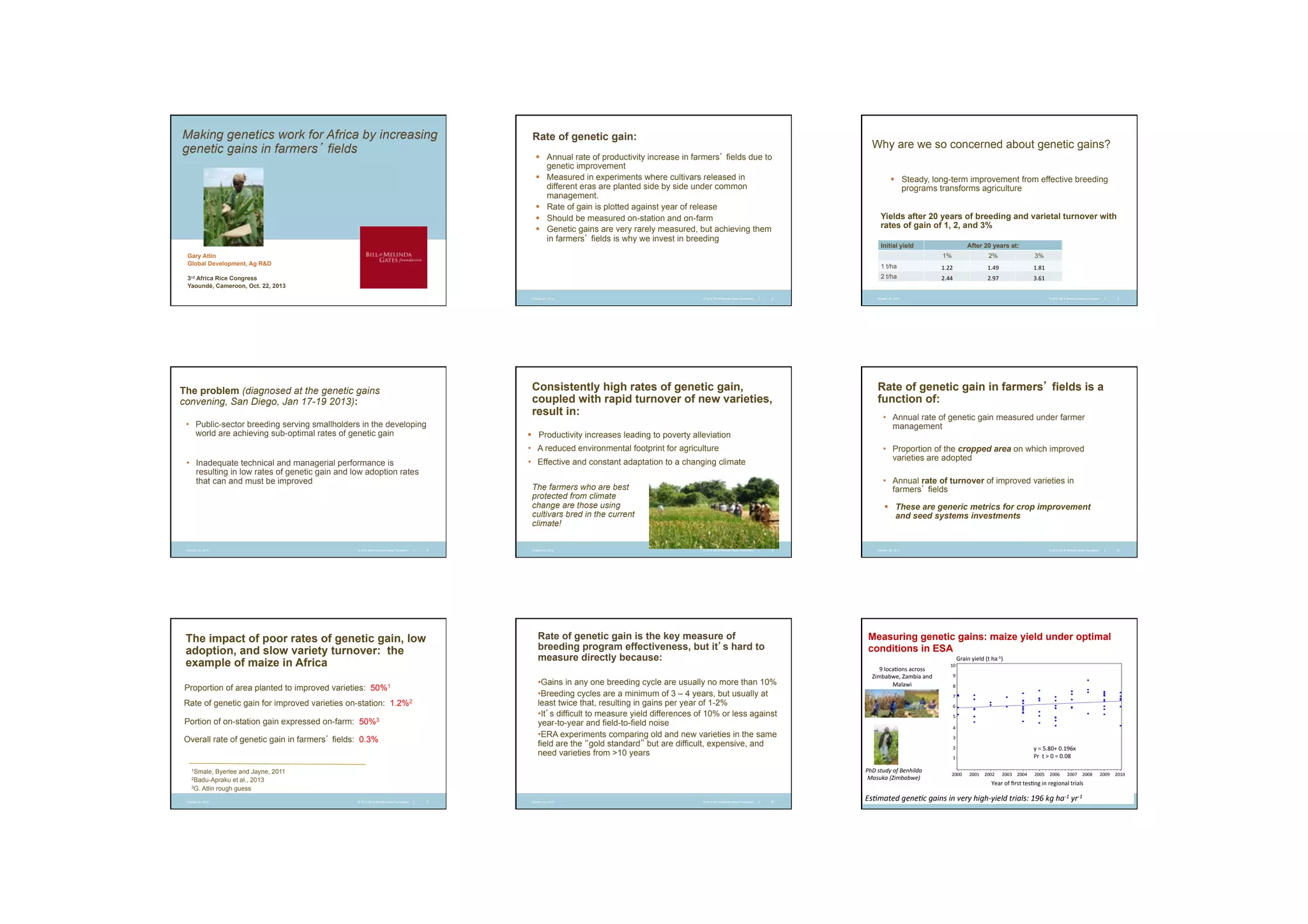
    Making genetics workfor Africa by increasing genetic gains in farmers’ fields Rate of genetic gain: Why are we so concerned about genetic gains? §  Annual rate of productivity increase in farmers’ fields due to genetic improvement §  Measured in experiments where cultivars released in different eras are planted side by side under common management. §  Rate of gain is plotted against year of release §  Should be measured on-station and on-farm §  Genetic gains are very rarely measured, but achieving them in farmers’ fields is why we invest in breeding After 20 years at: October 22, 2013 © 2012 Bill & Melinda Gates Foundation | 2 Consistently high rates of genetic gain, coupled with rapid turnover of new varieties, result in: The problem (diagnosed at the genetic gains convening, San Diego, Jan 17-19 2013): •  Public-sector breeding serving smallholders in the developing world are achieving sub-optimal rates of genetic gain §  Productivity increases leading to poverty alleviation •  A reduced environmental footprint for agriculture © 2012 Bill & Melinda Gates Foundation | October 22, 2013 © 2012 Bill & Melinda Gates Foundation | 5 Portion of on-station gain expressed on-farm: 50%3 Overall rate of genetic gain in farmers’ fields: 0.3% 2.97   3.61   7 October 22, 2013 | 6 Rate of genetic gain in farmers’ fields is a function of: •  Annual rate of genetic gain measured under farmer management © 2012 Bill & Melinda Gates Foundation | © 2012 Bill & Melinda Gates Foundation October 22, 2013 9  loca4ons  across   Zimbabwe,  Zambia  and   Malawi   8 10   9   8   7   6   5   4   3   y  =  5.80+  0.196x   Pr    t  >  0  =  0.08   2   1   PhD  study  of  Benhilda   Masuka  (Zimbabwe)   Byerlee and Jayne, 2011 et al., 2013 Atlin rough guess 2Badu-Apraku | 3 Grain  yield  (t  ha-­‐1)   1Smale, © 2012 Bill & Melinda Gates Foundation | © 2012 Bill & Melinda Gates Foundation Measuring genetic gains: maize yield under optimal conditions in ESA • Gains in any one breeding cycle are usually no more than 10% • Breeding cycles are a minimum of 3 – 4 years, but usually at least twice that, resulting in gains per year of 1-2% • It’s difficult to measure yield differences of 10% or less against year-to-year and field-to-field noise • ERA experiments comparing old and new varieties in the same field are the “gold standard” but are difficult, expensive, and need varieties from >10 years Proportion of area planted to improved varieties: 50%1 Rate of genetic gain for improved varieties on-station: 1.2%2 2.44   October 22, 2013 §  These are generic metrics for crop improvement and seed systems investments Rate of genetic gain is the key measure of breeding program effectiveness, but it’s hard to measure directly because: The impact of poor rates of genetic gain, low adoption, and slow variety turnover: the example of maize in Africa 1.81   •  Annual rate of turnover of improved varieties in farmers’ fields The farmers who are best protected from climate change are those using cultivars bred in the current climate! 4 3% 1.49   •  Proportion of the cropped area on which improved varieties are adopted •  Effective and constant adaptation to a changing climate •  Inadequate technical and managerial performance is resulting in low rates of genetic gain and low adoption rates that can and must be improved 2% 1.22   2 t/ha Africa Rice Congress Yaoundé, Cameroon, Oct. 22, 2013 October 22, 2013 Initial yield 1 t/ha 3rd 3G. Yields after 20 years of breeding and varietal turnover with rates of gain of 1, 2, and 3% 1% Gary Atlin Global Development, Ag R&D October 22, 2013 §  Steady, long-term improvement from effective breeding programs transforms agriculture 2000   2001   2002   2003   2004   2005   2006   2007   2008   2009   2010   Year  of  first  tes4ng  in  regional  trials   Es#mated  gene#c  gains  in  very  high-­‐yield  trials:  196  kg  ha-­‐1  yr-­‐1       © 2012 Bill & Melinda Gates Foundation |
  • 2.
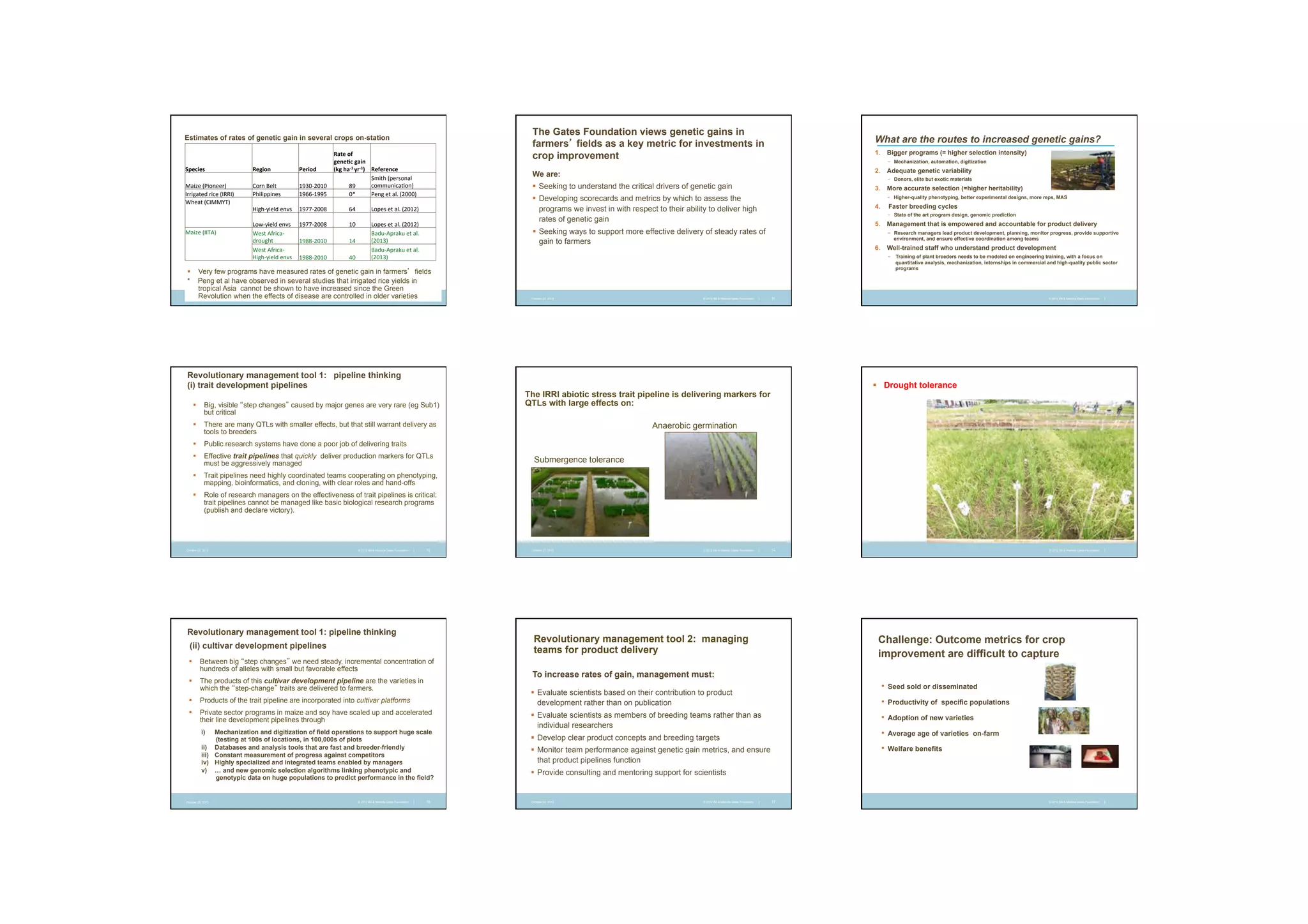
    The Gates Foundationviews genetic gains in farmers’ fields as a key metric for investments in crop improvement Estimates of rates of genetic gain in several crops on-station Species   Region   Maize  (Pioneer)   Irrigated  rice  (IRRI)   Wheat  (CIMMYT)   Corn  Belt   Philippines   Maize  (IITA)   High-­‐yield  envs   1977-­‐2008   64   10   40   Adequate genetic variability 3.  More accurate selection (=higher heritability) −  Mechanization, automation, digitization −  Donors, elite but exotic materials −  Higher-quality phenotyping, better experimental designs, more reps, MAS 4.  Faster breeding cycles 5.  Management that is empowered and accountable for product delivery 6.  Well-trained staff who understand product development −  State of the art program design, genomic prediction §  Seeking ways to support more effective delivery of steady rates of gain to farmers −  Research managers lead product development, planning, monitor progress, provide supportive environment, and ensure effective coordination among teams −  §  Very few programs have measured rates of genetic gain in farmers’ fields * Peng et al have observed in several studies that irrigated rice yields in tropical Asia cannot be shown to have increased since the Green Revolution when the effects of disease are controlled in older varieties 10 | October 22, 2013 Bigger programs (= higher selection intensity) 2.  §  Developing scorecards and metrics by which to assess the programs we invest in with respect to their ability to deliver high rates of genetic gain Lopes  et  al.  (2012)   Badu-­‐Apraku  et  al.   (2013)   Badu-­‐Apraku  et  al.   (2013)   14   1.  §  Seeking to understand the critical drivers of genetic gain Lopes  et  al.  (2012)   Low-­‐yield  envs   1977-­‐2008   West  Africa-­‐   drought   1988-­‐2010   West  Africa-­‐   High-­‐yield  envs   1988-­‐2010   What are the routes to increased genetic gains? We are: Rate  of   gene2c  gain   (kg  ha-­‐1  yr-­‐1)   Reference   Period   Smith  (personal   communica4on)   1930-­‐2010   89   1966-­‐1995   0*   Peng  et  al.  (2000)   © 2012 Bill & Melinda Gates Foundation Revolutionary management tool 1: pipeline thinking (i) trait development pipelines §  Big, visible “step changes” caused by major genes are very rare (eg Sub1) but critical October 22, 2013 © 2012 Bill & Melinda Gates Foundation | © 2012 Bill & Melinda Gates Foundation | © 2012 Bill & Melinda Gates Foundation 11 | §  Drought tolerance The IRRI abiotic stress trait pipeline is delivering markers for QTLs with large effects on: §  There are many QTLs with smaller effects, but that still warrant delivery as tools to breeders Training of plant breeders needs to be modeled on engineering training, with a focus on quantitative analysis, mechanization, internships in commercial and high-quality public sector programs Anaerobic germination §  Public research systems have done a poor job of delivering traits §  Effective trait pipelines that quickly deliver production markers for QTLs must be aggressively managed Submergence tolerance §  Trait pipelines need highly coordinated teams cooperating on phenotyping, mapping, bioinformatics, and cloning, with clear roles and hand-offs §  Role of research managers on the effectiveness of trait pipelines is critical; trait pipelines cannot be managed like basic biological research programs (publish and declare victory). October 22, 2013 © 2012 Bill & Melinda Gates Foundation | 13 Revolutionary management tool 1: pipeline thinking §  The products of this cultivar development pipeline are the varieties in which the “step-change” traits are delivered to farmers. | 14 §  Private sector programs in maize and soy have scaled up and accelerated their line development pipelines through i)  Mechanization and digitization of field operations to support huge scale (testing at 100s of locations, in 100,000s of plots ii)  Databases and analysis tools that are fast and breeder-friendly iii)  Constant measurement of progress against competitors iv)  Highly specialized and integrated teams enabled by managers v)  … and new genomic selection algorithms linking phenotypic and genotypic data on huge populations to predict performance in the field? | Challenge: Outcome metrics for crop improvement are difficult to capture To increase rates of gain, management must: •  Seed sold or disseminated §  Evaluate scientists based on their contribution to product development rather than on publication §  Products of the trait pipeline are incorporated into cultivar platforms © 2012 Bill & Melinda Gates Foundation © 2012 Bill & Melinda Gates Foundation Revolutionary management tool 2: managing teams for product delivery (ii) cultivar development pipelines §  Between big “step changes” we need steady, incremental concentration of hundreds of alleles with small but favorable effects October 22, 2013 October 22, 2013 16 •  Productivity of specific populations §  Evaluate scientists as members of breeding teams rather than as individual researchers •  Adoption of new varieties •  Average age of varieties on-farm §  Develop clear product concepts and breeding targets •  Welfare benefits §  Monitor team performance against genetic gain metrics, and ensure that product pipelines function §  Provide consulting and mentoring support for scientists October 22, 2013 © 2012 Bill & Melinda Gates Foundation | 17 © 2012 Bill & Melinda Gates Foundation |
  • 3.
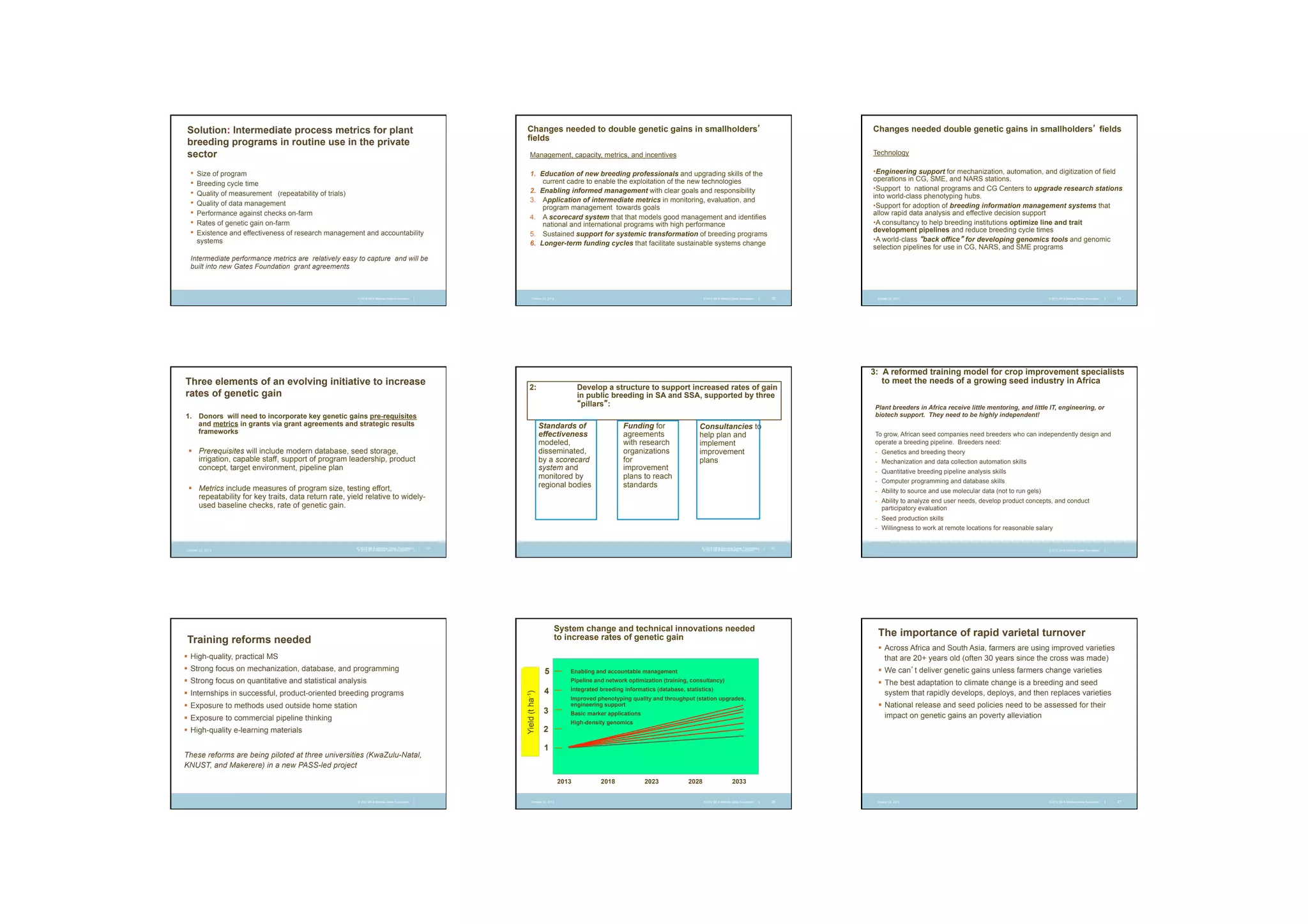
    Changes needed todouble genetic gains in smallholders’ fields Solution: Intermediate process metrics for plant breeding programs in routine use in the private sector Changes needed double genetic gains in smallholders’ fields Management, capacity, metrics, and incentives 1.  Education of new breeding professionals and upgrading skills of the current cadre to enable the exploitation of the new technologies 2.  Enabling informed management with clear goals and responsibility 3.  Application of intermediate metrics in monitoring, evaluation, and program management towards goals 4.  A scorecard system that that models good management and identifies national and international programs with high performance 5.  Sustained support for systemic transformation of breeding programs 6.  Longer-term funding cycles that facilitate sustainable systems change •  Size of program •  Breeding cycle time •  Quality of measurement (repeatability of trials) •  Quality of data management •  Performance against checks on-farm •  Rates of genetic gain on-farm •  Existence and effectiveness of research management and accountability systems Technology • Engineering support for mechanization, automation, and digitization of field operations in CG, SME, and NARS stations. • Support to national programs and CG Centers to upgrade research stations into world-class phenotyping hubs. • Support for adoption of breeding information management systems that allow rapid data analysis and effective decision support • A consultancy to help breeding institutions optimize line and trait development pipelines and reduce breeding cycle times • A world-class “back office” for developing genomics tools and genomic selection pipelines for use in CG, NARS, and SME programs Intermediate performance metrics are relatively easy to capture and will be built into new Gates Foundation grant agreements © 2012 Bill & Melinda Gates Foundation | © 2012 Bill & Melinda Gates Foundation October 22, 2013 Three elements of an evolving initiative to increase rates of genetic gain 2: 1. Donors will need to incorporate key genetic gains pre-requisites and metrics in grants via grant agreements and strategic results frameworks §  Metrics include measures of program size, testing effort, repeatability for key traits, data return rate, yield relative to widelyused baseline checks, rate of genetic gain. 20 Develop a structure to support increased rates of gain in public breeding in SA and SSA, supported by three “pillars”: Funding for agreements with research organizations for improvement plans to reach standards Standards of effectiveness modeled, disseminated, by a scorecard system and monitored by regional bodies §  Prerequisites will include modern database, seed storage, irrigation, capable staff, support of program leadership, product concept, target environment, pipeline plan | Consultancies to help plan and implement improvement plans © 2013 Bill & Melinda Gates Foundation © 2012 Bill & Melinda Gates Foundation | | © 2012 Bill & Melinda Gates Foundation | 21 3: A reformed training model for crop improvement specialists to meet the needs of a growing seed industry in Africa Plant breeders in Africa receive little mentoring, and little IT, engineering, or biotech support. They need to be highly independent! To grow, African seed companies need breeders who can independently design and operate a breeding pipeline. Breeders need: -  Genetics and breeding theory -  Mechanization and data collection automation skills -  Quantitative breeding pipeline analysis skills -  Computer programming and database skills -  Ability to source and use molecular data (not to run gels) -  Ability to analyze end user needs, develop product concepts, and conduct participatory evaluation -  Seed production skills -  Willingness to work at remote locations for reasonable salary October 22, 2013 October 22, 2013 October 22, 2013 22 © 2013 Bill & Melinda Gates Foundation © 2012 Bill & Melinda Gates Foundation | | 23 System change and technical innovations needed to increase rates of genetic gain Training reforms needed © 2012 Bill & Melinda Gates Foundation | The importance of rapid varietal turnover §  Across Africa and South Asia, farmers are using improved varieties that are 20+ years old (often 30 years since the cross was made) §  High-quality, practical MS §  Strong focus on mechanization, database, and programming Yield (t ha-1) §  Internships in successful, product-oriented breeding programs §  Exposure to methods used outside home station §  Exposure to commercial pipeline thinking §  High-quality e-learning materials These reforms are being piloted at three universities (KwaZulu-Natal, KNUST, and Makerere) in a new PASS-led project 4 3 2 Enabling and accountable management §  We can’t deliver genetic gains unless farmers change varieties Pipeline and network optimization (training, consultancy) 5 §  Strong focus on quantitative and statistical analysis §  The best adaptation to climate change is a breeding and seed system that rapidly develops, deploys, and then replaces varieties Integrated breeding informatics (database, statistics) Improved phenotyping quality and throughput (station upgrades, engineering support High-density genomics 1 2013 © 2012 Bill & Melinda Gates Foundation | §  National release and seed policies need to be assessed for their impact on genetic gains an poverty alleviation Basic marker applications October 22, 2013 2018 2023 2028 2033 © 2012 Bill & Melinda Gates Foundation | 26 October 22, 2013 © 2012 Bill & Melinda Gates Foundation | 27
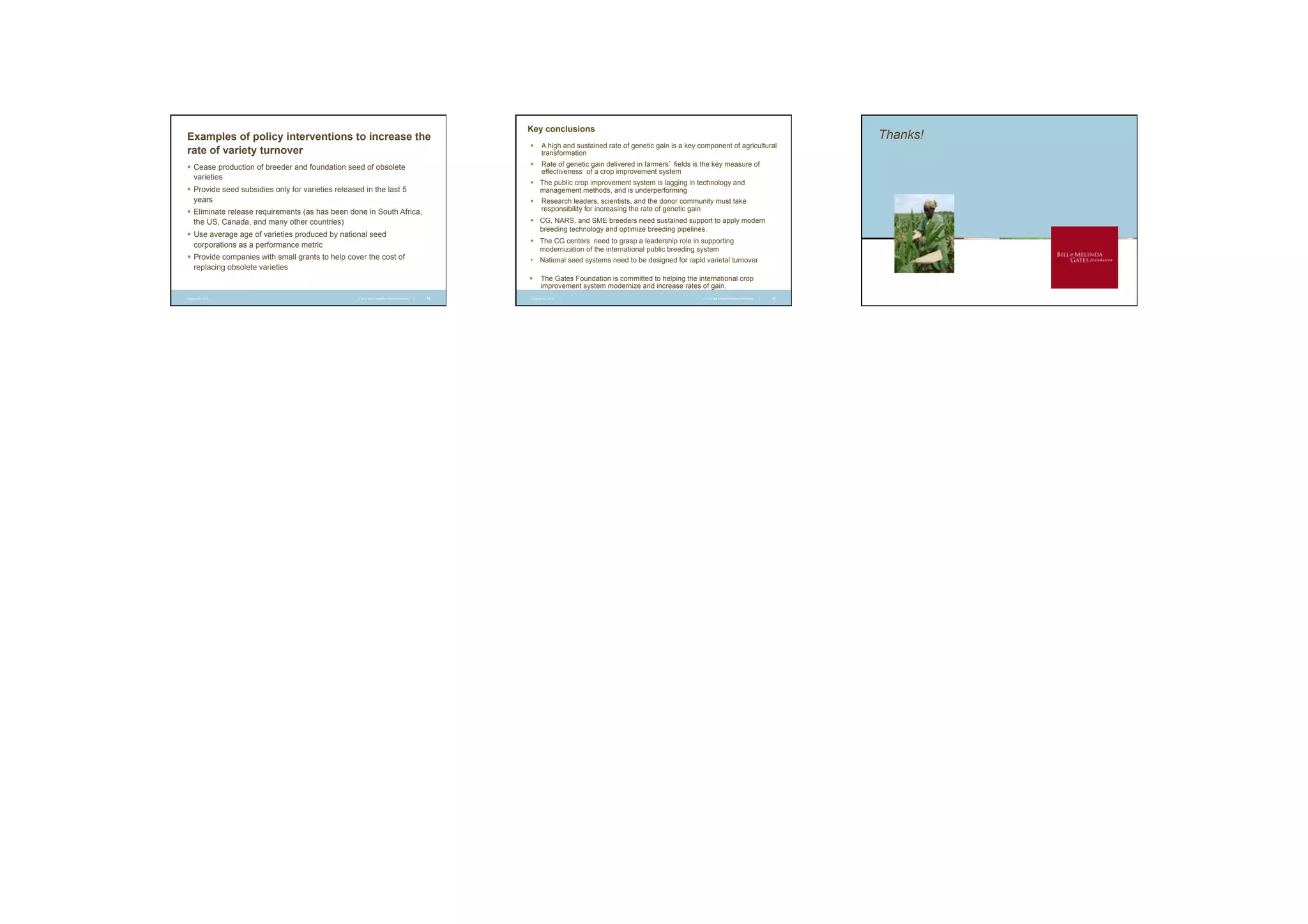
  • 4.
    Examples of policyinterventions to increase the rate of variety turnover Key conclusions §  A high and sustained rate of genetic gain is a key component of agricultural transformation §  Rate of genetic gain delivered in farmers’ fields is the key measure of effectiveness of a crop improvement system §  Cease production of breeder and foundation seed of obsolete varieties §  The public crop improvement system is lagging in technology and management methods, and is underperforming §  Provide seed subsidies only for varieties released in the last 5 years §  Research leaders, scientists, and the donor community must take responsibility for increasing the rate of genetic gain §  Eliminate release requirements (as has been done in South Africa, the US, Canada, and many other countries) §  CG, NARS, and SME breeders need sustained support to apply modern breeding technology and optimize breeding pipelines. §  Use average age of varieties produced by national seed corporations as a performance metric §  The CG centers need to grasp a leadership role in supporting modernization of the international public breeding system §  Provide companies with small grants to help cover the cost of replacing obsolete varieties •  National seed systems need to be designed for rapid varietal turnover §  The Gates Foundation is committed to helping the international crop improvement system modernize and increase rates of gain. October 22, 2013 © 2012 Bill & Melinda Gates Foundation | 28 October 22, 2013 © 2012 Bill & Melinda Gates Foundation | 29 Thanks!