Download to read offline




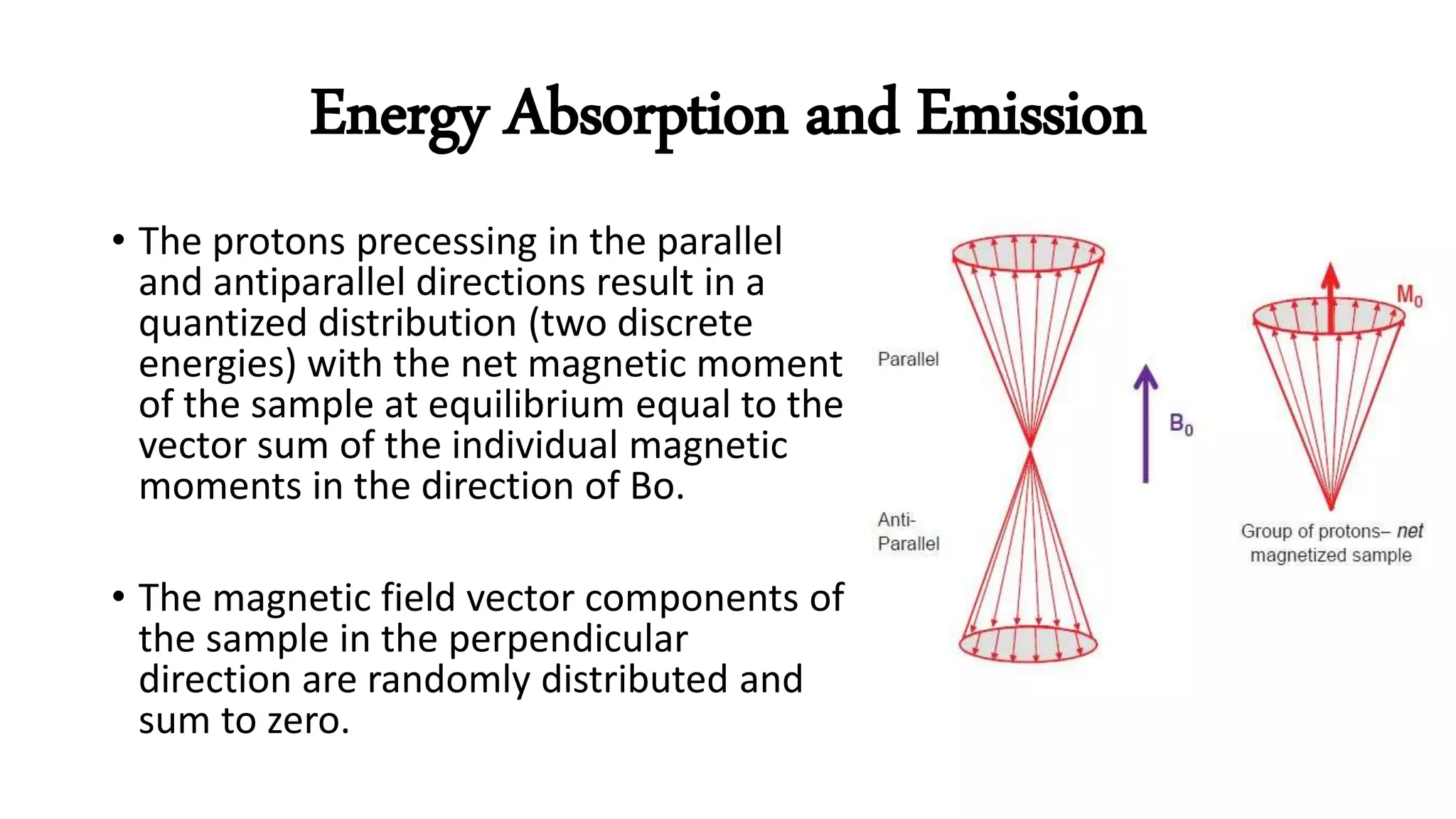


MRI uses resonance to selectively excite hydrogen protons in tissues placed in a strong magnetic field. When radiofrequency pulses are applied, the protons absorb and emit energy at their resonance frequency. This energy emission is detected to form MRI images with high contrast of soft tissues. While MRI provides advantages over other modalities, it also has drawbacks like high costs, long scan times, and artifacts. The behavior of protons in magnetic fields allows MRI to spatially encode tissue signals.


![Portable and mobile radiographic equipments [Autosaved].pptx](https://cdn.slidesharecdn.com/ss_thumbnails/portableandmobileradiographicequipmentsautosaved-230729155829-aadaaabd-thumbnail.jpg?width=640&height=640&fit=bounds)


