This document provides an overview of the physics principles behind Magnetic Resonance Imaging (MRI). It discusses how MRI works by using strong magnetic fields to align the spin of hydrogen protons in the body. When radiofrequency pulses are applied, the protons absorb energy and their spins are tipped into the transverse plane, generating a signal that is picked up by the MRI machine. The signal provides information used to create grayscale images of tissues and organs. The document also introduces key MRI concepts like spin states, precession, T1 and T2 relaxation times, and basic pulse sequences. An experiment is described that allows students to collect MRI data using a pulsed nuclear magnetic resonance spectrometer in order to better understand the physics behind the imaging process.








![CHAPTER 1. INTRODUCTION & BACKGROUND
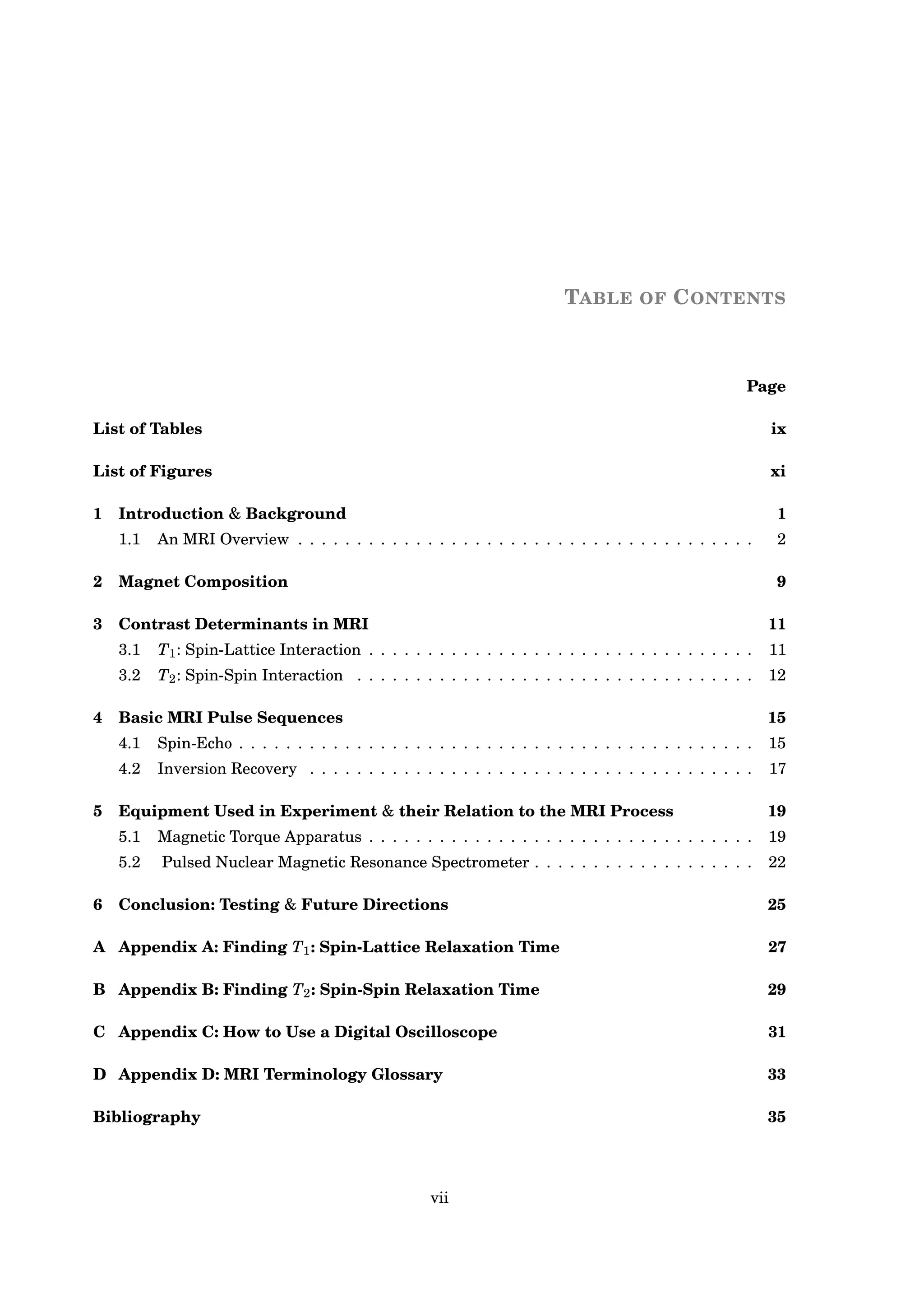
Figure 1.2: Each proton generates a magnetic field around it as it moves inside the nucleus. The
magnetic field has two poles, just like a basic magnet. For purposes of simplicity, we can think
of each proton in the sample as a mini magnet, whose net magnetization is represented by the
vector quantity µ, the nuclear Magnetic Moment. The sum of all µ in a sample is expressed as
the Net Magnetization Vector (NMV), or M.
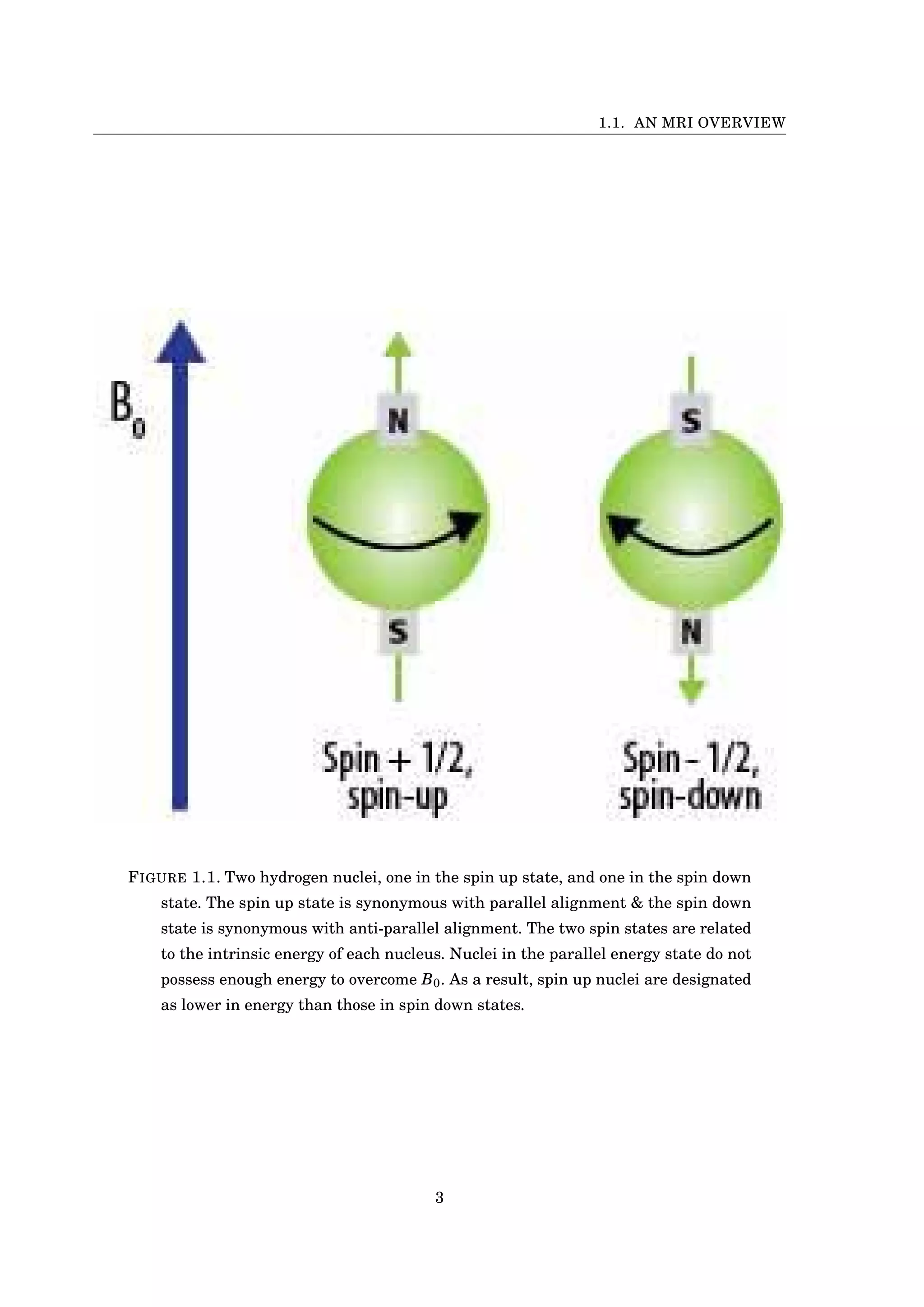
B0 causes the protons in the body to align parallel (the same direction) or anti-parallel (the
opposite direction) to the magnetic field. The two alignments are related to the two spin states of
the nuclei: spin up (spin of +1/2) is another term used to reference parallel alignment. Spin down
(spin of -1/2) is synonymous with anti-parallel alignment. Alignment is related to energy levels
(E) of the nuclei. Spin down nuclei have E = −µ×B and spin up nuclei have E = µ×B.
More nuclei prefer the parallel alignment state because it is lower in energy. Protons in the
anti-parallel state possess intrinsic energy at the time B0 is applied, so they are able to overcome
the magnetic field and align against it. Nuclei in the parallel state are unable to overpower the
magnetic field, and thus are forced to go along with it. For every one million nuclei in the sample,
about 3 more will prefer the parallel state. Any pair of parallel/anti-parallel magnetic moments
will neutralize each other in terms of magnetization. More nuclei prefer the parallel state so M
will align along the positive z-axis after the nuclei have all finished aligning - a state referred to
as Thermal Equilibrium. 1019
protons exist in one cubic centimeter of tissue, so there is never a
shortage of nuclei to supply M. [3]
4](https://image.slidesharecdn.com/141e38c5-5ecc-49a6-9f46-f79a22f9d482-151216084346/75/Muraoka_FinalThesis-18-2048.jpg)
![1.1. AN MRI OVERVIEW
Figure 1.3: Precession frequencies of Isotopes most commonly used in MRI. Hydrogen is the most
commonly imaged element, due to its natural abundance of 99.98 %. [6]
The number of nuclei that align with the spin up state over the spin down state is proportional
to strength of B0. The stronger the field, the more nuclei that end up in the parallel alignment.
In fields outside of health care such as research, magnets of up to 60 Tesla are used to generate
the best quality image possible. [5]
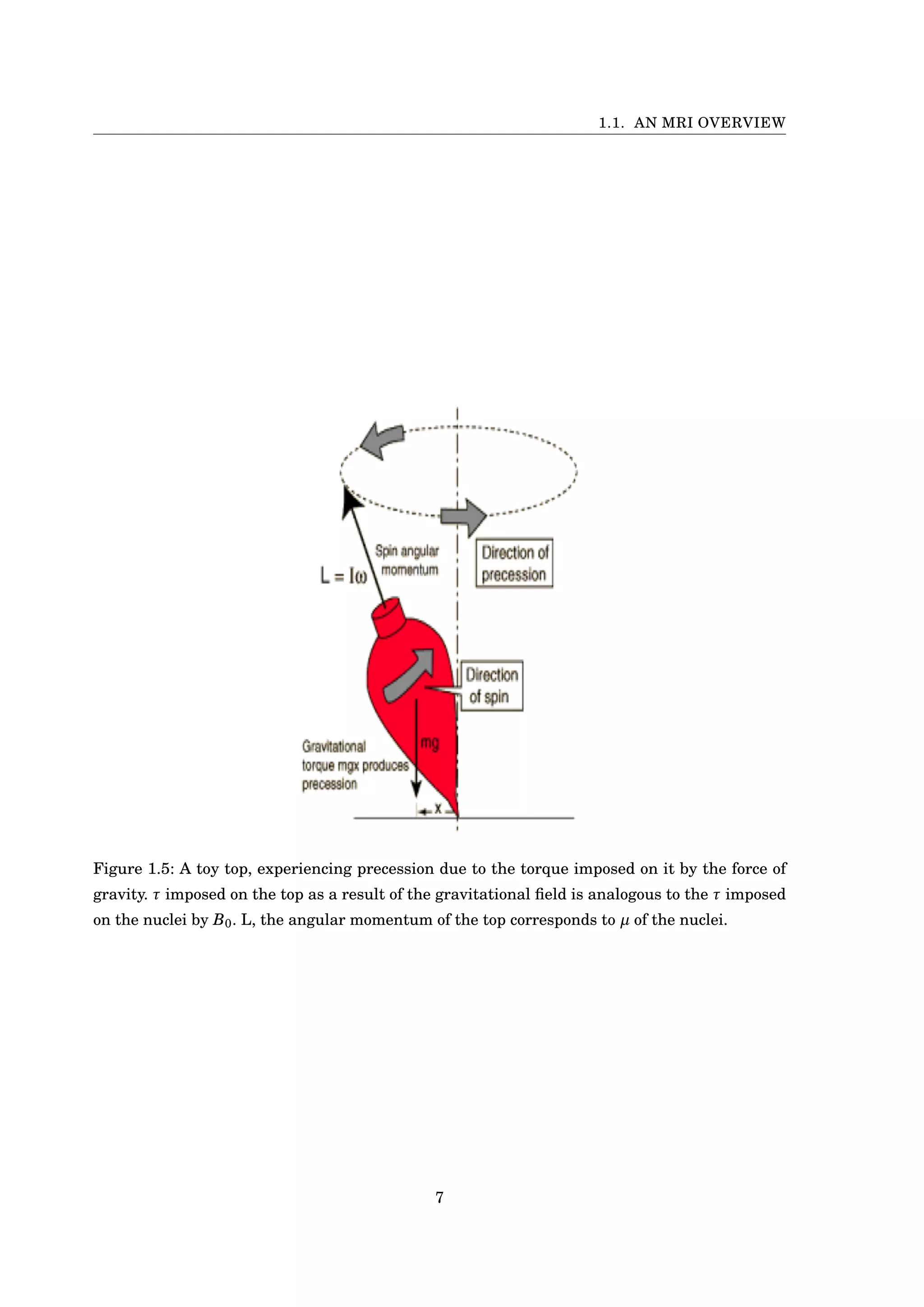
Alignment of the nuclei is also accompanied by a Torque-induced (τ) effect called precession.
This can be thought of as what happens to a toy top when it is spun on a tabletop. Before it falls
to its side, the top begins to wobble - the wobbling effect of the top caused by gravitational torque
is analogous to the precession the nuclei experience around the z-axis as a result of B0. This
is illustrated in Figure 1.5, and is represented by Equation (3). The nuclei precess constantly
throughout the MRI process from the moment B0 is applied. This is what generates a signal,
which is picked up on by the MRI’s pickup coils and read to generate an image.
(3) τ = µ×B0
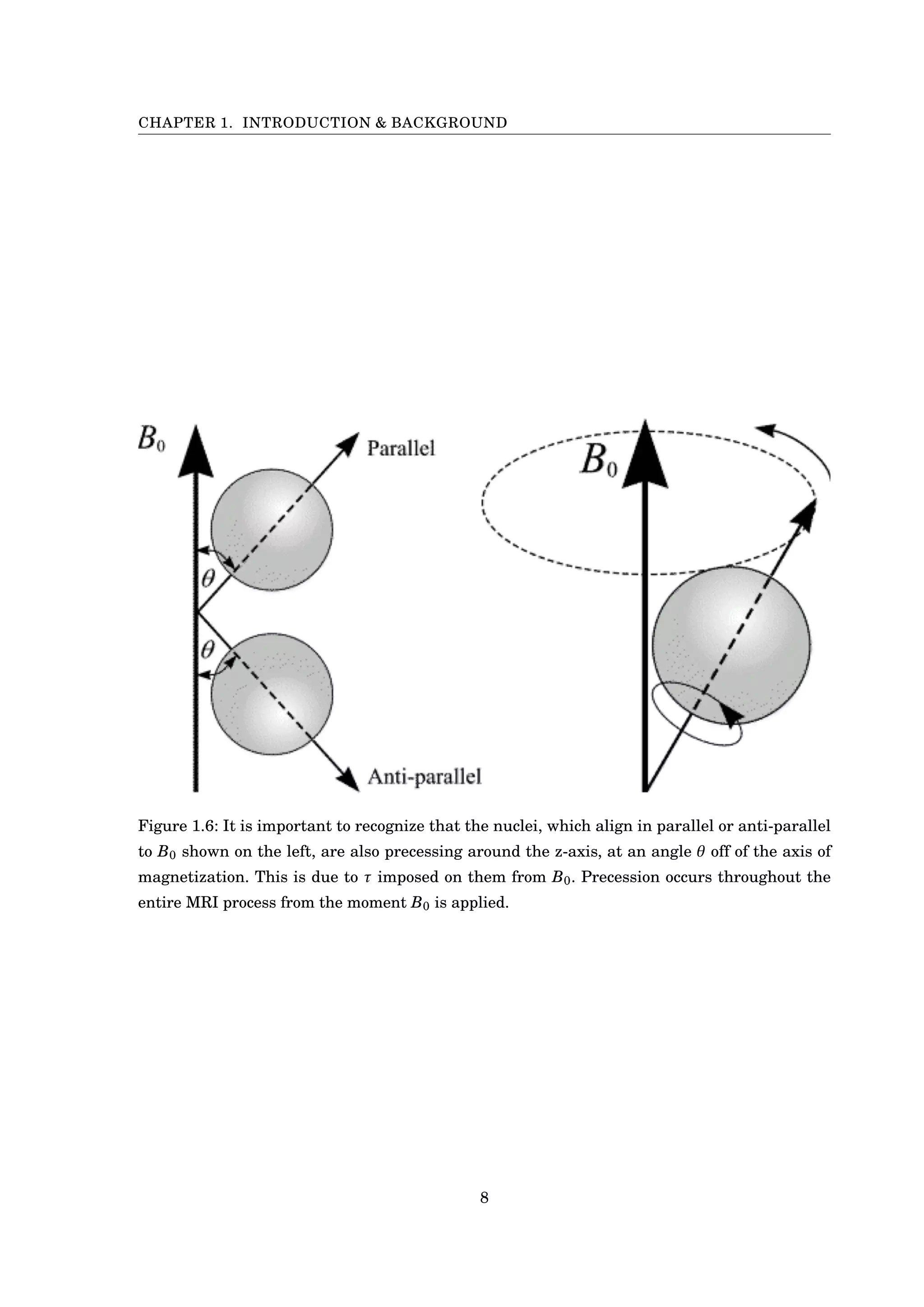
This changes the understood definitions of parallel and anti-parallel alignment. Not only are
the µ of the nuclei aligned in the same or opposite direction to B0, they are also offset by an angle
θ, and are precessing around the axis of magnetization, as shown in Figure 1.6.
From thermal equilibrium, a radiofrequency (RF) pulse is applied to the nuclei, and causes
M to be tipped into the transverse (xy-plane). The RF pulse is generated by coils oriented
perpendicular to B0. The nuclei absorb this energy and switch spin states, and as a result become
5](https://image.slidesharecdn.com/141e38c5-5ecc-49a6-9f46-f79a22f9d482-151216084346/75/Muraoka_FinalThesis-19-2048.jpg)
![CHAPTER 1. INTRODUCTION & BACKGROUND
Figure 1.4: The Magnetic Resonance Imaging apparatus. The permanent magnets of the MRI,
and the coils that generate the RF pulse are housed in the doughnut-shaped portion of the
machine. The flat attachment is where the patient is positioned to receive the scan.[5]
"in phase" in with one another. In phase means that all the nuclei’s µ are pointing in the same
direction. It is the point at which the M has it’s greatest strength. The energy-induced state is
temporary and the nuclei eventually make their way back to their original alignment once the
RF pulse is turned off & emit a signal as they do so. The MRI machine’s pickup coils, which can
only measure transverse magnetization, pick up on the signal and match it to a contrast gradient
which produces a gray-scale image.
6](https://image.slidesharecdn.com/141e38c5-5ecc-49a6-9f46-f79a22f9d482-151216084346/75/Muraoka_FinalThesis-20-2048.jpg)
![CHAPTER
2
MAGNET COMPOSITION
M
agnets can be made of various metals, but the most commonly used in Magnetic
Resonance Imaging are iron, cobalt, and nickel. Often alloys of these metals are used,
with the most common being a combination of aluminum, nickel, and cobalt called
AlNiCo.
One way magnetic fields are generated in MRI is through electromagnets. Electromagnets
use the movement of current through wires to create a magnetic field. There are different types
of electromagnets used in MRI, and these magnets are responsible for generating the RF pulse
applied to the nuclei of the sample.
Resistive magnets generate a magnetic field of strength proportional to the amount of current
flowing through its wires. The field that is generated is perpendicular to B0. Ideally, wires with
the least amount of resistance are preferred so that less energy can be used to power the RF
pulse(s). The pulses of energy through these coils are responsible for the loud noises a patient will
hear while undergoing an MRI. The noise comes from the circulation of large pulses of electricity
flowing through the coils.
The strength of the magnetic field generated by the magnets, though necessary for creating
a quality image, poses one of the biggest dangers of receiving an MRI. Metal tools, or metal
embedded in the body can easily become deadly once the magnetic field is turned on. An example
of this is shown in Figure 2. [5]
All the energy rushing into the coils has to go somewhere, and it is released as heat. To
remedy for the heat that is created in the MRI process, the wires are cooled in a process called a
cryogen bath. The cryogen bath is either liquid helium or liquid nitrogen that surrounds the coils,
and is housed in a vacuum so that it doesn’t instantly evaporate.
9](https://image.slidesharecdn.com/141e38c5-5ecc-49a6-9f46-f79a22f9d482-151216084346/75/Muraoka_FinalThesis-23-2048.jpg)
![CHAPTER 2. MAGNET COMPOSITION
Figure 2.1: A person shown holding a scissors in free-float in the magnetic field generated by
the permanent magnets of an MRI. Because the field is so strong, any type of metal should be
removed from the imaging area. [5]
10](https://image.slidesharecdn.com/141e38c5-5ecc-49a6-9f46-f79a22f9d482-151216084346/75/Muraoka_FinalThesis-24-2048.jpg)
![CHAPTER
3
CONTRAST DETERMINANTS IN MRI
T
he differences in color in the gray scale image created in MRI are related to the signal
given off by the tissue. The image will show up as light, aka hyperintense, if there is a
large transverse component of magnetization when the signal is measured. Parts of the
image will show up as black (hypointense) if it has a small transverse component of magnetization
at the time the signal is measured.
Although there are many different types of contrast determinants in MRI, the most commonly
used are called T1 and T2. In a T1 weighted image, fats show up as bright. So T1 weighted images
are preferred for imaging soft, fatty-filled tissues like the brain. It is also used to view areas with
high protein content or slow blood flow. In a T2 weighted image, fluids show up as bright. T2
weighting is preferred when imaging diseased tissues, as diseased tissues typically have higher
water content. [3] T2 is the contrast determinant chosen to image tumors, edemas, and inflamed
areas in the body. In real MRI, T1 and T2 happen simultaneously - in fact, some MRI images are
a blend of T1 and T2 weighting. For purposes of this experiment, it is useful to understand the
two weightings independently.
3.1 T1: Spin-Lattice Interaction
T1, also referred to as spin-lattice recovery/relaxation/interaction/delay time is the time constant
needed for the M to realign along the z-axis to 63% of its value at thermal equilibrium following
the removal of the RF pulse. It is a measure of how the energy given to the nuclei by the original
RF pulse is released to the surrounding environment. Not all tissues return to equilibrium at an
identical rate, so a tissue’s T1 allows the MRI to identify the tissue being imaged.
To understand why fats show up as bright in a T1 weighted image, one must consider their
11](https://image.slidesharecdn.com/141e38c5-5ecc-49a6-9f46-f79a22f9d482-151216084346/75/Muraoka_FinalThesis-25-2048.jpg)
![CHAPTER 3. CONTRAST DETERMINANTS IN MRI
molecular structure. The molecule is large, and the atoms are closely packed together. Because of
this, the molecules are not able to move very quickly, and therefore do not possess much inherent
energy. When the RF pulse is removed, the Hydrogen nuclei are able to release the energy into
the fat molecule (their surroundings), which efficiently absorbs the energy. A lewis structure of a
fat molecule illustrating the network of Hydrogen with other elements is shown in Figure 3.1.
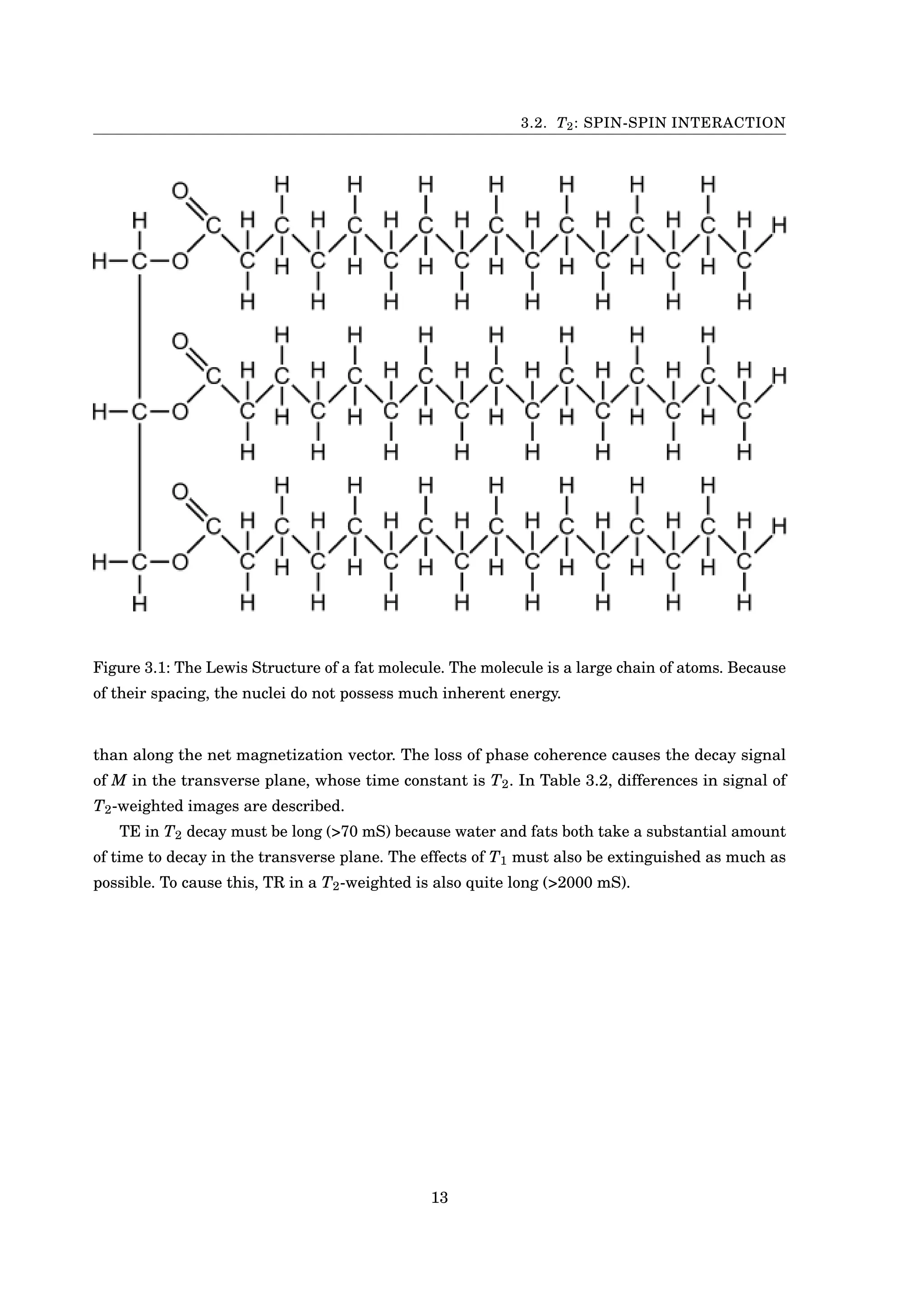
In contrast, fluids like water shown in Figure 3.1, are made up of molecules that are very
small. This means that the water molecules have a lot of space to move, and thus more inherent
energy. The nuclei don’t have as much "free-space" to put the energy received by the RF pulse,
and thus T1 is longer in fluids, as the nuclei take longer to disperse the energy to the water
molecule. In Table 3.1, contrast signals of different tissues are described.
T1 Signals of Different Tissues
Signal Tissue Being Imaged
High Cysts with Proteinaceous Fluid
High Methaemoglobin
Low Infections
Low Tumors
None Air
None Scar Tissue/Calcification
Table 3.1: T1 signals of different tissues. In a T1 weighted image, fatty-filled tissues/tissues with
high protein content show up as hyperintense, while tissues with high fluid content show up as
dark. Tissues with no fatty or proteinaceous content do not show up in a T1 weighted image. [5]
T1 also depends on how closely the motion of the molecules matches ωL. If there is a good
match between ωL and the molecular tumbling, then energy is effectively exchanged between
Hydrogen and the surrounding molecular lattice.
In a T1 weighted image, a short TE and short TR are desirable. TE, known as the "time to
echo" is the time between the RF pulse and the maximum signal received by the MRI. TR is
called the repetition time and is the time between RF pulses. In T1 weighting, the differences
between T1 and T2 readings have to be exaggerated to form a contrast. To reduce the effects of
T2, the TE has to be short.
3.2 T2: Spin-Spin Interaction
T2, which is known as spin-spin relaxation/interaction/decay time is the amount of time it takes
for the nuclei’s magnetic moments to become out of phase with one another in the transverse
plane. This corresponds to 63 % of the transverse magnetization being lost. The nuclei, all as
individual precessing mini-magnets, generate magnetic fields that influence the magnetic fields
of the nuclei around them. This causes their magnetic moments to point in different directions
12](https://image.slidesharecdn.com/141e38c5-5ecc-49a6-9f46-f79a22f9d482-151216084346/75/Muraoka_FinalThesis-26-2048.jpg)
![CHAPTER 3. CONTRAST DETERMINANTS IN MRI
Figure 3.2: The Lewis Structure of a water molecule. The molecule is small, with only 3 atoms.
Because of it’s size, the nuclei possess greater inherent energy in comparison to large molecules
like fat.
T2 Signals of Different Tissues
Signal Tissue Being Imaged
High Infection
High Haemorrhage
Low Calcification
Low Deoxyhaemoglobin
None Air
None Scar Tissue/Calcification
Table 3.2: T2 signals of different tissues. In a T2 weighted image, fluid-filled tissues/tissues with
high water content show up as hyperintense, while tissues with low fluid content show up as
dark. Tissues with no fluid content do not show up in a T1 weighted image. [5]
14](https://image.slidesharecdn.com/141e38c5-5ecc-49a6-9f46-f79a22f9d482-151216084346/75/Muraoka_FinalThesis-28-2048.jpg)

![CHAPTER 4. BASIC MRI PULSE SEQUENCES
Figure 4.1: Example Spin-Echo pulse sequence. After the initial π/2 pulse,the nuclei are in phase.
As they start to de-phase, they emit a signal called the Free Induction Decay. Then, before
dephasing completely occurs, the nuclei are re-phased by a 180 degree pulse. This is applied at
time interval τ after the π/2 pulse. As the nuclei make their way back to thermal equilibrium,
they emit a signal that is called an echo. The echo is smaller in magnitude than the original
RF pulse. Note that the lower part of the figure, which shows the re-phasing of the nuclei, is
illustrated from the point of view of the rotating reference frame [2]
16](https://image.slidesharecdn.com/141e38c5-5ecc-49a6-9f46-f79a22f9d482-151216084346/75/Muraoka_FinalThesis-30-2048.jpg)
![4.2. INVERSION RECOVERY
Erwin Hahn, who originally thought of implementing a Spin-Echo pulse sequence to account
for inhomogeneities in the magnetic field, described the re-phasing using this analogy:
Let a team of runners with different but constant running speeds start off at a time
t = 0 as they would do at a track meet... At some time T these runners would be
distributed around the race track in apparently random positions. The referee fires
his gun at a time t = τ > T, and by previous arrangement the racers quickly turn
about-face and run in the opposite direction with their original speeds. Obviously, at
a time t = 2τ , the runners will return together precisely at the starting line. [1]
In simple terms, even though some nuclei begin to get "ahead" and precess faster than other
nuclei, they all end up back in the same place due to the re-phasing pulse.
4.2 Inversion Recovery
Inversion recovery sequences can be thought of as the direct opposite of Spin-Echo in terms of
how the RF pulses are applied. The A pulse in an Inversion Recovery sequence is the 180 degree
pulse. This flips the NMV from the positive z-axis to the negative z-axis. The B pulse moves the
NMV into the transverse plane (a π/2 pulse), which allows the pickup coils of the MRI to generate
a reading as it moves back to thermal equilibrium.
17](https://image.slidesharecdn.com/141e38c5-5ecc-49a6-9f46-f79a22f9d482-151216084346/75/Muraoka_FinalThesis-31-2048.jpg)

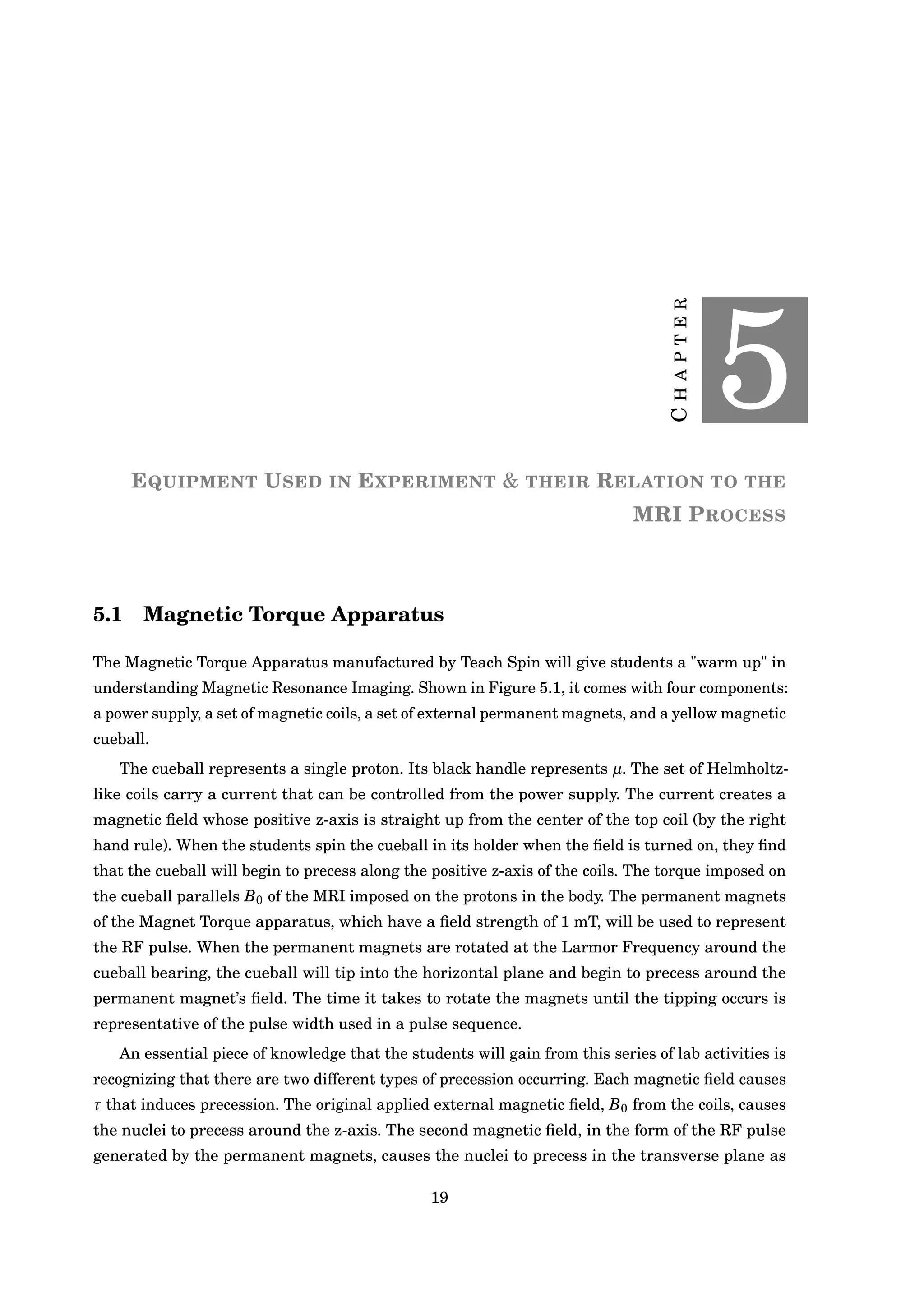
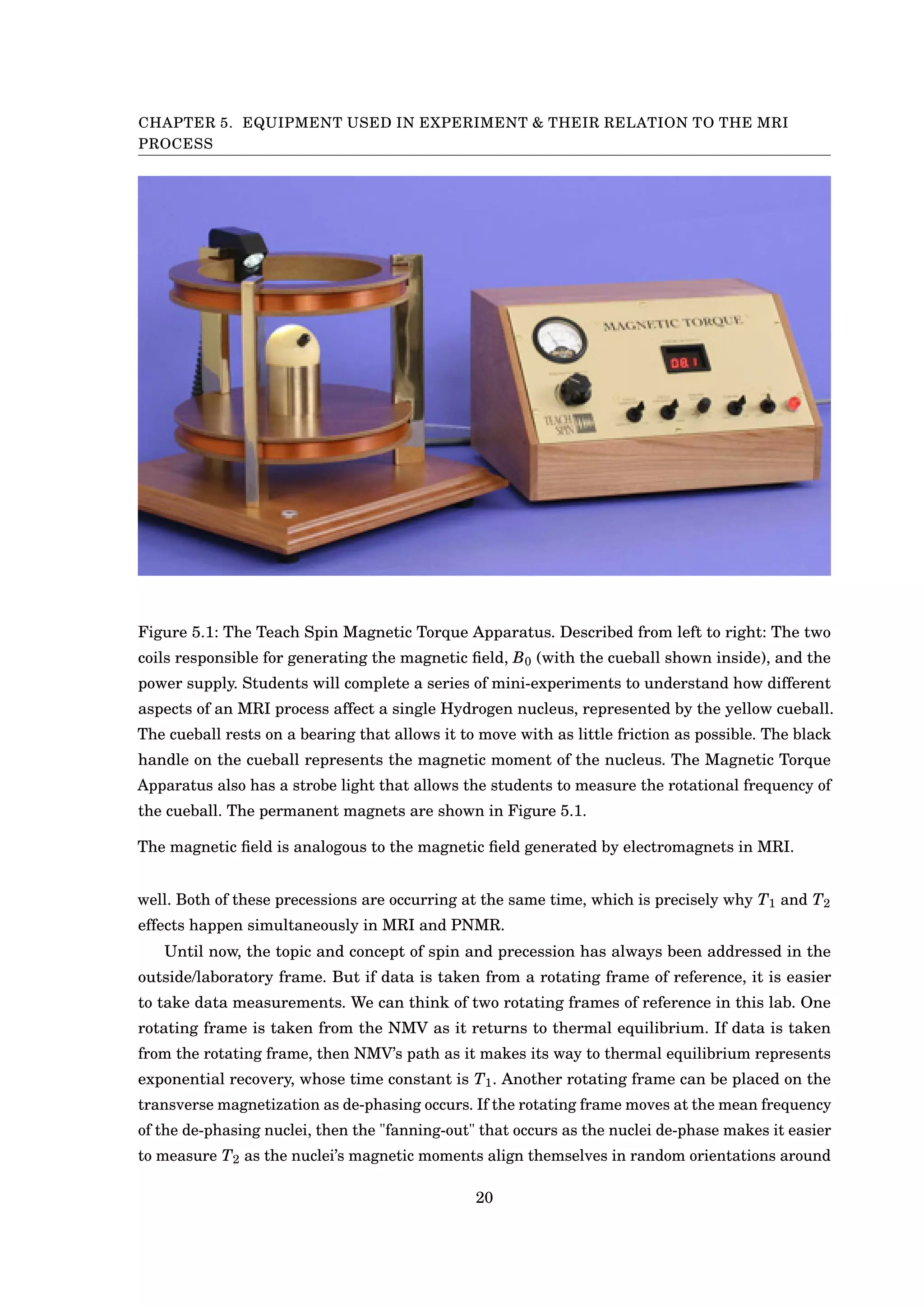
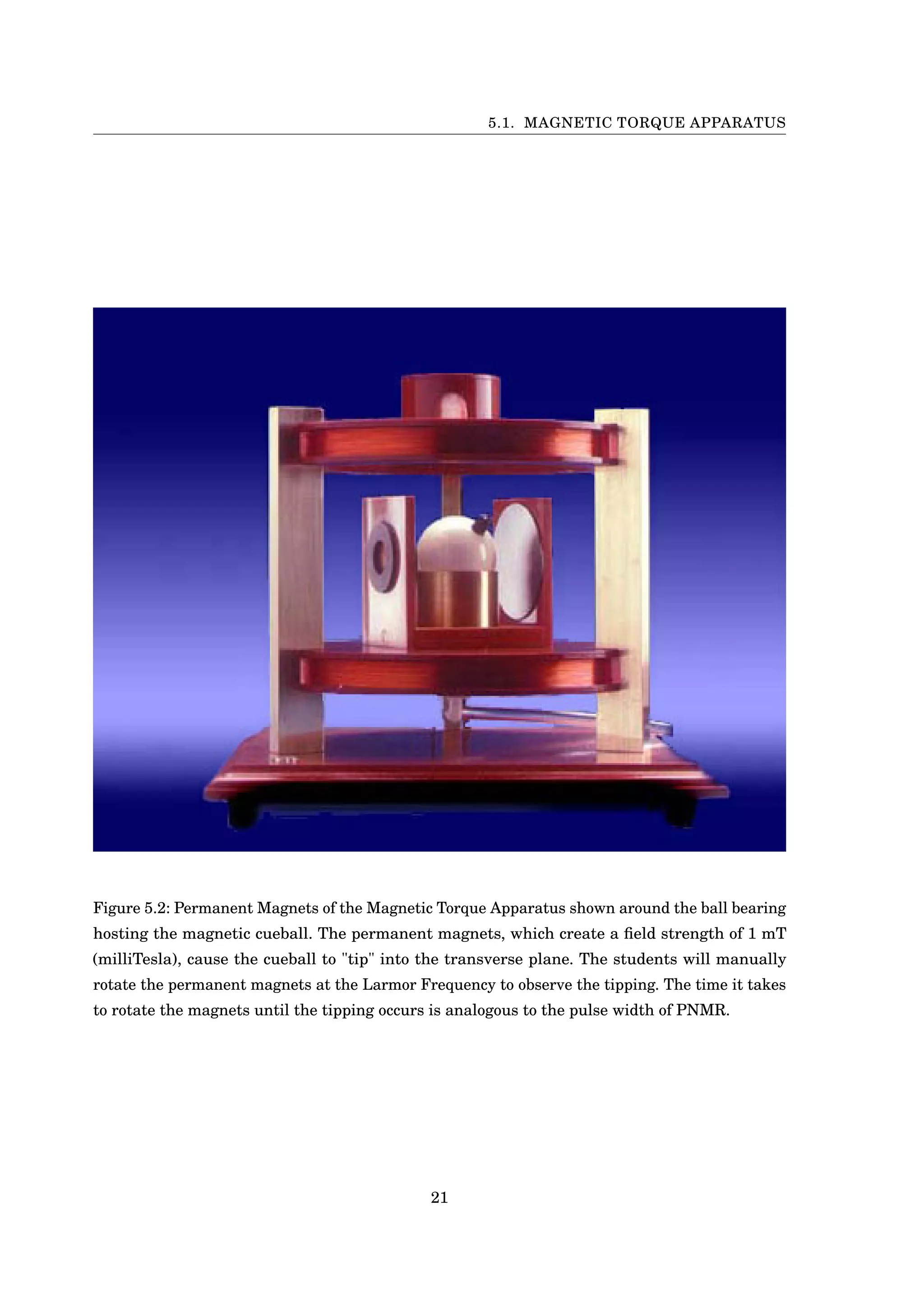
![CHAPTER 5. EQUIPMENT USED IN EXPERIMENT & THEIR RELATION TO THE MRI
PROCESS
the z-axis.
The permanent magnets, analogous to the RF pulse in actual MRI and PNMR, trick the
nucleus into falling into a moving frame of reference. This is why the cueball precesses around
the field of the permanent magnets when they are rotated at the Larmor Frequency.
Understanding the concepts of how magnetic fields induce τ on the cueball, how the nucleus
behaves when the spins are tipped, how the RF pulse causes the spins to tip (or flip in PNMR/MRI),
and how the incorporation of a rotating frame of reference can be useful in data collection will
give students a solid foundation to start working with the PNMR Spectrometer.
5.2 Pulsed Nuclear Magnetic Resonance Spectrometer
Although students will be unable to generate T1 and T2 gray-scale images using the PSI-A model
PNMR Spectrometer manufactured by Teach Spin, they’ll still be able to use the equipment
to pick up on T1 and T2 signals because PNMR and MRI both rely on the same fundamental
technology.
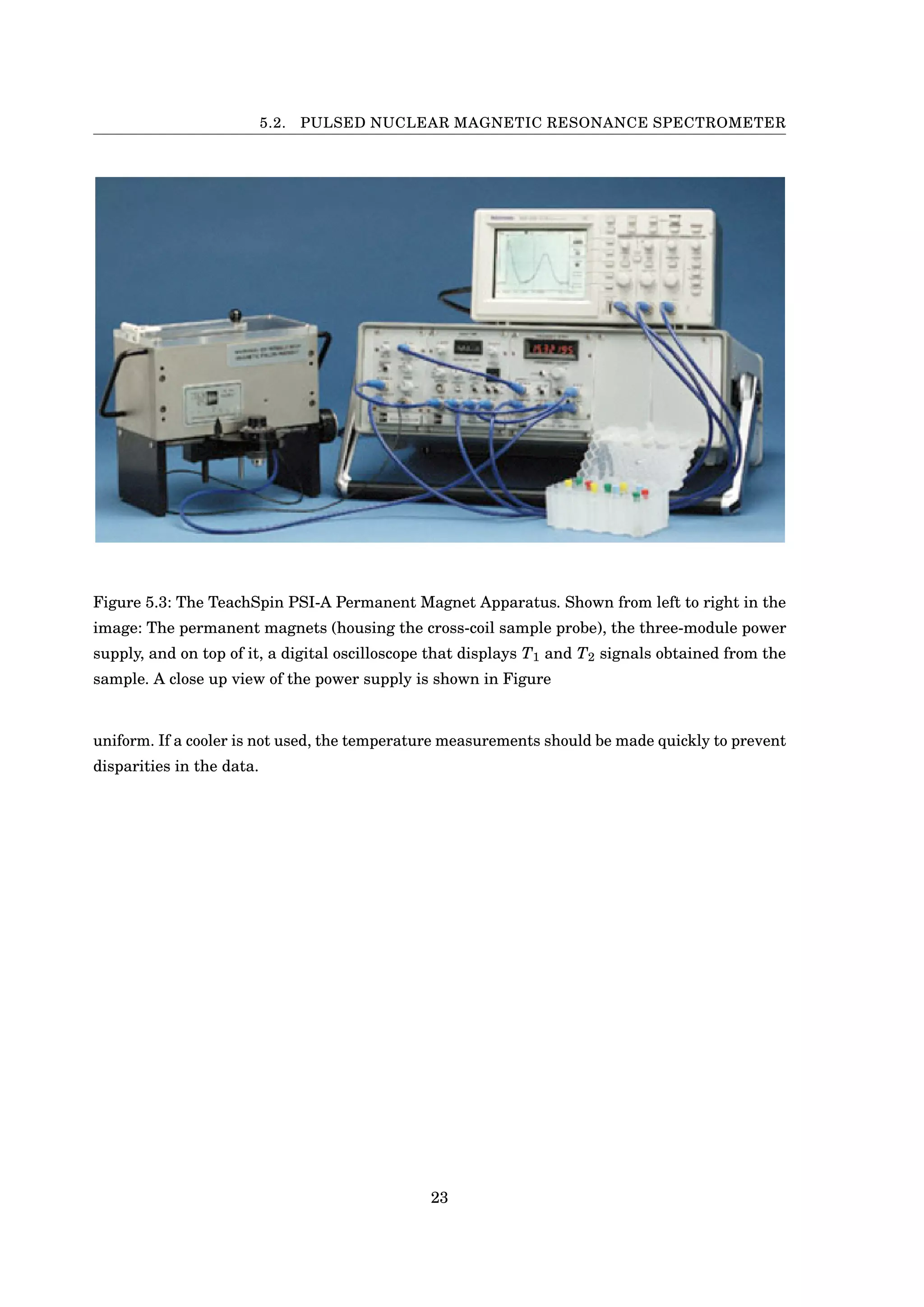
The Pulsed Nuclear Magnetic Resonance Spectrometer includes a permanent magnet, cross
coil sample probe, and three electronic modules that produce a signal shown on a digital oscillo-
scope. The setup is shown in Figure 5.2.
Quoted from Teach Spin’s conceptual introduction to the equipment:
The three electronic modules are a receiver, pulse programmer, and mixer. The
receiver amplifies the signal coming from the pickup coil, which measures transverse
magnetization. The mixer multiplies the RF signal from the transmitter coil with the
actual precession frequency of the protons as sensed by the pick up coil. This allows
the experimenter to see if they are the same. When the oscillator is properly tuned to
the resonant frequency, the signal output of the mixer should show no “beats." [7]
No beats refers to a Free Induction Decay Signal shown on the oscilloscope. The frequency
adjust tuning can then be used to match the frequency of the RF pulse to the nuclei’s precession
frequency. The precession frequency drifts because the temperature of the permanent magnet is
not absolutely constant. Any change in magnet temperature causes a change in B0 and thus in
the precession frequency."
The pulse programmer of the apparatus allows the student to implement their designed pulse
sequence with a series of A and B pulses. The pulse width of each pulse can be changed along
with the delay time between pulses. Repetition time allows the students to change how often the
pulse sequence is repeated.
As mentioned by Teach Spin’s conceptual introduction, the magnetic field is extremely tem-
perature dependent. The students will realize this as they complete a pre-requisite lab activity
that requires them to plot the magnetic field at various locations over a period of time. To remedy
this, a cooler can be placed around the permanent magnets so that the temperature remains
22](https://image.slidesharecdn.com/141e38c5-5ecc-49a6-9f46-f79a22f9d482-151216084346/75/Muraoka_FinalThesis-36-2048.jpg)







![APPENDIX
D
APPENDIX D: MRI TERMINOLOGY GLOSSARY
The documents are included as screenshots of a PDF format because incorporating them into this
Latex document made the file size too large to compile. Page breaks correspond to page breaks in
the lab, not in the design of the thesis. This document was found online, on MIT’s website. [4]
33](https://image.slidesharecdn.com/141e38c5-5ecc-49a6-9f46-f79a22f9d482-151216084346/75/Muraoka_FinalThesis-47-2048.jpg)

![BIBLIOGRAPHY
[1] E. L. HAHN, Free nuclear induction, Physics Today, (1953), p. 8.
[2] R. V. D. J. STOLTENBERG, D. PENGRA AND O. VILCHES, Pulsed Nuclear Magnetic Resonance,
PhD thesis, Rutgers, feb 2006.
[3] J. B. J. SWAIN, K. BUSH, Diagnostic Imaging for Physical Therapists, Saunders Elsevier.
[4] R. S. . J. JOVICICH, Mri glossary.
Obtained from Massachusetts Institute of Technology, Fall 2011.
[5] C. WESTBROOK, MRI at a Glance, Wiley Blackwell, 2010.
[6] T. A. WILKINSON, Mri latex table.
http://tinkertailorsoldiersponge.com/tag/mri/, jul 2003.
[7] B. WOLFF-REICHERT, Conceptual tour of pnmr.
Instruction Manual From Teach Spin, mar 2003.
35](https://image.slidesharecdn.com/141e38c5-5ecc-49a6-9f46-f79a22f9d482-151216084346/75/Muraoka_FinalThesis-49-2048.jpg)


