
Topology Independent LFA
Orange use case & applicability
Stéphane Litkowski, Orange Expert
Bruno Decraene, Orange Expert
MPLS 2014
2 TI-LFA
Orange Business Service
MPLS 2014
One of the largest dedicated network for business
•Worldwide :
• 172 countries, 900+ cities
•France :
• more than 2 million business clients, SMBs and
companies in France
IP VPN
Ethernet
Internet
Cloud
Voice & Telepresence
High value: availability,
security, SLA
3 TI-LFA MPLS 2014
Agenda
 Requirements
 Topology Independent LFA
 Applicability on Orange topologies
 Simulation results
4 TI-LFA MPLS 2014
Agenda
 Requirements
 Topology Independent LFA
 Applicability on Orange topologies
 Simulation results
5 TI-LFA MPLS 2014
Why using Fast Reroute ?
 Fast convergence is below 1sec BUT:
– hard to have the same performance on all nodes
– hard to maintain convergence time while network is growing
 Applications are more and more sensitive (VoIP, CRM, Sync, transport)
 Customers do not want to rewrite or customize their applications code
to handle network failures 
6 TI-LFA
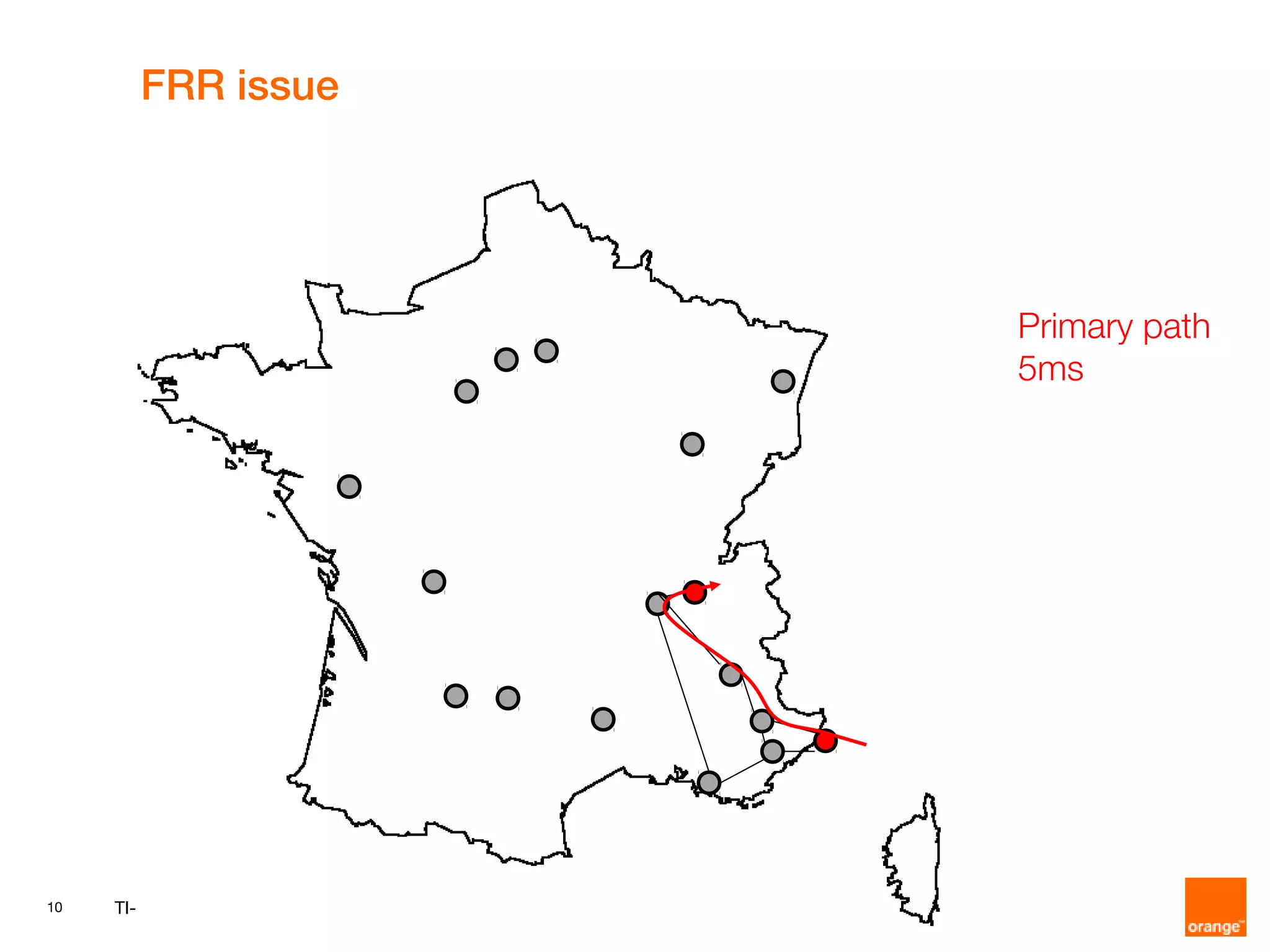
FRR issue
MPLS 2014MPLS 2014MPLS 2014
7 TI-LFA
FRR issue Primary path
MPLS 2014MPLS 2014MPLS 2014
South
East
5ms
8 TI-LFA
FRR issue Primary path Backup path
MPLS 2014MPLS 2014MPLS 2014
South
East
8ms
9 TI-LFA MPLS 2014
FRR issue
MPLS 2014MPLS 2014
10 TI-LFA MPLS 2014
FRR issue
MPLS 2014MPLS 2014
Primary path
5ms
11 TI-LFA MPLS 2014
FRR issue
MPLS 2014MPLS 2014
12 TI-LFA MPLS 2014
FRR issue
MPLS 2014MPLS 2014
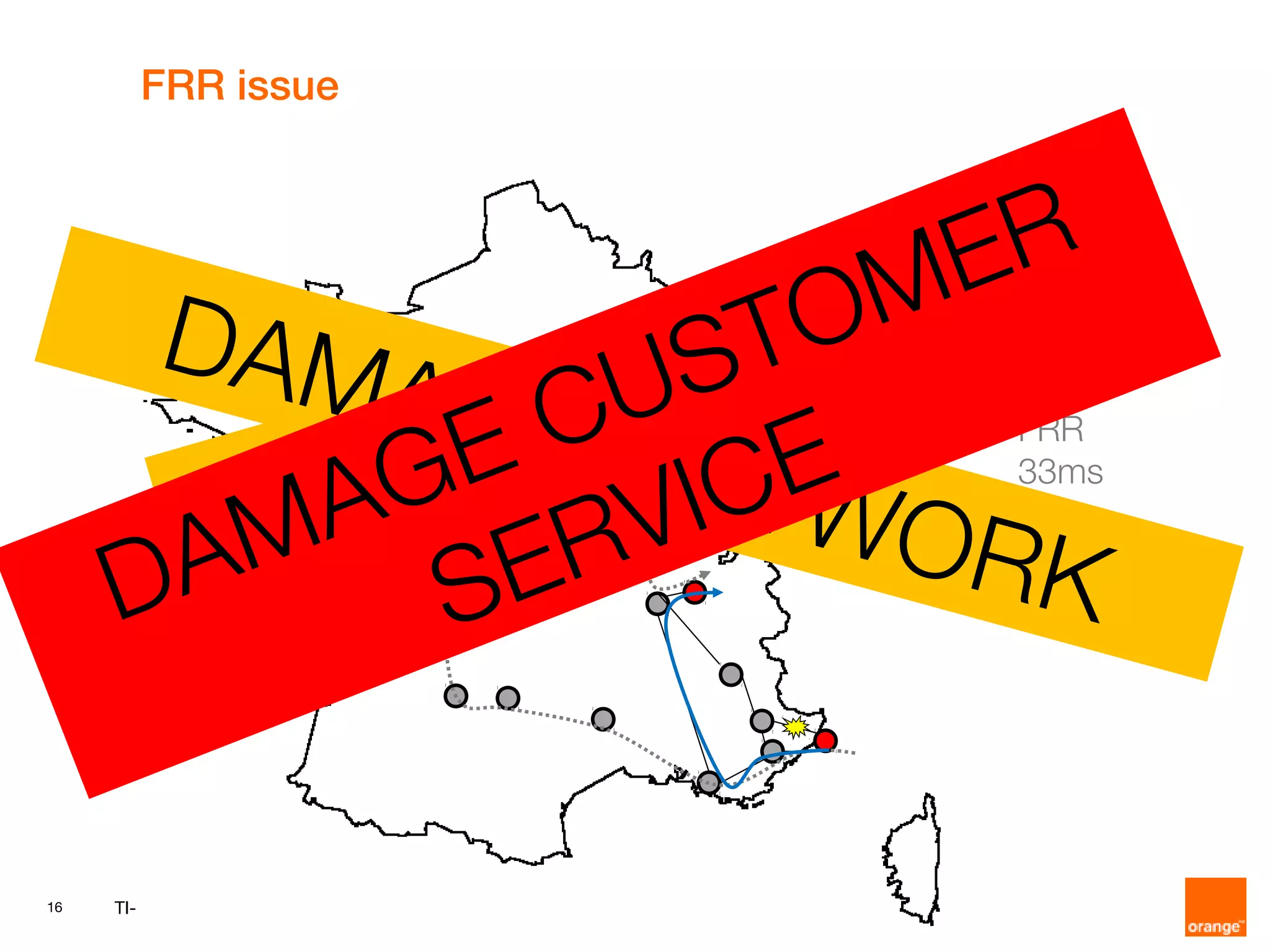
FRR
33ms
13 TI-LFA
Backup
8ms
MPLS 2014
FRR issue
MPLS 2014MPLS 2014
FRR
33ms
14 TI-LFA
Backup
8ms
MPLS 2014
FRR issue
MPLS 2014MPLS 2014
FRR
33ms
COMPLETELY
UNOPTIMAL !!!!
15 TI-LFA
Backup
8ms
MPLS 2014
FRR issue
MPLS 2014MPLS 2014
FRR
33ms
COMPLETELY
UNOPTIMAL !!!!
DAMAGE NETWORK
16 TI-LFA
Backup
8ms
MPLS 2014
FRR issue
MPLS 2014MPLS 2014
FRR
33ms
COMPLETELY
UNOPTIMAL !!!!
DAMAGE NETWORKDAMAGE CUSTOMER
SERVICE
17 TI-LFA
Backup
8ms
MPLS 2014
FRR issue
MPLS 2014MPLS 2014
FRR
33ms
COMPLETELY
UNOPTIMAL !!!!
DAMAGE NETWORKDAMAGE CUSTOMER
SERVICEFRR
18 TI-LFA MPLS 2014
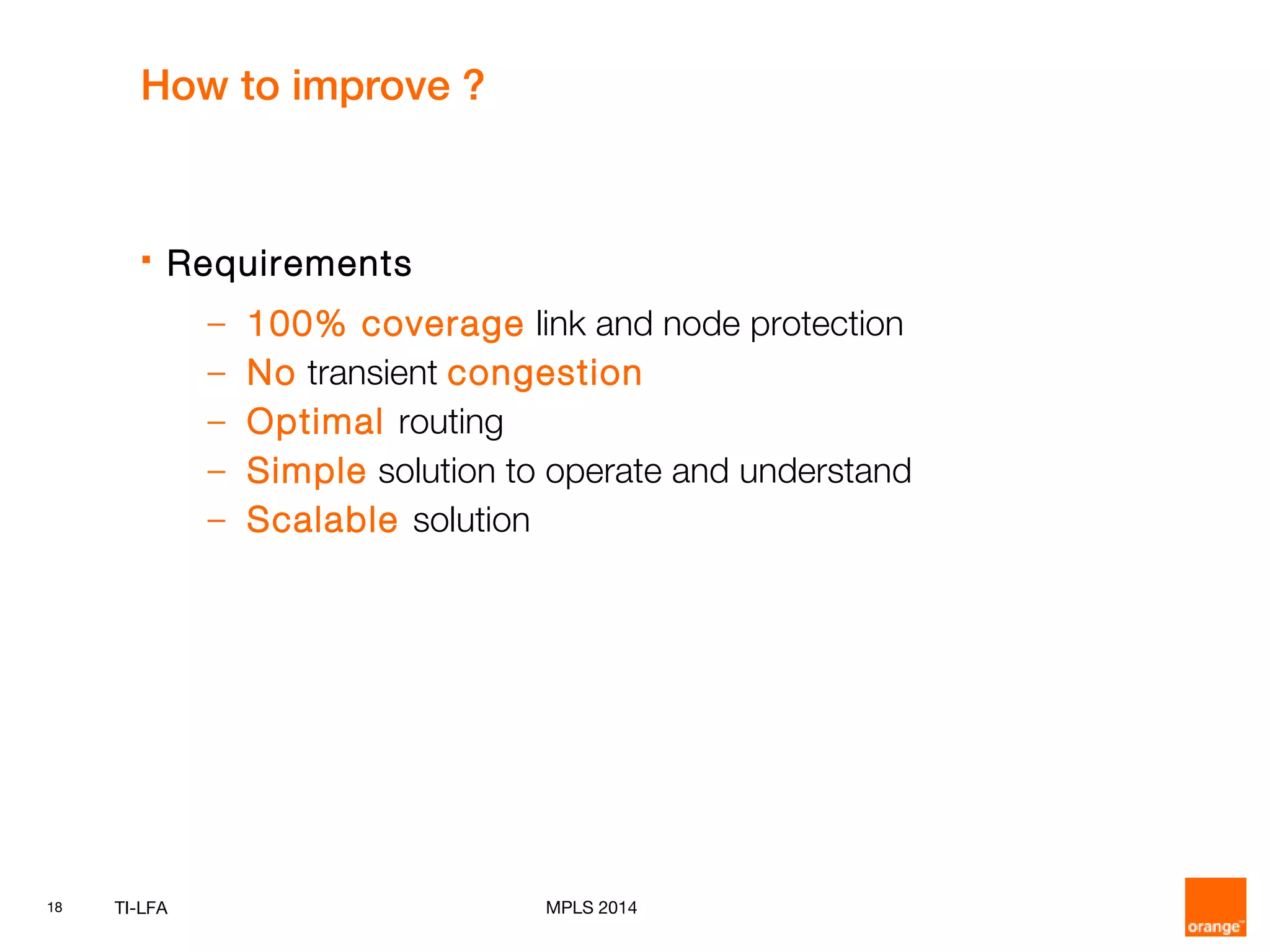
How to improve ?
 Requirements
– 100% coverage link and node protection
– No transient congestion
– Optimal routing
– Simple solution to operate and understand
– Scalable solution
19 TI-LFA MPLS 2014
 What is the more optimal and natural path upon a failure ?
 Post-convergence path from the PLR
 Benefits of using Postconvergence path :
– Policy compliant and optimized
– Well sized
– Well known
D
S Potential backup
Path
Postconvergence
Path
How to use Post-convergence path for
FRR ?
How to improve ?
20 TI-LFA
Agenda
 Requirements
 Topology Independent LFA
 Applicability on Orange topologies
 Simulation results
21 TI-LFA
 Providing 100% coverage (node/link/SRLG)
 Segment Routing Fast-Reroute solution
– SR allows to use « unlimited » number of paths
 encoding any FRR path by using Segment Routing blocks :
– any Service Provider policy (LFA policy framework)
– including post-convergence path as new criteria
 Primary traffic does not require to be SR :
– IP or LDP can be protected by SR
MPLS 2014
Topology Independent LFA
22 TI-LFA MPLS 2014
Topology Independent LFA
 Cannot use a strict only Explicit Path due to depth of segment
stack
 We need to compress the stack
 Done by reusing rLFA/dLFA building blocks (P & Q space)
S R1 R2 R3 D
R4 R5 R6
MPLS MPLS MPLS MPLS
2
MPLS
AdjR5
AdjR6
AdjR3
MPLS
AdjR6
AdjR3
MPLS
AdjR3
MPLS
Primary
TI-LFA
23 TI-LFA
MPLS 2014
Topology Independent LFA
 FRR path is computed as follows :
– Compute postconvergence shortest path (new SPF)
– Enforce loop-freeness by :
– finding a P node on the path
– finding a Q node on the path after P (P and Q may be equal)
– Only P to Q path would be explicit and may be additionnaly
compressed using nodal segments
S R1 R2 R3 D
R4 R5 R6
MPLS MPLS
2
MPLS
NodeR5
MPLS
NodeR5
MPLS
MPLS
PQ
S R1 R2 R3 D
R4 R5 R6
MPLS MPLS
2
MPLS
NodeR5
MPLS MPLS
MPLS
P
50
Q
AdjR6
NodeR5
AdjR6 AdjR6
24 TI-LFA MPLS 2014
Agenda
 Requirements
 Topology Independent LFA
 Applicability on Orange topologies
 Simulation results
25 TI-LFA
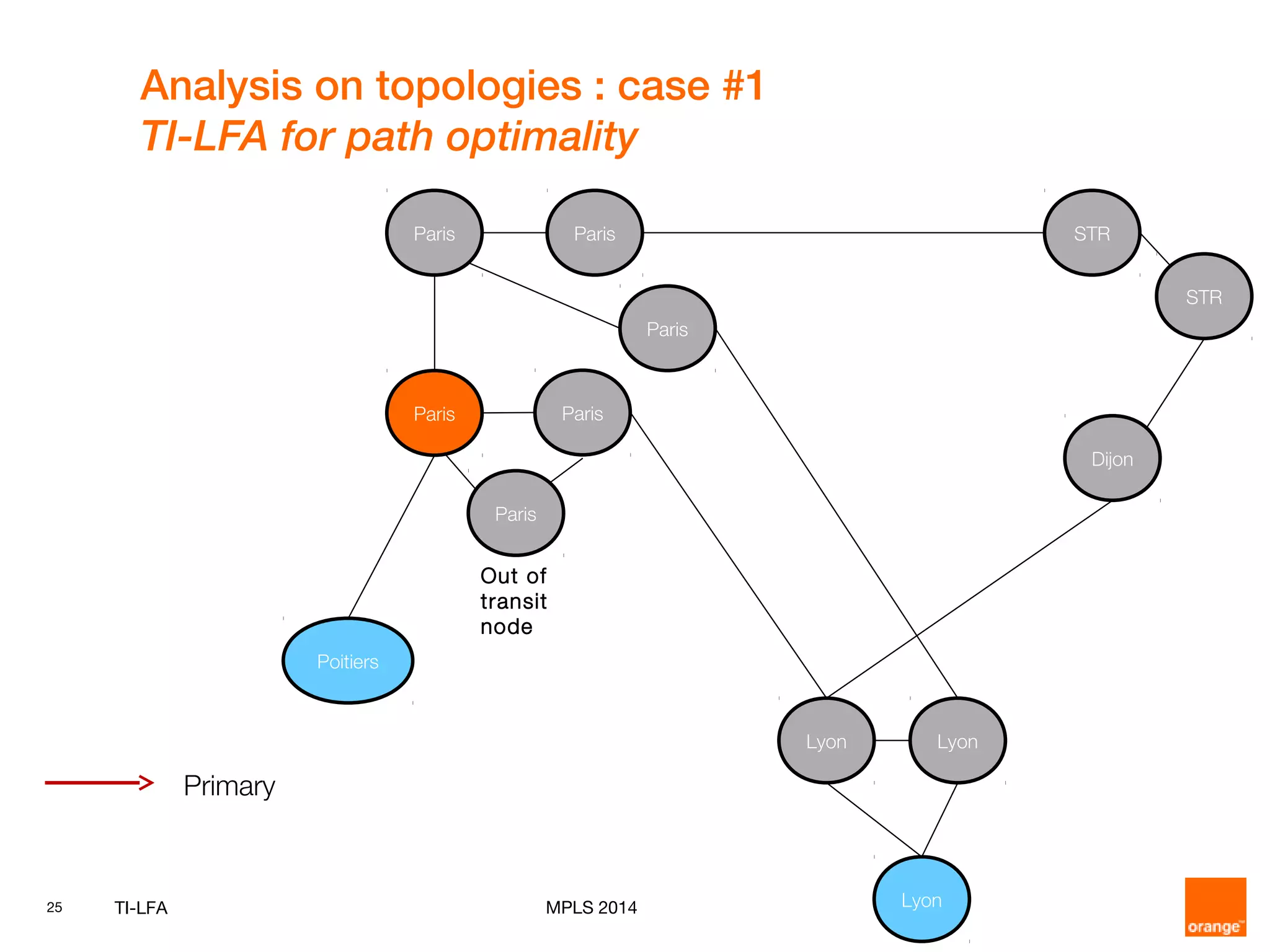
Analysis on topologies : case #1
TI-LFA for path optimality
Paris Paris
Paris Paris STR
STR
Dijon
Lyon
Lyon
Paris
Lyon
Poitiers
Primary
MPLS 2014
Paris
Out of
transit
node
26 TI-LFA
Analysis on topologies : case #1
TI-LFA for path optimality
Paris Paris
Paris Paris STR
STR
Dijon
Lyon
Lyon
Paris
Lyon
Poitiers
Primary
MPLS 2014
Paris
Out of
transit
node
27 TI-LFA
Analysis on topologies : case #1
TI-LFA for path optimality
Paris Paris
Paris Paris STR
STR
Dijon
Lyon
Lyon
Paris
Lyon
Poitiers
Primary
Backup
MPLS 2014
Paris
Out of
transit
node
28 TI-LFA MPLS 2014
Analysis on topologies : case #1
TI-LFA for path optimality
Paris Paris
Paris Paris STR
STR
Dijon
Lyon
Lyon
Paris
Lyon
Poitiers
FRR path
Paris
Out of
transit
node
29 TI-LFA MPLS 2014
Analysis on topologies : case #1
TI-LFA for path optimality
Paris Paris
Paris Paris STR
STR
Dijon
Lyon
Lyon
Paris
Lyon
Poitiers
MRT
FRR path
Paris
Out of
transit
node
30 TI-LFA MPLS 2014
Analysis on topologies : case #1
TI-LFA for path optimality
Paris Paris
Paris Paris STR
STR
Dijon
Lyon
Lyon
Paris
Lyon
Poitiers
MRT
FRR path
RSVP-TE link
protection (1:n)
Paris
Out of
transit
node
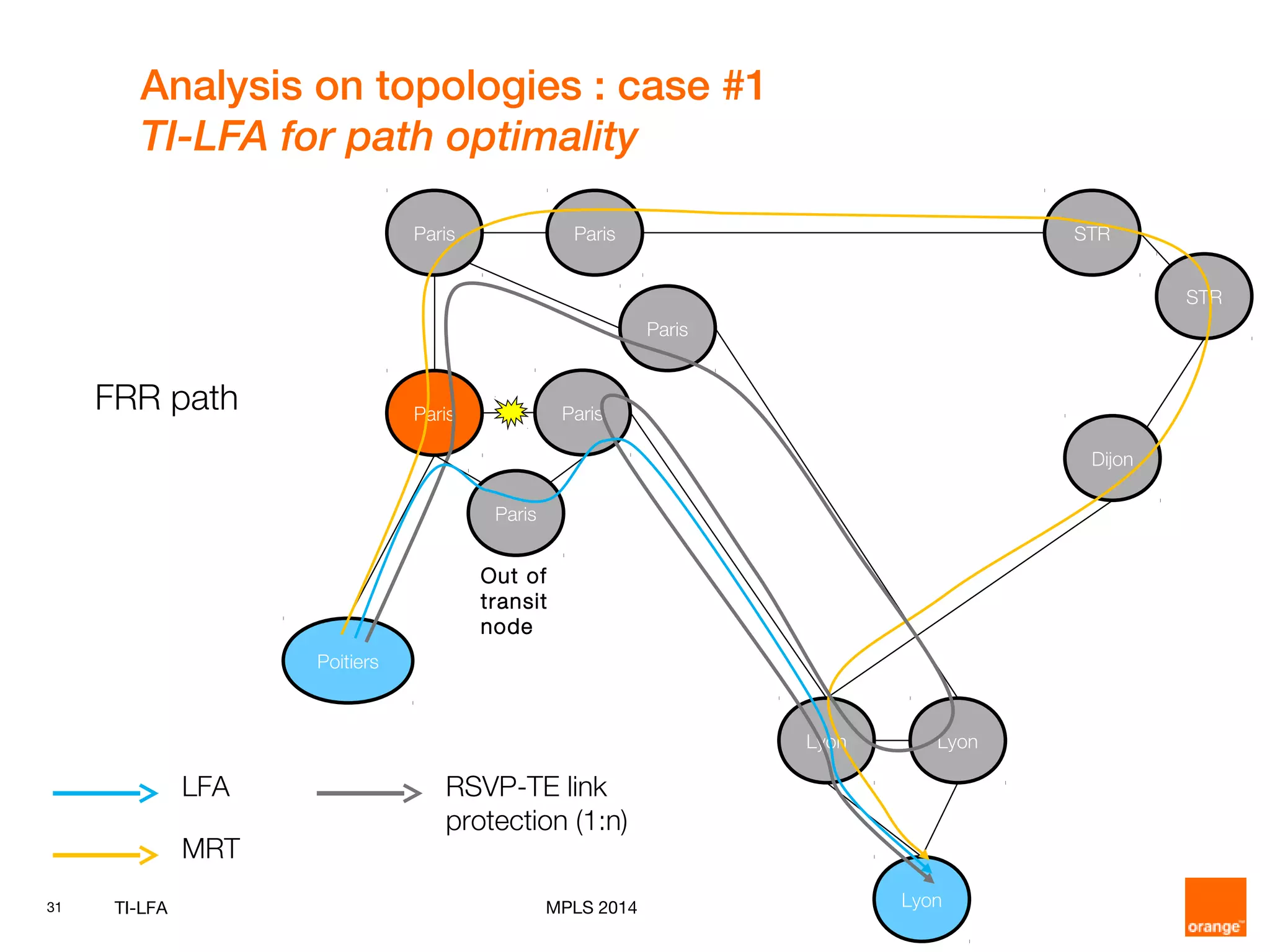
31 TI-LFA MPLS 2014
Analysis on topologies : case #1
TI-LFA for path optimality
Paris Paris
Paris Paris STR
STR
Dijon
Lyon
Lyon
Paris
Lyon
Poitiers
LFA
MRT
FRR path
RSVP-TE link
protection (1:n)
Paris
Out of
transit
node
32 TI-LFA
Analysis on topologies : case #1
TI-LFA for path optimality
Paris
1
Paris
2
Paris
3
Paris
5
STR
STR
Dijon
Lyon
Lyon
Paris
4
Lyon
Poitiers
EPC FRR
Nodal
EPC stack composed of one segment
Protection stack
Node_Paris
4
MPLS 2014
Paris
Out of
transit
node
33 TI-LFA MPLS 2014
Analysis on topologies : case #2
TI-LFA using multiple segments
PE1
R1
PE2
R2
R3
R4 R5
R6
R7
PE3
1
7
3
3
3
1
1 1
11
2
100 100
Primary
Backup
SR
Segments
34 TI-LFA MPLS 2014
Analysis on topologies : case #2
TI-LFA using multiple segments
PE1
R1
PE2
R2
R3
R4 R5
R6
R7
PE3
1
7
3
3
3
1
1 1
11
2
100 100
Primary
Backup
SR
Segments
35 TI-LFA MPLS 2014
Analysis on topologies : case #2
TI-LFA using multiple segments
PE1
R1
PE2
R2
R3
R4 R5
R6
R7
PE3
1
7
3
3
3
1
1 1
11
2
100 100
Primary
Backup
SR
Segments
36 TI-LFA MPLS 2014
Analysis on topologies : case #2
TI-LFA using multiple segments
PE1
R1
PE2
R2
R3
R4 R5
R6
R7
PE3
1
7
3
3
3
1
1 1
11
2
100 100
Primary
Backup
SR
Segments
P
Q
37 TI-LFA MPLS 2014
Analysis on topologies : case #2
TI-LFA using multiple segments
PE1
R1
PE2
R2
R3
R4 R5
R6
R7
PE3
1
7
3
3
3
1
1 1
11
2
100 100
Primary
Backup
SR
Segments
P
QProtection stack (PQ)
Adj_R3
Adj_R4
Adj_R6
Adj_R7
Adj_PE3
Top
Bottom
38 TI-LFA MPLS 2014
Analysis on topologies : case #2
TI-LFA using multiple segments
PE1
R1
PE2
R2
R3
R4 R5
R6
R7
PE3
1
7
3
3
3
1
1 1
11
2
100 100
Primary
Backup
SR
Segments
Protection stack
compressed
P
QProtection stack (PQ)
Adj_R3
Adj_R4
Adj_R6
Adj_R7
Adj_PE3
Top
Bottom
39 TI-LFA MPLS 2014
Analysis on topologies : case #2
TI-LFA using multiple segments
PE1
R1
PE2
R2
R3
R4 R5
R6
R7
PE3
1
7
3
3
3
1
1 1
11
2
100 100
Primary
Backup
SR
Segments
Protection stack
compressed
Node_R3
P
QProtection stack (PQ)
Adj_R3
Adj_R4
Adj_R6
Adj_R7
Adj_PE3
Top
Bottom
Top
Nodal to R3
Nodal to PE3
40 TI-LFA MPLS 2014
Analysis on topologies : case #2
TI-LFA using multiple segments
PE1
R1
PE2
R2
R3
R4 R5
R6
R7
PE3
1
7
3
3
3
1
1 1
11
2
100 100
Primary
Backup
SR
Segments
Nodal to PE3
Protection stack
compressed
Node_R3
Node_PE3
P
QProtection stack (PQ)
Adj_R3
Adj_R4
Adj_R6
Adj_R7
Adj_PE3
Top
Bottom
Top
Bottom
Nodal to R3
Nodal to PE3
41 TI-LFA MPLS 2014
Analysis on topologies : case #2
TI-LFA using multiple segments
PE1
R1
PE2
R2
R3
R4 R5
R6
R7
PE3
1
7
3
3
3
1
1 1
11
2
100 100
Primary
Backup
SR
Segments
Nodal to PE3
Protection stack
compressed
Node_R3
Node_PE3
P
QProtection stack (PQ)
Adj_R3
Adj_R4
Adj_R6
Adj_R7
Adj_PE3
Top
Bottom
Top
Bottom
Nodal to R3
Nodal to PE3
42 TI-LFA MPLS 2014
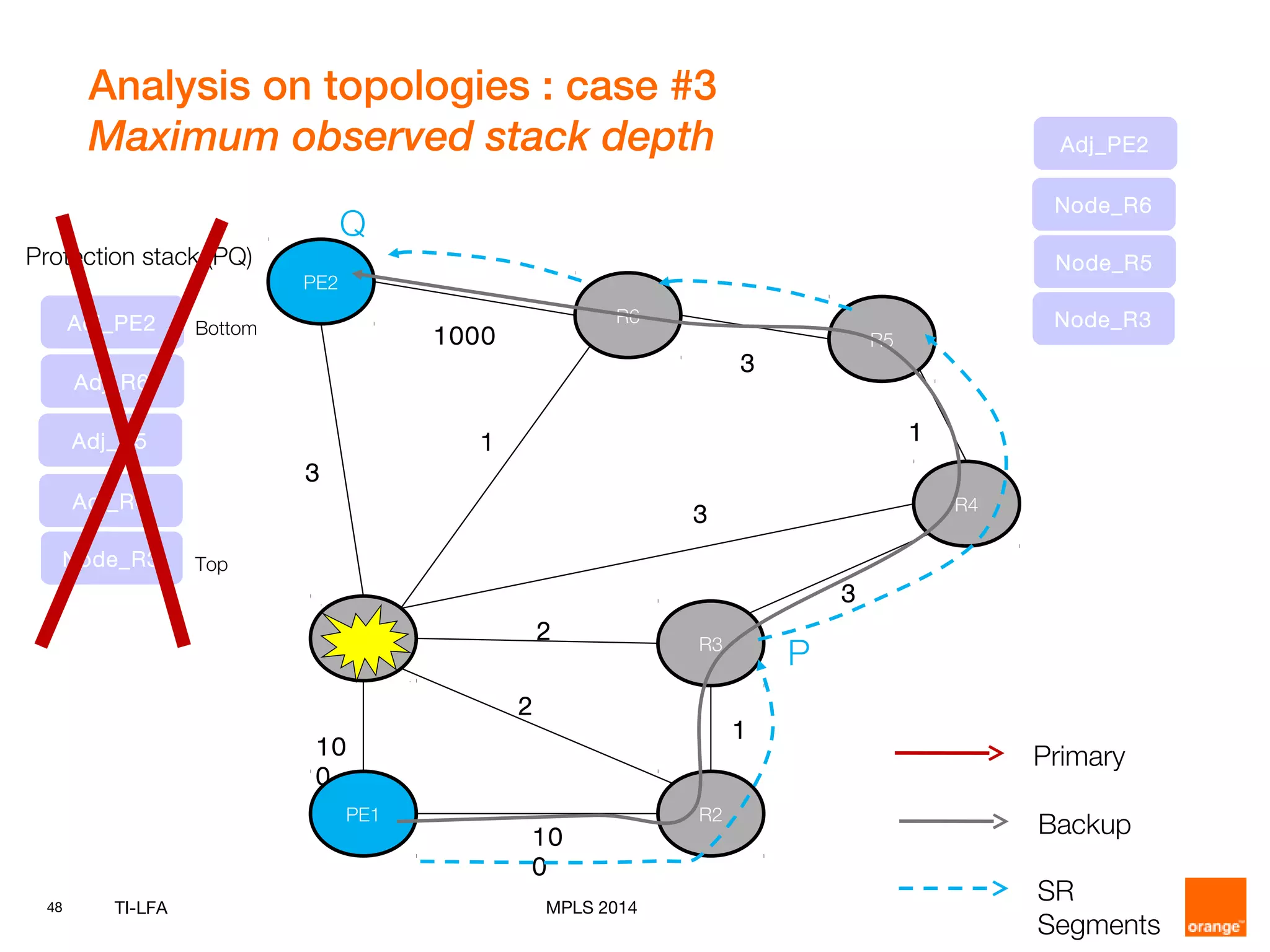
Analysis on topologies : case #3
Maximum observed stack depth
PE1
PE2
R1
R2
R3
R4
R5
R6
10
0
10
0
2
1
2
3
3
1
3
1
3
1000
Primary
Backup
SR
Segments
43 TI-LFA MPLS 2014
Analysis on topologies : case #3
Maximum observed stack depth
PE1
PE2
R1
R2
R3
R4
R5
R6
10
0
10
0
2
1
2
3
3
1
3
1
3
1000
Primary
Backup
SR
Segments
44 TI-LFA MPLS 2014
Analysis on topologies : case #3
Maximum observed stack depth
PE1
PE2
R1
R2
R3
R4
R5
R6
10
0
10
0
2
1
2
3
3
1
3
1
3
1000
P
Q
Protection stack (PQ)
Node_R3
Adj_R4
Adj_R5
Adj_R6
Adj_PE2
Primary
Backup
SR
Segments
Top
Bottom
45 TI-LFA MPLS 2014
Analysis on topologies : case #3
Maximum observed stack depth
PE1
PE2
R1
R2
R3
R4
R5
R6
10
0
10
0
2
1
2
3
3
1
3
1
3
1000
P
Q
Protection stack (PQ)
Node_R3
Adj_R4
Adj_R5
Adj_R6
Adj_PE2 Node_R3
Primary
Backup
SR
Segments
Top
Bottom
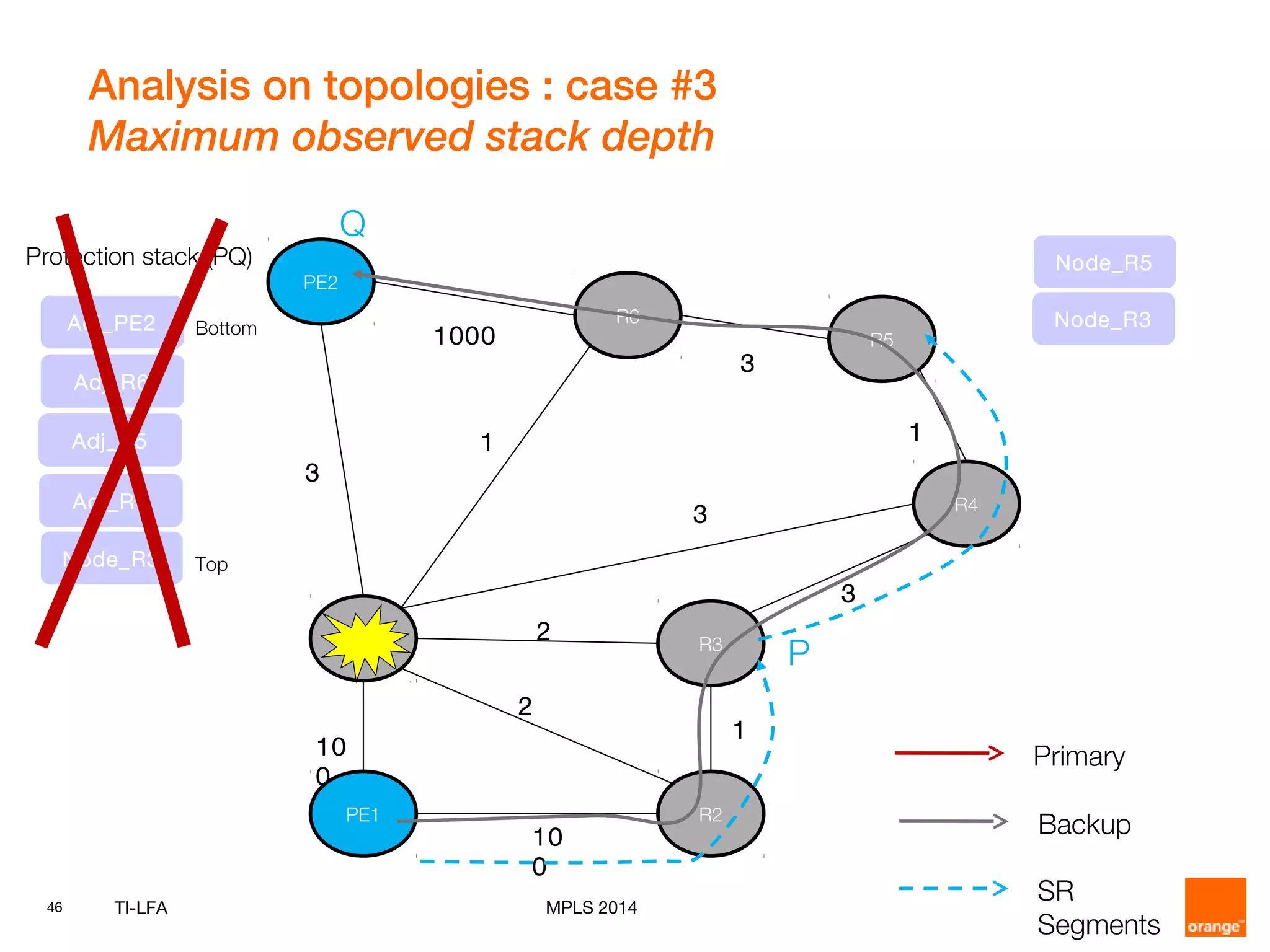
46 TI-LFA MPLS 2014
Analysis on topologies : case #3
Maximum observed stack depth
PE1
PE2
R1
R2
R3
R4
R5
R6
10
0
10
0
2
1
2
3
3
1
3
1
3
1000
P
Q
Protection stack (PQ)
Node_R3
Adj_R4
Adj_R5
Adj_R6
Adj_PE2
Node_R5
Node_R3
Primary
Backup
SR
Segments
Top
Bottom
47 TI-LFA MPLS 2014
Analysis on topologies : case #3
Maximum observed stack depth
PE1
PE2
R1
R2
R3
R4
R5
R6
10
0
10
0
2
1
2
3
3
1
3
1
3
1000
P
Q
Protection stack (PQ)
Node_R3
Adj_R4
Adj_R5
Adj_R6
Adj_PE2
Node_R5
Node_R6
Node_R3
Primary
Backup
SR
Segments
Top
Bottom
48 TI-LFA MPLS 2014
Analysis on topologies : case #3
Maximum observed stack depth
PE1
PE2
R1
R2
R3
R4
R5
R6
10
0
10
0
2
1
2
3
3
1
3
1
3
1000
P
Q
Protection stack (PQ)
Node_R3
Adj_R4
Adj_R5
Adj_R6
Adj_PE2
Node_R5
Node_R6
Node_R3
Adj_PE2
Primary
Backup
SR
Segments
Top
Bottom
49 TI-LFA MPLS 2014
Analysis on topologies : case #3
Maximum observed stack depth
PE1
PE2
R1
R2
R3
R4
R5
R6
10
0
10
0
2
1
2
3
3
1
3
1
3
1000
P
Q
Protection stack (PQ)
Node_R3
Adj_R4
Adj_R5
Adj_R6
Adj_PE2
Protection stack
compressed
Node_R5
Node_R6
Node_R3
Adj_PE2
Primary
Backup
SR
Segments
Top
Bottom Top
Bottom
50 TI-LFA MPLS 2014
Agenda
 Requirements
 Topology Independent LFA
 Applicability on Orange topologies
 Simulation results
51 TI-LFA MPLS 2014
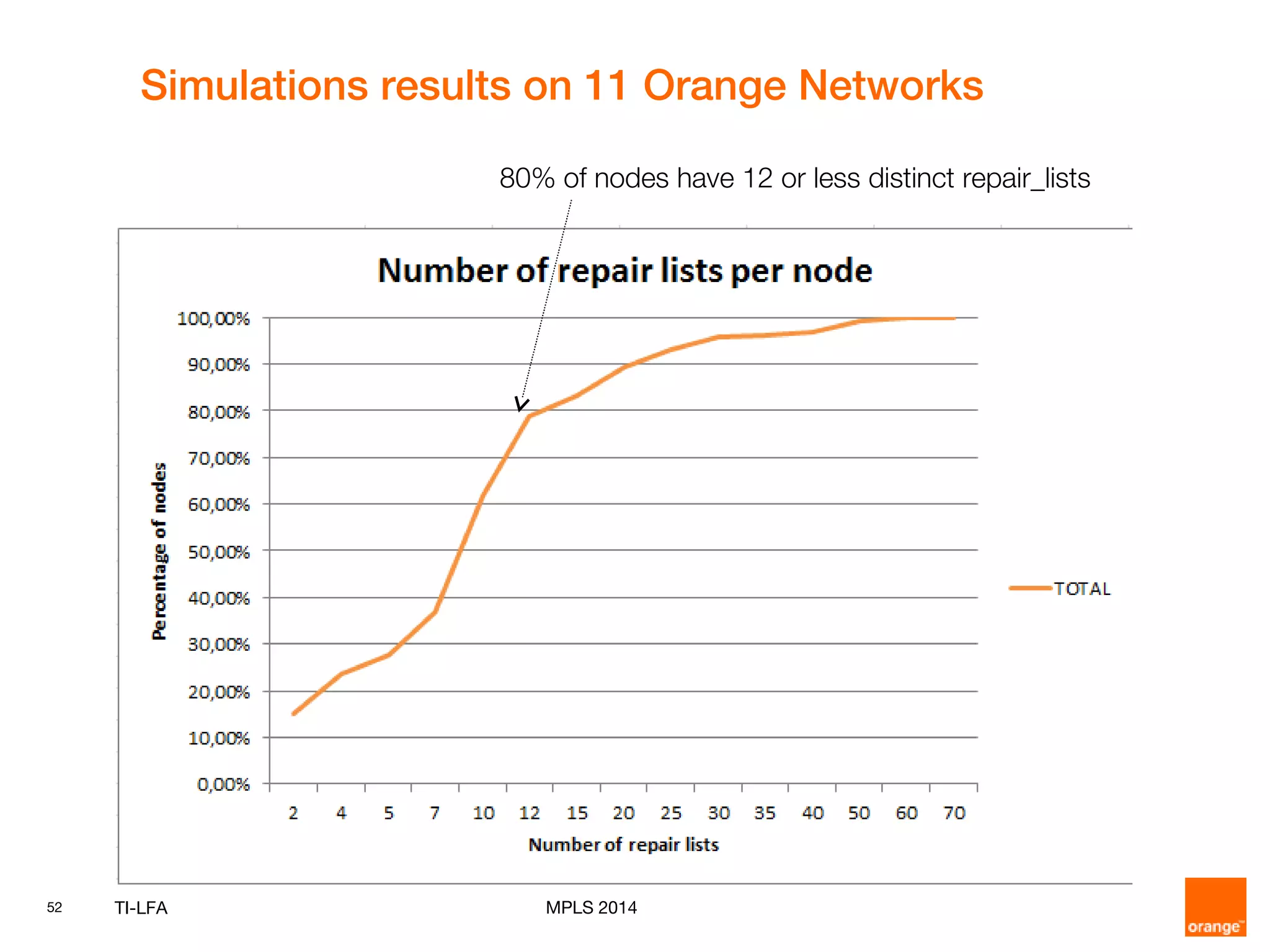
Simulations results on 11 Orange Networks
Depth of protection stack
11 topologies have been
analyzed including multiple
network types and size
52 TI-LFA
Simulations results on 11 Orange Networks
MPLS 2014
80% of nodes have 12 or less distinct repair_lists
53 TI-LFA
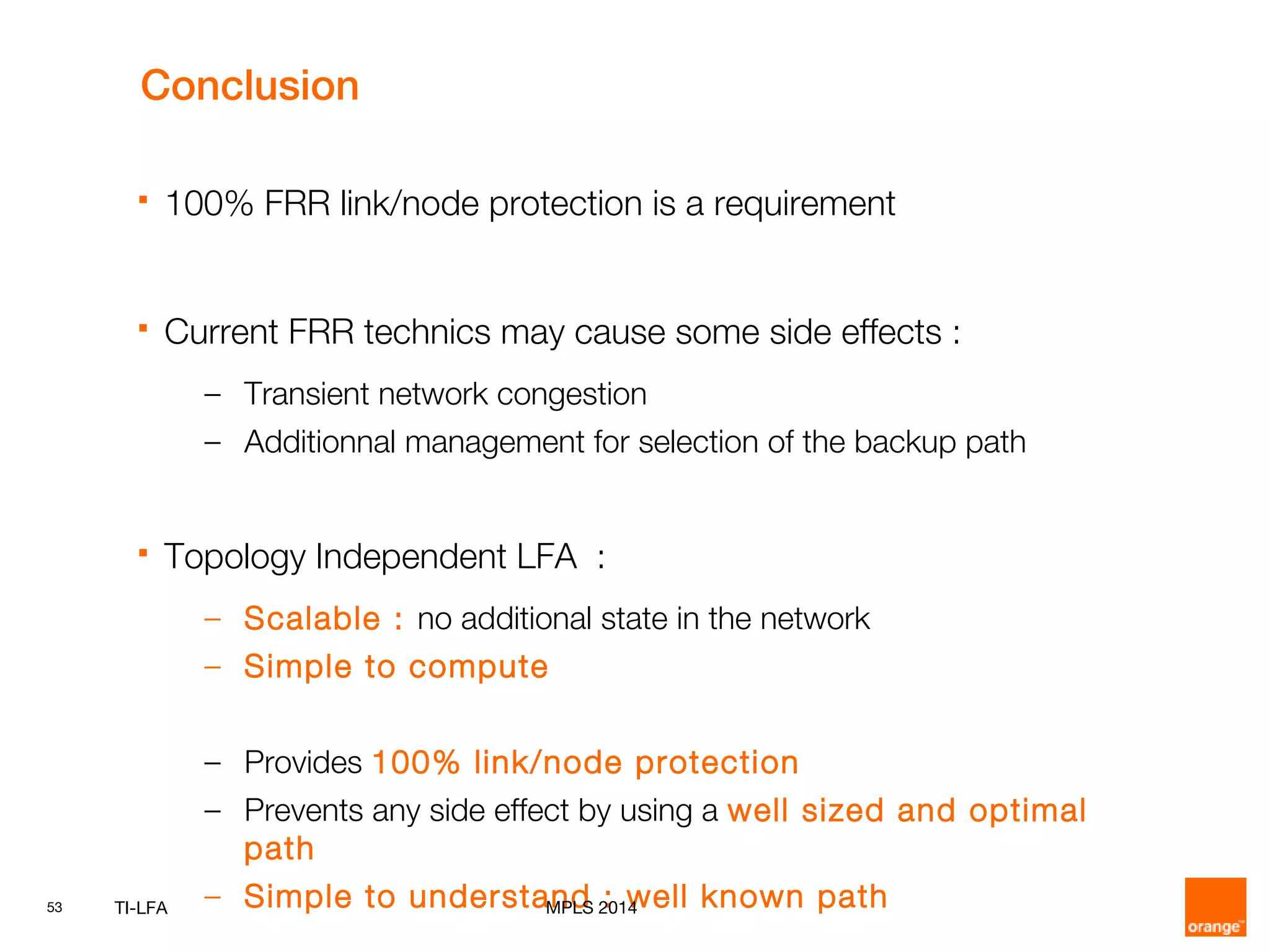
 100% FRR link/node protection is a requirement
 Current FRR technics may cause some side effects :
– Transient network congestion
– Additionnal management for selection of the backup path
 Topology Independent LFA :
– Scalable : no additional state in the network
– Simple to compute
– Provides 100% link/node protection
– Prevents any side effect by using a well sized and optimal
path
– Simple to understand : well known pathMPLS 2014
Conclusion
Thank you !

MPLS SDN 2014 - Topology independant LFA

  • 1.
    Topology Independent LFA Orangeuse case & applicability Stéphane Litkowski, Orange Expert Bruno Decraene, Orange Expert MPLS 2014
  • 2.
    2 TI-LFA Orange BusinessService MPLS 2014 One of the largest dedicated network for business •Worldwide : • 172 countries, 900+ cities •France : • more than 2 million business clients, SMBs and companies in France IP VPN Ethernet Internet Cloud Voice & Telepresence High value: availability, security, SLA
  • 3.
    3 TI-LFA MPLS2014 Agenda  Requirements  Topology Independent LFA  Applicability on Orange topologies  Simulation results
  • 4.
    4 TI-LFA MPLS2014 Agenda  Requirements  Topology Independent LFA  Applicability on Orange topologies  Simulation results
  • 5.
    5 TI-LFA MPLS2014 Why using Fast Reroute ?  Fast convergence is below 1sec BUT: – hard to have the same performance on all nodes – hard to maintain convergence time while network is growing  Applications are more and more sensitive (VoIP, CRM, Sync, transport)  Customers do not want to rewrite or customize their applications code to handle network failures 
  • 6.
    6 TI-LFA FRR issue MPLS2014MPLS 2014MPLS 2014
  • 7.
    7 TI-LFA FRR issuePrimary path MPLS 2014MPLS 2014MPLS 2014 South East 5ms
  • 8.
    8 TI-LFA FRR issuePrimary path Backup path MPLS 2014MPLS 2014MPLS 2014 South East 8ms
  • 9.
    9 TI-LFA MPLS2014 FRR issue MPLS 2014MPLS 2014
  • 10.
    10 TI-LFA MPLS2014 FRR issue MPLS 2014MPLS 2014 Primary path 5ms
  • 11.
    11 TI-LFA MPLS2014 FRR issue MPLS 2014MPLS 2014
  • 12.
    12 TI-LFA MPLS2014 FRR issue MPLS 2014MPLS 2014 FRR 33ms
  • 13.
    13 TI-LFA Backup 8ms MPLS 2014 FRRissue MPLS 2014MPLS 2014 FRR 33ms
  • 14.
    14 TI-LFA Backup 8ms MPLS 2014 FRRissue MPLS 2014MPLS 2014 FRR 33ms COMPLETELY UNOPTIMAL !!!!
  • 15.
    15 TI-LFA Backup 8ms MPLS 2014 FRRissue MPLS 2014MPLS 2014 FRR 33ms COMPLETELY UNOPTIMAL !!!! DAMAGE NETWORK
  • 16.
    16 TI-LFA Backup 8ms MPLS 2014 FRRissue MPLS 2014MPLS 2014 FRR 33ms COMPLETELY UNOPTIMAL !!!! DAMAGE NETWORKDAMAGE CUSTOMER SERVICE
  • 17.
    17 TI-LFA Backup 8ms MPLS 2014 FRRissue MPLS 2014MPLS 2014 FRR 33ms COMPLETELY UNOPTIMAL !!!! DAMAGE NETWORKDAMAGE CUSTOMER SERVICEFRR
  • 18.
    18 TI-LFA MPLS2014 How to improve ?  Requirements – 100% coverage link and node protection – No transient congestion – Optimal routing – Simple solution to operate and understand – Scalable solution
  • 19.
    19 TI-LFA MPLS2014  What is the more optimal and natural path upon a failure ?  Post-convergence path from the PLR  Benefits of using Postconvergence path : – Policy compliant and optimized – Well sized – Well known D S Potential backup Path Postconvergence Path How to use Post-convergence path for FRR ? How to improve ?
  • 20.
    20 TI-LFA Agenda  Requirements Topology Independent LFA  Applicability on Orange topologies  Simulation results
  • 21.
    21 TI-LFA  Providing100% coverage (node/link/SRLG)  Segment Routing Fast-Reroute solution – SR allows to use « unlimited » number of paths  encoding any FRR path by using Segment Routing blocks : – any Service Provider policy (LFA policy framework) – including post-convergence path as new criteria  Primary traffic does not require to be SR : – IP or LDP can be protected by SR MPLS 2014 Topology Independent LFA
  • 22.
    22 TI-LFA MPLS2014 Topology Independent LFA  Cannot use a strict only Explicit Path due to depth of segment stack  We need to compress the stack  Done by reusing rLFA/dLFA building blocks (P & Q space) S R1 R2 R3 D R4 R5 R6 MPLS MPLS MPLS MPLS 2 MPLS AdjR5 AdjR6 AdjR3 MPLS AdjR6 AdjR3 MPLS AdjR3 MPLS Primary TI-LFA
  • 23.
    23 TI-LFA MPLS 2014 TopologyIndependent LFA  FRR path is computed as follows : – Compute postconvergence shortest path (new SPF) – Enforce loop-freeness by : – finding a P node on the path – finding a Q node on the path after P (P and Q may be equal) – Only P to Q path would be explicit and may be additionnaly compressed using nodal segments S R1 R2 R3 D R4 R5 R6 MPLS MPLS 2 MPLS NodeR5 MPLS NodeR5 MPLS MPLS PQ S R1 R2 R3 D R4 R5 R6 MPLS MPLS 2 MPLS NodeR5 MPLS MPLS MPLS P 50 Q AdjR6 NodeR5 AdjR6 AdjR6
  • 24.
    24 TI-LFA MPLS2014 Agenda  Requirements  Topology Independent LFA  Applicability on Orange topologies  Simulation results
  • 25.
    25 TI-LFA Analysis ontopologies : case #1 TI-LFA for path optimality Paris Paris Paris Paris STR STR Dijon Lyon Lyon Paris Lyon Poitiers Primary MPLS 2014 Paris Out of transit node
  • 26.
    26 TI-LFA Analysis ontopologies : case #1 TI-LFA for path optimality Paris Paris Paris Paris STR STR Dijon Lyon Lyon Paris Lyon Poitiers Primary MPLS 2014 Paris Out of transit node
  • 27.
    27 TI-LFA Analysis ontopologies : case #1 TI-LFA for path optimality Paris Paris Paris Paris STR STR Dijon Lyon Lyon Paris Lyon Poitiers Primary Backup MPLS 2014 Paris Out of transit node
  • 28.
    28 TI-LFA MPLS2014 Analysis on topologies : case #1 TI-LFA for path optimality Paris Paris Paris Paris STR STR Dijon Lyon Lyon Paris Lyon Poitiers FRR path Paris Out of transit node
  • 29.
    29 TI-LFA MPLS2014 Analysis on topologies : case #1 TI-LFA for path optimality Paris Paris Paris Paris STR STR Dijon Lyon Lyon Paris Lyon Poitiers MRT FRR path Paris Out of transit node
  • 30.
    30 TI-LFA MPLS2014 Analysis on topologies : case #1 TI-LFA for path optimality Paris Paris Paris Paris STR STR Dijon Lyon Lyon Paris Lyon Poitiers MRT FRR path RSVP-TE link protection (1:n) Paris Out of transit node
  • 31.
    31 TI-LFA MPLS2014 Analysis on topologies : case #1 TI-LFA for path optimality Paris Paris Paris Paris STR STR Dijon Lyon Lyon Paris Lyon Poitiers LFA MRT FRR path RSVP-TE link protection (1:n) Paris Out of transit node
  • 32.
    32 TI-LFA Analysis ontopologies : case #1 TI-LFA for path optimality Paris 1 Paris 2 Paris 3 Paris 5 STR STR Dijon Lyon Lyon Paris 4 Lyon Poitiers EPC FRR Nodal EPC stack composed of one segment Protection stack Node_Paris 4 MPLS 2014 Paris Out of transit node
  • 33.
    33 TI-LFA MPLS2014 Analysis on topologies : case #2 TI-LFA using multiple segments PE1 R1 PE2 R2 R3 R4 R5 R6 R7 PE3 1 7 3 3 3 1 1 1 11 2 100 100 Primary Backup SR Segments
  • 34.
    34 TI-LFA MPLS2014 Analysis on topologies : case #2 TI-LFA using multiple segments PE1 R1 PE2 R2 R3 R4 R5 R6 R7 PE3 1 7 3 3 3 1 1 1 11 2 100 100 Primary Backup SR Segments
  • 35.
    35 TI-LFA MPLS2014 Analysis on topologies : case #2 TI-LFA using multiple segments PE1 R1 PE2 R2 R3 R4 R5 R6 R7 PE3 1 7 3 3 3 1 1 1 11 2 100 100 Primary Backup SR Segments
  • 36.
    36 TI-LFA MPLS2014 Analysis on topologies : case #2 TI-LFA using multiple segments PE1 R1 PE2 R2 R3 R4 R5 R6 R7 PE3 1 7 3 3 3 1 1 1 11 2 100 100 Primary Backup SR Segments P Q
  • 37.
    37 TI-LFA MPLS2014 Analysis on topologies : case #2 TI-LFA using multiple segments PE1 R1 PE2 R2 R3 R4 R5 R6 R7 PE3 1 7 3 3 3 1 1 1 11 2 100 100 Primary Backup SR Segments P QProtection stack (PQ) Adj_R3 Adj_R4 Adj_R6 Adj_R7 Adj_PE3 Top Bottom
  • 38.
    38 TI-LFA MPLS2014 Analysis on topologies : case #2 TI-LFA using multiple segments PE1 R1 PE2 R2 R3 R4 R5 R6 R7 PE3 1 7 3 3 3 1 1 1 11 2 100 100 Primary Backup SR Segments Protection stack compressed P QProtection stack (PQ) Adj_R3 Adj_R4 Adj_R6 Adj_R7 Adj_PE3 Top Bottom
  • 39.
    39 TI-LFA MPLS2014 Analysis on topologies : case #2 TI-LFA using multiple segments PE1 R1 PE2 R2 R3 R4 R5 R6 R7 PE3 1 7 3 3 3 1 1 1 11 2 100 100 Primary Backup SR Segments Protection stack compressed Node_R3 P QProtection stack (PQ) Adj_R3 Adj_R4 Adj_R6 Adj_R7 Adj_PE3 Top Bottom Top Nodal to R3 Nodal to PE3
  • 40.
    40 TI-LFA MPLS2014 Analysis on topologies : case #2 TI-LFA using multiple segments PE1 R1 PE2 R2 R3 R4 R5 R6 R7 PE3 1 7 3 3 3 1 1 1 11 2 100 100 Primary Backup SR Segments Nodal to PE3 Protection stack compressed Node_R3 Node_PE3 P QProtection stack (PQ) Adj_R3 Adj_R4 Adj_R6 Adj_R7 Adj_PE3 Top Bottom Top Bottom Nodal to R3 Nodal to PE3
  • 41.
    41 TI-LFA MPLS2014 Analysis on topologies : case #2 TI-LFA using multiple segments PE1 R1 PE2 R2 R3 R4 R5 R6 R7 PE3 1 7 3 3 3 1 1 1 11 2 100 100 Primary Backup SR Segments Nodal to PE3 Protection stack compressed Node_R3 Node_PE3 P QProtection stack (PQ) Adj_R3 Adj_R4 Adj_R6 Adj_R7 Adj_PE3 Top Bottom Top Bottom Nodal to R3 Nodal to PE3
  • 42.
    42 TI-LFA MPLS2014 Analysis on topologies : case #3 Maximum observed stack depth PE1 PE2 R1 R2 R3 R4 R5 R6 10 0 10 0 2 1 2 3 3 1 3 1 3 1000 Primary Backup SR Segments
  • 43.
    43 TI-LFA MPLS2014 Analysis on topologies : case #3 Maximum observed stack depth PE1 PE2 R1 R2 R3 R4 R5 R6 10 0 10 0 2 1 2 3 3 1 3 1 3 1000 Primary Backup SR Segments
  • 44.
    44 TI-LFA MPLS2014 Analysis on topologies : case #3 Maximum observed stack depth PE1 PE2 R1 R2 R3 R4 R5 R6 10 0 10 0 2 1 2 3 3 1 3 1 3 1000 P Q Protection stack (PQ) Node_R3 Adj_R4 Adj_R5 Adj_R6 Adj_PE2 Primary Backup SR Segments Top Bottom
  • 45.
    45 TI-LFA MPLS2014 Analysis on topologies : case #3 Maximum observed stack depth PE1 PE2 R1 R2 R3 R4 R5 R6 10 0 10 0 2 1 2 3 3 1 3 1 3 1000 P Q Protection stack (PQ) Node_R3 Adj_R4 Adj_R5 Adj_R6 Adj_PE2 Node_R3 Primary Backup SR Segments Top Bottom
  • 46.
    46 TI-LFA MPLS2014 Analysis on topologies : case #3 Maximum observed stack depth PE1 PE2 R1 R2 R3 R4 R5 R6 10 0 10 0 2 1 2 3 3 1 3 1 3 1000 P Q Protection stack (PQ) Node_R3 Adj_R4 Adj_R5 Adj_R6 Adj_PE2 Node_R5 Node_R3 Primary Backup SR Segments Top Bottom
  • 47.
    47 TI-LFA MPLS2014 Analysis on topologies : case #3 Maximum observed stack depth PE1 PE2 R1 R2 R3 R4 R5 R6 10 0 10 0 2 1 2 3 3 1 3 1 3 1000 P Q Protection stack (PQ) Node_R3 Adj_R4 Adj_R5 Adj_R6 Adj_PE2 Node_R5 Node_R6 Node_R3 Primary Backup SR Segments Top Bottom
  • 48.
    48 TI-LFA MPLS2014 Analysis on topologies : case #3 Maximum observed stack depth PE1 PE2 R1 R2 R3 R4 R5 R6 10 0 10 0 2 1 2 3 3 1 3 1 3 1000 P Q Protection stack (PQ) Node_R3 Adj_R4 Adj_R5 Adj_R6 Adj_PE2 Node_R5 Node_R6 Node_R3 Adj_PE2 Primary Backup SR Segments Top Bottom
  • 49.
    49 TI-LFA MPLS2014 Analysis on topologies : case #3 Maximum observed stack depth PE1 PE2 R1 R2 R3 R4 R5 R6 10 0 10 0 2 1 2 3 3 1 3 1 3 1000 P Q Protection stack (PQ) Node_R3 Adj_R4 Adj_R5 Adj_R6 Adj_PE2 Protection stack compressed Node_R5 Node_R6 Node_R3 Adj_PE2 Primary Backup SR Segments Top Bottom Top Bottom
  • 50.
    50 TI-LFA MPLS2014 Agenda  Requirements  Topology Independent LFA  Applicability on Orange topologies  Simulation results
  • 51.
    51 TI-LFA MPLS2014 Simulations results on 11 Orange Networks Depth of protection stack 11 topologies have been analyzed including multiple network types and size
  • 52.
    52 TI-LFA Simulations resultson 11 Orange Networks MPLS 2014 80% of nodes have 12 or less distinct repair_lists
  • 53.
    53 TI-LFA  100%FRR link/node protection is a requirement  Current FRR technics may cause some side effects : – Transient network congestion – Additionnal management for selection of the backup path  Topology Independent LFA : – Scalable : no additional state in the network – Simple to compute – Provides 100% link/node protection – Prevents any side effect by using a well sized and optimal path – Simple to understand : well known pathMPLS 2014 Conclusion
  • 54.