MPLS-TE Fault Tolerance
MPLS-TE PROTECTION OR FAST REROUTE (FRR)
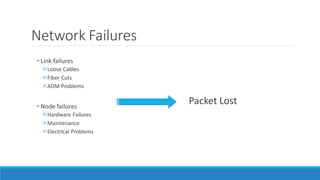
Network Failures
• Node failures
Hardware Failures
Maintenance
Electrical Problems
• Link failures
Loose Cables
Fiber Cuts
ADM Problems
Packet Lost
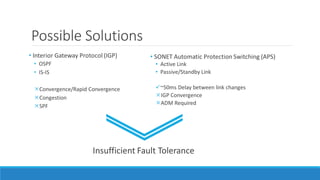
Possible Solutions
• Interior Gateway Protocol (IGP)
• OSPF
• IS-IS
Convergence/Rapid Convergence
Congestion
SPF
• SONET Automatic Protection Switching (APS)
• Active Link
• Passive/Standby Link
~50ms Delay between link changes
IGP Convergence
ADM Required
Insufficient Fault Tolerance
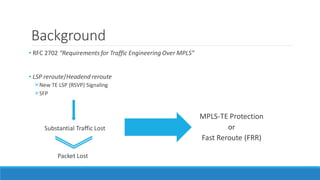
Background
• RFC 2702 “Requirements for Traffic Engineering Over MPLS”
• LSP reroute/Headend reroute
New TE LSP (RSVP) Signaling
SFP
Substantial Traffic Lost
Packet Lost
MPLS-TE Protection
or
Fast Reroute (FRR)
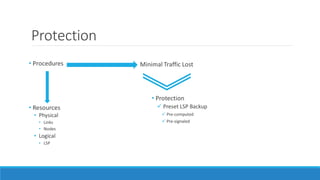
Protection
• Procedures
• Resources
• Physical
• Links
• Nodes
• Logical
• LSP
Minimal Traffic Lost
• Protection
 Preset LSP Backup
 Pre-computed
 Pre-signaled
Protection Schemes
• Path Protection
• End-to-End Protection
• Local Protection
• Link Protection
• Node Protection
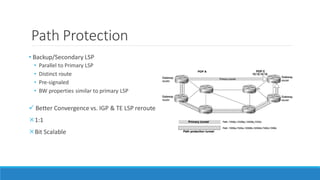
Path Protection
• Backup/Secondary LSP
• Parallel to Primary LSP
• Distinct route
• Pre-signaled
• BW properties similar to primary LSP
 Better Convergence vs. IGP & TE LSP reroute
1:1
Bit Scalable
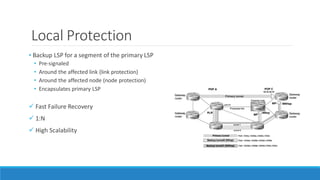
Local Protection
• Backup LSP for a segment of the primary LSP
• Pre-signaled
• Around the affected link (link protection)
• Around the affected node (node protection)
• Encapsulates primary LSP
 Fast Failure Recovery
 1:N
 High Scalability
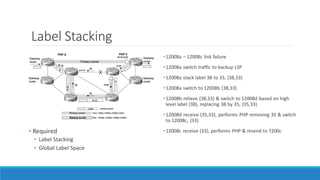
Label Stacking
•12008a – 12008c link failure
•12008a switch traffic to backup LSP
•12008a stack label 38 to 33, {38,33}
•12008a switch to 12008b {38,33}
•12008b relieve {38,33} & switch to 12008d based on high
level label (38), replacing 38 by 35, {35,33}
•12008d receive {35,33}, performs PHP removing 35 & switch
to 12008c, {33}
•12008c receive {33}, performs PHP & resend to 7200c• Required
• Label Stacking
• Global Label Space
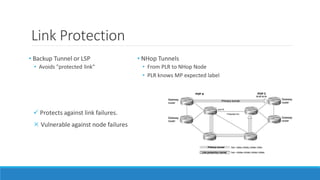
Link Protection
• Backup Tunnel or LSP
• Avoids "protected link"
 Protects against link failures.
 Vulnerable against node failures
• NHop Tunnels
• From PLR to NHop Node
• PLR knows MP expected label
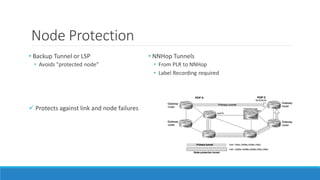
Node Protection
• Backup Tunnel or LSP
• Avoids "protected node"
• NNHop Tunnels
• From PLR to NNHop
• Label Recording required
 Protects against link and node failures
Advanced Methods of Protection
• Multiple backup tunnels
• Backup BW Reservation
• Promotion
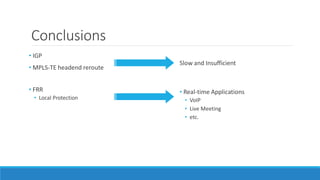
Conclusions
• IGP
• MPLS-TE headend reroute
Slow and Insufficient
• Real-time Applications
• VoIP
• Live Meeting
• etc.
• FRR
• Local Protection
Bibliography
• Traffic Engineering with MPLS, Eric Osborne CCIE #4122, Ajay Simha CCIE #2970, Cisco Press

MPLS-TE Fault Tolerance

  • 1.
    MPLS-TE Fault Tolerance MPLS-TEPROTECTION OR FAST REROUTE (FRR)
  • 2.
    Network Failures • Nodefailures Hardware Failures Maintenance Electrical Problems • Link failures Loose Cables Fiber Cuts ADM Problems Packet Lost
  • 3.
    Possible Solutions • InteriorGateway Protocol (IGP) • OSPF • IS-IS Convergence/Rapid Convergence Congestion SPF • SONET Automatic Protection Switching (APS) • Active Link • Passive/Standby Link ~50ms Delay between link changes IGP Convergence ADM Required Insufficient Fault Tolerance
  • 4.
    Background • RFC 2702“Requirements for Traffic Engineering Over MPLS” • LSP reroute/Headend reroute New TE LSP (RSVP) Signaling SFP Substantial Traffic Lost Packet Lost MPLS-TE Protection or Fast Reroute (FRR)
  • 5.
    Protection • Procedures • Resources •Physical • Links • Nodes • Logical • LSP Minimal Traffic Lost • Protection  Preset LSP Backup  Pre-computed  Pre-signaled
  • 6.
    Protection Schemes • PathProtection • End-to-End Protection • Local Protection • Link Protection • Node Protection
  • 7.
    Path Protection • Backup/SecondaryLSP • Parallel to Primary LSP • Distinct route • Pre-signaled • BW properties similar to primary LSP  Better Convergence vs. IGP & TE LSP reroute 1:1 Bit Scalable
  • 8.
    Local Protection • BackupLSP for a segment of the primary LSP • Pre-signaled • Around the affected link (link protection) • Around the affected node (node protection) • Encapsulates primary LSP  Fast Failure Recovery  1:N  High Scalability
  • 9.
    Label Stacking •12008a –12008c link failure •12008a switch traffic to backup LSP •12008a stack label 38 to 33, {38,33} •12008a switch to 12008b {38,33} •12008b relieve {38,33} & switch to 12008d based on high level label (38), replacing 38 by 35, {35,33} •12008d receive {35,33}, performs PHP removing 35 & switch to 12008c, {33} •12008c receive {33}, performs PHP & resend to 7200c• Required • Label Stacking • Global Label Space
  • 10.
    Link Protection • BackupTunnel or LSP • Avoids "protected link"  Protects against link failures.  Vulnerable against node failures • NHop Tunnels • From PLR to NHop Node • PLR knows MP expected label
  • 11.
    Node Protection • BackupTunnel or LSP • Avoids "protected node" • NNHop Tunnels • From PLR to NNHop • Label Recording required  Protects against link and node failures
  • 12.
    Advanced Methods ofProtection • Multiple backup tunnels • Backup BW Reservation • Promotion
  • 13.
    Conclusions • IGP • MPLS-TEheadend reroute Slow and Insufficient • Real-time Applications • VoIP • Live Meeting • etc. • FRR • Local Protection
  • 14.
    Bibliography • Traffic Engineeringwith MPLS, Eric Osborne CCIE #4122, Ajay Simha CCIE #2970, Cisco Press