1 Orange Restricted
Avoiding micro-loops using
Segment Routing
Stéphane LITKOWSKI
Network Architect, Orange Expert
2 Orange Restricted
A micro-loop ? Does my network have loops ?
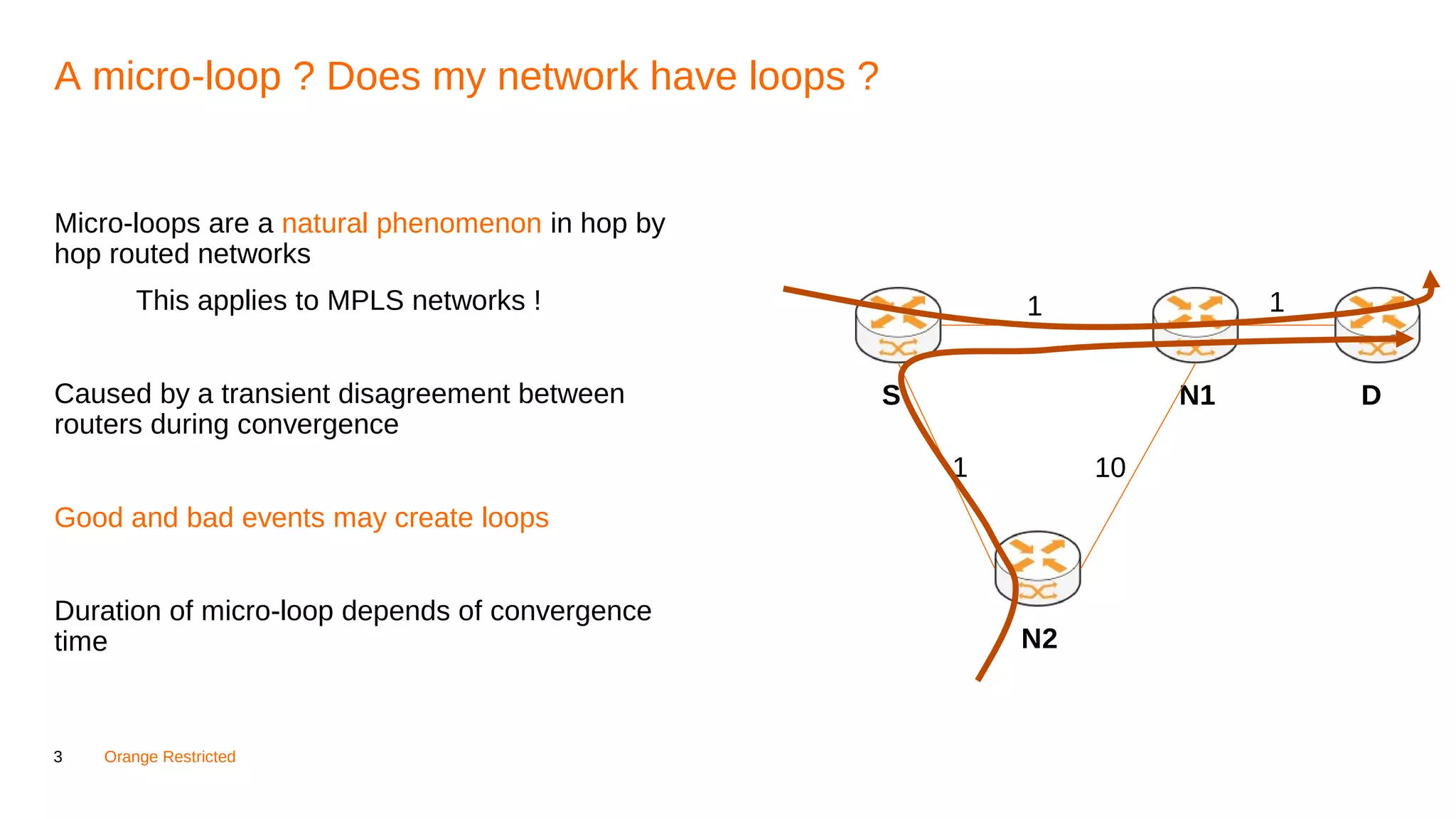
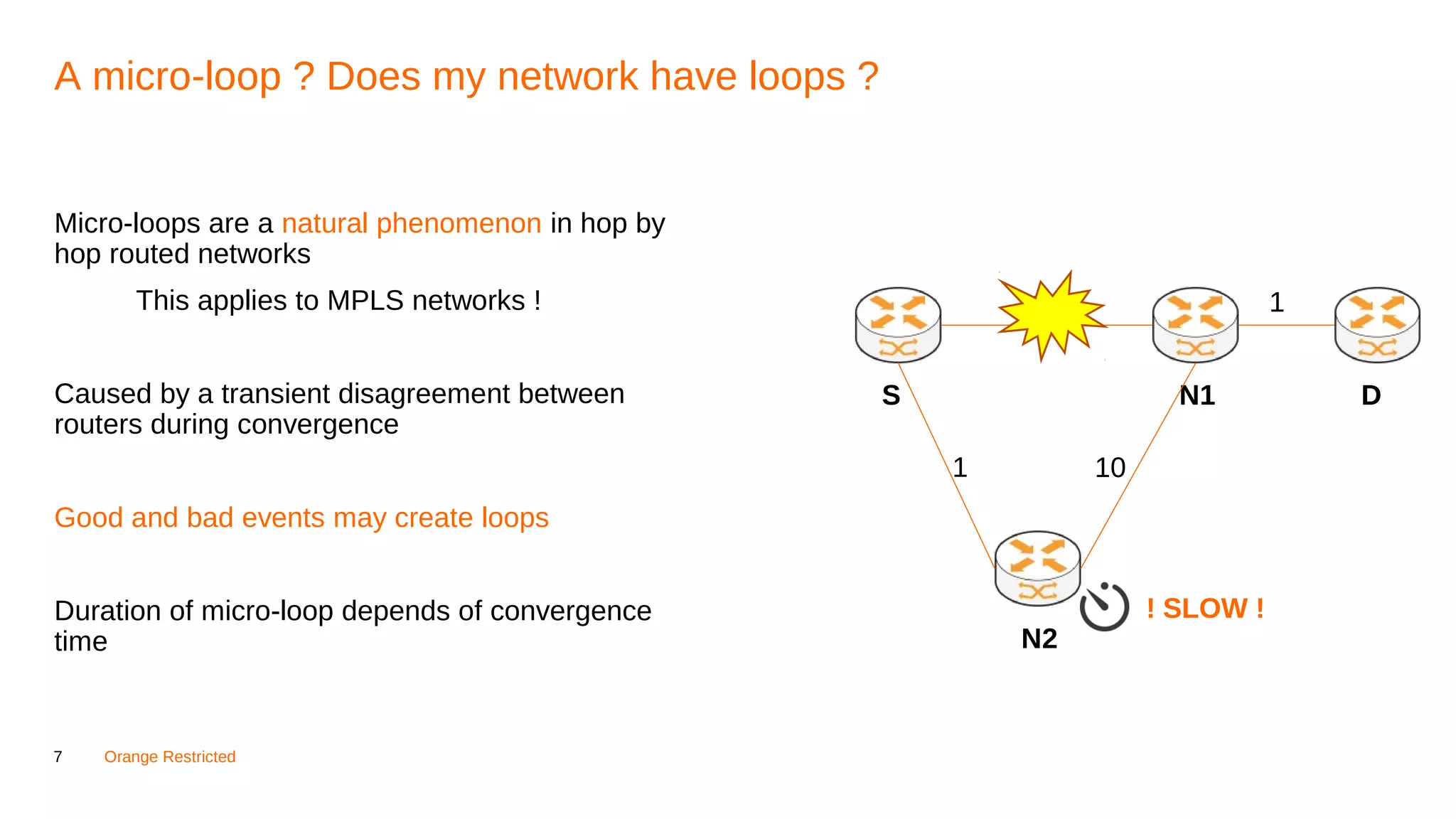
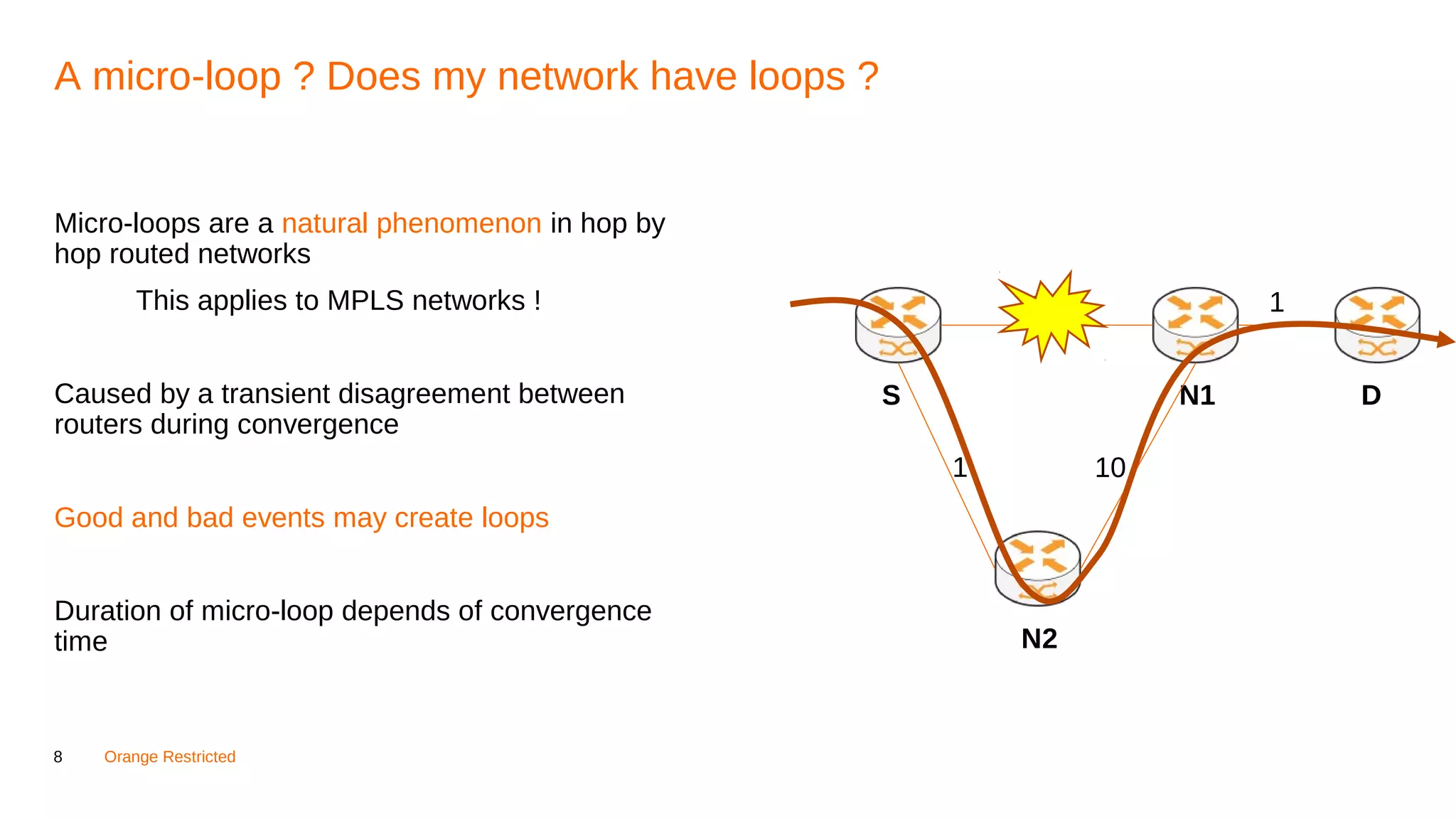
Micro-loops are a natural phenomenon in hop by
hop routed networks
This applies to MPLS networks !
Caused by a transient disagreement between
routers during convergence
Good and bad events may create loops
Duration of micro-loop depends of convergence
time
S N1
N2
D
1
101
1
3 Orange Restricted
A micro-loop ? Does my network have loops ?
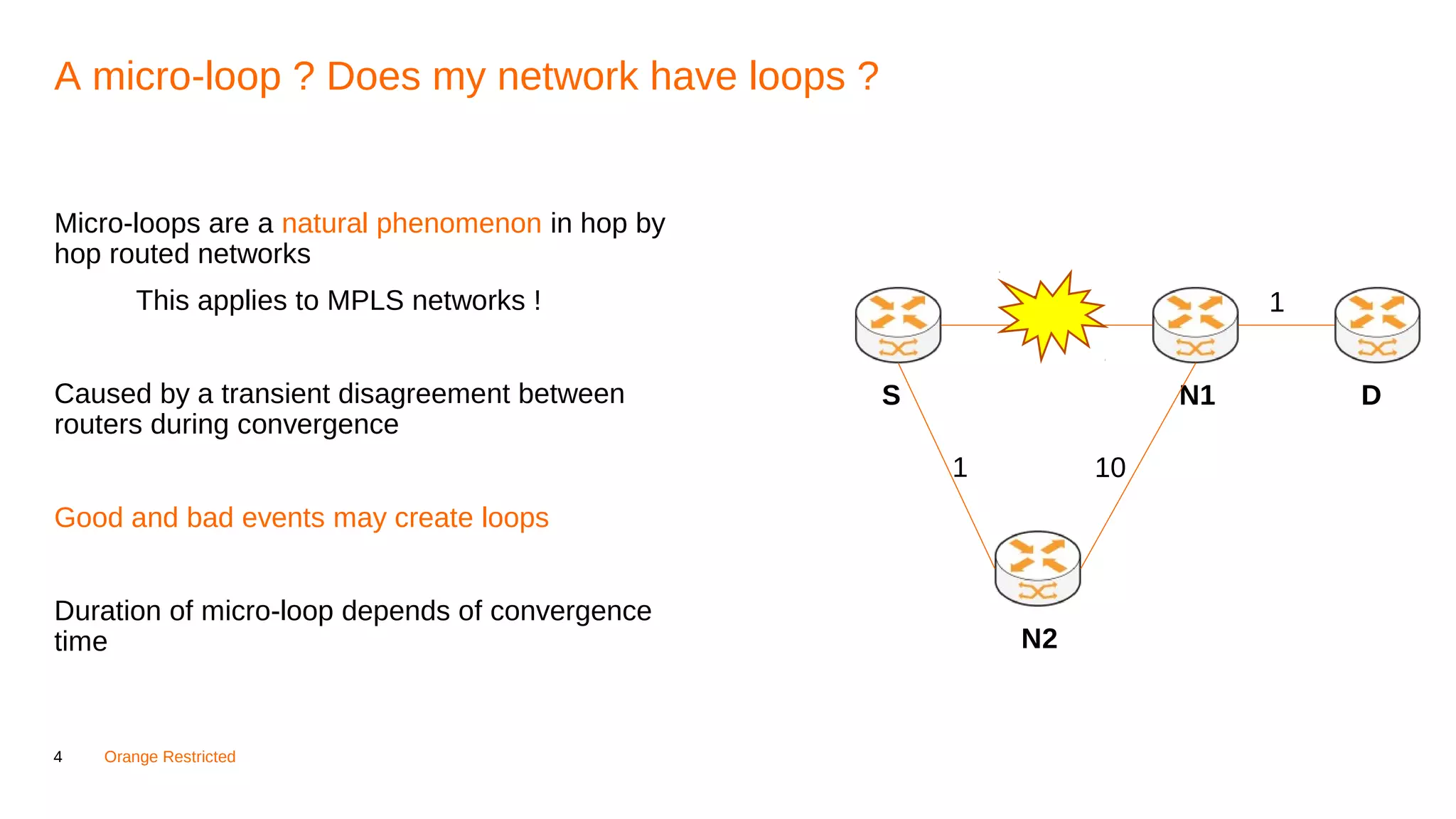
Micro-loops are a natural phenomenon in hop by
hop routed networks
This applies to MPLS networks !
Caused by a transient disagreement between
routers during convergence
Good and bad events may create loops
Duration of micro-loop depends of convergence
time
S N1
N2
D
1
101
1
4 Orange Restricted
A micro-loop ? Does my network have loops ?
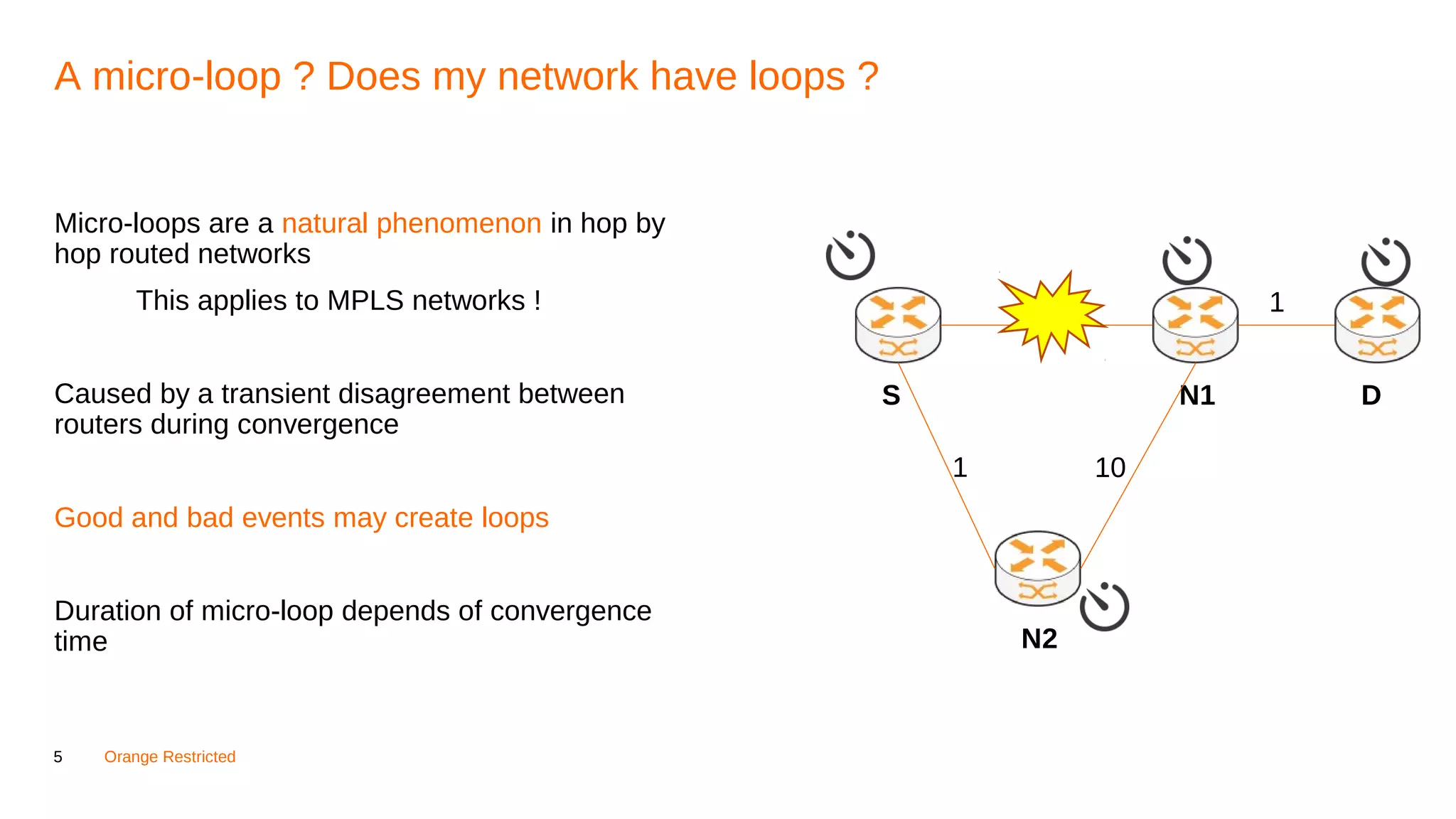
Micro-loops are a natural phenomenon in hop by
hop routed networks
This applies to MPLS networks !
Caused by a transient disagreement between
routers during convergence
Good and bad events may create loops
Duration of micro-loop depends of convergence
time
S N1
N2
D
1
101
1
5 Orange Restricted
A micro-loop ? Does my network have loops ?
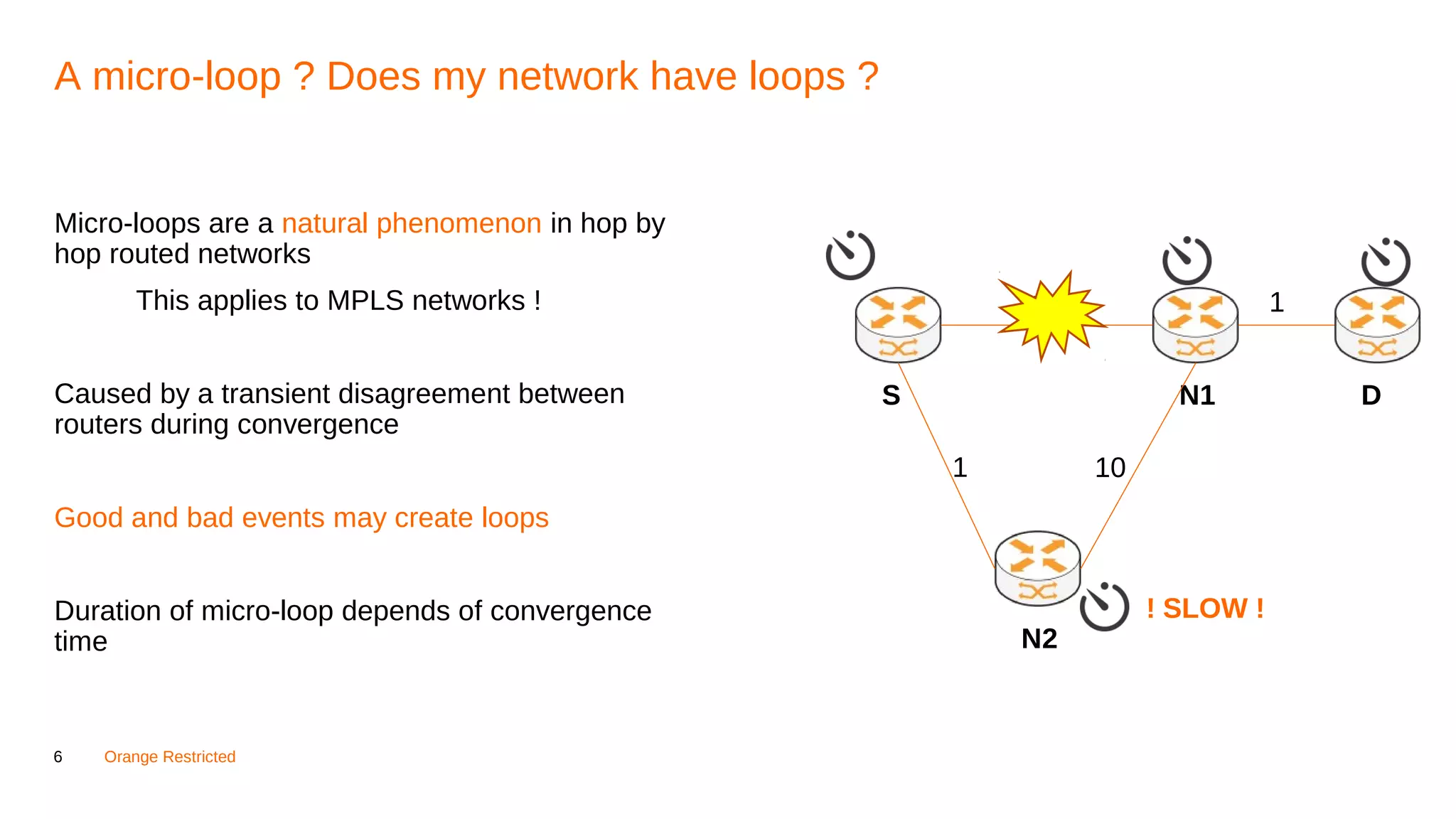
Micro-loops are a natural phenomenon in hop by
hop routed networks
This applies to MPLS networks !
Caused by a transient disagreement between
routers during convergence
Good and bad events may create loops
Duration of micro-loop depends of convergence
time
S N1
N2
D
1
101
1
6 Orange Restricted
A micro-loop ? Does my network have loops ?
Micro-loops are a natural phenomenon in hop by
hop routed networks
This applies to MPLS networks !
Caused by a transient disagreement between
routers during convergence
Good and bad events may create loops
Duration of micro-loop depends of convergence
time
S N1
N2
D
1
101
1
! SLOW !
7 Orange Restricted
A micro-loop ? Does my network have loops ?
Micro-loops are a natural phenomenon in hop by
hop routed networks
This applies to MPLS networks !
Caused by a transient disagreement between
routers during convergence
Good and bad events may create loops
Duration of micro-loop depends of convergence
time
S N1
N2
D
1
101
1
! SLOW !
8 Orange Restricted
A micro-loop ? Does my network have loops ?
Micro-loops are a natural phenomenon in hop by
hop routed networks
This applies to MPLS networks !
Caused by a transient disagreement between
routers during convergence
Good and bad events may create loops
Duration of micro-loop depends of convergence
time
S N1
N2
D
1
101
1
9 Orange Restricted
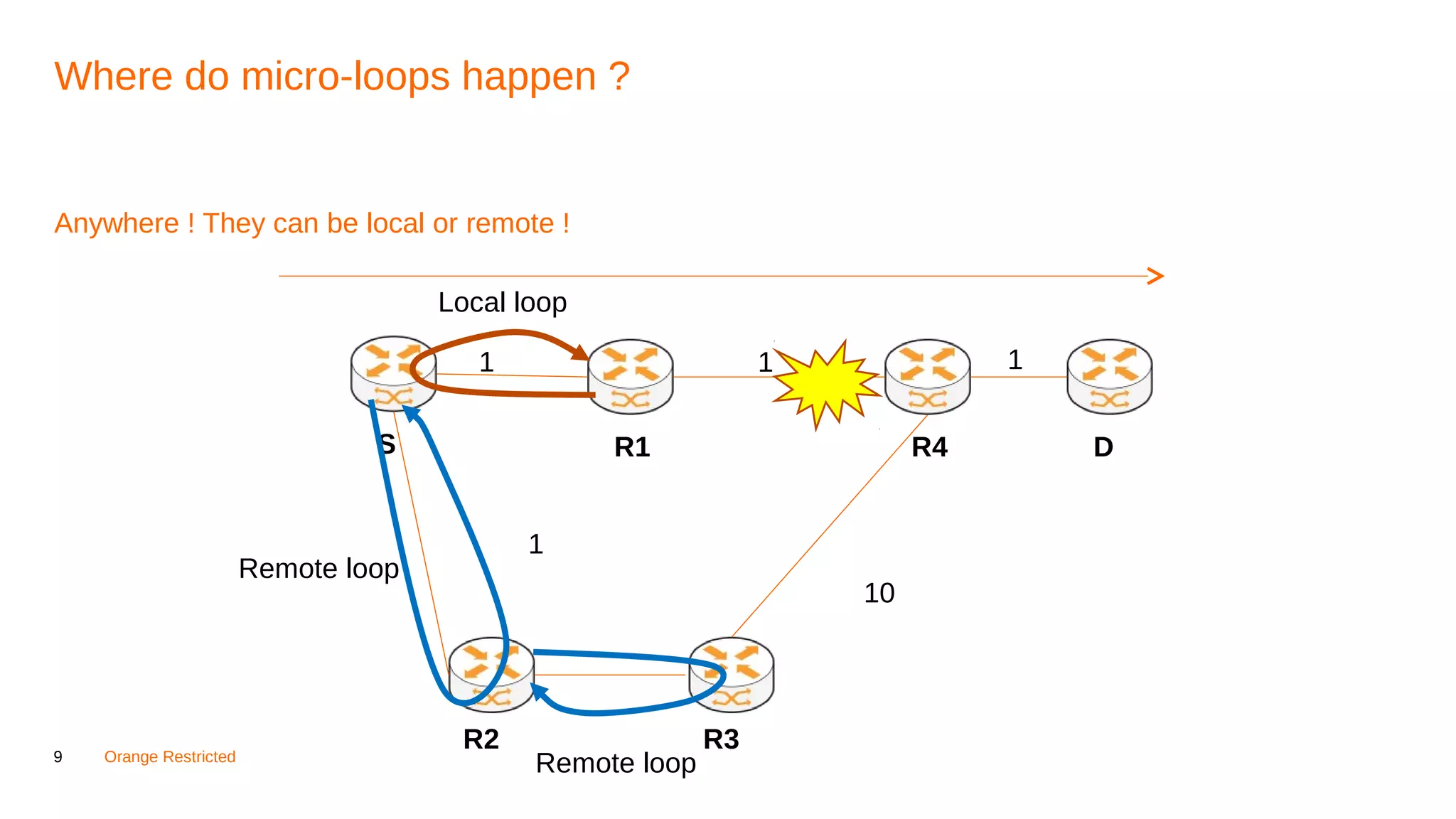
Where do micro-loops happen ?
Anywhere ! They can be local or remote !
R1 R4
R2
DS
10
111
1
R3
Local loop
Remote loop
Remote loop
10 Orange Restricted
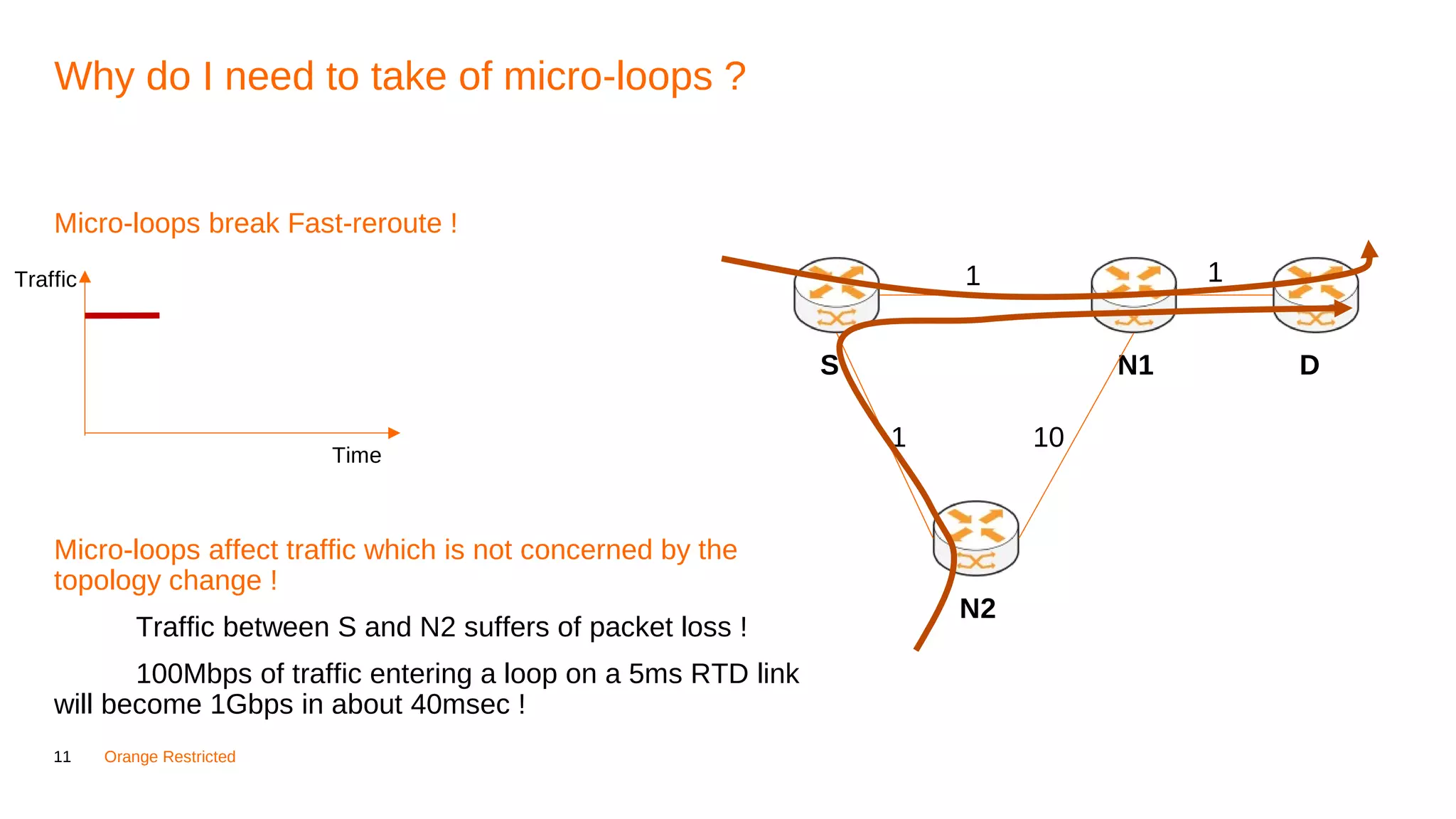
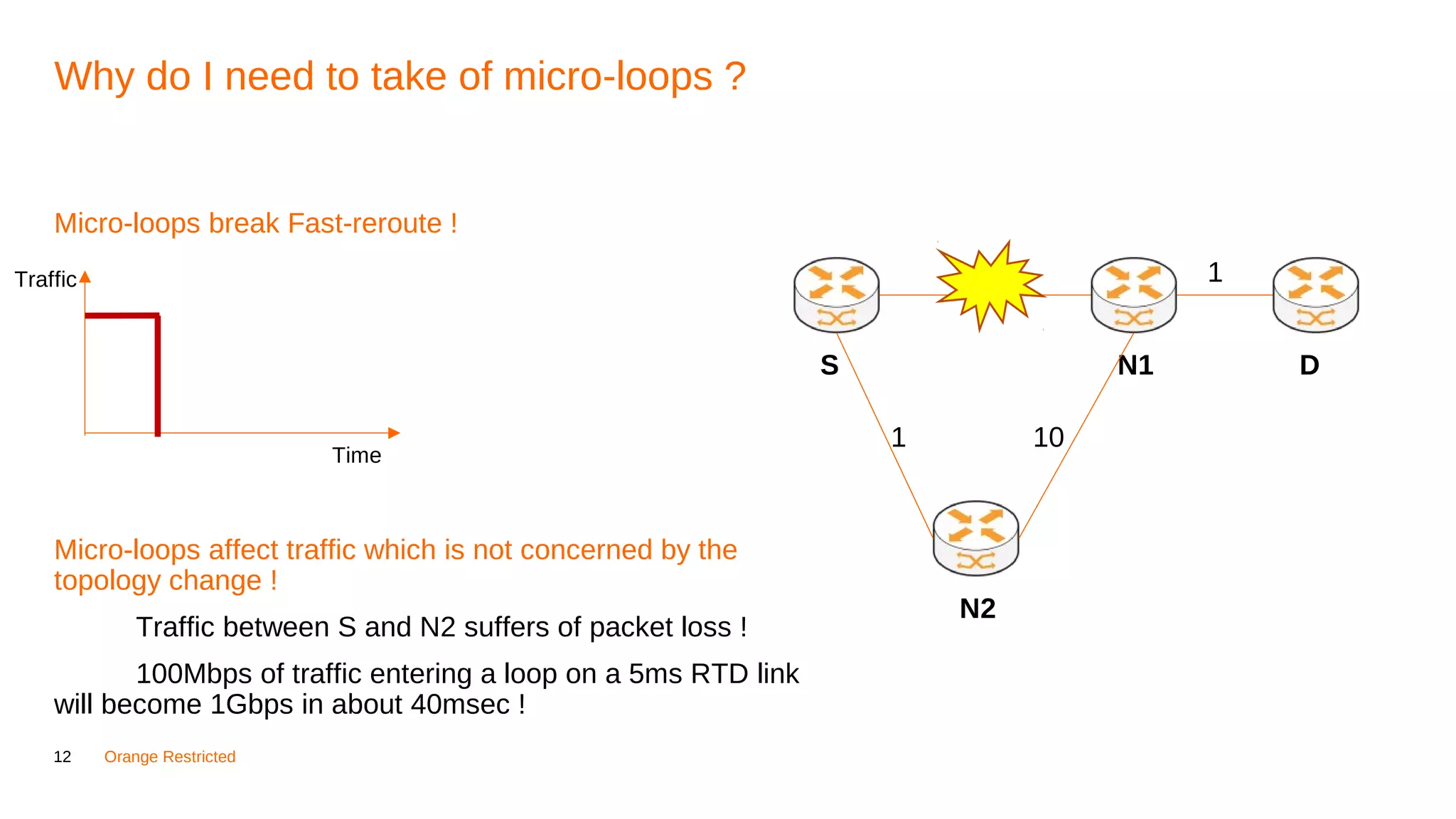
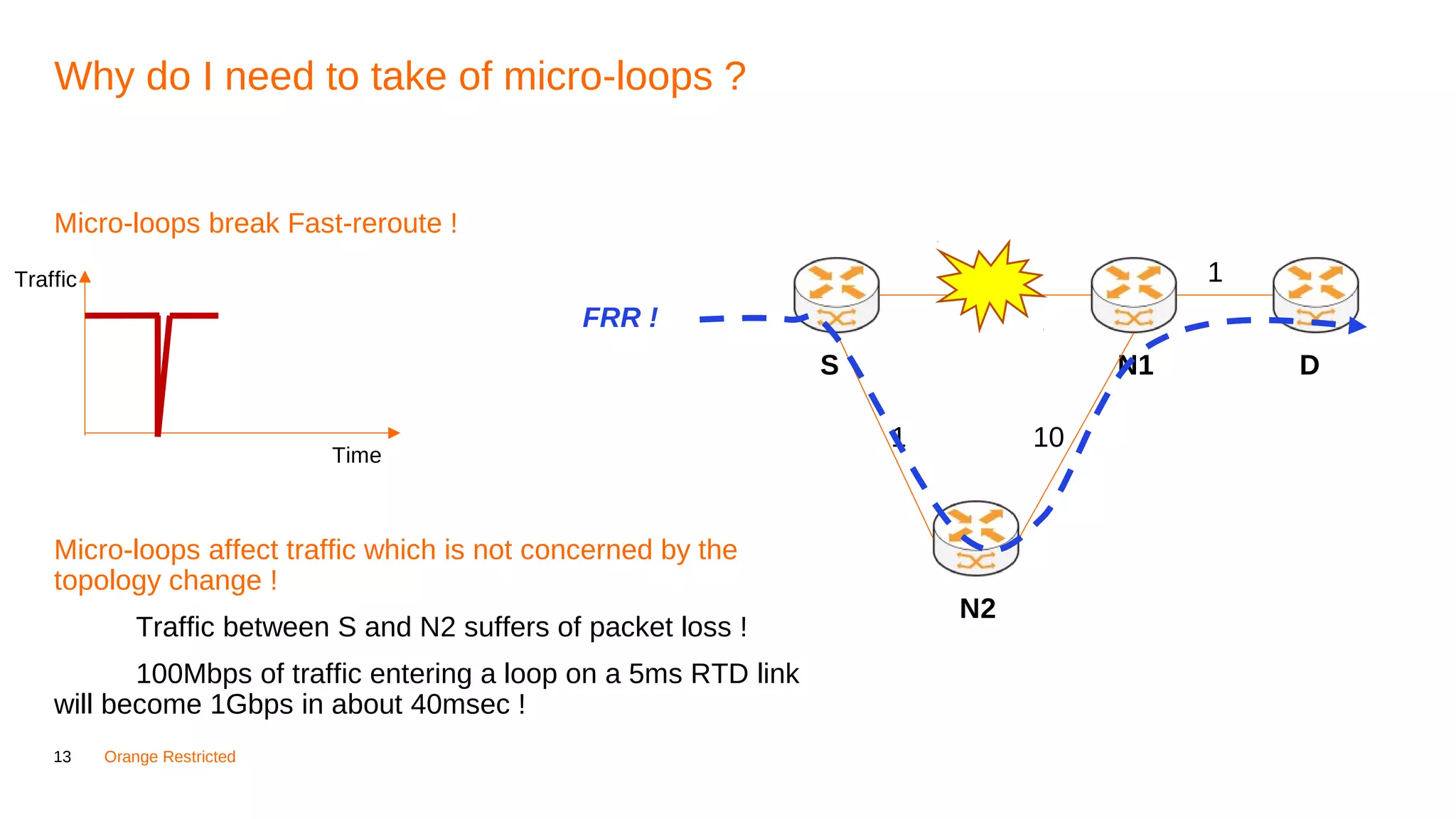
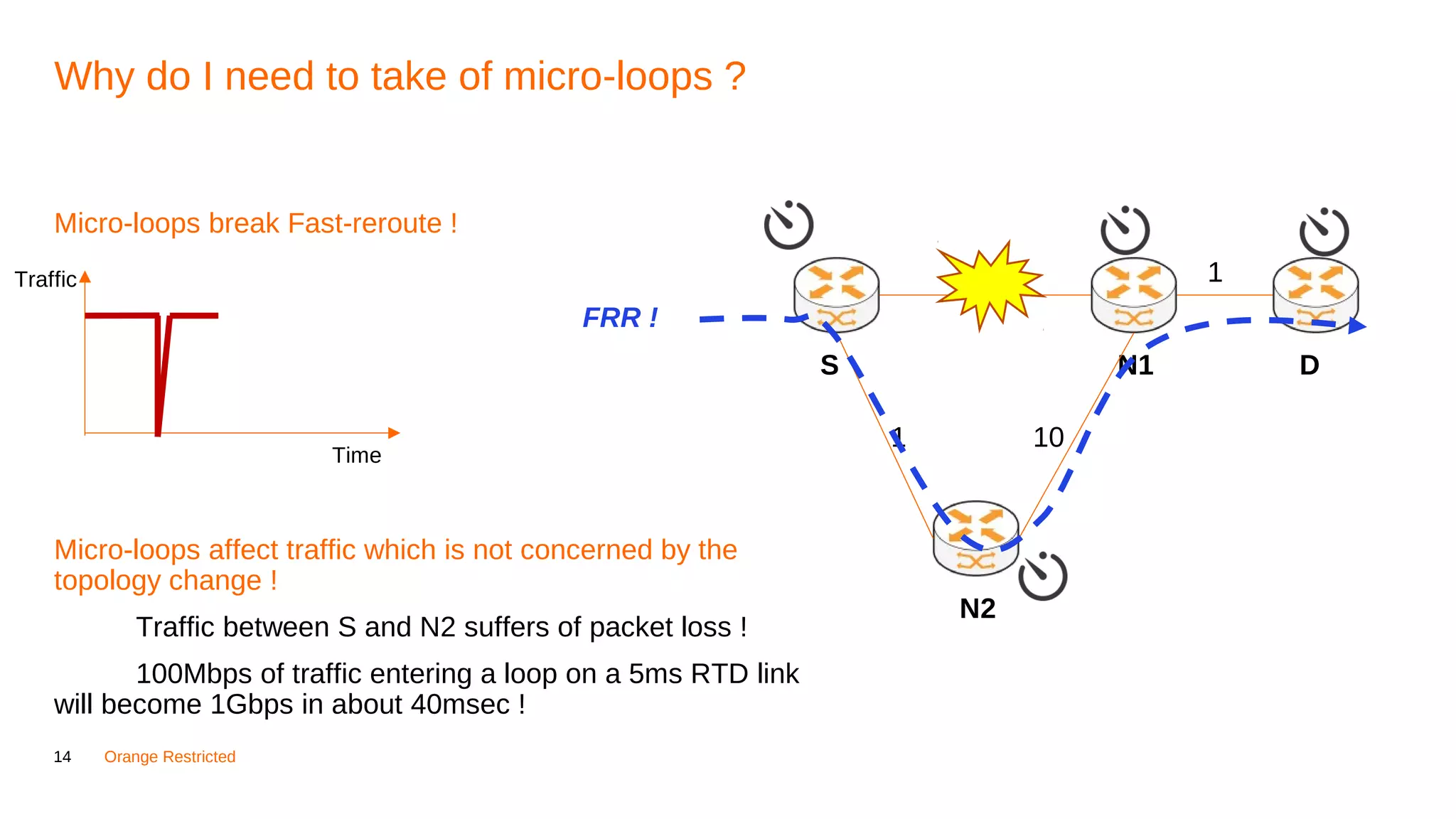
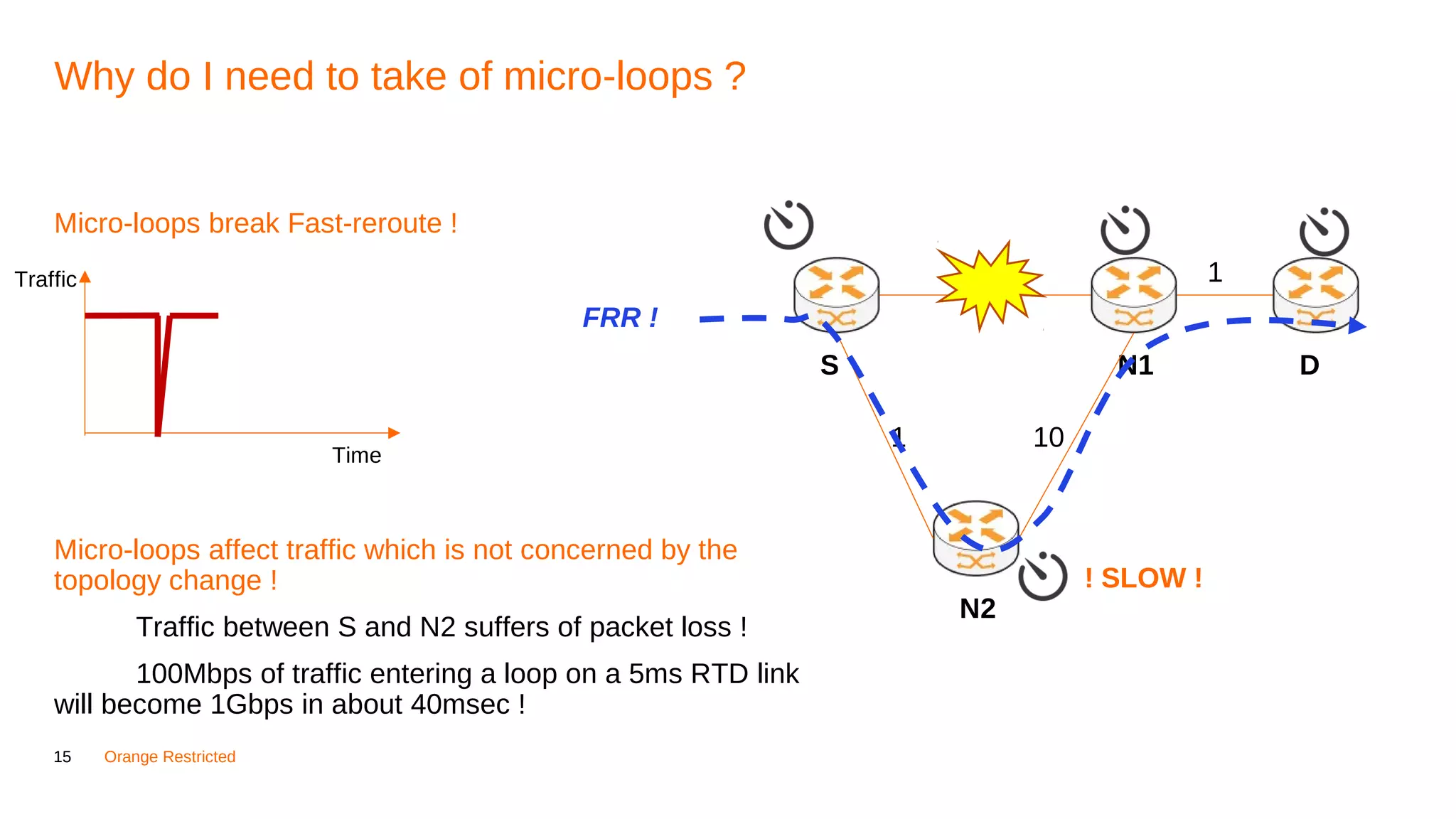
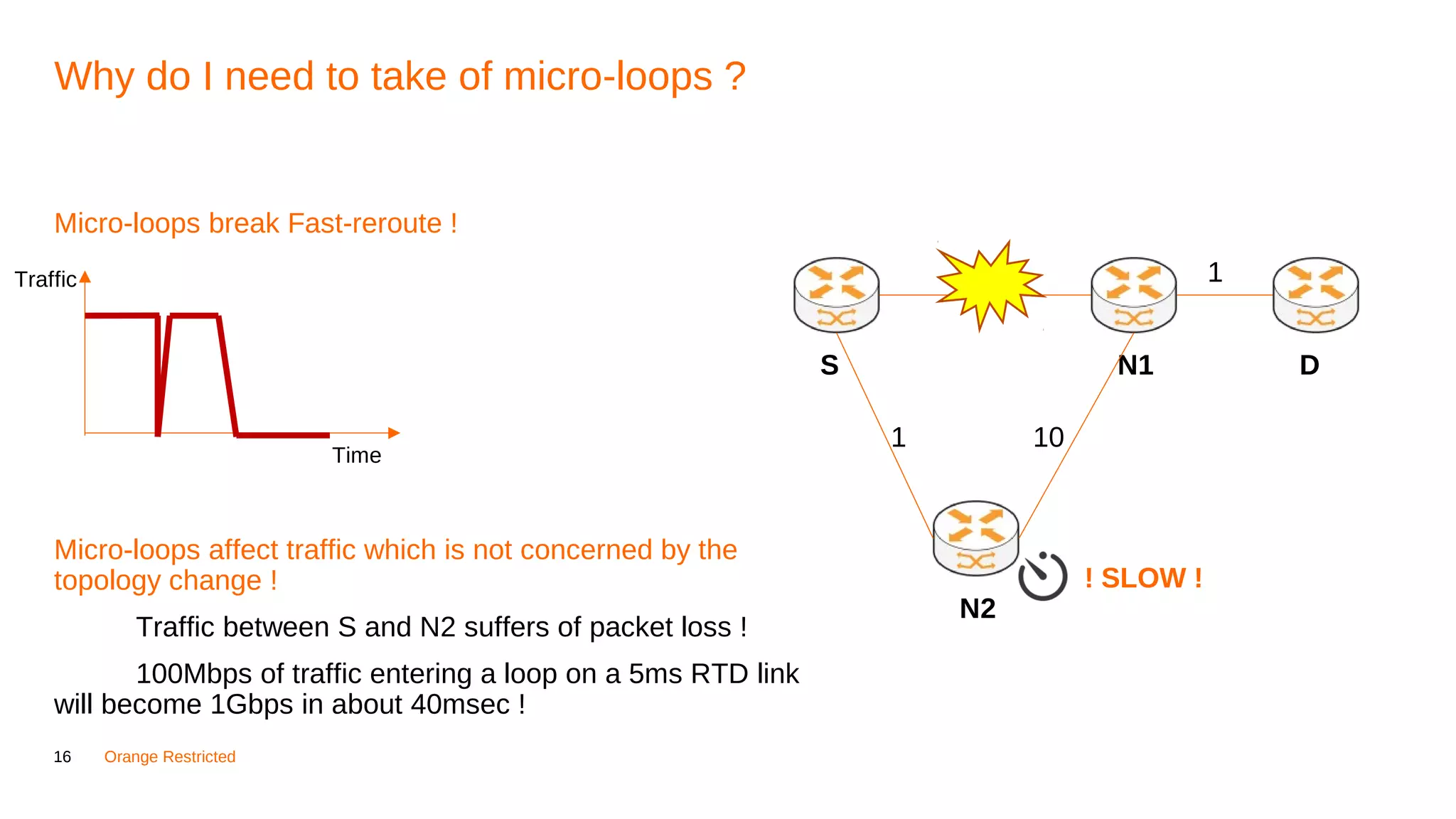
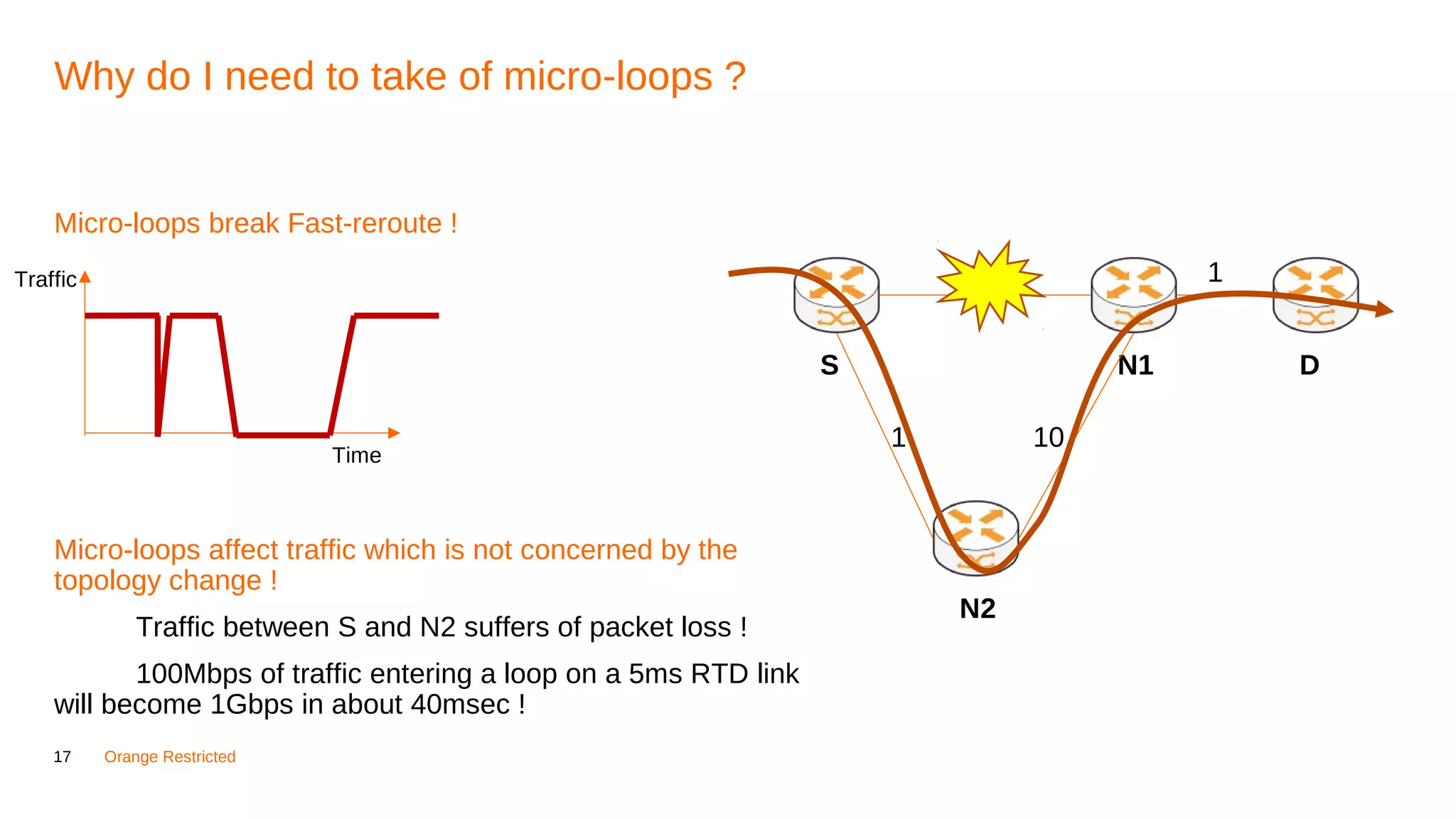
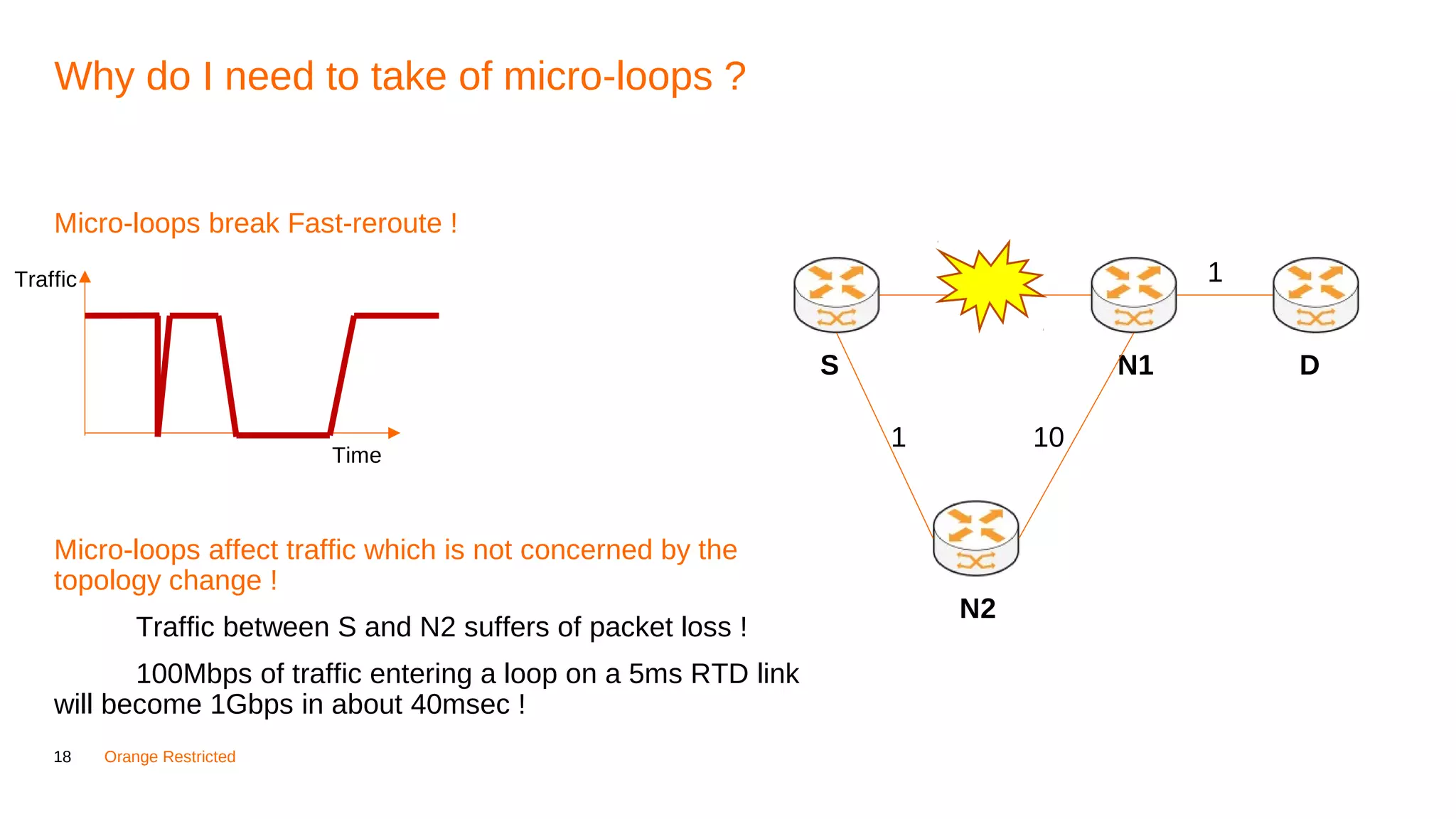
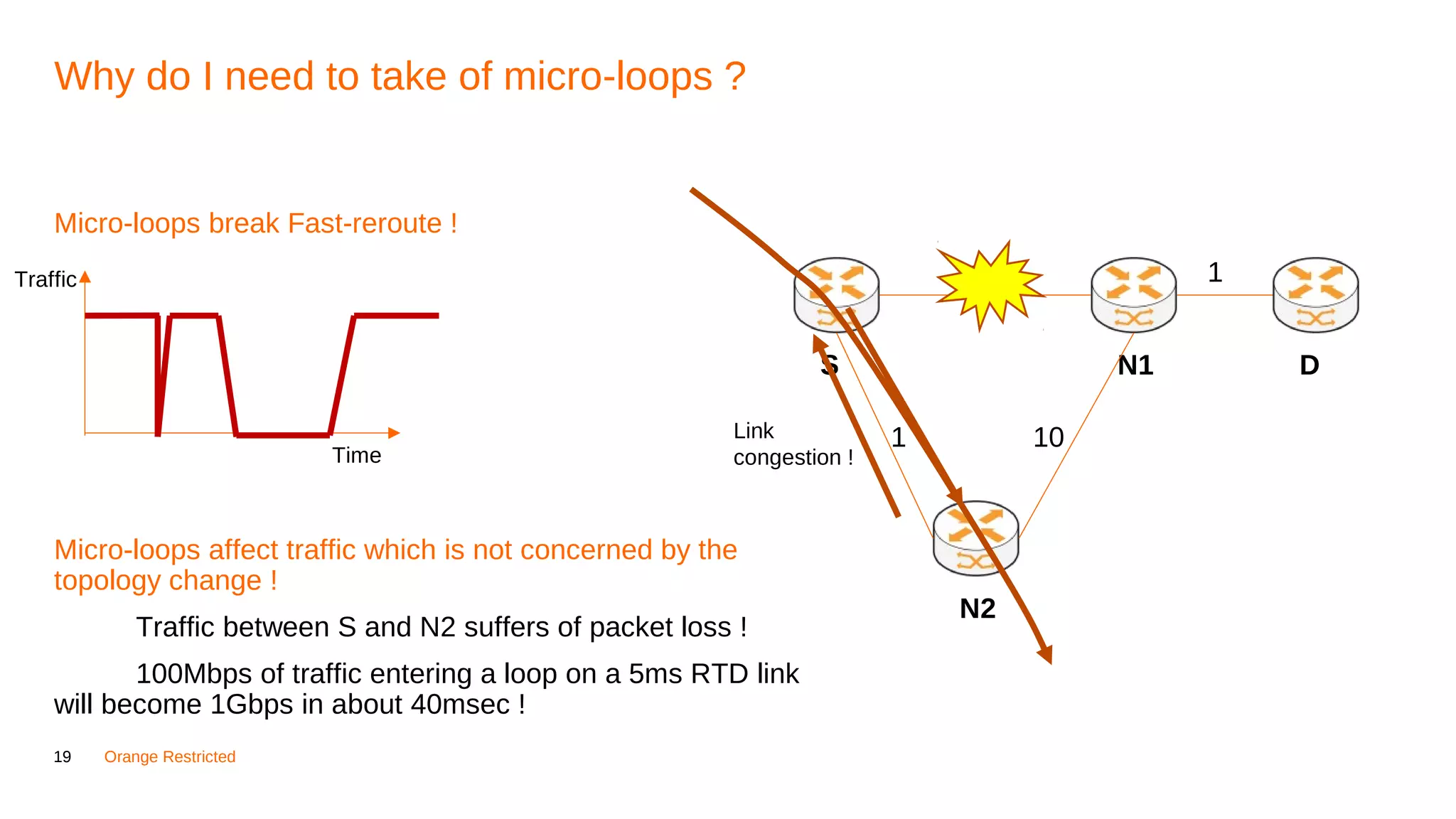
Why do I need to take of micro-loops ?
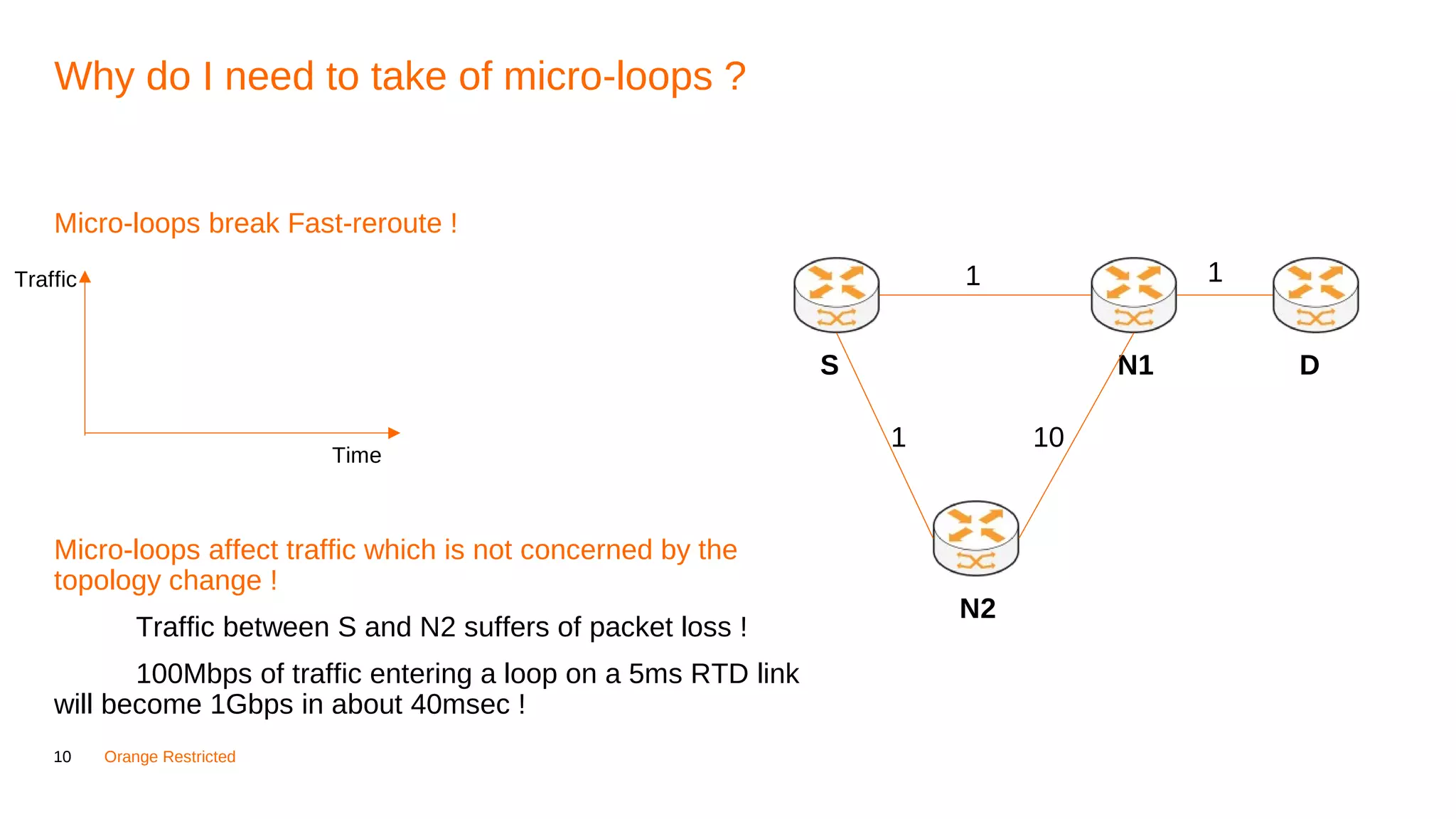
Micro-loops break Fast-reroute !
Micro-loops affect traffic which is not concerned by the
topology change !
Traffic between S and N2 suffers of packet loss !
100Mbps of traffic entering a loop on a 5ms RTD link
will become 1Gbps in about 40msec !
S N1
N2
D
1
101
1Traffic
Time
11 Orange Restricted
Why do I need to take of micro-loops ?
Micro-loops break Fast-reroute !
Micro-loops affect traffic which is not concerned by the
topology change !
Traffic between S and N2 suffers of packet loss !
100Mbps of traffic entering a loop on a 5ms RTD link
will become 1Gbps in about 40msec !
S N1
N2
D
1
101
1Traffic
Time
12 Orange Restricted
Why do I need to take of micro-loops ?
Micro-loops break Fast-reroute !
Micro-loops affect traffic which is not concerned by the
topology change !
Traffic between S and N2 suffers of packet loss !
100Mbps of traffic entering a loop on a 5ms RTD link
will become 1Gbps in about 40msec !
S N1
N2
D
1
101
1Traffic
Time
13 Orange Restricted
Why do I need to take of micro-loops ?
Micro-loops break Fast-reroute !
Micro-loops affect traffic which is not concerned by the
topology change !
Traffic between S and N2 suffers of packet loss !
100Mbps of traffic entering a loop on a 5ms RTD link
will become 1Gbps in about 40msec !
S N1
N2
D
1
101
1
FRR !
Traffic
Time
14 Orange Restricted
Why do I need to take of micro-loops ?
Micro-loops break Fast-reroute !
Micro-loops affect traffic which is not concerned by the
topology change !
Traffic between S and N2 suffers of packet loss !
100Mbps of traffic entering a loop on a 5ms RTD link
will become 1Gbps in about 40msec !
S N1
N2
D
1
101
1
FRR !
Traffic
Time
15 Orange Restricted
Why do I need to take of micro-loops ?
Micro-loops break Fast-reroute !
Micro-loops affect traffic which is not concerned by the
topology change !
Traffic between S and N2 suffers of packet loss !
100Mbps of traffic entering a loop on a 5ms RTD link
will become 1Gbps in about 40msec !
S N1
N2
D
1
101
1
! SLOW !
FRR !
Traffic
Time
16 Orange Restricted
Why do I need to take of micro-loops ?
Micro-loops break Fast-reroute !
Micro-loops affect traffic which is not concerned by the
topology change !
Traffic between S and N2 suffers of packet loss !
100Mbps of traffic entering a loop on a 5ms RTD link
will become 1Gbps in about 40msec !
S N1
N2
D
1
101
1
! SLOW !
Traffic
Time
17 Orange Restricted
Why do I need to take of micro-loops ?
Micro-loops break Fast-reroute !
Micro-loops affect traffic which is not concerned by the
topology change !
Traffic between S and N2 suffers of packet loss !
100Mbps of traffic entering a loop on a 5ms RTD link
will become 1Gbps in about 40msec !
S N1
N2
D
1
101
1Traffic
Time
18 Orange Restricted
Why do I need to take of micro-loops ?
Micro-loops break Fast-reroute !
Micro-loops affect traffic which is not concerned by the
topology change !
Traffic between S and N2 suffers of packet loss !
100Mbps of traffic entering a loop on a 5ms RTD link
will become 1Gbps in about 40msec !
S N1
N2
D
1
101
1Traffic
Time
19 Orange Restricted
Why do I need to take of micro-loops ?
Micro-loops break Fast-reroute !
Micro-loops affect traffic which is not concerned by the
topology change !
Traffic between S and N2 suffers of packet loss !
100Mbps of traffic entering a loop on a 5ms RTD link
will become 1Gbps in about 40msec !
S N1
N2
D
1
101
1Traffic
Time
Link
congestion !
20 Orange Restricted
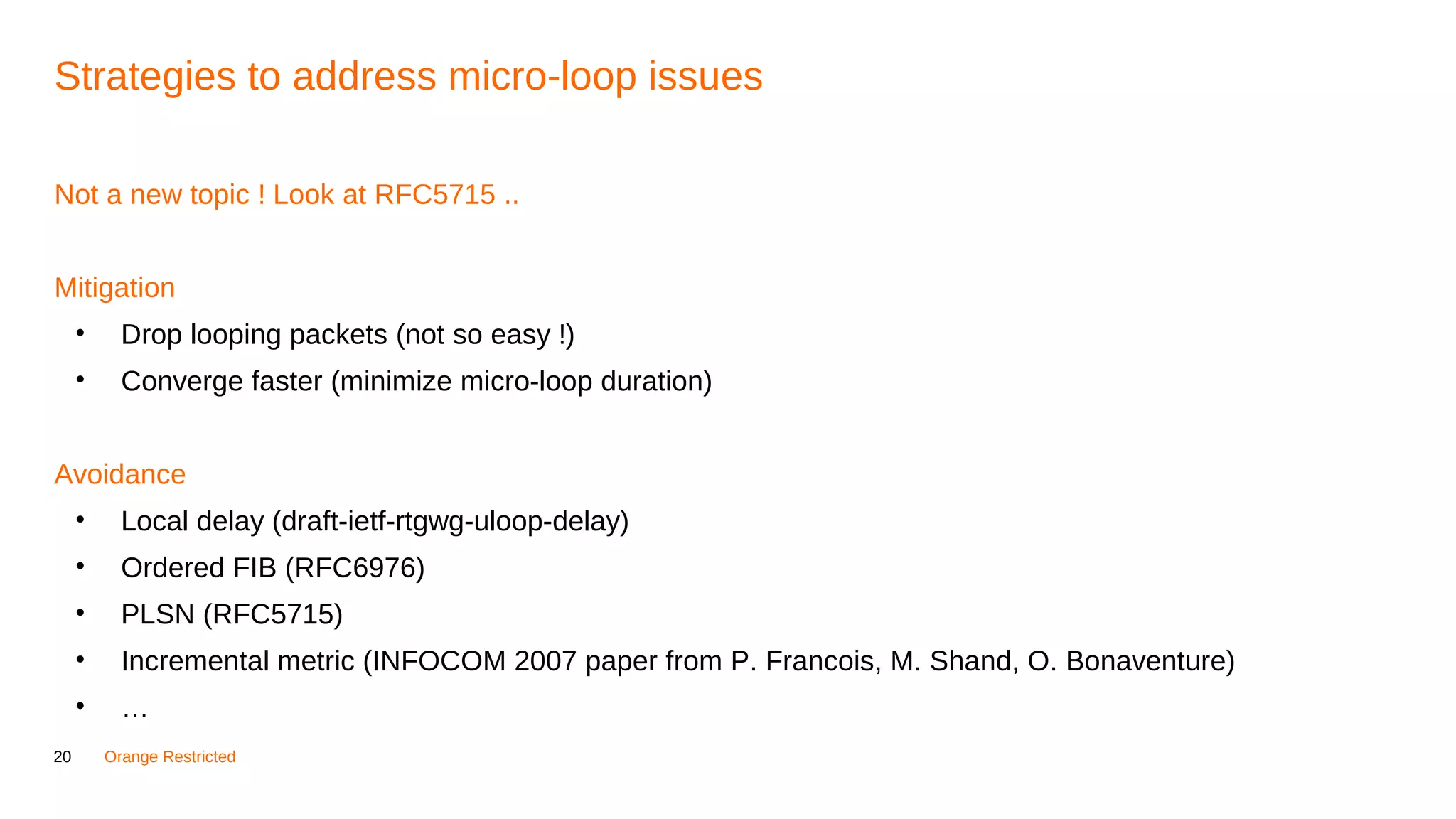
Strategies to address micro-loop issues
Not a new topic ! Look at RFC5715 ..
Mitigation
• Drop looping packets (not so easy !)
• Converge faster (minimize micro-loop duration)
Avoidance
• Local delay (draft-ietf-rtgwg-uloop-delay)
• Ordered FIB (RFC6976)
• PLSN (RFC5715)
• Incremental metric (INFOCOM 2007 paper from P. Francois, M. Shand, O. Bonaventure)
• …
22 Orange Restricted
Strategies to avoid micro-loops
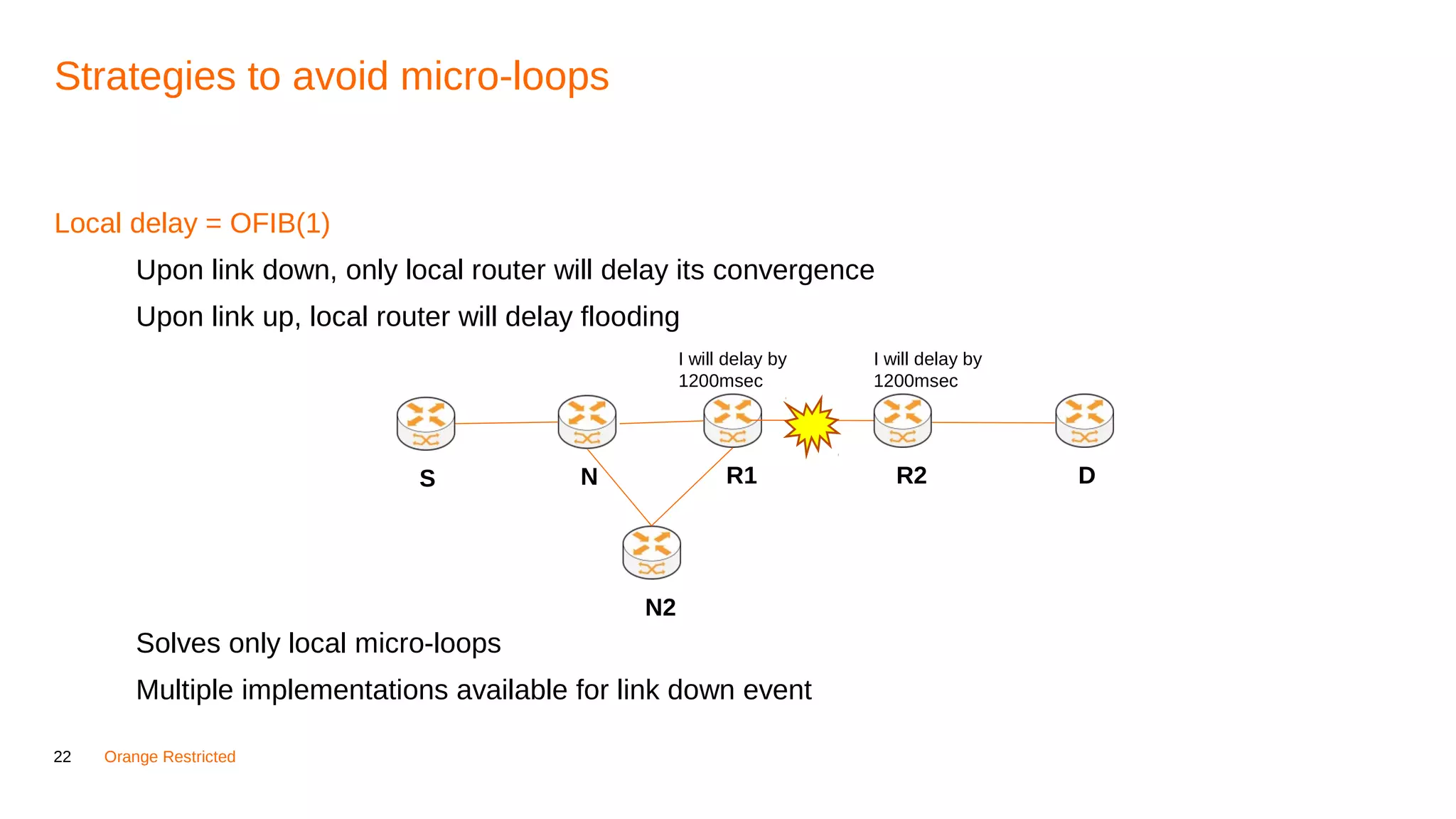
Local delay = OFIB(1)
Upon link down, only local router will delay its convergence
Upon link up, local router will delay flooding
Solves only local micro-loops
Multiple implementations available for link down event
S N R1 R2 D
N2
I will delay by
1200msec
I will delay by
1200msec
23 Orange Restricted
Conclusion on current state of the art
No definitive solution to avoid micro-loops
Local delay is good but not perfect 
Mitigation is not enough and sometimes complex to implement
How can we improve ?
24 Orange Restricted
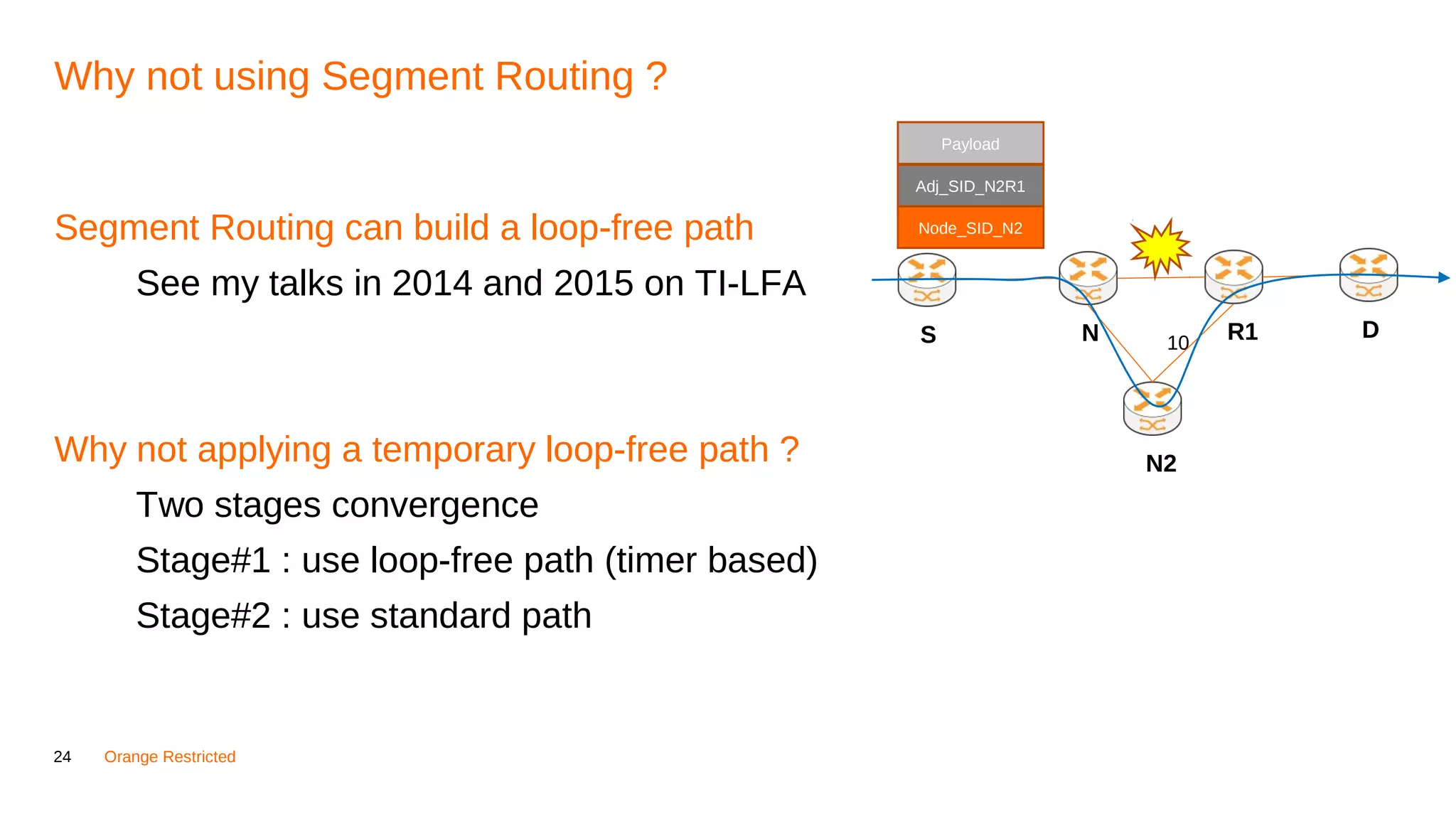
Why not using Segment Routing ?
Segment Routing can build a loop-free path
See my talks in 2014 and 2015 on TI-LFA
Why not applying a temporary loop-free path ?
Two stages convergence
Stage#1 : use loop-free path (timer based)
Stage#2 : use standard path
S N R1 D
N2
10
Node_SID_N2
Adj_SID_N2R1
Payload
36 Orange Restricted
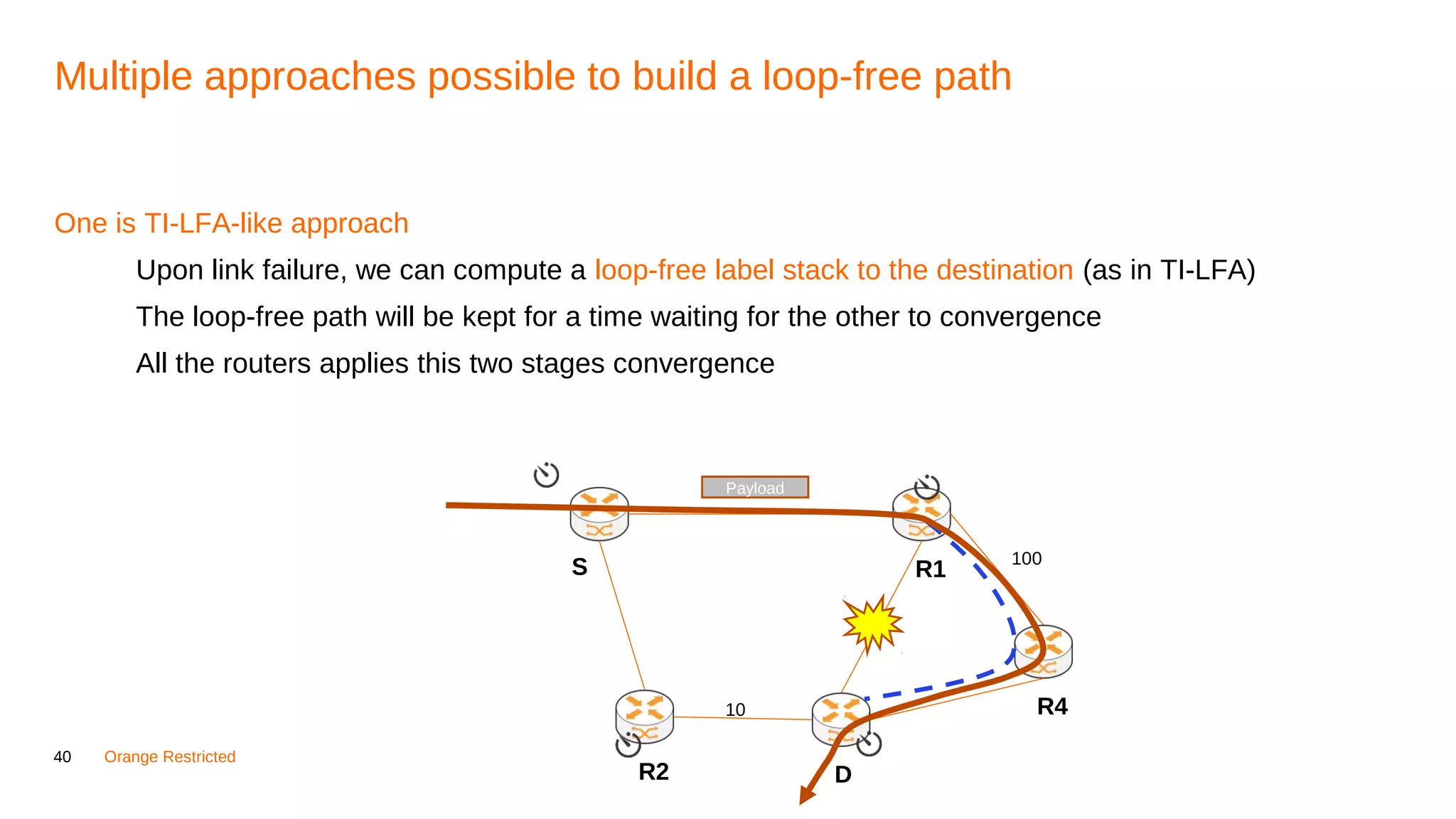
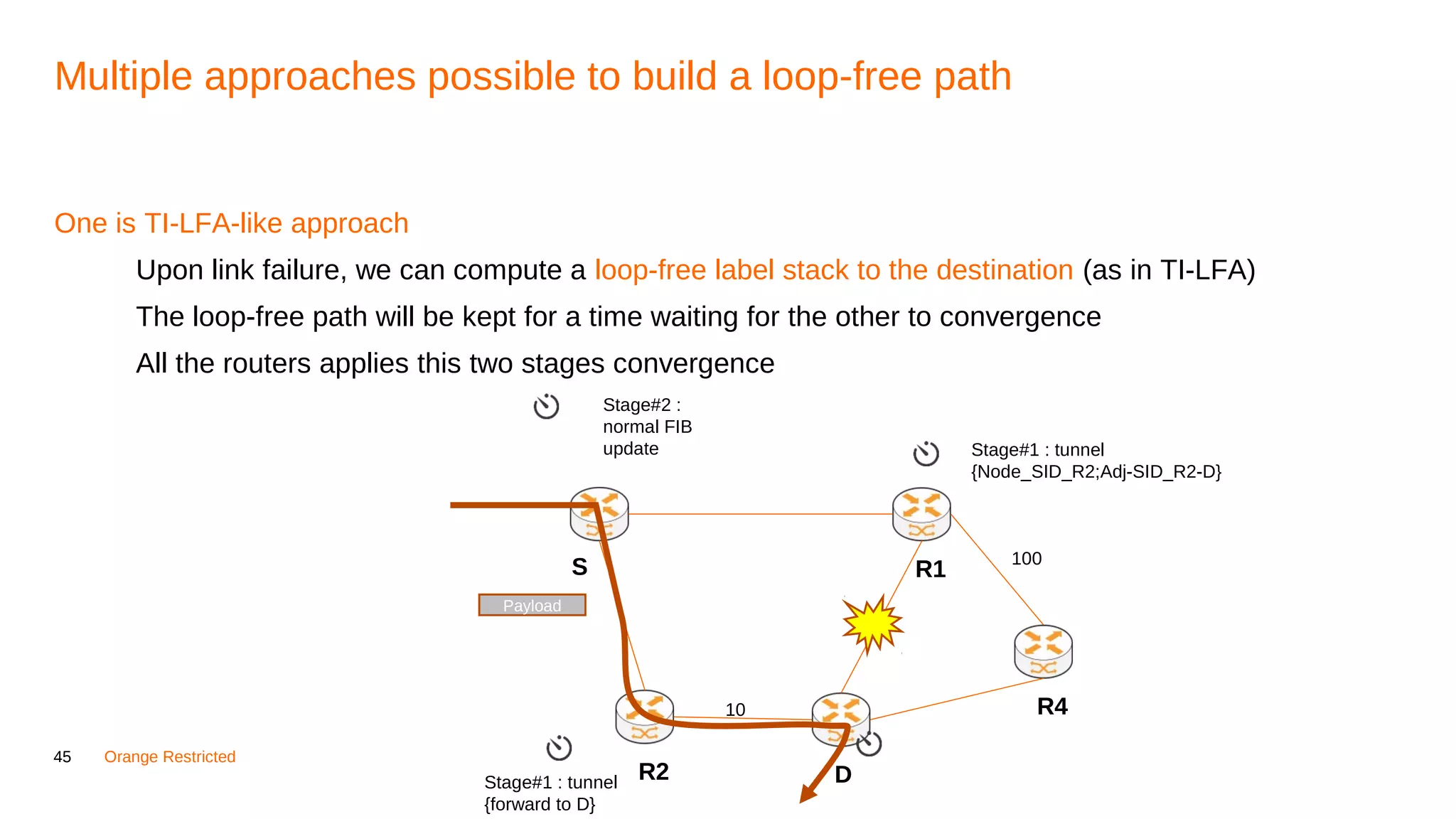
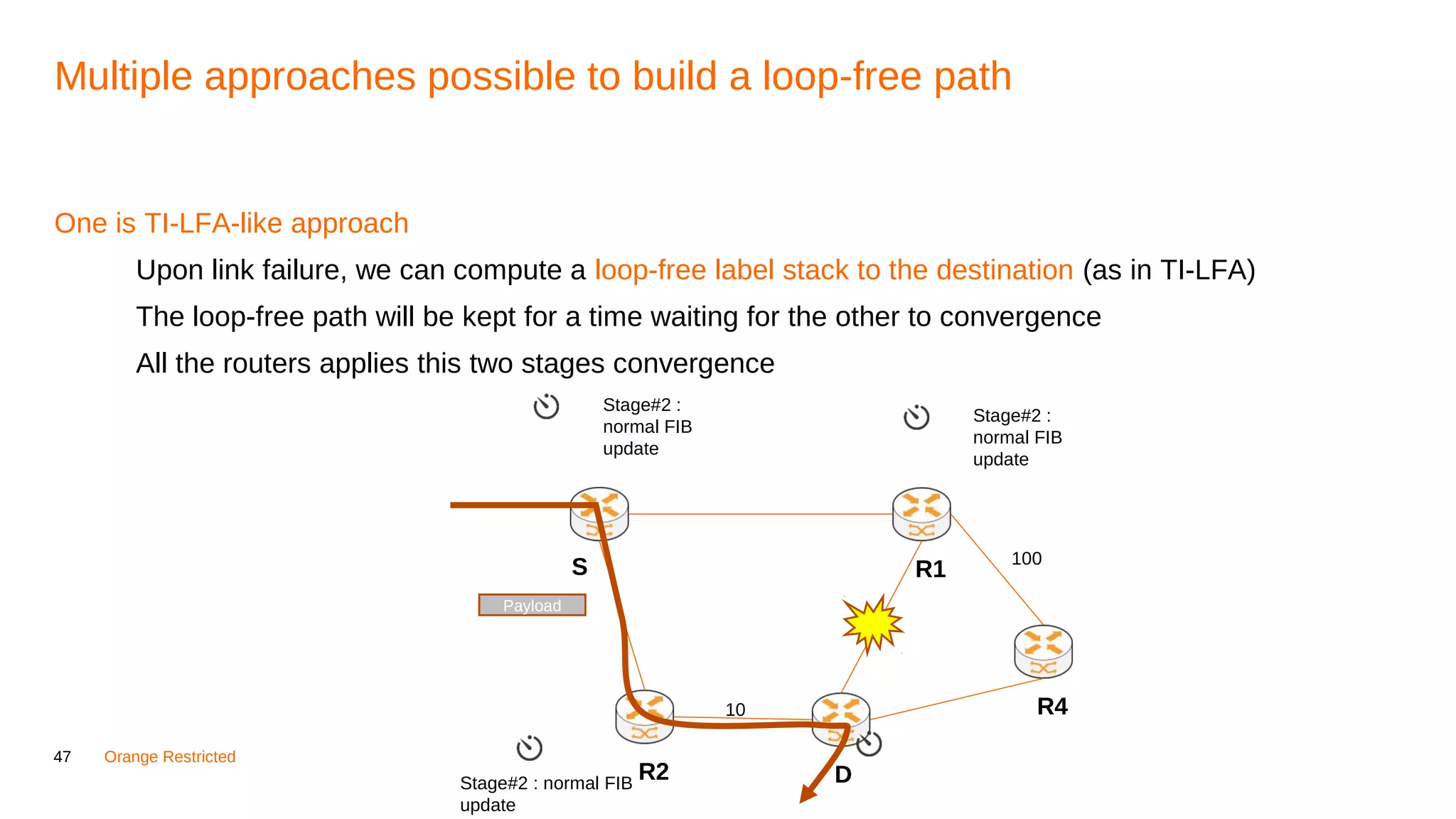
Multiple approaches possible to build a loop-free path
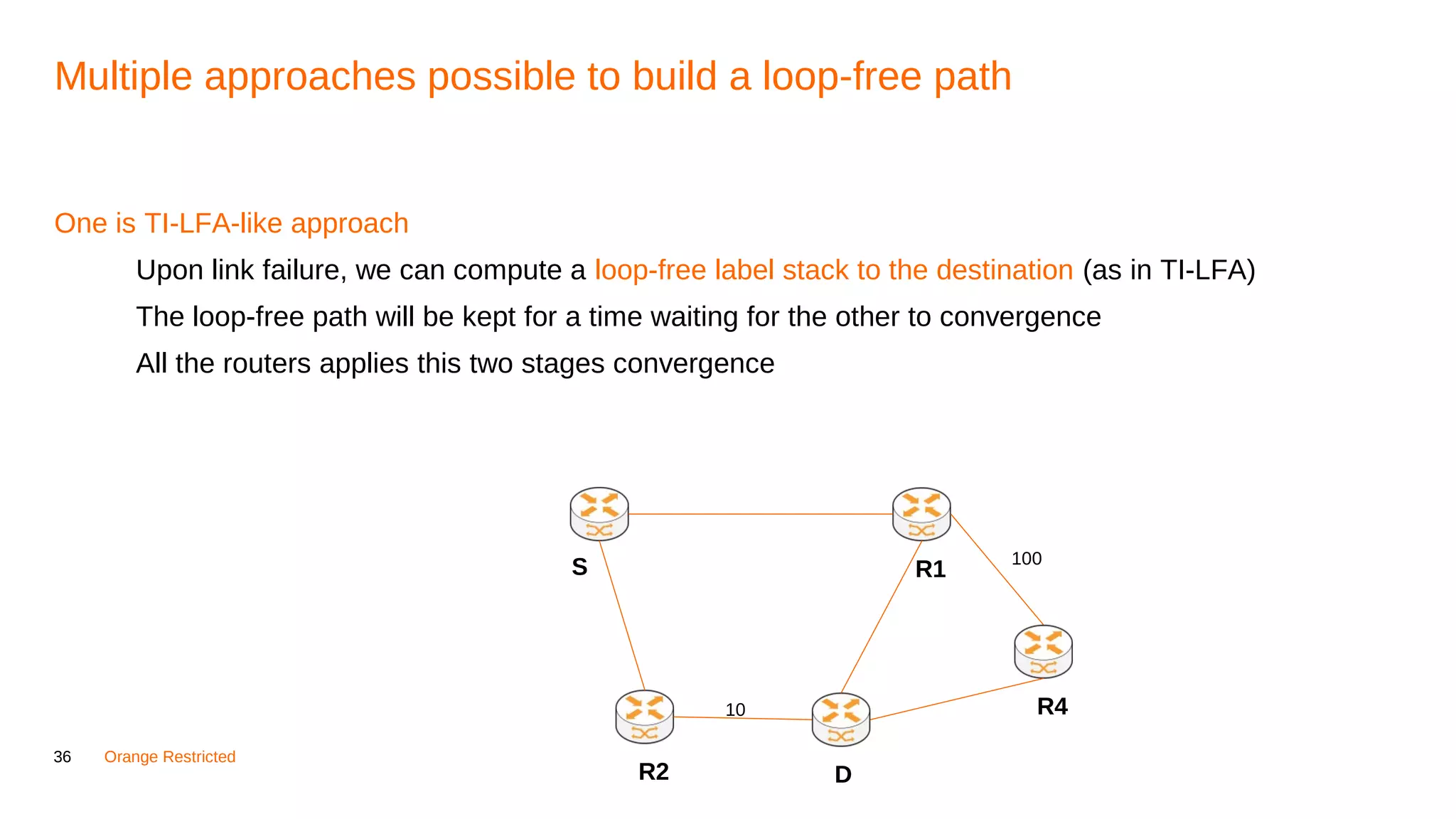
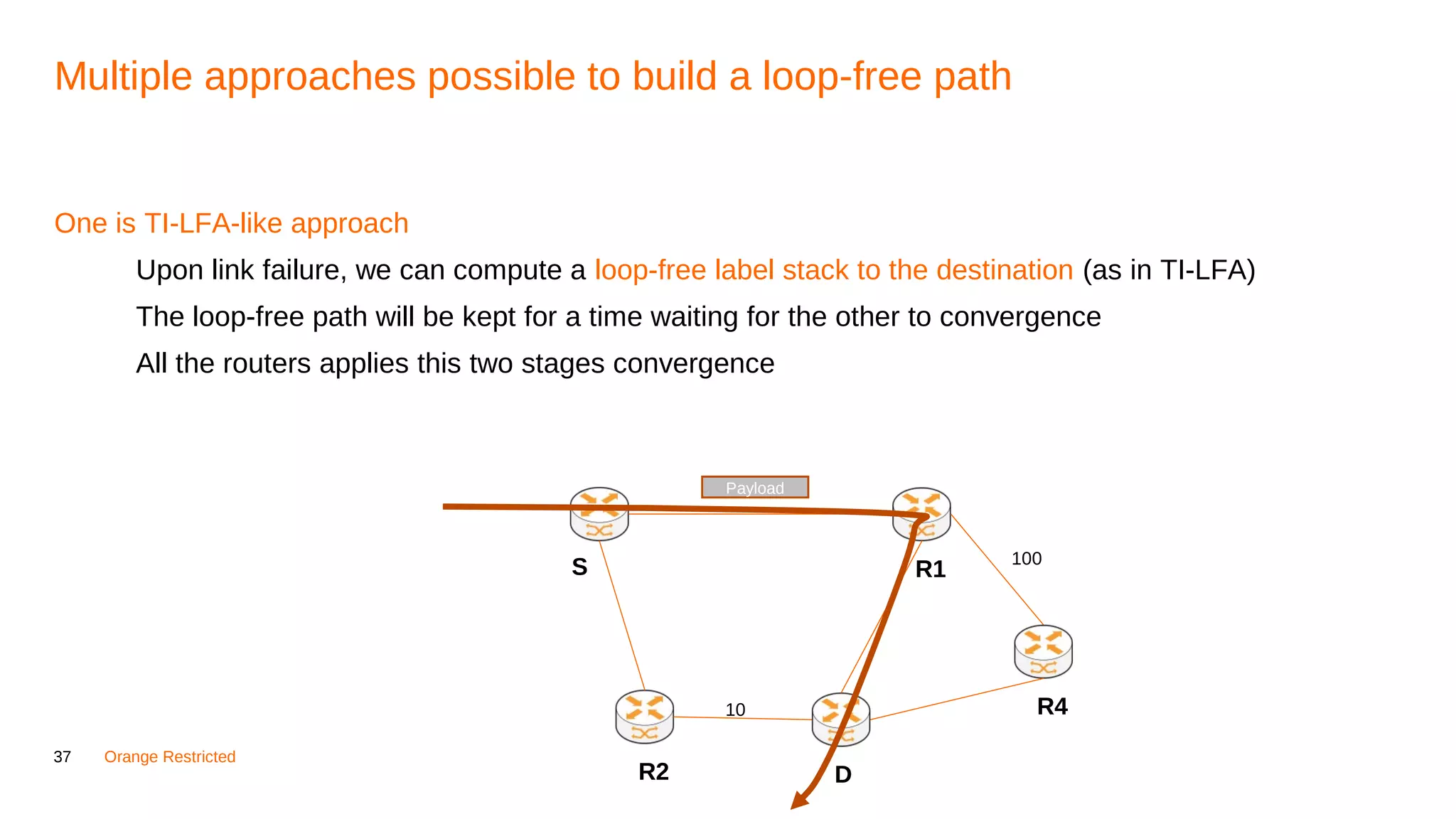
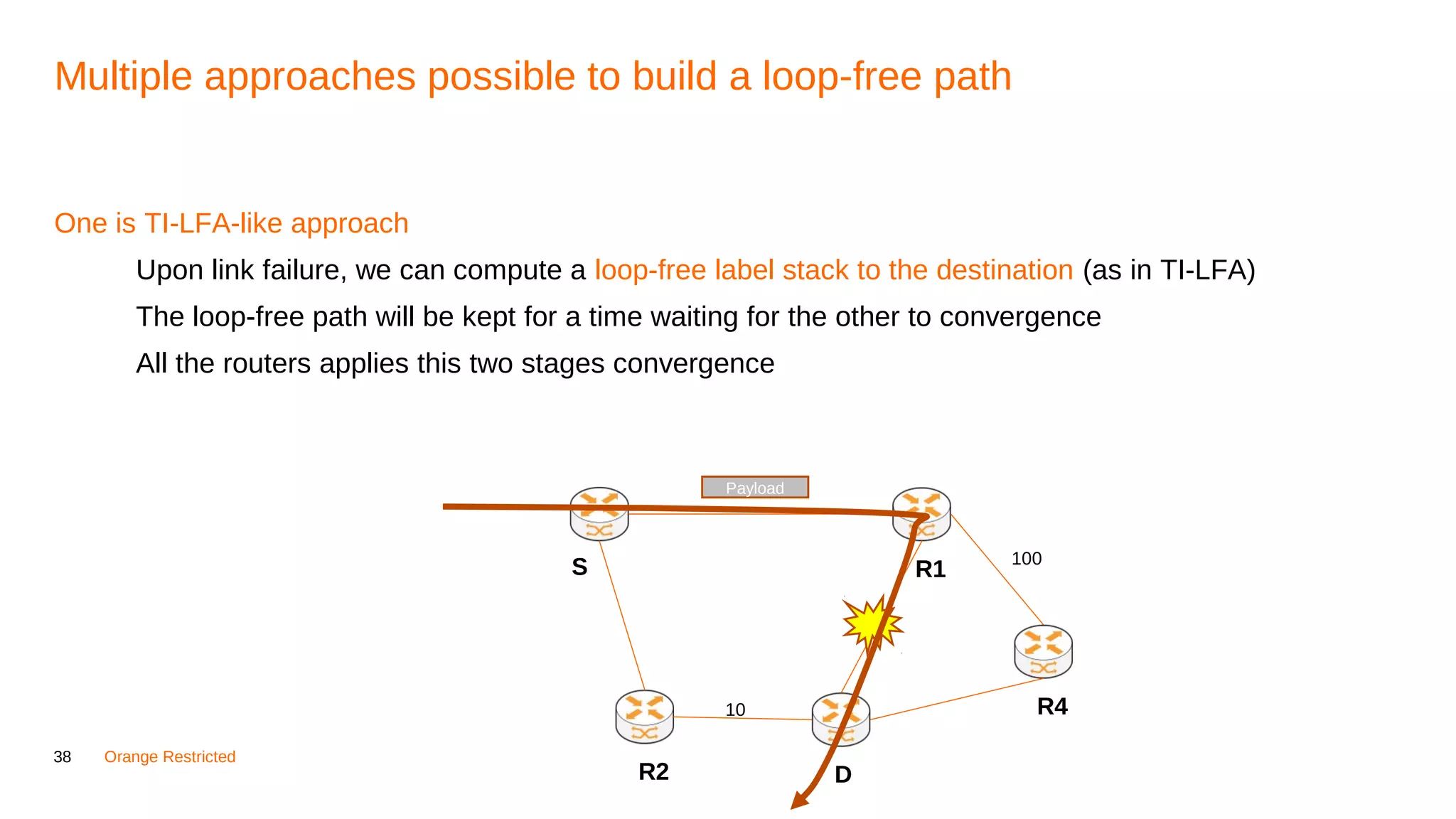
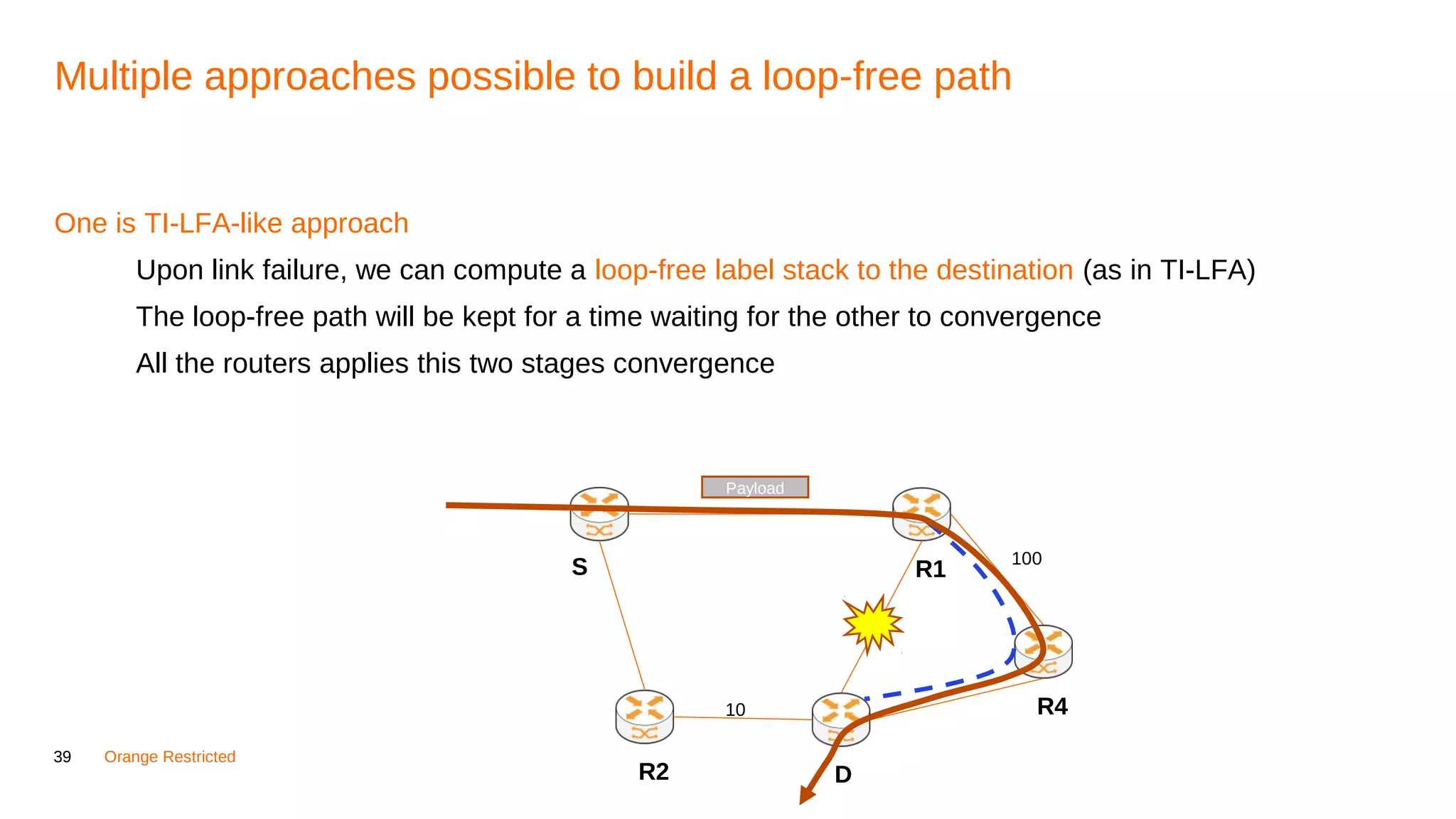
One is TI-LFA-like approach
Upon link failure, we can compute a loop-free label stack to the destination (as in TI-LFA)
The loop-free path will be kept for a time waiting for the other to convergence
All the routers applies this two stages convergence
R1S
DR2
10 R4
100
37 Orange Restricted
Multiple approaches possible to build a loop-free path
One is TI-LFA-like approach
Upon link failure, we can compute a loop-free label stack to the destination (as in TI-LFA)
The loop-free path will be kept for a time waiting for the other to convergence
All the routers applies this two stages convergence
R1S
DR2
10 R4
100
Payload
38 Orange Restricted
Multiple approaches possible to build a loop-free path
One is TI-LFA-like approach
Upon link failure, we can compute a loop-free label stack to the destination (as in TI-LFA)
The loop-free path will be kept for a time waiting for the other to convergence
All the routers applies this two stages convergence
R1S
DR2
10 R4
100
Payload
39 Orange Restricted
Multiple approaches possible to build a loop-free path
One is TI-LFA-like approach
Upon link failure, we can compute a loop-free label stack to the destination (as in TI-LFA)
The loop-free path will be kept for a time waiting for the other to convergence
All the routers applies this two stages convergence
R1S
DR2
10 R4
100
Payload
40 Orange Restricted
Multiple approaches possible to build a loop-free path
One is TI-LFA-like approach
Upon link failure, we can compute a loop-free label stack to the destination (as in TI-LFA)
The loop-free path will be kept for a time waiting for the other to convergence
All the routers applies this two stages convergence
R1S
DR2
10 R4
100
Payload
41 Orange Restricted
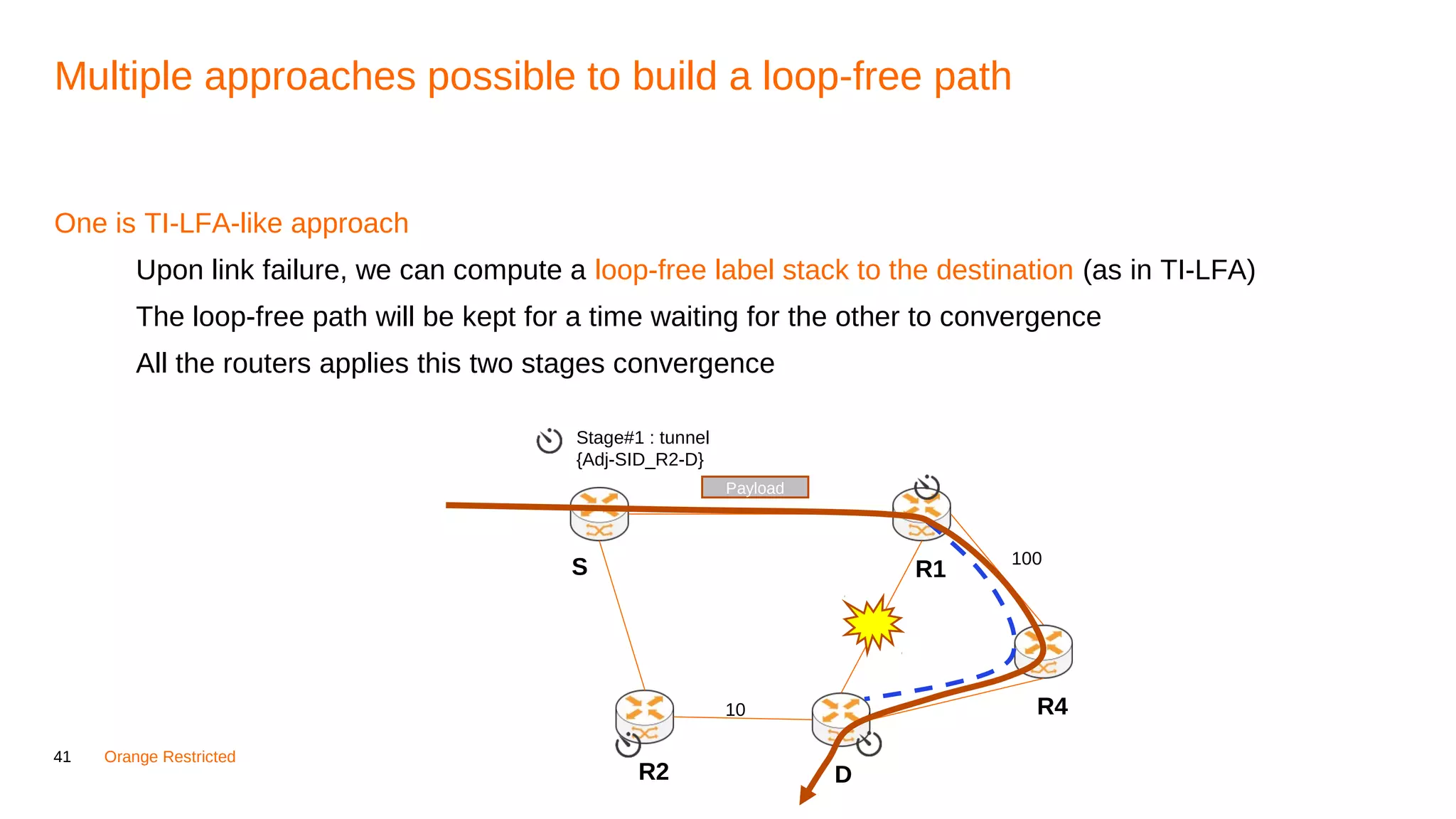
Multiple approaches possible to build a loop-free path
One is TI-LFA-like approach
Upon link failure, we can compute a loop-free label stack to the destination (as in TI-LFA)
The loop-free path will be kept for a time waiting for the other to convergence
All the routers applies this two stages convergence
R1S
DR2
10 R4
100
Payload
Stage#1 : tunnel
{Adj-SID_R2-D}
42 Orange Restricted
Multiple approaches possible to build a loop-free path
One is TI-LFA-like approach
Upon link failure, we can compute a loop-free label stack to the destination (as in TI-LFA)
The loop-free path will be kept for a time waiting for the other to convergence
All the routers applies this two stages convergence
R1S
DR2
10 R4
100
Stage#1 : tunnel
{Adj-SID_R2-D}
Payload
Adj-
SID_R2-D
43 Orange Restricted
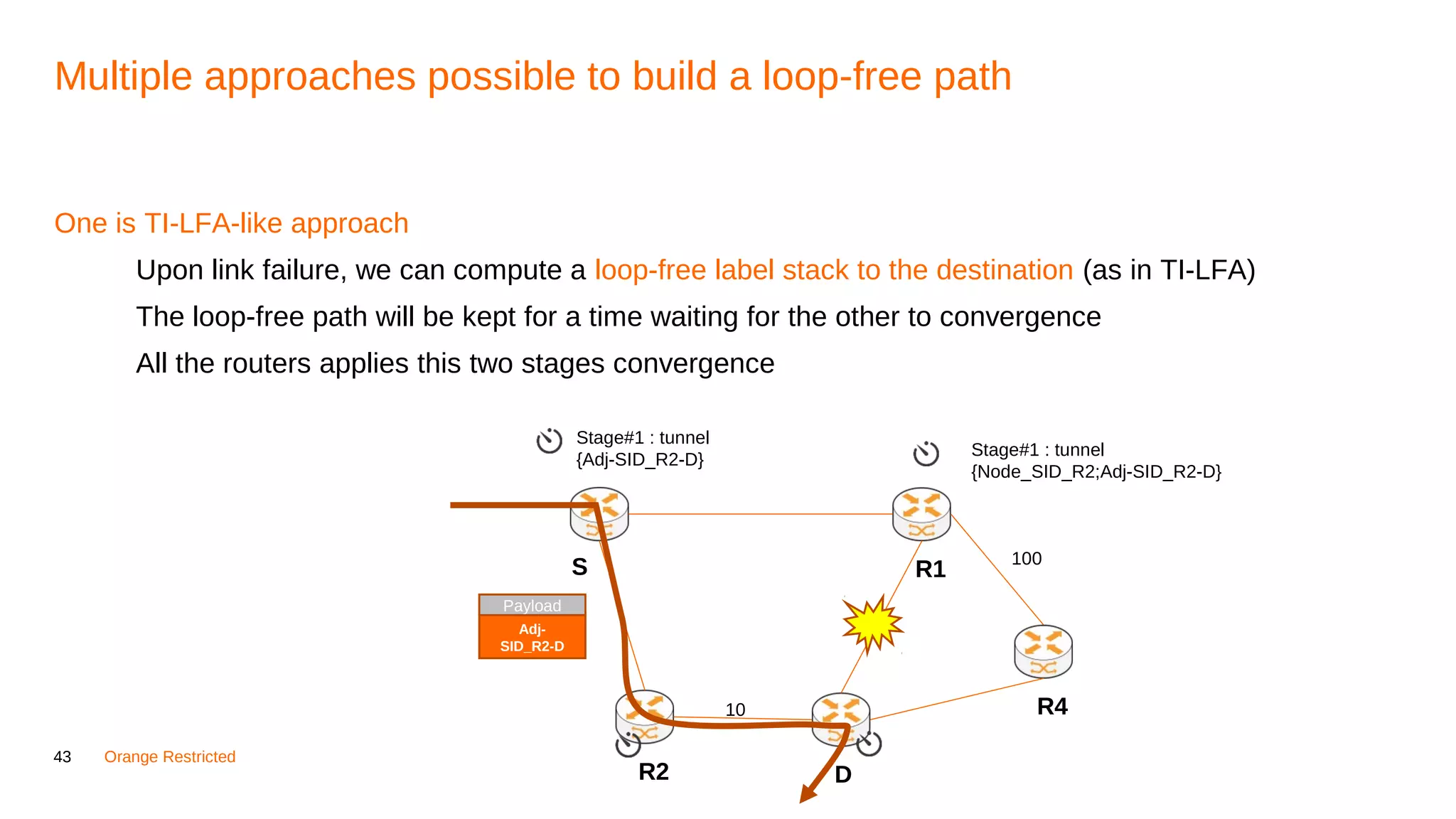
Multiple approaches possible to build a loop-free path
One is TI-LFA-like approach
Upon link failure, we can compute a loop-free label stack to the destination (as in TI-LFA)
The loop-free path will be kept for a time waiting for the other to convergence
All the routers applies this two stages convergence
R1S
DR2
10 R4
100
Stage#1 : tunnel
{Adj-SID_R2-D}
Payload
Adj-
SID_R2-D
Stage#1 : tunnel
{Node_SID_R2;Adj-SID_R2-D}
44 Orange Restricted
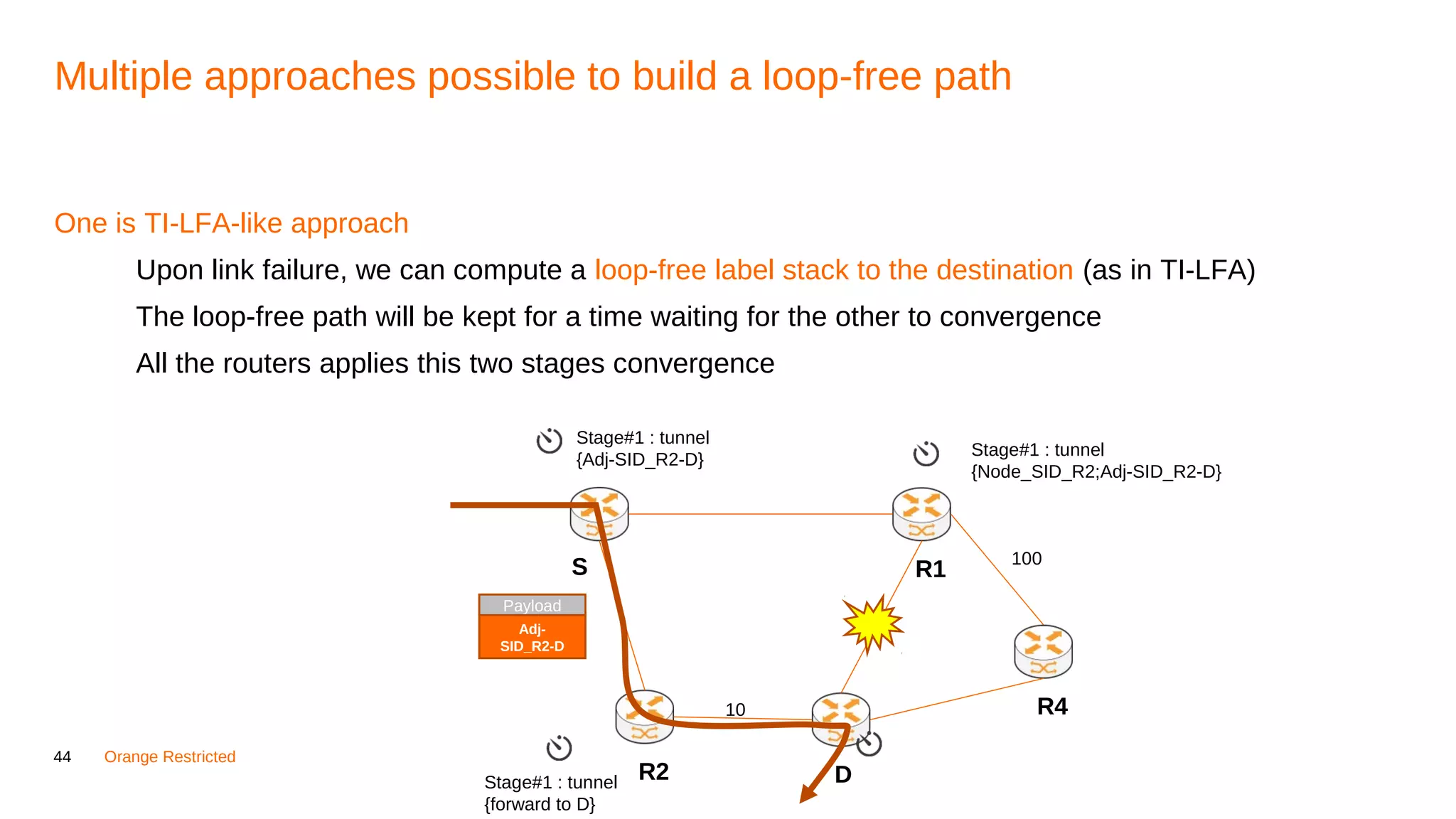
Multiple approaches possible to build a loop-free path
One is TI-LFA-like approach
Upon link failure, we can compute a loop-free label stack to the destination (as in TI-LFA)
The loop-free path will be kept for a time waiting for the other to convergence
All the routers applies this two stages convergence
R1S
DR2
10 R4
100
Stage#1 : tunnel
{Adj-SID_R2-D}
Payload
Adj-
SID_R2-D
Stage#1 : tunnel
{Node_SID_R2;Adj-SID_R2-D}
Stage#1 : tunnel
{forward to D}
45 Orange Restricted
Multiple approaches possible to build a loop-free path
One is TI-LFA-like approach
Upon link failure, we can compute a loop-free label stack to the destination (as in TI-LFA)
The loop-free path will be kept for a time waiting for the other to convergence
All the routers applies this two stages convergence
R1S
DR2
10 R4
100
Payload
Stage#1 : tunnel
{Node_SID_R2;Adj-SID_R2-D}
Stage#1 : tunnel
{forward to D}
Stage#2 :
normal FIB
update
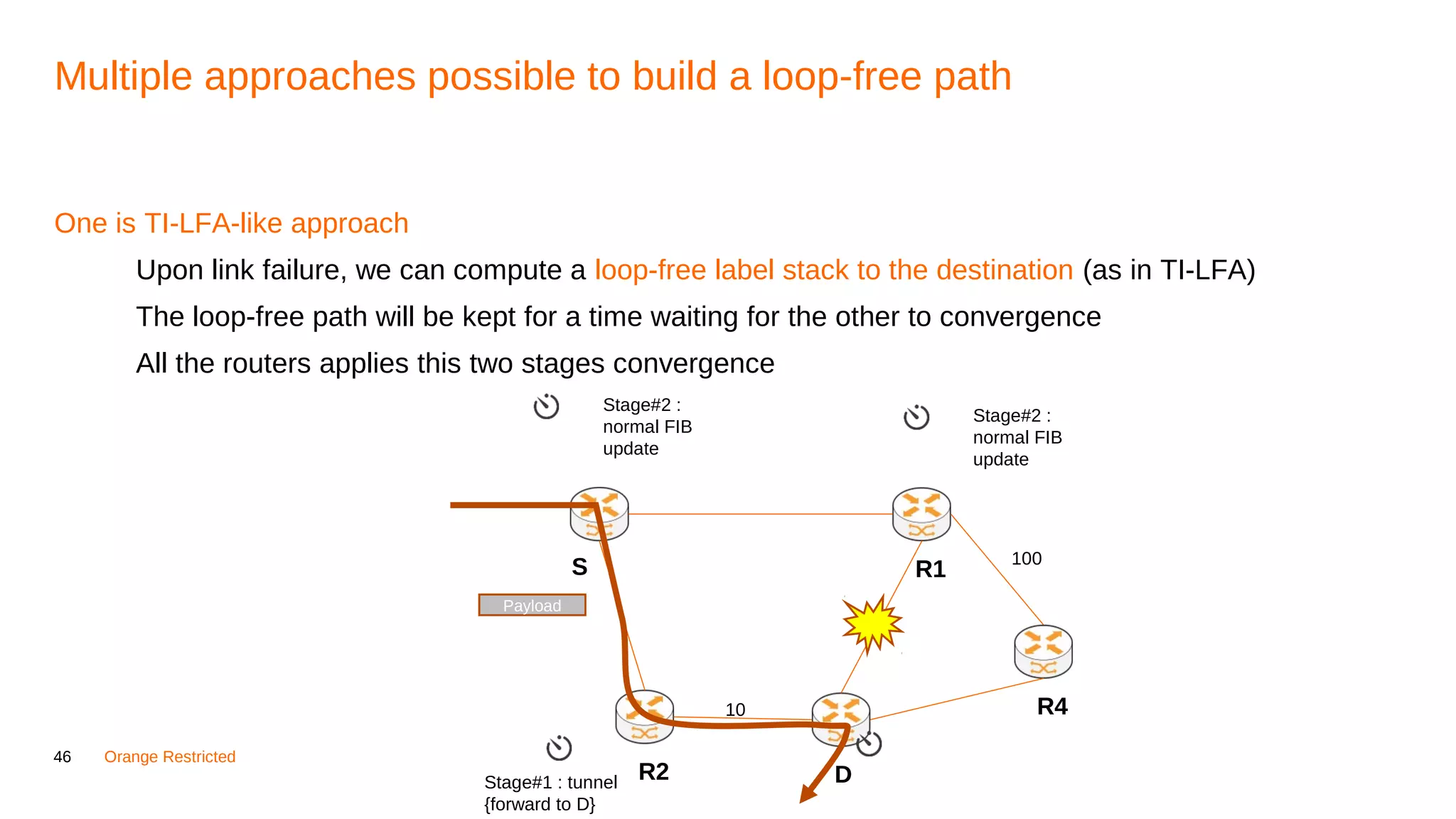
46 Orange Restricted
Multiple approaches possible to build a loop-free path
One is TI-LFA-like approach
Upon link failure, we can compute a loop-free label stack to the destination (as in TI-LFA)
The loop-free path will be kept for a time waiting for the other to convergence
All the routers applies this two stages convergence
R1S
DR2
10 R4
100
Payload
Stage#1 : tunnel
{forward to D}
Stage#2 :
normal FIB
update
Stage#2 :
normal FIB
update
47 Orange Restricted
Multiple approaches possible to build a loop-free path
One is TI-LFA-like approach
Upon link failure, we can compute a loop-free label stack to the destination (as in TI-LFA)
The loop-free path will be kept for a time waiting for the other to convergence
All the routers applies this two stages convergence
R1S
DR2
10 R4
100
Payload
Stage#2 :
normal FIB
update
Stage#2 :
normal FIB
update
Stage#2 : normal FIB
update
48 Orange Restricted
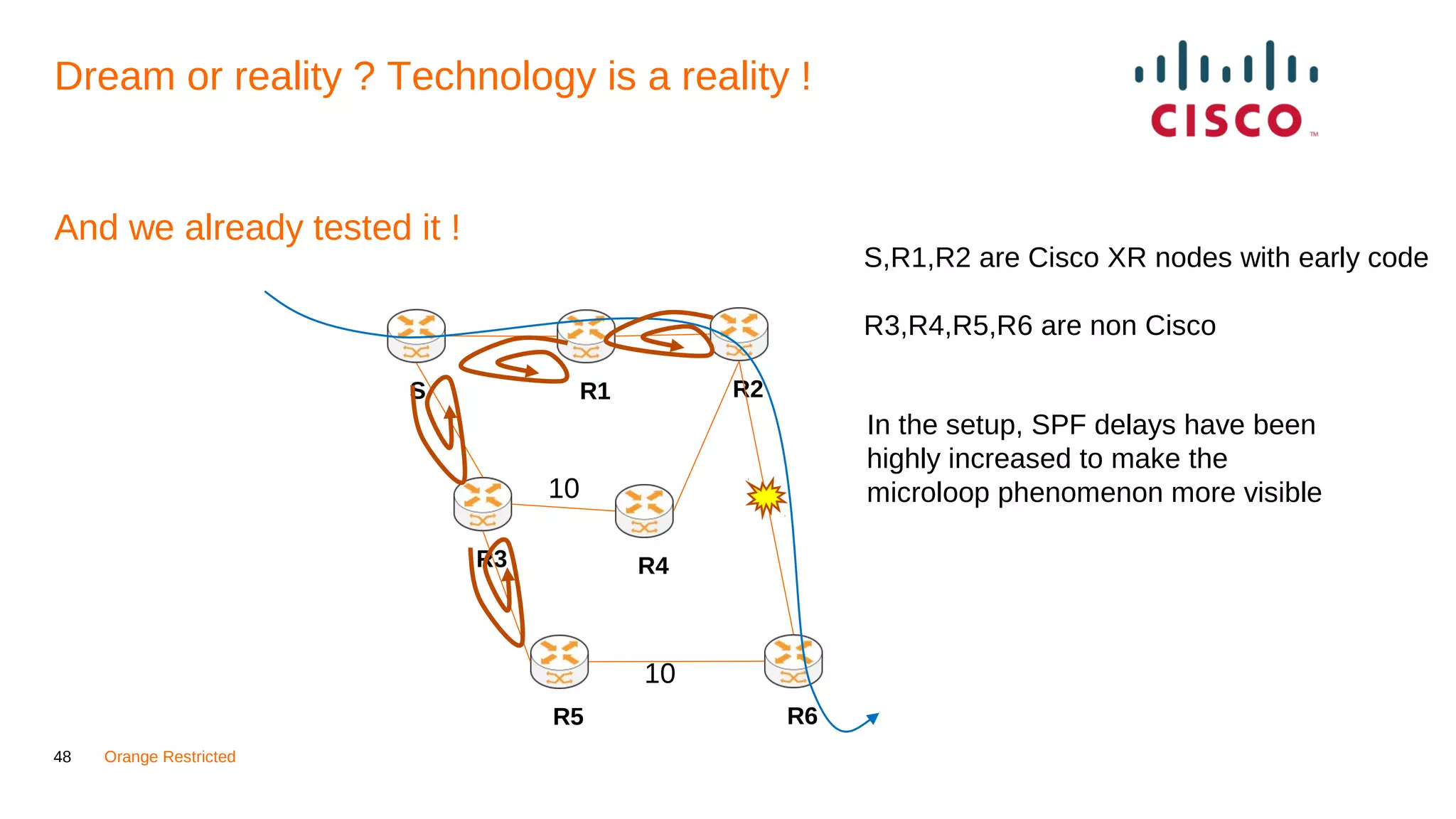
Dream or reality ? Technology is a reality !
And we already tested it !
R2R1S
R3 R4
R5 R6
10
10
S,R1,R2 are Cisco XR nodes with early code
R3,R4,R5,R6 are non Cisco
In the setup, SPF delays have been
highly increased to make the
microloop phenomenon more visible
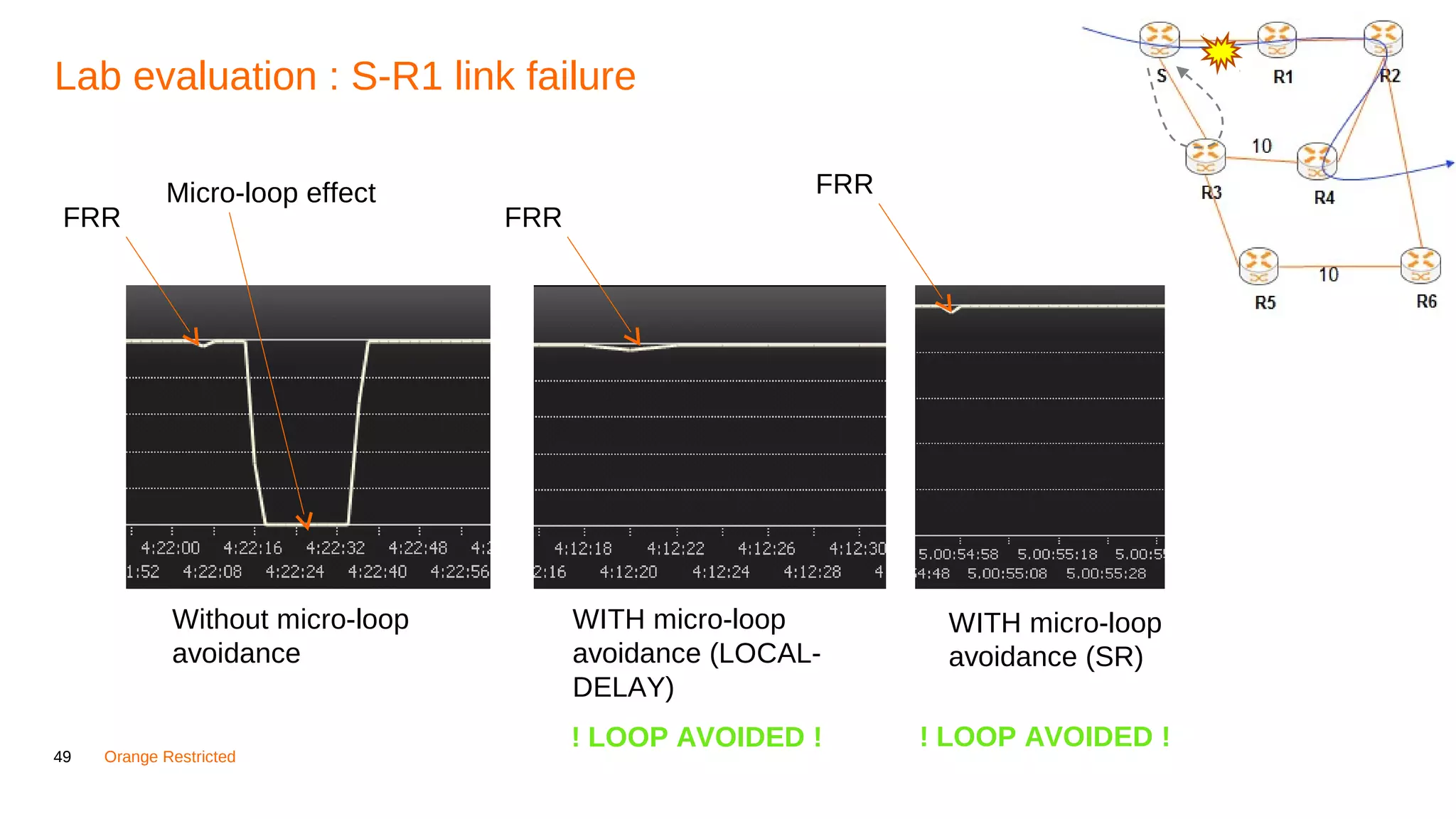
49 Orange Restricted
Lab evaluation : S-R1 link failure
Without micro-loop
avoidance
FRR
Micro-loop effect
WITH micro-loop
avoidance (LOCAL-
DELAY)
FRR
! LOOP AVOIDED !
FRR
! LOOP AVOIDED !
WITH micro-loop
avoidance (SR)
50 Orange Restricted
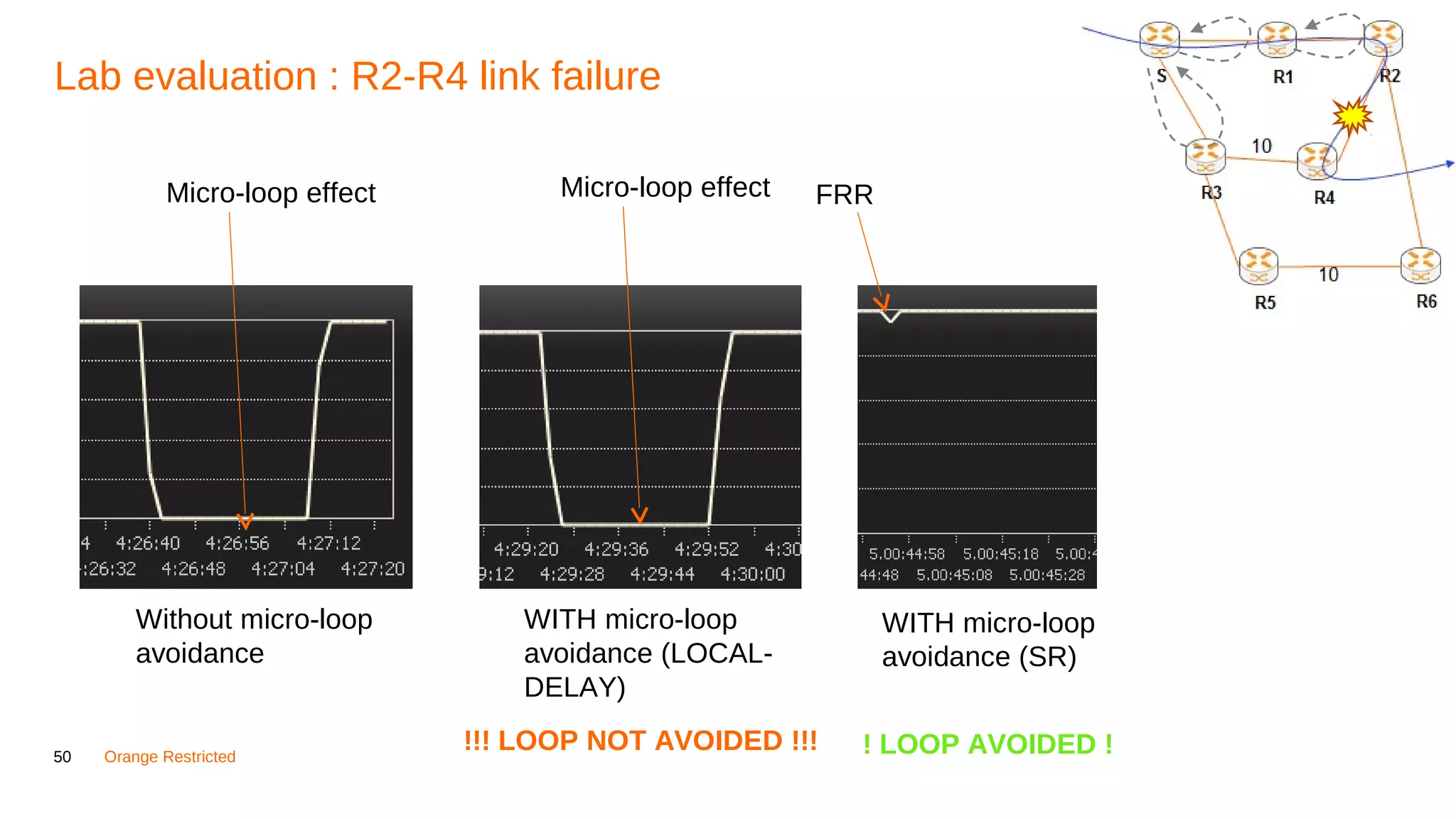
Lab evaluation : R2-R4 link failure
Without micro-loop
avoidance
Micro-loop effect
WITH micro-loop
avoidance (LOCAL-
DELAY)
Micro-loop effect
!!! LOOP NOT AVOIDED !!!
FRR
WITH micro-loop
avoidance (SR)
! LOOP AVOIDED !
51 Orange Restricted
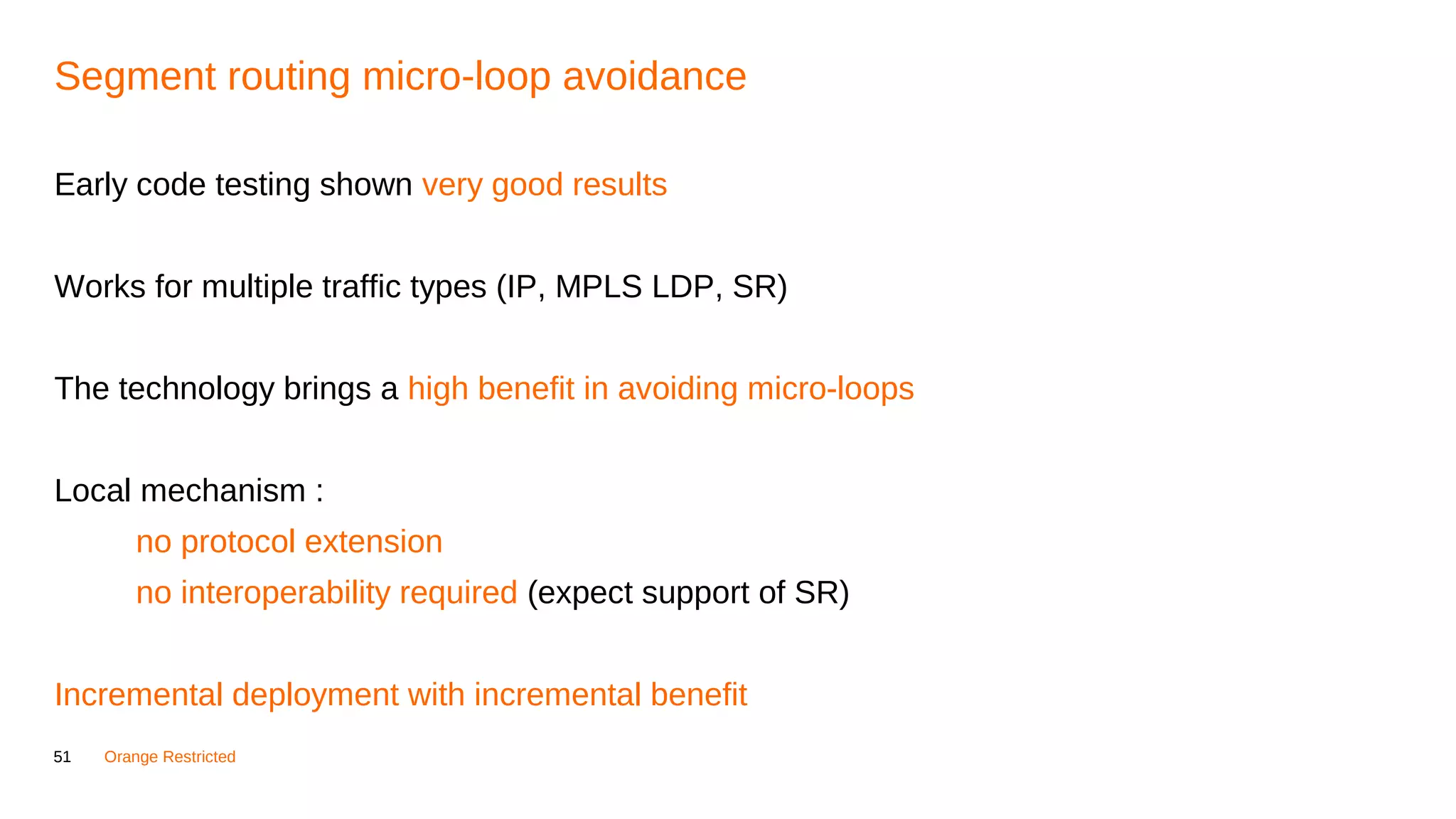
Segment routing micro-loop avoidance
Early code testing shown very good results
Works for multiple traffic types (IP, MPLS LDP, SR)
The technology brings a high benefit in avoiding micro-loops
Local mechanism :
no protocol extension
no interoperability required (expect support of SR)
Incremental deployment with incremental benefit
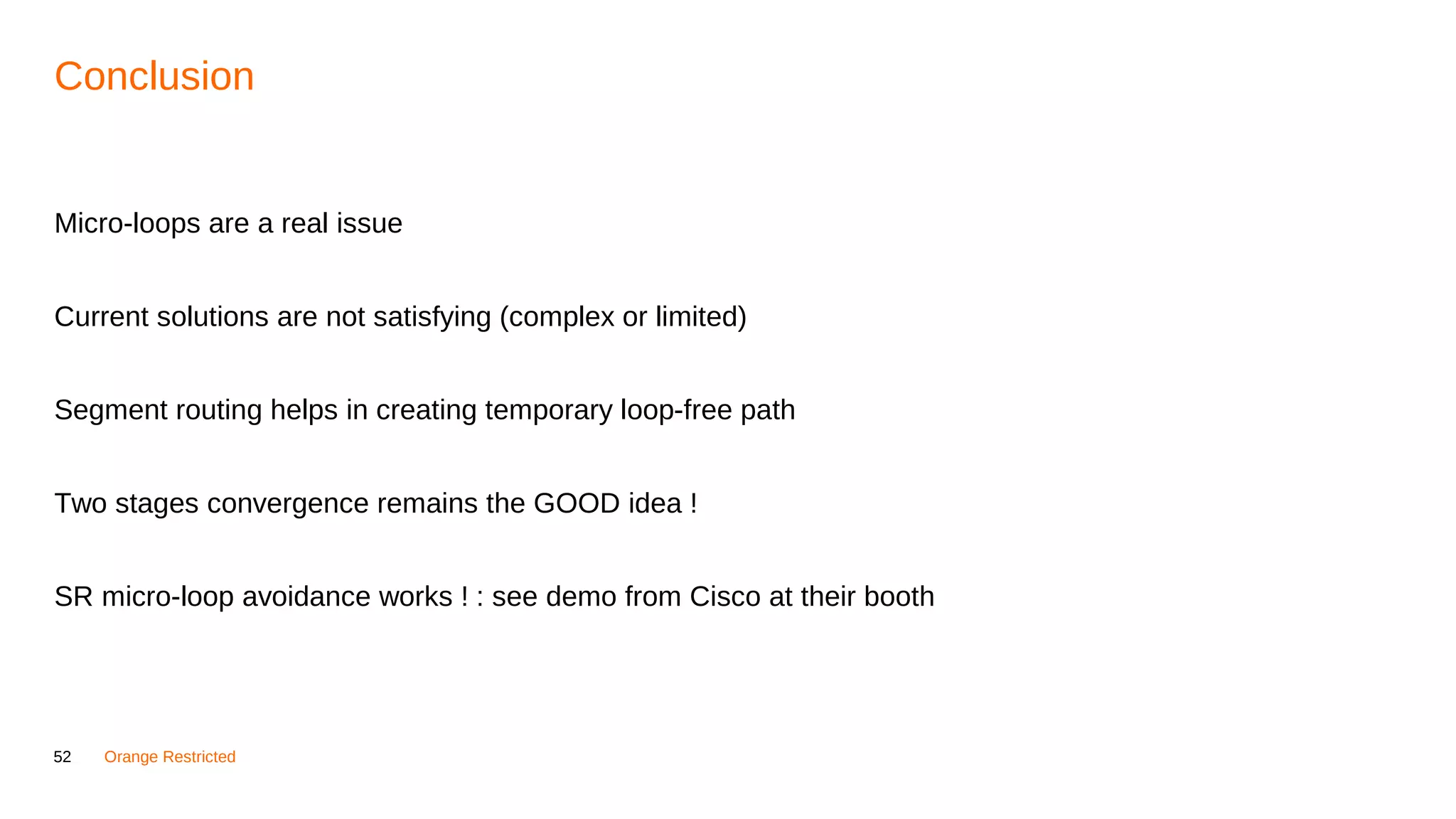
52 Orange Restricted
Conclusion
Micro-loops are a real issue
Current solutions are not satisfying (complex or limited)
Segment routing helps in creating temporary loop-free path
Two stages convergence remains the GOOD idea !
SR micro-loop avoidance works ! : see demo from Cisco at their booth
53 Orange Restricted
Thank you

MPLS SDN 2016 - Microloop avoidance with segment routing

  • 1.
    1 Orange Restricted Avoidingmicro-loops using Segment Routing Stéphane LITKOWSKI Network Architect, Orange Expert
  • 2.
    2 Orange Restricted Amicro-loop ? Does my network have loops ? Micro-loops are a natural phenomenon in hop by hop routed networks This applies to MPLS networks ! Caused by a transient disagreement between routers during convergence Good and bad events may create loops Duration of micro-loop depends of convergence time S N1 N2 D 1 101 1
  • 3.
    3 Orange Restricted Amicro-loop ? Does my network have loops ? Micro-loops are a natural phenomenon in hop by hop routed networks This applies to MPLS networks ! Caused by a transient disagreement between routers during convergence Good and bad events may create loops Duration of micro-loop depends of convergence time S N1 N2 D 1 101 1
  • 4.
    4 Orange Restricted Amicro-loop ? Does my network have loops ? Micro-loops are a natural phenomenon in hop by hop routed networks This applies to MPLS networks ! Caused by a transient disagreement between routers during convergence Good and bad events may create loops Duration of micro-loop depends of convergence time S N1 N2 D 1 101 1
  • 5.
    5 Orange Restricted Amicro-loop ? Does my network have loops ? Micro-loops are a natural phenomenon in hop by hop routed networks This applies to MPLS networks ! Caused by a transient disagreement between routers during convergence Good and bad events may create loops Duration of micro-loop depends of convergence time S N1 N2 D 1 101 1
  • 6.
    6 Orange Restricted Amicro-loop ? Does my network have loops ? Micro-loops are a natural phenomenon in hop by hop routed networks This applies to MPLS networks ! Caused by a transient disagreement between routers during convergence Good and bad events may create loops Duration of micro-loop depends of convergence time S N1 N2 D 1 101 1 ! SLOW !
  • 7.
    7 Orange Restricted Amicro-loop ? Does my network have loops ? Micro-loops are a natural phenomenon in hop by hop routed networks This applies to MPLS networks ! Caused by a transient disagreement between routers during convergence Good and bad events may create loops Duration of micro-loop depends of convergence time S N1 N2 D 1 101 1 ! SLOW !
  • 8.
    8 Orange Restricted Amicro-loop ? Does my network have loops ? Micro-loops are a natural phenomenon in hop by hop routed networks This applies to MPLS networks ! Caused by a transient disagreement between routers during convergence Good and bad events may create loops Duration of micro-loop depends of convergence time S N1 N2 D 1 101 1
  • 9.
    9 Orange Restricted Wheredo micro-loops happen ? Anywhere ! They can be local or remote ! R1 R4 R2 DS 10 111 1 R3 Local loop Remote loop Remote loop
  • 10.
    10 Orange Restricted Whydo I need to take of micro-loops ? Micro-loops break Fast-reroute ! Micro-loops affect traffic which is not concerned by the topology change ! Traffic between S and N2 suffers of packet loss ! 100Mbps of traffic entering a loop on a 5ms RTD link will become 1Gbps in about 40msec ! S N1 N2 D 1 101 1Traffic Time
  • 11.
    11 Orange Restricted Whydo I need to take of micro-loops ? Micro-loops break Fast-reroute ! Micro-loops affect traffic which is not concerned by the topology change ! Traffic between S and N2 suffers of packet loss ! 100Mbps of traffic entering a loop on a 5ms RTD link will become 1Gbps in about 40msec ! S N1 N2 D 1 101 1Traffic Time
  • 12.
    12 Orange Restricted Whydo I need to take of micro-loops ? Micro-loops break Fast-reroute ! Micro-loops affect traffic which is not concerned by the topology change ! Traffic between S and N2 suffers of packet loss ! 100Mbps of traffic entering a loop on a 5ms RTD link will become 1Gbps in about 40msec ! S N1 N2 D 1 101 1Traffic Time
  • 13.
    13 Orange Restricted Whydo I need to take of micro-loops ? Micro-loops break Fast-reroute ! Micro-loops affect traffic which is not concerned by the topology change ! Traffic between S and N2 suffers of packet loss ! 100Mbps of traffic entering a loop on a 5ms RTD link will become 1Gbps in about 40msec ! S N1 N2 D 1 101 1 FRR ! Traffic Time
  • 14.
    14 Orange Restricted Whydo I need to take of micro-loops ? Micro-loops break Fast-reroute ! Micro-loops affect traffic which is not concerned by the topology change ! Traffic between S and N2 suffers of packet loss ! 100Mbps of traffic entering a loop on a 5ms RTD link will become 1Gbps in about 40msec ! S N1 N2 D 1 101 1 FRR ! Traffic Time
  • 15.
    15 Orange Restricted Whydo I need to take of micro-loops ? Micro-loops break Fast-reroute ! Micro-loops affect traffic which is not concerned by the topology change ! Traffic between S and N2 suffers of packet loss ! 100Mbps of traffic entering a loop on a 5ms RTD link will become 1Gbps in about 40msec ! S N1 N2 D 1 101 1 ! SLOW ! FRR ! Traffic Time
  • 16.
    16 Orange Restricted Whydo I need to take of micro-loops ? Micro-loops break Fast-reroute ! Micro-loops affect traffic which is not concerned by the topology change ! Traffic between S and N2 suffers of packet loss ! 100Mbps of traffic entering a loop on a 5ms RTD link will become 1Gbps in about 40msec ! S N1 N2 D 1 101 1 ! SLOW ! Traffic Time
  • 17.
    17 Orange Restricted Whydo I need to take of micro-loops ? Micro-loops break Fast-reroute ! Micro-loops affect traffic which is not concerned by the topology change ! Traffic between S and N2 suffers of packet loss ! 100Mbps of traffic entering a loop on a 5ms RTD link will become 1Gbps in about 40msec ! S N1 N2 D 1 101 1Traffic Time
  • 18.
    18 Orange Restricted Whydo I need to take of micro-loops ? Micro-loops break Fast-reroute ! Micro-loops affect traffic which is not concerned by the topology change ! Traffic between S and N2 suffers of packet loss ! 100Mbps of traffic entering a loop on a 5ms RTD link will become 1Gbps in about 40msec ! S N1 N2 D 1 101 1Traffic Time
  • 19.
    19 Orange Restricted Whydo I need to take of micro-loops ? Micro-loops break Fast-reroute ! Micro-loops affect traffic which is not concerned by the topology change ! Traffic between S and N2 suffers of packet loss ! 100Mbps of traffic entering a loop on a 5ms RTD link will become 1Gbps in about 40msec ! S N1 N2 D 1 101 1Traffic Time Link congestion !
  • 20.
    20 Orange Restricted Strategiesto address micro-loop issues Not a new topic ! Look at RFC5715 .. Mitigation • Drop looping packets (not so easy !) • Converge faster (minimize micro-loop duration) Avoidance • Local delay (draft-ietf-rtgwg-uloop-delay) • Ordered FIB (RFC6976) • PLSN (RFC5715) • Incremental metric (INFOCOM 2007 paper from P. Francois, M. Shand, O. Bonaventure) • …
  • 21.
    22 Orange Restricted Strategiesto avoid micro-loops Local delay = OFIB(1) Upon link down, only local router will delay its convergence Upon link up, local router will delay flooding Solves only local micro-loops Multiple implementations available for link down event S N R1 R2 D N2 I will delay by 1200msec I will delay by 1200msec
  • 22.
    23 Orange Restricted Conclusionon current state of the art No definitive solution to avoid micro-loops Local delay is good but not perfect  Mitigation is not enough and sometimes complex to implement How can we improve ?
  • 23.
    24 Orange Restricted Whynot using Segment Routing ? Segment Routing can build a loop-free path See my talks in 2014 and 2015 on TI-LFA Why not applying a temporary loop-free path ? Two stages convergence Stage#1 : use loop-free path (timer based) Stage#2 : use standard path S N R1 D N2 10 Node_SID_N2 Adj_SID_N2R1 Payload
  • 24.
    36 Orange Restricted Multipleapproaches possible to build a loop-free path One is TI-LFA-like approach Upon link failure, we can compute a loop-free label stack to the destination (as in TI-LFA) The loop-free path will be kept for a time waiting for the other to convergence All the routers applies this two stages convergence R1S DR2 10 R4 100
  • 25.
    37 Orange Restricted Multipleapproaches possible to build a loop-free path One is TI-LFA-like approach Upon link failure, we can compute a loop-free label stack to the destination (as in TI-LFA) The loop-free path will be kept for a time waiting for the other to convergence All the routers applies this two stages convergence R1S DR2 10 R4 100 Payload
  • 26.
    38 Orange Restricted Multipleapproaches possible to build a loop-free path One is TI-LFA-like approach Upon link failure, we can compute a loop-free label stack to the destination (as in TI-LFA) The loop-free path will be kept for a time waiting for the other to convergence All the routers applies this two stages convergence R1S DR2 10 R4 100 Payload
  • 27.
    39 Orange Restricted Multipleapproaches possible to build a loop-free path One is TI-LFA-like approach Upon link failure, we can compute a loop-free label stack to the destination (as in TI-LFA) The loop-free path will be kept for a time waiting for the other to convergence All the routers applies this two stages convergence R1S DR2 10 R4 100 Payload
  • 28.
    40 Orange Restricted Multipleapproaches possible to build a loop-free path One is TI-LFA-like approach Upon link failure, we can compute a loop-free label stack to the destination (as in TI-LFA) The loop-free path will be kept for a time waiting for the other to convergence All the routers applies this two stages convergence R1S DR2 10 R4 100 Payload
  • 29.
    41 Orange Restricted Multipleapproaches possible to build a loop-free path One is TI-LFA-like approach Upon link failure, we can compute a loop-free label stack to the destination (as in TI-LFA) The loop-free path will be kept for a time waiting for the other to convergence All the routers applies this two stages convergence R1S DR2 10 R4 100 Payload Stage#1 : tunnel {Adj-SID_R2-D}
  • 30.
    42 Orange Restricted Multipleapproaches possible to build a loop-free path One is TI-LFA-like approach Upon link failure, we can compute a loop-free label stack to the destination (as in TI-LFA) The loop-free path will be kept for a time waiting for the other to convergence All the routers applies this two stages convergence R1S DR2 10 R4 100 Stage#1 : tunnel {Adj-SID_R2-D} Payload Adj- SID_R2-D
  • 31.
    43 Orange Restricted Multipleapproaches possible to build a loop-free path One is TI-LFA-like approach Upon link failure, we can compute a loop-free label stack to the destination (as in TI-LFA) The loop-free path will be kept for a time waiting for the other to convergence All the routers applies this two stages convergence R1S DR2 10 R4 100 Stage#1 : tunnel {Adj-SID_R2-D} Payload Adj- SID_R2-D Stage#1 : tunnel {Node_SID_R2;Adj-SID_R2-D}
  • 32.
    44 Orange Restricted Multipleapproaches possible to build a loop-free path One is TI-LFA-like approach Upon link failure, we can compute a loop-free label stack to the destination (as in TI-LFA) The loop-free path will be kept for a time waiting for the other to convergence All the routers applies this two stages convergence R1S DR2 10 R4 100 Stage#1 : tunnel {Adj-SID_R2-D} Payload Adj- SID_R2-D Stage#1 : tunnel {Node_SID_R2;Adj-SID_R2-D} Stage#1 : tunnel {forward to D}
  • 33.
    45 Orange Restricted Multipleapproaches possible to build a loop-free path One is TI-LFA-like approach Upon link failure, we can compute a loop-free label stack to the destination (as in TI-LFA) The loop-free path will be kept for a time waiting for the other to convergence All the routers applies this two stages convergence R1S DR2 10 R4 100 Payload Stage#1 : tunnel {Node_SID_R2;Adj-SID_R2-D} Stage#1 : tunnel {forward to D} Stage#2 : normal FIB update
  • 34.
    46 Orange Restricted Multipleapproaches possible to build a loop-free path One is TI-LFA-like approach Upon link failure, we can compute a loop-free label stack to the destination (as in TI-LFA) The loop-free path will be kept for a time waiting for the other to convergence All the routers applies this two stages convergence R1S DR2 10 R4 100 Payload Stage#1 : tunnel {forward to D} Stage#2 : normal FIB update Stage#2 : normal FIB update
  • 35.
    47 Orange Restricted Multipleapproaches possible to build a loop-free path One is TI-LFA-like approach Upon link failure, we can compute a loop-free label stack to the destination (as in TI-LFA) The loop-free path will be kept for a time waiting for the other to convergence All the routers applies this two stages convergence R1S DR2 10 R4 100 Payload Stage#2 : normal FIB update Stage#2 : normal FIB update Stage#2 : normal FIB update
  • 36.
    48 Orange Restricted Dreamor reality ? Technology is a reality ! And we already tested it ! R2R1S R3 R4 R5 R6 10 10 S,R1,R2 are Cisco XR nodes with early code R3,R4,R5,R6 are non Cisco In the setup, SPF delays have been highly increased to make the microloop phenomenon more visible
  • 37.
    49 Orange Restricted Labevaluation : S-R1 link failure Without micro-loop avoidance FRR Micro-loop effect WITH micro-loop avoidance (LOCAL- DELAY) FRR ! LOOP AVOIDED ! FRR ! LOOP AVOIDED ! WITH micro-loop avoidance (SR)
  • 38.
    50 Orange Restricted Labevaluation : R2-R4 link failure Without micro-loop avoidance Micro-loop effect WITH micro-loop avoidance (LOCAL- DELAY) Micro-loop effect !!! LOOP NOT AVOIDED !!! FRR WITH micro-loop avoidance (SR) ! LOOP AVOIDED !
  • 39.
    51 Orange Restricted Segmentrouting micro-loop avoidance Early code testing shown very good results Works for multiple traffic types (IP, MPLS LDP, SR) The technology brings a high benefit in avoiding micro-loops Local mechanism : no protocol extension no interoperability required (expect support of SR) Incremental deployment with incremental benefit
  • 40.
    52 Orange Restricted Conclusion Micro-loopsare a real issue Current solutions are not satisfying (complex or limited) Segment routing helps in creating temporary loop-free path Two stages convergence remains the GOOD idea ! SR micro-loop avoidance works ! : see demo from Cisco at their booth
  • 41.