Moving Security Model
From Content To Context


        Quick Random Thoughts on
 Security Trends and Technologies for 2012

                Paolo Passeri


                                       paulsparrows.wordpress.com
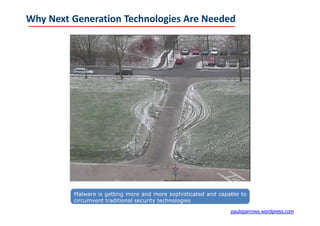
Why Next Generation Technologies Are Needed


         Malware is getting more and more sophisticated and capable to
         circumvent traditional security technologies

                                                                paulsparrows.wordpress.com
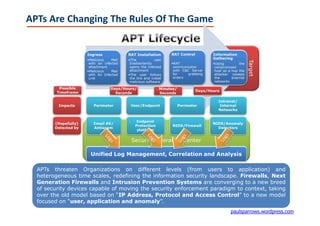
APTs Are Changing The Rules Of The Game


  APTs threaten Organizations on different levels (from users to application) and
  heterogeneous time scales, redefining the information security landscape. Firewalls, Next
  Generation Firewalls and Intrusion Prevention Systems are converging to a new breed
  of security devices capable of moving the security enforcement paradigm to context, taking
  over the old model based on “IP Address, Protocol and Access Control” to a new model
  focused on “user, application and anomaly”.
                                                                        paulsparrows.wordpress.com
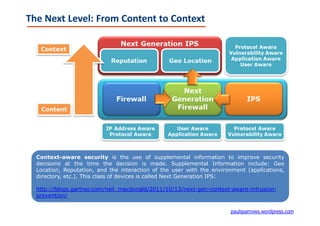
The Next Level: From Content to Context


  Context-aware security is the use of supplemental information to improve security
  decisions at the time the decision is made. Supplemental Information include: Geo
  Location, Reputation, and the interaction of the user with the environment (applications,
  directory, etc.). This class of devices is called Next Generation IPS:

  http://blogs.gartner.com/neil_macdonald/2011/10/13/next-gen-context-aware-intrusion-
  prevention/

                                                                       paulsparrows.wordpress.com
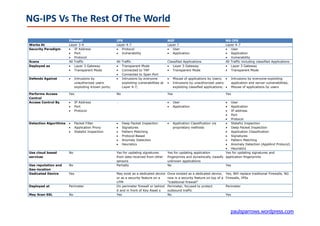
NG-IPS Vs The Rest Of The World
                       Firewall                        IPS                                   NGF                                       NG-IPS
Works At               Layer 3-4                       Layer 4-7                             Layer 7                                   Layer 4-7
Security Paradigm      • IP Address                    • Protocol                            • User                                    • User
                       • Port                          • Vulnerability                       • Application                             • Application
                       • Protocol                                                                                                      • Vulnerability
Scans                  All Traffic                     All   Traffic                         Classified Applications                   All Traffic including classified Applications
Deployed as            • Layer 3 Gateway               •     Transparent Mode                • Layer 3 Gateway                         • Layer 3 Gateway
                       • Transparent Mode              •     Connected to TAP                • Transparent Mode                        • Transparent Mode
                                                       •     Connected to Span Port
Defends Against        •     Intrusions by             •     Intrusions by everyone          •     Misuse of applications by Users; •        Intrusions by everyone exploiting
                             unauthorized users              exploiting vulnerabilities at   •     Intrusions by unauthorized users          application and server vulnerabilities,
                             exploiting known ports;         Layer 4-7;                            exploiting classified applications; •     Misuse of applications by users

Performs Access        Yes                             No                                    Yes                                       Yes
Control
Access Control By      •     IP Address                -                                     •     User                            • User
                       •     Port                                                            •     Application                     • Application
                       •     Protocol                                                                                              • IP address
                                                                                                                                   • Port
                                                                                                                                   • Protocol
Detection Algorithms   •     Packet Filter             •     Deep Packet Inspection          • Application Classification via      • Stateful Inspection
                       •     Application Proxy         •     Signatures                          proprietary methods               • Deep Packet Inspection
                       •     Stateful Inspection       •     Pattern Matching                                                      • Application Classification
                                                       •     Protocol-Based                                                        • Signatures
                                                       •     Anomaly Detection                                                     • Pattern Matching
                                                       •     Heuristics                                                            • Anomaly Detection (ApplAnd Protocol)
                                                                                                                                   • Heuristics
Use cloud based        No                              Yes for updating signatures           Yes for updating application          Yes for updating signatures and
services                                               from data received from other         fingerprints and dynamically classify application fingerprints
                                                       sensors                               unknown applications
Use reputation and     No                              Partially                             No                                    Yes
Geo-location
Dedicated Device       Yes                             May exist as a dedicated device       Once existed as a dedicated device,       Yes, Will replace traditional Firewalls, NG
                                                       or as a security feature on a         now is a security feature on top of a     Firewalls, IPSs
                                                       UTM                                   “traditional firewall”
Deployed at            Perimeter                       On perimeter firewall or behind       Perimeter, focused to protect             Perimeter
                                                       it and in front of Key Asset s        outbound traffic
May Scan SSL           No                              Yes                                   No                                        Yes


                                                                                                                                           paulsparrows.wordpress.com
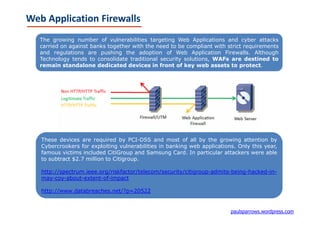
Web Application Firewalls
   The growing number of vulnerabilities targeting Web Applications and cyber attacks
   carried on against banks together with the need to be compliant with strict requirements
   and regulations are pushing the adoption of Web Application Firewalls. Although
   Technology tends to consolidate traditional security solutions, WAFs are destined to
   remain standalone dedicated devices in front of key web assets to protect.


   These devices are required by PCI-DSS and most of all by the growing attention by
   Cybercrookers for exploiting vulnerabilities in banking web applications. Only this year,
   famous victims included CitiGroup and Samsung Card. In particular attackers were able
   to subtract $2.7 million to Citigroup.

   http://spectrum.ieee.org/riskfactor/telecom/security/citigroup-admits-being-hacked-in-
   may-coy-about-extent-of-impact

   http://www.databreaches.net/?p=20522


                                                                          paulsparrows.wordpress.com
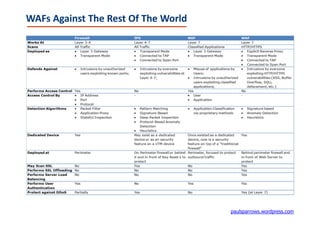
WAFs Against The Rest Of The World


                                     paulsparrows.wordpress.com
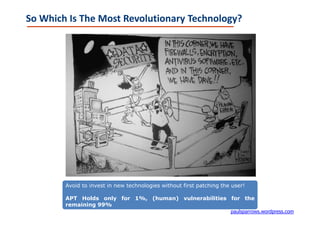
So Which Is The Most Revolutionary Technology?


        Avoid to invest in new technologies without first patching the user!

        APT Holds only for 1%, (human) vulnerabilities for the
        remaining 99%
                                                                      paulsparrows.wordpress.com
References


Oct 5, 2011:    Information, The Next Battlefield
                http://paulsparrows.wordpress.com/2011/10/05/information-the-
                next-battlefield/

Oct 7, 2011:    Next Generation Firewalls and Web Applications Firewall Q&A
                http://paulsparrows.wordpress.com/2011/10/07/next-generation-
                firewalls-and-web-applications-firewall-qa/

Oct 13, 2011:   Advanced Persistent Threats and Security Information Management
                http://paulsparrows.wordpress.com/2011/10/13/apts-and-
                security-information-management/

Oct 27, 2011:   Are You Ready For The Next Generation IPS?
                http://paulsparrows.wordpress.com/2011/10/27/are-you-ready-
                for-the-next-generation-ips/

Nov 20, 2011:   Advanced Persistent Threats and Human Errors
                http://paulsparrows.wordpress.com/2011/11/20/advanced-
                persistent-threats-and-human-errors/

Moving Security Model From Content to Context

  • 1.
    Moving Security Model FromContent To Context Quick Random Thoughts on Security Trends and Technologies for 2012 Paolo Passeri paulsparrows.wordpress.com
  • 2.
    Why Next GenerationTechnologies Are Needed Malware is getting more and more sophisticated and capable to circumvent traditional security technologies paulsparrows.wordpress.com
  • 3.
    APTs Are ChangingThe Rules Of The Game APTs threaten Organizations on different levels (from users to application) and heterogeneous time scales, redefining the information security landscape. Firewalls, Next Generation Firewalls and Intrusion Prevention Systems are converging to a new breed of security devices capable of moving the security enforcement paradigm to context, taking over the old model based on “IP Address, Protocol and Access Control” to a new model focused on “user, application and anomaly”. paulsparrows.wordpress.com
  • 4.
    The Next Level:From Content to Context Context-aware security is the use of supplemental information to improve security decisions at the time the decision is made. Supplemental Information include: Geo Location, Reputation, and the interaction of the user with the environment (applications, directory, etc.). This class of devices is called Next Generation IPS: http://blogs.gartner.com/neil_macdonald/2011/10/13/next-gen-context-aware-intrusion- prevention/ paulsparrows.wordpress.com
  • 5.
    NG-IPS Vs TheRest Of The World Firewall IPS NGF NG-IPS Works At Layer 3-4 Layer 4-7 Layer 7 Layer 4-7 Security Paradigm • IP Address • Protocol • User • User • Port • Vulnerability • Application • Application • Protocol • Vulnerability Scans All Traffic All Traffic Classified Applications All Traffic including classified Applications Deployed as • Layer 3 Gateway • Transparent Mode • Layer 3 Gateway • Layer 3 Gateway • Transparent Mode • Connected to TAP • Transparent Mode • Transparent Mode • Connected to Span Port Defends Against • Intrusions by • Intrusions by everyone • Misuse of applications by Users; • Intrusions by everyone exploiting unauthorized users exploiting vulnerabilities at • Intrusions by unauthorized users application and server vulnerabilities, exploiting known ports; Layer 4-7; exploiting classified applications; • Misuse of applications by users Performs Access Yes No Yes Yes Control Access Control By • IP Address - • User • User • Port • Application • Application • Protocol • IP address • Port • Protocol Detection Algorithms • Packet Filter • Deep Packet Inspection • Application Classification via • Stateful Inspection • Application Proxy • Signatures proprietary methods • Deep Packet Inspection • Stateful Inspection • Pattern Matching • Application Classification • Protocol-Based • Signatures • Anomaly Detection • Pattern Matching • Heuristics • Anomaly Detection (ApplAnd Protocol) • Heuristics Use cloud based No Yes for updating signatures Yes for updating application Yes for updating signatures and services from data received from other fingerprints and dynamically classify application fingerprints sensors unknown applications Use reputation and No Partially No Yes Geo-location Dedicated Device Yes May exist as a dedicated device Once existed as a dedicated device, Yes, Will replace traditional Firewalls, NG or as a security feature on a now is a security feature on top of a Firewalls, IPSs UTM “traditional firewall” Deployed at Perimeter On perimeter firewall or behind Perimeter, focused to protect Perimeter it and in front of Key Asset s outbound traffic May Scan SSL No Yes No Yes paulsparrows.wordpress.com
  • 6.
    Web Application Firewalls The growing number of vulnerabilities targeting Web Applications and cyber attacks carried on against banks together with the need to be compliant with strict requirements and regulations are pushing the adoption of Web Application Firewalls. Although Technology tends to consolidate traditional security solutions, WAFs are destined to remain standalone dedicated devices in front of key web assets to protect. These devices are required by PCI-DSS and most of all by the growing attention by Cybercrookers for exploiting vulnerabilities in banking web applications. Only this year, famous victims included CitiGroup and Samsung Card. In particular attackers were able to subtract $2.7 million to Citigroup. http://spectrum.ieee.org/riskfactor/telecom/security/citigroup-admits-being-hacked-in- may-coy-about-extent-of-impact http://www.databreaches.net/?p=20522 paulsparrows.wordpress.com
  • 7.
    WAFs Against TheRest Of The World paulsparrows.wordpress.com
  • 8.
    So Which IsThe Most Revolutionary Technology? Avoid to invest in new technologies without first patching the user! APT Holds only for 1%, (human) vulnerabilities for the remaining 99% paulsparrows.wordpress.com
  • 9.
    References Oct 5, 2011: Information, The Next Battlefield http://paulsparrows.wordpress.com/2011/10/05/information-the- next-battlefield/ Oct 7, 2011: Next Generation Firewalls and Web Applications Firewall Q&A http://paulsparrows.wordpress.com/2011/10/07/next-generation- firewalls-and-web-applications-firewall-qa/ Oct 13, 2011: Advanced Persistent Threats and Security Information Management http://paulsparrows.wordpress.com/2011/10/13/apts-and- security-information-management/ Oct 27, 2011: Are You Ready For The Next Generation IPS? http://paulsparrows.wordpress.com/2011/10/27/are-you-ready- for-the-next-generation-ips/ Nov 20, 2011: Advanced Persistent Threats and Human Errors http://paulsparrows.wordpress.com/2011/11/20/advanced- persistent-threats-and-human-errors/