Prepared by :-
Bhadreshsinh Gohil
ME in Computer Engineering
3rd Sem.
Enroll no. :- 111060751030.
Gujarat Technological University,
Ahmedabad.

Guided by :-

Dr. Sandeep K. Joshi                Rishi K. Pathak            Satyaswarup Yerramilli
Principle Technical Officer         Senior Technical Officer   Seniour Technical Officer
NPSF Group                          NPSF Group                 NPSF Group
C-DAC                               C-DAC                      C-DAC
Pune                                Pune                       Pune


                                                               GTU   12/4/2012             1
 Introduction and Motivation
 The Identified Problem
 The Proposed Solution
 Illustrative Case Studies
 References


                                GTU   12/4/2012   2
 Internet is now ubiquitous
 Many Internet-based applications are in use
  today
 Web services is an important paradigm for
  designing Internet-based applications
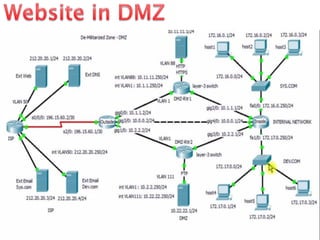
 This all web services are hosted not only in DMZ
  in datacenter but also with Public IPs using with
  various Network Technology like NAT.
 For this we need implementation of Security
  Devices and controls like firewalls.


                                     GTU   12/4/2012   3
GTU   12/4/2012   4
   The web hosting setup and associated
    network security and networking setup
    being vast and there being multiple
    stakeholders in the decision making
    process, releasing new websites/ web
    portals to the public internet becomes
    very intricate, cumbersome and error
    prone often leading to delays,
    unsatisfied expectations and ownership
    of responsibilities issues.

                               GTU   12/4/2012   5
   To resolve these issues it is proposed to build
    a framework which will streamline the
    process and also delegate most of the
    activities to several of designated
    stakeholders from each group.

   The framework will enable the users/groups
    to do most of the work related to public
    release of the websites/webportals and other
    network based services on their own with the
    intervention from the systems administrators
    or network security experts coming in only
    towards the final steps, if at all required. The
    framework will also support different roles.


                                      GTU   12/4/2012   6
   The proposed framework will be web enabled.

   It will be built using standard web development technologies
    like PHP, Java, Javascripts and use databases like
    mysql/postgresql in the backend.

   Apart from these the core networking technologies like
    firewall, router, bandwidth management and
    security/vulnerability assessment of web applications will be
    exploited to their maximum capabilities.

   The framework will require extensive scripting in either bash
    or python on linux platform to handle several of the backend
    tasks like implementing policy changes on the security
    device, enabling virtual hosting on apache server etc.

   The framework will use OpenAM based Single Sign-On or
    LDAP for user authentication and authorization purpose.


                                                GTU   12/4/2012     7
 Intranet Security Framework Based on
  Shortlived Certificate
 Symantec Security Framework
 Cyberroam Security Framework
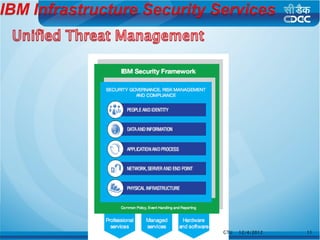
 IBM unified Threat Management


                                GTU   12/4/2012   8
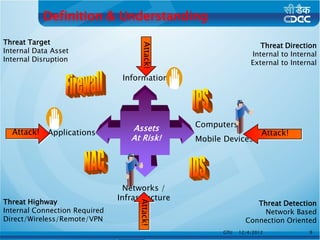
Definition & Understanding
Threat Target                                                      Threat Direction


                                      Attack!
Internal Data Asset                                             Internal to Internal
Internal Disruption                                             External to Internal

                                Information


                                  Assets        Computers
  Attack!   Applications                                            Attack!
                                  At Risk!      Mobile Devices


                                 Networks /
Threat Highway
                               Infrastructure
                                                                 Threat Detection
                                     Attack!


Internal Connection Required                                       Network Based
Direct/Wireless/Remote/VPN                                    Connection Oriented
                                                      GTU   12/4/2012            9
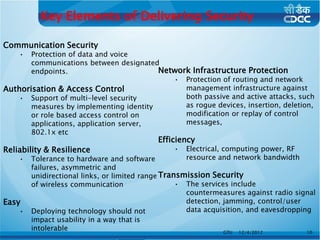
Key Elements of Delivering Security

Communication Security
    •  Protection of data and voice
       communications between designated
       endpoints.                        Network Infrastructure Protection
                                            • Protection of routing and network
Authorisation & Access Control                 management infrastructure against
   • Support of multi-level security           both passive and active attacks, such
       measures by implementing identity       as rogue devices, insertion, deletion,
       or role based access control on         modification or replay of control
       applications, application server,       messages,
       802.1x etc
                                            Efficiency
Reliability & Resilience                        •   Electrical, computing power, RF
    •   Tolerance to hardware and software          resource and network bandwidth
        failures, asymmetric and
        unidirectional links, or limited range Transmission Security
        of wireless communication                  • The services include
                                                     countermeasures against radio signal
Easy                                                 detection, jamming, control/user
    •   Deploying technology should not              data acquisition, and eavesdropping
        impact usability in a way that is
        intolerable                                             GTU 12/4/2012          10
GTU   12/4/2012   11
GTU   12/4/2012   12
GTU   12/4/2012   13
GTU   12/4/2012   14
GTU   12/4/2012   15
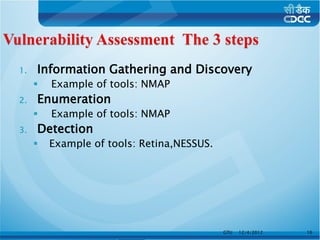
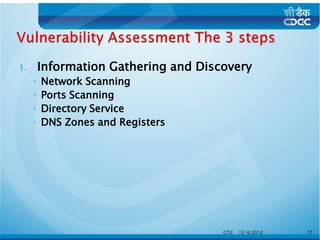
1.   Information Gathering and Discovery
        Example of tools: NMAP
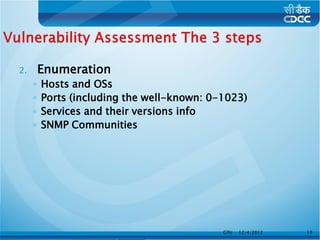
2.   Enumeration
        Example of tools: NMAP
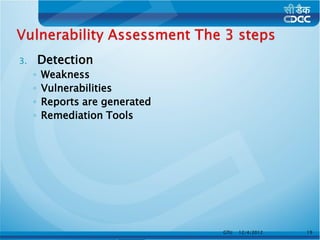
3.   Detection
        Example of tools: Retina,NESSUS.


                                            GTU   12/4/2012   16
1.       Information Gathering and Discovery
     ◦   Network Scanning
     ◦   Ports Scanning
     ◦   Directory Service
     ◦   DNS Zones and Registers


                                       GTU   12/4/2012   17
2.       Enumeration
     ◦   Hosts and OSs
     ◦   Ports (including the well-known: 0-1023)
     ◦   Services and their versions info
     ◦   SNMP Communities


                                            GTU   12/4/2012   18
3.       Detection
     ◦   Weakness
     ◦   Vulnerabilities
     ◦   Reports are generated
     ◦   Remediation Tools


                                 GTU   12/4/2012   19
GTU   12/4/2012   20
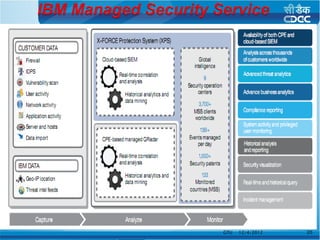
   Provide Access to the portal 24/7
   Security Intelligence Awareness And Alerting
   User Configuration & Policy Detail
   Security Incident & Service Ticket Information
   A Template Driven Reporting Dashboard
   Authorization to download log data.



                                           GTU   12/4/2012   21
   Mr. Rishi K. Pathak (Seniour Technical Officer,NPSF
    Group,C-DAC) for valuable comments and suggestions
   Satyaswarup Yerramilli(Seniour Technical Officer,NPSF
    Group, C-DAC) for his review of the thesis
   Mr. Rishi K. Pathak , Seniour Technical Officer, NPSF Group
    for continuous guidance and support
   Dr. Sandeep K. Joshi, Research Guide for his motivation
    throughout
   All my colleagues and staff members of my department for
    technical interactions
   The NPSF Group of C-DAC Pune for their administrative
    support


                                             GTU   12/4/2012      22
   Zachman, J. A. (1987). A framework for information
    systems architecture. IBM Systems Journal, 26(3), 276-292.
    Retrieved 18:15, January 21, 2009, from
    http://www.research.ibm.com/journal/sj/263/ibmsj2603E.
    pdf
   Zachman framework. (2009, January 19). In Wikipedia,
    The Free Encyclopedia. Retrieved 21:40, January 20, 2009,
    from
    http://en.wikipedia.org/w/index.php?title=Zachman_fra
    mework&oldid=267343979
   CCITT, “The Directory—Authentication Framework,”
    Recommen-dation X.509, 1989.
   935.ibm.com/services/au/gts/juniper/pdf/ibm_managed
    _security_services_for_unified_threat_management.pdf
   http://www-935.ibm.com/services/us/en/it-
    services/unified-threat-management-utm-service.html

                                              GTU   12/4/2012    23
GTU   12/4/2012   24
GTU   12/4/2012   25
GTU   12/4/2012   26

NEtwork Security Admin Portal

  • 1.
    Prepared by :- BhadreshsinhGohil ME in Computer Engineering 3rd Sem. Enroll no. :- 111060751030. Gujarat Technological University, Ahmedabad. Guided by :- Dr. Sandeep K. Joshi Rishi K. Pathak Satyaswarup Yerramilli Principle Technical Officer Senior Technical Officer Seniour Technical Officer NPSF Group NPSF Group NPSF Group C-DAC C-DAC C-DAC Pune Pune Pune GTU 12/4/2012 1
  • 2.
     Introduction andMotivation  The Identified Problem  The Proposed Solution  Illustrative Case Studies  References GTU 12/4/2012 2
  • 3.
     Internet isnow ubiquitous  Many Internet-based applications are in use today  Web services is an important paradigm for designing Internet-based applications  This all web services are hosted not only in DMZ in datacenter but also with Public IPs using with various Network Technology like NAT.  For this we need implementation of Security Devices and controls like firewalls. GTU 12/4/2012 3
  • 4.
    GTU 12/4/2012 4
  • 5.
    The web hosting setup and associated network security and networking setup being vast and there being multiple stakeholders in the decision making process, releasing new websites/ web portals to the public internet becomes very intricate, cumbersome and error prone often leading to delays, unsatisfied expectations and ownership of responsibilities issues. GTU 12/4/2012 5
  • 6.
    To resolve these issues it is proposed to build a framework which will streamline the process and also delegate most of the activities to several of designated stakeholders from each group.  The framework will enable the users/groups to do most of the work related to public release of the websites/webportals and other network based services on their own with the intervention from the systems administrators or network security experts coming in only towards the final steps, if at all required. The framework will also support different roles. GTU 12/4/2012 6
  • 7.
    The proposed framework will be web enabled.  It will be built using standard web development technologies like PHP, Java, Javascripts and use databases like mysql/postgresql in the backend.  Apart from these the core networking technologies like firewall, router, bandwidth management and security/vulnerability assessment of web applications will be exploited to their maximum capabilities.  The framework will require extensive scripting in either bash or python on linux platform to handle several of the backend tasks like implementing policy changes on the security device, enabling virtual hosting on apache server etc.  The framework will use OpenAM based Single Sign-On or LDAP for user authentication and authorization purpose. GTU 12/4/2012 7
  • 8.
     Intranet SecurityFramework Based on Shortlived Certificate  Symantec Security Framework  Cyberroam Security Framework  IBM unified Threat Management GTU 12/4/2012 8
  • 9.
    Definition & Understanding ThreatTarget Threat Direction Attack! Internal Data Asset Internal to Internal Internal Disruption External to Internal Information Assets Computers Attack! Applications Attack! At Risk! Mobile Devices Networks / Threat Highway Infrastructure Threat Detection Attack! Internal Connection Required Network Based Direct/Wireless/Remote/VPN Connection Oriented GTU 12/4/2012 9
  • 10.
    Key Elements ofDelivering Security Communication Security • Protection of data and voice communications between designated endpoints. Network Infrastructure Protection • Protection of routing and network Authorisation & Access Control management infrastructure against • Support of multi-level security both passive and active attacks, such measures by implementing identity as rogue devices, insertion, deletion, or role based access control on modification or replay of control applications, application server, messages, 802.1x etc Efficiency Reliability & Resilience • Electrical, computing power, RF • Tolerance to hardware and software resource and network bandwidth failures, asymmetric and unidirectional links, or limited range Transmission Security of wireless communication • The services include countermeasures against radio signal Easy detection, jamming, control/user • Deploying technology should not data acquisition, and eavesdropping impact usability in a way that is intolerable GTU 12/4/2012 10
  • 11.
    GTU 12/4/2012 11
  • 12.
    GTU 12/4/2012 12
  • 13.
    GTU 12/4/2012 13
  • 14.
    GTU 12/4/2012 14
  • 15.
    GTU 12/4/2012 15
  • 16.
    1. Information Gathering and Discovery  Example of tools: NMAP 2. Enumeration  Example of tools: NMAP 3. Detection  Example of tools: Retina,NESSUS. GTU 12/4/2012 16
  • 17.
    1. Information Gathering and Discovery ◦ Network Scanning ◦ Ports Scanning ◦ Directory Service ◦ DNS Zones and Registers GTU 12/4/2012 17
  • 18.
    2. Enumeration ◦ Hosts and OSs ◦ Ports (including the well-known: 0-1023) ◦ Services and their versions info ◦ SNMP Communities GTU 12/4/2012 18
  • 19.
    3. Detection ◦ Weakness ◦ Vulnerabilities ◦ Reports are generated ◦ Remediation Tools GTU 12/4/2012 19
  • 20.
    GTU 12/4/2012 20
  • 21.
    Provide Access to the portal 24/7  Security Intelligence Awareness And Alerting  User Configuration & Policy Detail  Security Incident & Service Ticket Information  A Template Driven Reporting Dashboard  Authorization to download log data.  GTU 12/4/2012 21
  • 22.
    Mr. Rishi K. Pathak (Seniour Technical Officer,NPSF Group,C-DAC) for valuable comments and suggestions  Satyaswarup Yerramilli(Seniour Technical Officer,NPSF Group, C-DAC) for his review of the thesis  Mr. Rishi K. Pathak , Seniour Technical Officer, NPSF Group for continuous guidance and support  Dr. Sandeep K. Joshi, Research Guide for his motivation throughout  All my colleagues and staff members of my department for technical interactions  The NPSF Group of C-DAC Pune for their administrative support GTU 12/4/2012 22
  • 23.
    Zachman, J. A. (1987). A framework for information systems architecture. IBM Systems Journal, 26(3), 276-292. Retrieved 18:15, January 21, 2009, from http://www.research.ibm.com/journal/sj/263/ibmsj2603E. pdf  Zachman framework. (2009, January 19). In Wikipedia, The Free Encyclopedia. Retrieved 21:40, January 20, 2009, from http://en.wikipedia.org/w/index.php?title=Zachman_fra mework&oldid=267343979  CCITT, “The Directory—Authentication Framework,” Recommen-dation X.509, 1989.  935.ibm.com/services/au/gts/juniper/pdf/ibm_managed _security_services_for_unified_threat_management.pdf  http://www-935.ibm.com/services/us/en/it- services/unified-threat-management-utm-service.html GTU 12/4/2012 23
  • 24.
    GTU 12/4/2012 24
  • 25.
    GTU 12/4/2012 25
  • 26.
    GTU 12/4/2012 26