PALO ALTO
SAFE APPLICATION ENABLEMENT


                              1
Palo Alto Networks Product
          James Sherlow
          Overview& Africa
     SE Manager WEUR
  jsherlow@paloaltonetworks.com
           @jsherlow
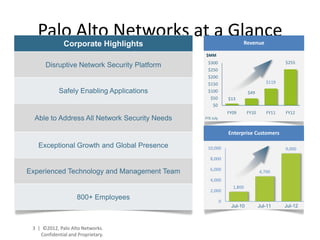
Palo Alto Networks at a Glance                                    Revenue
               Corporate Highlights
                                               $MM
                                                $300                                     $255
      Disruptive Network Security Platform
                                                $250
                                                $200
                                                $150                              $119

            Safely Enabling Applications        $100                    $49
                                                  $50         $13
                                                   $0
                                                              FY09      FY10      FY11   FY12
  Able to Address All Network Security Needs   FYE July


                                                              Enterprise Customers

   Exceptional Growth and Global Presence       10,000                                   9,000

                                                  8,000

                                                  6,000
Experienced Technology and Management Team                                     4,700
                                                  4,000
                                                                1,800
                                                  2,000
                     800+ Employees                       0
                                                               Jul-10          Jul-11    Jul-12


 3 | ©2012, Palo Alto Networks.
    Confidential and Proprietary.
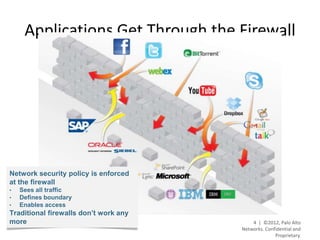
Applications Get Through the Firewall


Network security policy is enforced
at the firewall
•   Sees all traffic
•   Defines boundary
•   Enables access
Traditional firewalls don’t work any
more                                       4 | ©2012, Palo Alto
                                       Networks. Confidential and
                                                     Proprietary.
Applications Get Through the Firewall:
                    Threats


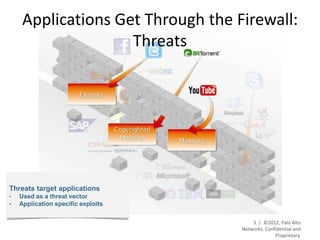
Threats target applications
•   Used as a threat vector
•   Application specific exploits

                                        5 | ©2012, Palo Alto
                                    Networks. Confidential and
                                                  Proprietary.
Applications Get Through the Firewall:
                  Exfiltration


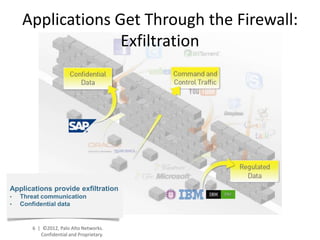
Applications provide exfiltration
•   Threat communication
•   Confidential data


       6 | ©2012, Palo Alto Networks.
          Confidential and Proprietary.
Applications Get Through the Firewall:
                  Encryption


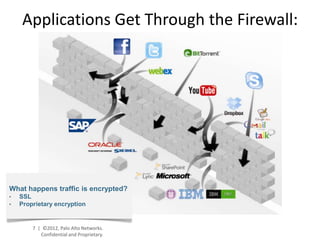
What happens traffic is encrypted?
•   SSL
•   Proprietary encryption


        7 | ©2012, Palo Alto Networks.
           Confidential and Proprietary.
Technology Sprawl and Creep
                 Aren’t the Answer
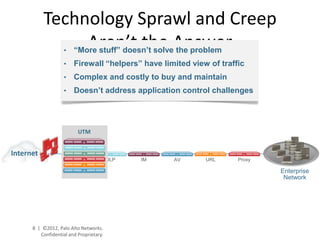
              “More stuff” doesn’t solve the problem
                    •
                    •   Firewall “helpers” have limited view of traffic
                    •   Complex and costly to buy and maintain
                    •   Doesn’t address application control challenges


                          UTM


Internet
                        IPS              DLP   IM   AV      URL      Proxy

                                                                             Enterprise
                                                                              Network


      8 | ©2012, Palo Alto Networks.
         Confidential and Proprietary.
The Answer? Make the Firewall Do
                Its Job
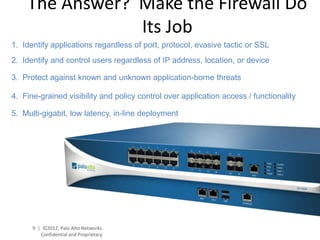
1. Identify applications regardless of port, protocol, evasive tactic or SSL
2. Identify and control users regardless of IP address, location, or device

3. Protect against known and unknown application-borne threats

4. Fine-grained visibility and policy control over application access / functionality

5. Multi-gigabit, low latency, in-line deployment


      9 | ©2012, Palo Alto Networks.
         Confidential and Proprietary.
Why Visibility & Control Must Be In
Traffic
                 The Firewall
                       Application Control as an Add-on
                                Port                            • Port-based FW + App Ctrl (IPS) = two policies
                                                                • Applications are threats; only block what you
              Firewall                        IPS                 expressly look for
                                          Applications          Implications
              Port Policy               App Ctrl Policy         • Network access decision is made with no
                                                                  information
               Decision                   Decision
                                                                • Cannot safely enable applications


 NGFW Application Control
 • Application control is in the firewall = single policy           Traffic                   Application
 • Visibility across all ports, for all traffic, all the time
                                                                                Firewall                          IPS
 Implications
                                                                               Applications
 • Network access decision is made based on
   application identity                                                       App Ctrl Policy               Scan Application
 • Safely enable application usage                                              Decision                       for Threats


          10 | ©2012, Palo Alto Networks.
              Confidential and Proprietary.
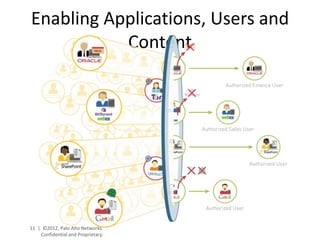
Enabling Applications, Users and
           Content


11 | ©2012, Palo Alto Networks.
    Confidential and Proprietary.
Enabling Applications, Users and
             Content
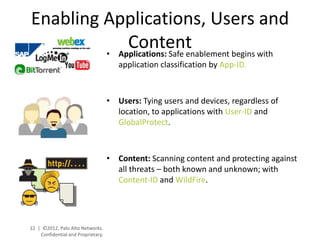
         • Applications: Safe enablement begins with
                                       application classification by App-ID.


                                    • Users: Tying users and devices, regardless of
                                      location, to applications with User-ID and
                                      GlobalProtect.


                                    • Content: Scanning content and protecting against
                                      all threats – both known and unknown; with
                                      Content-ID and WildFire.


12 | ©2012, Palo Alto Networks.
    Confidential and Proprietary.
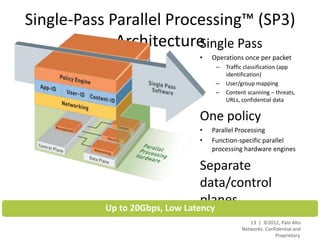
Single-Pass Parallel Processing™ (SP3)
             ArchitectureSingle Pass
                              •   Operations once per packet
                                   –   Traffic classification (app
                                       identification)
                                   –   User/group mapping
                                   –   Content scanning – threats,
                                       URLs, confidential data

                              One policy
                              •   Parallel Processing
                              •   Function-specific parallel
                                  processing hardware engines

                                 Separate
                                 data/control
                                 planes
           Up to 20Gbps, Low Latency
                                                13 | ©2012, Palo Alto
                                             Networks. Confidential and
                                                           Proprietary.
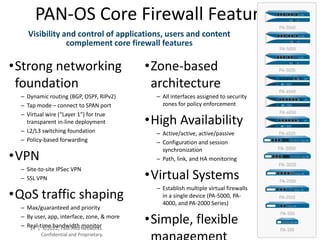
PAN-OS Core Firewall Features
      Visibility and control of applications, users and content
                  complement core firewall features

•Strong networking                            •Zone-based
 foundation                                    architecture
  – Dynamic routing (BGP, OSPF, RIPv2)          – All interfaces assigned to security
  – Tap mode – connect to SPAN port               zones for policy enforcement
  – Virtual wire (“Layer 1”) for true
    transparent in-line deployment            •High Availability
  – L2/L3 switching foundation                  – Active/active, active/passive
  – Policy-based forwarding                     – Configuration and session
                                                  synchronization
•VPN                                            – Path, link, and HA monitoring
  – Site-to-site IPSec VPN
  – SSL VPN                                   •Virtual Systems
                                                – Establish multiple virtual firewalls
•QoS traffic shaping                              in a single device (PA-5000, PA-
                                                  4000, and PA-2000 Series)
  –   Max/guaranteed and priority
  –
  –
      By user, app, interface, zone, & more
      Real-time bandwidth Networks.
       14 | ©2012, Palo Alto monitor
                                              •Simple, flexible
           Confidential and Proprietary.
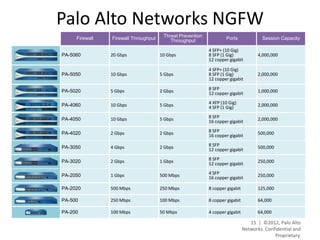
Palo Alto Networks NGFW
   Hardware Platforms
     Firewall   Firewall Throughput    Threat Prevention           Ports              Session Capacity
                                          Throughput
                                                           4 SFP+ (10 Gig)
PA-5060         20 Gbps               10 Gbps              8 SFP (1 Gig)             4,000,000
                                                           12 copper gigabit

                                                           4 SFP+ (10 Gig)
PA-5050         10 Gbps               5 Gbps               8 SFP (1 Gig)             2,000,000
                                                           12 copper gigabit

PA-5020         5 Gbps                2 Gbps               8 SFP                     1,000,000
                                                           12 copper gigabit

PA-4060         10 Gbps               5 Gbps               4 XFP (10 Gig)            2,000,000
                                                           4 SFP (1 Gig)

PA-4050         10 Gbps               5 Gbps               8 SFP                     2,000,000
                                                           16 copper gigabit

PA-4020         2 Gbps                2 Gbps               8 SFP                     500,000
                                                           16 copper gigabit

PA-3050         4 Gbps                2 Gbps               8 SFP                     500,000
                                                           12 copper gigabit

PA-3020         2 Gbps                1 Gbps               8 SFP                     250,000
                                                           12 copper gigabit

PA-2050         1 Gbps                500 Mbps             4 SFP                     250,000
                                                           16 copper gigabit

PA-2020         500 Mbps              250 Mbps             8 copper gigabit          125,000

PA-500          250 Mbps              100 Mbps             8 copper gigabit          64,000

PA-200          100 Mbps              50 Mbps              4 copper gigabit          64,000

                                                                                 15 | ©2012, Palo Alto
                                                                              Networks. Confidential and
                                                                                            Proprietary.
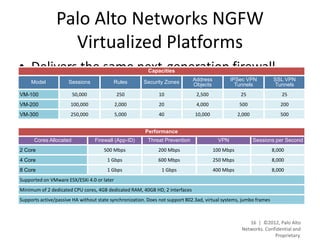
Palo Alto Networks NGFW
                  Virtualized Platforms
• Delivers the same next-generation firewall             Capacities

  features available in our hardware platforms
     Model            Sessions            Rules        Security Zones         Address
                                                                              Objects
                                                                                               IPSec VPN
                                                                                                 Tunnels
                                                                                                                    SSL VPN
                                                                                                                    Tunnels
VM-100                  50,000              250               10               2,500                25                  25
  in a virtualized form-factor
VM-200                100,000               2,000             20               4,000               500                 200
VM-300                250,000               5,000             40               10,000              2,000               500


                                                        Performance
      Cores Allocated            Firewall (App-ID)       Threat Prevention               VPN               Sessions per Second
2 Core                                500 Mbps                200 Mbps                  100 Mbps                    8,000
4 Core                                 1 Gbps                 600 Mbps                  250 Mbps                    8,000
8 Core                                 1 Gbps                   1 Gbps                  400 Mbps                    8,000
Supported on VMware ESX/ESXi 4.0 or later
Minimum of 2 dedicated CPU cores, 4GB dedicated RAM, 40GB HD, 2 interfaces
Supports active/passive HA without state synchronization. Does not support 802.3ad, virtual systems, jumbo frames


                                                                                                       16 | ©2012, Palo Alto
                                                                                                    Networks. Confidential and
                                                                                                                  Proprietary.
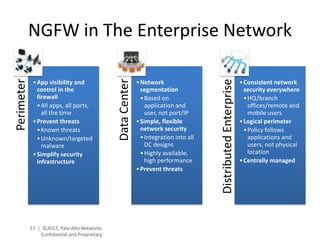
NGFW in The Enterprise Network
Perimeter


                                                Data Center


                                                                                         Distributed Enterprise
             • App visibility and                             • Network                                           • Consistent network
               control in the                                   segmentation                                        security everywhere
               firewall                                         • Based on                                          • HQ/branch
               • All apps, all ports,                             application and                                     offices/remote and
                 all the time                                     user, not port/IP                                   mobile users
             • Prevent threats                                • Simple, flexible                                  • Logical perimeter
               • Known threats                                  network security                                    • Policy follows
               • Unknown/targeted                               • Integration into all                                applications and
                 malware                                          DC designs                                          users, not physical
             • Simplify security                                • Highly available,                                   location
               infrastructure                                     high performance                                • Centrally managed
                                                              • Prevent threats


            17 | ©2012, Palo Alto Networks.
                Confidential and Proprietary.
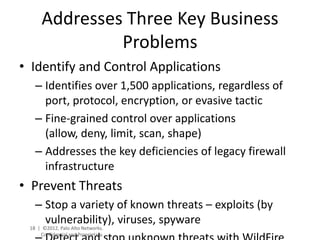
Addresses Three Key Business
               Problems
• Identify and Control Applications
   – Identifies over 1,500 applications, regardless of
     port, protocol, encryption, or evasive tactic
   – Fine-grained control over applications
     (allow, deny, limit, scan, shape)
   – Addresses the key deficiencies of legacy firewall
     infrastructure
• Prevent Threats
   – Stop a variety of known threats – exploits (by
     vulnerability), viruses, spyware
 18 | ©2012, Palo Alto Networks.
     Confidential and Proprietary.
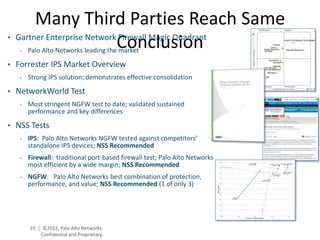
Many Third Parties Reach Same
•
    -
                              Conclusion
    Gartner Enterprise Network Firewall Magic Quadrant
        Palo Alto Networks leading the market

• Forrester IPS Market Overview
    -   Strong IPS solution; demonstrates effective consolidation

• NetworkWorld Test
    -   Most stringent NGFW test to date; validated sustained
        performance and key differences

• NSS Tests
    -   IPS: Palo Alto Networks NGFW tested against competitors’
        standalone IPS devices; NSS Recommended
    -   Firewall: traditional port-based firewall test; Palo Alto Networks
        most efficient by a wide margin; NSS Recommended
    -   NGFW: Palo Alto Networks best combination of protection,
        performance, and value; NSS Recommended (1 of only 3)


        19 | ©2012, Palo Alto Networks.
            Confidential and Proprietary.
20 | ©2012, Palo Alto
Networks. Confidential and
              Proprietary.

Palo alto safe application enablement

  • 1.
  • 2.
    Palo Alto NetworksProduct James Sherlow Overview& Africa SE Manager WEUR jsherlow@paloaltonetworks.com @jsherlow
  • 3.
    Palo Alto Networksat a Glance Revenue Corporate Highlights $MM $300 $255 Disruptive Network Security Platform $250 $200 $150 $119 Safely Enabling Applications $100 $49 $50 $13 $0 FY09 FY10 FY11 FY12 Able to Address All Network Security Needs FYE July Enterprise Customers Exceptional Growth and Global Presence 10,000 9,000 8,000 6,000 Experienced Technology and Management Team 4,700 4,000 1,800 2,000 800+ Employees 0 Jul-10 Jul-11 Jul-12 3 | ©2012, Palo Alto Networks. Confidential and Proprietary.
  • 4.
    Applications Get Throughthe Firewall Network security policy is enforced at the firewall • Sees all traffic • Defines boundary • Enables access Traditional firewalls don’t work any more 4 | ©2012, Palo Alto Networks. Confidential and Proprietary.
  • 5.
    Applications Get Throughthe Firewall: Threats Threats target applications • Used as a threat vector • Application specific exploits 5 | ©2012, Palo Alto Networks. Confidential and Proprietary.
  • 6.
    Applications Get Throughthe Firewall: Exfiltration Applications provide exfiltration • Threat communication • Confidential data 6 | ©2012, Palo Alto Networks. Confidential and Proprietary.
  • 7.
    Applications Get Throughthe Firewall: Encryption What happens traffic is encrypted? • SSL • Proprietary encryption 7 | ©2012, Palo Alto Networks. Confidential and Proprietary.
  • 8.
    Technology Sprawl andCreep Aren’t the Answer “More stuff” doesn’t solve the problem • • Firewall “helpers” have limited view of traffic • Complex and costly to buy and maintain • Doesn’t address application control challenges UTM Internet IPS DLP IM AV URL Proxy Enterprise Network 8 | ©2012, Palo Alto Networks. Confidential and Proprietary.
  • 9.
    The Answer? Makethe Firewall Do Its Job 1. Identify applications regardless of port, protocol, evasive tactic or SSL 2. Identify and control users regardless of IP address, location, or device 3. Protect against known and unknown application-borne threats 4. Fine-grained visibility and policy control over application access / functionality 5. Multi-gigabit, low latency, in-line deployment 9 | ©2012, Palo Alto Networks. Confidential and Proprietary.
  • 10.
    Why Visibility &Control Must Be In Traffic The Firewall Application Control as an Add-on Port • Port-based FW + App Ctrl (IPS) = two policies • Applications are threats; only block what you Firewall IPS expressly look for Applications Implications Port Policy App Ctrl Policy • Network access decision is made with no information Decision Decision • Cannot safely enable applications NGFW Application Control • Application control is in the firewall = single policy Traffic Application • Visibility across all ports, for all traffic, all the time Firewall IPS Implications Applications • Network access decision is made based on application identity App Ctrl Policy Scan Application • Safely enable application usage Decision for Threats 10 | ©2012, Palo Alto Networks. Confidential and Proprietary.
  • 11.
    Enabling Applications, Usersand Content 11 | ©2012, Palo Alto Networks. Confidential and Proprietary.
  • 12.
    Enabling Applications, Usersand Content • Applications: Safe enablement begins with application classification by App-ID. • Users: Tying users and devices, regardless of location, to applications with User-ID and GlobalProtect. • Content: Scanning content and protecting against all threats – both known and unknown; with Content-ID and WildFire. 12 | ©2012, Palo Alto Networks. Confidential and Proprietary.
  • 13.
    Single-Pass Parallel Processing™(SP3) ArchitectureSingle Pass • Operations once per packet – Traffic classification (app identification) – User/group mapping – Content scanning – threats, URLs, confidential data One policy • Parallel Processing • Function-specific parallel processing hardware engines Separate data/control planes Up to 20Gbps, Low Latency 13 | ©2012, Palo Alto Networks. Confidential and Proprietary.
  • 14.
    PAN-OS Core FirewallFeatures Visibility and control of applications, users and content complement core firewall features •Strong networking •Zone-based foundation architecture – Dynamic routing (BGP, OSPF, RIPv2) – All interfaces assigned to security – Tap mode – connect to SPAN port zones for policy enforcement – Virtual wire (“Layer 1”) for true transparent in-line deployment •High Availability – L2/L3 switching foundation – Active/active, active/passive – Policy-based forwarding – Configuration and session synchronization •VPN – Path, link, and HA monitoring – Site-to-site IPSec VPN – SSL VPN •Virtual Systems – Establish multiple virtual firewalls •QoS traffic shaping in a single device (PA-5000, PA- 4000, and PA-2000 Series) – Max/guaranteed and priority – – By user, app, interface, zone, & more Real-time bandwidth Networks. 14 | ©2012, Palo Alto monitor •Simple, flexible Confidential and Proprietary.
  • 15.
    Palo Alto NetworksNGFW Hardware Platforms Firewall Firewall Throughput Threat Prevention Ports Session Capacity Throughput 4 SFP+ (10 Gig) PA-5060 20 Gbps 10 Gbps 8 SFP (1 Gig) 4,000,000 12 copper gigabit 4 SFP+ (10 Gig) PA-5050 10 Gbps 5 Gbps 8 SFP (1 Gig) 2,000,000 12 copper gigabit PA-5020 5 Gbps 2 Gbps 8 SFP 1,000,000 12 copper gigabit PA-4060 10 Gbps 5 Gbps 4 XFP (10 Gig) 2,000,000 4 SFP (1 Gig) PA-4050 10 Gbps 5 Gbps 8 SFP 2,000,000 16 copper gigabit PA-4020 2 Gbps 2 Gbps 8 SFP 500,000 16 copper gigabit PA-3050 4 Gbps 2 Gbps 8 SFP 500,000 12 copper gigabit PA-3020 2 Gbps 1 Gbps 8 SFP 250,000 12 copper gigabit PA-2050 1 Gbps 500 Mbps 4 SFP 250,000 16 copper gigabit PA-2020 500 Mbps 250 Mbps 8 copper gigabit 125,000 PA-500 250 Mbps 100 Mbps 8 copper gigabit 64,000 PA-200 100 Mbps 50 Mbps 4 copper gigabit 64,000 15 | ©2012, Palo Alto Networks. Confidential and Proprietary.
  • 16.
    Palo Alto NetworksNGFW Virtualized Platforms • Delivers the same next-generation firewall Capacities features available in our hardware platforms Model Sessions Rules Security Zones Address Objects IPSec VPN Tunnels SSL VPN Tunnels VM-100 50,000 250 10 2,500 25 25 in a virtualized form-factor VM-200 100,000 2,000 20 4,000 500 200 VM-300 250,000 5,000 40 10,000 2,000 500 Performance Cores Allocated Firewall (App-ID) Threat Prevention VPN Sessions per Second 2 Core 500 Mbps 200 Mbps 100 Mbps 8,000 4 Core 1 Gbps 600 Mbps 250 Mbps 8,000 8 Core 1 Gbps 1 Gbps 400 Mbps 8,000 Supported on VMware ESX/ESXi 4.0 or later Minimum of 2 dedicated CPU cores, 4GB dedicated RAM, 40GB HD, 2 interfaces Supports active/passive HA without state synchronization. Does not support 802.3ad, virtual systems, jumbo frames 16 | ©2012, Palo Alto Networks. Confidential and Proprietary.
  • 17.
    NGFW in TheEnterprise Network Perimeter Data Center Distributed Enterprise • App visibility and • Network • Consistent network control in the segmentation security everywhere firewall • Based on • HQ/branch • All apps, all ports, application and offices/remote and all the time user, not port/IP mobile users • Prevent threats • Simple, flexible • Logical perimeter • Known threats network security • Policy follows • Unknown/targeted • Integration into all applications and malware DC designs users, not physical • Simplify security • Highly available, location infrastructure high performance • Centrally managed • Prevent threats 17 | ©2012, Palo Alto Networks. Confidential and Proprietary.
  • 18.
    Addresses Three KeyBusiness Problems • Identify and Control Applications – Identifies over 1,500 applications, regardless of port, protocol, encryption, or evasive tactic – Fine-grained control over applications (allow, deny, limit, scan, shape) – Addresses the key deficiencies of legacy firewall infrastructure • Prevent Threats – Stop a variety of known threats – exploits (by vulnerability), viruses, spyware 18 | ©2012, Palo Alto Networks. Confidential and Proprietary.
  • 19.
    Many Third PartiesReach Same • - Conclusion Gartner Enterprise Network Firewall Magic Quadrant Palo Alto Networks leading the market • Forrester IPS Market Overview - Strong IPS solution; demonstrates effective consolidation • NetworkWorld Test - Most stringent NGFW test to date; validated sustained performance and key differences • NSS Tests - IPS: Palo Alto Networks NGFW tested against competitors’ standalone IPS devices; NSS Recommended - Firewall: traditional port-based firewall test; Palo Alto Networks most efficient by a wide margin; NSS Recommended - NGFW: Palo Alto Networks best combination of protection, performance, and value; NSS Recommended (1 of only 3) 19 | ©2012, Palo Alto Networks. Confidential and Proprietary.
  • 20.
    20 | ©2012,Palo Alto Networks. Confidential and Proprietary.

Editor's Notes

  • #4 Our laser-like focus on innovation allows us to safely enable applications, user and content. Our broad family of platforms and rich feature set allow us to address all NW security needs (FW, VPN, IPS, URL filtering, Content inspection)The innovation we deliver to the market is influenced heavily by our customers who like us are innovating how their company is securing the NW. Our growth is driven by a product that works and a seasoned management team.
  • #5 Use interesting examples that are not Facebook and Twitter to show that applications have changes firewalls have not. They use evasive techniques to simplify use and avoid detection. AV in the late 90s started using port 80 (it is a C/S app), AIM prompted you to find an open port, BitTorrent and Skype hop ports, use encryption, MS Lync uses 443, 3489 and a host of ports above 50,000, SharePoint and function control use a range of web ports, but it is not a web app (it uses Office! SAP, Oracle, DropBox, Box.net
  • #6 Threat ramifications: Applications are a threat vector and a target
  • #7 Exfiltration ramifications: Today’s threats are applications – their command/control requires network communications. Apps can act as the conduit for data theft.
  • #8 SSL and SSH: more and more applications use encryption, rendering existing FWs useless.
  • #9 the control that once existed in the firewall has eroded over time. UTMs exist for the sole purpose of consolidating devices to save money – just google the IDC definition from 2004UTMs suffer from performance issues, multiple policies, silo-based scanning, multiple databases, logs, etcUTMs are all stateful inspection based – the all make their first decision on port. We are not a utm.
  • #11 Talk about how Stateful FWs default policy is deny all versus IPS being allow all. This is how competitive application identification technologies work unless tunedDiscuss need to forward traffic from Stateful FW engine to IPS engine. How do you determine what to send?Point out that in IPS model need to know what to block. What happens if you don’t know all components of an application or what is even available to me. How do you spend time doing this.Multiple rulebases, multiple databases, multiple log databases, etc – all mean policy reconciliation challenges, and a weakening of the deny all else premise…
  • #12 The goal is to use applications, users and content as a means of talking about all 5 technologies and services: app-id, user-id, contentid, globalprotect and wildfire – not just the 3 core ones. This slide includes several good application examples – none of which are Facebook or Twitter . Each example has a user, an app and some content – doc, file, threat – when traversing the FW, those elements are either allowed or blocked for specific groups of users**********************Classifying all applications, across all ports, all the time with App-ID. Palo Alto Networks next-generation firewalls are built upon App-ID, a traffic classification technology that identifies the applications traversing the network, regardless of port, encryption (SSL or SSH) or evasive technique employed. The knowledge of exactly which applications are traversing the network, not just the port and protocol, then becomes the basis for all security policy decisions. Unidentified applications, typically a small percentage of traffic yet high in potential risk, are automatically categorized for systematic management, which can include policy control and inspection, threat forensics, creation of a custom App-ID, or submission of a packet capture App-ID for development.Tying users and devices, not just IP addresses to applications with User-ID and GlobalProtect. The application identity is tied to the user through User-ID, allowing organizations to deploy enablement policies that are not based solely on the IP address. These policies can then be extended to any device at any location with GlobalProtect. User-ID integrates with a wide range of enterprise user repositories to provide the identity of the Microsoft Windows, Mac OS X, Linux or Android, iOS users accessing the application. GlobalProtect ensures that the remote user is protected consistently, in the same manner as they would be if they were operating on the local network. The combined visibility and control over a users' application activity means organizations can safely enable the use of Oracle, BitTorrent, or Gmail, or any other application traversing the network, no matter where or how the user is accessing the network.Protecting against all threats, both known and unknown, with Content-ID and WildFire. To protect against a blend of known exploits, malware and spyware as well as completely unknown and targeted threats, organizations can first reduce the threat footprint through an explicit deny policy for unwanted applications. Content-ID can then be used to protect the applications and associated features by blocking known vulnerability exploits, viruses, and spyware in the allowed traffic. Content-ID addresses common threat evasion tactics by executing the prevention policy using the application and protocol context generated by the decoders in App-ID. Custom or unknown malware that is not controlled through traditional signatures is addressed through WildFire, which executes unknown files and monitors for more than 100 malicious behaviors in a virtualized sandbox environment. If malware is found, a signature is automatically developed and delivered to the user community.Enterprise wide enablement: Safe application enablement policies can help organizations improve their security posture, regardless of the deployment location. At the perimeter, organizations can reduce their threat footprint by blocking a wide range of unwanted applications and then inspecting the allowed applications for threats - both known and unknown. In the datacenter, application enablement translates to confirming the applications users and content are allowed and protected from threats while simultaneously finding rogue, misconfigured applications - all at multi-Gbps speeds. In virtualized datacenter environments, organizations can apply consistent application enablement policies while addressing security challenges introduced by virtual machine movement and orchestration. Expanding outwards to enterprise branch offices and remote users, enablement is delivered through policy consistency - the same policy deployed at the corporate location and is extended, seamlessly to other locations.
  • #14 Major benefit is predictable performance. It doesn’t matter if we enable 1 profile with one signature or all profiles/all signatures we have very consistent performance. Good spot to mention competitors recommend up to 20X of our TP performance number when they are sizing in the same deal.We are the only vendor where consistently, across all of our platforms, have dedicated dataplane processing to handle L7 inspection. Our competitors have a couple of platforms sprinkled throughout their extensive portfolios that do this…the rest of their products need to use their central CPU to process this traffic.Most other products have some scanning components that are proxy based
  • #16 Take this slide as an opportunity to talk about VSYS and how we don’t have any feature loss when enabling it as well as don’t need additional products/OS to deploy it.Discuss how reporting is built in to the FW and the same when using Panorama which is mainly used to manage many firewallsI like to take some time to discuss QoS and how we can shape traffic during widely viewed events such as March Madness, etc and tie this into our App-ID story