Resilient IoT Security:
The end of flat security models
Milosch Meriac
IoT Security Engineer
milosch.meriac@arm.com
©ARM 20152
“Securing a computer system has
traditionally been a battle of wits: the
penetrator tries to find the holes, and
the designer tries to close them.”
– Morrie Gasser,Author of “Building a Secure Computer System”
©ARM 20153
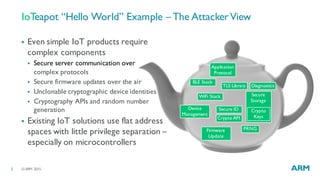
§ Even simple IoT products require
complex components
§ Secure server communication over
complex protocols
§ Secure firmware updates over the air
§ Unclonable cryptographic device identities
§ Cryptography APIs and random number
generation
§ Existing IoT solutions use flat address
spaces with little privilege separation –
especially on microcontrollers
IoTeapot “Hello World” Example – The AttackerView
Application
Protocol
TLS Library Diagnostics
Secure
Storage
Crypto
Keys
Secure ID
Crypto API
WiFi Stack
BLE Stack
Device
Management
Firmware
Update
PRNG
©ARM 20154
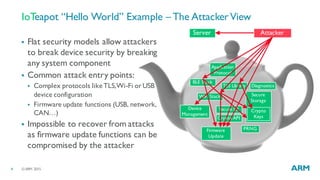
IoTeapot “Hello World” Example – The AttackerView
Application
Protocol
TLS Library Diagnostics
Secure
Storage
Crypto
Keys
Secure ID
Crypto API
WiFi Stack
BLE Stack
Device
Management
Firmware
Update
Server Attacker
PRNG
§ Flat security models allow attackers
to break device security by breaking
any system component
§ Common attack entry points:
§ Complex protocols likeTLS,Wi-Fi or USB
device configuration
§ Firmware update functions (USB, network,
CAN…)
§ Impossible to recover from attacks
as firmware update functions can be
compromised by the attacker
©ARM 20155
“It ain’t what you don’t know that gets you
into trouble. It’s what you know for sure
that just ain’t.”
– MarkTwain
©ARM 20156
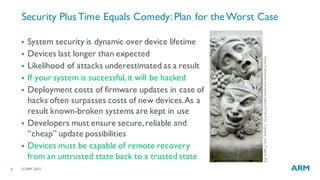
Security Plus Time Equals Comedy: Plan for theWorst Case
https://commons.wikimedia.org/wiki/File:Cret_Comedy_and_Tragedy.JPG
§ System security is dynamic over device lifetime
§ Devices last longer than expected
§ Likelihood of attacks underestimated as a result
§ If your system is successful,it will be hacked
§ Deployment costs of firmware updates in case of
hacks often surpasses costs of new devices.As a
result known-broken systems are kept in use
§ Developers must ensure secure,reliable and
“cheap” update possibilities
§ Devices must be capable of remote recovery
from an untrusted state back to a trusted state
©ARM 20157
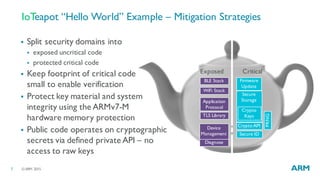
§ Split security domains into
§ exposed uncritical code
§ protected critical code
§ Keep footprint of critical code
small to enable verification
§ Protect key material and system
integrity using the ARMv7-M
hardware memory protection
§ Public code operates on cryptographic
secrets via defined private API – no
access to raw keys
IoTeapot “Hello World” Example – Mitigation Strategies
Application
Protocol
TLS Library
Diagnose
WiFi Stack
BLE Stack
Device
Management
Secure
Storage
Crypto
Keys
Secure ID
Crypto API
Firmware
Update
PRNG
Exposed Critical
©ARM 20158
IoTeapot “Hello World” Example – Mitigation Strategies
Server Attacker
Exposed Critical
x
x
x
x
x
Secure
Storage
Crypto
Keys
Secure ID
Firmware
Update
Crypto API
PRNG
Application
Protocol
TLS Library
Diagnose
WiFi Stack
BLE Stack
Device
Management
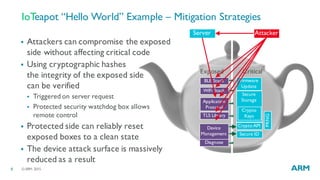
§ Attackers can compromise the exposed
side without affecting critical code
§ Using cryptographic hashes
the integrity of the exposed side
can be verified
§ Triggered on server request
§ Protected security watchdog box allows
remote control
§ Protected side can reliably reset
exposed boxes to a clean state
§ The device attack surface is massively
reduced as a result
©ARM 20159
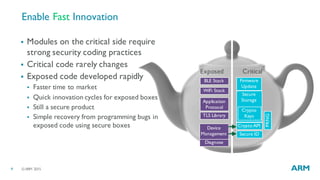
Enable Fast Innovation
§ Modules on the critical side require
strong security coding practices
§ Critical code rarely changes
§ Exposed code developed rapidly
§ Faster time to market
§ Quick innovation cycles for exposed boxes
§ Still a secure product
§ Simple recovery from programming bugs in
exposed code using secure boxes
Exposed Critical
Secure
Storage
Crypto
Keys
Secure ID
Firmware
Update
Crypto API
PRNG
Application
Protocol
TLS Library
Diagnose
WiFi Stack
BLE Stack
Device
Management
©ARM 201510
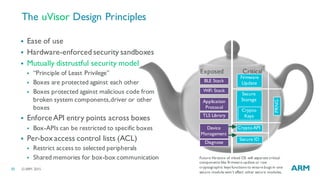
The uVisor Design Principles
Exposed Critical
Secure
Storage
Crypto
Keys
Secure ID
Firmware
Update
Crypto API
PRNG
Application
Protocol
TLS Library
Diagnose
WiFi Stack
BLE Stack
Device
Management
Future Versions of mbed OS will separate critical
components like firmware update or raw
cryptographic keys functions to ensure bugs in one
secure module won’t affect other secure modules.
§ Ease of use
§ Hardware-enforced security sandboxes
§ Mutually distrustful security model
§ “Principle of Least Privilege”
§ Boxes are protected against each other
§ Boxes protected against malicious code from
broken system components,driver or other
boxes
§ EnforceAPI entry points across boxes
§ Box-APIs can be restricted to specific boxes
§ Per-box access control lists (ACL)
§ Restrict access to selected peripherals
§ Shared memories for box-box communication
©ARM 201511
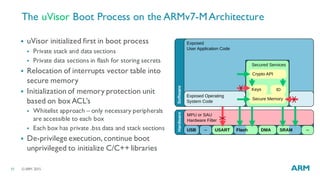
§ uVisor initialized first in boot process
§ Private stack and data sections
§ Private data sections in flash for storing secrets
§ Relocation of interrupts vector table into
secure memory
§ Initialization of memory protection unit
based on box ACL’s
§ Whitelist approach – only necessary peripherals
are accessible to each box
§ Each box has private .bss data and stack sections
§ De-privilege execution, continue boot
unprivileged to initialize C/C++ libraries
The uVisor Boot Process on the ARMv7-MArchitecture
©ARM 201512
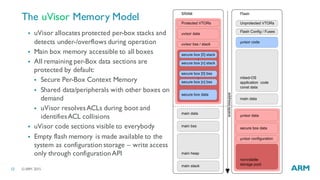
The uVisor Memory Model
§ uVisor allocates protected per-box stacks and
detects under-/overflows during operation
§ Main box memory accessible to all boxes
§ All remaining per-Box data sections are
protected by default:
§ Secure Per-Box Context Memory
§ Shared data/peripherals with other boxes on
demand
§ uVisor resolvesACLs during boot and
identifiesACL collisions
§ uVisor code sections visible to everybody
§ Empty flash memory is made available to the
system as configuration storage – write access
only through configurationAPI
©ARM 201513
“Developers, developers,
…, developers”
– Steve Ballmer
©ARM 201514
Enable uVisor and Share Peripherals Across Boxes
#include <uvisor-lib/uvisor-lib.h>
/* create background ACLs for the main box */
static const UvBoxAclItem g_background_acl[] = {
{UART0, sizeof(*UART0), UVISOR_TACL_PERIPHERAL},
{UART1, sizeof(*UART1), UVISOR_TACL_PERIPHERAL},
{PIT, sizeof(*PIT), UVISOR_TACL_PERIPHERAL},
};
/* set uvisor mode (enable) */
UVISOR_SET_MODE_ACL(UVISOR_ENABLED, g_background_acl);
#include <uvisor-lib/uvisor-lib.h>
/* set uvisor mode (enable) */
UVISOR_SET_MODE(UVISOR_ENABLED);
§ enable uVisor – optionally with shared peripherals across boxes:
©ARM 201515
Setting up Protected Sandboxes
/* create private box context */
typedef struct {
uint8_t secret[SECRET_SIZE];
bool initialized;
} BoxContext;
/* create ACLs for the module */
static const UvBoxAclItem g_box_acl[] = {
{RNG, sizeof(*RNG), UVISOR_TACL_PERIPHERAL}, /* a peripheral */
};
/*required stack size */
#define BOX_STACK_SIZE 0x100
/* configure secure box compartment */
UVISOR_BOX_CONFIG(my_box_name, g_box_acl, BOX_STACK_SIZE, BoxContext);
©ARM 201516
Define Function Call Gateways Across Security Boundaries
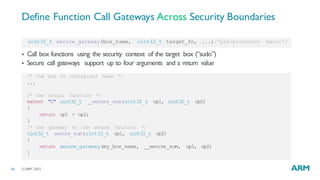
uint32_t secure_gateway(box_name, uint32_t target_fn, ...)/*pre-processor macro*/
§ Call box functions using the security context of the target box (“sudo”)
§ Secure call gateways support up to four arguments and a return value
/* the box is configured here */
...
/* the actual function */
extern "C" uint32_t __secure_sum(uint32_t op1, uint32_t op2)
{
return op1 + op2;
}
/* the gateway to the secure function */
uint32_t secure_sum(uint32_t op1, uint32_t op2)
{
return secure_gateway(my_box_name, __secure_sum, op1, op2)
}
©ARM 201517
Secure uVisor API
void vIRQ_SetVector(uint32_t irqn, uint32_t vector);
uint32_t vIRQ_GetVector(uint32_t irqn);
void vIRQ_EnableIRQ(uint32_t irqn);
void vIRQ_DisableIRQ(uint32_t irqn);
void vIRQ_ClearPendingIRQ(uint32_t irqn);
void vIRQ_SetPendingIRQ(uint32_t irqn);
uint32_t vIRQ_GetPendingIRQ(uint32_t irqn);
void vIRQ_SetPriority(uint32_t irqn, uint32_t priority);
uint32_t vIRQ_GetPriority(uint32_t irqn);
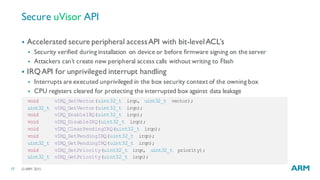
§ Accelerated secure peripheral accessAPI with bit-levelACL’s
§ Security verified during installation on device or before firmware signing on the server
§ Attackers can’t create new peripheral access calls without writing to Flash
§ IRQAPI for unprivileged interrupt handling
§ Interrupts are executed unprivileged in the box security context of the owning box
§ CPU registers cleared for protecting the interrupted box against data leakage
©ARM 201518
#define MY_HANDLER_IRQn 42
void my_irq_handler(void)
{
...
}
int register_my_irq_handler(void)
{
vIRQ_SetVector(MY_HANDLER_IRQn, (uint32_t) &my_irq_handler);
vIRQ_EnableIRQ(MY_HANDLER_IRQn);
}
Secure uVisor InterruptAPI
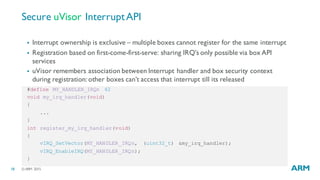
§ Interrupt ownership is exclusive – multiple boxes cannot register for the same interrupt
§ Registration based on first-come-first-serve: sharing IRQ’s only possible via box API
services
§ uVisor remembers association between Interrupt handler and box security context
during registration: other boxes can’t access that interrupt till its released
©ARM 201519
“The Devil is in the details, but so is salvation”
– Hyman G. Rickover, United States Navy Admiral
©ARM 201520
Call Gateway Internals forARMv7-M Systems
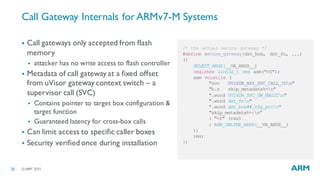
§ Call gateways only accepted from flash
memory
§ attacker has no write access to flash controller
§ Metadata of call gateway at a fixed offset
from uVisor gateway context switch – a
supervisor call (SVC)
§ Contains pointer to target box configuration &
target function
§ Guaranteed latency for cross-box calls
§ Can limit access to specific caller boxes
§ Security verified once during installation
/* the actual secure gateway */
#define secure_gateway(dst_box, dst_fn, ...)
({
SELECT_ARGS(__VA_ARGS__)
register uint32_t res asm("r0");
asm volatile (
"svc UVISOR_API_SVC_CALL_IDn"
"b.n skip_metadata%=n"
".word UVISOR_SVC_GW_MAGICn"
".word dst_fnn"
".word dst_box##_cfg_ptrn"
"skip_metadata%=:n”
: "=r" (res)
: ASM_INLINE_ARGS(__VA_ARGS__)
);
res;
})
©ARM 201521
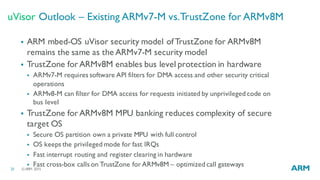
§ ARM mbed-OS uVisor security model of TrustZone for ARMv8M
remains the same as the ARMv7-M security model
§ TrustZone for ARMv8M enables bus level protection in hardware
§ ARMv7-M requires software API filters for DMA access and other security critical
operations
§ ARMv8-M can filter for DMA access for requests initiated by unprivileged code on
bus level
§ TrustZone for ARMv8M MPU banking reduces complexity of secure
target OS
§ Secure OS partition own a private MPU with full control
§ OS keeps the privileged mode for fast IRQs
§ Fast interrupt routing and register clearing in hardware
§ Fast cross-box calls on TrustZone for ARMv8M – optimized call gateways
uVisor Outlook – Existing ARMv7-M vs.TrustZone for ARMv8M
©ARM 201522
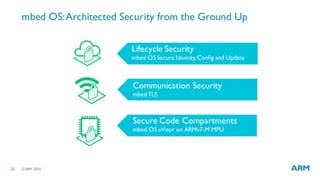
Lifecycle Security
mbed OS Secure Identity,Config and Update
Secure Code Compartments
mbed OS uVisor on ARMv7-M MPU
Communication Security
mbedTLS
mbed OS:Architected Security from the Ground Up
©ARM 201523
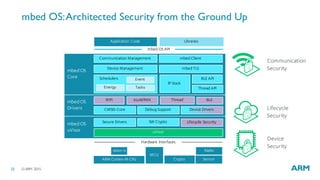
Hardware Interfaces
mbed OS
uVisor
mbed OS
Drivers
mbed OS
Core Schedulers
mbed OS API
Communication Management
Device Management mbed TLS
mbed Client
IP Stack
BLE APIEvent
TasksEnergy
Device DriversCMSIS-Core
Application Code Libraries
uVisor
Debug Support
Lifecycle SecuritySecure Drivers
ARMv7-M
ARM Cortex-M CPU
MCU
Radio
SensorCrypto
SW Crypto
ThreadWiFi BLE6LoWPAN
Thread API
Communication
Security
Lifecycle
Security
Device
Security
mbed OS:Architected Security from the Ground Up
Secure IoT: Example Use Cases
©ARM 201525
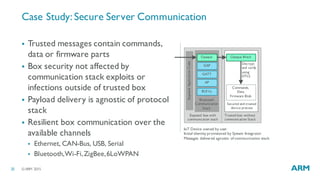
§ Trusted messages contain commands,
data or firmware parts
§ Box security not affected by
communication stack exploits or
infections outside of trusted box
§ Payload delivery is agnostic of protocol
stack
§ Resilient box communication over the
available channels
§ Ethernet, CAN-Bus, USB, Serial
§ Bluetooth,Wi-Fi,ZigBee,6LoWPAN
Case Study: Secure Server Communication
Exposed box with
communication stack
Decrypt
and verify
using
DTLS
GAP
Secured and trusted
device process
GATT
AP
BLE LL
Trusted box without
communication Stack
Opaque Block
Commands,
Data,
Firmware Blob
Opaque
Bluetooth
Communication
Stack
ExposedApplicationCode
IoT Device owned by user.
Initial identity provisioned by System Integrator
Messages delivered agnostic of communication stack
©ARM 201526
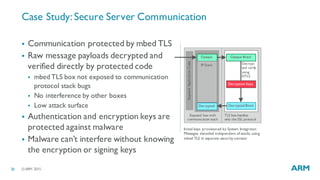
§ Communication protected by mbed TLS
§ Raw message payloads decrypted and
verified directly by protected code
§ mbed TLS box not exposed to communication
protocol stack bugs
§ No interference by other boxes
§ Low attack surface
§ Authentication and encryption keys are
protected against malware
§ Malware can’t interfere without knowing
the encryption or signing keys
Case Study: Secure Server Communication
Exposed box with
communication stack
Decrypt
and verify
using
DTLS
TLS box handles
only the SSL protocol
Opaque BlockOpaque
Initial keys provisioned by System Integrator.
Messages decoded independent of stacks using
mbed TLS in separate security context
ExposedApplicationCode
Decryption Keys
Decrypted BlockDecrypted
IP Stack
©ARM 201527
Case Study: Secure Remote Firmware Updates
Exposed box with
communication stack
GAP
GATT
AP
BLE LL
Bluetooth
Communication
Stack
Flash interface box protected by uVisor
– without own communication stack
CustomApplicationCode
Opaque Block
IoT device owned by user,
Initial identity provisioned by System Integrator,
Messages delivered independent of stacks
Firmware
update blocks
FW005
Firmware Update Image
Secure Storage,
Firmware Update Blocks
Re-flash Untrusted
Application Upon Completion
Opaque
Secured and trusted
device process
Decrypt
and verify
using
DTLS
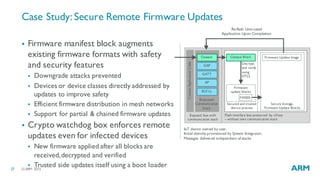
§ Firmware manifest block augments
existing firmware formats with safety
and security features
§ Downgrade attacks prevented
§ Devices or device classes directly addressed by
updates to improve safety
§ Efficient firmware distribution in mesh networks
§ Support for partial & chained firmware updates
§ Crypto watchdog box enforces remote
updates even for infected devices
§ New firmware applied after all blocks are
received,decrypted and verified
§ Trusted side updates itself using a boot loader
©ARM 201528
Case Study: Controlled Malware Recovery
§ Secure box detects malware infection
§ Enforces communication through the exposed side to the server
§ Receives latest security rules and virus behaviour fingerprints for
detection
§ Shares detected pattern fingerprint matches with control server
§ Distributed detection of viruses and live infrastructure attacks
§ When communication with the server breaks for a
minimum time, parts of the device stack are reset to
a known-good state
§ Prevents malware from staying on the device
§ Switches to a safe mode to detect network problems or to
remotely update the firmware
©ARM 201529
“The mantra of any good security engineer is: “Security is not
a product, but a process”It's more than designing
strong cryptography into a system;it's designing the entire system such that
all security measures,including cryptography,work together.”
– Bruce Schneier
ThankYou – Questions?
The trademarks featured in this presentation are
registered and/or unregistered trademarks of ARM
Limited (or its subsidiaries) in the EU and/or elsewhere.
All rights reserved.
All other marks featured may be trademarks of their
respective owners.
Copyright © 2015ARM Limited
Get the latest information on mbed security…
https://www.mbed.com/en/technologies/security/
.... and follow uVisor development on github:
https://github.com/ARMmbed/uvisor/
(uVisor is shared under Apache 2.0 license)

Resilient IoT Security: The end of flat security models

  • 1.
    Resilient IoT Security: Theend of flat security models Milosch Meriac IoT Security Engineer milosch.meriac@arm.com
  • 2.
    ©ARM 20152 “Securing acomputer system has traditionally been a battle of wits: the penetrator tries to find the holes, and the designer tries to close them.” – Morrie Gasser,Author of “Building a Secure Computer System”
  • 3.
    ©ARM 20153 § Evensimple IoT products require complex components § Secure server communication over complex protocols § Secure firmware updates over the air § Unclonable cryptographic device identities § Cryptography APIs and random number generation § Existing IoT solutions use flat address spaces with little privilege separation – especially on microcontrollers IoTeapot “Hello World” Example – The AttackerView Application Protocol TLS Library Diagnostics Secure Storage Crypto Keys Secure ID Crypto API WiFi Stack BLE Stack Device Management Firmware Update PRNG
  • 4.
    ©ARM 20154 IoTeapot “HelloWorld” Example – The AttackerView Application Protocol TLS Library Diagnostics Secure Storage Crypto Keys Secure ID Crypto API WiFi Stack BLE Stack Device Management Firmware Update Server Attacker PRNG § Flat security models allow attackers to break device security by breaking any system component § Common attack entry points: § Complex protocols likeTLS,Wi-Fi or USB device configuration § Firmware update functions (USB, network, CAN…) § Impossible to recover from attacks as firmware update functions can be compromised by the attacker
  • 5.
    ©ARM 20155 “It ain’twhat you don’t know that gets you into trouble. It’s what you know for sure that just ain’t.” – MarkTwain
  • 6.
    ©ARM 20156 Security PlusTime Equals Comedy: Plan for theWorst Case https://commons.wikimedia.org/wiki/File:Cret_Comedy_and_Tragedy.JPG § System security is dynamic over device lifetime § Devices last longer than expected § Likelihood of attacks underestimated as a result § If your system is successful,it will be hacked § Deployment costs of firmware updates in case of hacks often surpasses costs of new devices.As a result known-broken systems are kept in use § Developers must ensure secure,reliable and “cheap” update possibilities § Devices must be capable of remote recovery from an untrusted state back to a trusted state
  • 7.
    ©ARM 20157 § Splitsecurity domains into § exposed uncritical code § protected critical code § Keep footprint of critical code small to enable verification § Protect key material and system integrity using the ARMv7-M hardware memory protection § Public code operates on cryptographic secrets via defined private API – no access to raw keys IoTeapot “Hello World” Example – Mitigation Strategies Application Protocol TLS Library Diagnose WiFi Stack BLE Stack Device Management Secure Storage Crypto Keys Secure ID Crypto API Firmware Update PRNG Exposed Critical
  • 8.
    ©ARM 20158 IoTeapot “HelloWorld” Example – Mitigation Strategies Server Attacker Exposed Critical x x x x x Secure Storage Crypto Keys Secure ID Firmware Update Crypto API PRNG Application Protocol TLS Library Diagnose WiFi Stack BLE Stack Device Management § Attackers can compromise the exposed side without affecting critical code § Using cryptographic hashes the integrity of the exposed side can be verified § Triggered on server request § Protected security watchdog box allows remote control § Protected side can reliably reset exposed boxes to a clean state § The device attack surface is massively reduced as a result
  • 9.
    ©ARM 20159 Enable FastInnovation § Modules on the critical side require strong security coding practices § Critical code rarely changes § Exposed code developed rapidly § Faster time to market § Quick innovation cycles for exposed boxes § Still a secure product § Simple recovery from programming bugs in exposed code using secure boxes Exposed Critical Secure Storage Crypto Keys Secure ID Firmware Update Crypto API PRNG Application Protocol TLS Library Diagnose WiFi Stack BLE Stack Device Management
  • 10.
    ©ARM 201510 The uVisorDesign Principles Exposed Critical Secure Storage Crypto Keys Secure ID Firmware Update Crypto API PRNG Application Protocol TLS Library Diagnose WiFi Stack BLE Stack Device Management Future Versions of mbed OS will separate critical components like firmware update or raw cryptographic keys functions to ensure bugs in one secure module won’t affect other secure modules. § Ease of use § Hardware-enforced security sandboxes § Mutually distrustful security model § “Principle of Least Privilege” § Boxes are protected against each other § Boxes protected against malicious code from broken system components,driver or other boxes § EnforceAPI entry points across boxes § Box-APIs can be restricted to specific boxes § Per-box access control lists (ACL) § Restrict access to selected peripherals § Shared memories for box-box communication
  • 11.
    ©ARM 201511 § uVisorinitialized first in boot process § Private stack and data sections § Private data sections in flash for storing secrets § Relocation of interrupts vector table into secure memory § Initialization of memory protection unit based on box ACL’s § Whitelist approach – only necessary peripherals are accessible to each box § Each box has private .bss data and stack sections § De-privilege execution, continue boot unprivileged to initialize C/C++ libraries The uVisor Boot Process on the ARMv7-MArchitecture
  • 12.
    ©ARM 201512 The uVisorMemory Model § uVisor allocates protected per-box stacks and detects under-/overflows during operation § Main box memory accessible to all boxes § All remaining per-Box data sections are protected by default: § Secure Per-Box Context Memory § Shared data/peripherals with other boxes on demand § uVisor resolvesACLs during boot and identifiesACL collisions § uVisor code sections visible to everybody § Empty flash memory is made available to the system as configuration storage – write access only through configurationAPI
  • 13.
    ©ARM 201513 “Developers, developers, …,developers” – Steve Ballmer
  • 14.
    ©ARM 201514 Enable uVisorand Share Peripherals Across Boxes #include <uvisor-lib/uvisor-lib.h> /* create background ACLs for the main box */ static const UvBoxAclItem g_background_acl[] = { {UART0, sizeof(*UART0), UVISOR_TACL_PERIPHERAL}, {UART1, sizeof(*UART1), UVISOR_TACL_PERIPHERAL}, {PIT, sizeof(*PIT), UVISOR_TACL_PERIPHERAL}, }; /* set uvisor mode (enable) */ UVISOR_SET_MODE_ACL(UVISOR_ENABLED, g_background_acl); #include <uvisor-lib/uvisor-lib.h> /* set uvisor mode (enable) */ UVISOR_SET_MODE(UVISOR_ENABLED); § enable uVisor – optionally with shared peripherals across boxes:
  • 15.
    ©ARM 201515 Setting upProtected Sandboxes /* create private box context */ typedef struct { uint8_t secret[SECRET_SIZE]; bool initialized; } BoxContext; /* create ACLs for the module */ static const UvBoxAclItem g_box_acl[] = { {RNG, sizeof(*RNG), UVISOR_TACL_PERIPHERAL}, /* a peripheral */ }; /*required stack size */ #define BOX_STACK_SIZE 0x100 /* configure secure box compartment */ UVISOR_BOX_CONFIG(my_box_name, g_box_acl, BOX_STACK_SIZE, BoxContext);
  • 16.
    ©ARM 201516 Define FunctionCall Gateways Across Security Boundaries uint32_t secure_gateway(box_name, uint32_t target_fn, ...)/*pre-processor macro*/ § Call box functions using the security context of the target box (“sudo”) § Secure call gateways support up to four arguments and a return value /* the box is configured here */ ... /* the actual function */ extern "C" uint32_t __secure_sum(uint32_t op1, uint32_t op2) { return op1 + op2; } /* the gateway to the secure function */ uint32_t secure_sum(uint32_t op1, uint32_t op2) { return secure_gateway(my_box_name, __secure_sum, op1, op2) }
  • 17.
    ©ARM 201517 Secure uVisorAPI void vIRQ_SetVector(uint32_t irqn, uint32_t vector); uint32_t vIRQ_GetVector(uint32_t irqn); void vIRQ_EnableIRQ(uint32_t irqn); void vIRQ_DisableIRQ(uint32_t irqn); void vIRQ_ClearPendingIRQ(uint32_t irqn); void vIRQ_SetPendingIRQ(uint32_t irqn); uint32_t vIRQ_GetPendingIRQ(uint32_t irqn); void vIRQ_SetPriority(uint32_t irqn, uint32_t priority); uint32_t vIRQ_GetPriority(uint32_t irqn); § Accelerated secure peripheral accessAPI with bit-levelACL’s § Security verified during installation on device or before firmware signing on the server § Attackers can’t create new peripheral access calls without writing to Flash § IRQAPI for unprivileged interrupt handling § Interrupts are executed unprivileged in the box security context of the owning box § CPU registers cleared for protecting the interrupted box against data leakage
  • 18.
    ©ARM 201518 #define MY_HANDLER_IRQn42 void my_irq_handler(void) { ... } int register_my_irq_handler(void) { vIRQ_SetVector(MY_HANDLER_IRQn, (uint32_t) &my_irq_handler); vIRQ_EnableIRQ(MY_HANDLER_IRQn); } Secure uVisor InterruptAPI § Interrupt ownership is exclusive – multiple boxes cannot register for the same interrupt § Registration based on first-come-first-serve: sharing IRQ’s only possible via box API services § uVisor remembers association between Interrupt handler and box security context during registration: other boxes can’t access that interrupt till its released
  • 19.
    ©ARM 201519 “The Devilis in the details, but so is salvation” – Hyman G. Rickover, United States Navy Admiral
  • 20.
    ©ARM 201520 Call GatewayInternals forARMv7-M Systems § Call gateways only accepted from flash memory § attacker has no write access to flash controller § Metadata of call gateway at a fixed offset from uVisor gateway context switch – a supervisor call (SVC) § Contains pointer to target box configuration & target function § Guaranteed latency for cross-box calls § Can limit access to specific caller boxes § Security verified once during installation /* the actual secure gateway */ #define secure_gateway(dst_box, dst_fn, ...) ({ SELECT_ARGS(__VA_ARGS__) register uint32_t res asm("r0"); asm volatile ( "svc UVISOR_API_SVC_CALL_IDn" "b.n skip_metadata%=n" ".word UVISOR_SVC_GW_MAGICn" ".word dst_fnn" ".word dst_box##_cfg_ptrn" "skip_metadata%=:n” : "=r" (res) : ASM_INLINE_ARGS(__VA_ARGS__) ); res; })
  • 21.
    ©ARM 201521 § ARMmbed-OS uVisor security model of TrustZone for ARMv8M remains the same as the ARMv7-M security model § TrustZone for ARMv8M enables bus level protection in hardware § ARMv7-M requires software API filters for DMA access and other security critical operations § ARMv8-M can filter for DMA access for requests initiated by unprivileged code on bus level § TrustZone for ARMv8M MPU banking reduces complexity of secure target OS § Secure OS partition own a private MPU with full control § OS keeps the privileged mode for fast IRQs § Fast interrupt routing and register clearing in hardware § Fast cross-box calls on TrustZone for ARMv8M – optimized call gateways uVisor Outlook – Existing ARMv7-M vs.TrustZone for ARMv8M
  • 22.
    ©ARM 201522 Lifecycle Security mbedOS Secure Identity,Config and Update Secure Code Compartments mbed OS uVisor on ARMv7-M MPU Communication Security mbedTLS mbed OS:Architected Security from the Ground Up
  • 23.
    ©ARM 201523 Hardware Interfaces mbedOS uVisor mbed OS Drivers mbed OS Core Schedulers mbed OS API Communication Management Device Management mbed TLS mbed Client IP Stack BLE APIEvent TasksEnergy Device DriversCMSIS-Core Application Code Libraries uVisor Debug Support Lifecycle SecuritySecure Drivers ARMv7-M ARM Cortex-M CPU MCU Radio SensorCrypto SW Crypto ThreadWiFi BLE6LoWPAN Thread API Communication Security Lifecycle Security Device Security mbed OS:Architected Security from the Ground Up
  • 24.
  • 25.
    ©ARM 201525 § Trustedmessages contain commands, data or firmware parts § Box security not affected by communication stack exploits or infections outside of trusted box § Payload delivery is agnostic of protocol stack § Resilient box communication over the available channels § Ethernet, CAN-Bus, USB, Serial § Bluetooth,Wi-Fi,ZigBee,6LoWPAN Case Study: Secure Server Communication Exposed box with communication stack Decrypt and verify using DTLS GAP Secured and trusted device process GATT AP BLE LL Trusted box without communication Stack Opaque Block Commands, Data, Firmware Blob Opaque Bluetooth Communication Stack ExposedApplicationCode IoT Device owned by user. Initial identity provisioned by System Integrator Messages delivered agnostic of communication stack
  • 26.
    ©ARM 201526 § Communicationprotected by mbed TLS § Raw message payloads decrypted and verified directly by protected code § mbed TLS box not exposed to communication protocol stack bugs § No interference by other boxes § Low attack surface § Authentication and encryption keys are protected against malware § Malware can’t interfere without knowing the encryption or signing keys Case Study: Secure Server Communication Exposed box with communication stack Decrypt and verify using DTLS TLS box handles only the SSL protocol Opaque BlockOpaque Initial keys provisioned by System Integrator. Messages decoded independent of stacks using mbed TLS in separate security context ExposedApplicationCode Decryption Keys Decrypted BlockDecrypted IP Stack
  • 27.
    ©ARM 201527 Case Study:Secure Remote Firmware Updates Exposed box with communication stack GAP GATT AP BLE LL Bluetooth Communication Stack Flash interface box protected by uVisor – without own communication stack CustomApplicationCode Opaque Block IoT device owned by user, Initial identity provisioned by System Integrator, Messages delivered independent of stacks Firmware update blocks FW005 Firmware Update Image Secure Storage, Firmware Update Blocks Re-flash Untrusted Application Upon Completion Opaque Secured and trusted device process Decrypt and verify using DTLS § Firmware manifest block augments existing firmware formats with safety and security features § Downgrade attacks prevented § Devices or device classes directly addressed by updates to improve safety § Efficient firmware distribution in mesh networks § Support for partial & chained firmware updates § Crypto watchdog box enforces remote updates even for infected devices § New firmware applied after all blocks are received,decrypted and verified § Trusted side updates itself using a boot loader
  • 28.
    ©ARM 201528 Case Study:Controlled Malware Recovery § Secure box detects malware infection § Enforces communication through the exposed side to the server § Receives latest security rules and virus behaviour fingerprints for detection § Shares detected pattern fingerprint matches with control server § Distributed detection of viruses and live infrastructure attacks § When communication with the server breaks for a minimum time, parts of the device stack are reset to a known-good state § Prevents malware from staying on the device § Switches to a safe mode to detect network problems or to remotely update the firmware
  • 29.
    ©ARM 201529 “The mantraof any good security engineer is: “Security is not a product, but a process”It's more than designing strong cryptography into a system;it's designing the entire system such that all security measures,including cryptography,work together.” – Bruce Schneier
  • 30.
    ThankYou – Questions? Thetrademarks featured in this presentation are registered and/or unregistered trademarks of ARM Limited (or its subsidiaries) in the EU and/or elsewhere. All rights reserved. All other marks featured may be trademarks of their respective owners. Copyright © 2015ARM Limited Get the latest information on mbed security… https://www.mbed.com/en/technologies/security/ .... and follow uVisor development on github: https://github.com/ARMmbed/uvisor/ (uVisor is shared under Apache 2.0 license)