Philosophy is: A search for meaning(s) and truth(s) the general beliefs and attitudes of an individual or group the body of principles underlying a branch of learning or major discipline
Definitions   “ Love of Wisdom”  [Philo] love of [Sophia] wisdom The systematic development of theories of : Knowledge Truth Existence Cause Good
Organizational Strategies for studying Educational Philosophies Subjective Begin with the personal Systematic  “Schools” of philosophy Philosophical Approach Branches of philosophy Relationship between Theory and Practice
Subjective Everyone has a “philosophy of Life” Usually at a tacit level (metaphorical) Often fails the three “C”s clarity coherence consistency A Philosophy of Education should grow out of a personal philosophy or a personal set of beliefs
Systematic Idealism Realism Eastern Pragmatism Reconstructionism Existentialism Marxism Postmodernism
Philosophical Approach The Traditional Branches of Philosophy Ontology What is real?  What is truth? Epistemology What does  it mean to know? Logic What are the “rules” of reasoning? Axiology How do we know the good? right from wrong? (Ethics) How do we make judgments about beauty? (Aesthetics)
Ontology Concerned with theories of the nature of reality.  What is the nature of existence? Is reality limited to what we can experience? Can reality be pursued through the application of intellect and reason? Is reality subjective or objective? Is truth eternal and unchanging? Is truth situational and contextual?
Epistemology Concerned with theories of  the nature of knowledge Epistemological questions: How do people learn?  What knowledge is of utmost value?  What are the different types of knowledge?  What are the educational goals of schools?
Axiology Concerned with theories of value Two major divisions of axiology ethics  What is right and wrong?  What is evil and good?  aesthetics  What is beautiful and ugly?
Relationship Between Theory and Practice What are the educational  aims  of a philosophy? What are the educational  methods  of a philosophy? What  curriculum  fits the philosophy? What is the  Role of the Teacher ?
Idealism As a philosophy of Education
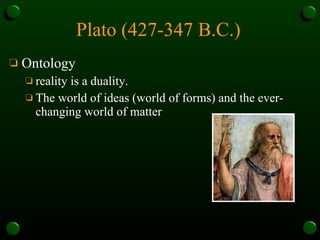
Plato (427-347 B.C.)   Ontology reality is a duality.  The world of ideas (world of forms) and the ever-changing world of matter
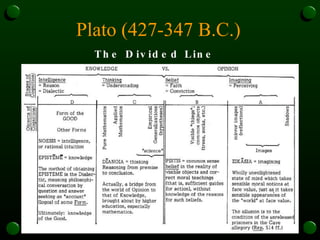
Plato (427-347 B.C.)   The Divided Line
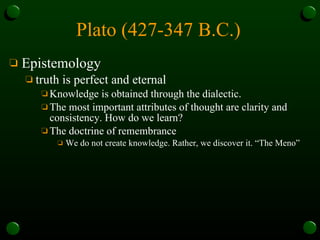
Plato (427-347 B.C.)   Epistemology truth is perfect and eternal Knowledge is obtained through the dialectic.  The most important attributes of thought are clarity and consistency. How do we learn?  The doctrine of remembrance  We do not create knowledge. Rather, we discover it. “The Meno”
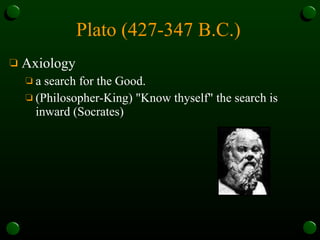
Plato (427-347 B.C.)   Axiology a search for the Good.  (Philosopher-King) "Know thyself" the search is inward (Socrates)
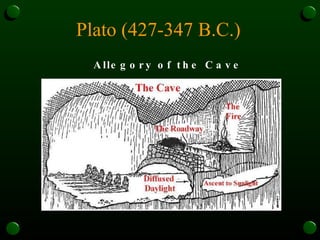
Plato (427-347 B.C.)   Allegory of the Cave
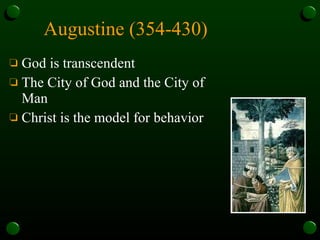
Augustine (354-430)   God is transcendent The City of God and the City of Man Christ is the model for behavior
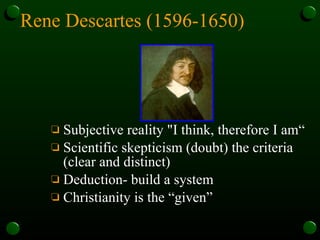
Rene Descartes (1596-1650)   Subjective reality "I think, therefore I am“ Scientific skepticism (doubt) the criteria (clear and distinct) Deduction- build a system  Christianity is the “given”
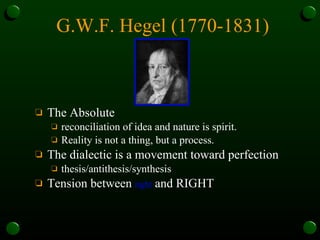
G.W.F. Hegel (1770-1831) The Absolute  reconciliation of idea and nature is spirit. Reality is not a thing, but a process.  The dialectic is a movement toward perfection  thesis/antithesis/synthesis Tension between  right  and RIGHT
Idealism As A Philosophy of Education Society /Civilization not of central importance.  HUMAN VALUES  In a purposeful, spiritual environment, the individual personality develops.  Thus society is a means to a higher goal (i.e. The Republic)
Aim of Education Absolutist- The search for “TRUTH”- True Ideas Rationalist- The search for truth is a rational process. Thus, to be educated, is to reason effectively. Subjectivist- Individuals should strive for self-realization Character Development Wisdom Moral conviction Good will Loyalty
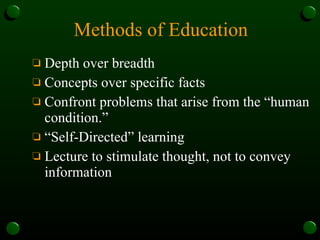
Methods of Education Depth over breadth  Concepts over specific facts Confront problems that arise from the “human condition.”  “Self-Directed” learning Lecture to stimulate thought, not to convey information
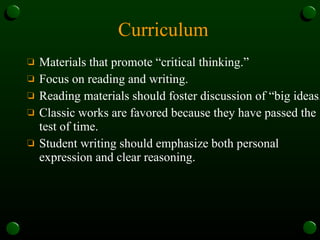
Curriculum Materials that promote “critical thinking.” Focus on reading and writing. Reading materials should foster discussion of “big ideas.” Classic works are favored because they have passed the test of time. Student writing should emphasize both personal expression and clear reasoning.
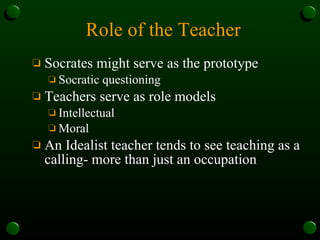
Role of the Teacher Socrates might serve as the prototype Socratic questioning Teachers serve as role models Intellectual Moral An Idealist teacher tends to see teaching as a calling- more than just an occupation
Realism As a Philosophy of Education
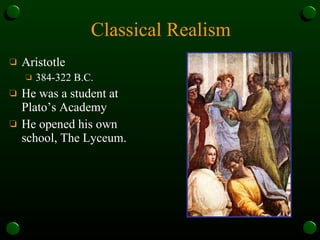
Classical Realism Aristotle 384-322 B.C. He was a student at Plato’s Academy He opened his own school, The Lyceum.
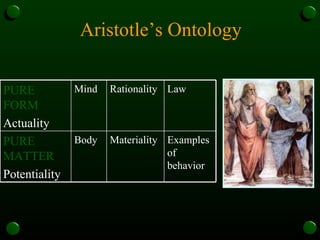
Aristotle’s Ontology Prime Matter Principle of Potentiality Pure Form Principle of Actuality FORM and MATTER are separate concepts, but they are never found alone
Aristotle’s Ontology Plato’s FORMS  are the universal property of material things Each particular piece of  MATTER has both a universal and a particular property
Aristotle’s Ontology The PRINCIPLE OF INDEPENDENCE FORMS are the nonmaterial aspect of each particular material object that relates to all other particulars of that class We arrive at forms (classes) by examining material objects that exist in themselves, independent of us as observers Thus, MATTER is primary and prior to FORM
Aristotle’s Ontology Examples of behavior Materiality Body PURE MATTER Potentiality Law Rationality Mind PURE FORM Actuality
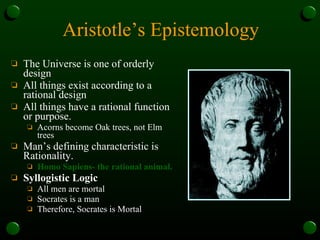
Aristotle’s Epistemology The Universe is one of orderly design All things exist according to a rational design All things have a rational function or purpose. Acorns become Oak trees, not Elm trees Man’s defining characteristic is Rationality.  Homo Sapiens- the rational animal. Syllogistic Logic All men are mortal Socrates is a man Therefore, Socrates is Mortal
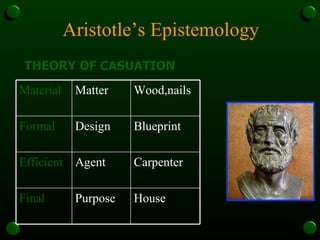
Aristotle’s Epistemology THEORY OF CASUATION House Purpose Final Carpenter Agent Efficient Blueprint Design Formal Wood,nails Matter Material
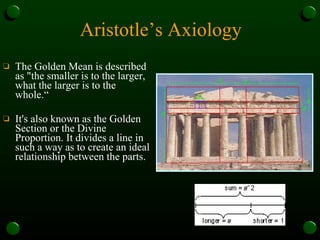
Aristotle’s Axiology The Golden Mean is described as "the smaller is to the larger, what the larger is to the whole.“ It's also known as the Golden Section or the Divine Proportion. It divides a line in such a way as to create an ideal relationship between the parts.
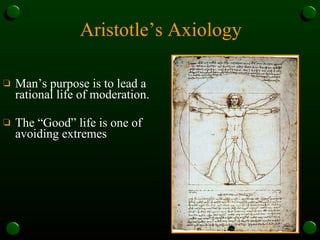
Aristotle’s Axiology Man’s purpose is to lead a rational life of moderation. The “Good” life is one of avoiding extremes
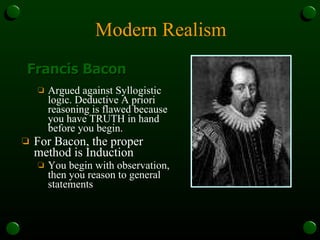
Modern Realism Argued against Syllogistic logic. Deductive A priori reasoning is flawed because you have TRUTH in hand before you begin. For Bacon, the proper method is Induction You begin with observation, then you reason to general statements Francis Bacon
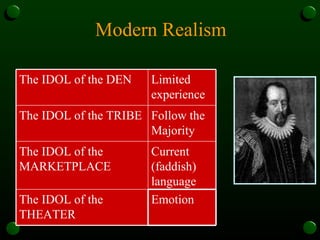
Modern Realism Emotion The IDOL of the THEATER Current (faddish) language The IDOL of the MARKETPLACE Follow the Majority The IDOL of the TRIBE Limited experience The IDOL of the DEN
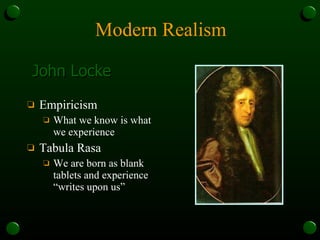
Modern Realism Empiricism What we know is what we experience Tabula Rasa We are born as blank tablets and experience “writes upon us” John Locke
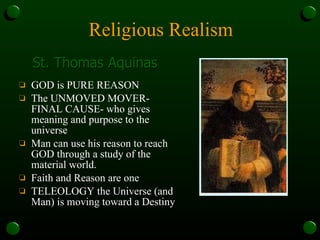
Religious Realism GOD is PURE REASON The UNMOVED MOVER- FINAL CAUSE- who gives meaning and purpose to the universe Man can use his reason to reach GOD through a study of the material world. Faith and Reason are one TELEOLOGY the Universe (and Man) is moving toward a Destiny St. Thomas Aquinas
Realism as a Philosophy of Education Absolutist- Education should focus on the truth of the natural and physical world Empiricist- Teach students the scientific method of problem solving by exploring the material world Objectivist- Emphasize basic skills and basic facts- “3Rs” There are objective skills and facts that all students should learn. Character Development: Establish high standards and increased rigor and hold students accountable Emphasize practical knowledge that will prepare students for the world of work Aims of Education
Realism as a Philosophy of Education Methods of Education Direct teaching techniques are preferable.  Students should be presented information in an organized, efficient and logical format. Given the “information overload” in today’s society, it is important that “non-essential” learning should be eliminated. Students should be taught based upon their strengths and abilities. Scientific testing should be used to diagnose and place students in settings most appropriate to their needs Technology should be utilized whenever appropriate in schools
Realism as a Philosophy of Education Curriculum Curricula should be practical and useful Curricula should concentrate on the “Basics” and avoid fads and frills. Curricula should be highly organized, correlated and aligned throughout the scope and sequence offered by schools Curricula should be based upon pre-established standards and criteria.  Curricula should be “experiential” whenever possible
Realism as a Philosophy of Education Role of the Teacher A Realist teacher should be a subject matter expert. A Realist teachers should be able to present material in an organized and systematic way. A Realist teacher should be able to explain the lesson objectives in a way that is understandable to the learner. A Realist teacher should be able to effectively assess students in such a way that all students are challenged and motivated to learn. A Realist teacher should understand current research and technology and be able to utilize it in the classroom.

Philosophy Intro

  • 1.
    Philosophy is: Asearch for meaning(s) and truth(s) the general beliefs and attitudes of an individual or group the body of principles underlying a branch of learning or major discipline
  • 2.
    Definitions “ Love of Wisdom” [Philo] love of [Sophia] wisdom The systematic development of theories of : Knowledge Truth Existence Cause Good
  • 3.
    Organizational Strategies forstudying Educational Philosophies Subjective Begin with the personal Systematic “Schools” of philosophy Philosophical Approach Branches of philosophy Relationship between Theory and Practice
  • 4.
    Subjective Everyone hasa “philosophy of Life” Usually at a tacit level (metaphorical) Often fails the three “C”s clarity coherence consistency A Philosophy of Education should grow out of a personal philosophy or a personal set of beliefs
  • 5.
    Systematic Idealism RealismEastern Pragmatism Reconstructionism Existentialism Marxism Postmodernism
  • 6.
    Philosophical Approach TheTraditional Branches of Philosophy Ontology What is real? What is truth? Epistemology What does it mean to know? Logic What are the “rules” of reasoning? Axiology How do we know the good? right from wrong? (Ethics) How do we make judgments about beauty? (Aesthetics)
  • 7.
    Ontology Concerned withtheories of the nature of reality. What is the nature of existence? Is reality limited to what we can experience? Can reality be pursued through the application of intellect and reason? Is reality subjective or objective? Is truth eternal and unchanging? Is truth situational and contextual?
  • 8.
    Epistemology Concerned withtheories of the nature of knowledge Epistemological questions: How do people learn? What knowledge is of utmost value? What are the different types of knowledge? What are the educational goals of schools?
  • 9.
    Axiology Concerned withtheories of value Two major divisions of axiology ethics What is right and wrong? What is evil and good? aesthetics What is beautiful and ugly?
  • 10.
    Relationship Between Theoryand Practice What are the educational aims of a philosophy? What are the educational methods of a philosophy? What curriculum fits the philosophy? What is the Role of the Teacher ?
  • 11.
    Idealism As aphilosophy of Education
  • 12.
    Plato (427-347 B.C.) Ontology reality is a duality. The world of ideas (world of forms) and the ever-changing world of matter
  • 13.
    Plato (427-347 B.C.) The Divided Line
  • 14.
    Plato (427-347 B.C.) Epistemology truth is perfect and eternal Knowledge is obtained through the dialectic. The most important attributes of thought are clarity and consistency. How do we learn? The doctrine of remembrance We do not create knowledge. Rather, we discover it. “The Meno”
  • 15.
    Plato (427-347 B.C.) Axiology a search for the Good. (Philosopher-King) "Know thyself" the search is inward (Socrates)
  • 16.
    Plato (427-347 B.C.) Allegory of the Cave
  • 17.
    Augustine (354-430) God is transcendent The City of God and the City of Man Christ is the model for behavior
  • 18.
    Rene Descartes (1596-1650) Subjective reality "I think, therefore I am“ Scientific skepticism (doubt) the criteria (clear and distinct) Deduction- build a system Christianity is the “given”
  • 19.
    G.W.F. Hegel (1770-1831)The Absolute reconciliation of idea and nature is spirit. Reality is not a thing, but a process. The dialectic is a movement toward perfection thesis/antithesis/synthesis Tension between right and RIGHT
  • 20.
    Idealism As APhilosophy of Education Society /Civilization not of central importance. HUMAN VALUES In a purposeful, spiritual environment, the individual personality develops. Thus society is a means to a higher goal (i.e. The Republic)
  • 21.
    Aim of EducationAbsolutist- The search for “TRUTH”- True Ideas Rationalist- The search for truth is a rational process. Thus, to be educated, is to reason effectively. Subjectivist- Individuals should strive for self-realization Character Development Wisdom Moral conviction Good will Loyalty
  • 22.
    Methods of EducationDepth over breadth Concepts over specific facts Confront problems that arise from the “human condition.” “Self-Directed” learning Lecture to stimulate thought, not to convey information
  • 23.
    Curriculum Materials thatpromote “critical thinking.” Focus on reading and writing. Reading materials should foster discussion of “big ideas.” Classic works are favored because they have passed the test of time. Student writing should emphasize both personal expression and clear reasoning.
  • 24.
    Role of theTeacher Socrates might serve as the prototype Socratic questioning Teachers serve as role models Intellectual Moral An Idealist teacher tends to see teaching as a calling- more than just an occupation
  • 25.
    Realism As aPhilosophy of Education
  • 26.
    Classical Realism Aristotle384-322 B.C. He was a student at Plato’s Academy He opened his own school, The Lyceum.
  • 27.
    Aristotle’s Ontology PrimeMatter Principle of Potentiality Pure Form Principle of Actuality FORM and MATTER are separate concepts, but they are never found alone
  • 28.
    Aristotle’s Ontology Plato’sFORMS are the universal property of material things Each particular piece of MATTER has both a universal and a particular property
  • 29.
    Aristotle’s Ontology ThePRINCIPLE OF INDEPENDENCE FORMS are the nonmaterial aspect of each particular material object that relates to all other particulars of that class We arrive at forms (classes) by examining material objects that exist in themselves, independent of us as observers Thus, MATTER is primary and prior to FORM
  • 30.
    Aristotle’s Ontology Examplesof behavior Materiality Body PURE MATTER Potentiality Law Rationality Mind PURE FORM Actuality
  • 31.
    Aristotle’s Epistemology TheUniverse is one of orderly design All things exist according to a rational design All things have a rational function or purpose. Acorns become Oak trees, not Elm trees Man’s defining characteristic is Rationality. Homo Sapiens- the rational animal. Syllogistic Logic All men are mortal Socrates is a man Therefore, Socrates is Mortal
  • 32.
    Aristotle’s Epistemology THEORYOF CASUATION House Purpose Final Carpenter Agent Efficient Blueprint Design Formal Wood,nails Matter Material
  • 33.
    Aristotle’s Axiology TheGolden Mean is described as "the smaller is to the larger, what the larger is to the whole.“ It's also known as the Golden Section or the Divine Proportion. It divides a line in such a way as to create an ideal relationship between the parts.
  • 34.
    Aristotle’s Axiology Man’spurpose is to lead a rational life of moderation. The “Good” life is one of avoiding extremes
  • 35.
    Modern Realism Arguedagainst Syllogistic logic. Deductive A priori reasoning is flawed because you have TRUTH in hand before you begin. For Bacon, the proper method is Induction You begin with observation, then you reason to general statements Francis Bacon
  • 36.
    Modern Realism EmotionThe IDOL of the THEATER Current (faddish) language The IDOL of the MARKETPLACE Follow the Majority The IDOL of the TRIBE Limited experience The IDOL of the DEN
  • 37.
    Modern Realism EmpiricismWhat we know is what we experience Tabula Rasa We are born as blank tablets and experience “writes upon us” John Locke
  • 38.
    Religious Realism GODis PURE REASON The UNMOVED MOVER- FINAL CAUSE- who gives meaning and purpose to the universe Man can use his reason to reach GOD through a study of the material world. Faith and Reason are one TELEOLOGY the Universe (and Man) is moving toward a Destiny St. Thomas Aquinas
  • 39.
    Realism as aPhilosophy of Education Absolutist- Education should focus on the truth of the natural and physical world Empiricist- Teach students the scientific method of problem solving by exploring the material world Objectivist- Emphasize basic skills and basic facts- “3Rs” There are objective skills and facts that all students should learn. Character Development: Establish high standards and increased rigor and hold students accountable Emphasize practical knowledge that will prepare students for the world of work Aims of Education
  • 40.
    Realism as aPhilosophy of Education Methods of Education Direct teaching techniques are preferable. Students should be presented information in an organized, efficient and logical format. Given the “information overload” in today’s society, it is important that “non-essential” learning should be eliminated. Students should be taught based upon their strengths and abilities. Scientific testing should be used to diagnose and place students in settings most appropriate to their needs Technology should be utilized whenever appropriate in schools
  • 41.
    Realism as aPhilosophy of Education Curriculum Curricula should be practical and useful Curricula should concentrate on the “Basics” and avoid fads and frills. Curricula should be highly organized, correlated and aligned throughout the scope and sequence offered by schools Curricula should be based upon pre-established standards and criteria. Curricula should be “experiential” whenever possible
  • 42.
    Realism as aPhilosophy of Education Role of the Teacher A Realist teacher should be a subject matter expert. A Realist teachers should be able to present material in an organized and systematic way. A Realist teacher should be able to explain the lesson objectives in a way that is understandable to the learner. A Realist teacher should be able to effectively assess students in such a way that all students are challenged and motivated to learn. A Realist teacher should understand current research and technology and be able to utilize it in the classroom.