BY:  SYAFIE ASRUL HAFIZ MUHAMMAD SHAFIQ WAN MOHD RIDZAUDIN
MOTION What is motion ? What are the different types of motion? What is the physics relating to motion called? ok! we have answers to all these questions .
1.  What is motion? when a body is continuously changing its position with respect to the surroundings , then we say that the body is in motion.
EXAMPLE :   1.When an athlete  is running on the ground then he is continuously changing his position with respect  to the audience who are sitting at rest. 2.We are continuously changing our position since morning till night  with respect to earth which is at rest. 3.The earth is continuously changing position with respect to sun which is at rest.
2.What are the different types of motion? Linear motion  :  when a body moves either in a straight line or along a curved path, then we say that it is executing linear motion. 1. when a body moves in a straight line then the linear motion is  called  rectilinear motion . eg ., an athelete running a 100 meter race along a straight track is said to be a linear motion or rectilinear motion. 2.when a body moves along a curved path  then the linear motion is called  curvilinear motion . eg., a planet revolving around  its parent star
Other types of motion are : Rotatory motion  :  A body is said to be in rotatory motion  when  it stays at one place and turns round and round about an axis. example :a rotating fan,a spinning top, the earth. Oscillatory motion  :  a body is said to be in oscillatory motion when it swings to and fro about a mean position. example : the pendulum of a clock, the swing   etc.,
What is the physics relating to motion called  ? Mechanics  :  it is an important branch of physics and deals with the effect of force on bodies. It is further divided into  two parts 1. Dynamics  :  In dynamics we discuss the  motion of bodies under the action of forces. 2.Kinematics   :  it deals with the study of motion of bodies Without any reference to the cause of motion .
SCALARS AND VECTORS
Characteristics of a Scalar Quantity Only has magnitude Requires 2 things: 1. A value 2. Appropriate units Ex. Mass: 5kg   Temp: 21 ° C   Speed: 65 mph
Characteristics of a Vector Quantity Has magnitude & direction Requires 3 things: 1. A value 2. Appropriate units 3.  A direction! Ex.  Acceleration: 9.8 m/s 2  down   Velocity:25 mph West
More about Vectors A vector is represented on paper by an arrow 1. the length represents magnitude 2. the arrow faces the direction of motion 3. a vector can be “picked up” and moved on the paper as long as the length and direction its pointing does  not  change
Addition of Vectors Graphical Algebraic Resultant:  sum of vectors
Properties of Vector Addition Commutative Property of Addition A  +  B  =  B  +  A Associative Property of Addition (A  +  B)  +  C = A  + ( B  +  C)
Graphical Addition of Vectors Head-to-Tail Method Parallelogram Method
Graphical Addition of Vectors Head-to-Tail Method  Vectors are moved parallel to themselves so that they are positioned  in such a way that the head of one is adjacent to the tail of the other. The resultant is drawn by starting at the first tail (loose tail) and ending (arrow head pointed) at the last head (loose head).  A B Resultant
Graphical Addition of Vectors Parallelogram Method The vectors are placed tail to tail forming a rectangle.  The diagonal that starts at the joint tails has its tail at the joint tails) is the resultant. A B Resultant
Subtraction of Vectors (cont.) Subtraction used when trying to find a change in a quantity. Equations to remember: ∆ d = d f  – d i   or  ∆v = v f  – v i   Therefore, you add the second vector to the opposite of the first vector.
Graphical Vector Subtraction When subtracting  A - B  : Invert vector  B  to get  -B Add  A +( -B ) normally
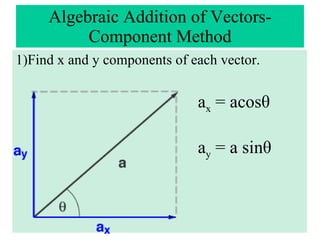
Algebraic Addition of Vectors- Component Method 1)Find x and y components of each vector. a x  = acos θ a y  = a sin θ
Component Method Cont’d 2)Add x and y components. 3)Use the Pythagorean Theorem to find the magnitude of the resultant. 4)Use   =tan -1  | Y  | to find the direction   X with respect to the x-axis.
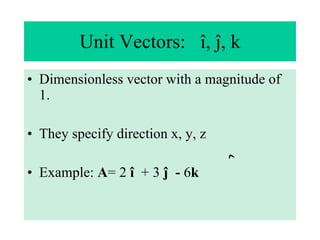
Unit Vectors:  î, ĵ, k Dimensionless vector with a magnitude of 1. They specify direction x, y, z Example:  A = 2  î   + 3  ĵ  -  6 k
Example 1 Add the vectors: A = 10  î   - 1  ĵ  -   6 k B = - 6 î   + 5  ĵ  +   6 k Give the components of the resultant vector, its magnitude and its direction with respect to the x-axis. Answer: R= 4 î  + 4 ĵ,  5.7,  45 deg above +x axis

Motion - Vektor

  • 1.
    BY: SYAFIEASRUL HAFIZ MUHAMMAD SHAFIQ WAN MOHD RIDZAUDIN
  • 2.
    MOTION What ismotion ? What are the different types of motion? What is the physics relating to motion called? ok! we have answers to all these questions .
  • 3.
    1. Whatis motion? when a body is continuously changing its position with respect to the surroundings , then we say that the body is in motion.
  • 4.
    EXAMPLE : 1.When an athlete is running on the ground then he is continuously changing his position with respect to the audience who are sitting at rest. 2.We are continuously changing our position since morning till night with respect to earth which is at rest. 3.The earth is continuously changing position with respect to sun which is at rest.
  • 5.
    2.What are thedifferent types of motion? Linear motion : when a body moves either in a straight line or along a curved path, then we say that it is executing linear motion. 1. when a body moves in a straight line then the linear motion is called rectilinear motion . eg ., an athelete running a 100 meter race along a straight track is said to be a linear motion or rectilinear motion. 2.when a body moves along a curved path then the linear motion is called curvilinear motion . eg., a planet revolving around its parent star
  • 6.
    Other types ofmotion are : Rotatory motion : A body is said to be in rotatory motion when it stays at one place and turns round and round about an axis. example :a rotating fan,a spinning top, the earth. Oscillatory motion : a body is said to be in oscillatory motion when it swings to and fro about a mean position. example : the pendulum of a clock, the swing etc.,
  • 7.
    What is thephysics relating to motion called ? Mechanics : it is an important branch of physics and deals with the effect of force on bodies. It is further divided into two parts 1. Dynamics : In dynamics we discuss the motion of bodies under the action of forces. 2.Kinematics : it deals with the study of motion of bodies Without any reference to the cause of motion .
  • 8.
  • 9.
    Characteristics of aScalar Quantity Only has magnitude Requires 2 things: 1. A value 2. Appropriate units Ex. Mass: 5kg Temp: 21 ° C Speed: 65 mph
  • 10.
    Characteristics of aVector Quantity Has magnitude & direction Requires 3 things: 1. A value 2. Appropriate units 3. A direction! Ex. Acceleration: 9.8 m/s 2 down Velocity:25 mph West
  • 11.
    More about VectorsA vector is represented on paper by an arrow 1. the length represents magnitude 2. the arrow faces the direction of motion 3. a vector can be “picked up” and moved on the paper as long as the length and direction its pointing does not change
  • 12.
    Addition of VectorsGraphical Algebraic Resultant: sum of vectors
  • 13.
    Properties of VectorAddition Commutative Property of Addition A + B = B + A Associative Property of Addition (A + B) + C = A + ( B + C)
  • 14.
    Graphical Addition ofVectors Head-to-Tail Method Parallelogram Method
  • 15.
    Graphical Addition ofVectors Head-to-Tail Method Vectors are moved parallel to themselves so that they are positioned in such a way that the head of one is adjacent to the tail of the other. The resultant is drawn by starting at the first tail (loose tail) and ending (arrow head pointed) at the last head (loose head). A B Resultant
  • 16.
    Graphical Addition ofVectors Parallelogram Method The vectors are placed tail to tail forming a rectangle. The diagonal that starts at the joint tails has its tail at the joint tails) is the resultant. A B Resultant
  • 17.
    Subtraction of Vectors(cont.) Subtraction used when trying to find a change in a quantity. Equations to remember: ∆ d = d f – d i or ∆v = v f – v i Therefore, you add the second vector to the opposite of the first vector.
  • 18.
    Graphical Vector SubtractionWhen subtracting A - B : Invert vector B to get -B Add A +( -B ) normally
  • 19.
    Algebraic Addition ofVectors- Component Method 1)Find x and y components of each vector. a x = acos θ a y = a sin θ
  • 20.
    Component Method Cont’d2)Add x and y components. 3)Use the Pythagorean Theorem to find the magnitude of the resultant. 4)Use  =tan -1 | Y | to find the direction X with respect to the x-axis.
  • 21.
    Unit Vectors: î, ĵ, k Dimensionless vector with a magnitude of 1. They specify direction x, y, z Example: A = 2 î + 3 ĵ - 6 k
  • 22.
    Example 1 Addthe vectors: A = 10 î - 1 ĵ - 6 k B = - 6 î + 5 ĵ + 6 k Give the components of the resultant vector, its magnitude and its direction with respect to the x-axis. Answer: R= 4 î + 4 ĵ, 5.7, 45 deg above +x axis