Service Marketing
Marketing Basics


             What is Marketing???

          Think about organizations/companies (Google,
          Trader Joe’s, The San Jose Chamber of
          Commerce, World Wildlife Fund, …) as well as
          individuals (politicians, professional athletes, …)


           They all do marketing! How and why?
Marketing Basics


     Marketing consists of activities designed to
    generate and facilitate exchanges intended to
   satisfy human or organizational needs or wants.
Marketing Basics

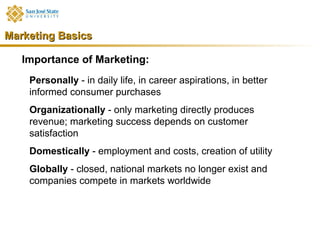
   Importance of Marketing:
    Personally - in daily life, in career aspirations, in better
    informed consumer purchases
    Organizationally - only marketing directly produces
    revenue; marketing success depends on customer
    satisfaction
    Domestically - employment and costs, creation of utility
    Globally - closed, national markets no longer exist and
    companies compete in markets worldwide
Marketing Basics

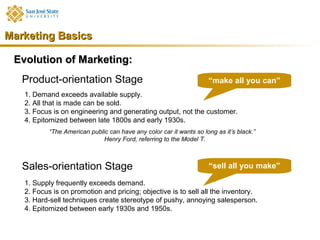
 Evolution of Marketing:
   Product-orientation Stage                                         “make all you can”
   1. Demand exceeds available supply.
   2. All that is made can be sold.
   3. Focus is on engineering and generating output, not the customer.
   4. Epitomized between late 1800s and early 1930s.
           “The American public can have any color car it wants so long as it’s black.”
                              Henry Ford, referring to the Model T.


   Sales-orientation Stage                                           “sell all you make”

   1. Supply frequently exceeds demand.
   2. Focus is on promotion and pricing; objective is to sell all the inventory.
   3. Hard-sell techniques create stereotype of pushy, annoying salesperson.
   4. Epitomized between early 1930s and 1950s.
Marketing Basics

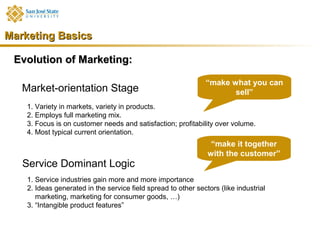
 Evolution of Marketing:

                                                                “make what you can
   Market-orientation Stage                                            sell”
    1. Variety in markets, variety in products.
    2. Employs full marketing mix.
    3. Focus is on customer needs and satisfaction; profitability over volume.
    4. Most typical current orientation.
                                                                 “make it together
                                                                with the customer”
   Service Dominant Logic
    1. Service industries gain more and more importance
    2. Ideas generated in the service field spread to other sectors (like industrial
       marketing, marketing for consumer goods, …)
    3. “Intangible product features”
Marketing Goals

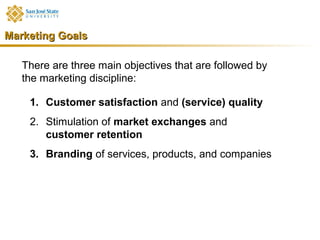
   There are three main objectives that are followed by
   the marketing discipline:

    1. Customer satisfaction and (service) quality
    2. Stimulation of market exchanges and
       customer retention
    3. Branding of services, products, and companies
Marketing Goals

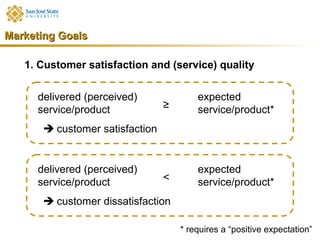
   1. Customer satisfaction and (service) quality


      delivered (perceived)              expected
      service/product            ≥       service/product*
        customer satisfaction


      delivered (perceived)              expected
      service/product            <       service/product*
        customer dissatisfaction

                                     * requires a “positive expectation”
Marketing Goals

  2. Stimulation of market exchanges and customer
     retention
     - Customer satisfaction is a main determinant for
       stable and voluntary buying relationships
     - Compliance management plays an important role in
       retaining customers
     - Stimulation of market exchanges and customer
       retention is supported by a strong
       service/product/company brand
Marketing Goals

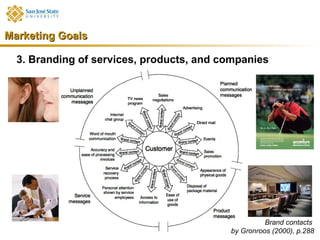
  3. Branding of services, products, and companies


                                                    Brand contacts
                                          by Gronroos (2000), p.288
The GAP Model

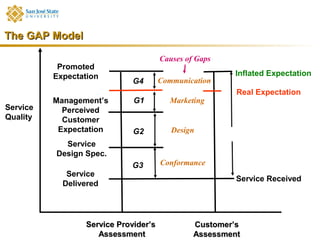
                                       Causes of Gaps
           Promoted
          Expectation                                   Inflated Expectation
                              G4       Communication
                                                         Real Expectation
          Management’s        G1         Marketing
Service     Perceived
Quality     Customer
           Expectation        G2          Design
            Service
          Design Spec.
                             G3        Conformance
             Service
                                                         Service Received
            Delivered


                  Service Provider’s            Customer’s
                     Assessment                 Assessment
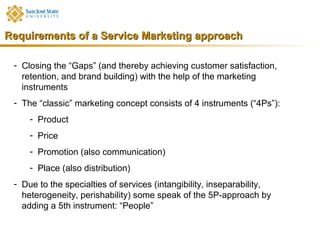
Requirements of a Service Marketing approach

 - Closing the “Gaps” (and thereby achieving customer satisfaction,
   retention, and brand building) with the help of the marketing
   instruments
 - The “classic” marketing concept consists of 4 instruments (“4Ps”):
     - Product
     - Price
     - Promotion (also communication)
     - Place (also distribution)
 - Due to the specialties of services (intangibility, inseparability,
   heterogeneity, perishability) some speak of the 5P-approach by
   adding a 5th instrument: “People”
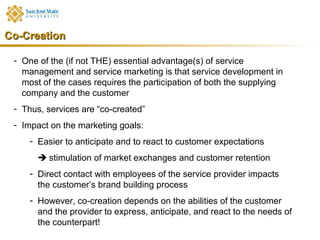
Co-Creation

 - One of the (if not THE) essential advantage(s) of service
   management and service marketing is that service development in
   most of the cases requires the participation of both the supplying
   company and the customer
 - Thus, services are “co-created”
 - Impact on the marketing goals:
     - Easier to anticipate and to react to customer expectations
        stimulation of market exchanges and customer retention
     - Direct contact with employees of the service provider impacts
       the customer’s brand building process
     - However, co-creation depends on the abilities of the customer
       and the provider to express, anticipate, and react to the needs of
       the counterpart!
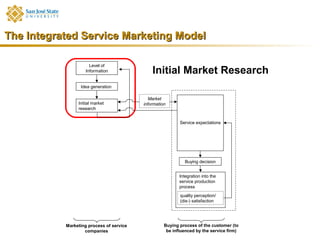
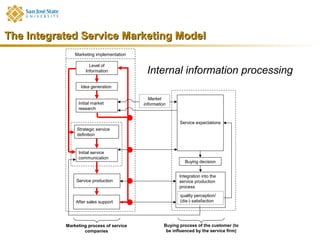
The Integrated Service Marketing Model

                      Level of
                    Information               Initial Market Research
                 Idea generation

                                             Market
                Initial market            information
                research


                                                           Service expectations


                                                              Buying decision


                                                           Integration into the
                                                           service production
                                                           process
                                                           quality perception/
                                                           (dis-) satisfaction


           Marketing process of service             Buying process of the customer (to
                   companies                         be influenced by the service firm)
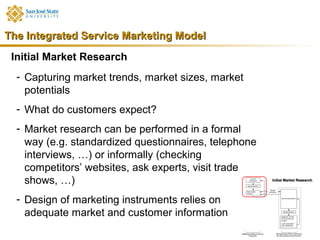
The Integrated Service Marketing Model
 Initial Market Research
  - Capturing market trends, market sizes, market
    potentials
  - What do customers expect?
  - Market research can be performed in a formal
    way (e.g. standardized questionnaires, telephone
    interviews, …) or informally (checking
    competitors’ websites, ask experts, visit trade
    shows, …)
  - Design of marketing instruments relies on
    adequate market and customer information
The Integrated Service Marketing Model

                      Level of
                    Information               Strategic Service Definition
                 Idea generation

                                             Market
                Initial market            information
                research


                                                           Service expectations
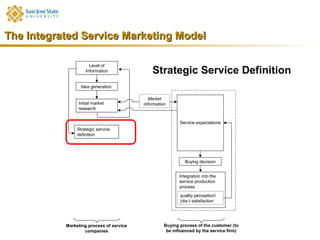
                Strategic service
                definition


                                                              Buying decision


                                                           Integration into the
                                                           service production
                                                           process
                                                           quality perception/
                                                           (dis-) satisfaction


           Marketing process of service             Buying process of the customer (to
                   companies                         be influenced by the service firm)
The Integrated Service Marketing Model
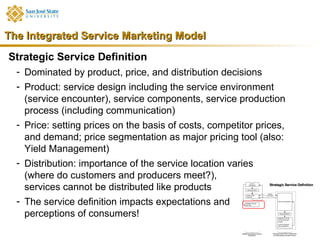
Strategic Service Definition
  - Dominated by product, price, and distribution decisions
  - Product: service design including the service environment
    (service encounter), service components, service production
    process (including communication)
  - Price: setting prices on the basis of costs, competitor prices,
    and demand; price segmentation as major pricing tool (also:
    Yield Management)
  - Distribution: importance of the service location varies
    (where do customers and producers meet?),
    services cannot be distributed like products
  - The service definition impacts expectations and
    perceptions of consumers!
The Integrated Service Marketing Model

                      Level of
                    Information               Initial Service Communication
                 Idea generation

                                             Market
                Initial market            information
                research


                                                           Service expectations
                Strategic service
                definition


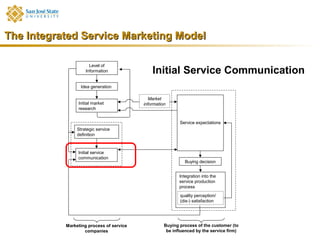
                Initial service
                communication
                                                              Buying decision


                                                           Integration into the
                                                           service production
                                                           process
                                                           quality perception/
                                                           (dis-) satisfaction


           Marketing process of service             Buying process of the customer (to
                   companies                         be influenced by the service firm)
The Integrated Service Marketing Model
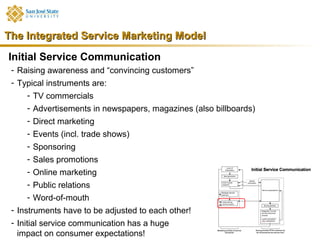
Initial Service Communication
 - Raising awareness and “convincing customers”
 - Typical instruments are:
     - TV commercials
     - Advertisements in newspapers, magazines (also billboards)
     - Direct marketing
     - Events (incl. trade shows)
     - Sponsoring
     - Sales promotions
     - Online marketing
     - Public relations
     - Word-of-mouth
 - Instruments have to be adjusted to each other!
 - Initial service communication has a huge
   impact on consumer expectations!
The Integrated Service Marketing Model

                      Level of
                    Information
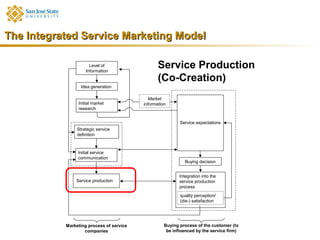
                                                 Service Production
                                                 (Co-Creation)
                 Idea generation

                                             Market
                Initial market            information
                research


                                                           Service expectations
                Strategic service
                definition


                Initial service
                communication
                                                              Buying decision


                                                           Integration into the
               Service production                          service production
                                                           process
                                                           quality perception/
                                                           (dis-) satisfaction


           Marketing process of service             Buying process of the customer (to
                   companies                         be influenced by the service firm)
The Integrated Service Marketing Model
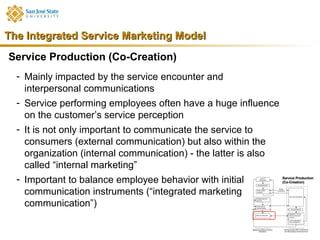
Service Production (Co-Creation)
  - Mainly impacted by the service encounter and
    interpersonal communications
  - Service performing employees often have a huge influence
    on the customer’s service perception
  - It is not only important to communicate the service to
    consumers (external communication) but also within the
    organization (internal communication) - the latter is also
    called “internal marketing”
  - Important to balance employee behavior with initial
    communication instruments (“integrated marketing
    communication”)
The Integrated Service Marketing Model

                      Level of
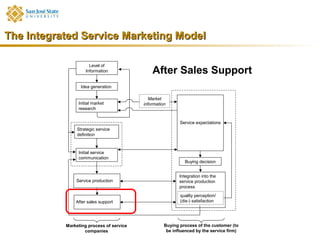
                    Information               After Sales Support
                 Idea generation

                                             Market
                Initial market            information
                research


                                                           Service expectations
                Strategic service
                definition


                Initial service
                communication
                                                              Buying decision


                                                           Integration into the
               Service production                          service production
                                                           process
                                                           quality perception/
               After sales support                         (dis-) satisfaction


           Marketing process of service             Buying process of the customer (to
                   companies                         be influenced by the service firm)
The Integrated Service Marketing Model
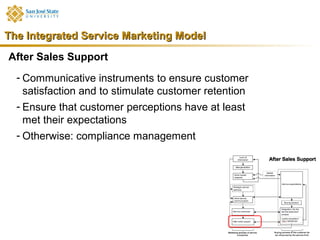
After Sales Support
  - Communicative instruments to ensure customer
    satisfaction and to stimulate customer retention
  - Ensure that customer perceptions have at least
    met their expectations
  - Otherwise: compliance management
The Integrated Service Marketing Model
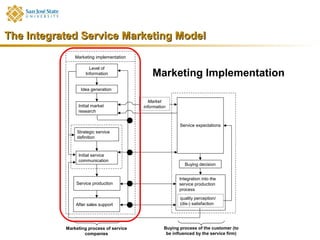
               Marketing implementation

                      Level of
                    Information               Marketing Implementation
                 Idea generation

                                             Market
                Initial market            information
                research


                                                           Service expectations
                Strategic service
                definition


                Initial service
                communication
                                                              Buying decision


                                                           Integration into the
               Service production                          service production
                                                           process
                                                           quality perception/
               After sales support                         (dis-) satisfaction


           Marketing process of service             Buying process of the customer (to
                   companies                         be influenced by the service firm)
The Integrated Service Marketing Model
Marketing Implementation
 - Information management plays a crucial role in service
   marketing
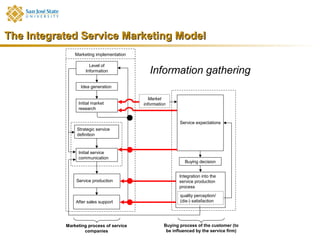
 - Information is not only gathered during initial market
   research but also during the whole service (marketing)
   process
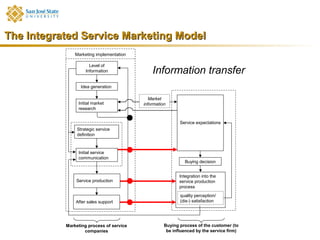
 - Also, information can be spread not only during the initial
   communication phase but also (and especially) during the
   service production process
 - Important to ensure an effective information flow within the
   company
The Integrated Service Marketing Model
               Marketing implementation

                      Level of
                    Information              Information gathering
                 Idea generation

                                             Market
                Initial market            information
                research


                                                           Service expectations
                Strategic service
                definition


                Initial service
                communication
                                                              Buying decision


                                                           Integration into the
               Service production                          service production
                                                           process
                                                           quality perception/
               After sales support                         (dis-) satisfaction


           Marketing process of service             Buying process of the customer (to
                   companies                         be influenced by the service firm)
The Integrated Service Marketing Model
               Marketing implementation

                      Level of
                    Information               Information transfer
                 Idea generation

                                             Market
                Initial market            information
                research


                                                           Service expectations
                Strategic service
                definition


                Initial service
                communication
                                                              Buying decision


                                                           Integration into the
               Service production                          service production
                                                           process
                                                           quality perception/
               After sales support                         (dis-) satisfaction


           Marketing process of service             Buying process of the customer (to
                   companies                         be influenced by the service firm)
The Integrated Service Marketing Model
               Marketing implementation

                      Level of
                    Information            Internal information processing
                 Idea generation

                                             Market
                Initial market            information
                research


                                                           Service expectations
                Strategic service
                definition


                Initial service
                communication
                                                              Buying decision


                                                           Integration into the
               Service production                          service production
                                                           process
                                                           quality perception/
               After sales support                         (dis-) satisfaction


           Marketing process of service             Buying process of the customer (to
                   companies                         be influenced by the service firm)
Conclusion

 - Coordination of all marketing instruments
 - Achievement of marketing goals:
    - Service marketing offers several opportunities to balance
      customer expectations with customer perceptions
    - Customer satisfaction (service quality) is a main factor
      that impacts customer retention
    - Continuous and constant service quality accompanied by
      continuous, constant, and balanced communication
      efforts lead to the development of a strong brand image
 - Growing impact of service marketing on the whole marketing
   field
Case Study Questions

 1. Evaluate the Zipcar venture. What are the strengths, opportunities,
    weaknesses, and threats of the business model?
 2. How does the Zipcar idea fit the “Integrated Service Marketing Model”?
    Please apply the case to the several marketing instruments that are
    discussed in the model.
 3. What are the main drivers of customer satisfaction at Zipcar?
 4. Describe the process of co-creation at Zipcar!
 5. What are the success factors of Zipcar’s promotional strategy? Please
    consider also the impact of environmental issues on the marketing
    success of Zipcar.
 6. Imagine that Zipcar aims on entering the Chinese market. What factors
    have to be covered in an according market research study? Would you
    recommend China as target market?


 Please search for additional information to answer the case study questions!

most marketing

  • 1.
  • 2.
    Marketing Basics What is Marketing??? Think about organizations/companies (Google, Trader Joe’s, The San Jose Chamber of Commerce, World Wildlife Fund, …) as well as individuals (politicians, professional athletes, …)  They all do marketing! How and why?
  • 3.
    Marketing Basics Marketing consists of activities designed to generate and facilitate exchanges intended to satisfy human or organizational needs or wants.
  • 4.
    Marketing Basics Importance of Marketing: Personally - in daily life, in career aspirations, in better informed consumer purchases Organizationally - only marketing directly produces revenue; marketing success depends on customer satisfaction Domestically - employment and costs, creation of utility Globally - closed, national markets no longer exist and companies compete in markets worldwide
  • 5.
    Marketing Basics Evolutionof Marketing: Product-orientation Stage “make all you can” 1. Demand exceeds available supply. 2. All that is made can be sold. 3. Focus is on engineering and generating output, not the customer. 4. Epitomized between late 1800s and early 1930s. “The American public can have any color car it wants so long as it’s black.” Henry Ford, referring to the Model T. Sales-orientation Stage “sell all you make” 1. Supply frequently exceeds demand. 2. Focus is on promotion and pricing; objective is to sell all the inventory. 3. Hard-sell techniques create stereotype of pushy, annoying salesperson. 4. Epitomized between early 1930s and 1950s.
  • 6.
    Marketing Basics Evolutionof Marketing: “make what you can Market-orientation Stage sell” 1. Variety in markets, variety in products. 2. Employs full marketing mix. 3. Focus is on customer needs and satisfaction; profitability over volume. 4. Most typical current orientation. “make it together with the customer” Service Dominant Logic 1. Service industries gain more and more importance 2. Ideas generated in the service field spread to other sectors (like industrial marketing, marketing for consumer goods, …) 3. “Intangible product features”
  • 7.
    Marketing Goals There are three main objectives that are followed by the marketing discipline: 1. Customer satisfaction and (service) quality 2. Stimulation of market exchanges and customer retention 3. Branding of services, products, and companies
  • 8.
    Marketing Goals 1. Customer satisfaction and (service) quality delivered (perceived) expected service/product ≥ service/product*  customer satisfaction delivered (perceived) expected service/product < service/product*  customer dissatisfaction * requires a “positive expectation”
  • 9.
    Marketing Goals 2. Stimulation of market exchanges and customer retention - Customer satisfaction is a main determinant for stable and voluntary buying relationships - Compliance management plays an important role in retaining customers - Stimulation of market exchanges and customer retention is supported by a strong service/product/company brand
  • 10.
    Marketing Goals 3. Branding of services, products, and companies Brand contacts by Gronroos (2000), p.288
  • 11.
    The GAP Model Causes of Gaps Promoted Expectation Inflated Expectation G4 Communication Real Expectation Management’s G1 Marketing Service Perceived Quality Customer Expectation G2 Design Service Design Spec. G3 Conformance Service Service Received Delivered Service Provider’s Customer’s Assessment Assessment
  • 12.
    Requirements of aService Marketing approach - Closing the “Gaps” (and thereby achieving customer satisfaction, retention, and brand building) with the help of the marketing instruments - The “classic” marketing concept consists of 4 instruments (“4Ps”): - Product - Price - Promotion (also communication) - Place (also distribution) - Due to the specialties of services (intangibility, inseparability, heterogeneity, perishability) some speak of the 5P-approach by adding a 5th instrument: “People”
  • 13.
    Co-Creation - Oneof the (if not THE) essential advantage(s) of service management and service marketing is that service development in most of the cases requires the participation of both the supplying company and the customer - Thus, services are “co-created” - Impact on the marketing goals: - Easier to anticipate and to react to customer expectations  stimulation of market exchanges and customer retention - Direct contact with employees of the service provider impacts the customer’s brand building process - However, co-creation depends on the abilities of the customer and the provider to express, anticipate, and react to the needs of the counterpart!
  • 14.
    The Integrated ServiceMarketing Model Level of Information Initial Market Research Idea generation Market Initial market information research Service expectations Buying decision Integration into the service production process quality perception/ (dis-) satisfaction Marketing process of service Buying process of the customer (to companies be influenced by the service firm)
  • 15.
    The Integrated ServiceMarketing Model Initial Market Research - Capturing market trends, market sizes, market potentials - What do customers expect? - Market research can be performed in a formal way (e.g. standardized questionnaires, telephone interviews, …) or informally (checking competitors’ websites, ask experts, visit trade shows, …) - Design of marketing instruments relies on adequate market and customer information
  • 16.
    The Integrated ServiceMarketing Model Level of Information Strategic Service Definition Idea generation Market Initial market information research Service expectations Strategic service definition Buying decision Integration into the service production process quality perception/ (dis-) satisfaction Marketing process of service Buying process of the customer (to companies be influenced by the service firm)
  • 17.
    The Integrated ServiceMarketing Model Strategic Service Definition - Dominated by product, price, and distribution decisions - Product: service design including the service environment (service encounter), service components, service production process (including communication) - Price: setting prices on the basis of costs, competitor prices, and demand; price segmentation as major pricing tool (also: Yield Management) - Distribution: importance of the service location varies (where do customers and producers meet?), services cannot be distributed like products - The service definition impacts expectations and perceptions of consumers!
  • 18.
    The Integrated ServiceMarketing Model Level of Information Initial Service Communication Idea generation Market Initial market information research Service expectations Strategic service definition Initial service communication Buying decision Integration into the service production process quality perception/ (dis-) satisfaction Marketing process of service Buying process of the customer (to companies be influenced by the service firm)
  • 19.
    The Integrated ServiceMarketing Model Initial Service Communication - Raising awareness and “convincing customers” - Typical instruments are: - TV commercials - Advertisements in newspapers, magazines (also billboards) - Direct marketing - Events (incl. trade shows) - Sponsoring - Sales promotions - Online marketing - Public relations - Word-of-mouth - Instruments have to be adjusted to each other! - Initial service communication has a huge impact on consumer expectations!
  • 20.
    The Integrated ServiceMarketing Model Level of Information Service Production (Co-Creation) Idea generation Market Initial market information research Service expectations Strategic service definition Initial service communication Buying decision Integration into the Service production service production process quality perception/ (dis-) satisfaction Marketing process of service Buying process of the customer (to companies be influenced by the service firm)
  • 21.
    The Integrated ServiceMarketing Model Service Production (Co-Creation) - Mainly impacted by the service encounter and interpersonal communications - Service performing employees often have a huge influence on the customer’s service perception - It is not only important to communicate the service to consumers (external communication) but also within the organization (internal communication) - the latter is also called “internal marketing” - Important to balance employee behavior with initial communication instruments (“integrated marketing communication”)
  • 22.
    The Integrated ServiceMarketing Model Level of Information After Sales Support Idea generation Market Initial market information research Service expectations Strategic service definition Initial service communication Buying decision Integration into the Service production service production process quality perception/ After sales support (dis-) satisfaction Marketing process of service Buying process of the customer (to companies be influenced by the service firm)
  • 23.
    The Integrated ServiceMarketing Model After Sales Support - Communicative instruments to ensure customer satisfaction and to stimulate customer retention - Ensure that customer perceptions have at least met their expectations - Otherwise: compliance management
  • 24.
    The Integrated ServiceMarketing Model Marketing implementation Level of Information Marketing Implementation Idea generation Market Initial market information research Service expectations Strategic service definition Initial service communication Buying decision Integration into the Service production service production process quality perception/ After sales support (dis-) satisfaction Marketing process of service Buying process of the customer (to companies be influenced by the service firm)
  • 25.
    The Integrated ServiceMarketing Model Marketing Implementation - Information management plays a crucial role in service marketing - Information is not only gathered during initial market research but also during the whole service (marketing) process - Also, information can be spread not only during the initial communication phase but also (and especially) during the service production process - Important to ensure an effective information flow within the company
  • 26.
    The Integrated ServiceMarketing Model Marketing implementation Level of Information Information gathering Idea generation Market Initial market information research Service expectations Strategic service definition Initial service communication Buying decision Integration into the Service production service production process quality perception/ After sales support (dis-) satisfaction Marketing process of service Buying process of the customer (to companies be influenced by the service firm)
  • 27.
    The Integrated ServiceMarketing Model Marketing implementation Level of Information Information transfer Idea generation Market Initial market information research Service expectations Strategic service definition Initial service communication Buying decision Integration into the Service production service production process quality perception/ After sales support (dis-) satisfaction Marketing process of service Buying process of the customer (to companies be influenced by the service firm)
  • 28.
    The Integrated ServiceMarketing Model Marketing implementation Level of Information Internal information processing Idea generation Market Initial market information research Service expectations Strategic service definition Initial service communication Buying decision Integration into the Service production service production process quality perception/ After sales support (dis-) satisfaction Marketing process of service Buying process of the customer (to companies be influenced by the service firm)
  • 29.
    Conclusion - Coordinationof all marketing instruments - Achievement of marketing goals: - Service marketing offers several opportunities to balance customer expectations with customer perceptions - Customer satisfaction (service quality) is a main factor that impacts customer retention - Continuous and constant service quality accompanied by continuous, constant, and balanced communication efforts lead to the development of a strong brand image - Growing impact of service marketing on the whole marketing field
  • 30.
    Case Study Questions 1. Evaluate the Zipcar venture. What are the strengths, opportunities, weaknesses, and threats of the business model? 2. How does the Zipcar idea fit the “Integrated Service Marketing Model”? Please apply the case to the several marketing instruments that are discussed in the model. 3. What are the main drivers of customer satisfaction at Zipcar? 4. Describe the process of co-creation at Zipcar! 5. What are the success factors of Zipcar’s promotional strategy? Please consider also the impact of environmental issues on the marketing success of Zipcar. 6. Imagine that Zipcar aims on entering the Chinese market. What factors have to be covered in an according market research study? Would you recommend China as target market? Please search for additional information to answer the case study questions!

Editor's Notes

  • #9 Why can people be satisfied after visiting McDonald’s and dissatisfied after visiting a fancy restaurant (http://www.forbes.com/2004/10/14/cx_cv_1014feat.html)??? Marketing instruments impact customer expectations as well as customer perceptions!
  • #10 It can be 5 times more expensive to attract a new customer than keeping an existing one! Satisfied “repeating customers” spread positive word-of-mouth (unhappy customers spread negative word-of-mouth!!! - also, it has been found that it is more likely that unhappy customers express their negative experiences than happy customers telling their positive experiences)
  • #20 In services: Use tangible products as quality indicators for intangible offerings In products: Use intangible elements to add extra-value to tangible offerings