
MARKETING TOOLBOX
PREMIUM POWERPOINT SLIDES
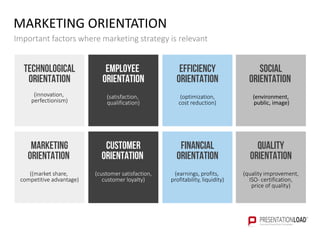
MARKETING ORIENTATION
Important factors where marketing strategy is relevant
Technological
orientation
(innovation,
perfectionism)
Employee
orientation
(satisfaction,
qualification)
Efficiency
orientation
(optimization,
cost reduction)
Social
orientation
(environment,
public, image)
Marketing
orientation
((market share,
competitive advantage)
Customer
orientation
(customer satisfaction,
customer loyalty)
Financial
orientation
(earnings, profits,
profitability, liquidity)
Quality
orientation
(quality improvement,
ISO- certification,
price of quality)
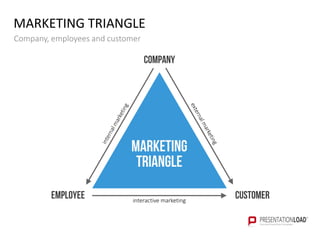
MARKETING TRIANGLE
Company, employees and customer
Company
interactive marketing
CustomerEmployee
Marketing
Triangle
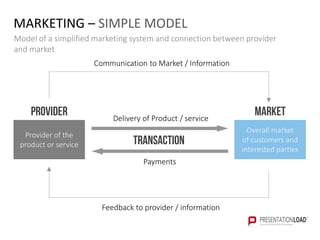
MARKETING – SIMPLE MODEL
Model of a simplified marketing system and connection between provider
and market
Provider of the
product or service
Provider
Overall market
of customers and
interested parties
MarketDelivery of Product / service
TRANSACTION
Payments
Feedback to provider / information
Communication to Market / Information
DEFINITION MARKETING
A market consists of all actual and potential
customers with a specific need, which the
company tries to satisfy with their product.
Scharf / Schubert (1995)
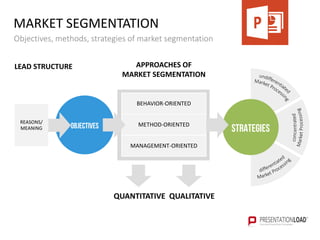
MARKET SEGMENTATION
Objectives, methods, strategies of market segmentation
APPROACHES OF
MARKET SEGMENTATION
BEHAVIOR-ORIENTED
METHOD-ORIENTED
MANAGEMENT-ORIENTED
QUANTITATIVE QUALITATIVE
LEAD STRUCTURE
OBJECTIVES
REASONS/
MEANING STRATEGIES
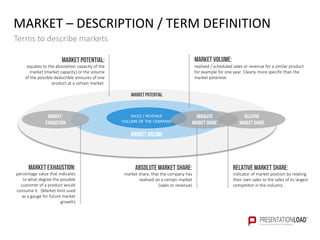
MARKET – DESCRIPTION / TERM DEFINITION
Terms to describe markets
MARKET POTENTIAL
Marketvolume
SALES / REVENUE
VOLUME OF THE COMPANY
Market volume:
realized / scheduled sales or revenue for a similar product
for example for one year. Clearly more specific than the
market potential.
Market potential:
equates to the absorption capacity of the
market (market capacity) or the volume
of the possible deductible amounts of one
product at a certain market.
Absolute market share:
market share, that the company has
realized on a certain market
(sales or revenue)
Relative market share:
indicator of market position by relating
their own sales to the sales of its largest
competitor in the industry.
Market exhaustion:
percentage value that indicates
to what degree the possible
customer of a product would
consume it. (Market limit used
as a gauge for future market
growth)
Market-
exhaustion
Absolute
market share
Relative
market share
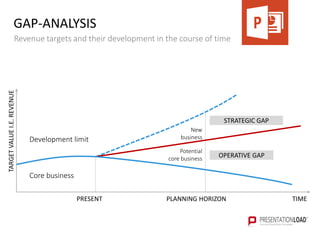
GAP-ANALYSIS
Revenue targets and their development in the course of time
TARGETVALUEI.E.REVENUE
TIMEPRESENT PLANNING HORIZON
Development limit
New
business
Potential
core business
Core business
STRATEGIC GAP
OPERATIVE GAP
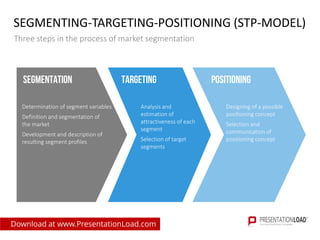
SEGMENTING-TARGETING-POSITIONING (STP-MODEL)
Three steps in the process of market segmentation
Segmentation TARGETING Positioning
Determination of segment variables
Definition and segmentation of
the market
Development and description of
resulting segment profiles
Analysis and
estimation of
attractiveness of each
segment
Selection of target
segments
Designing of a possible
positioning concept
Selection and
communication of
positioning concept
Download at www.PresentationLoad.com
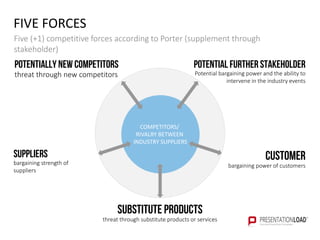
FIVE FORCES
Five (+1) competitive forces according to Porter (supplement through
stakeholder)
Potentially new competitors
threat through new competitors
Potential further stakeholder
Potential bargaining power and the ability to
intervene in the industry events
Customer
bargaining power of customers
Substitute products
threat through substitute products or services
Suppliers
bargaining strength of
suppliers
COMPETITORS/
RIVALRY BETWEEN
INDUSTRY SUPPLIERS
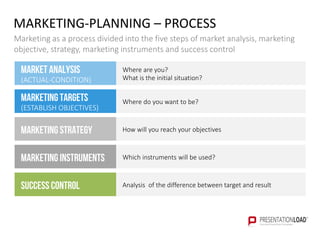
MARKETING-PLANNING – PROCESS
Marketing as a process divided into the five steps of market analysis, marketing
objective, strategy, marketing instruments and success control
MARKET ANALYSIS
(ACTUAL-CONDITION)
Where are you?
What is the initial situation?
MARKETING TARGETS
(ESTABLISH OBJECTIVES)
Where do you want to be?
Marketing strategy How will you reach your objectives
Marketing instruments Which instruments will be used?
Success control Analysis of the difference between target and result
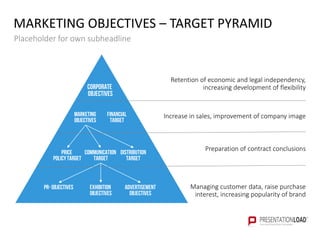
MARKETING OBJECTIVES – TARGET PYRAMID
Placeholder for own subheadline
Corporate
objectives
Financial
target
Communication
target
Exhibition
objectives
Marketing
objectives
Price
policytarget
Distribution
target
PR-objectives Advertisement
objectives
Retention of economic and legal independency,
increasing development of flexibility
Increase in sales, improvement of company image
Preparation of contract conclusions
Managing customer data, raise purchase
interest, increasing popularity of brand
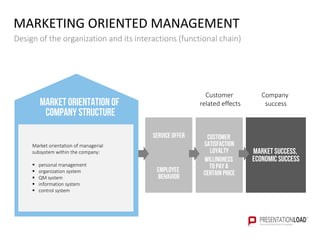
MARKETING ORIENTED MANAGEMENT
Design of the organization and its interactions (functional chain)
Market orientation of
company structure
Market orientation of managerial
subsystem within the company:
 personal management
 organization system
 QM system
 information system
 control system
Customer
related effects
Company
success
Service offer
Employee
behavior
Customer
satisfaction
loyalty
willingness
to pay a
certain price
Market success,
economic success
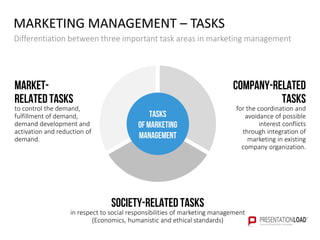
Tasks
of marketing
management
Market-
related tasks
to control the demand,
fulfillment of demand,
demand development and
activation and reduction of
demand.
Company-related
tasks
for the coordination and
avoidance of possible
interest conflicts
through integration of
marketing in existing
company organization.
Society-related tasks
in respect to social responsibilities of marketing management
(Economics, humanistic and ethical standards)
MARKETING MANAGEMENT – TASKS
Differentiation between three important task areas in marketing management
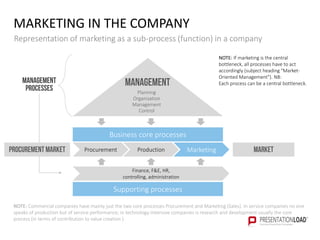
MARKETING IN THE COMPANY
Representation of marketing as a sub-process (function) in a company
Planning
Organization
Management
Control
Business core processes
Management
processes
Procurement Production Marketing
Finance, F&E, HR,
controlling, administration
Supporting processes
Procurement market Market
NOTE: If marketing is the central
bottleneck, all processes have to act
accordingly (subject heading "Market-
Oriented Management"). NB:
Each process can be a central bottleneck.
NOTE: Commercial companies have mainly just the two core processes Procurement and Marketing (Sales). In service companies no one
speaks of production but of service performance; in technology-intensive companies is research and development usually the core
process (in terms of contribution to value creation ).
Management
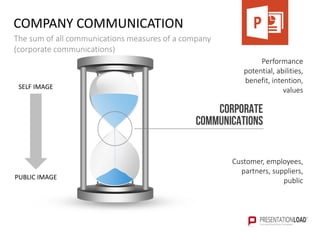
COMPANY COMMUNICATION
The sum of all communications measures of a company
(corporate communications)
CORPORATE
COMMUNICATIONS
Performance
potential, abilities,
benefit, intention,
values
Customer, employees,
partners, suppliers,
public
SELF IMAGE
PUBLIC IMAGE
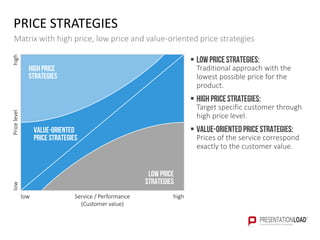
PRICE STRATEGIES
Matrix with high price, low price and value-oriented price strategies
 Low pricestrategies:
Traditional approach with the
lowest possible price for the
product.
 Highpricestrategies:
Target specific customer through
high price level.
 Value-orientedpricestrategies:
Prices of the service correspond
exactly to the customer value.
highlowPricelevel
highlow Service / Performance
(Customer value)
Highprice
strategies
Value-oriented
price strategies
Low price
strategies
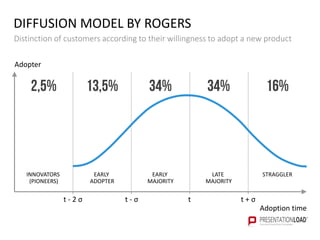
DIFFUSION MODEL BY ROGERS
Distinction of customers according to their willingness to adopt a new product
t + σt - 2 σ t - σ t
Adoption time
Adopter
2,5% 13,5% 34% 34% 16%
INNOVATORS
(PIONEERS)
EARLY
ADOPTER
EARLY
MAJORITY
LATE
MAJORITY
STRAGGLER
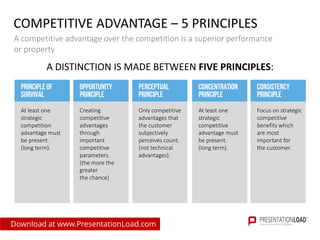
COMPETITIVE ADVANTAGE – 5 PRINCIPLES
A competitive advantage over the competition is a superior performance
or property
Principleof
survival
Opportunity
principle
Perceptual
principle
Concentration
principle
Consistency
principle
At least one
strategic
competition
advantage must
be present.
(long term).
Creating
competitive
advantages
through
important
competitive
parameters.
(the more the
greater
the chance)
Only competitive
advantages that
the customer
subjectively
perceives count.
(not technical
advantages).
At least one
strategic
competitive
advantage must
be present.
(long term).
Focus on strategic
competitive
benefits which
are most
important for
the customer.
A DISTINCTION IS MADE BETWEEN FIVE PRINCIPLES:
Download at www.PresentationLoad.com
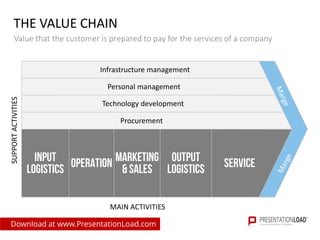
THE VALUE CHAIN
Value that the customer is prepared to pay for the services of a company
SUPPORTACTIVITIES
Infrastructure management
Personal management
Technology development
Procurement
INPUT
LOGISTICS OPERATION MARKETING
& SALES
OUTPUT
LOGISTICS SERVICE
MAIN ACTIVITIES
Download at www.PresentationLoad.com
Click here to visit www.PresentationLoad.com
DOWNLOAD POWERPOINT SLIDES

Marketing Toolbox

  • 1.
  • 2.
    MARKETING ORIENTATION Important factorswhere marketing strategy is relevant Technological orientation (innovation, perfectionism) Employee orientation (satisfaction, qualification) Efficiency orientation (optimization, cost reduction) Social orientation (environment, public, image) Marketing orientation ((market share, competitive advantage) Customer orientation (customer satisfaction, customer loyalty) Financial orientation (earnings, profits, profitability, liquidity) Quality orientation (quality improvement, ISO- certification, price of quality)
  • 3.
    MARKETING TRIANGLE Company, employeesand customer Company interactive marketing CustomerEmployee Marketing Triangle
  • 4.
    MARKETING – SIMPLEMODEL Model of a simplified marketing system and connection between provider and market Provider of the product or service Provider Overall market of customers and interested parties MarketDelivery of Product / service TRANSACTION Payments Feedback to provider / information Communication to Market / Information
  • 5.
    DEFINITION MARKETING A marketconsists of all actual and potential customers with a specific need, which the company tries to satisfy with their product. Scharf / Schubert (1995)
  • 6.
    MARKET SEGMENTATION Objectives, methods,strategies of market segmentation APPROACHES OF MARKET SEGMENTATION BEHAVIOR-ORIENTED METHOD-ORIENTED MANAGEMENT-ORIENTED QUANTITATIVE QUALITATIVE LEAD STRUCTURE OBJECTIVES REASONS/ MEANING STRATEGIES
  • 7.
    MARKET – DESCRIPTION/ TERM DEFINITION Terms to describe markets MARKET POTENTIAL Marketvolume SALES / REVENUE VOLUME OF THE COMPANY Market volume: realized / scheduled sales or revenue for a similar product for example for one year. Clearly more specific than the market potential. Market potential: equates to the absorption capacity of the market (market capacity) or the volume of the possible deductible amounts of one product at a certain market. Absolute market share: market share, that the company has realized on a certain market (sales or revenue) Relative market share: indicator of market position by relating their own sales to the sales of its largest competitor in the industry. Market exhaustion: percentage value that indicates to what degree the possible customer of a product would consume it. (Market limit used as a gauge for future market growth) Market- exhaustion Absolute market share Relative market share
  • 8.
    GAP-ANALYSIS Revenue targets andtheir development in the course of time TARGETVALUEI.E.REVENUE TIMEPRESENT PLANNING HORIZON Development limit New business Potential core business Core business STRATEGIC GAP OPERATIVE GAP
  • 9.
    SEGMENTING-TARGETING-POSITIONING (STP-MODEL) Three stepsin the process of market segmentation Segmentation TARGETING Positioning Determination of segment variables Definition and segmentation of the market Development and description of resulting segment profiles Analysis and estimation of attractiveness of each segment Selection of target segments Designing of a possible positioning concept Selection and communication of positioning concept Download at www.PresentationLoad.com
  • 10.
    FIVE FORCES Five (+1)competitive forces according to Porter (supplement through stakeholder) Potentially new competitors threat through new competitors Potential further stakeholder Potential bargaining power and the ability to intervene in the industry events Customer bargaining power of customers Substitute products threat through substitute products or services Suppliers bargaining strength of suppliers COMPETITORS/ RIVALRY BETWEEN INDUSTRY SUPPLIERS
  • 11.
    MARKETING-PLANNING – PROCESS Marketingas a process divided into the five steps of market analysis, marketing objective, strategy, marketing instruments and success control MARKET ANALYSIS (ACTUAL-CONDITION) Where are you? What is the initial situation? MARKETING TARGETS (ESTABLISH OBJECTIVES) Where do you want to be? Marketing strategy How will you reach your objectives Marketing instruments Which instruments will be used? Success control Analysis of the difference between target and result
  • 12.
    MARKETING OBJECTIVES –TARGET PYRAMID Placeholder for own subheadline Corporate objectives Financial target Communication target Exhibition objectives Marketing objectives Price policytarget Distribution target PR-objectives Advertisement objectives Retention of economic and legal independency, increasing development of flexibility Increase in sales, improvement of company image Preparation of contract conclusions Managing customer data, raise purchase interest, increasing popularity of brand
  • 13.
    MARKETING ORIENTED MANAGEMENT Designof the organization and its interactions (functional chain) Market orientation of company structure Market orientation of managerial subsystem within the company:  personal management  organization system  QM system  information system  control system Customer related effects Company success Service offer Employee behavior Customer satisfaction loyalty willingness to pay a certain price Market success, economic success
  • 14.
    Tasks of marketing management Market- related tasks tocontrol the demand, fulfillment of demand, demand development and activation and reduction of demand. Company-related tasks for the coordination and avoidance of possible interest conflicts through integration of marketing in existing company organization. Society-related tasks in respect to social responsibilities of marketing management (Economics, humanistic and ethical standards) MARKETING MANAGEMENT – TASKS Differentiation between three important task areas in marketing management
  • 15.
    MARKETING IN THECOMPANY Representation of marketing as a sub-process (function) in a company Planning Organization Management Control Business core processes Management processes Procurement Production Marketing Finance, F&E, HR, controlling, administration Supporting processes Procurement market Market NOTE: If marketing is the central bottleneck, all processes have to act accordingly (subject heading "Market- Oriented Management"). NB: Each process can be a central bottleneck. NOTE: Commercial companies have mainly just the two core processes Procurement and Marketing (Sales). In service companies no one speaks of production but of service performance; in technology-intensive companies is research and development usually the core process (in terms of contribution to value creation ). Management
  • 16.
    COMPANY COMMUNICATION The sumof all communications measures of a company (corporate communications) CORPORATE COMMUNICATIONS Performance potential, abilities, benefit, intention, values Customer, employees, partners, suppliers, public SELF IMAGE PUBLIC IMAGE
  • 17.
    PRICE STRATEGIES Matrix withhigh price, low price and value-oriented price strategies  Low pricestrategies: Traditional approach with the lowest possible price for the product.  Highpricestrategies: Target specific customer through high price level.  Value-orientedpricestrategies: Prices of the service correspond exactly to the customer value. highlowPricelevel highlow Service / Performance (Customer value) Highprice strategies Value-oriented price strategies Low price strategies
  • 18.
    DIFFUSION MODEL BYROGERS Distinction of customers according to their willingness to adopt a new product t + σt - 2 σ t - σ t Adoption time Adopter 2,5% 13,5% 34% 34% 16% INNOVATORS (PIONEERS) EARLY ADOPTER EARLY MAJORITY LATE MAJORITY STRAGGLER
  • 19.
    COMPETITIVE ADVANTAGE –5 PRINCIPLES A competitive advantage over the competition is a superior performance or property Principleof survival Opportunity principle Perceptual principle Concentration principle Consistency principle At least one strategic competition advantage must be present. (long term). Creating competitive advantages through important competitive parameters. (the more the greater the chance) Only competitive advantages that the customer subjectively perceives count. (not technical advantages). At least one strategic competitive advantage must be present. (long term). Focus on strategic competitive benefits which are most important for the customer. A DISTINCTION IS MADE BETWEEN FIVE PRINCIPLES: Download at www.PresentationLoad.com
  • 20.
    THE VALUE CHAIN Valuethat the customer is prepared to pay for the services of a company SUPPORTACTIVITIES Infrastructure management Personal management Technology development Procurement INPUT LOGISTICS OPERATION MARKETING & SALES OUTPUT LOGISTICS SERVICE MAIN ACTIVITIES Download at www.PresentationLoad.com
  • 21.
    Click here tovisit www.PresentationLoad.com DOWNLOAD POWERPOINT SLIDES