INTERNATIONAL MARKETING MANAGEMENT
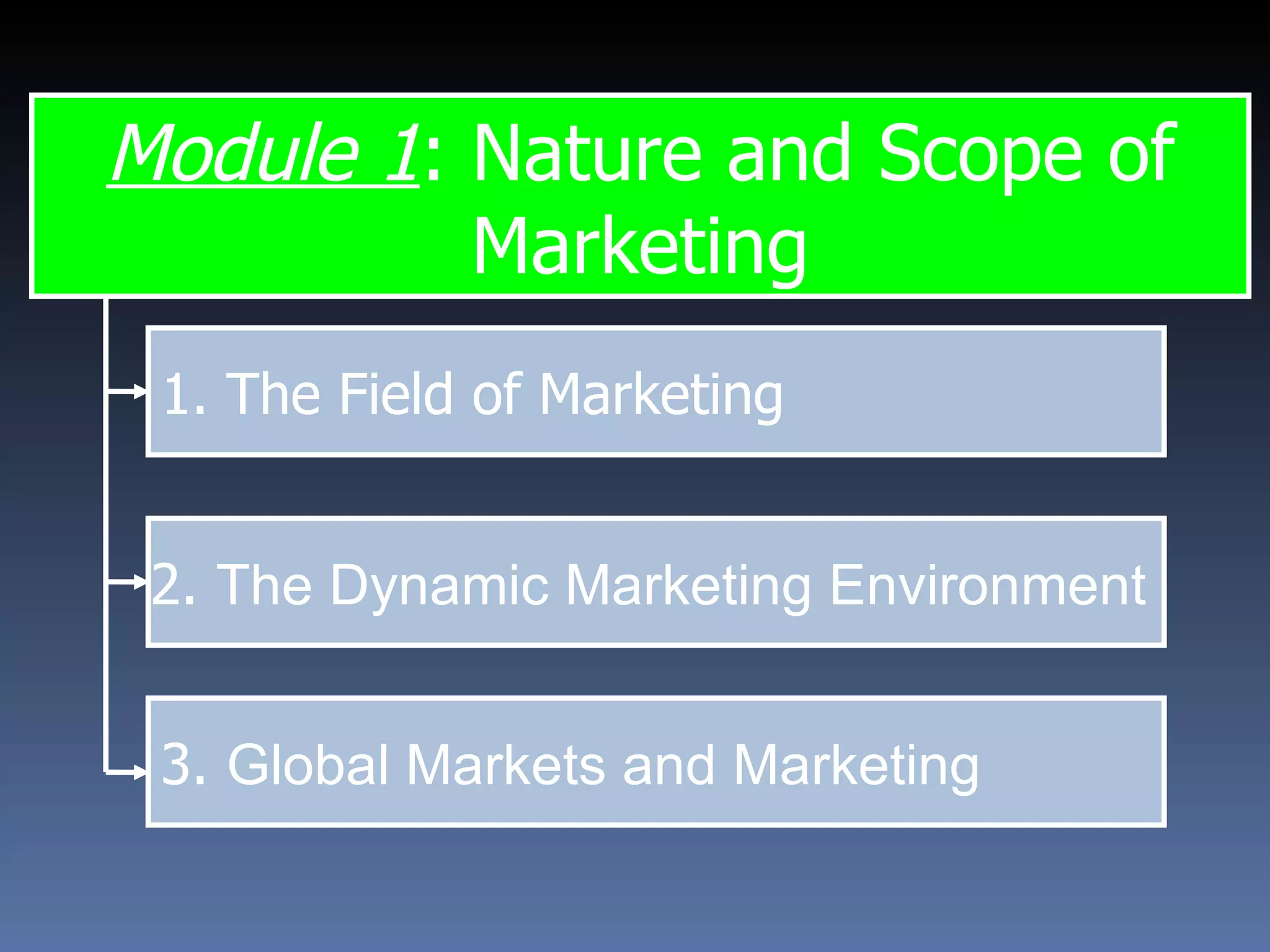
Module 1 : Nature and Scope of Marketing 3.  Global Markets and Marketing  2.  The Dynamic Marketing Environment  1. The Field of Marketing
1. The Field of Marketing
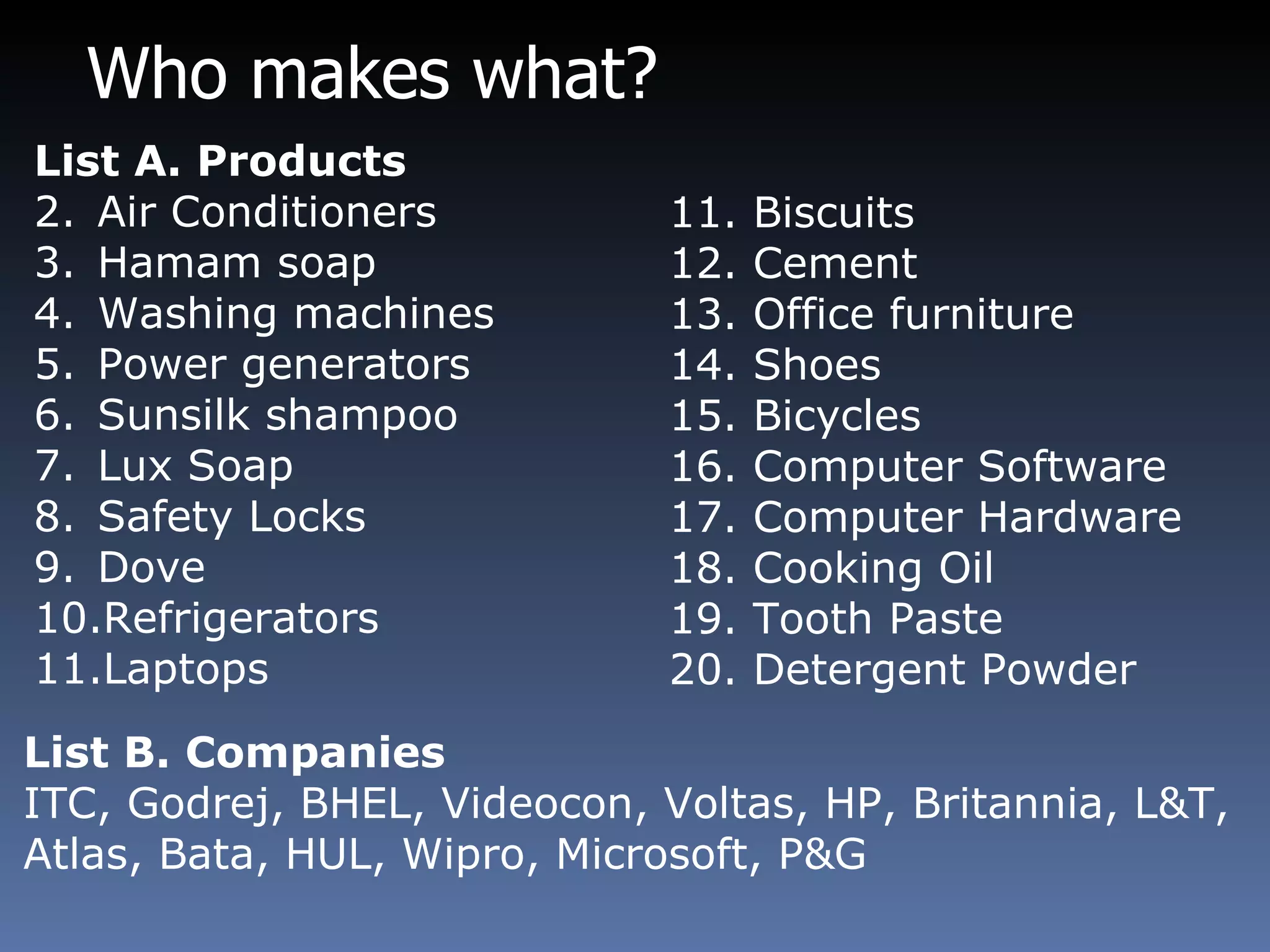
Who makes what?  List B. Companies ITC, Godrej, BHEL, Videocon, Voltas, HP, Britannia, L&T, Atlas, Bata, HUL, Wipro, Microsoft, P&G List A. Products Air Conditioners Hamam soap Washing machines Power generators Sunsilk shampoo Lux Soap Safety Locks Dove Refrigerators Laptops 11. Biscuits 12. Cement 13. Office furniture 14. Shoes 15. Bicycles 16. Computer Software 17. Computer Hardware 18. Cooking Oil 19. Tooth Paste 20. Detergent Powder
What does a Marketer Do?
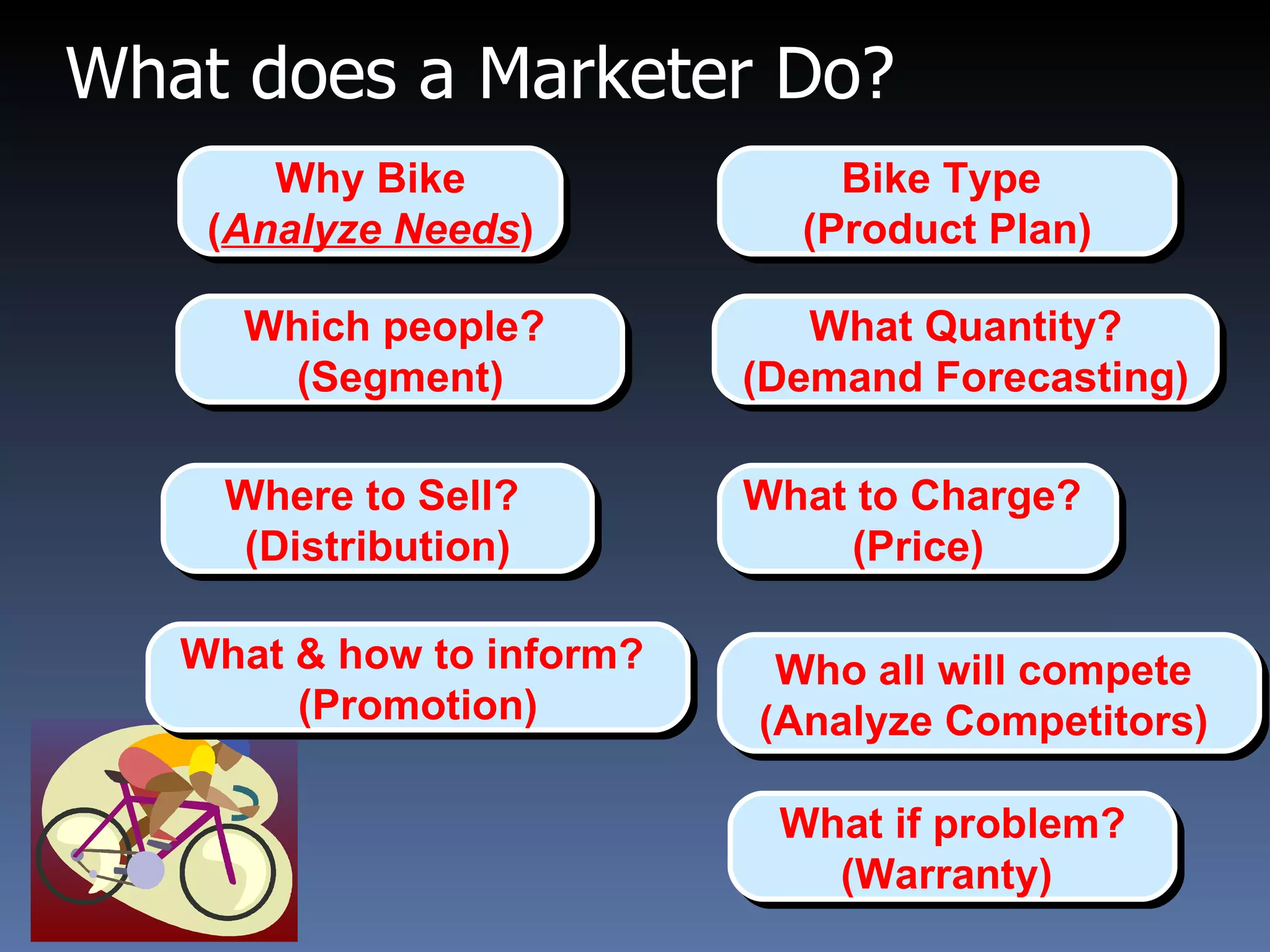
What does a Marketer Do?  Why Bike ( Analyze Needs )  Bike Type  (Product Plan) Which people?  (Segment) What Quantity? (Demand Forecasting) Where to Sell?  (Distribution) What to Charge?  (Price) What & how to inform?  (Promotion) Who all will compete  (Analyze Competitors)  What if problem? (Warranty)
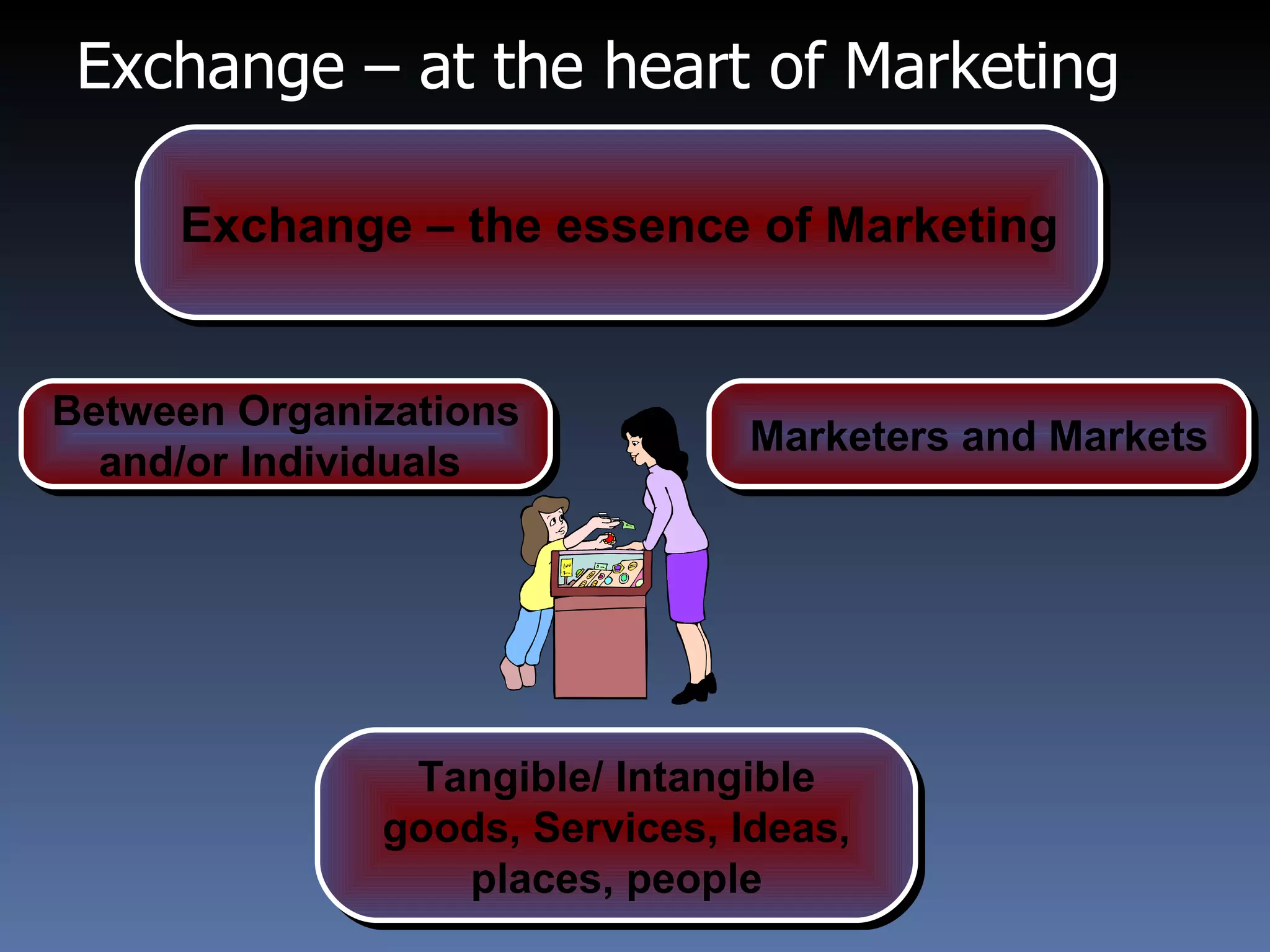
Exchange – at the heart of Marketing Between Organizations and/or Individuals  Marketers and Markets Exchange – the essence of Marketing Tangible/ Intangible goods, Services, Ideas, places, people
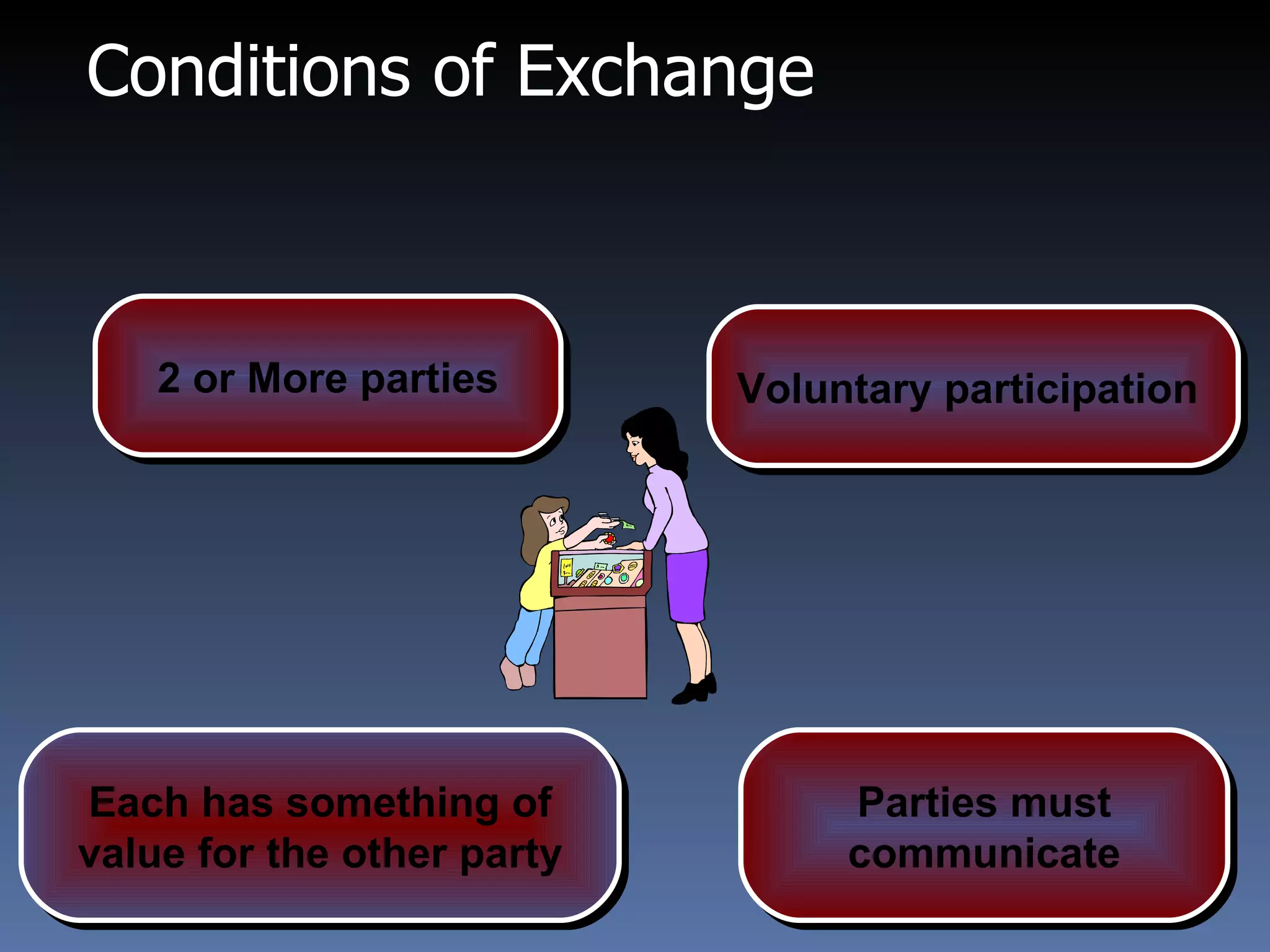
Conditions of Exchange Voluntary participation  2 or More parties Each has something of value for the other party Parties must communicate
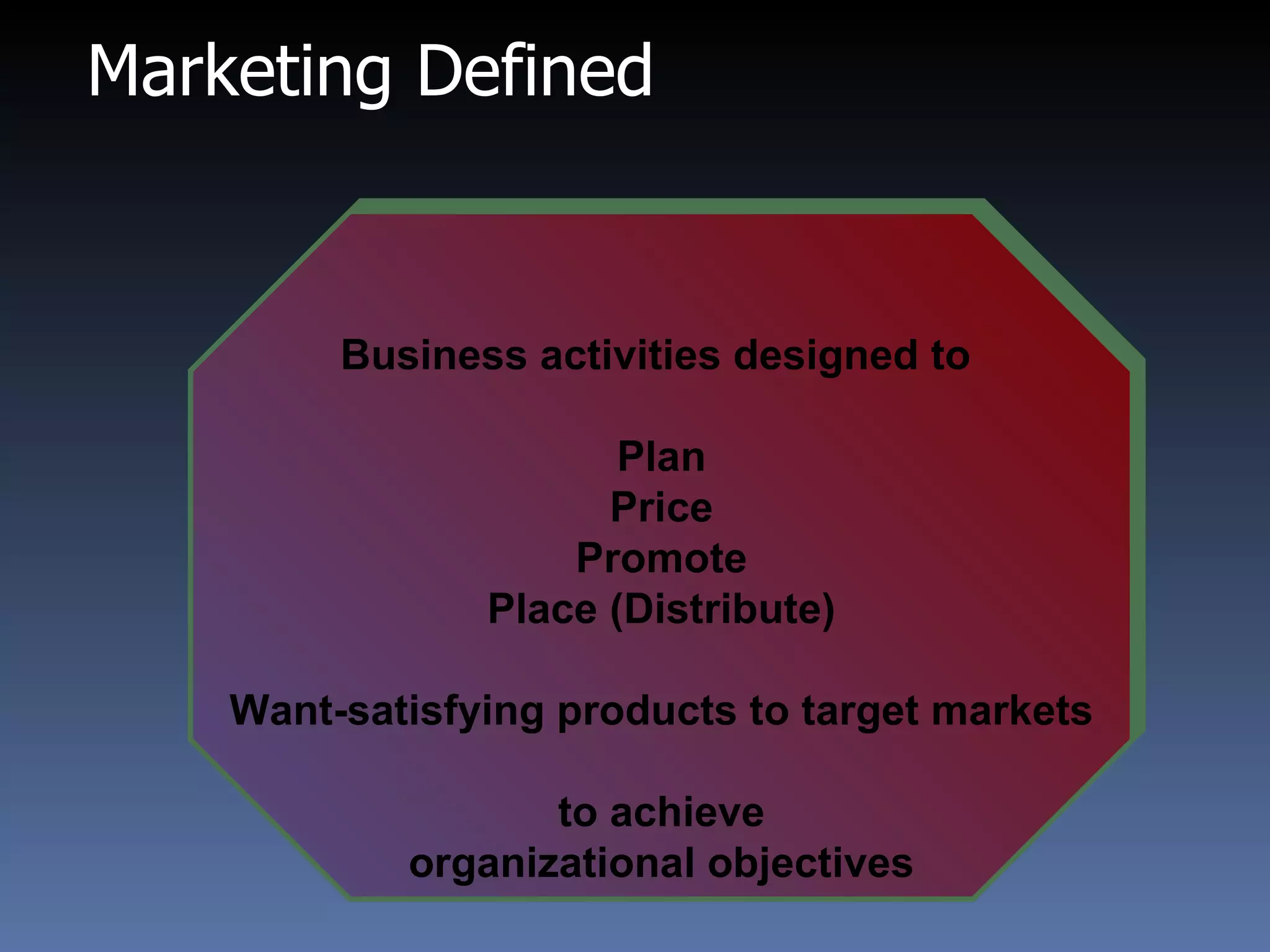
Marketing Defined Business activities designed to  Plan Price Promote Place (Distribute) Want-satisfying products to target markets to achieve organizational objectives
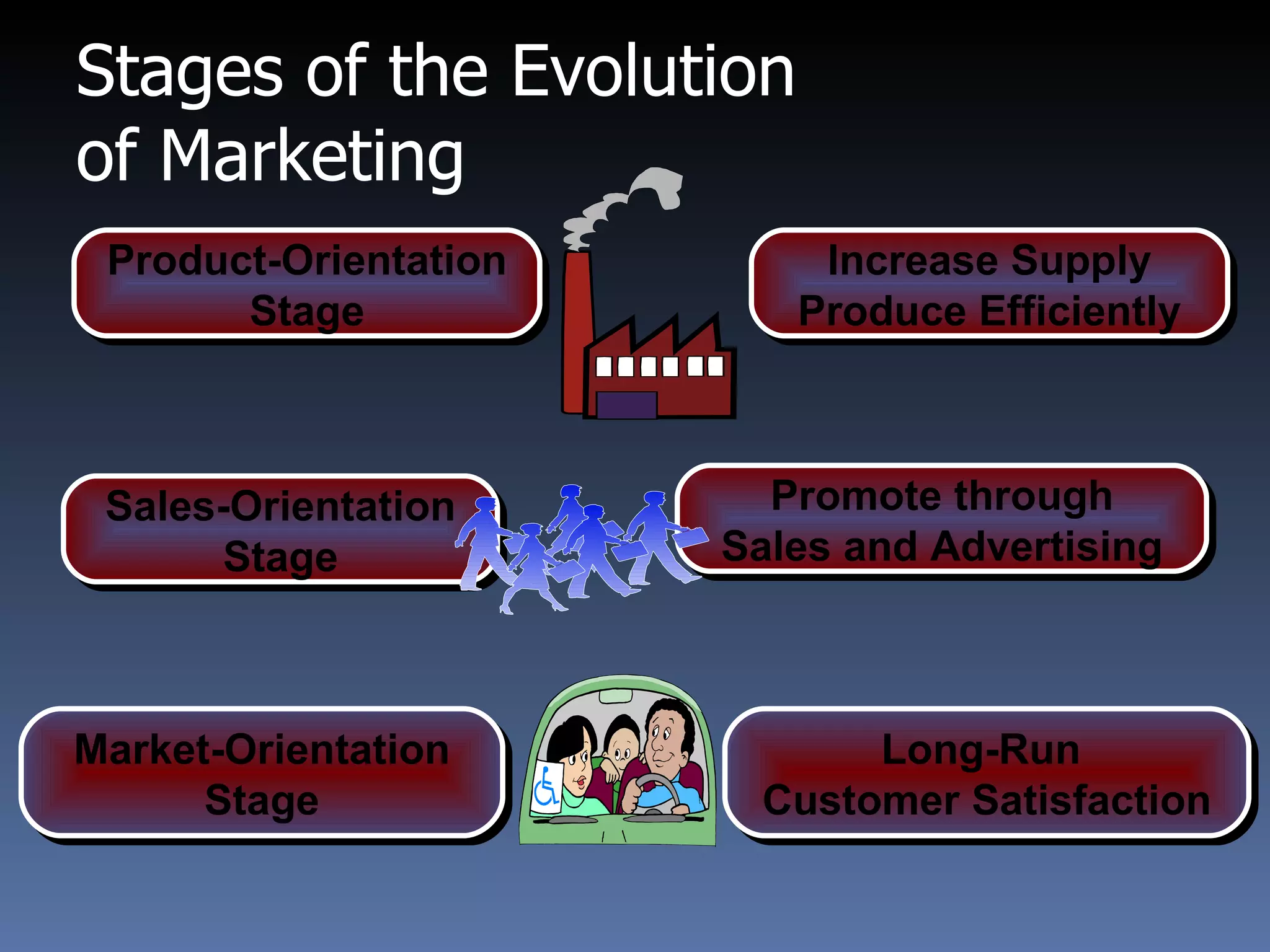
Stages of the Evolution  of Marketing Promote through Sales and Advertising Sales-Orientation Stage Increase Supply Produce Efficiently Product-Orientation Stage Market-Orientation Stage Long-Run  Customer Satisfaction
How Should a Business Be Defined? Kodak We make Cameras and Films We help Preserve  Beautiful Memories. HUL We make and sell  Soaps & Detergents ?? IBM We make  Computer  ?? SSIM We provide  MBA Degree ?? Company Product oriented answer Market oriented answer
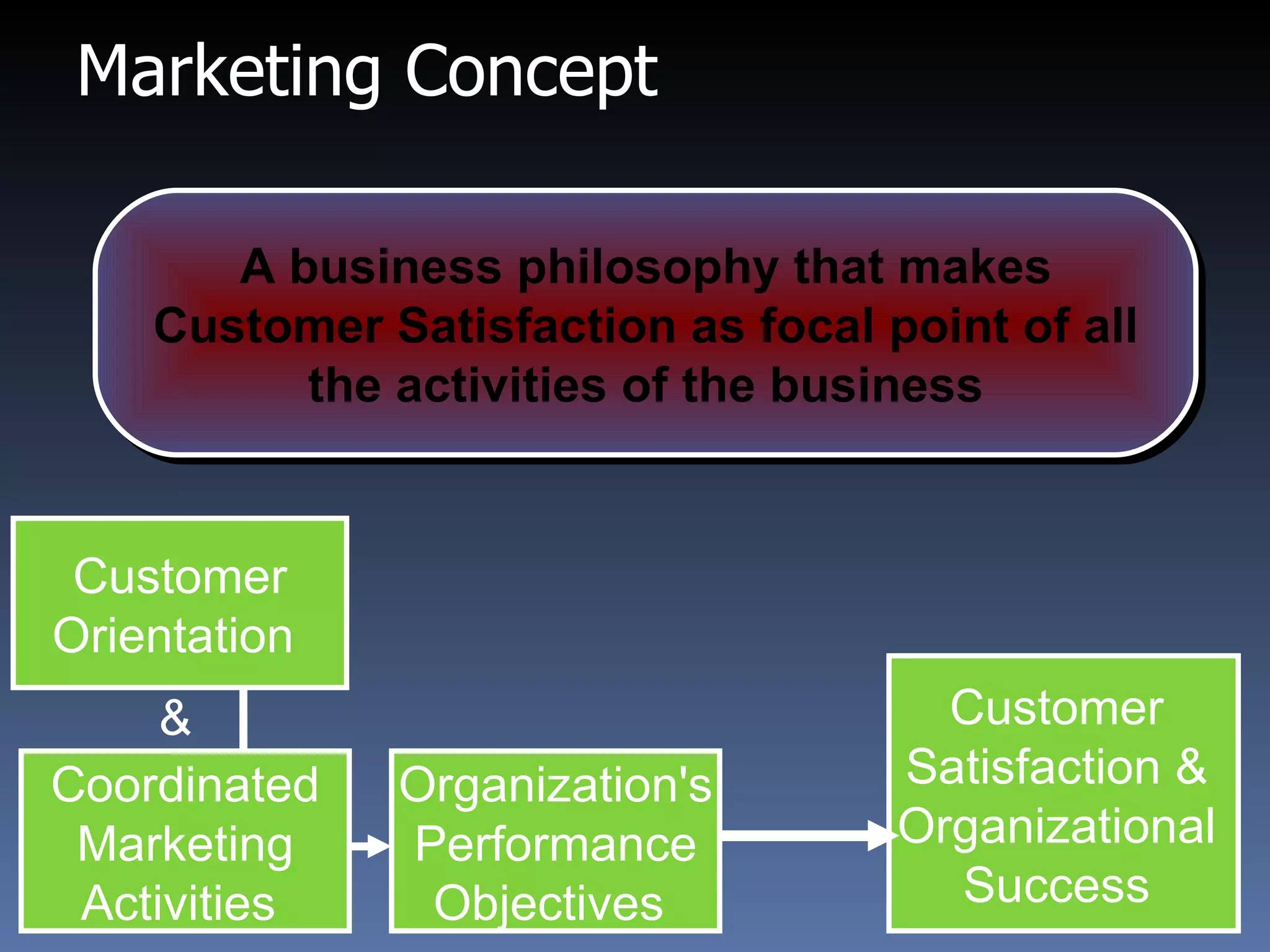
Marketing Concept Customer  Satisfaction &  Organizational  Success  A business philosophy that makes Customer Satisfaction as focal point of all the activities of the business Customer Orientation  & Organization's Performance Objectives  Coordinated Marketing Activities
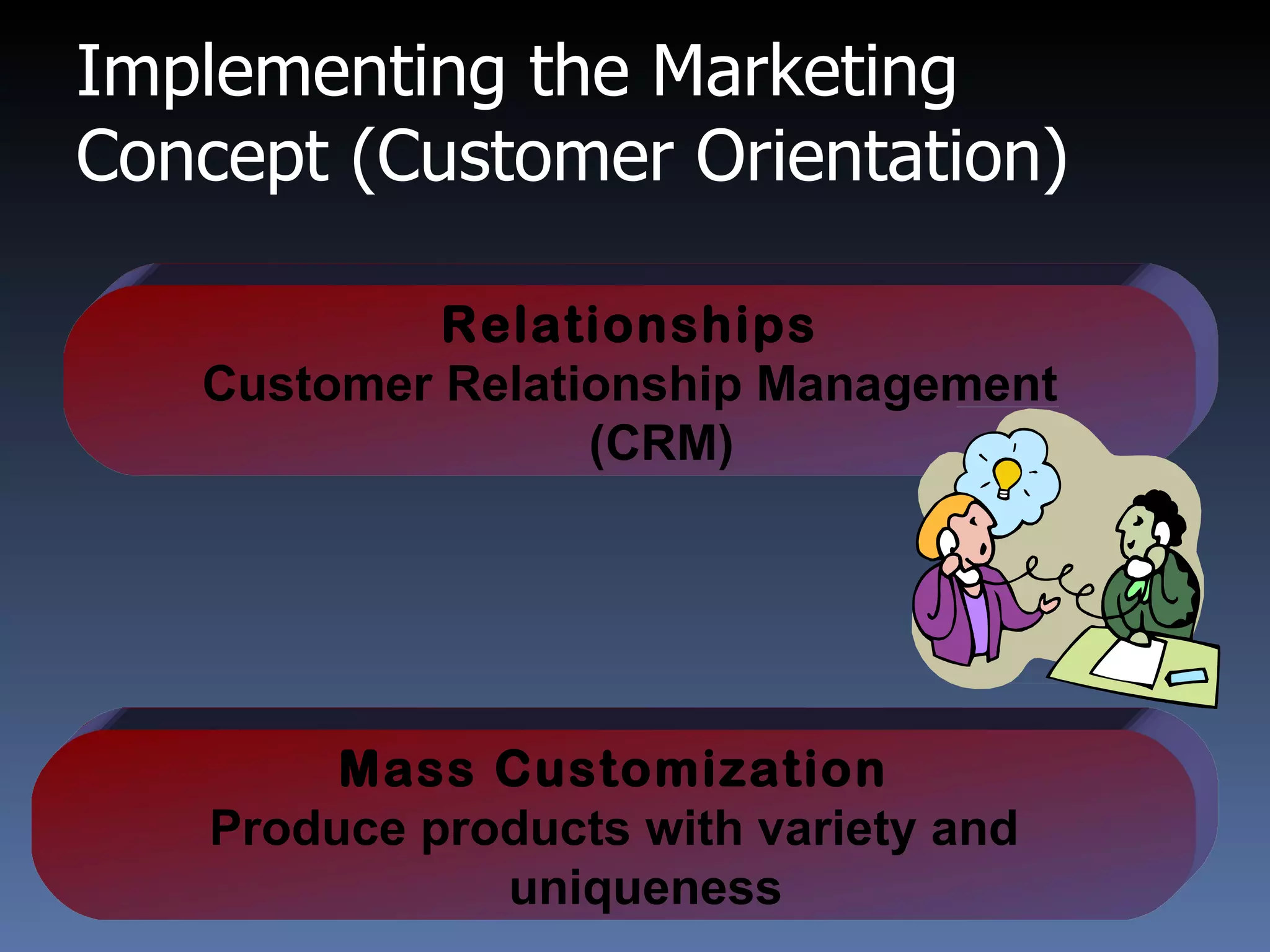
Implementing the Marketing Concept (Customer Orientation) Mass Customization Produce products with variety and uniqueness Relationships Customer Relationship Management (CRM)
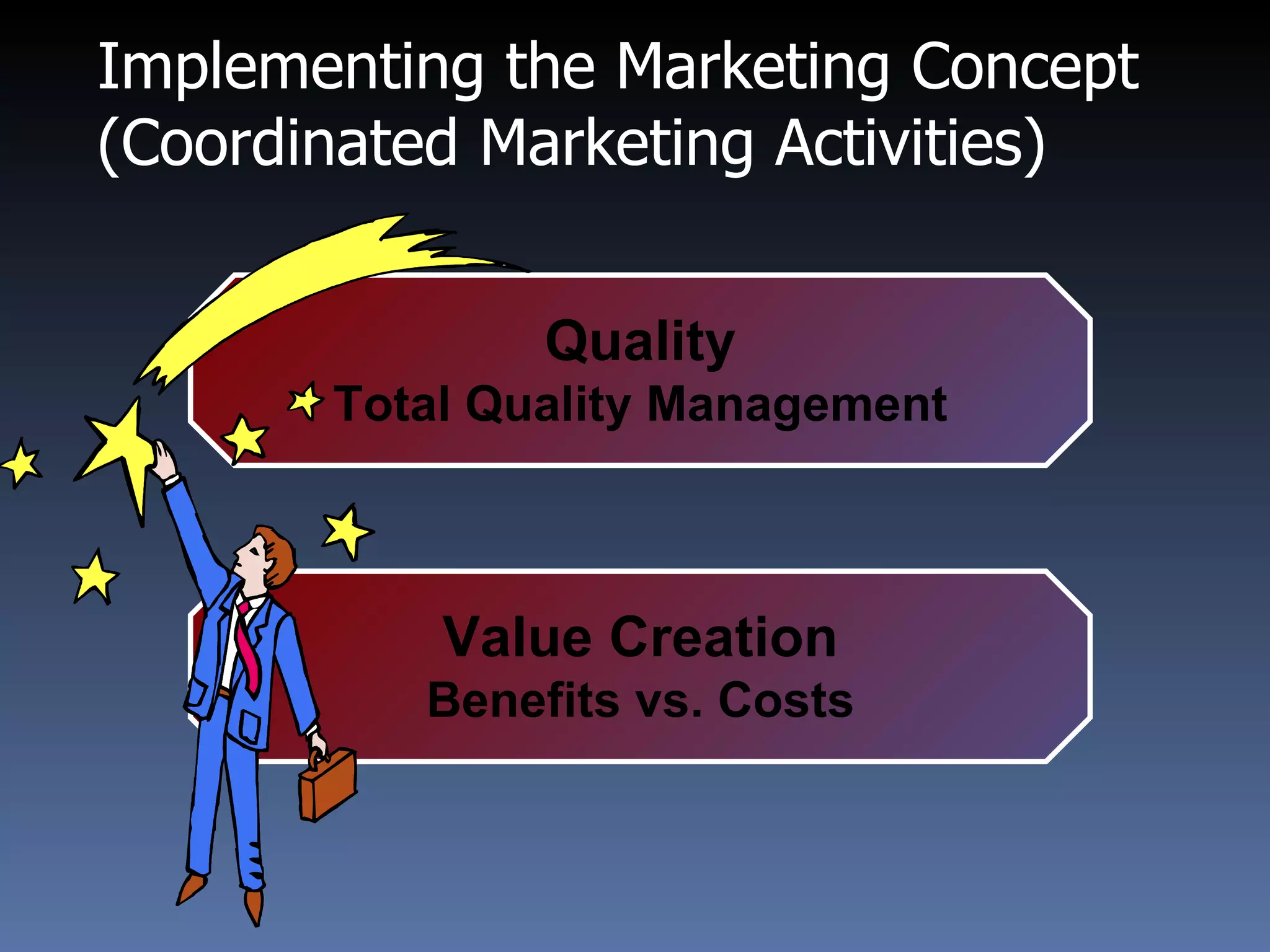
Implementing the Marketing Concept (Coordinated Marketing Activities) Value Creation Benefits vs. Costs Quality Total Quality Management
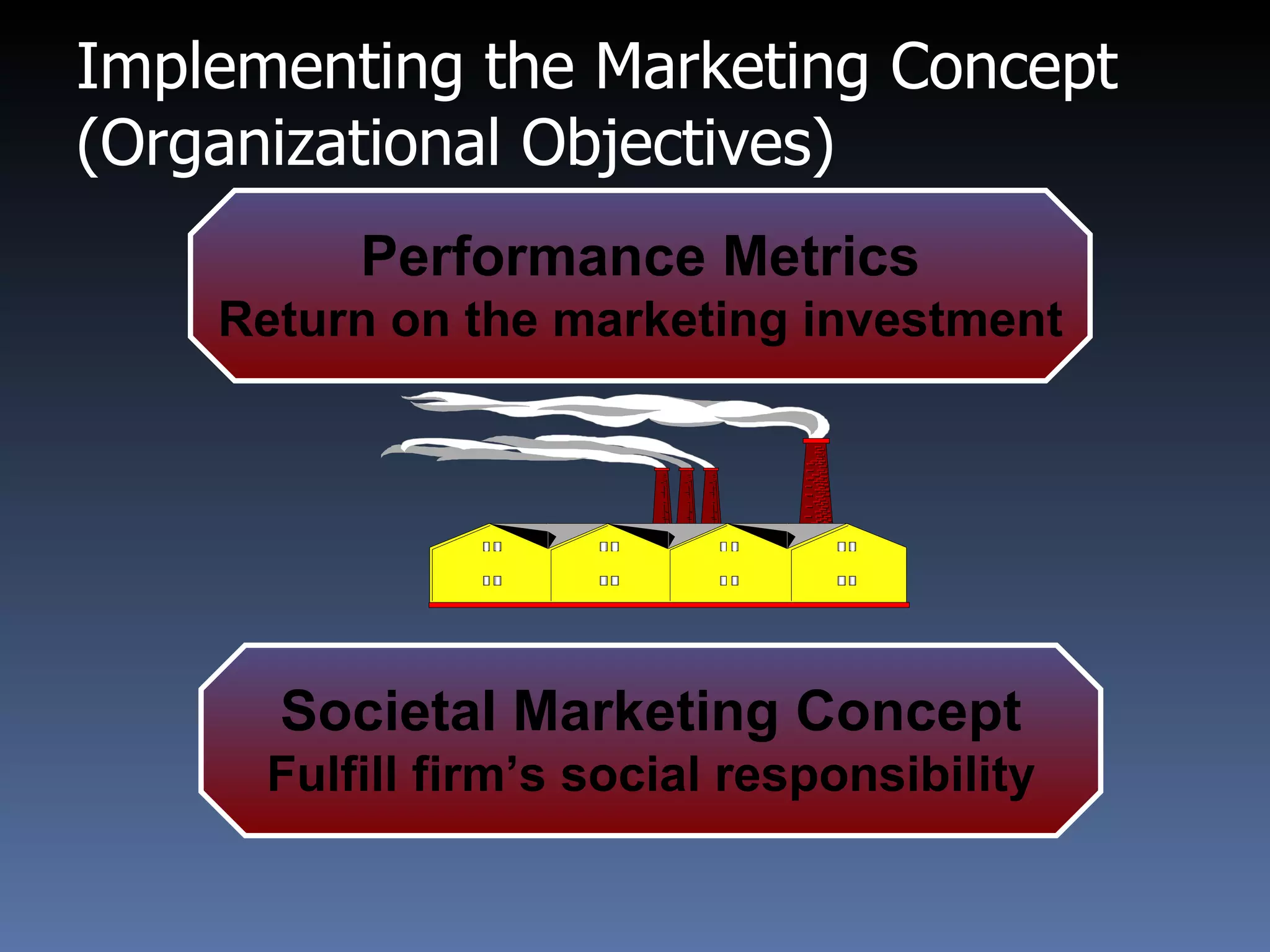
Implementing the Marketing Concept  (Organizational Objectives) Societal Marketing Concept Fulfill firm’s social responsibility Performance Metrics Return on the marketing investment
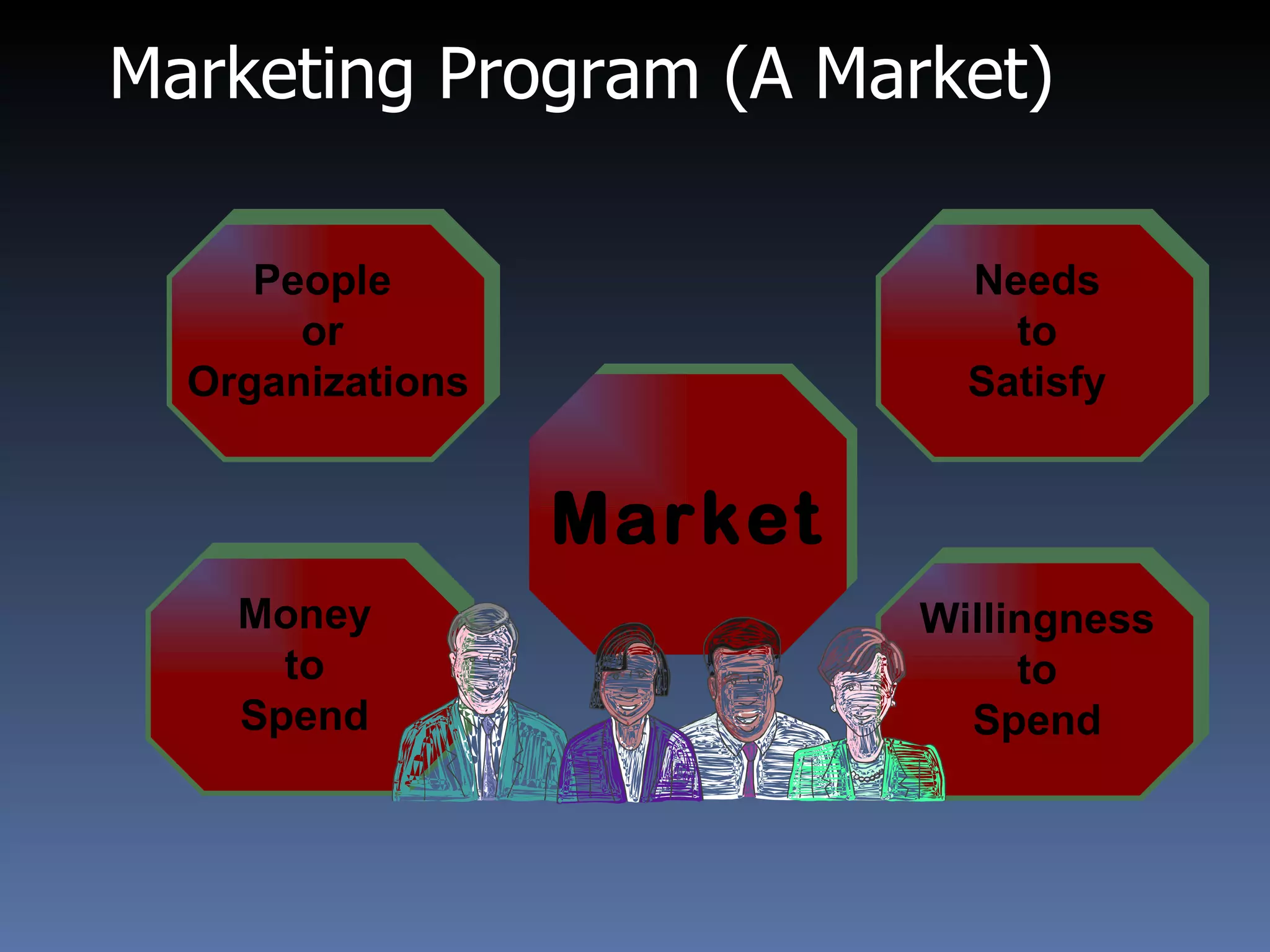
Marketing Program (A Market)  People  or  Organizations Money to Spend Willingness to Spend Needs to  Satisfy Market
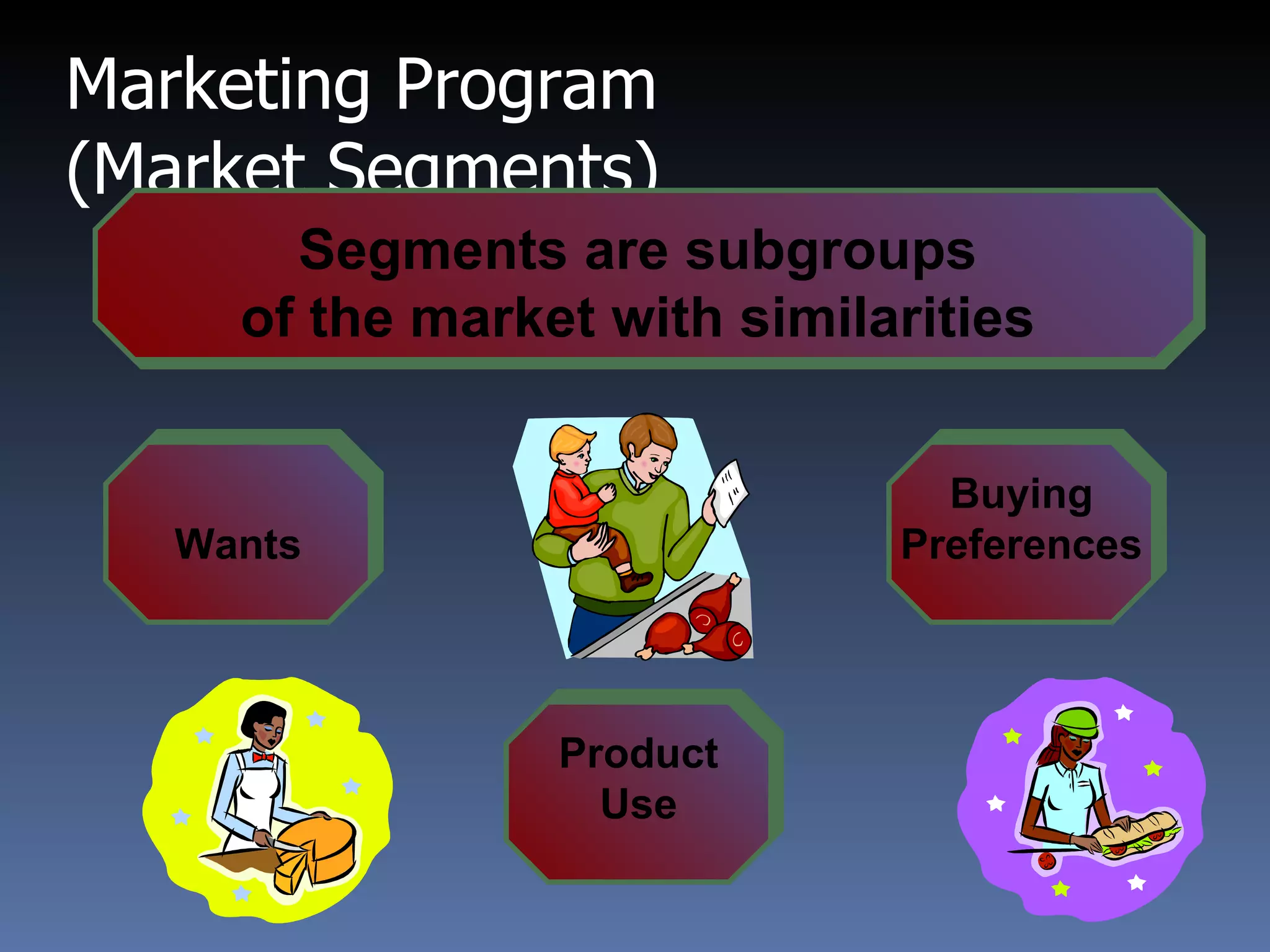
Marketing Program  (Market Segments) Segments are subgroups  of the market with similarities  Wants Product Use Buying Preferences
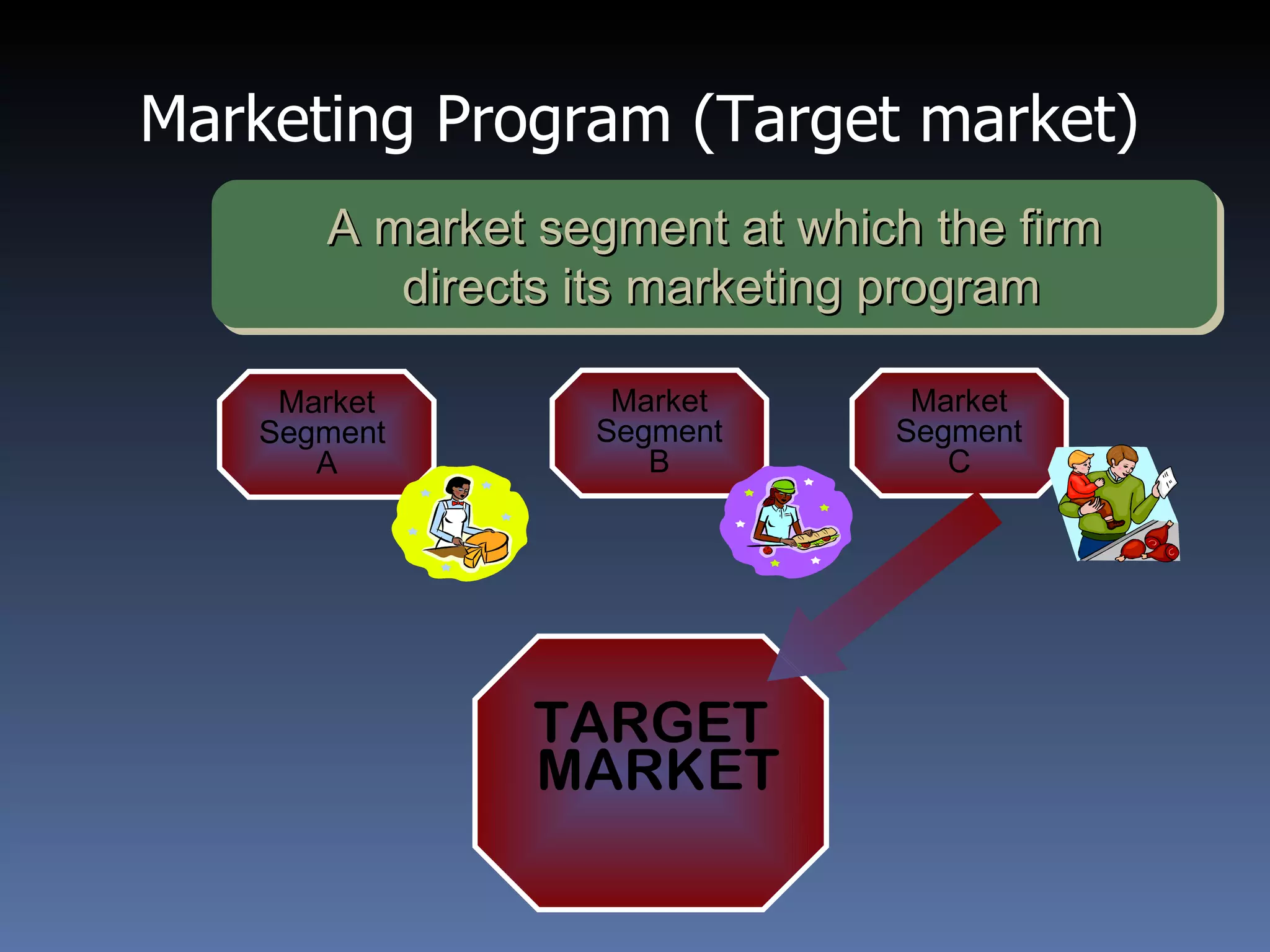
Marketing Program (Target market) A market segment at which the firm directs its marketing program Market Segment  A Market Segment C Market Segment B TARGET MARKET
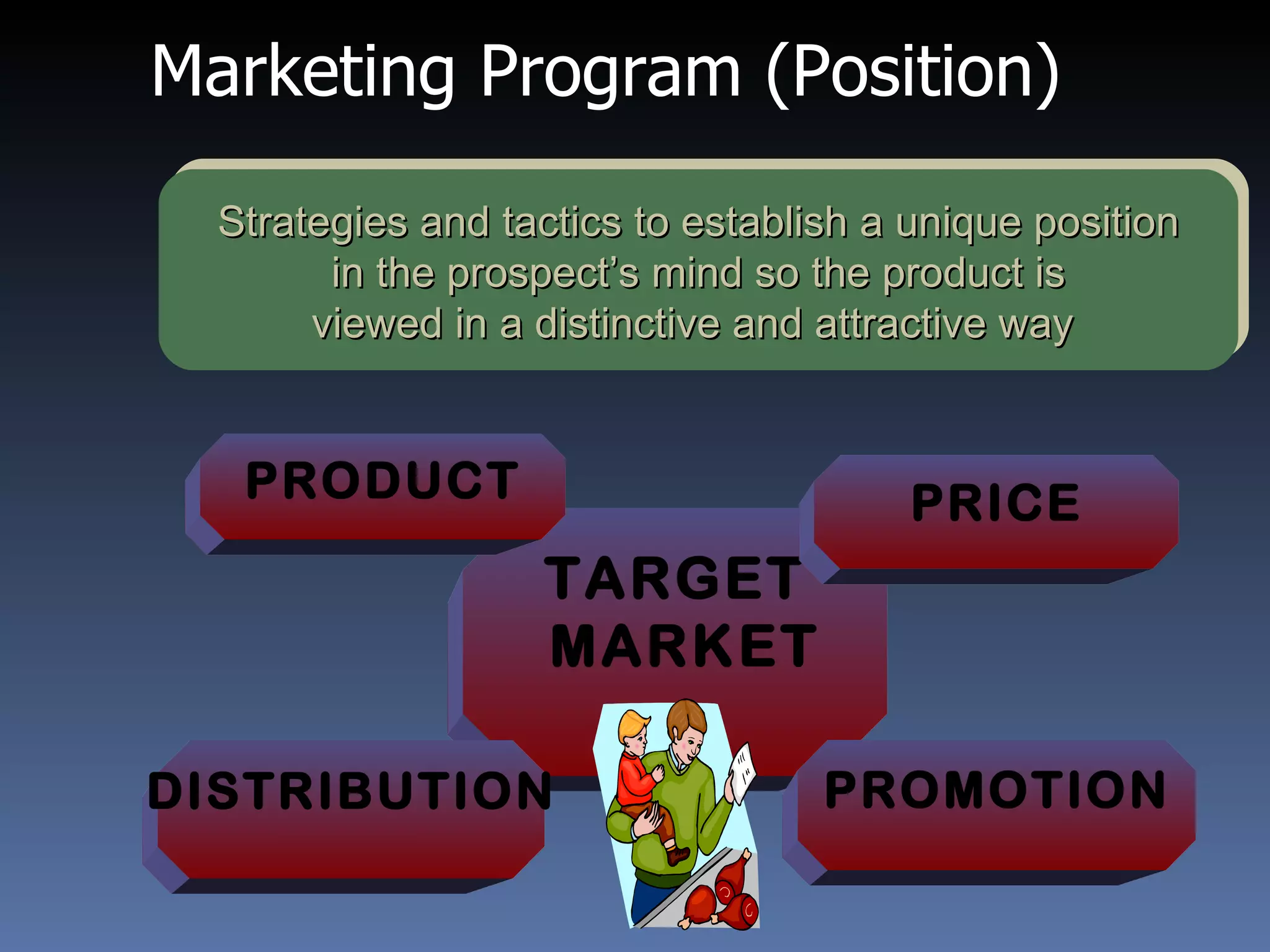
Marketing Program (Position) Strategies and tactics to establish a unique position in the prospect’s mind so the product is  viewed in a distinctive and attractive way  DISTRIBUTION PROMOTION PRODUCT PRICE TARGET MARKET
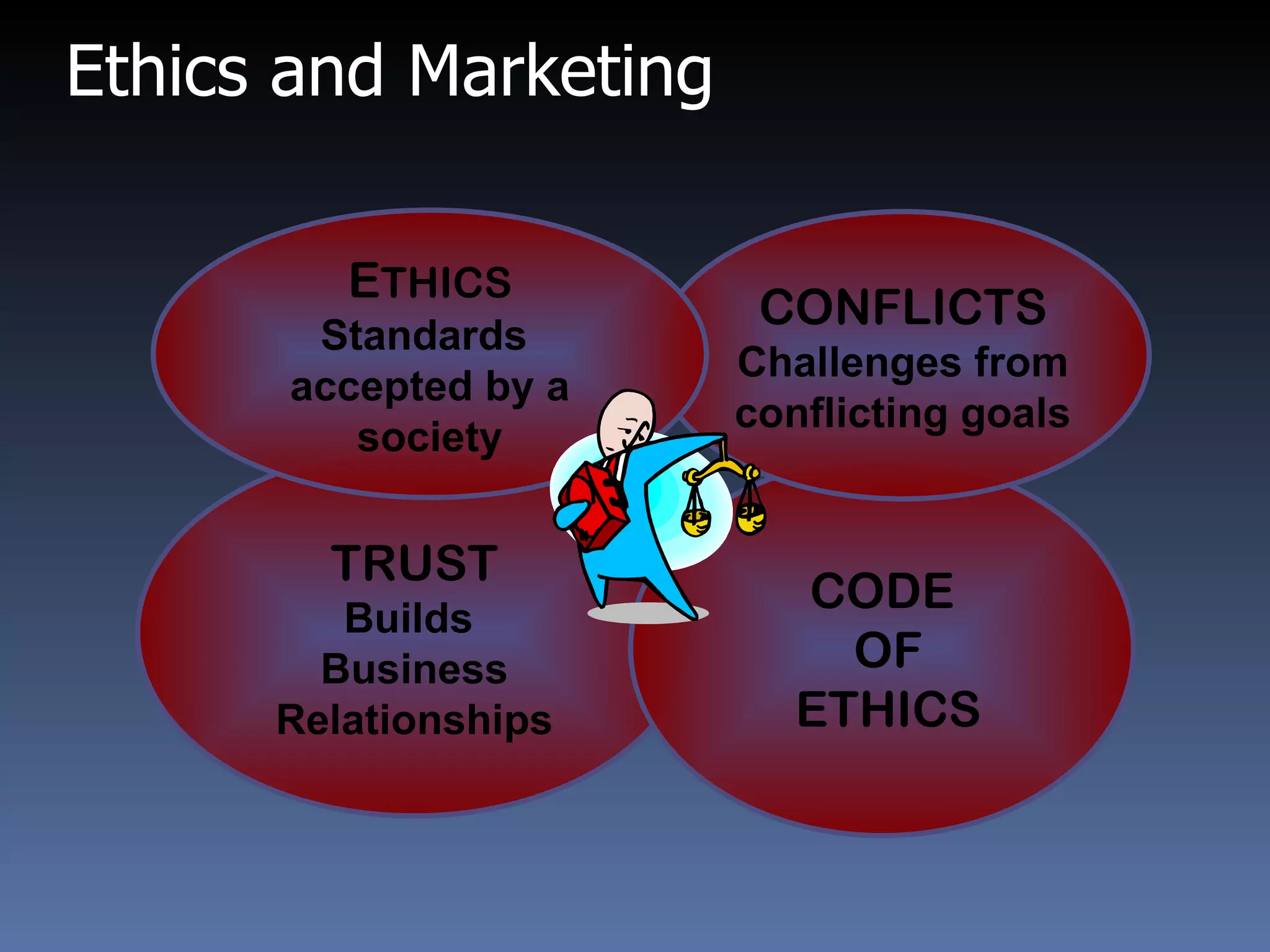
Ethics and Marketing TRUST Builds  Business Relationships CODE OF ETHICS CONFLICTS Challenges from conflicting goals E THICS Standards  accepted by a society
Importance of Marketing Personally Organizationally Domestically Globally
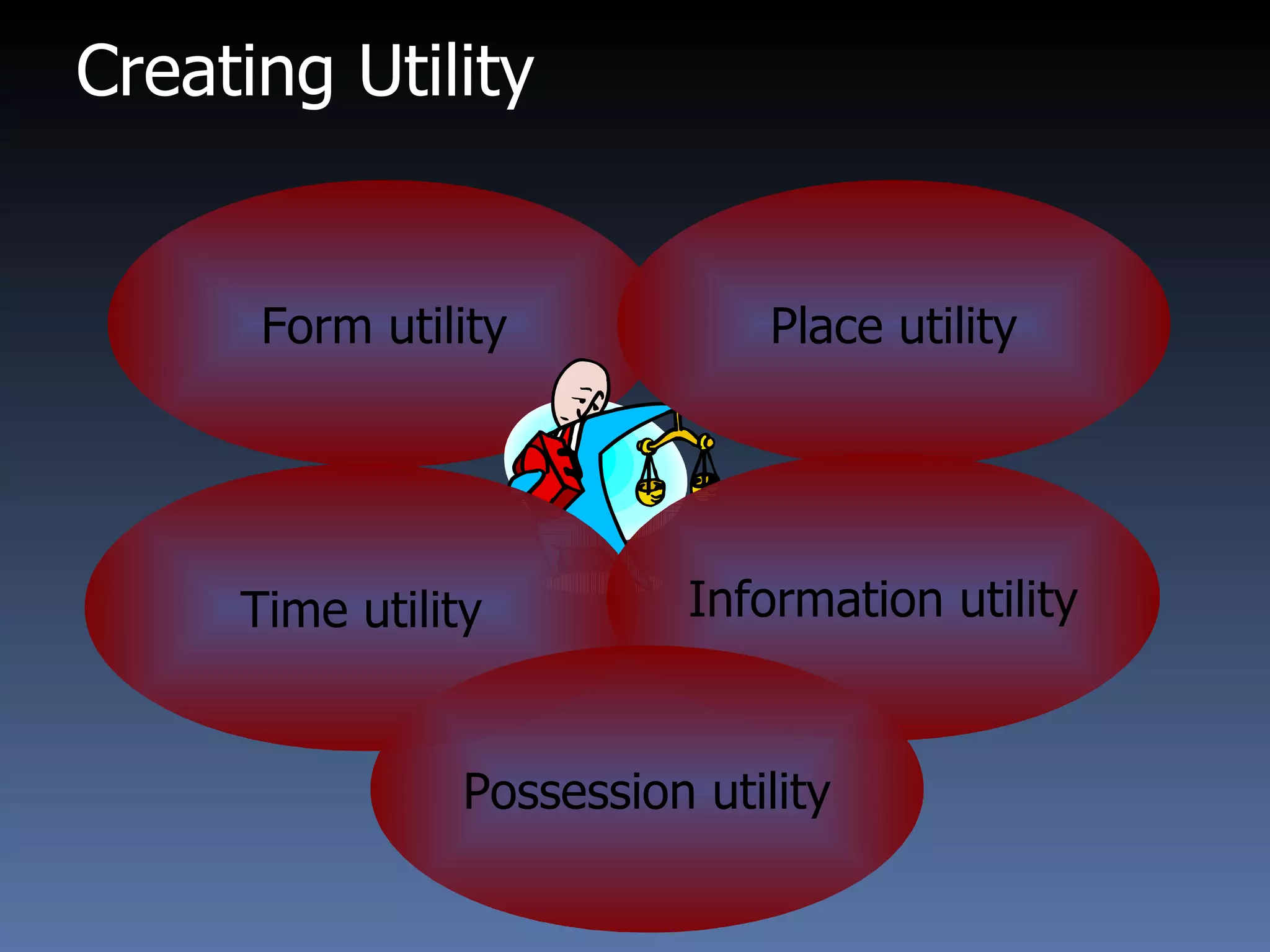
Creating Utility Form utility Place utility Time utility Information utility Possession utility
2.  The Dynamic Marketing Environment
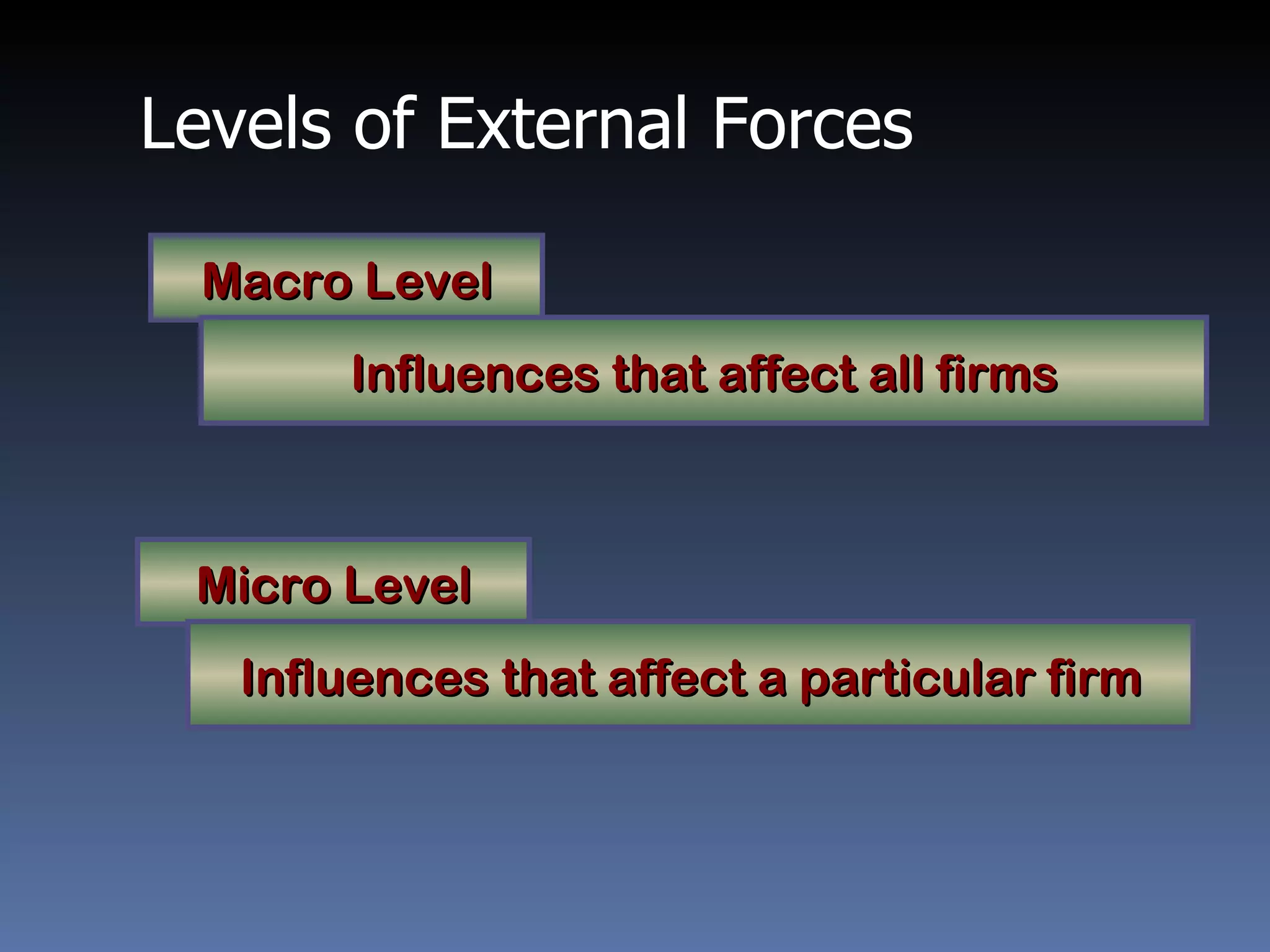
Levels of External Forces Macro Level Influences that affect all firms Micro Level Influences that affect a particular firm
External Macroenvironment Forces Company’s Marketing Program Technology Political and Legal Forces Social & Cultural Forces Natural Environment Competition Demo- graphics Economic conditions
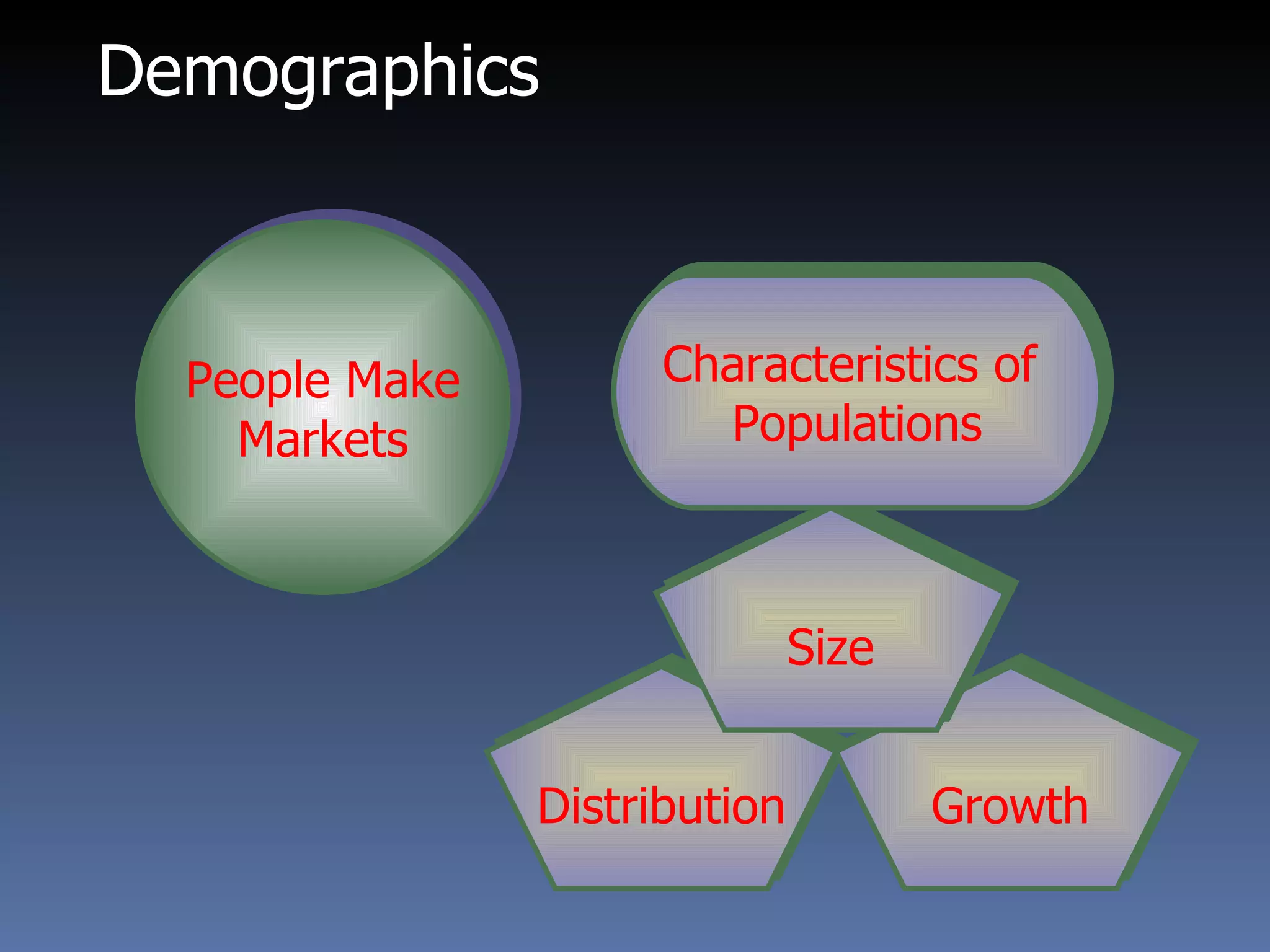
Demographics People Make Markets Distribution Growth Size Characteristics of  Populations
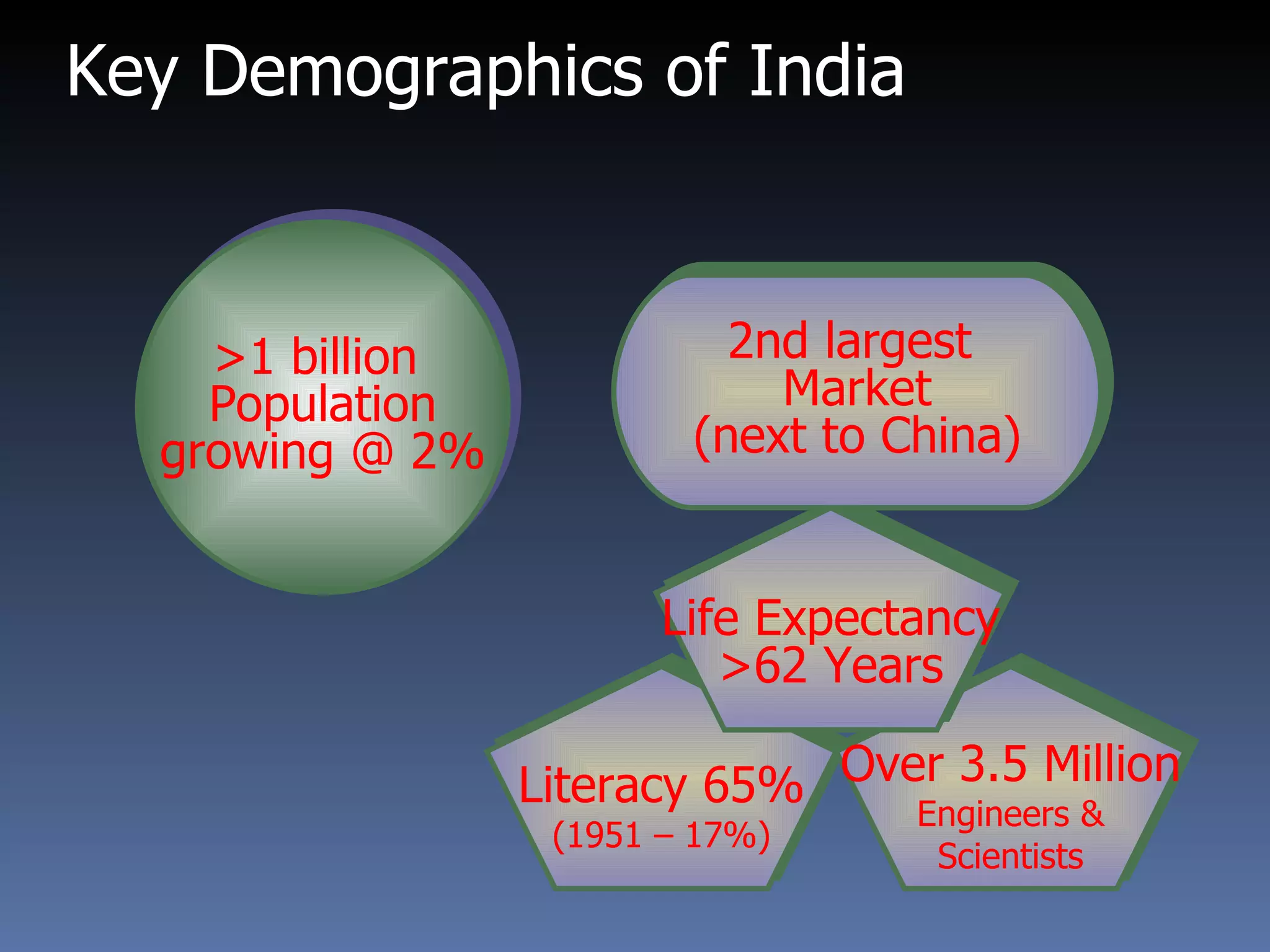
Key Demographics of India >1 billion  Population growing @ 2% Literacy 65% (1951 – 17%) Over 3.5 Million Engineers & Scientists Life Expectancy >62 Years 2nd largest  Market (next to China)
Economic Factors Inflation Interest Rates Stage of the  Business  Cycle People with Money to Spend and Willing to Spend it
Key Economic Facts (Indian Environment) Significant FDI, Vibrant Capital Market, High  FE Reserve Inflation (Moderate – High) Interest  Rates (High) Economy Growing @8-9.5%
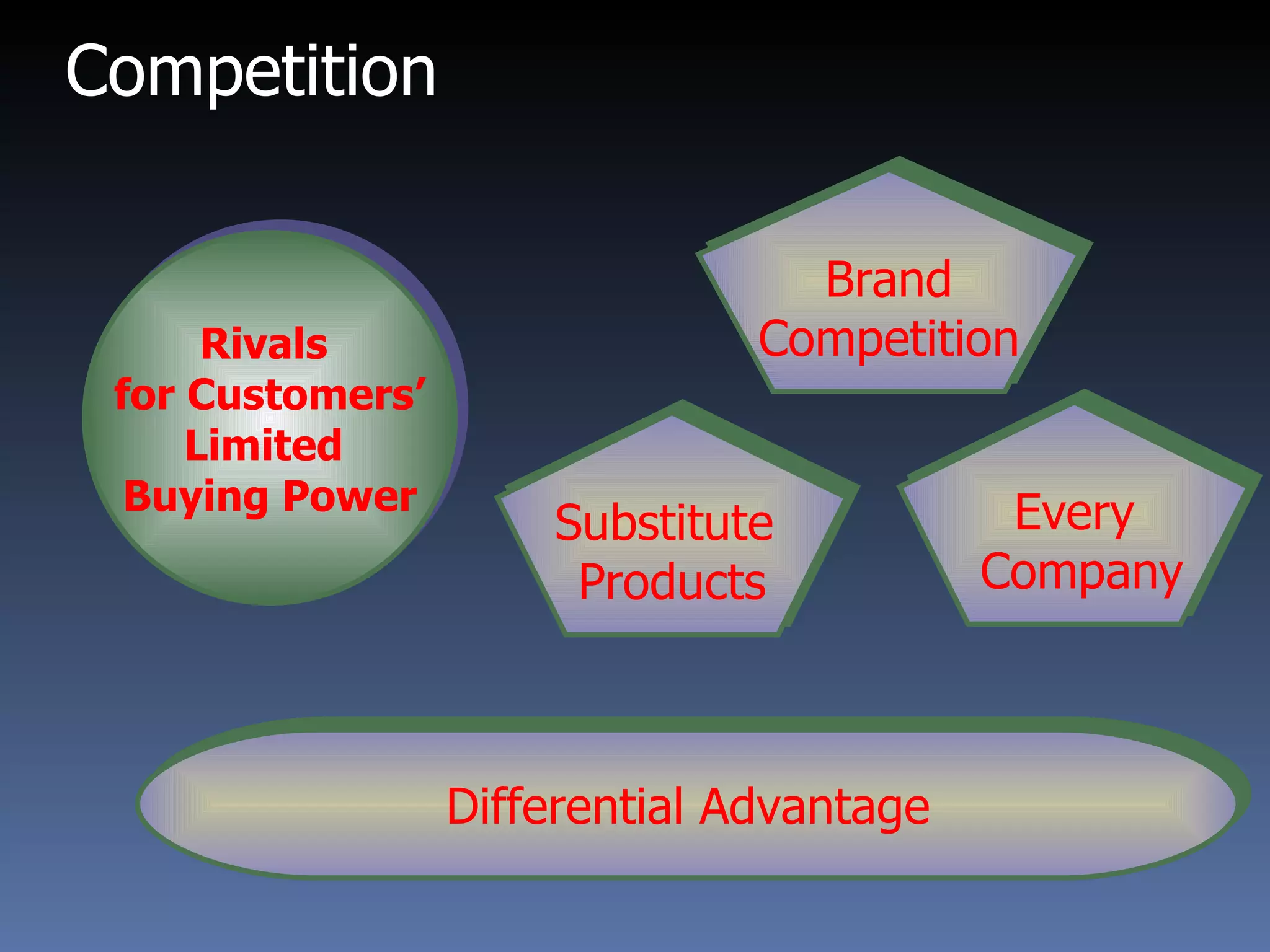
Competition Rivals  for Customers’ Limited  Buying Power Substitute  Products Every Company Brand Competition Differential Advantage
Social and Cultural Forces People Make Markets Beliefs Socio-cultural Patterns Changing Quickly Values Lifestyles
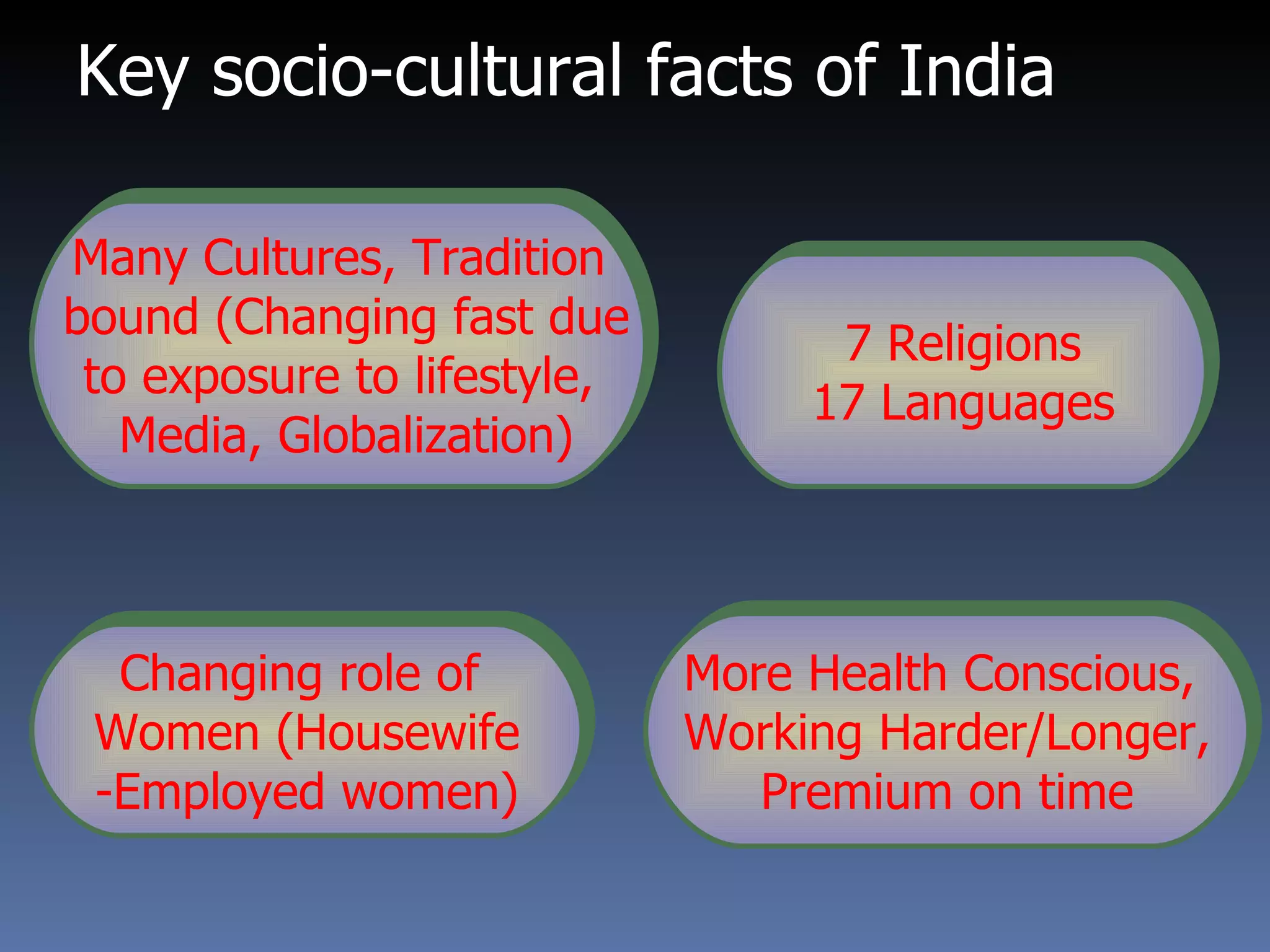
Key socio-cultural facts of India 7 Religions 17 Languages Many Cultures, Tradition bound (Changing fast due to exposure to lifestyle, Media, Globalization) More Health Conscious,  Working Harder/Longer, Premium on time Changing role of  Women (Housewife -Employed women)
Political and Legal Forces Type of  Governance and Direction  Governmental Relationship  with  Industries Monetary and Fiscal Policies Legislation -  Social & Related to Marketing
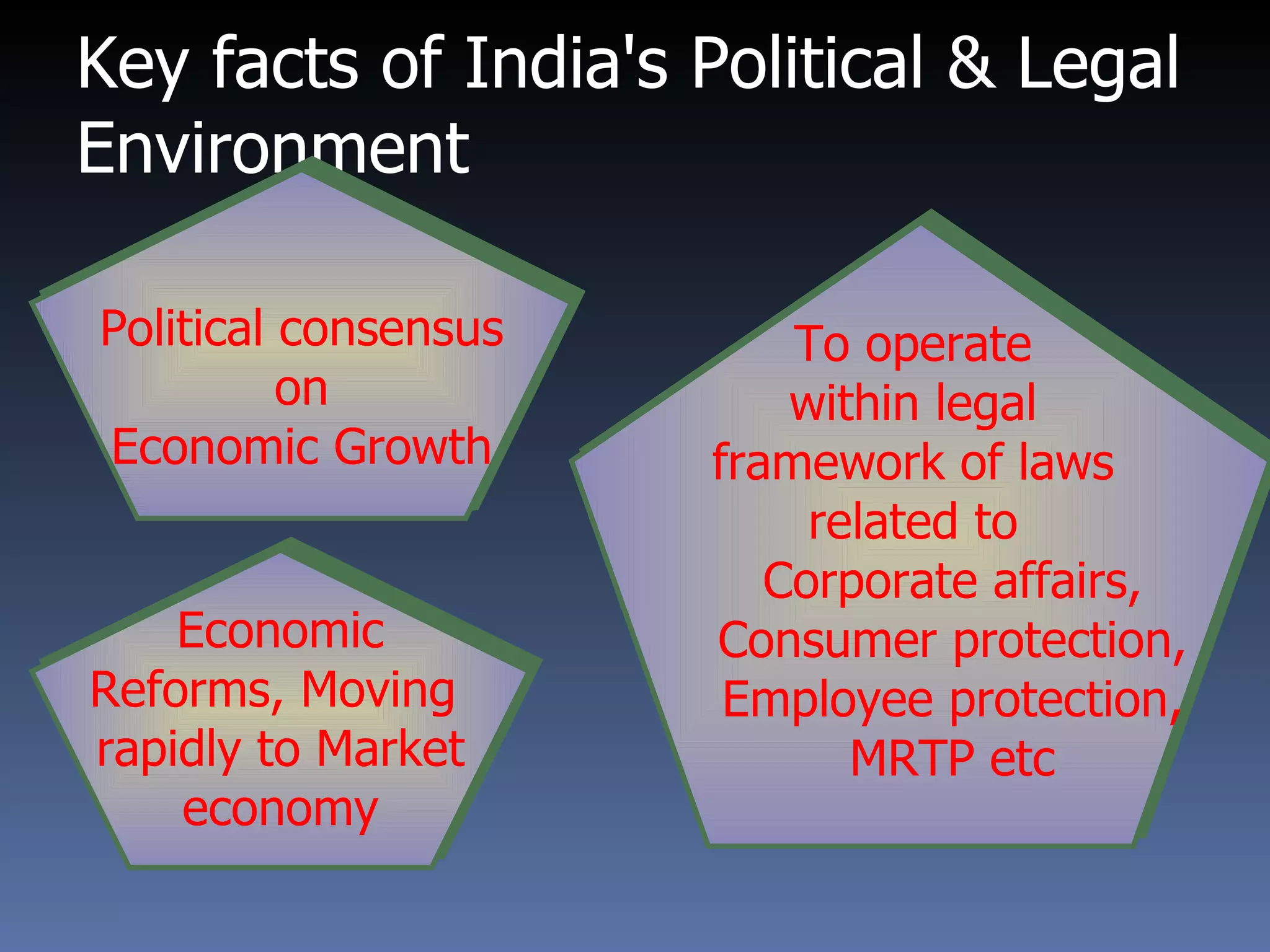
Key facts of India's Political & Legal Environment Political consensus on Economic Growth Economic Reforms, Moving  rapidly to Market economy To operate  within legal  framework of laws  related to  Corporate affairs, Consumer protection, Employee protection, MRTP etc
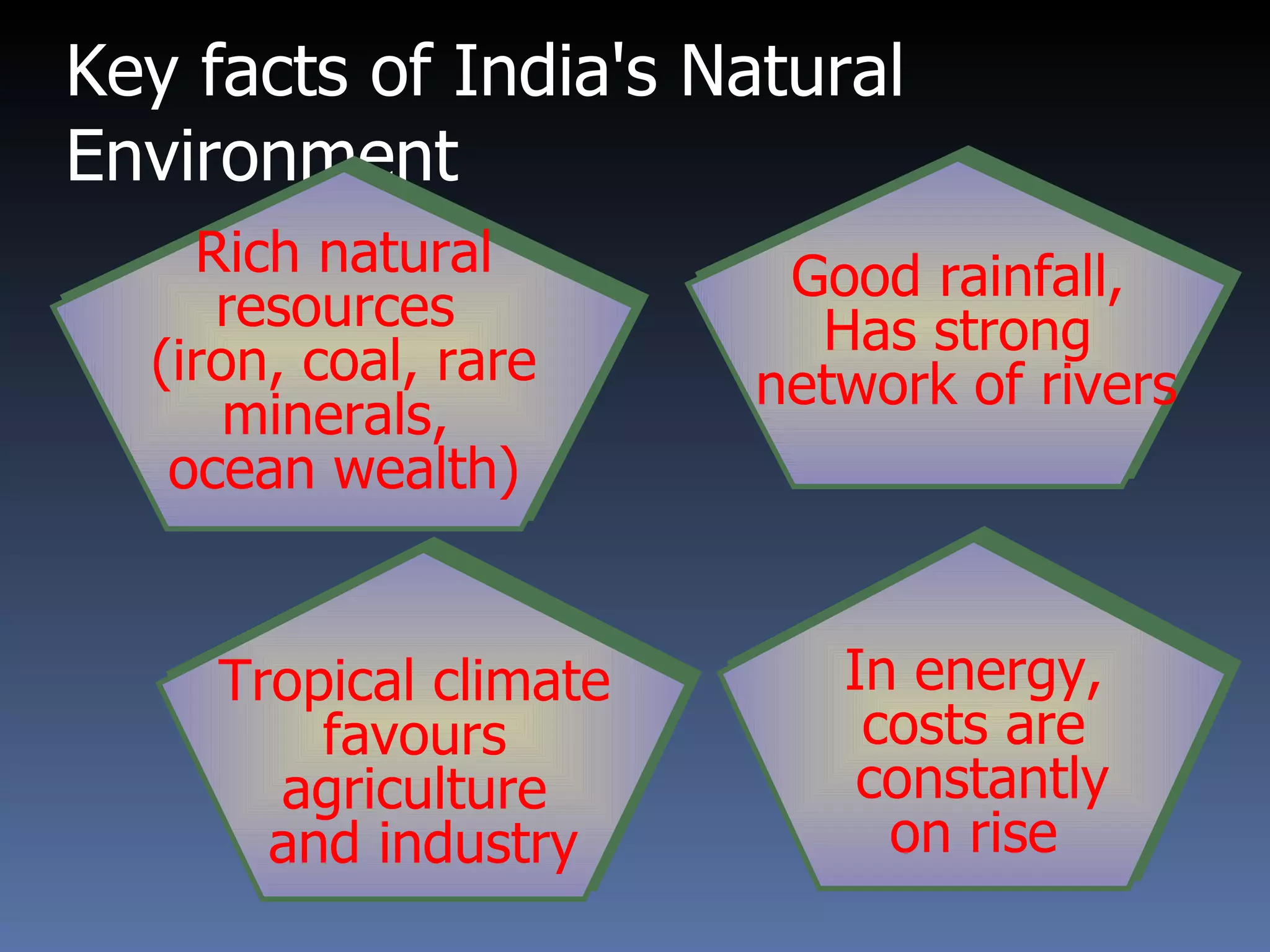
Key facts of India's Natural Environment Rich natural resources  (iron, coal, rare minerals,  ocean wealth) Tropical climate  favours  agriculture  and industry Good rainfall, Has strong network of rivers In energy, costs are constantly on rise
Technology Affects How Marketing is Carried Out Altering  Existing Industries Impacts lifestyles,  consumption patterns, economic well-being Starting New Industries Stimulates Markets and  Other Industries
External Microenvironment of a Company’s Marketing Program Company’s Marketing Program Marketing Interme- diaries The Market Marketing Interme- diaries Suppliers Value Chain
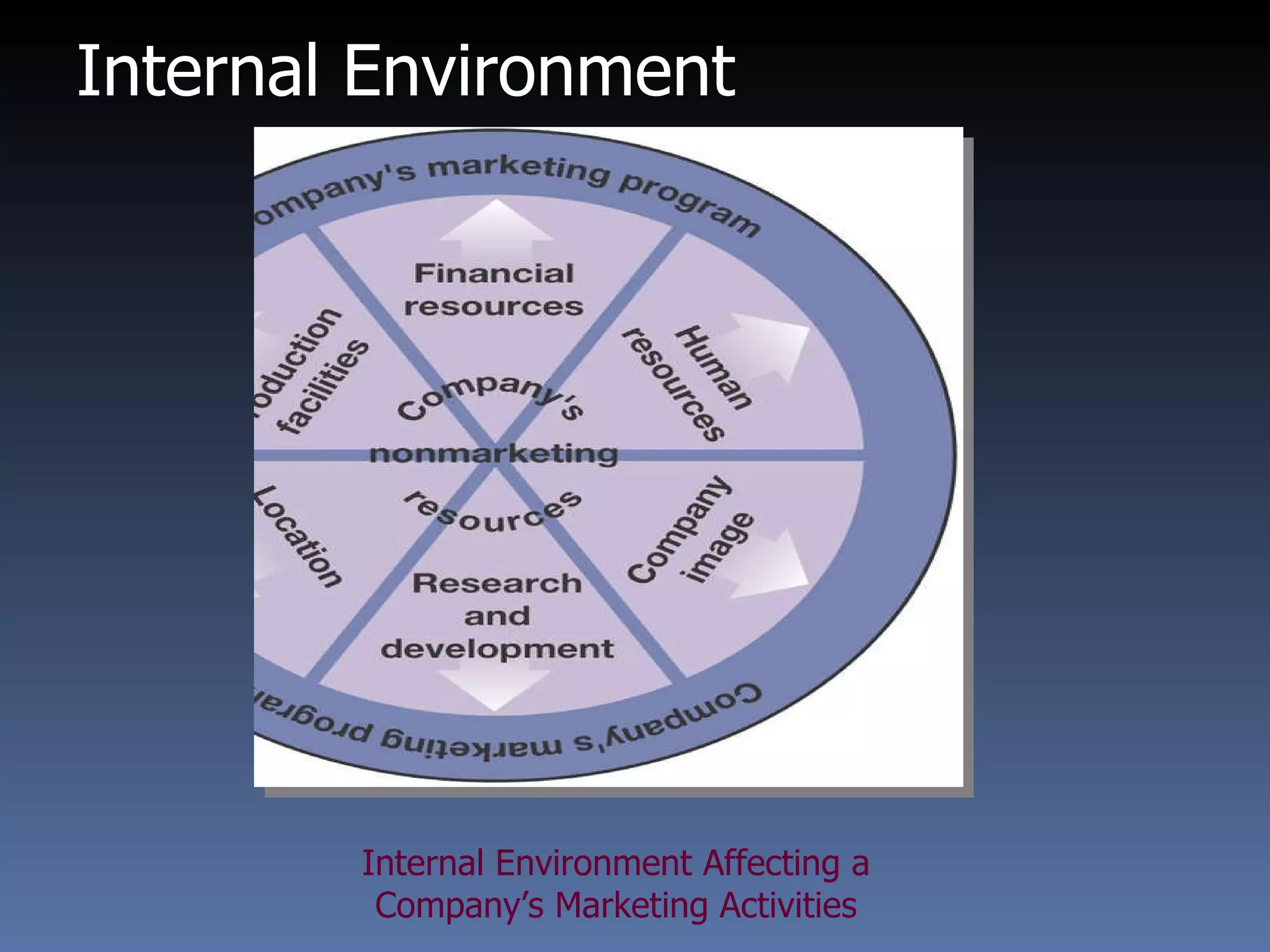
Internal Environment Internal Environment Affecting a Company’s Marketing Activities
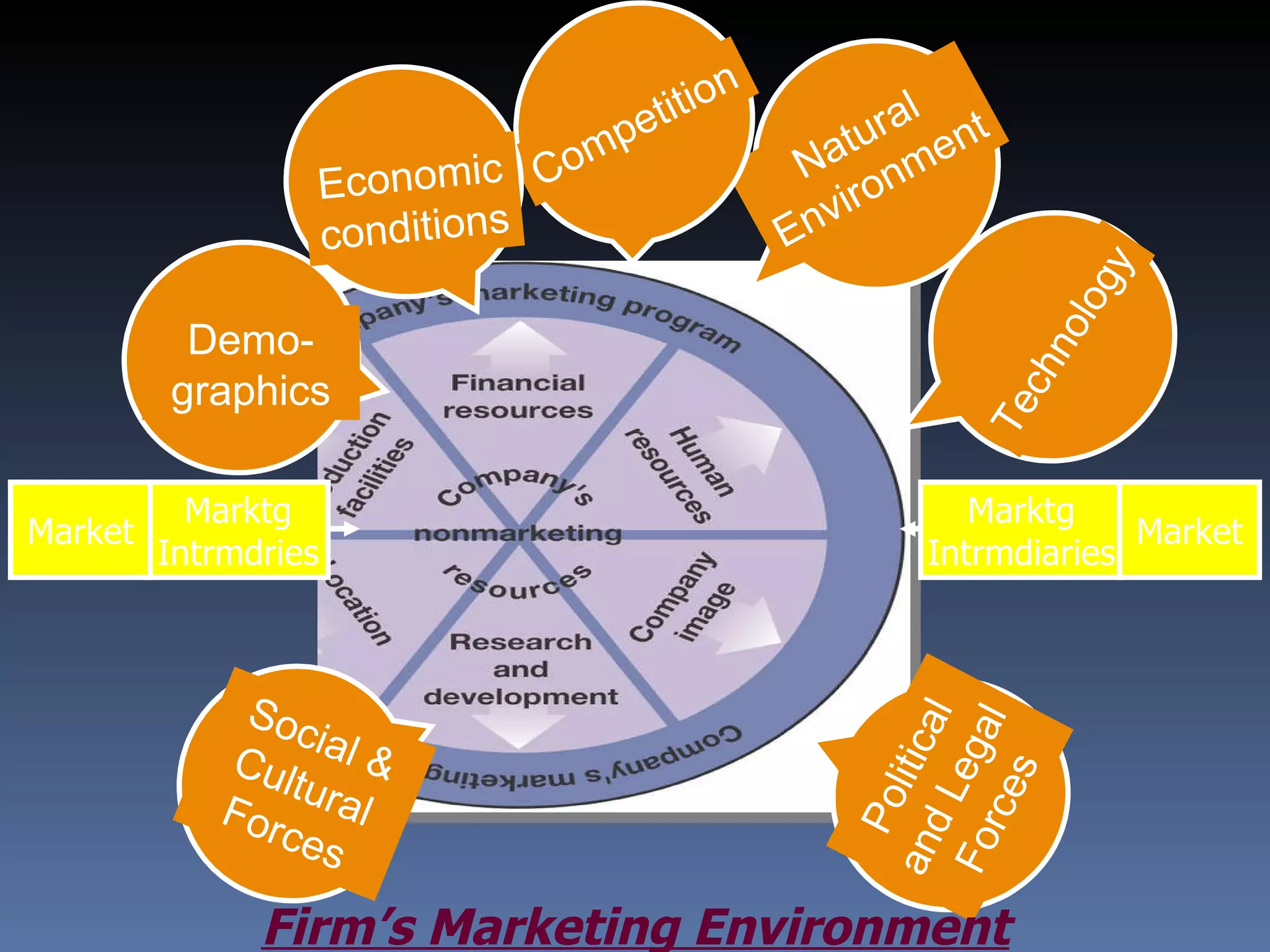
Firm’s Marketing Environment Marktg Intrmdries Market Marktg Intrmdiaries Market Technology Political and Legal Forces Social & Cultural Forces Natural Environment Competition Demo- graphics Economic conditions
3.  Global Markets and Marketing
Lesson Objectives The significance of marketing to firms and countries The attractiveness of foreign markets The challenges of designing international marketing strategies The alternative organizational structures The international marketing mix issues and concepts
Reasons for International Trade Access to products Comparative Advantage
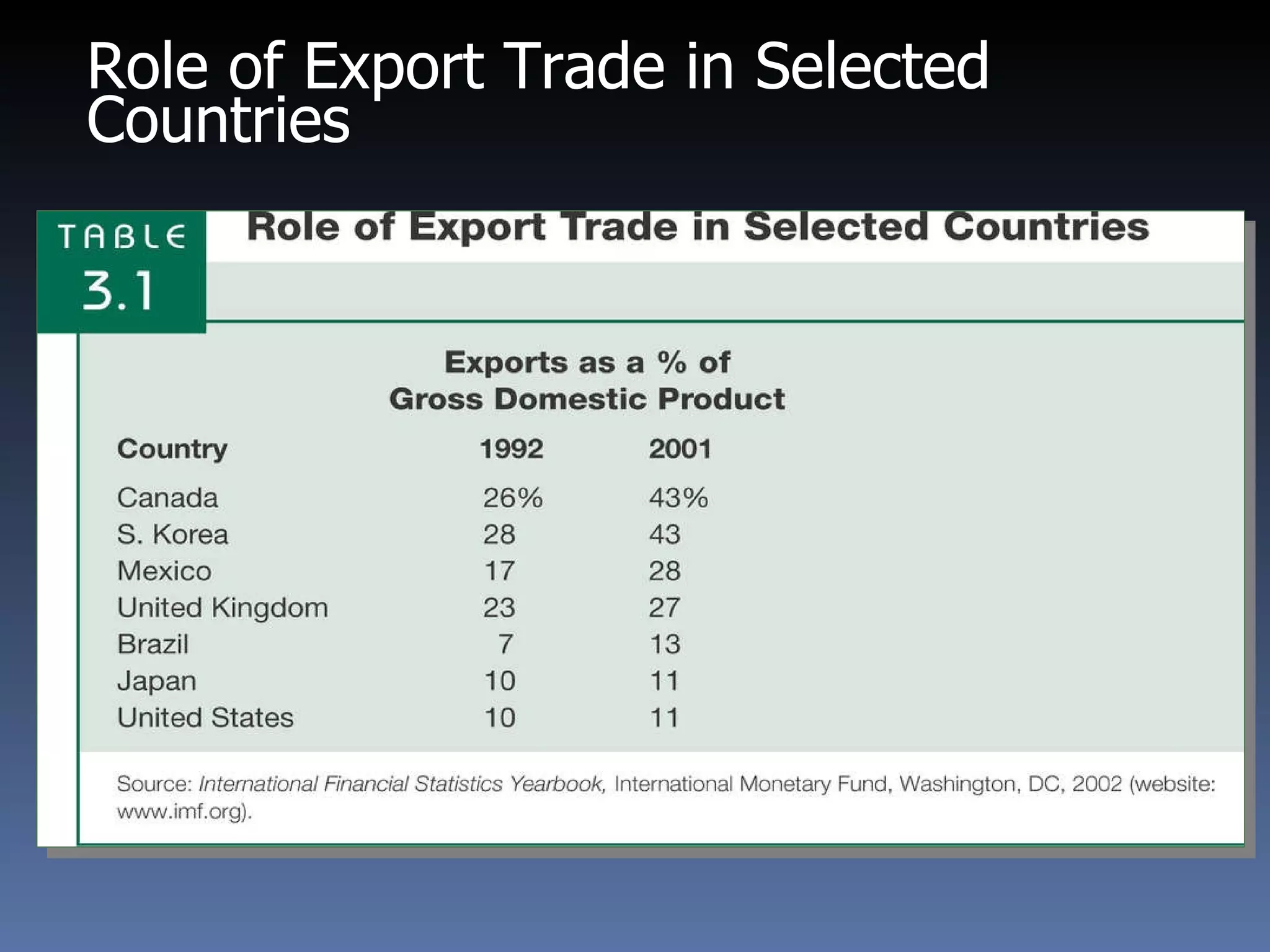
Role of Export Trade in Selected Countries INSERT TABLE 3.1
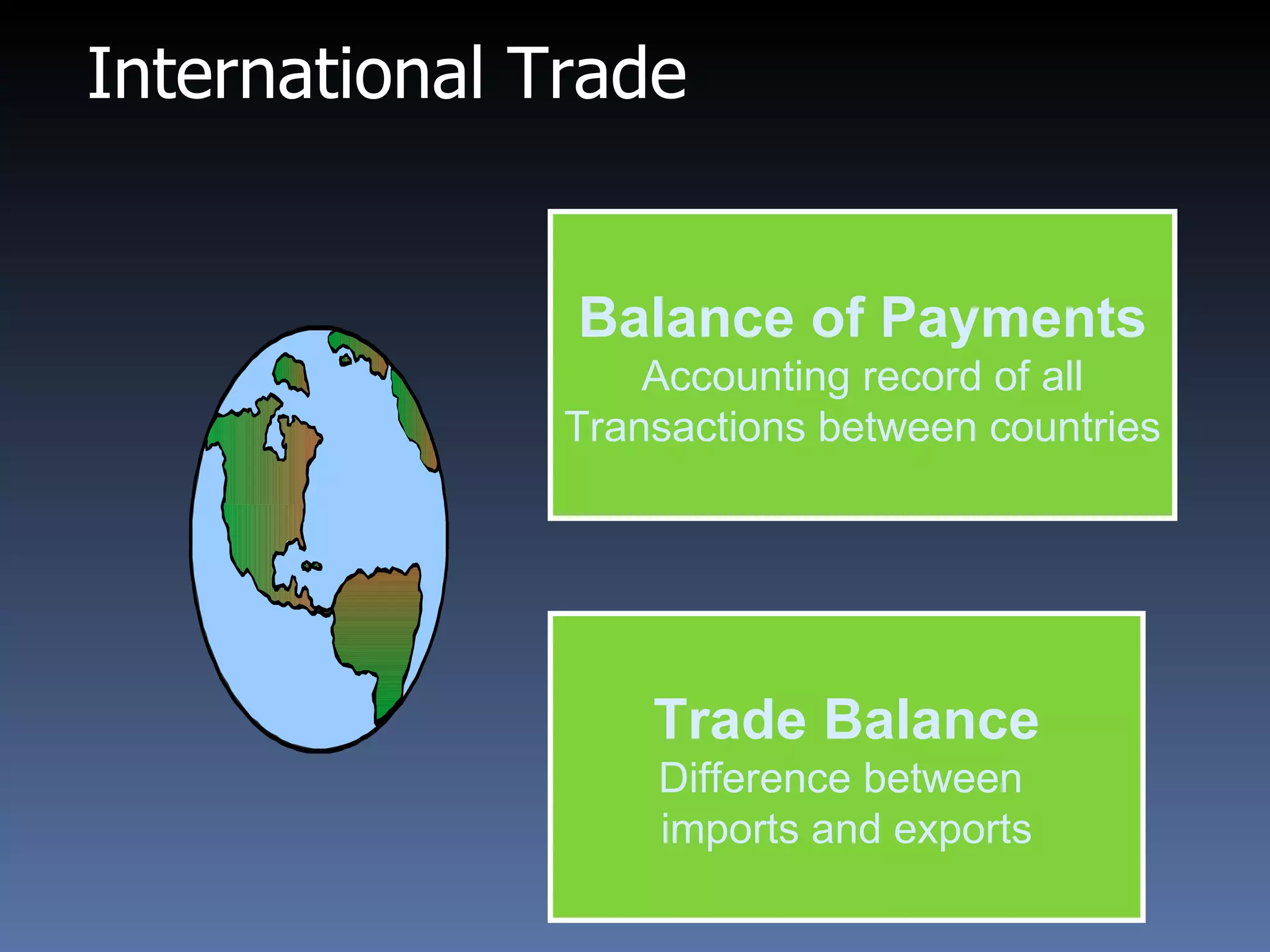
International Trade Balance of Payments Accounting record of all Transactions between countries Trade Balance Difference between  imports and exports
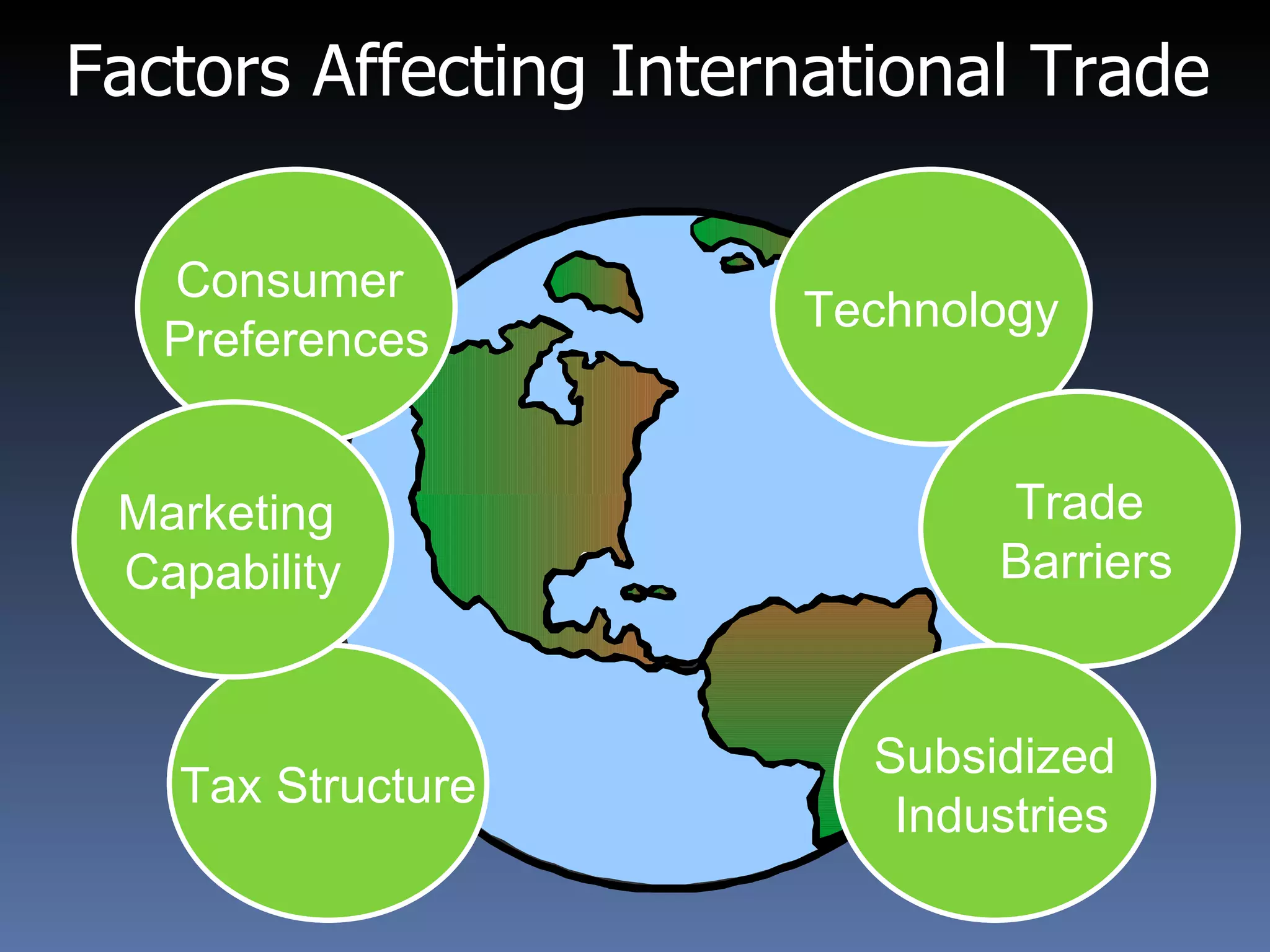
Factors Affecting International Trade Technology Consumer  Preferences Trade Barriers Subsidized Industries Tax Structure Marketing  Capability
Why International Marketing? Potential Demand Market Saturation Customer Expectations
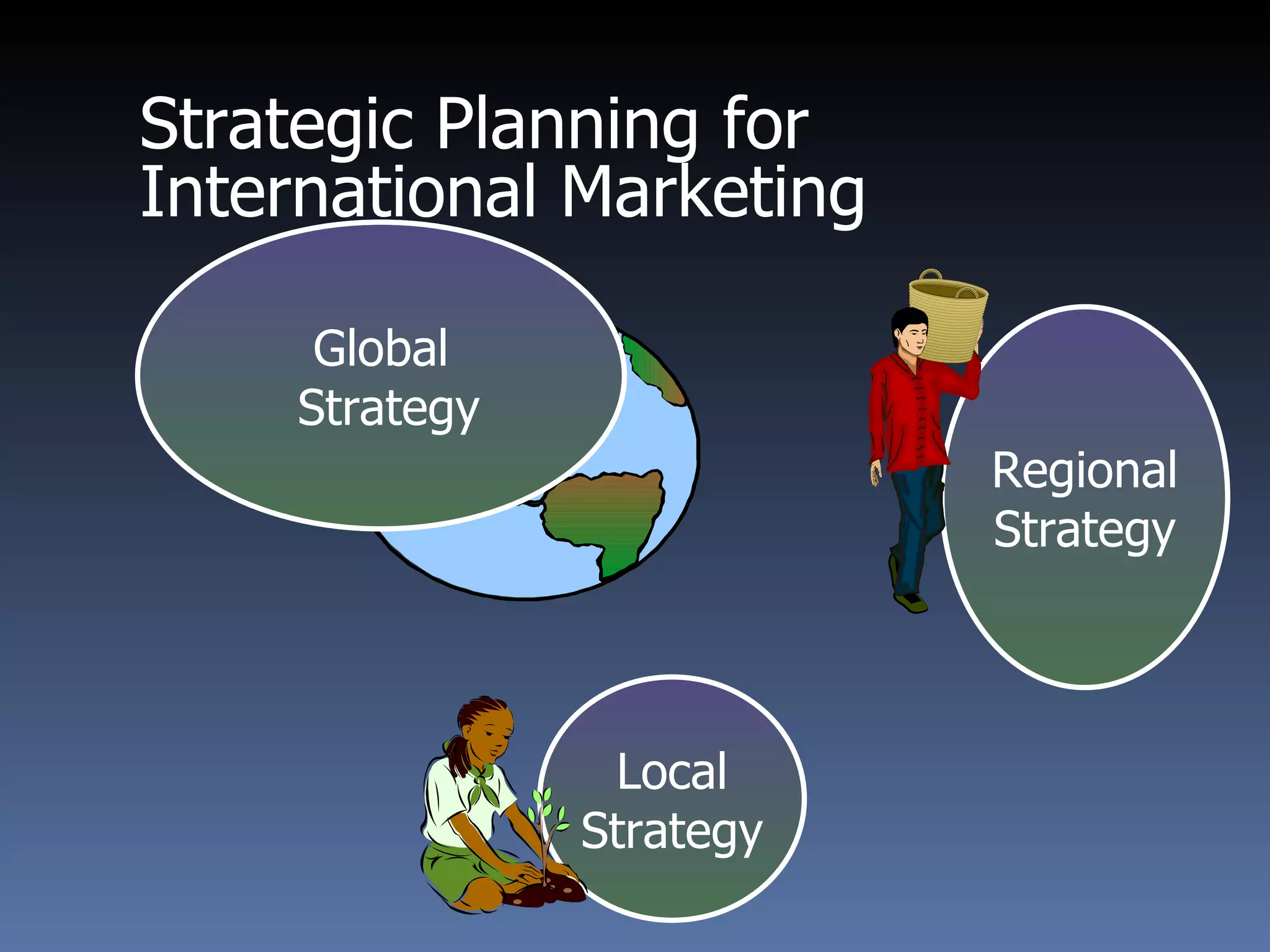
Strategic Planning for  International Marketing Regional Strategy Local Strategy Global Strategy
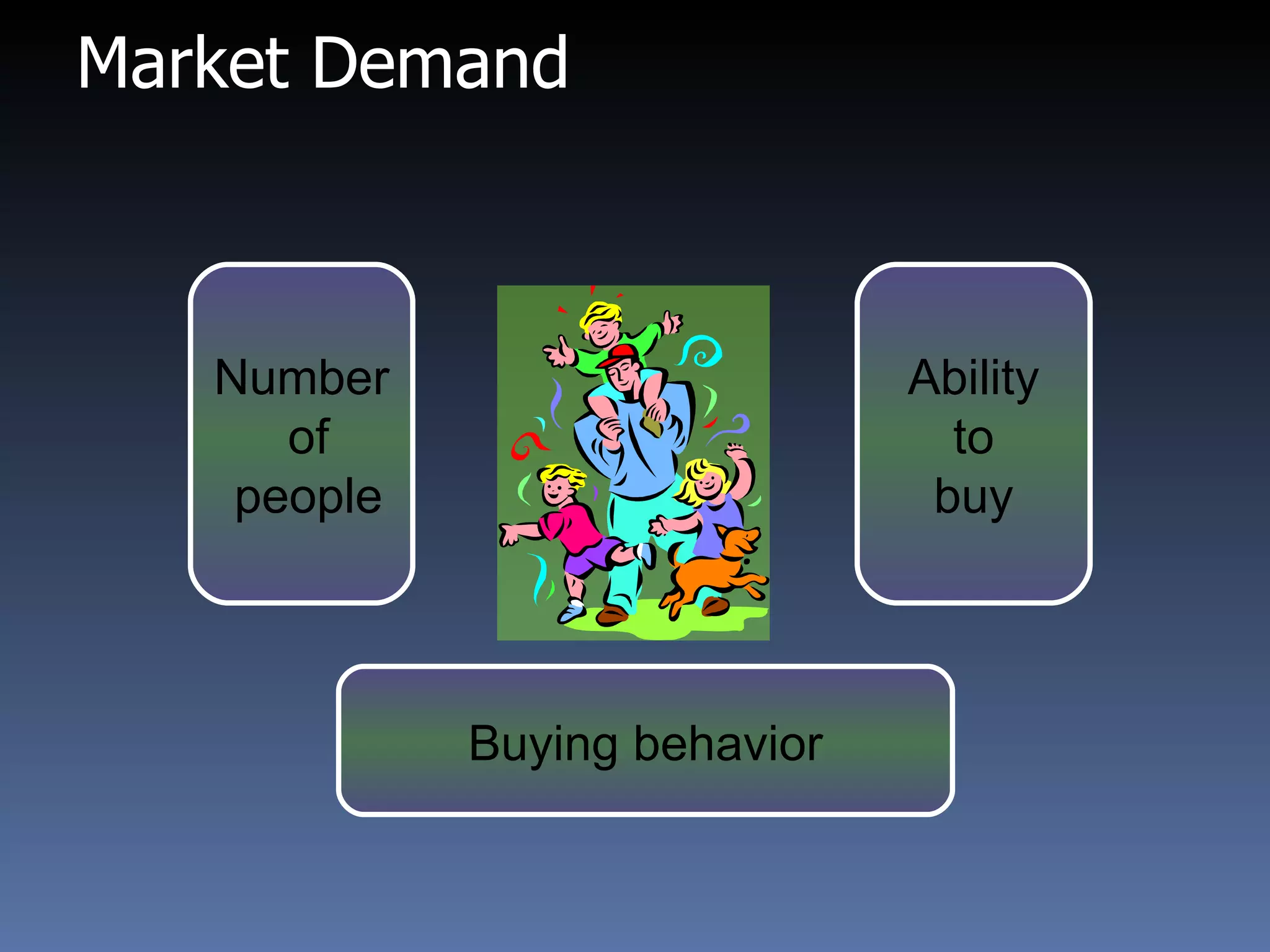
Market Demand Number of people Buying behavior Ability to  buy
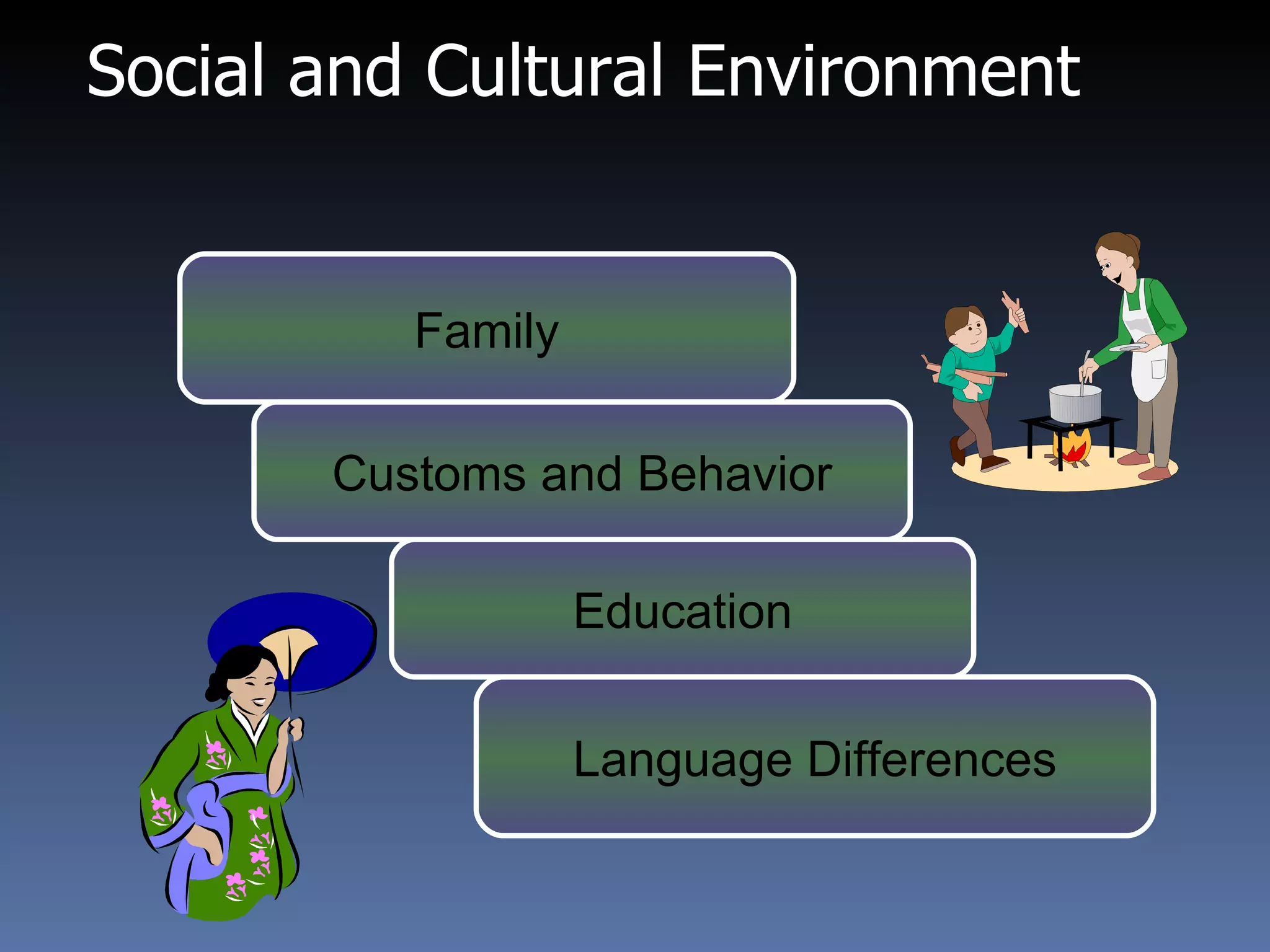
Social and Cultural Environment Family Customs and Behavior Education Language Differences
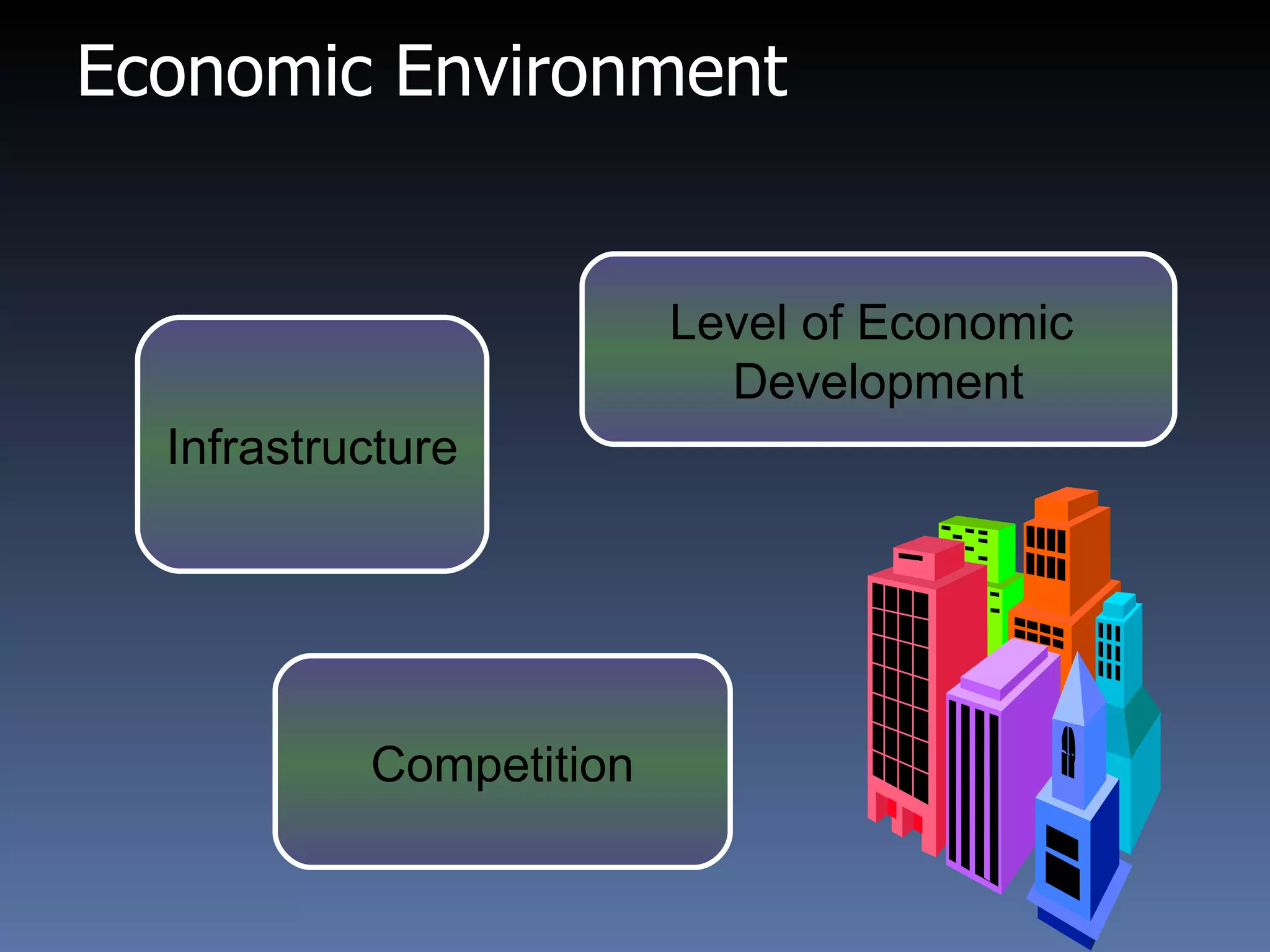
Economic Environment Infrastructure Competition Level of Economic  Development
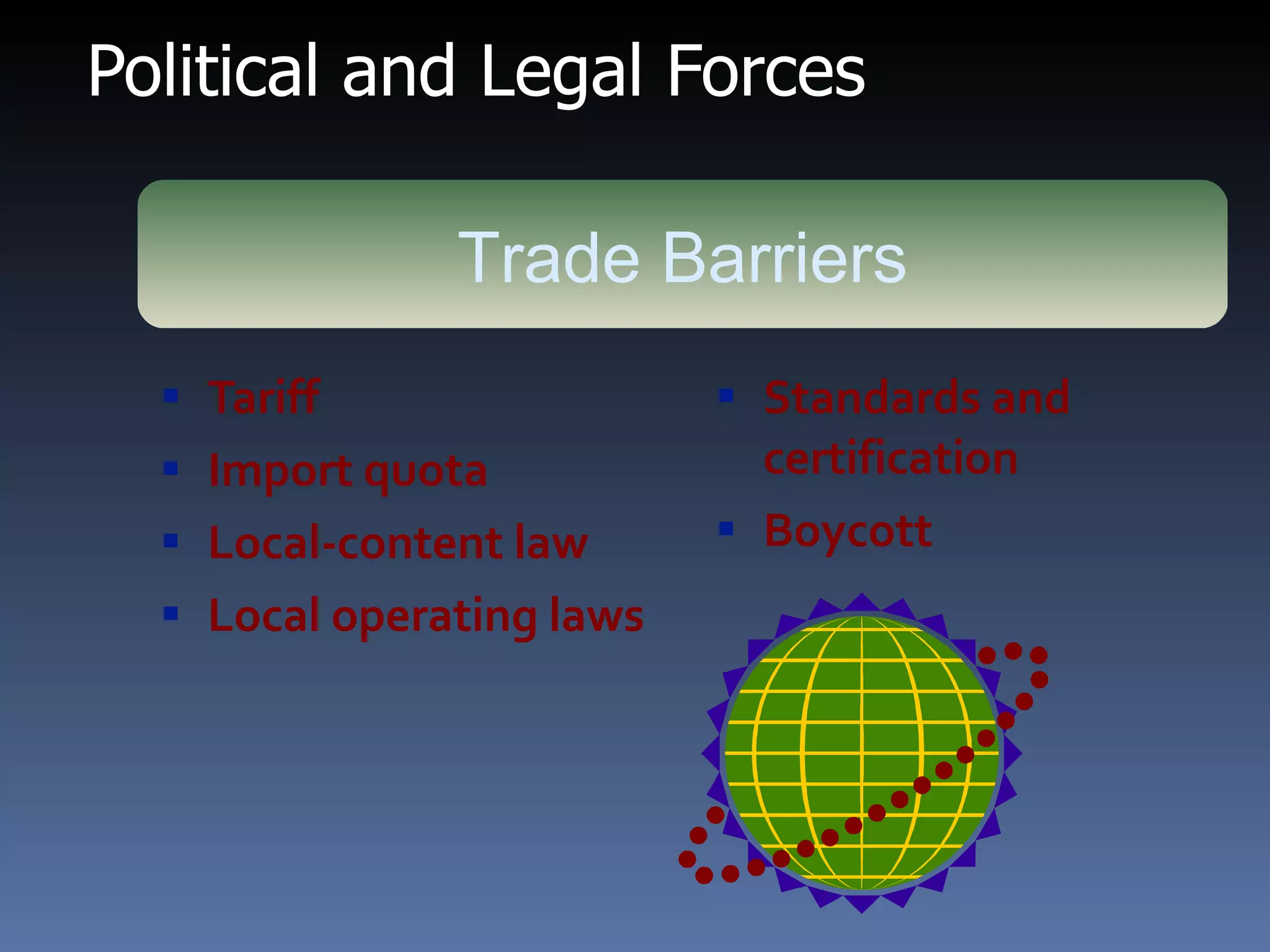
Political and Legal Forces Tariff Import quota Local-content law Local operating laws Standards and certification Boycott Trade Barriers
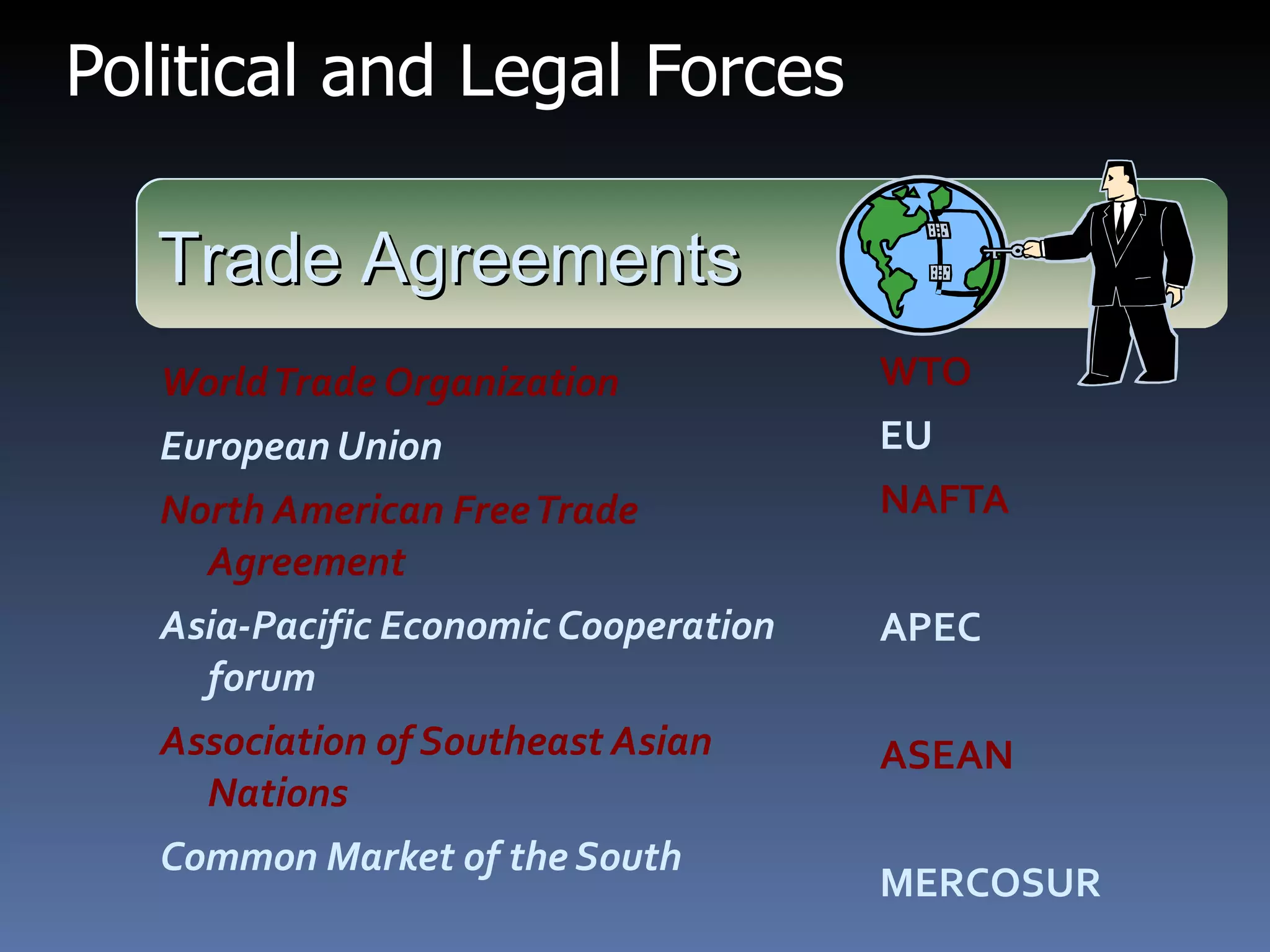
Political and Legal Forces World Trade Organization European Union North American Free Trade Agreement Asia-Pacific Economic Cooperation forum Association of Southeast Asian Nations Common Market of the South WTO EU NAFTA APEC ASEAN MERCOSUR Trade Agreements
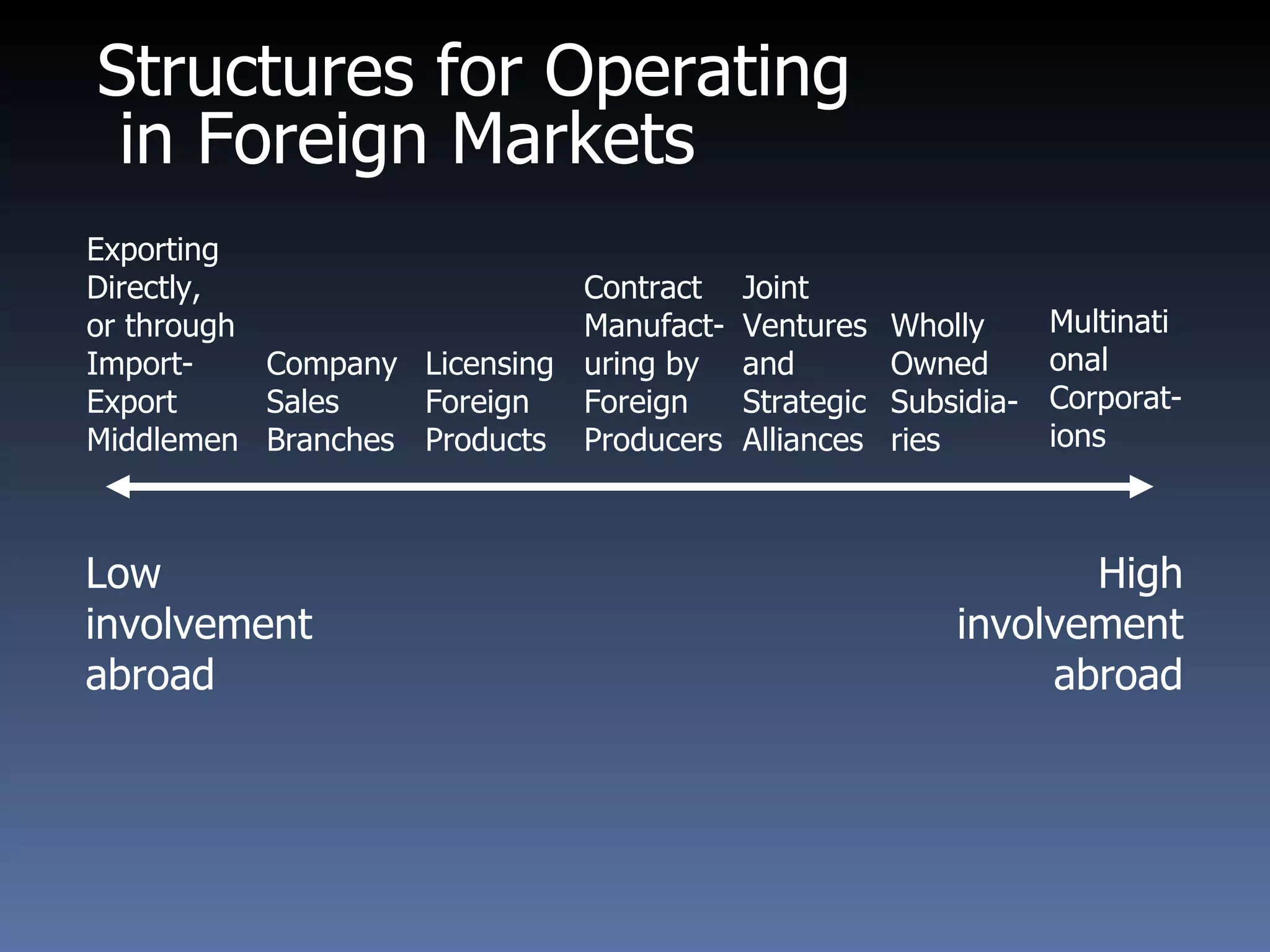
Structures for Operating  in Foreign Markets Exporting Directly, or through Import-Export Middlemen Company Sales Branches Licensing Foreign Products Contract Manufact-uring by Foreign Producers Joint Ventures and Strategic Alliances Wholly Owned Subsidia-ries Multinational Corporat-ions Low involvement abroad High involvement abroad
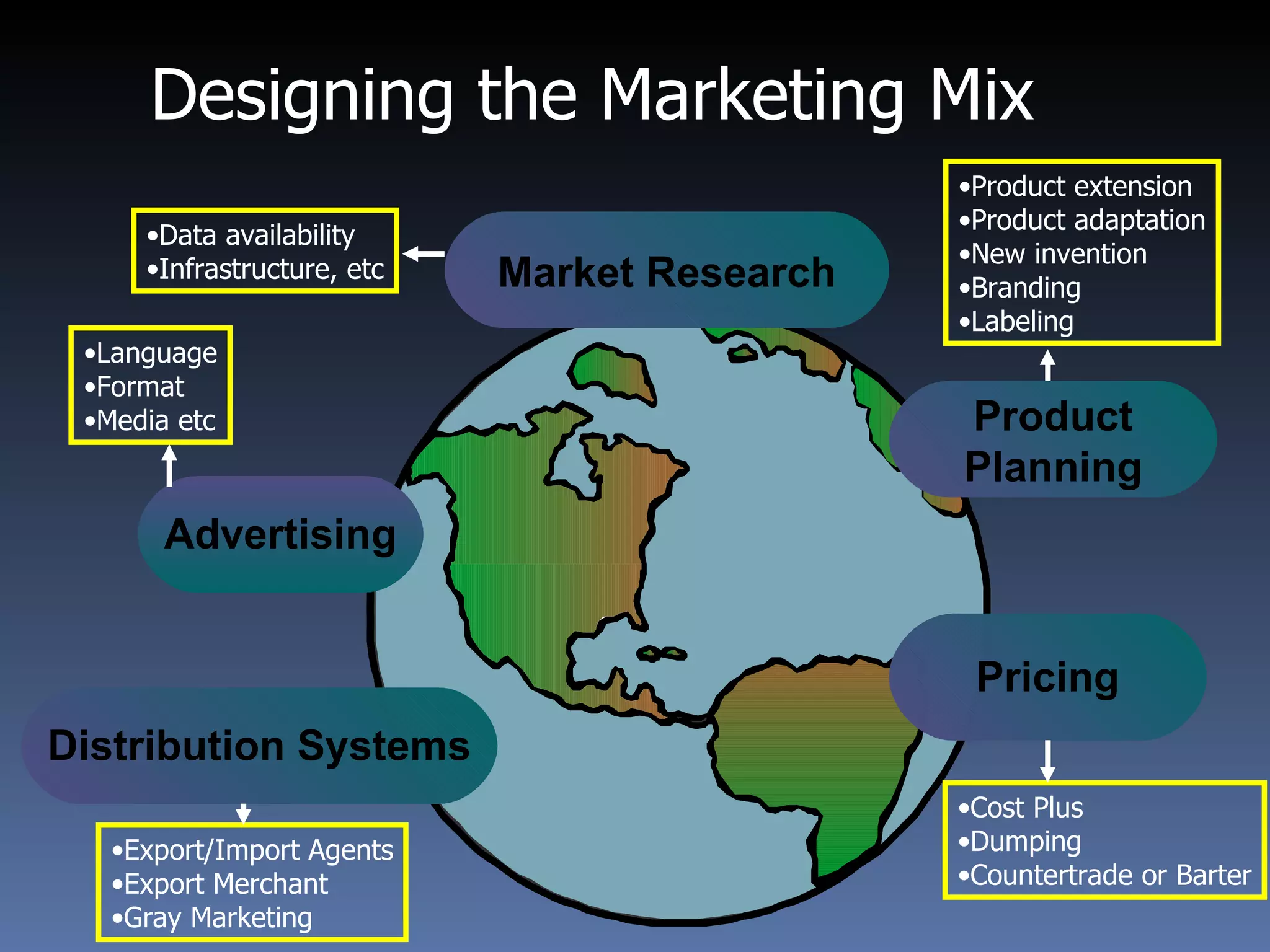
Designing the Marketing Mix Market Research Data availability Infrastructure, etc Product Planning Product extension Product adaptation New invention Branding Labeling Pricing Cost Plus Dumping Countertrade or Barter Distribution Systems Export/Import Agents Export Merchant Gray Marketing Advertising Language Format Media etc

Imm nature & scope

  • 1.
  • 2.
    Module 1 :Nature and Scope of Marketing 3. Global Markets and Marketing 2. The Dynamic Marketing Environment 1. The Field of Marketing
  • 3.
    1. The Fieldof Marketing
  • 4.
    Who makes what? List B. Companies ITC, Godrej, BHEL, Videocon, Voltas, HP, Britannia, L&T, Atlas, Bata, HUL, Wipro, Microsoft, P&G List A. Products Air Conditioners Hamam soap Washing machines Power generators Sunsilk shampoo Lux Soap Safety Locks Dove Refrigerators Laptops 11. Biscuits 12. Cement 13. Office furniture 14. Shoes 15. Bicycles 16. Computer Software 17. Computer Hardware 18. Cooking Oil 19. Tooth Paste 20. Detergent Powder
  • 5.
    What does aMarketer Do?
  • 6.
    What does aMarketer Do? Why Bike ( Analyze Needs ) Bike Type (Product Plan) Which people? (Segment) What Quantity? (Demand Forecasting) Where to Sell? (Distribution) What to Charge? (Price) What & how to inform? (Promotion) Who all will compete (Analyze Competitors) What if problem? (Warranty)
  • 7.
    Exchange – atthe heart of Marketing Between Organizations and/or Individuals Marketers and Markets Exchange – the essence of Marketing Tangible/ Intangible goods, Services, Ideas, places, people
  • 8.
    Conditions of ExchangeVoluntary participation 2 or More parties Each has something of value for the other party Parties must communicate
  • 9.
    Marketing Defined Businessactivities designed to Plan Price Promote Place (Distribute) Want-satisfying products to target markets to achieve organizational objectives
  • 10.
    Stages of theEvolution of Marketing Promote through Sales and Advertising Sales-Orientation Stage Increase Supply Produce Efficiently Product-Orientation Stage Market-Orientation Stage Long-Run Customer Satisfaction
  • 11.
    How Should aBusiness Be Defined? Kodak We make Cameras and Films We help Preserve Beautiful Memories. HUL We make and sell Soaps & Detergents ?? IBM We make Computer ?? SSIM We provide MBA Degree ?? Company Product oriented answer Market oriented answer
  • 12.
    Marketing Concept Customer Satisfaction & Organizational Success A business philosophy that makes Customer Satisfaction as focal point of all the activities of the business Customer Orientation & Organization's Performance Objectives Coordinated Marketing Activities
  • 13.
    Implementing the MarketingConcept (Customer Orientation) Mass Customization Produce products with variety and uniqueness Relationships Customer Relationship Management (CRM)
  • 14.
    Implementing the MarketingConcept (Coordinated Marketing Activities) Value Creation Benefits vs. Costs Quality Total Quality Management
  • 15.
    Implementing the MarketingConcept (Organizational Objectives) Societal Marketing Concept Fulfill firm’s social responsibility Performance Metrics Return on the marketing investment
  • 16.
    Marketing Program (AMarket) People or Organizations Money to Spend Willingness to Spend Needs to Satisfy Market
  • 17.
    Marketing Program (Market Segments) Segments are subgroups of the market with similarities Wants Product Use Buying Preferences
  • 18.
    Marketing Program (Targetmarket) A market segment at which the firm directs its marketing program Market Segment A Market Segment C Market Segment B TARGET MARKET
  • 19.
    Marketing Program (Position)Strategies and tactics to establish a unique position in the prospect’s mind so the product is viewed in a distinctive and attractive way DISTRIBUTION PROMOTION PRODUCT PRICE TARGET MARKET
  • 20.
    Ethics and MarketingTRUST Builds Business Relationships CODE OF ETHICS CONFLICTS Challenges from conflicting goals E THICS Standards accepted by a society
  • 21.
    Importance of MarketingPersonally Organizationally Domestically Globally
  • 22.
    Creating Utility Formutility Place utility Time utility Information utility Possession utility
  • 23.
    2. TheDynamic Marketing Environment
  • 24.
    Levels of ExternalForces Macro Level Influences that affect all firms Micro Level Influences that affect a particular firm
  • 25.
    External Macroenvironment ForcesCompany’s Marketing Program Technology Political and Legal Forces Social & Cultural Forces Natural Environment Competition Demo- graphics Economic conditions
  • 26.
    Demographics People MakeMarkets Distribution Growth Size Characteristics of Populations
  • 27.
    Key Demographics ofIndia >1 billion Population growing @ 2% Literacy 65% (1951 – 17%) Over 3.5 Million Engineers & Scientists Life Expectancy >62 Years 2nd largest Market (next to China)
  • 28.
    Economic Factors InflationInterest Rates Stage of the Business Cycle People with Money to Spend and Willing to Spend it
  • 29.
    Key Economic Facts(Indian Environment) Significant FDI, Vibrant Capital Market, High FE Reserve Inflation (Moderate – High) Interest Rates (High) Economy Growing @8-9.5%
  • 30.
    Competition Rivals for Customers’ Limited Buying Power Substitute Products Every Company Brand Competition Differential Advantage
  • 31.
    Social and CulturalForces People Make Markets Beliefs Socio-cultural Patterns Changing Quickly Values Lifestyles
  • 32.
    Key socio-cultural factsof India 7 Religions 17 Languages Many Cultures, Tradition bound (Changing fast due to exposure to lifestyle, Media, Globalization) More Health Conscious, Working Harder/Longer, Premium on time Changing role of Women (Housewife -Employed women)
  • 33.
    Political and LegalForces Type of Governance and Direction Governmental Relationship with Industries Monetary and Fiscal Policies Legislation - Social & Related to Marketing
  • 34.
    Key facts ofIndia's Political & Legal Environment Political consensus on Economic Growth Economic Reforms, Moving rapidly to Market economy To operate within legal framework of laws related to Corporate affairs, Consumer protection, Employee protection, MRTP etc
  • 35.
    Key facts ofIndia's Natural Environment Rich natural resources (iron, coal, rare minerals, ocean wealth) Tropical climate favours agriculture and industry Good rainfall, Has strong network of rivers In energy, costs are constantly on rise
  • 36.
    Technology Affects HowMarketing is Carried Out Altering Existing Industries Impacts lifestyles, consumption patterns, economic well-being Starting New Industries Stimulates Markets and Other Industries
  • 37.
    External Microenvironment ofa Company’s Marketing Program Company’s Marketing Program Marketing Interme- diaries The Market Marketing Interme- diaries Suppliers Value Chain
  • 38.
    Internal Environment InternalEnvironment Affecting a Company’s Marketing Activities
  • 39.
    Firm’s Marketing EnvironmentMarktg Intrmdries Market Marktg Intrmdiaries Market Technology Political and Legal Forces Social & Cultural Forces Natural Environment Competition Demo- graphics Economic conditions
  • 40.
    3. GlobalMarkets and Marketing
  • 41.
    Lesson Objectives Thesignificance of marketing to firms and countries The attractiveness of foreign markets The challenges of designing international marketing strategies The alternative organizational structures The international marketing mix issues and concepts
  • 42.
    Reasons for InternationalTrade Access to products Comparative Advantage
  • 43.
    Role of ExportTrade in Selected Countries INSERT TABLE 3.1
  • 44.
    International Trade Balanceof Payments Accounting record of all Transactions between countries Trade Balance Difference between imports and exports
  • 45.
    Factors Affecting InternationalTrade Technology Consumer Preferences Trade Barriers Subsidized Industries Tax Structure Marketing Capability
  • 46.
    Why International Marketing?Potential Demand Market Saturation Customer Expectations
  • 47.
    Strategic Planning for International Marketing Regional Strategy Local Strategy Global Strategy
  • 48.
    Market Demand Numberof people Buying behavior Ability to buy
  • 49.
    Social and CulturalEnvironment Family Customs and Behavior Education Language Differences
  • 50.
    Economic Environment InfrastructureCompetition Level of Economic Development
  • 51.
    Political and LegalForces Tariff Import quota Local-content law Local operating laws Standards and certification Boycott Trade Barriers
  • 52.
    Political and LegalForces World Trade Organization European Union North American Free Trade Agreement Asia-Pacific Economic Cooperation forum Association of Southeast Asian Nations Common Market of the South WTO EU NAFTA APEC ASEAN MERCOSUR Trade Agreements
  • 53.
    Structures for Operating in Foreign Markets Exporting Directly, or through Import-Export Middlemen Company Sales Branches Licensing Foreign Products Contract Manufact-uring by Foreign Producers Joint Ventures and Strategic Alliances Wholly Owned Subsidia-ries Multinational Corporat-ions Low involvement abroad High involvement abroad
  • 54.
    Designing the MarketingMix Market Research Data availability Infrastructure, etc Product Planning Product extension Product adaptation New invention Branding Labeling Pricing Cost Plus Dumping Countertrade or Barter Distribution Systems Export/Import Agents Export Merchant Gray Marketing Advertising Language Format Media etc

Editor's Notes