SERVICES MARKETING Introduction
Levitt – “There are no such things as service industries. There are only service industries whose service components are greater or less than other industries. Everybody is in service.”
Growth of services About 80% of US’s GDP is accounted for by services In India, it is about 60% Matched by a growth in employment The software industry is growing at a CAGR of 28% over the past 5 years
Characteristics of services Intangibility Perishability Inseparability Heterogenity (variability)
Intangibility Marketing implications No patents Display issues Communication issues Pricing
Intangibility Strategies Tangible clues Personal sources Word-of-mouth Post purchase communication
Inseparability Marketing implications Consumer is involved in production No mass production Supply demand match Strategies Selection and training of contact person Multi-site location
Heterogeneity  Marketing implications Standardisation difficult Quality control difficult Strategies Industrialise  Customise
Perishability Marketing implication No inventorisation Demand management Develop off peak pricing Non-peak promotion & demand creation Develop complementary services Create reservation systems
Perishability Capacity management Use part time employees Lower options or supply base-versions Increase efficiency or multi-tasking Get more participation of consumer Share capacity Expansion options
Consumer evaluation of services Consistency (reliability of performance) Concern (prompt service, etc) Competence (knowledge and skills) Contact (approachability and access) Courtesy (politeness) Communication (keeping customers informed)
Consumer evaluation of services Credibility (trust) Confidentiality (security at ATM) Customer knowledge (effort to understand the customer) Bateson – “Higher degree of perceived control leads to greater satisfaction”
The Service product The ‘core’ service Facilitating services – mandatory? Support services – do not facilitate the consumption of core services Brand
Pricing Pricing strategy can help in handling demand fluctuations Factor in cost of tangible clues Price may be used as a quality indicator Price should be used to ward off competition from....
Customer as competitor During a party, housewife vs catering service During transfer of residence, packer & mover vs family Laundry vs spouse,  Taxi vs walk it down Beauty care services vs do-it-yourself
Place Brokers Agents Franchisee
Promotion Consumers of services are less likely to buy without prior information, than those of goods  Importance of personal relationship Competency, consistency are main messages Post purchase communication significant
People  Internal marketing Employees are the first market Focus on developing customer-conscious personnel Investing in people quality is investing in product quality
People Compete as hard for employees as for customers Give the employees a vision to believe in Develop skill and knowledge Stress team play Give freedom and structure Measure and reward performance Listen to employees
Physical evidence Customer makes purchase decision on perceptions based on tangible clues Essential evidences (cannot be possessed) Peripheral evidence (can be possessed) Physical facilities are important in facilitating the delivery of services
Service gaps Marketing information gap  - Not knowing what the customer expects Standards gap  - Inability to set the right type of standards Service performance gap  - Not delivering to service standards Communication gap  - Mismatch between promise and performance
Measuring service delivery Reliability Tangibles Responsiveness Assurance Empathy
SERVICES MARKETING Re-introduction
SM Paradigm Paradigm – fundamental set of assumptions Shapes formulation of theory, focus data gathering and influences research gathering The validity of underlying assumptions should be open to challenge
IHIP Kerin – intangibility, inconsistency, inseparability and inventory Kotler Pride & Ferrell add customer relationship and contact
Differences between services and goods Customers do not obtain ownership of goods Service products cannot be inventoried Intangible elements dominate value creation Other people may form part of the product There is greater variability in operational inputs and outputs
Differences between services and goods Many services are difficult for customers to evaluate The ‘time’ factor assumes great importance Distribution channels take different forms
Origin of the terms Intangible – Adam Smith differentiated between output of ‘productive’ and ‘unproductive’ labour Also, material and immaterial production were widely used terms
Intangibility Physical intangibility – it cannot be touched Mental intangibility – it cannot be visualised before experiencing it
Servicescape: physical aspects Sensory package  to elicit emotional responses A  facilitator  to shape consumer behaviour A  differentiator  to distinguish from competitors
Mental intangibility Mental intangibility is not correlated with physical intangibility Search qualities – attributes that can be determined before purchase Experience qualities – attributes determined after consumption Credence – hard to evaluate even after consumption
Heterogeneity Performance variation between workers Also from one customer to another External conditions Customer perceptions of variability ‘ industrialisation’, use of technology and procedures, leads to lesser variability Standardisation, modularisation and customisation
Inseparability  Consumer as prosumer or coproducer Separable services – r & m, laundry To customer’s possessions
Perishability Inventory carrying costs are disguised as idle capacity Perishable capacity is not the same as perishable output Surgery  CDs, tapes and other storages
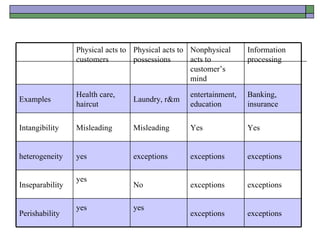
Banking, insurance entertainment, education Laundry, r&m Health care, haircut Examples exceptions exceptions yes yes Perishability exceptions exceptions No yes Inseparability exceptions exceptions exceptions yes heterogeneity Yes Yes Misleading Misleading Intangibility Information processing Nonphysical acts to customer’s mind Physical acts to possessions Physical acts to customers
So.... Service Marketing is what marketing is all about. Make it the core of marketing thought Service marketing ceases to exist as an independent sub-field
Focus on independent subfields High-contact services delivering tangible actions to the person of the customer Low-contact highly intangible services like e-services Separable services Information-based services that can be stored
New paradigm: Non-Ownership Rented goods Space rental Labour and expertise rentals Physical facility usage Network access
Implications Manufactured goods can form the basis of services Services often involve selling slices of larger physical entities Labour and expertise is a renewable resource Time plays a central role New approach to pricing Resource sharing (Zipcar, graminphone)

Services marketing

  • 1.
  • 2.
    Levitt – “Thereare no such things as service industries. There are only service industries whose service components are greater or less than other industries. Everybody is in service.”
  • 3.
    Growth of servicesAbout 80% of US’s GDP is accounted for by services In India, it is about 60% Matched by a growth in employment The software industry is growing at a CAGR of 28% over the past 5 years
  • 4.
    Characteristics of servicesIntangibility Perishability Inseparability Heterogenity (variability)
  • 5.
    Intangibility Marketing implicationsNo patents Display issues Communication issues Pricing
  • 6.
    Intangibility Strategies Tangibleclues Personal sources Word-of-mouth Post purchase communication
  • 7.
    Inseparability Marketing implicationsConsumer is involved in production No mass production Supply demand match Strategies Selection and training of contact person Multi-site location
  • 8.
    Heterogeneity Marketingimplications Standardisation difficult Quality control difficult Strategies Industrialise Customise
  • 9.
    Perishability Marketing implicationNo inventorisation Demand management Develop off peak pricing Non-peak promotion & demand creation Develop complementary services Create reservation systems
  • 10.
    Perishability Capacity managementUse part time employees Lower options or supply base-versions Increase efficiency or multi-tasking Get more participation of consumer Share capacity Expansion options
  • 11.
    Consumer evaluation ofservices Consistency (reliability of performance) Concern (prompt service, etc) Competence (knowledge and skills) Contact (approachability and access) Courtesy (politeness) Communication (keeping customers informed)
  • 12.
    Consumer evaluation ofservices Credibility (trust) Confidentiality (security at ATM) Customer knowledge (effort to understand the customer) Bateson – “Higher degree of perceived control leads to greater satisfaction”
  • 13.
    The Service productThe ‘core’ service Facilitating services – mandatory? Support services – do not facilitate the consumption of core services Brand
  • 14.
    Pricing Pricing strategycan help in handling demand fluctuations Factor in cost of tangible clues Price may be used as a quality indicator Price should be used to ward off competition from....
  • 15.
    Customer as competitorDuring a party, housewife vs catering service During transfer of residence, packer & mover vs family Laundry vs spouse, Taxi vs walk it down Beauty care services vs do-it-yourself
  • 16.
  • 17.
    Promotion Consumers ofservices are less likely to buy without prior information, than those of goods Importance of personal relationship Competency, consistency are main messages Post purchase communication significant
  • 18.
    People Internalmarketing Employees are the first market Focus on developing customer-conscious personnel Investing in people quality is investing in product quality
  • 19.
    People Compete ashard for employees as for customers Give the employees a vision to believe in Develop skill and knowledge Stress team play Give freedom and structure Measure and reward performance Listen to employees
  • 20.
    Physical evidence Customermakes purchase decision on perceptions based on tangible clues Essential evidences (cannot be possessed) Peripheral evidence (can be possessed) Physical facilities are important in facilitating the delivery of services
  • 21.
    Service gaps Marketinginformation gap - Not knowing what the customer expects Standards gap - Inability to set the right type of standards Service performance gap - Not delivering to service standards Communication gap - Mismatch between promise and performance
  • 22.
    Measuring service deliveryReliability Tangibles Responsiveness Assurance Empathy
  • 23.
  • 24.
    SM Paradigm Paradigm– fundamental set of assumptions Shapes formulation of theory, focus data gathering and influences research gathering The validity of underlying assumptions should be open to challenge
  • 25.
    IHIP Kerin –intangibility, inconsistency, inseparability and inventory Kotler Pride & Ferrell add customer relationship and contact
  • 26.
    Differences between servicesand goods Customers do not obtain ownership of goods Service products cannot be inventoried Intangible elements dominate value creation Other people may form part of the product There is greater variability in operational inputs and outputs
  • 27.
    Differences between servicesand goods Many services are difficult for customers to evaluate The ‘time’ factor assumes great importance Distribution channels take different forms
  • 28.
    Origin of theterms Intangible – Adam Smith differentiated between output of ‘productive’ and ‘unproductive’ labour Also, material and immaterial production were widely used terms
  • 29.
    Intangibility Physical intangibility– it cannot be touched Mental intangibility – it cannot be visualised before experiencing it
  • 30.
    Servicescape: physical aspectsSensory package to elicit emotional responses A facilitator to shape consumer behaviour A differentiator to distinguish from competitors
  • 31.
    Mental intangibility Mentalintangibility is not correlated with physical intangibility Search qualities – attributes that can be determined before purchase Experience qualities – attributes determined after consumption Credence – hard to evaluate even after consumption
  • 32.
    Heterogeneity Performance variationbetween workers Also from one customer to another External conditions Customer perceptions of variability ‘ industrialisation’, use of technology and procedures, leads to lesser variability Standardisation, modularisation and customisation
  • 33.
    Inseparability Consumeras prosumer or coproducer Separable services – r & m, laundry To customer’s possessions
  • 34.
    Perishability Inventory carryingcosts are disguised as idle capacity Perishable capacity is not the same as perishable output Surgery CDs, tapes and other storages
  • 35.
    Banking, insurance entertainment,education Laundry, r&m Health care, haircut Examples exceptions exceptions yes yes Perishability exceptions exceptions No yes Inseparability exceptions exceptions exceptions yes heterogeneity Yes Yes Misleading Misleading Intangibility Information processing Nonphysical acts to customer’s mind Physical acts to possessions Physical acts to customers
  • 36.
    So.... Service Marketingis what marketing is all about. Make it the core of marketing thought Service marketing ceases to exist as an independent sub-field
  • 37.
    Focus on independentsubfields High-contact services delivering tangible actions to the person of the customer Low-contact highly intangible services like e-services Separable services Information-based services that can be stored
  • 38.
    New paradigm: Non-OwnershipRented goods Space rental Labour and expertise rentals Physical facility usage Network access
  • 39.
    Implications Manufactured goodscan form the basis of services Services often involve selling slices of larger physical entities Labour and expertise is a renewable resource Time plays a central role New approach to pricing Resource sharing (Zipcar, graminphone)