Morphology of fungi
Introduction
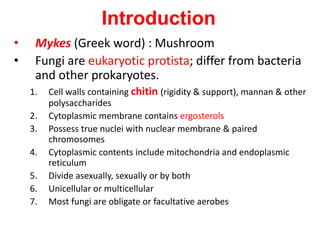
• Mykes (Greek word) : Mushroom
• Fungi are eukaryotic protista; differ from bacteria
and other prokaryotes.
1. Cell walls containing chitin (rigidity & support), mannan & other
polysaccharides
2. Cytoplasmic membrane contains ergosterols
3. Possess true nuclei with nuclear membrane & paired
chromosomes
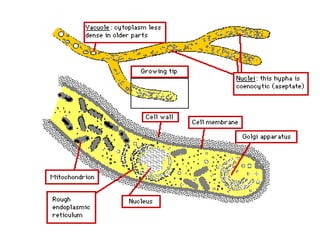
4. Cytoplasmic contents include mitochondria and endoplasmic
reticulum
5. Divide asexually, sexually or by both
6. Unicellular or multicellular
7. Most fungi are obligate or facultative aerobes
Difference from Bacteria
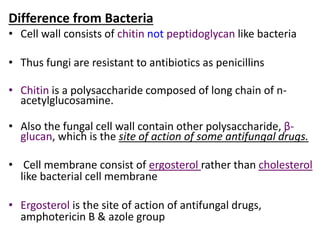
• Cell wall consists of chitin not peptidoglycan like bacteria
• Thus fungi are resistant to antibiotics as penicillins
• Chitin is a polysaccharide composed of long chain of n-
acetylglucosamine.
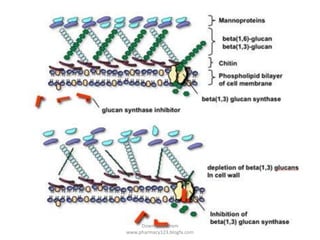
• Also the fungal cell wall contain other polysaccharide, β-
glucan, which is the site of action of some antifungal drugs.
• Cell membrane consist of ergosterol rather than cholesterol
like bacterial cell membrane
• Ergosterol is the site of action of antifungal drugs,
amphotericin B & azole group
Downloded from
www.pharmacy123.blogfa.com
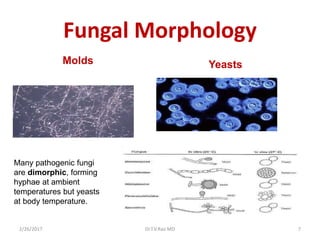
Fungal Morphology
Molds Yeasts
Many pathogenic fungi
are dimorphic, forming
hyphae at ambient
temperatures but yeasts
at body temperature.
2/26/2017 Dr.T.V.Rao MD 7
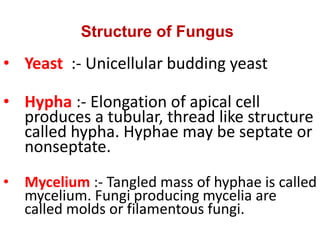
Structure of Fungus
• Yeast :- Unicellular budding yeast
• Hypha :- Elongation of apical cell
produces a tubular, thread like structure
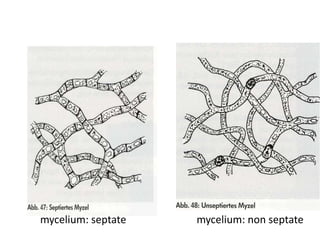
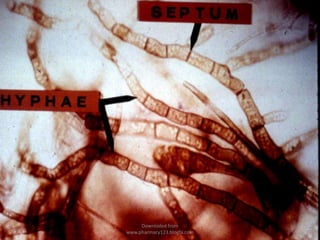
called hypha. Hyphae may be septate or
nonseptate.
• Mycelium :- Tangled mass of hyphae is called
mycelium. Fungi producing mycelia are
called molds or filamentous fungi.
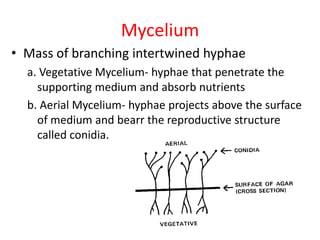
Mycelium
• Mass of branching intertwined hyphae
a. Vegetative Mycelium- hyphae that penetrate the
supporting medium and absorb nutrients
b. Aerial Mycelium- hyphae projects above the surface
of medium and bearr the reproductive structure
called conidia.
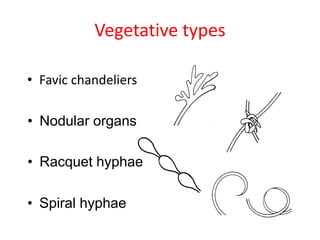
Vegetative types
• Favic chandeliers
• Nodular organs
• Racquet hyphae
• Spiral hyphae
Classification of fungi
1.Morphological classification
2.Systematic classification
1. Yeasts
2. Yeast-like fungi
3. Filamentous fungi (molds)
4. Dimorphic fungi
Morphological classification
Yeasts
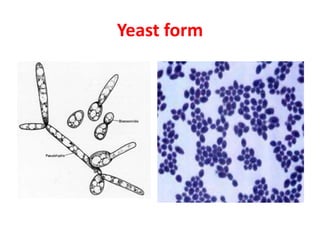
 These occur in the form of round or oval bodies
which reproduce by an asexual process called
budding in which the cell develops a protuberance
which enlarges and eventually separates from the
parent cell.
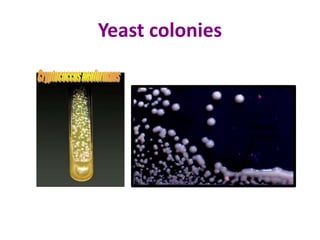
 Yeasts colonies resemble bacterial colonies in
appearance and in consistency
 Examples are- Saccharomyces cerevisiae,
Cryptococcus neoformans
Yeast form
Yeast colonies
Mucoid
colonies
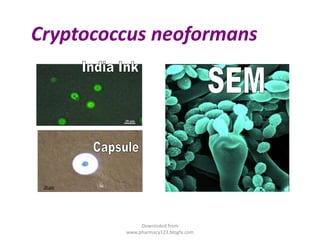
Cryptococcus neoformans
Downloded from
www.pharmacy123.blogfa.com
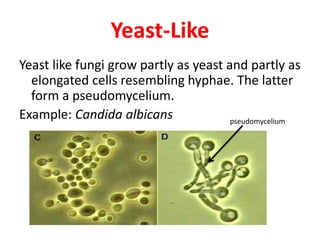
Yeast-Like
Yeast like fungi grow partly as yeast and partly as
elongated cells resembling hyphae. The latter
form a pseudomycelium.
Example: Candida albicans pseudomycelium
Molds or Filamentous Fungi
 The basic morphological elements of filamentous
fungi are long branching filaments or hyphae, which
intertwine to produce a mass of filaments or mycelium
 Colonies are strongly adherent to the medium and
unlike most bacterial colonies cannot be emulsified in
water
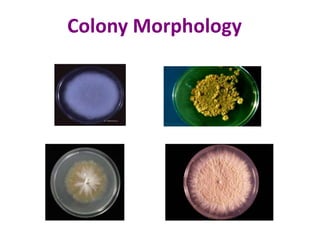
 The surface of these colonies may be velvety, powdery,
or may show a cottony aerial mycelium.
 Reproduce by the formation of different types of
spores
 Example: Dermatophytes, Aspergillus, Penicillium,
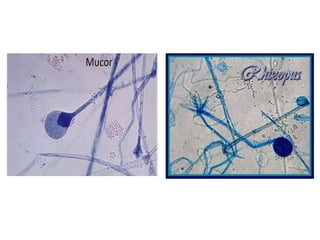
Mucor, Rhizopus
mycelium: septate mycelium: non septate
Downloded from
www.pharmacy123.blogfa.com
Colony Morphology
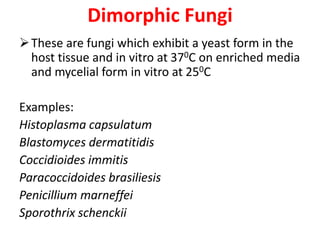
Dimorphic Fungi
These are fungi which exhibit a yeast form in the
host tissue and in vitro at 370C on enriched media
and mycelial form in vitro at 250C
Examples:
Histoplasma capsulatum
Blastomyces dermatitidis
Coccidioides immitis
Paracoccidoides brasiliesis
Penicillium marneffei
Sporothrix schenckii
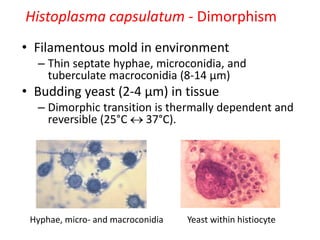
Histoplasma capsulatum - Dimorphism
• Filamentous mold in environment
– Thin septate hyphae, microconidia, and
tuberculate macroconidia (8-14 µm)
• Budding yeast (2-4 µm) in tissue
– Dimorphic transition is thermally dependent and
reversible (25°C  37°C).
Hyphae, micro- and macroconidia Yeast within histiocyte
Systematic classification
• Based on sexual spores formation:
4 classes
1. Zygomycetes
2. Ascomycetes reproduce sexually
3. Basidiomycetes
4. Deuteromycetes (fungi imperfectii)
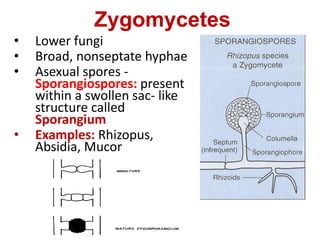
Zygomycetes
• Lower fungi
• Broad, nonseptate hyphae
• Asexual spores -
Sporangiospores: present
within a swollen sac- like
structure called
Sporangium
• Examples: Rhizopus,
Absidia, Mucor
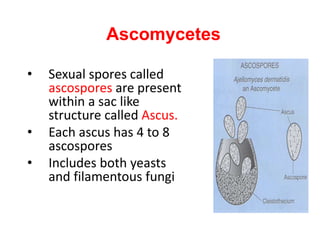
Ascomycetes
• Sexual spores called
ascospores are present
within a sac like
structure called Ascus.
• Each ascus has 4 to 8
ascospores
• Includes both yeasts
and filamentous fungi
Ascomycetes
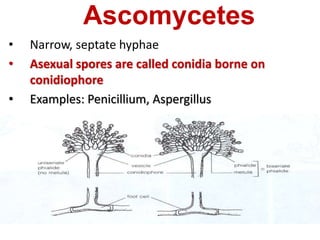
• Narrow, septate hyphae
• Asexual spores are called conidia borne on
conidiophore
• Examples: Penicillium, Aspergillus
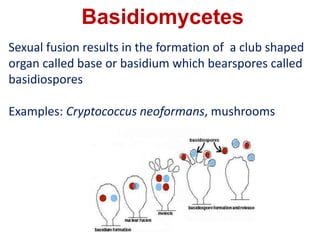
Basidiomycetes
Sexual fusion results in the formation of a club shaped
organ called base or basidium which bearspores called
basidiospores
Examples: Cryptococcus neoformans, mushrooms
Deuteromycetes
or Fungi imperfectii
• Group of fungi whose sexual phases are not
identified
• Grow as molds as well as yeasts
• Most fungi of medical importance belong
to this class
• Examples: Coccidioides immitis,
Paracoccidioides brasiliensis, Candida
albicans
Reproduction and sporulation
Types of fungal spores
1.Sexual spores
2.Asexual spores
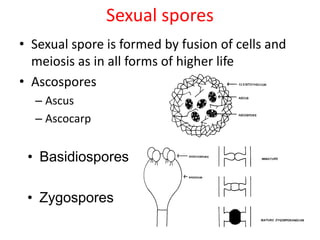
Sexual spores
• Sexual spore is formed by fusion of cells and
meiosis as in all forms of higher life
• Ascospores
– Ascus
– Ascocarp
• Basidiospores
• Zygospores
Asexual spores
 These spores are produced by mitosis
1. Vegetative spores
2. Aerial spores
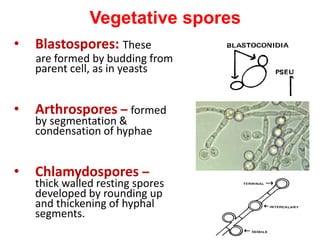
Vegetative spores
• Blastospores: These
are formed by budding from
parent cell, as in yeasts
• Arthrospores – formed
by segmentation &
condensation of hyphae
• Chlamydospores –
thick walled resting spores
developed by rounding up
and thickening of hyphal
segments.
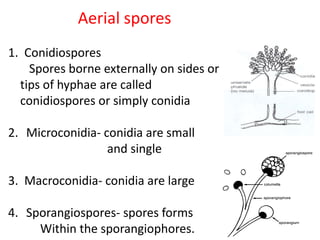
Aerial spores
1. Conidiospores
Spores borne externally on sides or
tips of hyphae are called
conidiospores or simply conidia
2. Microconidia- conidia are small
and single
3. Macroconidia- conidia are large
4. Sporangiospores- spores forms
Within the sporangiophores.
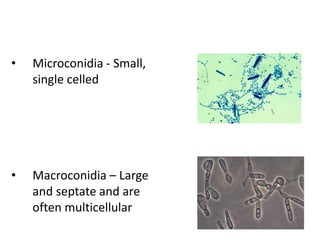
• Microconidia - Small,
single celled
• Macroconidia – Large
and septate and are
often multicellular
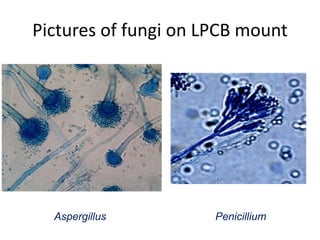
Pictures of fungi on LPCB mount
Aspergillus Penicillium
Morphologyoffungi 170226153026

Morphologyoffungi 170226153026

  • 1.
  • 2.
    Introduction • Mykes (Greekword) : Mushroom • Fungi are eukaryotic protista; differ from bacteria and other prokaryotes. 1. Cell walls containing chitin (rigidity & support), mannan & other polysaccharides 2. Cytoplasmic membrane contains ergosterols 3. Possess true nuclei with nuclear membrane & paired chromosomes 4. Cytoplasmic contents include mitochondria and endoplasmic reticulum 5. Divide asexually, sexually or by both 6. Unicellular or multicellular 7. Most fungi are obligate or facultative aerobes
  • 4.
    Difference from Bacteria •Cell wall consists of chitin not peptidoglycan like bacteria • Thus fungi are resistant to antibiotics as penicillins • Chitin is a polysaccharide composed of long chain of n- acetylglucosamine. • Also the fungal cell wall contain other polysaccharide, β- glucan, which is the site of action of some antifungal drugs. • Cell membrane consist of ergosterol rather than cholesterol like bacterial cell membrane • Ergosterol is the site of action of antifungal drugs, amphotericin B & azole group
  • 5.
  • 7.
    Fungal Morphology Molds Yeasts Manypathogenic fungi are dimorphic, forming hyphae at ambient temperatures but yeasts at body temperature. 2/26/2017 Dr.T.V.Rao MD 7
  • 8.
    Structure of Fungus •Yeast :- Unicellular budding yeast • Hypha :- Elongation of apical cell produces a tubular, thread like structure called hypha. Hyphae may be septate or nonseptate. • Mycelium :- Tangled mass of hyphae is called mycelium. Fungi producing mycelia are called molds or filamentous fungi.
  • 9.
    Mycelium • Mass ofbranching intertwined hyphae a. Vegetative Mycelium- hyphae that penetrate the supporting medium and absorb nutrients b. Aerial Mycelium- hyphae projects above the surface of medium and bearr the reproductive structure called conidia.
  • 10.
    Vegetative types • Favicchandeliers • Nodular organs • Racquet hyphae • Spiral hyphae
  • 11.
    Classification of fungi 1.Morphologicalclassification 2.Systematic classification
  • 12.
    1. Yeasts 2. Yeast-likefungi 3. Filamentous fungi (molds) 4. Dimorphic fungi Morphological classification
  • 13.
    Yeasts  These occurin the form of round or oval bodies which reproduce by an asexual process called budding in which the cell develops a protuberance which enlarges and eventually separates from the parent cell.  Yeasts colonies resemble bacterial colonies in appearance and in consistency  Examples are- Saccharomyces cerevisiae, Cryptococcus neoformans
  • 14.
  • 15.
  • 16.
  • 17.
    Yeast-Like Yeast like fungigrow partly as yeast and partly as elongated cells resembling hyphae. The latter form a pseudomycelium. Example: Candida albicans pseudomycelium
  • 18.
    Molds or FilamentousFungi  The basic morphological elements of filamentous fungi are long branching filaments or hyphae, which intertwine to produce a mass of filaments or mycelium  Colonies are strongly adherent to the medium and unlike most bacterial colonies cannot be emulsified in water  The surface of these colonies may be velvety, powdery, or may show a cottony aerial mycelium.  Reproduce by the formation of different types of spores  Example: Dermatophytes, Aspergillus, Penicillium, Mucor, Rhizopus
  • 19.
  • 20.
  • 21.
  • 22.
    Dimorphic Fungi These arefungi which exhibit a yeast form in the host tissue and in vitro at 370C on enriched media and mycelial form in vitro at 250C Examples: Histoplasma capsulatum Blastomyces dermatitidis Coccidioides immitis Paracoccidoides brasiliesis Penicillium marneffei Sporothrix schenckii
  • 23.
    Histoplasma capsulatum -Dimorphism • Filamentous mold in environment – Thin septate hyphae, microconidia, and tuberculate macroconidia (8-14 µm) • Budding yeast (2-4 µm) in tissue – Dimorphic transition is thermally dependent and reversible (25°C  37°C). Hyphae, micro- and macroconidia Yeast within histiocyte
  • 24.
    Systematic classification • Basedon sexual spores formation: 4 classes 1. Zygomycetes 2. Ascomycetes reproduce sexually 3. Basidiomycetes 4. Deuteromycetes (fungi imperfectii)
  • 25.
    Zygomycetes • Lower fungi •Broad, nonseptate hyphae • Asexual spores - Sporangiospores: present within a swollen sac- like structure called Sporangium • Examples: Rhizopus, Absidia, Mucor
  • 26.
    Ascomycetes • Sexual sporescalled ascospores are present within a sac like structure called Ascus. • Each ascus has 4 to 8 ascospores • Includes both yeasts and filamentous fungi
  • 27.
    Ascomycetes • Narrow, septatehyphae • Asexual spores are called conidia borne on conidiophore • Examples: Penicillium, Aspergillus
  • 28.
    Basidiomycetes Sexual fusion resultsin the formation of a club shaped organ called base or basidium which bearspores called basidiospores Examples: Cryptococcus neoformans, mushrooms
  • 29.
    Deuteromycetes or Fungi imperfectii •Group of fungi whose sexual phases are not identified • Grow as molds as well as yeasts • Most fungi of medical importance belong to this class • Examples: Coccidioides immitis, Paracoccidioides brasiliensis, Candida albicans
  • 30.
    Reproduction and sporulation Typesof fungal spores 1.Sexual spores 2.Asexual spores
  • 31.
    Sexual spores • Sexualspore is formed by fusion of cells and meiosis as in all forms of higher life • Ascospores – Ascus – Ascocarp • Basidiospores • Zygospores
  • 32.
    Asexual spores  Thesespores are produced by mitosis 1. Vegetative spores 2. Aerial spores
  • 33.
    Vegetative spores • Blastospores:These are formed by budding from parent cell, as in yeasts • Arthrospores – formed by segmentation & condensation of hyphae • Chlamydospores – thick walled resting spores developed by rounding up and thickening of hyphal segments.
  • 34.
    Aerial spores 1. Conidiospores Sporesborne externally on sides or tips of hyphae are called conidiospores or simply conidia 2. Microconidia- conidia are small and single 3. Macroconidia- conidia are large 4. Sporangiospores- spores forms Within the sporangiophores.
  • 35.
    • Microconidia -Small, single celled • Macroconidia – Large and septate and are often multicellular
  • 36.
    Pictures of fungion LPCB mount Aspergillus Penicillium