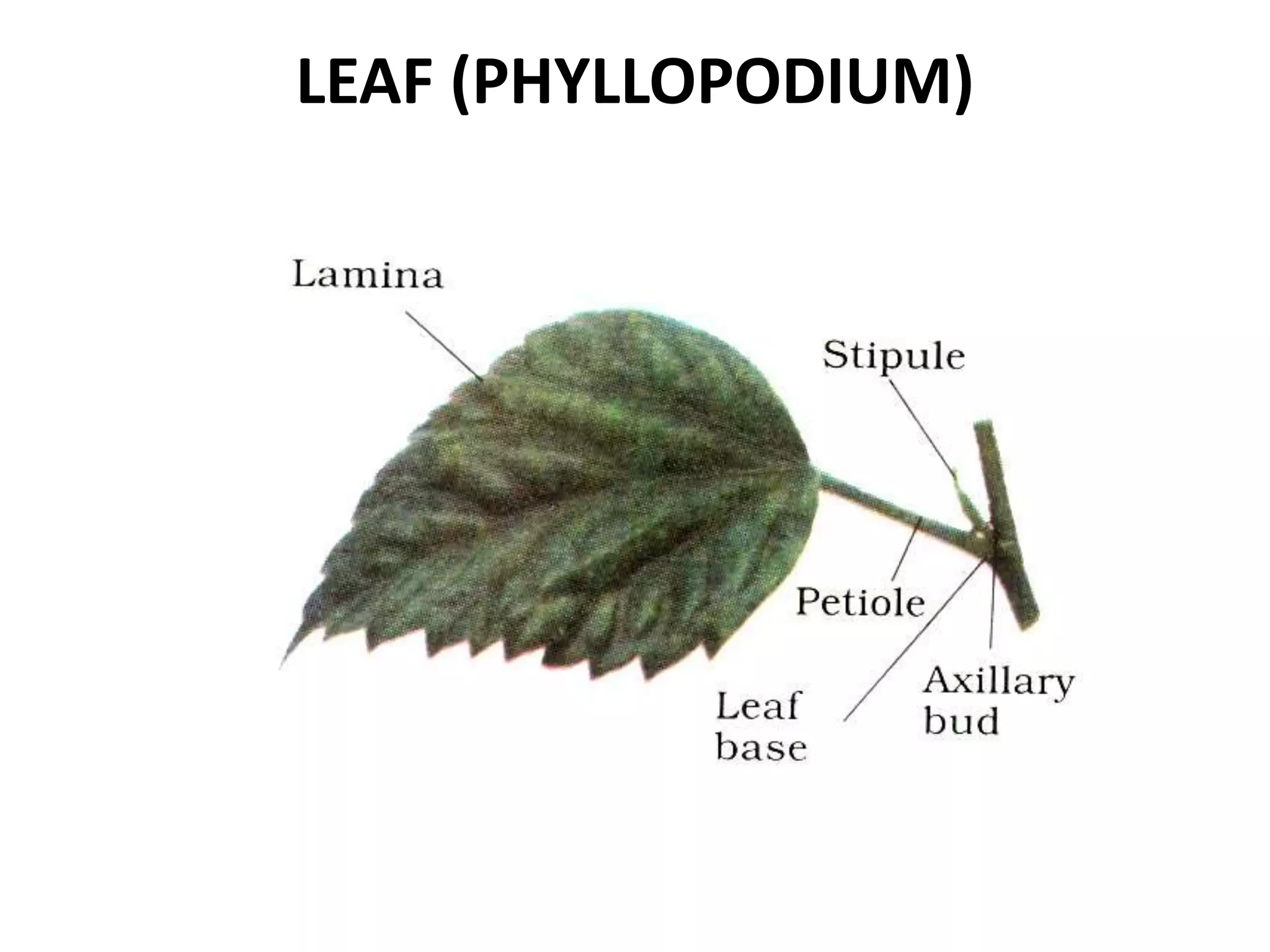
LEAF (PHYLLOPODIUM)
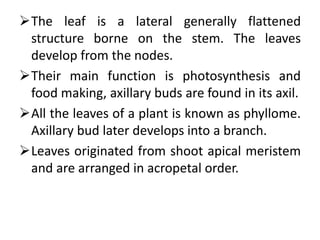
The leaf is a lateral generally flattened
structure borne on the stem. The leaves
develop from the nodes.
Their main function is photosynthesis and
food making, axillary buds are found in its axil.
All the leaves of a plant is known as phyllome.
Axillary bud later develops into a branch.
Leaves originated from shoot apical meristem
and are arranged in acropetal order.
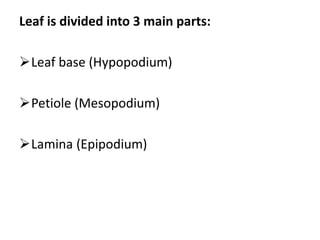
Leaf is divided into 3 main parts:
Leaf base (Hypopodium)
Petiole (Mesopodium)
Lamina (Epipodium)
Leaf base (Hypopodium) –
✧ Leaves are attached to stem by leaf base.
Pulvinus- In some plants, leaf base becomes
swollen. e.g., Cassia, mimosa, bean.
Sheathing leaf base- In some plants, leaf base
expands into sheath, e.g., grasses and
banana.
Pulvinus Sheathing
Semi amplexicaul- When the leaf base partially
encloses the stem. e.g., Prickly poppy,
Calotropis procera (Madar).
Amplexicaul- When the leaf base completely
encloses the stem, e.g., Sonchus, Polygonum.
Semi amplexicaul
Amplexicaul
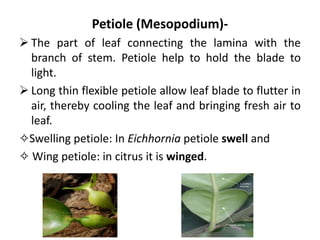
Petiole (Mesopodium)-
 The part of leaf connecting the lamina with the
branch of stem. Petiole help to hold the blade to
light.
 Long thin flexible petiole allow leaf blade to flutter in
air, thereby cooling the leaf and bringing fresh air to
leaf.
✧Swelling petiole: In Eichhornia petiole swell and
✧ Wing petiole: in citrus it is winged.
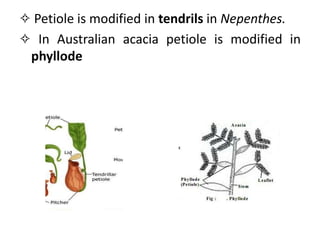
✧ Petiole is modified in tendrils in Nepenthes.
✧ In Australian acacia petiole is modified in
phyllode
Lamina (Epipodium) –
 It is a broad and flattened part of leaf. Its main functions
are photosynthesis and transpiration.
Shape of lamina are:
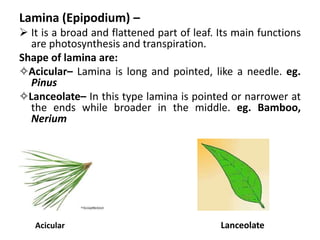
✧Acicular– Lamina is long and pointed, like a needle. eg.
Pinus
✧Lanceolate– In this type lamina is pointed or narrower at
the ends while broader in the middle. eg. Bamboo,
Nerium
Acicular Lanceolate
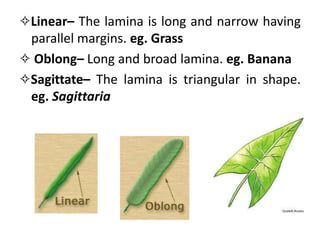
✧Linear– The lamina is long and narrow having
parallel margins. eg. Grass
✧ Oblong– Long and broad lamina. eg. Banana
✧Sagittate– The lamina is triangular in shape.
eg. Sagittaria
✧Ovate– In this type lamina is egg-shaped
having broad base with slight narrow top. eg.
Ocimum, Banyan, China rose.
✧Cordate– Its shape is like a heart. eg. Betel.
✧Spathulate– The lamina is broad spoon
shaped. eg. Calendula
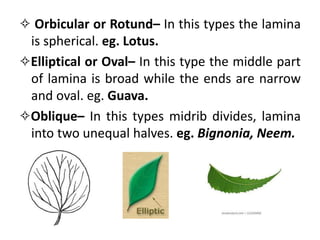
✧ Orbicular or Rotund– In this types the lamina
is spherical. eg. Lotus.
✧Elliptical or Oval– In this type the middle part
of lamina is broad while the ends are narrow
and oval. eg. Guava.
✧Oblique– In this types midrib divides, lamina
into two unequal halves. eg. Bignonia, Neem.
Stipules
 Lateral appendages on either side of leaf base
Stipules are of various types –
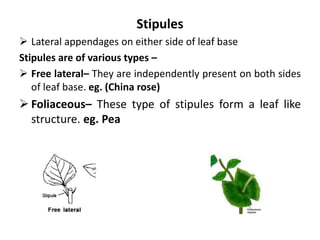
 Free lateral– They are independently present on both sides
of leaf base. eg. (China rose)
 Foliaceous– These type of stipules form a leaf like
structure. eg. Pea
 Interpetioler– When two leaves are meet oppositely
at the node then nearest stipules of each leaf join
with each other. In this way only two stipules of two
leaves are found in place of four. eg. Ixora,
Anthocephalus.
 Intrapetioler– In this type both stipules of a single
leaf join with each other to form a single stipule. eg.
Gardenia
Scaly– Stipules are dry, small and paper like.
eg. Desmodium
Spiny– Stipules modified into spine. eg.
Zizyphus (Beri), Acacia.
Ochreate– When both stipules of leaf
combine together and form a tube like
structure. eg. Polygonum
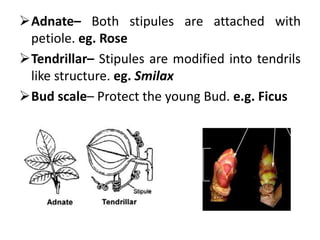
Adnate– Both stipules are attached with
petiole. eg. Rose
Tendrillar– Stipules are modified into tendrils
like structure. eg. Smilax
Bud scale– Protect the young Bud. e.g. Ficus

Morphology of Leaf.pptx

  • 1.
  • 2.
    The leaf isa lateral generally flattened structure borne on the stem. The leaves develop from the nodes. Their main function is photosynthesis and food making, axillary buds are found in its axil. All the leaves of a plant is known as phyllome. Axillary bud later develops into a branch. Leaves originated from shoot apical meristem and are arranged in acropetal order.
  • 3.
    Leaf is dividedinto 3 main parts: Leaf base (Hypopodium) Petiole (Mesopodium) Lamina (Epipodium)
  • 4.
    Leaf base (Hypopodium)– ✧ Leaves are attached to stem by leaf base. Pulvinus- In some plants, leaf base becomes swollen. e.g., Cassia, mimosa, bean. Sheathing leaf base- In some plants, leaf base expands into sheath, e.g., grasses and banana. Pulvinus Sheathing
  • 5.
    Semi amplexicaul- Whenthe leaf base partially encloses the stem. e.g., Prickly poppy, Calotropis procera (Madar). Amplexicaul- When the leaf base completely encloses the stem, e.g., Sonchus, Polygonum. Semi amplexicaul Amplexicaul
  • 6.
    Petiole (Mesopodium)-  Thepart of leaf connecting the lamina with the branch of stem. Petiole help to hold the blade to light.  Long thin flexible petiole allow leaf blade to flutter in air, thereby cooling the leaf and bringing fresh air to leaf. ✧Swelling petiole: In Eichhornia petiole swell and ✧ Wing petiole: in citrus it is winged.
  • 7.
    ✧ Petiole ismodified in tendrils in Nepenthes. ✧ In Australian acacia petiole is modified in phyllode
  • 8.
    Lamina (Epipodium) – It is a broad and flattened part of leaf. Its main functions are photosynthesis and transpiration. Shape of lamina are: ✧Acicular– Lamina is long and pointed, like a needle. eg. Pinus ✧Lanceolate– In this type lamina is pointed or narrower at the ends while broader in the middle. eg. Bamboo, Nerium Acicular Lanceolate
  • 9.
    ✧Linear– The laminais long and narrow having parallel margins. eg. Grass ✧ Oblong– Long and broad lamina. eg. Banana ✧Sagittate– The lamina is triangular in shape. eg. Sagittaria
  • 10.
    ✧Ovate– In thistype lamina is egg-shaped having broad base with slight narrow top. eg. Ocimum, Banyan, China rose. ✧Cordate– Its shape is like a heart. eg. Betel. ✧Spathulate– The lamina is broad spoon shaped. eg. Calendula
  • 11.
    ✧ Orbicular orRotund– In this types the lamina is spherical. eg. Lotus. ✧Elliptical or Oval– In this type the middle part of lamina is broad while the ends are narrow and oval. eg. Guava. ✧Oblique– In this types midrib divides, lamina into two unequal halves. eg. Bignonia, Neem.
  • 12.
    Stipules  Lateral appendageson either side of leaf base Stipules are of various types –  Free lateral– They are independently present on both sides of leaf base. eg. (China rose)  Foliaceous– These type of stipules form a leaf like structure. eg. Pea
  • 13.
     Interpetioler– Whentwo leaves are meet oppositely at the node then nearest stipules of each leaf join with each other. In this way only two stipules of two leaves are found in place of four. eg. Ixora, Anthocephalus.  Intrapetioler– In this type both stipules of a single leaf join with each other to form a single stipule. eg. Gardenia
  • 14.
    Scaly– Stipules aredry, small and paper like. eg. Desmodium Spiny– Stipules modified into spine. eg. Zizyphus (Beri), Acacia. Ochreate– When both stipules of leaf combine together and form a tube like structure. eg. Polygonum
  • 15.
    Adnate– Both stipulesare attached with petiole. eg. Rose Tendrillar– Stipules are modified into tendrils like structure. eg. Smilax Bud scale– Protect the young Bud. e.g. Ficus