APPENDAGES OF HEAD
1. ANTENNAE
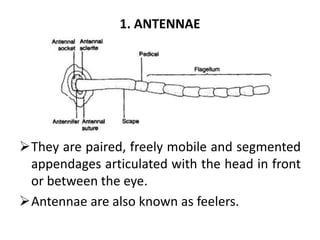
They are paired, freely mobile and segmented
appendages articulated with the head in front
or between the eye.
Antennae are also known as feelers.
 They are well developed in adults and poorly
developed in immature stages.
 Antennae are absent in order protura and class
Arachnida whereas 2 pairs of antenna are present in
class Crustacea.
 Aantennal socket (antennifer) is provided with an
antennal suture.
 The base of socket is connected to the edge of the
socket by an articulatory membrane.
 This permits free movement of antennae
Parts of antennae
Scape- Basal segments which is attached with
the head.
Pedicel- 2nd segment which is shorter than
scape. Its bears sensory apparatus know as
organ of Johnston
Flagellum- Remaining division which varies in its
form and structure according to the
surrounding and habits of insect. It is also
know as clavola.
Function of antennae
Main function is sensory, which is modified
according to use and need of insect like:
i) Olfactory (Organ of smell)- eg, ants, honey bees
and jiants moths
ii) (Gustatory) Organ of taste- eg, cockroach
iii) Sound producing/stridulatorial organ- eg,
cricket
iv) Hearing/chordotonal- eg, male mosquito,
green bottle fly and paper wasp
v) Sexual characters- Mosquito
vi) Seizing pray- eg Chaoborus
vii) Mating- eg, male Meloe
Modification of antennae
1. ARISTATE- Aristate antennae are pouch-like
with a lateral bristle, used to detect air
movement and odours. Eg, House and shore
flies (order Diptera).
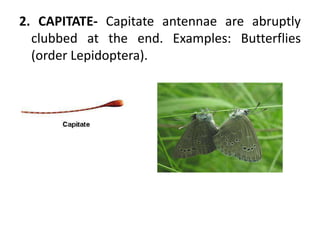
2. CAPITATE- Capitate antennae are abruptly
clubbed at the end. Examples: Butterflies
(order Lepidoptera).
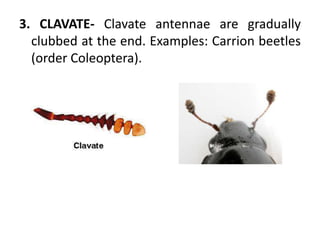
3. CLAVATE- Clavate antennae are gradually
clubbed at the end. Examples: Carrion beetles
(order Coleoptera).
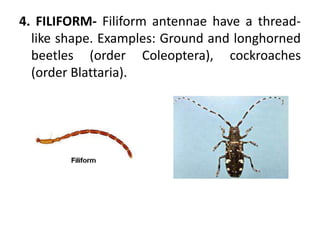
4. FILIFORM- Filiform antennae have a thread-
like shape. Examples: Ground and longhorned
beetles (order Coleoptera), cockroaches
(order Blattaria).
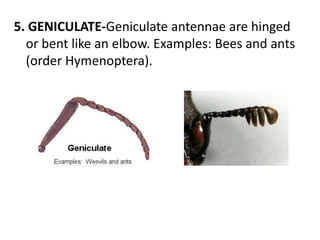
5. GENICULATE-Geniculate antennae are hinged
or bent like an elbow. Examples: Bees and ants
(order Hymenoptera).
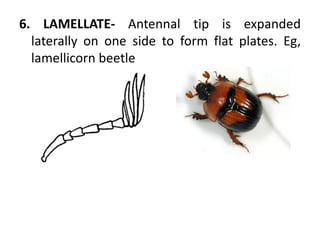
6. LAMELLATE- Antennal tip is expanded
laterally on one side to form flat plates. Eg,
lamellicorn beetle
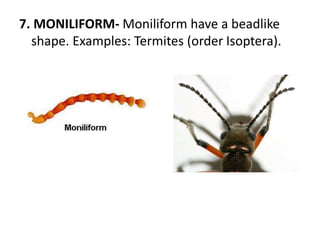
7. MONILIFORM- Moniliform have a beadlike
shape. Examples: Termites (order Isoptera).
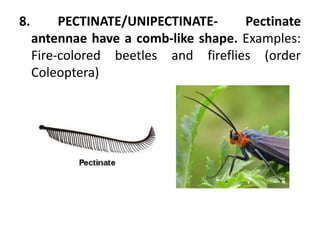
8. PECTINATE/UNIPECTINATE- Pectinate
antennae have a comb-like shape. Examples:
Fire-colored beetles and fireflies (order
Coleoptera)
9. Bipectinate- (Double comb like) Segments
with long slender lateral processes on both
the sides e.g. Silkworm moth
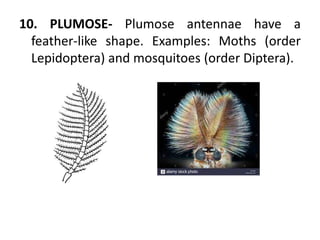
10. PLUMOSE- Plumose antennae have a
feather-like shape. Examples: Moths (order
Lepidoptera) and mosquitoes (order Diptera).
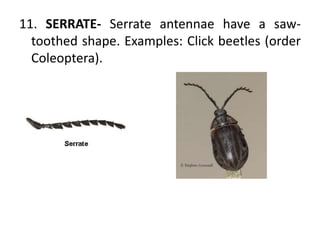
11. SERRATE- Serrate antennae have a saw-
toothed shape. Examples: Click beetles (order
Coleoptera).
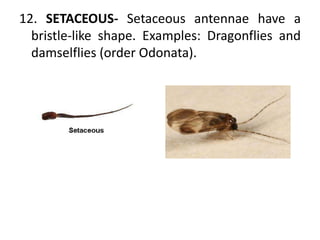
12. SETACEOUS- Setaceous antennae have a
bristle-like shape. Examples: Dragonflies and
damselflies (order Odonata).
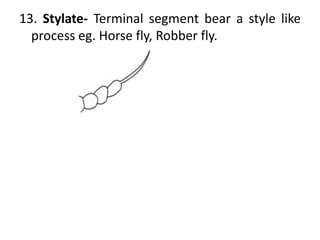
13. Stylate- Terminal segment bear a style like
process eg. Horse fly, Robber fly.
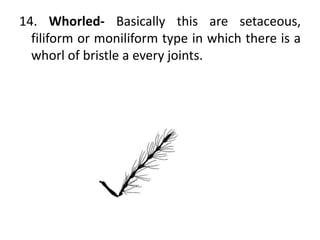
14. Whorled- Basically this are setaceous,
filiform or moniliform type in which there is a
whorl of bristle a every joints.
INSECTS MOUTH
 Typical mouthpart of an insect consists of the
following parts:
(i) Labrum (upper lip)
(ii) A pair of mandibles (upper Jaw)
(iii) A pair of maxillae (lower Jaw)
(iv)Labium (lower lip)
(v) Hypopharynx (tongue)
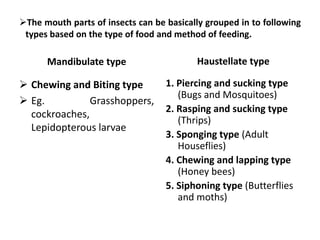
The mouth parts of insects can be basically grouped in to following
types based on the type of food and method of feeding.
Mandibulate type
 Chewing and Biting type
 Eg. Grasshoppers,
cockroaches,
Lepidopterous larvae
Haustellate type
1. Piercing and sucking type
(Bugs and Mosquitoes)
2. Rasping and sucking type
(Thrips)
3. Sponging type (Adult
Houseflies)
4. Chewing and lapping type
(Honey bees)
5. Siphoning type (Butterflies
and moths)
MANDIBULATE TYPE OF MOUTH PARTS
 Those insects feeding on solid food material such as
leaves, fruits, tree bark.
CHEWING AND BITING TYPE
 E.g. Grass hopper, Cockroach, Beetles, Lepidopterous
larvae
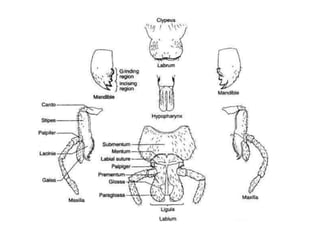
(a) Labrum:
 It is a single unpaired that forms the upper lip of the
mouth cavity.
 It protects the mandibles and helps in closing of the
mouth cavity and guides the food in to mouth or
hold the food material while feeding.
 Labrum hangs down from the clypeus through a
clypeo-labral suture.
(b) Mandibles:
 These are the paired, un-segmented, strongest and
sclerotized structures called first pair of jaws.
 They are attached to the head capsule by means of
two joints known as ginglymus and condyle.
 They possess teeth like molars and incisors that help
in the process of cutting the food material.
 Each mandible is moved by powerful Abductor and
adductor muscles.
(c) Maxillae:
 These are paired and also known as second pair of
jaws.
 These are homologous structures with basal
triangular ‘cardo’, middle rectangular ‘stipes’ and the
lateral ‘palpifer’ bearing maxillary palpi and lobe like
inner ‘lacinia’ and outer ‘galea’.
 Maxillary palps possess olfactory and gustatory
sense receptors and function as sensory organs.
 These Galea and lacinia helps in holding the food
material along with the mandibles.
(d) Labium:
 It is known as lower lip and is also called as second
maxillae.
 It closes the mouth cavity from below.
 It is divided in to proximal prementum, Central
mentum and distal submentum.
 Prementum has three terminal lobes.
 Near the base of pre mentum, on either side lobe
like ‘palpiger’ is present which bears labial palps.
 The median pair is ‘glossae’ and outer ‘para glossae’
together called ligula that function mainly as
gustatory sense organs.
(e) Hypopharynx:
 It is a tongue like structure situated between labrum
and labium and ducts of salivary glands open on or
near its base.
 The function of hypopharynx is to mix saliva with the
food material.
Appendages of Insect Head.pptx

Appendages of Insect Head.pptx

  • 1.
  • 2.
    1. ANTENNAE They arepaired, freely mobile and segmented appendages articulated with the head in front or between the eye. Antennae are also known as feelers.
  • 3.
     They arewell developed in adults and poorly developed in immature stages.  Antennae are absent in order protura and class Arachnida whereas 2 pairs of antenna are present in class Crustacea.  Aantennal socket (antennifer) is provided with an antennal suture.  The base of socket is connected to the edge of the socket by an articulatory membrane.  This permits free movement of antennae
  • 4.
    Parts of antennae Scape-Basal segments which is attached with the head. Pedicel- 2nd segment which is shorter than scape. Its bears sensory apparatus know as organ of Johnston Flagellum- Remaining division which varies in its form and structure according to the surrounding and habits of insect. It is also know as clavola.
  • 5.
    Function of antennae Mainfunction is sensory, which is modified according to use and need of insect like: i) Olfactory (Organ of smell)- eg, ants, honey bees and jiants moths ii) (Gustatory) Organ of taste- eg, cockroach iii) Sound producing/stridulatorial organ- eg, cricket iv) Hearing/chordotonal- eg, male mosquito, green bottle fly and paper wasp v) Sexual characters- Mosquito vi) Seizing pray- eg Chaoborus vii) Mating- eg, male Meloe
  • 6.
    Modification of antennae 1.ARISTATE- Aristate antennae are pouch-like with a lateral bristle, used to detect air movement and odours. Eg, House and shore flies (order Diptera).
  • 7.
    2. CAPITATE- Capitateantennae are abruptly clubbed at the end. Examples: Butterflies (order Lepidoptera).
  • 8.
    3. CLAVATE- Clavateantennae are gradually clubbed at the end. Examples: Carrion beetles (order Coleoptera).
  • 9.
    4. FILIFORM- Filiformantennae have a thread- like shape. Examples: Ground and longhorned beetles (order Coleoptera), cockroaches (order Blattaria).
  • 10.
    5. GENICULATE-Geniculate antennaeare hinged or bent like an elbow. Examples: Bees and ants (order Hymenoptera).
  • 11.
    6. LAMELLATE- Antennaltip is expanded laterally on one side to form flat plates. Eg, lamellicorn beetle
  • 12.
    7. MONILIFORM- Moniliformhave a beadlike shape. Examples: Termites (order Isoptera).
  • 13.
    8. PECTINATE/UNIPECTINATE- Pectinate antennaehave a comb-like shape. Examples: Fire-colored beetles and fireflies (order Coleoptera)
  • 14.
    9. Bipectinate- (Doublecomb like) Segments with long slender lateral processes on both the sides e.g. Silkworm moth
  • 15.
    10. PLUMOSE- Plumoseantennae have a feather-like shape. Examples: Moths (order Lepidoptera) and mosquitoes (order Diptera).
  • 16.
    11. SERRATE- Serrateantennae have a saw- toothed shape. Examples: Click beetles (order Coleoptera).
  • 17.
    12. SETACEOUS- Setaceousantennae have a bristle-like shape. Examples: Dragonflies and damselflies (order Odonata).
  • 18.
    13. Stylate- Terminalsegment bear a style like process eg. Horse fly, Robber fly.
  • 19.
    14. Whorled- Basicallythis are setaceous, filiform or moniliform type in which there is a whorl of bristle a every joints.
  • 20.
  • 21.
     Typical mouthpartof an insect consists of the following parts: (i) Labrum (upper lip) (ii) A pair of mandibles (upper Jaw) (iii) A pair of maxillae (lower Jaw) (iv)Labium (lower lip) (v) Hypopharynx (tongue)
  • 22.
    The mouth partsof insects can be basically grouped in to following types based on the type of food and method of feeding. Mandibulate type  Chewing and Biting type  Eg. Grasshoppers, cockroaches, Lepidopterous larvae Haustellate type 1. Piercing and sucking type (Bugs and Mosquitoes) 2. Rasping and sucking type (Thrips) 3. Sponging type (Adult Houseflies) 4. Chewing and lapping type (Honey bees) 5. Siphoning type (Butterflies and moths)
  • 23.
    MANDIBULATE TYPE OFMOUTH PARTS  Those insects feeding on solid food material such as leaves, fruits, tree bark. CHEWING AND BITING TYPE  E.g. Grass hopper, Cockroach, Beetles, Lepidopterous larvae (a) Labrum:  It is a single unpaired that forms the upper lip of the mouth cavity.  It protects the mandibles and helps in closing of the mouth cavity and guides the food in to mouth or hold the food material while feeding.  Labrum hangs down from the clypeus through a clypeo-labral suture.
  • 24.
    (b) Mandibles:  Theseare the paired, un-segmented, strongest and sclerotized structures called first pair of jaws.  They are attached to the head capsule by means of two joints known as ginglymus and condyle.  They possess teeth like molars and incisors that help in the process of cutting the food material.  Each mandible is moved by powerful Abductor and adductor muscles.
  • 25.
    (c) Maxillae:  Theseare paired and also known as second pair of jaws.  These are homologous structures with basal triangular ‘cardo’, middle rectangular ‘stipes’ and the lateral ‘palpifer’ bearing maxillary palpi and lobe like inner ‘lacinia’ and outer ‘galea’.  Maxillary palps possess olfactory and gustatory sense receptors and function as sensory organs.  These Galea and lacinia helps in holding the food material along with the mandibles.
  • 26.
    (d) Labium:  Itis known as lower lip and is also called as second maxillae.  It closes the mouth cavity from below.  It is divided in to proximal prementum, Central mentum and distal submentum.  Prementum has three terminal lobes.  Near the base of pre mentum, on either side lobe like ‘palpiger’ is present which bears labial palps.  The median pair is ‘glossae’ and outer ‘para glossae’ together called ligula that function mainly as gustatory sense organs.
  • 27.
    (e) Hypopharynx:  Itis a tongue like structure situated between labrum and labium and ducts of salivary glands open on or near its base.  The function of hypopharynx is to mix saliva with the food material.