Morphology
lecturer:
Siti Mukminatun, S.Pd.,M.Hum.
Mohamad Hariza
(14202241063)
Chandraning Kurnia Putri
(14202241035)
Mohamad Syarifudin
(15202241081)
Abda Rais Syihab
(15202241089)
Jl. Colombo No.1, Caturtunggal, Depok,
Caturtunggal, Kec. Depok, Kabupaten Sleman,
Daerah Istimewa Yogyakarta 55281
Telepon : +62-274-586168. Humas : (0274)
542185, Email Humas :humas@uny.ac.id.
What is Morphology?
Morphology is the branch of linguistics that
studies how the words are formed
What is Word?
Word can be defined as a smallest elemets in a
sentence
The properties of word:
1. Words are entities having a part of speech
specification
2. Words are syntactic atoms
3. Words (usually) have one main stress
4. Words (usually) are indivisible units (no
intervening material possible)
Morphs, Morphemes, Lexemes
 Morphs: morphs means word-form
 Morphemes: morphemes is the smallest unit of word that have
meaning
for example:
1. Playing (have 2 morphemes Play+ing)
2. Dislocation (have 3 morphemes dis+locate+ion)
3. Systematically (have 4 morphemes system+atic+al+ly)
 Lexemes: Lexemes is such an abstract morphological entities
“The word be occurs twice in the sentence.”
the word 'be' is have same pronounce with 'bee' so, if we listen the
sentence in spoken, we don't know is it 'be' or 'bee'
Free vs bound morphemes
 Free Morphemes: A word or word element that can stand
alone, in other words the word can not be divided into smaller
parts that also meaningful.
Word : milk, cow, book, etc.
 Bound morphemes: A word element that can not stand alone
as a word, it includes affixes. It is attached to free morpheme
and mostly change the meaning.
pre- : un-, -s, -ness, -ing
re- : -in-, -ed, -er, -en
Derivational
Morpheme:
Create new
words by
changing the
meaning
(Kind = Unkind)
Inflectional
Morpheme:
Give extra
grammatical
information
(Work = Working)
Types of bound morphemes
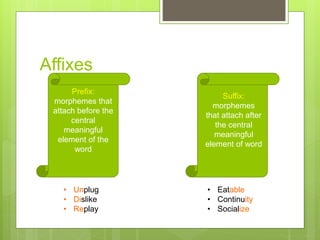
Affixes
Prefix:
morphemes that
attach before the
central
meaningful
element of the
word
Suffix:
morphemes
that attach after
the central
meaningful
element of word
• Unplug
• Dislike
• Replay
• Eatable
• Continuity
• Socialize
Base and Roots
 The part of a word which an affix is attached
to is called base (loveable)
 Bases that cannot be analyzed further into
morphemes is called roots (simulate,
circulation)
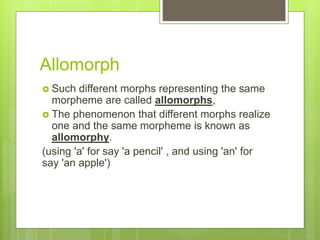
Allomorph
 Such different morphs representing the same
morpheme are called allomorphs,
 The phenomenon that different morphs realize
one and the same morpheme is known as
allomorphy.
(using 'a' for say 'a pencil' , and using 'an' for
say 'an apple')
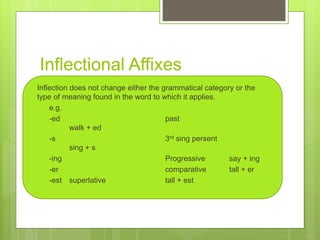
Inflectional Affixes
Inflection does not change either the grammatical category or the
type of meaning found in the word to which it applies.
e.g.
-ed past
walk + ed
-s 3rd sing persent
sing + s
-ing Progressive say + ing
-er comparative tall + er
-est superlative tall + est
Derivational Affixes
Eatable
Eat is a verb, but
eatable is an adjective
Derive or make a new word from different grammatical class
from the original one.
derivation vs inflection
Productive Word Formation
A productive morpheme is one that can be
attached regularly to any word of
the appropriate class
Less Productive Word
Productions
A less productive morpheme is one that cannot
be attached regularly to any word of the
appropriate class
Word formation
Coinage: Inventing a new
word
e.g. genocide(1943)
Borrowing: Borrowing
word from another
language
e.g. agenda(Latin),
panorama (Greek)
Calque: Direct translation
from another language
e.g. perros calientes to
hot dog (Spanish from
English)
Compounding: Mixing two
words to build a new one
e.g. homework
Derivation: Adding
morpheme into a word
e.g. lovely Blending: Blending two
words to create a word
e.g. emoticon (emotion &
icon)
Backformation: Removing
part of the word and
change the word class
e.g. enthusiasm =
enthuse
Conversion: Changing
word class without adding
affixes
e.g. chase (verb and
noun)
Acronym: Words from
initial sets of word
e.g. PIN (personal
identification number)
Initialism: Set of letter as
a representative of words
e.g. FBI (Federal Bureau
of Investigation)
Onomatopoeia: Words
from certain sound
e.g. buzz, cock-a-doodle-
doo
Clipping: Shortening of a
poly-syllabic word
e.g. fan=fanatic
Refferences
 Plag, Ingo.2002.Word-Formation in English. Cambridge:
Cambridge University Press
 Rahman, T. 2010. Linguistics for beginner. Pakistan: Oxford
University Press
Thank You

Morphology

  • 1.
    Morphology lecturer: Siti Mukminatun, S.Pd.,M.Hum. MohamadHariza (14202241063) Chandraning Kurnia Putri (14202241035) Mohamad Syarifudin (15202241081) Abda Rais Syihab (15202241089) Jl. Colombo No.1, Caturtunggal, Depok, Caturtunggal, Kec. Depok, Kabupaten Sleman, Daerah Istimewa Yogyakarta 55281 Telepon : +62-274-586168. Humas : (0274) 542185, Email Humas :humas@uny.ac.id.
  • 2.
    What is Morphology? Morphologyis the branch of linguistics that studies how the words are formed
  • 3.
    What is Word? Wordcan be defined as a smallest elemets in a sentence The properties of word: 1. Words are entities having a part of speech specification 2. Words are syntactic atoms 3. Words (usually) have one main stress 4. Words (usually) are indivisible units (no intervening material possible)
  • 4.
    Morphs, Morphemes, Lexemes Morphs: morphs means word-form  Morphemes: morphemes is the smallest unit of word that have meaning for example: 1. Playing (have 2 morphemes Play+ing) 2. Dislocation (have 3 morphemes dis+locate+ion) 3. Systematically (have 4 morphemes system+atic+al+ly)  Lexemes: Lexemes is such an abstract morphological entities “The word be occurs twice in the sentence.” the word 'be' is have same pronounce with 'bee' so, if we listen the sentence in spoken, we don't know is it 'be' or 'bee'
  • 5.
    Free vs boundmorphemes  Free Morphemes: A word or word element that can stand alone, in other words the word can not be divided into smaller parts that also meaningful. Word : milk, cow, book, etc.  Bound morphemes: A word element that can not stand alone as a word, it includes affixes. It is attached to free morpheme and mostly change the meaning. pre- : un-, -s, -ness, -ing re- : -in-, -ed, -er, -en
  • 6.
    Derivational Morpheme: Create new words by changingthe meaning (Kind = Unkind) Inflectional Morpheme: Give extra grammatical information (Work = Working) Types of bound morphemes
  • 7.
    Affixes Prefix: morphemes that attach beforethe central meaningful element of the word Suffix: morphemes that attach after the central meaningful element of word • Unplug • Dislike • Replay • Eatable • Continuity • Socialize
  • 8.
    Base and Roots The part of a word which an affix is attached to is called base (loveable)  Bases that cannot be analyzed further into morphemes is called roots (simulate, circulation)
  • 9.
    Allomorph  Such differentmorphs representing the same morpheme are called allomorphs,  The phenomenon that different morphs realize one and the same morpheme is known as allomorphy. (using 'a' for say 'a pencil' , and using 'an' for say 'an apple')
  • 10.
    Inflectional Affixes Inflection doesnot change either the grammatical category or the type of meaning found in the word to which it applies. e.g. -ed past walk + ed -s 3rd sing persent sing + s -ing Progressive say + ing -er comparative tall + er -est superlative tall + est
  • 11.
    Derivational Affixes Eatable Eat isa verb, but eatable is an adjective Derive or make a new word from different grammatical class from the original one.
  • 12.
  • 13.
    Productive Word Formation Aproductive morpheme is one that can be attached regularly to any word of the appropriate class
  • 14.
    Less Productive Word Productions Aless productive morpheme is one that cannot be attached regularly to any word of the appropriate class
  • 15.
    Word formation Coinage: Inventinga new word e.g. genocide(1943) Borrowing: Borrowing word from another language e.g. agenda(Latin), panorama (Greek) Calque: Direct translation from another language e.g. perros calientes to hot dog (Spanish from English) Compounding: Mixing two words to build a new one e.g. homework Derivation: Adding morpheme into a word e.g. lovely Blending: Blending two words to create a word e.g. emoticon (emotion & icon)
  • 16.
    Backformation: Removing part ofthe word and change the word class e.g. enthusiasm = enthuse Conversion: Changing word class without adding affixes e.g. chase (verb and noun) Acronym: Words from initial sets of word e.g. PIN (personal identification number) Initialism: Set of letter as a representative of words e.g. FBI (Federal Bureau of Investigation) Onomatopoeia: Words from certain sound e.g. buzz, cock-a-doodle- doo Clipping: Shortening of a poly-syllabic word e.g. fan=fanatic
  • 17.
    Refferences  Plag, Ingo.2002.Word-Formationin English. Cambridge: Cambridge University Press  Rahman, T. 2010. Linguistics for beginner. Pakistan: Oxford University Press
  • 18.