

MOOCs & Social Learning
Challenges and opportunities
Vitomir Kovanovic
School of Informatics
The University of Edinburgh
v.kovanovic@ed.ac.uk
ANC Workshop
2 June 2015
MOOCs: an overview
● Major hype in EdTech world since 2011
● Millions of $$$ raised
● 2012 “year of the MOOCs”
● Led by highly respected institutions
● Attracted interest of general public
○ “Tsunami in world of education”
○ “Disruptive change”
● Primarily content-focused
○ short video lectures
○ quizzes
2
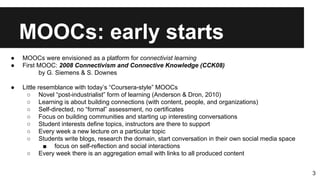
MOOCs: early starts
● MOOCs were envisioned as a platform for connectivist learning
● First MOOC: 2008 Connectivism and Connective Knowledge (CCK08)
by G. Siemens & S. Downes
● Little resemblance with today’s “Coursera-style” MOOCs
○ Novel “post-industrialist” form of learning (Anderson & Dron, 2010)
○ Learning is about building connections (with content, people, and organizations)
○ Self-directed, no “formal” assessment, no certificates
○ Focus on building communities and starting up interesting conversations
○ Student interests define topics, instructors are there to support
○ Every week a new lecture on a particular topic
○ Students write blogs, research the domain, start conversation in their own social media space
■ focus on self-reflection and social interactions
○ Every week there is an aggregation email with links to all produced content
3
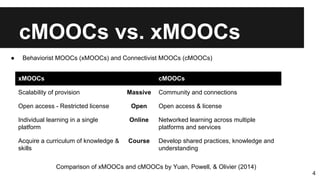
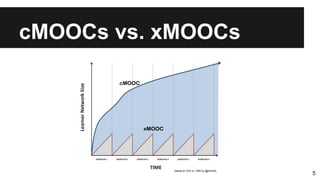
cMOOCs vs. xMOOCs
● Behaviorist MOOCs (xMOOCs) and Connectivist MOOCs (cMOOCs)
xMOOCs cMOOCs
Scalability of provision Massive Community and connections
Open access - Restricted license Open Open access & license
Individual learning in a single
platform
Online Networked learning across multiple
platforms and services
Acquire a curriculum of knowledge &
skills
Course Develop shared practices, knowledge and
understanding
Comparison of xMOOCs and cMOOCs by Yuan, Powell, & Olivier (2014)
4
cMOOCs vs. xMOOCs
5
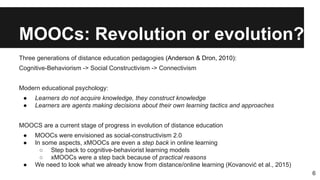
MOOCs: Revolution or evolution?
Three generations of distance education pedagogies (Anderson & Dron, 2010):
Cognitive-Behaviorism -> Social Constructivism -> Connectivism
Modern educational psychology:
● Learners do not acquire knowledge, they construct knowledge
● Learners are agents making decisions about their own learning tactics and approaches
MOOCS are a current stage of progress in evolution of distance education
● MOOCs were envisioned as social-constructivism 2.0
● In some aspects, xMOOCs are even a step back in online learning
○ Step back to cognitive-behaviorist learning models
○ xMOOCs were a step back because of practical reasons
● We need to look what we already know from distance/online learning (Kovanović et al., 2015)
6
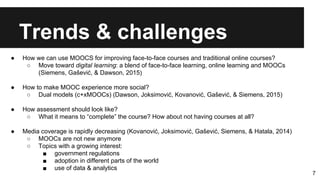
Trends & challenges
● How we can use MOOCS for improving face-to-face courses and traditional online courses?
○ Move toward digital learning: a blend of face-to-face learning, online learning and MOOCs
(Siemens, Gašević, & Dawson, 2015)
● How to make MOOC experience more social?
○ Dual models (c+xMOOCs) (Dawson, Joksimović, Kovanović, Gašević, & Siemens, 2015)
● How assessment should look like?
○ What it means to “complete” the course? How about not having courses at all?
● Media coverage is rapidly decreasing (Kovanović, Joksimović, Gašević, Siemens, & Hatala, 2014)
○ MOOCs are not new anymore
○ Topics with a growing interest:
■ government regulations
■ adoption in different parts of the world
■ use of data & analytics
7
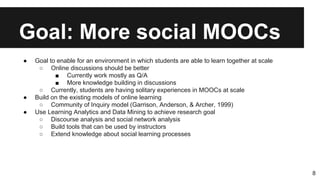
Goal: More social MOOCs
● Goal to enable for an environment in which students are able to learn together at scale
○ Online discussions should be better
■ Currently work mostly as Q/A
■ More knowledge building in discussions
○ Currently, students are having solitary experiences in MOOCs at scale
● Build on the existing models of online learning
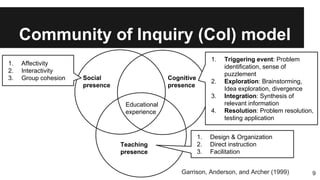
○ Community of Inquiry model (Garrison, Anderson, & Archer, 1999)
● Use Learning Analytics and Data Mining to achieve research goal
○ Discourse analysis and social network analysis
○ Build tools that can be used by instructors
○ Extend knowledge about social learning processes
8
Community of Inquiry (CoI) model
Social
presence
Cognitive
presence
Teaching
presence
Educational
experience
1. Affectivity
2. Interactivity
3. Group cohesion
1. Triggering event: Problem
identification, sense of
puzzlement
2. Exploration: Brainstorming,
Idea exploration, divergence
3. Integration: Synthesis of
relevant information
4. Resolution: Problem resolution,
testing application
1. Design & Organization
2. Direct instruction
3. Facilitation
Garrison, Anderson, and Archer (1999) 9
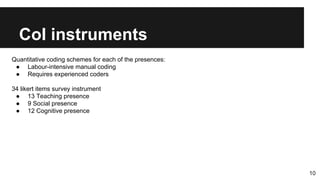
CoI instruments
Quantitative coding schemes for each of the presences:
● Labour-intensive manual coding
● Requires experienced coders
34 likert items survey instrument
● 13 Teaching presence
● 9 Social presence
● 12 Cognitive presence
10
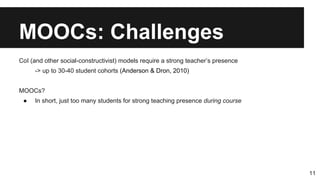
MOOCs: Challenges
CoI (and other social-constructivist) models require a strong teacher’s presence
-> up to 30-40 student cohorts (Anderson & Dron, 2010)
MOOCs?
● In short, just too many students for strong teaching presence during course
11
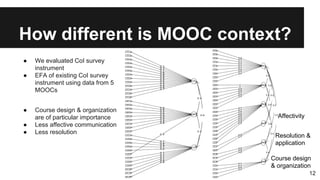
How different is MOOC context?
● We evaluated CoI survey
instrument
● EFA of existing CoI survey
instrument using data from 5
MOOCs
● Course design & organization
are of particular importance
● Less affective communication
● Less resolution
Resolution &
application
Affectivity
Course design
& organization
12
How different is MOOC context?
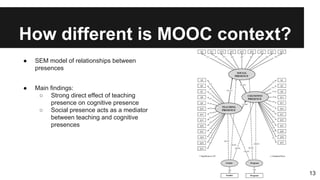
● SEM model of relationships between
presences
● Main findings:
○ Strong direct effect of teaching
presence on cognitive presence
○ Social presence acts as a mediator
between teaching and cognitive
presences
13
How different is MOOC context?
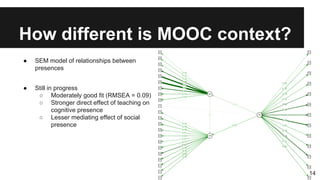
● SEM model of relationships between
presences
● Still in progress
○ Moderately good fit (RMSEA = 0.09)
○ Stronger direct effect of teaching on
cognitive presence
○ Lesser mediating effect of social
presence
14
CoI content analysis
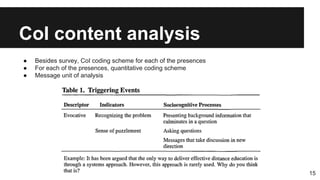
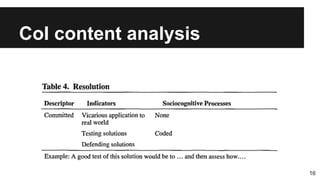
● Besides survey, CoI coding scheme for each of the presences
● For each of the presences, quantitative coding scheme
● Message unit of analysis
15
CoI content analysis
16
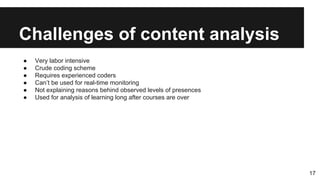
Challenges of content analysis
● Very labor intensive
● Crude coding scheme
● Requires experienced coders
● Can’t be used for real-time monitoring
● Not explaining reasons behind observed levels of presences
● Used for analysis of learning long after courses are over
17
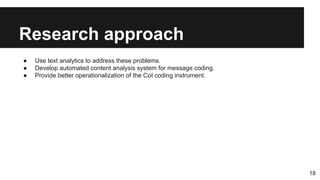
Research approach
● Use text analytics to address these problems.
● Develop automated content analysis system for message coding.
● Provide better operationalization of the CoI coding instrument.
18
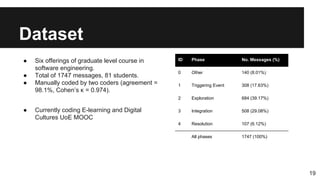
Dataset
● Six offerings of graduate level course in
software engineering.
● Total of 1747 messages, 81 students.
● Manually coded by two coders (agreement =
98.1%, Cohen’s κ = 0.974).
● Currently coding E-learning and Digital
Cultures UoE MOOC
ID Phase No. Messages (%)
0 Other 140 (8.01%)
1 Triggering Event 308 (17.63%)
2 Exploration 684 (39.17%)
3 Integration 508 (29.08%)
4 Resolution 107 (6.12%)
All phases 1747 (100%)
19
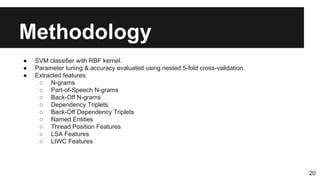
Methodology
● SVM classifier with RBF kernel.
● Parameter tuning & accuracy evaluated using nested 5-fold cross-validation.
● Extracted features:
○ N-grams
○ Part-of-Speech N-grams
○ Back-Off N-grams
○ Dependency Triplets
○ Back-Off Dependency Triplets
○ Named Entities
○ Thread Position Features
○ LSA Features
○ LIWC Features
20
Results
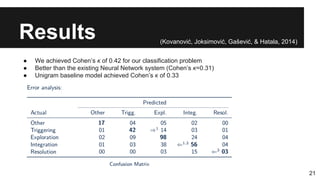
● We achieved Cohen’s κ of 0.42 for our classification problem
● Better than the existing Neural Network system (Cohen’s κ=0.31)
● Unigram baseline model achieved Cohen’s κ of 0.33
21
(Kovanović, Joksimović, Gašević, & Hatala, 2014)
Challenges
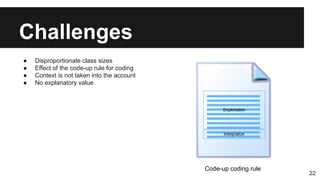
● Disproportionate class sizes
● Effect of the code-up rule for coding
● Context is not taken into the account
● No explanatory value
Code-up coding rule
22
In progress
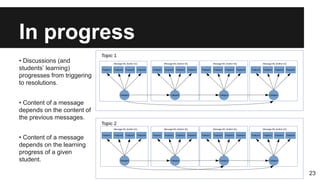
• Discussions (and
students’ learning)
progresses from triggering
to resolutions.
• Content of a message
depends on the content of
the previous messages.
• Content of a message
depends on the learning
progress of a given
student.
23
Summary
● Social-constructivist pedagogies do not work well in MOOC context
○ xMOOCs: focus on content-delivery
○ cMOOCs: focus on connecting, reflecting in a self-directed way
● MOOCs
○ put more emphasis on course organization and design
○ building community a challenge
○ focus more on remembering than on understanding and evaluating
○ need for a more social experience in MOOCs
● Community of Inquiry model
○ Widely used, hard to adopt
○ Automated coding of messages:
● An overview of student progress in development of cognitive presence
● Support instructional interventions
● Further understanding of CoI model, particularly in MOOC context
● More detailed operationalization of CoI coding scheme
24
25
Thank you
References
Anderson, T., & Dron, J. (2010). Three generations of distance education pedagogy. The International Review of Research in
Open and Distance Learning, 12(3), 80–97.
Garrison, D. R., Anderson, T., & Archer, W. (1999). Critical Inquiry in a Text-Based Environment: Computer Conferencing in
Higher Education. The Internet and Higher Education, 2(2–3), 87–105.
Kovanović, V., Joksimović, S., Gašević, D., Siemens, G., & Hatala, M. (2014). What public media reveals about MOOCs?
British Journal of Educational Technology 43(3), 510-527.
Dawson, S., Joksimović, S., Kovanović, V., Gašević, D., & Siemens, G. (2015). Recognising learner autonomy: Lessons and
reflections from a joint x/c MOOC. In Proceedings of 2015 HERDSA conference. Melbourne, AU.
Siemens, G., Gašević, D., & Dawson, S. (2015). Preparing for the digital university: a review of the history and current state of
distance, blended, and online learning. Athabasca University. Retrieved from http://linkresearchlab.
org/PreparingDigitalUniversity.pdf
Kovanović, V., Joksimović, S., Skrypnyk, O., Gašević, D., Dawson, S., & Siemens, G. (2015). The history and state of distance
education. Athabasca University.
Kovanović, V., Joksimović, S., Gašević, D., & Hatala, M. (2014). Automated Content Analysis of Online Discussion Transcripts.
In Proceedings of the Workshops at the LAK 2014 Conference co-located with 4th International Conference on Learning
Analytics and Knowledge (LAK 2014). Indianapolis, IN. Retrieved from http://ceur-ws.org/Vol-1137/
Yuan, L., Powell, S., & Olivier, B. (2014). Beyond MOOCs: Sustainable Online Learning in Institutions. CETIS: Centre for
Educational Technology, Interoperability and Standards.
26

MOOCs & Social Learning: Challenges and opportunities

  • 1.
    MOOCs & SocialLearning Challenges and opportunities Vitomir Kovanovic School of Informatics The University of Edinburgh v.kovanovic@ed.ac.uk ANC Workshop 2 June 2015
  • 2.
    MOOCs: an overview ●Major hype in EdTech world since 2011 ● Millions of $$$ raised ● 2012 “year of the MOOCs” ● Led by highly respected institutions ● Attracted interest of general public ○ “Tsunami in world of education” ○ “Disruptive change” ● Primarily content-focused ○ short video lectures ○ quizzes 2
  • 3.
    MOOCs: early starts ●MOOCs were envisioned as a platform for connectivist learning ● First MOOC: 2008 Connectivism and Connective Knowledge (CCK08) by G. Siemens & S. Downes ● Little resemblance with today’s “Coursera-style” MOOCs ○ Novel “post-industrialist” form of learning (Anderson & Dron, 2010) ○ Learning is about building connections (with content, people, and organizations) ○ Self-directed, no “formal” assessment, no certificates ○ Focus on building communities and starting up interesting conversations ○ Student interests define topics, instructors are there to support ○ Every week a new lecture on a particular topic ○ Students write blogs, research the domain, start conversation in their own social media space ■ focus on self-reflection and social interactions ○ Every week there is an aggregation email with links to all produced content 3
  • 4.
    cMOOCs vs. xMOOCs ●Behaviorist MOOCs (xMOOCs) and Connectivist MOOCs (cMOOCs) xMOOCs cMOOCs Scalability of provision Massive Community and connections Open access - Restricted license Open Open access & license Individual learning in a single platform Online Networked learning across multiple platforms and services Acquire a curriculum of knowledge & skills Course Develop shared practices, knowledge and understanding Comparison of xMOOCs and cMOOCs by Yuan, Powell, & Olivier (2014) 4
  • 5.
  • 6.
    MOOCs: Revolution orevolution? Three generations of distance education pedagogies (Anderson & Dron, 2010): Cognitive-Behaviorism -> Social Constructivism -> Connectivism Modern educational psychology: ● Learners do not acquire knowledge, they construct knowledge ● Learners are agents making decisions about their own learning tactics and approaches MOOCS are a current stage of progress in evolution of distance education ● MOOCs were envisioned as social-constructivism 2.0 ● In some aspects, xMOOCs are even a step back in online learning ○ Step back to cognitive-behaviorist learning models ○ xMOOCs were a step back because of practical reasons ● We need to look what we already know from distance/online learning (Kovanović et al., 2015) 6
  • 7.
    Trends & challenges ●How we can use MOOCS for improving face-to-face courses and traditional online courses? ○ Move toward digital learning: a blend of face-to-face learning, online learning and MOOCs (Siemens, Gašević, & Dawson, 2015) ● How to make MOOC experience more social? ○ Dual models (c+xMOOCs) (Dawson, Joksimović, Kovanović, Gašević, & Siemens, 2015) ● How assessment should look like? ○ What it means to “complete” the course? How about not having courses at all? ● Media coverage is rapidly decreasing (Kovanović, Joksimović, Gašević, Siemens, & Hatala, 2014) ○ MOOCs are not new anymore ○ Topics with a growing interest: ■ government regulations ■ adoption in different parts of the world ■ use of data & analytics 7
  • 8.
    Goal: More socialMOOCs ● Goal to enable for an environment in which students are able to learn together at scale ○ Online discussions should be better ■ Currently work mostly as Q/A ■ More knowledge building in discussions ○ Currently, students are having solitary experiences in MOOCs at scale ● Build on the existing models of online learning ○ Community of Inquiry model (Garrison, Anderson, & Archer, 1999) ● Use Learning Analytics and Data Mining to achieve research goal ○ Discourse analysis and social network analysis ○ Build tools that can be used by instructors ○ Extend knowledge about social learning processes 8
  • 9.
    Community of Inquiry(CoI) model Social presence Cognitive presence Teaching presence Educational experience 1. Affectivity 2. Interactivity 3. Group cohesion 1. Triggering event: Problem identification, sense of puzzlement 2. Exploration: Brainstorming, Idea exploration, divergence 3. Integration: Synthesis of relevant information 4. Resolution: Problem resolution, testing application 1. Design & Organization 2. Direct instruction 3. Facilitation Garrison, Anderson, and Archer (1999) 9
  • 10.
    CoI instruments Quantitative codingschemes for each of the presences: ● Labour-intensive manual coding ● Requires experienced coders 34 likert items survey instrument ● 13 Teaching presence ● 9 Social presence ● 12 Cognitive presence 10
  • 11.
    MOOCs: Challenges CoI (andother social-constructivist) models require a strong teacher’s presence -> up to 30-40 student cohorts (Anderson & Dron, 2010) MOOCs? ● In short, just too many students for strong teaching presence during course 11
  • 12.
    How different isMOOC context? ● We evaluated CoI survey instrument ● EFA of existing CoI survey instrument using data from 5 MOOCs ● Course design & organization are of particular importance ● Less affective communication ● Less resolution Resolution & application Affectivity Course design & organization 12
  • 13.
    How different isMOOC context? ● SEM model of relationships between presences ● Main findings: ○ Strong direct effect of teaching presence on cognitive presence ○ Social presence acts as a mediator between teaching and cognitive presences 13
  • 14.
    How different isMOOC context? ● SEM model of relationships between presences ● Still in progress ○ Moderately good fit (RMSEA = 0.09) ○ Stronger direct effect of teaching on cognitive presence ○ Lesser mediating effect of social presence 14
  • 15.
    CoI content analysis ●Besides survey, CoI coding scheme for each of the presences ● For each of the presences, quantitative coding scheme ● Message unit of analysis 15
  • 16.
  • 17.
    Challenges of contentanalysis ● Very labor intensive ● Crude coding scheme ● Requires experienced coders ● Can’t be used for real-time monitoring ● Not explaining reasons behind observed levels of presences ● Used for analysis of learning long after courses are over 17
  • 18.
    Research approach ● Usetext analytics to address these problems. ● Develop automated content analysis system for message coding. ● Provide better operationalization of the CoI coding instrument. 18
  • 19.
    Dataset ● Six offeringsof graduate level course in software engineering. ● Total of 1747 messages, 81 students. ● Manually coded by two coders (agreement = 98.1%, Cohen’s κ = 0.974). ● Currently coding E-learning and Digital Cultures UoE MOOC ID Phase No. Messages (%) 0 Other 140 (8.01%) 1 Triggering Event 308 (17.63%) 2 Exploration 684 (39.17%) 3 Integration 508 (29.08%) 4 Resolution 107 (6.12%) All phases 1747 (100%) 19
  • 20.
    Methodology ● SVM classifierwith RBF kernel. ● Parameter tuning & accuracy evaluated using nested 5-fold cross-validation. ● Extracted features: ○ N-grams ○ Part-of-Speech N-grams ○ Back-Off N-grams ○ Dependency Triplets ○ Back-Off Dependency Triplets ○ Named Entities ○ Thread Position Features ○ LSA Features ○ LIWC Features 20
  • 21.
    Results ● We achievedCohen’s κ of 0.42 for our classification problem ● Better than the existing Neural Network system (Cohen’s κ=0.31) ● Unigram baseline model achieved Cohen’s κ of 0.33 21 (Kovanović, Joksimović, Gašević, & Hatala, 2014)
  • 22.
    Challenges ● Disproportionate classsizes ● Effect of the code-up rule for coding ● Context is not taken into the account ● No explanatory value Code-up coding rule 22
  • 23.
    In progress • Discussions(and students’ learning) progresses from triggering to resolutions. • Content of a message depends on the content of the previous messages. • Content of a message depends on the learning progress of a given student. 23
  • 24.
    Summary ● Social-constructivist pedagogiesdo not work well in MOOC context ○ xMOOCs: focus on content-delivery ○ cMOOCs: focus on connecting, reflecting in a self-directed way ● MOOCs ○ put more emphasis on course organization and design ○ building community a challenge ○ focus more on remembering than on understanding and evaluating ○ need for a more social experience in MOOCs ● Community of Inquiry model ○ Widely used, hard to adopt ○ Automated coding of messages: ● An overview of student progress in development of cognitive presence ● Support instructional interventions ● Further understanding of CoI model, particularly in MOOC context ● More detailed operationalization of CoI coding scheme 24
  • 25.
  • 26.
    References Anderson, T., &Dron, J. (2010). Three generations of distance education pedagogy. The International Review of Research in Open and Distance Learning, 12(3), 80–97. Garrison, D. R., Anderson, T., & Archer, W. (1999). Critical Inquiry in a Text-Based Environment: Computer Conferencing in Higher Education. The Internet and Higher Education, 2(2–3), 87–105. Kovanović, V., Joksimović, S., Gašević, D., Siemens, G., & Hatala, M. (2014). What public media reveals about MOOCs? British Journal of Educational Technology 43(3), 510-527. Dawson, S., Joksimović, S., Kovanović, V., Gašević, D., & Siemens, G. (2015). Recognising learner autonomy: Lessons and reflections from a joint x/c MOOC. In Proceedings of 2015 HERDSA conference. Melbourne, AU. Siemens, G., Gašević, D., & Dawson, S. (2015). Preparing for the digital university: a review of the history and current state of distance, blended, and online learning. Athabasca University. Retrieved from http://linkresearchlab. org/PreparingDigitalUniversity.pdf Kovanović, V., Joksimović, S., Skrypnyk, O., Gašević, D., Dawson, S., & Siemens, G. (2015). The history and state of distance education. Athabasca University. Kovanović, V., Joksimović, S., Gašević, D., & Hatala, M. (2014). Automated Content Analysis of Online Discussion Transcripts. In Proceedings of the Workshops at the LAK 2014 Conference co-located with 4th International Conference on Learning Analytics and Knowledge (LAK 2014). Indianapolis, IN. Retrieved from http://ceur-ws.org/Vol-1137/ Yuan, L., Powell, S., & Olivier, B. (2014). Beyond MOOCs: Sustainable Online Learning in Institutions. CETIS: Centre for Educational Technology, Interoperability and Standards. 26