Making MOOCs on a Budget
Pedagogies and Communication
Sustainable Interpersonal
Communication
Sustainable Interpersonal
Communication
• Students-to-students
– They will keep in touch and
communicate in multiple ways
disregarding the MOOC team desires
• Staff-to-students
– Platforms allow to send massive e-
mails every now and then
– Platforms seldom have simple and
useful tools like twitter or facebook
Sustainable Interpersonal
Communication
• Rational use of E-mail
– E-mail has been declared dead many times...
– But e-mail is more alive than ever
• E-mail is being used as center for
– Notifications
– Task management (along with calendar)
Sustainable Interpersonal
Communication
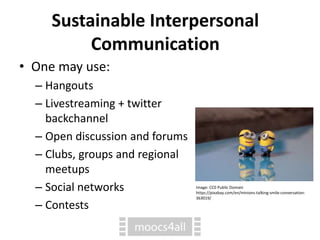
• One may use:
– Hangouts
– Livestreaming + twitter
backchannel
– Open discussion and forums
– Clubs, groups and regional
meetups
– Social networks
– Contests
Image: CC0 Public Domain
https://pixabay.com/en/minions-talking-smile-conversation-
363019/
Sustainable Interpersonal
Communication
• Allow for students to answer other students’
questions
• Monitor unanswered questions
• Correct minor errors and problems
Sustainable Interpersonal
Communication
• Let the world know about student-student
and student-staff interactions
• Use searchable and archiveable
communication systems if possible: e.g.,
twitter, instagram. And public/open.
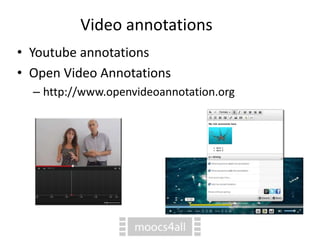
Video annotations
• Youtube annotations
• Open Video Annotations
– http://www.openvideoannotation.org
On a budget...
• Saving time: Simple tools/social networks:
twitter for text with some images; instagram
for images with some text. Gmail + google
services.
• Saving money: to manage twitter (several
accounts), just use TweetDeck, free.
• Saving energy: to manage several social
network accounts (write once, multiple
publishing) spend some money in HootSuite.
Question open for discussion
• Question: do we need to stick to tools
provided by the platform hosting our
MOOC?
Tell us about your opinion !
Thanks for your attention.

3.6 Sustainable Interpersonal Communication

  • 2.
    Making MOOCs ona Budget Pedagogies and Communication Sustainable Interpersonal Communication
  • 3.
    Sustainable Interpersonal Communication • Students-to-students –They will keep in touch and communicate in multiple ways disregarding the MOOC team desires • Staff-to-students – Platforms allow to send massive e- mails every now and then – Platforms seldom have simple and useful tools like twitter or facebook
  • 4.
    Sustainable Interpersonal Communication • Rationaluse of E-mail – E-mail has been declared dead many times... – But e-mail is more alive than ever • E-mail is being used as center for – Notifications – Task management (along with calendar)
  • 5.
    Sustainable Interpersonal Communication • Onemay use: – Hangouts – Livestreaming + twitter backchannel – Open discussion and forums – Clubs, groups and regional meetups – Social networks – Contests Image: CC0 Public Domain https://pixabay.com/en/minions-talking-smile-conversation- 363019/
  • 6.
    Sustainable Interpersonal Communication • Allowfor students to answer other students’ questions • Monitor unanswered questions • Correct minor errors and problems
  • 7.
    Sustainable Interpersonal Communication • Letthe world know about student-student and student-staff interactions • Use searchable and archiveable communication systems if possible: e.g., twitter, instagram. And public/open.
  • 8.
    Video annotations • Youtubeannotations • Open Video Annotations – http://www.openvideoannotation.org
  • 9.
    On a budget... •Saving time: Simple tools/social networks: twitter for text with some images; instagram for images with some text. Gmail + google services. • Saving money: to manage twitter (several accounts), just use TweetDeck, free. • Saving energy: to manage several social network accounts (write once, multiple publishing) spend some money in HootSuite.
  • 10.
    Question open fordiscussion • Question: do we need to stick to tools provided by the platform hosting our MOOC? Tell us about your opinion !
  • 11.
    Thanks for yourattention.