Policies for OER Uptake for the
post-secondary education sectors:
with emphasis on Member States
Paul Bacsich – Sero Consulting
and members of the POERUP policy team
Online Educa
5 December 2013, Berlin
Just one slide on POERUP
follows....
KA3 ICT

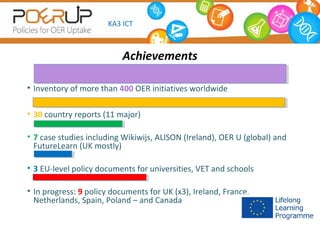
Achievements
• Inventory of more than 400 OER initiatives worldwide
• 30 country reports (11 major)
• 7 case studies including Wikiwijs, ALISON (Ireland), OER U (global) and
FutureLearn (UK mostly)
• 3 EU-level policy documents for universities, VET and schools
• In progress: 9 policy documents for UK (x3), Ireland, France,
Netherlands, Spain, Poland – and Canada
This presentation
• Summarises our initial policy recommendations
for HE and FE/VET
• Within a wider context of formal education
• Correlated to the European Commission’s
Opening Up Education policy recommendations
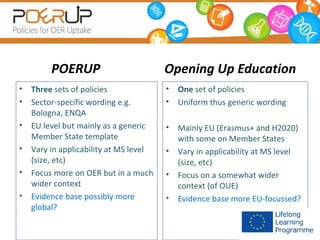
POERUP
•
•
•
•
•
•

Three sets of policies
Sector-specific wording e.g.
Bologna, ENQA
EU level but mainly as a generic
Member State template
Vary in applicability at MS level
(size, etc)
Focus more on OER but in a much
wider context
Evidence base possibly more
global?

Opening Up Education
•
•

One set of policies
Uniform thus generic wording

•

Mainly EU (Erasmus+ and H2020)
with some on Member States
Vary in applicability at MS level
(size, etc)
Focus on a somewhat wider
context (of OUE)
Evidence base more EU-focussed?

•
•
•
POERUP: Three types of intervention
• interventions that link OER to open access (to
research and to standards)
• interventions that foster important phenomena
(including access, cost and quality; but also others
such as development and informed citizenry) that
OER is said to facilitate
• interventions that serve to reduce or dismantle the
barriers to creation of innovative institutions and
innovative practice (including OER, MOOCs and
open educational practices).
Recommendations A (#1–#7)
•
•
•
•
•

Innovation
Accreditation of institutions (2)
Quality agencies
Competency-based education
Accreditation of Prior Learning (2)
Recommendations B (#8–#18)
•
•
•
•

Funding (4), mainly EU-level
Intellectual Property (4)
Teacher training (2)
Further research
Innovation
The key
but only at scale
Innovation – innovative institutions
• Since the era of building open
universities there has been little visible
activity in creating innovative institutions
New?-build institutions opening up education
Innovation – recommendation
• The European Commission should set up a
competitive innovation fund to set up one new
“European” university each year with a commitment
to “low-system-cost” online education around a core
proposition of open content.
• OUE: Support innovative teaching and learning
environments, including through the use of structural
and investment funds (ESIFs)
• OUE: Establish a European Hub of Digitally Innovative
Education institutions... complemented by a specific
European Award of Digital Excellence
Accreditation and quality
“Outside the rules”
or
“Within the (new) rules”
Accreditation of institutions –
new accrediting bodies and mutual recognition

• The European Commission should work to
reduce the regulatory barriers against
new kinds of HE providers (e.g. for-profit, from
outside the country, consortial, etc)

– OUE: Ensure that transparency and recognition
instruments for formal education are adapted to new
forms of learning including validation of skills
acquired online
Quality agencies
• Quality agencies in ENQA should focus more
on integration of new modes of learning,
copyright and removing implicit bias from
regulations
– OUE: Ensure that transparency and recognition
instruments for formal education are adapted to
new forms of learning including validation of skills
acquired online
Accreditation of prior learning
• The Commission should recommend to universities that
they should improve and proceduralise their activity on APL
(Accreditation of Prior Learning) including the ability to
accredit knowledge and competences developed through
online study and informal learning, including but not
restricted to OER and MOOCs
• Large Member States should set up an Open Accreditor
– OUE: Ensure that transparency and recognition instruments for
formal education are adapted to new forms of learning
including validation of skills acquired online

• But what does this lead logically to?....
THIS INEVITABLY LEADS TO
Competence-based, not time-based assessment
• The Commission and related authorities developing the
European Higher Education Area should reduce the regulatory
barriers against new non-study-time-based modes of
provision: in particular by developing a successor to Bologna
based primarily on competences gained not duration of study
– OUE: Ensure that transparency and recognition instruments for formal
education are adapted to new forms of learning including validation of
skills acquired online
Funding and costs
Still neglected....
Funding mechanisms
General agreement with OUE but we recommend also:
• The European Commission should foster work into
standardised syllabi EU-wide for undergraduate degrees
in certain professions (e.g. medicine, nursing,
mathematics, IS/IT) and... foster the developments of
common bases of OER material to support these
standards: open repositories and open textbooks
• Member states should increase their scrutiny of the
cost basis for university teaching and consider the
benefits of output-based funding for qualifications
Other important issues
Intellectual Property/Copyright
Training/Staff Development
Research
Intellectual Property Rights
• Standard Creative Commons license for EU and all
member states
• Technological methods to provide more and
standardised information on IPR to users of digital
educational content
• Mass EU-wide multi-level education campaign to
educate education staff on IPR issues
• Study the issues around the non commercial
restriction and make appropriate recommendations
Initial academic training and CPD
• Development of online initial and continuous
professional development programmes for teachers,
focussing on online learning with specific coverage of
distance learning, OER, MOOCs and other forms of
open educational practice, and also IPR issues
– OUE: Support teachers in acquiring a high level of digital
competences and adopt innovative teaching practices
through flexible training, incentive schemes, revised
curricula for teachers' initial education and new
professional evaluation mechanisms
Innovation and research into the benefits of OER

• The Commission should fund research into the
verifiable benefits of OER, with greater efforts
to integrate analyses with ongoing research
on distance learning, on-campus online
learning, and pedagogy
– OUE: European Commission support for better
knowledge and stronger evidence-based policies
(four detailed points)
Thank you for listening
Paul Bacsich
For the POERUP policy team
Policies in preparation for/with UK(x3), Ireland,
France, Netherlands, Spain, and Poland;
We want to work with other EU/EEA/LLP countries too

Policies for OER uptake - POERUP project explained

  • 1.
    Policies for OERUptake for the post-secondary education sectors: with emphasis on Member States Paul Bacsich – Sero Consulting and members of the POERUP policy team Online Educa 5 December 2013, Berlin
  • 2.
    Just one slideon POERUP follows....
  • 3.
    KA3 ICT Achievements • Inventoryof more than 400 OER initiatives worldwide • 30 country reports (11 major) • 7 case studies including Wikiwijs, ALISON (Ireland), OER U (global) and FutureLearn (UK mostly) • 3 EU-level policy documents for universities, VET and schools • In progress: 9 policy documents for UK (x3), Ireland, France, Netherlands, Spain, Poland – and Canada
  • 4.
    This presentation • Summarisesour initial policy recommendations for HE and FE/VET • Within a wider context of formal education • Correlated to the European Commission’s Opening Up Education policy recommendations
  • 5.
    POERUP • • • • • • Three sets ofpolicies Sector-specific wording e.g. Bologna, ENQA EU level but mainly as a generic Member State template Vary in applicability at MS level (size, etc) Focus more on OER but in a much wider context Evidence base possibly more global? Opening Up Education • • One set of policies Uniform thus generic wording • Mainly EU (Erasmus+ and H2020) with some on Member States Vary in applicability at MS level (size, etc) Focus on a somewhat wider context (of OUE) Evidence base more EU-focussed? • • •
  • 6.
    POERUP: Three typesof intervention • interventions that link OER to open access (to research and to standards) • interventions that foster important phenomena (including access, cost and quality; but also others such as development and informed citizenry) that OER is said to facilitate • interventions that serve to reduce or dismantle the barriers to creation of innovative institutions and innovative practice (including OER, MOOCs and open educational practices).
  • 7.
    Recommendations A (#1–#7) • • • • • Innovation Accreditationof institutions (2) Quality agencies Competency-based education Accreditation of Prior Learning (2)
  • 8.
    Recommendations B (#8–#18) • • • • Funding(4), mainly EU-level Intellectual Property (4) Teacher training (2) Further research
  • 9.
  • 10.
    Innovation – innovativeinstitutions • Since the era of building open universities there has been little visible activity in creating innovative institutions
  • 11.
  • 12.
    Innovation – recommendation •The European Commission should set up a competitive innovation fund to set up one new “European” university each year with a commitment to “low-system-cost” online education around a core proposition of open content. • OUE: Support innovative teaching and learning environments, including through the use of structural and investment funds (ESIFs) • OUE: Establish a European Hub of Digitally Innovative Education institutions... complemented by a specific European Award of Digital Excellence
  • 13.
    Accreditation and quality “Outsidethe rules” or “Within the (new) rules”
  • 14.
    Accreditation of institutions– new accrediting bodies and mutual recognition • The European Commission should work to reduce the regulatory barriers against new kinds of HE providers (e.g. for-profit, from outside the country, consortial, etc) – OUE: Ensure that transparency and recognition instruments for formal education are adapted to new forms of learning including validation of skills acquired online
  • 15.
    Quality agencies • Qualityagencies in ENQA should focus more on integration of new modes of learning, copyright and removing implicit bias from regulations – OUE: Ensure that transparency and recognition instruments for formal education are adapted to new forms of learning including validation of skills acquired online
  • 16.
    Accreditation of priorlearning • The Commission should recommend to universities that they should improve and proceduralise their activity on APL (Accreditation of Prior Learning) including the ability to accredit knowledge and competences developed through online study and informal learning, including but not restricted to OER and MOOCs • Large Member States should set up an Open Accreditor – OUE: Ensure that transparency and recognition instruments for formal education are adapted to new forms of learning including validation of skills acquired online • But what does this lead logically to?....
  • 17.
    THIS INEVITABLY LEADSTO Competence-based, not time-based assessment • The Commission and related authorities developing the European Higher Education Area should reduce the regulatory barriers against new non-study-time-based modes of provision: in particular by developing a successor to Bologna based primarily on competences gained not duration of study – OUE: Ensure that transparency and recognition instruments for formal education are adapted to new forms of learning including validation of skills acquired online
  • 18.
  • 19.
    Funding mechanisms General agreementwith OUE but we recommend also: • The European Commission should foster work into standardised syllabi EU-wide for undergraduate degrees in certain professions (e.g. medicine, nursing, mathematics, IS/IT) and... foster the developments of common bases of OER material to support these standards: open repositories and open textbooks • Member states should increase their scrutiny of the cost basis for university teaching and consider the benefits of output-based funding for qualifications
  • 20.
    Other important issues IntellectualProperty/Copyright Training/Staff Development Research
  • 21.
    Intellectual Property Rights •Standard Creative Commons license for EU and all member states • Technological methods to provide more and standardised information on IPR to users of digital educational content • Mass EU-wide multi-level education campaign to educate education staff on IPR issues • Study the issues around the non commercial restriction and make appropriate recommendations
  • 22.
    Initial academic trainingand CPD • Development of online initial and continuous professional development programmes for teachers, focussing on online learning with specific coverage of distance learning, OER, MOOCs and other forms of open educational practice, and also IPR issues – OUE: Support teachers in acquiring a high level of digital competences and adopt innovative teaching practices through flexible training, incentive schemes, revised curricula for teachers' initial education and new professional evaluation mechanisms
  • 23.
    Innovation and researchinto the benefits of OER • The Commission should fund research into the verifiable benefits of OER, with greater efforts to integrate analyses with ongoing research on distance learning, on-campus online learning, and pedagogy – OUE: European Commission support for better knowledge and stronger evidence-based policies (four detailed points)
  • 24.
    Thank you forlistening Paul Bacsich For the POERUP policy team Policies in preparation for/with UK(x3), Ireland, France, Netherlands, Spain, and Poland; We want to work with other EU/EEA/LLP countries too