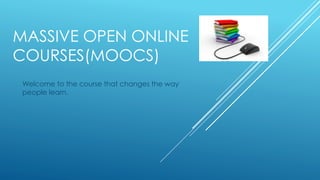
MASSIVE OPEN ONLINE
COURSES(MOOCS)
Welcome to the course that changes the way
people learn.
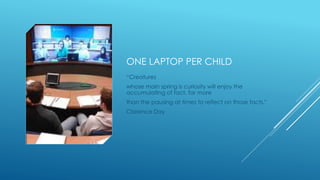
ONE LAPTOP PER CHILD
“Creatures
whose main spring is curiosity will enjoy the
accumulating of fact, far more
than the pausing at times to reflect on those facts."
Clarence Day
INTRODUCTION
What are MOOCs?
MOOCs are short courses that are delivered online for free.
These courses:
•do not have any entry requirements - all courses can be taken by anyone from anywhere online
•are usually run two or three times each year
•are led by world-class academics and supported by teaching assistants
•typically require 1-2 hours of study each week for around 5 weeks
•are self-directed, meaning you follow the course materials, complete the readings and assessments, and get help
from a large community of fellow learners through online forums.
•are comparable to a standard University of Edinburgh course in terms of content and study level
•meet high academic standards and are subject to internal quality assurance processes
Although our MOOCs do not have formal university credits assigned to them, Statements of Accomplishment will be
available to any student who completes a course with us.
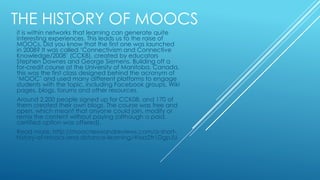
THE HISTORY OF MOOCS
it is within networks that learning can generate quite
interesting experiences. This leads us to the raise of
MOOCs. Did you know that the first one was launched
in 2008? It was called ‘Connectivism and Connective
Knowledge/2008’ (CCK8), created by educators
Stephen Downes and George Siemens. Building off a
for-credit course at the University of Manitoba, Canada,
this was the first class designed behind the acronym of
‘MOOC’ and used many different platforms to engage
students with the topic, including Facebook groups, Wiki
pages, blogs, forums and other resources.
Around 2,200 people signed up for CCK08, and 170 of
them created their own blogs. The course was free and
open, which meant that anyone could join, modify or
remix the content without paying (although a paid,
certified option was offered).
Read more: http://moocnewsandreviews.com/a-short-
history-of-moocs-and-distance-learning/#ixzz2tr1DgpJU
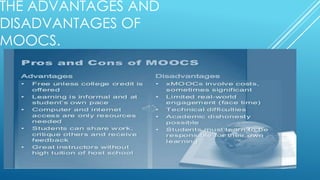
THE ADVANTAGES AND
DISADVANTAGES OF
MOOCS.
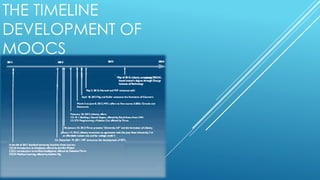
THE TIMELINE
DEVELOPMENT OF
MOOCS
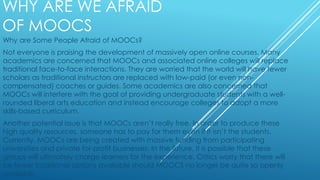
WHY ARE WE AFRAID
OF MOOCS
Why are Some People Afraid of MOOCs?
Not everyone is praising the development of massively open online courses. Many
academics are concerned that MOOCs and associated online colleges will replace
traditional face-to-face interactions. They are worried that the world will have fewer
scholars as traditional instructors are replaced with low-paid (or even non-
compensated) coaches or guides. Some academics are also concerned that
MOOCs will interfere with the goal of providing undergraduate students with a well-
rounded liberal arts education and instead encourage colleges to adopt a more
skills-based curriculum.
Another potential issue is that MOOCs aren’t really free. In order to produce these
high quality resources, someone has to pay for them even if it isn’t the students.
Currently, MOOCs are being created with massive funding from participating
universities and private for-profit businesses. In the future, it is possible that these
groups will ultimately charge learners for the experience. Critics worry that there will
be fewer traditional options available should MOOCS no longer be quite so openly
available
“
”
WHAT CAN WE DO TO CREATE SHARED
PROSPERITY? THE ANSWER IS NOT TO TRY TO SLOW
DOWN TECHNOLOGY. INSTEAD OF RACING
AGAINST THE MACHINE, WE NEED TO LEARN TO
RACE WITH THE MACHINE.” — ERIK BRYNJOLFSSON
"Learning for life,”
CERTIFICATION UPON
COMPLETION
 Mostly, success in moocs does not lead to credit but certificate.
 Certification can be traded for credit but its very expensive
THE COURSES THAT
INVOKES MY INTEREST
I am a teacher, therefore creating a healthy positive classroom
atmosphere is crucial also want to develop my character as an
educator, because when l am in class children look up to me and some
do take us as their role models. Build my character then comes in
hand.Morever,am also interested in developmental psychology
because that’s where the mind of a child is developed need to
understand the factors which influences their behavior so that l can give
them the help they need.
COURSERA AM
CURRENTLY ENROLLED IN.
 Teaching Character and Creating Positive Classrooms.
 Developmental psychology
REFERENCES
o http://www.slideshare.net/oerafrica/the-rise-of-moocs
o http://www.slideshare.net/LynGoodnight/multmedia-presentation-
goodnight
o http://www.slideshare.net/Downes/2013-05-06-moose
o http://www.slideshare.net/Downes/education-as-
platform?from_search=11
o http://www.slideshare.net/Downes/how-to-organize-a-
mooc?from_search=9

Doc

  • 1.
    MASSIVE OPEN ONLINE COURSES(MOOCS) Welcometo the course that changes the way people learn.
  • 2.
    ONE LAPTOP PERCHILD “Creatures whose main spring is curiosity will enjoy the accumulating of fact, far more than the pausing at times to reflect on those facts." Clarence Day
  • 3.
    INTRODUCTION What are MOOCs? MOOCsare short courses that are delivered online for free. These courses: •do not have any entry requirements - all courses can be taken by anyone from anywhere online •are usually run two or three times each year •are led by world-class academics and supported by teaching assistants •typically require 1-2 hours of study each week for around 5 weeks •are self-directed, meaning you follow the course materials, complete the readings and assessments, and get help from a large community of fellow learners through online forums. •are comparable to a standard University of Edinburgh course in terms of content and study level •meet high academic standards and are subject to internal quality assurance processes Although our MOOCs do not have formal university credits assigned to them, Statements of Accomplishment will be available to any student who completes a course with us.
  • 4.
    THE HISTORY OFMOOCS it is within networks that learning can generate quite interesting experiences. This leads us to the raise of MOOCs. Did you know that the first one was launched in 2008? It was called ‘Connectivism and Connective Knowledge/2008’ (CCK8), created by educators Stephen Downes and George Siemens. Building off a for-credit course at the University of Manitoba, Canada, this was the first class designed behind the acronym of ‘MOOC’ and used many different platforms to engage students with the topic, including Facebook groups, Wiki pages, blogs, forums and other resources. Around 2,200 people signed up for CCK08, and 170 of them created their own blogs. The course was free and open, which meant that anyone could join, modify or remix the content without paying (although a paid, certified option was offered). Read more: http://moocnewsandreviews.com/a-short- history-of-moocs-and-distance-learning/#ixzz2tr1DgpJU
  • 5.
  • 6.
  • 7.
    WHY ARE WEAFRAID OF MOOCS Why are Some People Afraid of MOOCs? Not everyone is praising the development of massively open online courses. Many academics are concerned that MOOCs and associated online colleges will replace traditional face-to-face interactions. They are worried that the world will have fewer scholars as traditional instructors are replaced with low-paid (or even non- compensated) coaches or guides. Some academics are also concerned that MOOCs will interfere with the goal of providing undergraduate students with a well- rounded liberal arts education and instead encourage colleges to adopt a more skills-based curriculum. Another potential issue is that MOOCs aren’t really free. In order to produce these high quality resources, someone has to pay for them even if it isn’t the students. Currently, MOOCs are being created with massive funding from participating universities and private for-profit businesses. In the future, it is possible that these groups will ultimately charge learners for the experience. Critics worry that there will be fewer traditional options available should MOOCS no longer be quite so openly available
  • 8.
    “ ” WHAT CAN WEDO TO CREATE SHARED PROSPERITY? THE ANSWER IS NOT TO TRY TO SLOW DOWN TECHNOLOGY. INSTEAD OF RACING AGAINST THE MACHINE, WE NEED TO LEARN TO RACE WITH THE MACHINE.” — ERIK BRYNJOLFSSON "Learning for life,”
  • 9.
    CERTIFICATION UPON COMPLETION  Mostly,success in moocs does not lead to credit but certificate.  Certification can be traded for credit but its very expensive
  • 10.
    THE COURSES THAT INVOKESMY INTEREST I am a teacher, therefore creating a healthy positive classroom atmosphere is crucial also want to develop my character as an educator, because when l am in class children look up to me and some do take us as their role models. Build my character then comes in hand.Morever,am also interested in developmental psychology because that’s where the mind of a child is developed need to understand the factors which influences their behavior so that l can give them the help they need.
  • 11.
    COURSERA AM CURRENTLY ENROLLEDIN.  Teaching Character and Creating Positive Classrooms.  Developmental psychology
  • 12.
    REFERENCES o http://www.slideshare.net/oerafrica/the-rise-of-moocs o http://www.slideshare.net/LynGoodnight/multmedia-presentation- goodnight ohttp://www.slideshare.net/Downes/2013-05-06-moose o http://www.slideshare.net/Downes/education-as- platform?from_search=11 o http://www.slideshare.net/Downes/how-to-organize-a- mooc?from_search=9