
Dr Li Yuan
Jisc CETIS, University of Bolton
MOOCs and Higher Education
- Concepts, Models and Trends
SCONUL Annual Conference
Dublin, 20 June, 2013
Open Educational Resources and Open Online Courses on Educational Technology
Designing Learning for the 21st Century
Outline of the Presentation
 Making sense of MOOCs
Context, concept and history
 MOOCs as a Business
Business models, revenues, partnerships and outcomes
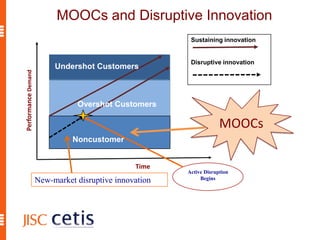
 MOOCs as Disruptive Innovation
Non-consumers, simple products, free or lower cost
 Potential Impacts on HE
Missions, provisions, costs, delivery models
What is a MOOC
- The concept of MOOCs was introduced by Dave Cormier in 2008
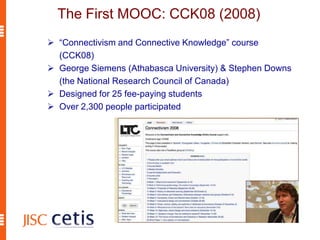
The First MOOC: CCK08 (2008)
 “Connectivism and Connective Knowledge” course
(CCK08)
 George Siemens (Athabasca University) & Stephen Downs
(the National Research Council of Canada)
 Designed for 25 fee-paying students
 Over 2,300 people participated
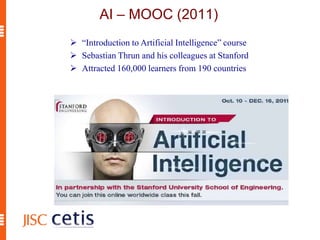
AI – MOOC (2011)
 “Introduction to Artificial Intelligence” course
 Sebastian Thrun and his colleagues at Stanford
 Attracted 160,000 learners from 190 countries
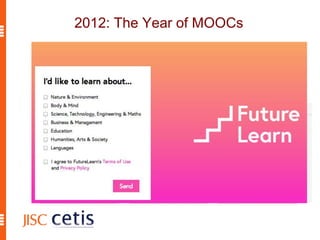
2012: The Year of MOOCs
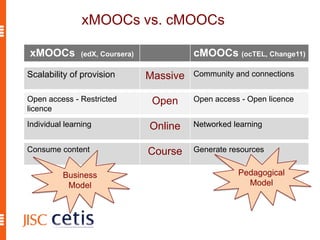
xMOOCs vs. cMOOCs
xMOOCs (edX, Coursera) cMOOCs (ocTEL, Change11)
Scalability of provision Massive Community and connections
Individual learning Online Networked learning
Open access - Restricted
licence
Open Open access - Open licence
Consume content Course Generate resources
Business
Model
Pedagogical
Model
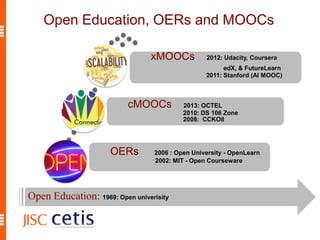
Open Education, OERs and MOOCs
OERs 2006 : Open University - OpenLearn
2002: MIT - Open Courseware
cMOOCs 2013: OCTEL
2010: DS 106 Zone
2008: CCKO8
xMOOCs 2012: Udacity, Coursera
edX, & FutureLearn
2011: Stanford (AI MOOC)
Open Education: 1969: Open univerisity
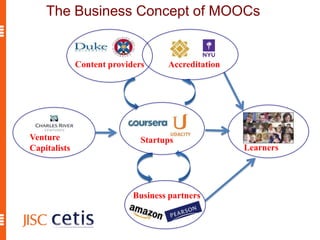
The Business Concept of MOOCs
Business partners
Content providers Accreditation
StartupsVenture
Capitalists Learners
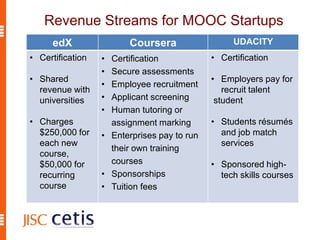
edX Coursera UDACITY
• Certification
• Shared
revenue with
universities
• Charges
$250,000 for
each new
course,
$50,000 for
recurring
course
• Certification
• Secure assessments
• Employee recruitment
• Applicant screening
• Human tutoring or
assignment marking
• Enterprises pay to run
their own training
courses
• Sponsorships
• Tuition fees
• Certification
• Employers pay for
recruit talent
student
• Students résumés
and job match
services
• Sponsored high-
tech skills courses
Revenue Streams for MOOC Startups
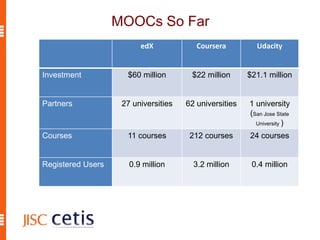
MOOCs So Far
edX Coursera Udacity
Investment $60 million $22 million $21.1 million
Partners 27 universities 62 universities 1 university
(San Jose State
University )
Courses 11 courses 212 courses 24 courses
Registered Users 0.9 million 3.2 million 0.4 million
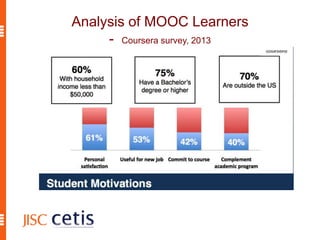
Analysis of MOOC Learners
- Coursera survey, 2013
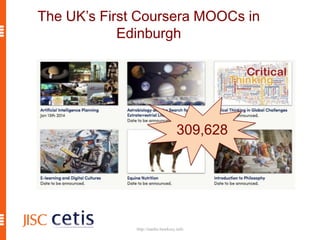
The UK’s First Coursera MOOCs in
Edinburgh
http://mashe.hawksey.info
309,628
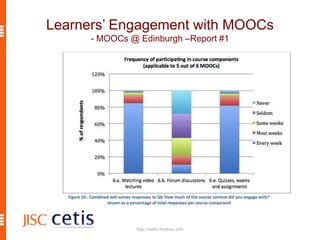
Learners’ Engagement with MOOCs
- MOOCs @ Edinburgh –Report #1
http://mashe.hawksey.info
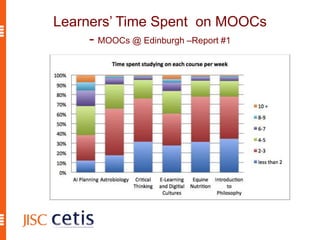
Learners’ Time Spent on MOOCs
- MOOCs @ Edinburgh –Report #1
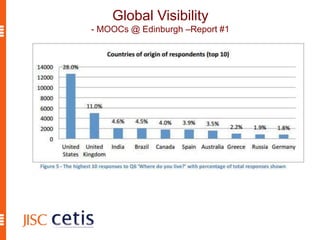
Global Visibility
- MOOCs @ Edinburgh –Report #1
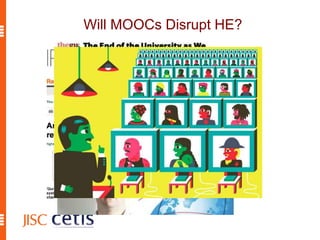
Will MOOCs Disrupt HE?
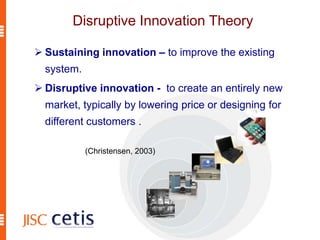
Disruptive Innovation Theory
 Sustaining innovation – to improve the existing
system.
 Disruptive innovation - to create an entirely new
market, typically by lowering price or designing for
different customers .
(Christensen, 2003)
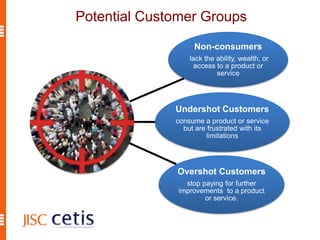
Potential Customer Groups
Non-consumers
lack the ability, wealth, or
access to a product or
service
Undershot Customers
consume a product or service
but are frustrated with its
limitations
Overshot Customers
stop paying for further
improvements to a product
or service.
MOOCs and Disruptive Innovation
Active Disruption
Begins
Noncustomer
Sustaining innovation
Disruptive innovation
PerformanceDemand
Time
New-market disruptive innovation
Undershot Customers
MOOCs
Overshot Customers
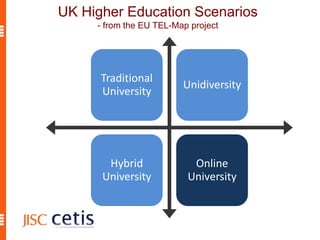
UK Higher Education Scenarios
- from the EU TEL-Map project
Traditional
University
Unidiversity
Hybrid
University
Online
University
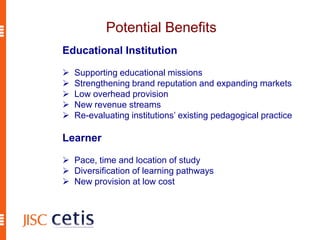
Potential Benefits
Educational Institution
 Supporting educational missions
 Strengthening brand reputation and expanding markets
 Low overhead provision
 New revenue streams
 Re-evaluating institutions’ existing pedagogical practice
Learner
 Pace, time and location of study
 Diversification of learning pathways
 New provision at low cost
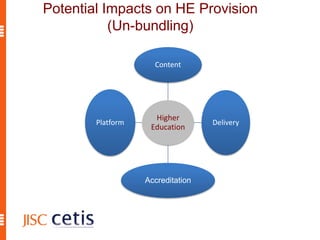
Potential Impacts on HE Provision
(Un-bundling)
Higher
Education
Content
Delivery
Accreditation
Platform
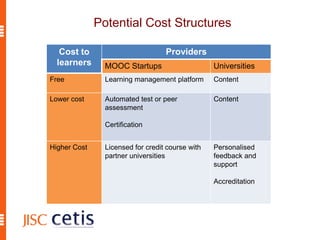
Potential Cost Structures
Cost to
learners
Providers
MOOC Startups Universities
Free Learning management platform Content
Lower cost Automated test or peer
assessment
Certification
Content
Higher Cost Licensed for credit course with
partner universities
Personalised
feedback and
support
Accreditation
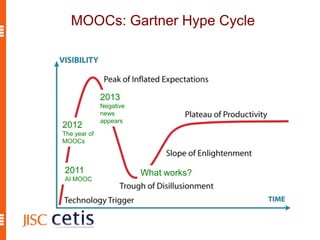
MOOCs: Gartner Hype Cycle
2011
AI MOOC
2012
The year of
MOOCs
What works?
2013
Negative
news
appears
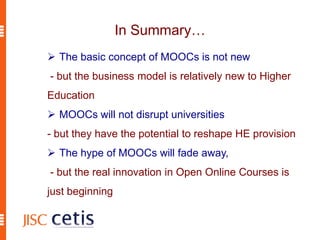
In Summary…
 The basic concept of MOOCs is not new
- but the business model is relatively new to Higher
Education
 MOOCs will not disrupt universities
- but they have the potential to reshape HE provision
 The hype of MOOCs will fade away,
- but the real innovation in Open Online Courses is
just beginning
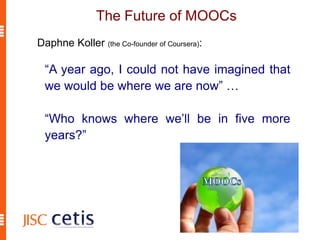
The Future of MOOCs
“A year ago, I could not have imagined that
we would be where we are now” …
“Who knows where we’ll be in five more
years?”
Daphne Koller (the Co-founder of Coursera):
Thank you!
Further Reading:
JISC CETIS, 2013, MOOCs and Open Education: Implications for Higher Education,
http://publications.cetis.ac.uk/2013/667
Moody, 2012, Shifting Ground: Technology Begins to Alter Centuries Old Business Model for Universities
http://www.etsu.edu/125/taskforces/Programs_and_Opportunities/documents/MOOC.PDF
Edinbourgh, 2013, MOOCs @ Edinburgh –Report #1,
http://www.era.lib.ed.ac.uk/bitstream/1842/6683/1/Edinburgh%20MOOCs%20Report%202013%20%231.pdf
Universities UK, 2013, Massive open online courses: higher education's digital moment?
http://www.universitiesuk.ac.uk/highereducation/Documents/2013/MassiveOpenOnlineCourses.pdf
Christensen, C., M. (2003). The innovator's solution: creating and sustaining successful growth. Harvard Business
Press.
Gartner (2013), Gartner Hype Cycles, http://www.gartner.com/technology/research/methodologies/hype-cycles.jsp
Hill P (2013), MOOCs Beyond Professional Development: Coursera’s Big Announcement in Context,
http://mfeldstein.com/moocs-beyond-professional-development-courseras-big-announcement-in-context/

Dr Li Yuan - MOOCs: Game changer or fringe benefit?

  • 1.
    Dr Li Yuan JiscCETIS, University of Bolton MOOCs and Higher Education - Concepts, Models and Trends SCONUL Annual Conference Dublin, 20 June, 2013
  • 2.
    Open Educational Resourcesand Open Online Courses on Educational Technology Designing Learning for the 21st Century
  • 3.
    Outline of thePresentation  Making sense of MOOCs Context, concept and history  MOOCs as a Business Business models, revenues, partnerships and outcomes  MOOCs as Disruptive Innovation Non-consumers, simple products, free or lower cost  Potential Impacts on HE Missions, provisions, costs, delivery models
  • 4.
    What is aMOOC - The concept of MOOCs was introduced by Dave Cormier in 2008
  • 5.
    The First MOOC:CCK08 (2008)  “Connectivism and Connective Knowledge” course (CCK08)  George Siemens (Athabasca University) & Stephen Downs (the National Research Council of Canada)  Designed for 25 fee-paying students  Over 2,300 people participated
  • 6.
    AI – MOOC(2011)  “Introduction to Artificial Intelligence” course  Sebastian Thrun and his colleagues at Stanford  Attracted 160,000 learners from 190 countries
  • 7.
  • 8.
    xMOOCs vs. cMOOCs xMOOCs(edX, Coursera) cMOOCs (ocTEL, Change11) Scalability of provision Massive Community and connections Individual learning Online Networked learning Open access - Restricted licence Open Open access - Open licence Consume content Course Generate resources Business Model Pedagogical Model
  • 9.
    Open Education, OERsand MOOCs OERs 2006 : Open University - OpenLearn 2002: MIT - Open Courseware cMOOCs 2013: OCTEL 2010: DS 106 Zone 2008: CCKO8 xMOOCs 2012: Udacity, Coursera edX, & FutureLearn 2011: Stanford (AI MOOC) Open Education: 1969: Open univerisity
  • 10.
    The Business Conceptof MOOCs Business partners Content providers Accreditation StartupsVenture Capitalists Learners
  • 11.
    edX Coursera UDACITY •Certification • Shared revenue with universities • Charges $250,000 for each new course, $50,000 for recurring course • Certification • Secure assessments • Employee recruitment • Applicant screening • Human tutoring or assignment marking • Enterprises pay to run their own training courses • Sponsorships • Tuition fees • Certification • Employers pay for recruit talent student • Students résumés and job match services • Sponsored high- tech skills courses Revenue Streams for MOOC Startups
  • 12.
    MOOCs So Far edXCoursera Udacity Investment $60 million $22 million $21.1 million Partners 27 universities 62 universities 1 university (San Jose State University ) Courses 11 courses 212 courses 24 courses Registered Users 0.9 million 3.2 million 0.4 million
  • 13.
    Analysis of MOOCLearners - Coursera survey, 2013
  • 14.
    The UK’s FirstCoursera MOOCs in Edinburgh http://mashe.hawksey.info 309,628
  • 15.
    Learners’ Engagement withMOOCs - MOOCs @ Edinburgh –Report #1 http://mashe.hawksey.info
  • 16.
    Learners’ Time Spenton MOOCs - MOOCs @ Edinburgh –Report #1
  • 17.
    Global Visibility - MOOCs@ Edinburgh –Report #1
  • 18.
  • 19.
    Disruptive Innovation Theory Sustaining innovation – to improve the existing system.  Disruptive innovation - to create an entirely new market, typically by lowering price or designing for different customers . (Christensen, 2003)
  • 20.
    Potential Customer Groups Non-consumers lackthe ability, wealth, or access to a product or service Undershot Customers consume a product or service but are frustrated with its limitations Overshot Customers stop paying for further improvements to a product or service.
  • 21.
    MOOCs and DisruptiveInnovation Active Disruption Begins Noncustomer Sustaining innovation Disruptive innovation PerformanceDemand Time New-market disruptive innovation Undershot Customers MOOCs Overshot Customers
  • 22.
    UK Higher EducationScenarios - from the EU TEL-Map project Traditional University Unidiversity Hybrid University Online University
  • 23.
    Potential Benefits Educational Institution Supporting educational missions  Strengthening brand reputation and expanding markets  Low overhead provision  New revenue streams  Re-evaluating institutions’ existing pedagogical practice Learner  Pace, time and location of study  Diversification of learning pathways  New provision at low cost
  • 24.
    Potential Impacts onHE Provision (Un-bundling) Higher Education Content Delivery Accreditation Platform
  • 25.
    Potential Cost Structures Costto learners Providers MOOC Startups Universities Free Learning management platform Content Lower cost Automated test or peer assessment Certification Content Higher Cost Licensed for credit course with partner universities Personalised feedback and support Accreditation
  • 26.
    MOOCs: Gartner HypeCycle 2011 AI MOOC 2012 The year of MOOCs What works? 2013 Negative news appears
  • 27.
    In Summary…  Thebasic concept of MOOCs is not new - but the business model is relatively new to Higher Education  MOOCs will not disrupt universities - but they have the potential to reshape HE provision  The hype of MOOCs will fade away, - but the real innovation in Open Online Courses is just beginning
  • 28.
    The Future ofMOOCs “A year ago, I could not have imagined that we would be where we are now” … “Who knows where we’ll be in five more years?” Daphne Koller (the Co-founder of Coursera):
  • 29.
  • 30.
    Further Reading: JISC CETIS,2013, MOOCs and Open Education: Implications for Higher Education, http://publications.cetis.ac.uk/2013/667 Moody, 2012, Shifting Ground: Technology Begins to Alter Centuries Old Business Model for Universities http://www.etsu.edu/125/taskforces/Programs_and_Opportunities/documents/MOOC.PDF Edinbourgh, 2013, MOOCs @ Edinburgh –Report #1, http://www.era.lib.ed.ac.uk/bitstream/1842/6683/1/Edinburgh%20MOOCs%20Report%202013%20%231.pdf Universities UK, 2013, Massive open online courses: higher education's digital moment? http://www.universitiesuk.ac.uk/highereducation/Documents/2013/MassiveOpenOnlineCourses.pdf Christensen, C., M. (2003). The innovator's solution: creating and sustaining successful growth. Harvard Business Press. Gartner (2013), Gartner Hype Cycles, http://www.gartner.com/technology/research/methodologies/hype-cycles.jsp Hill P (2013), MOOCs Beyond Professional Development: Coursera’s Big Announcement in Context, http://mfeldstein.com/moocs-beyond-professional-development-courseras-big-announcement-in-context/