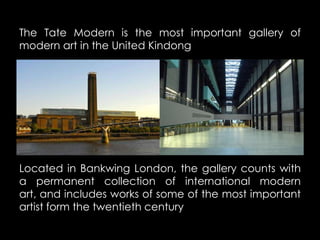


The Tate Modern is the most important gallery of
modern art in the United Kindong


Located in Bankwing London, the gallery counts with
a permanent collection of international modern
art, and includes works of some of the most important
artist form the twentieth century
OPENING   HOURS
Free entrance


• Sunday – Thursday, 10.00–18.00
• Friday and Saturday, 10.00–22.00
• Christmas closures
   – Closed 24, 25 and 26 December
   – Closing at 18.00 on 31 December
   – Open as normal on 1 January
GETTING HERE
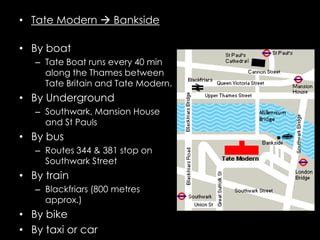
• Tate Modern  Bankside

• By boat
   – Tate Boat runs every 40 min
     along the Thames between
     Tate Britain and Tate Modern.
• By Underground
   – Southwark, Mansion House
     and St Pauls
• By bus
   – Routes 344 & 381 stop on
     Southwark Street
• By train
   – Blackfriars (800 metres
     approx.)
• By bike
• By taxi or car
EXPLORE THE TATE
    MODERN
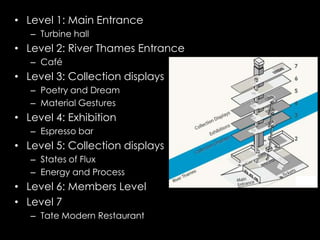
• Level 1: Main Entrance
   – Turbine hall
• Level 2: River Thames Entrance
   – Café
• Level 3: Collection displays
   – Poetry and Dream
   – Material Gestures
• Level 4: Exhibition
   – Espresso bar
• Level 5: Collection displays
   – States of Flux
   – Energy and Process
• Level 6: Members Level
• Level 7
   – Tate Modern Restaurant
PERMANENT
COLLECTION
MATERIAL GESTURES
       (LEVEL 3 – EAST WING)
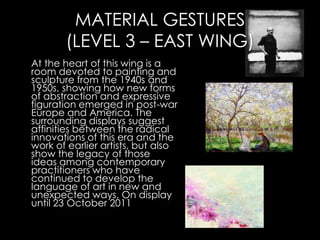
At the heart of this wing is a
room devoted to painting and
sculpture from the 1940s and
1950s, showing how new forms
of abstraction and expressive
figuration emerged in post-war
Europe and America. The
surrounding displays suggest
affinities between the radical
innovations of this era and the
work of earlier artists, but also
show the legacy of those
ideas among contemporary
practitioners who have
continued to develop the
language of art in new and
unexpected ways. On display
until 23 October 2011
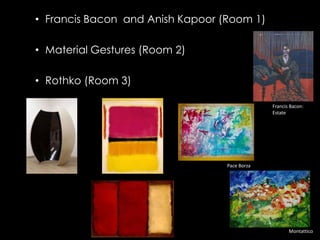
• Francis Bacon and Anish Kapoor (Room 1)

• Material Gestures (Room 2)

• Rothko (Room 3)

                                               Francis Bacon:
                                               Estate


                                  Pace Borza


                                                      Montattico
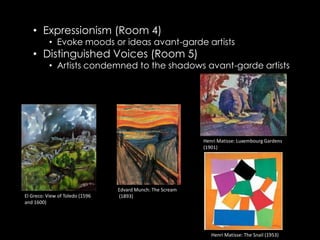
• Expressionism (Room 4)
           • Evoke moods or ideas avant-garde artists
   • Distinguished Voices (Room 5)
           • Artists condemned to the shadows avant-garde artists


                                                            Henri Matisse: Luxembourg Gardens
                                                            (1901)


                                 Edvard Munch: The Scream
El Greco: View of Toledo (1596   (1893)
and 1600)


                                                               Henri Matisse: The Snail (1953)
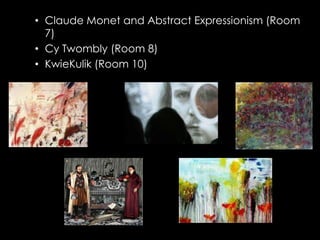
• Claude Monet and Abstract Expressionism (Room
  7)
• Cy Twombly (Room 8)
• KwieKulik (Room 10)
POETRY AND DREAM
      (LEVEL 3 – WEST WING)
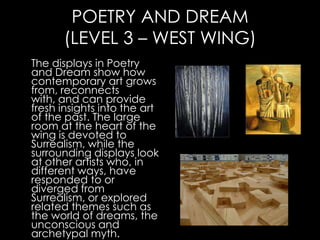
The displays in Poetry
and Dream show how
contemporary art grows
from, reconnects
with, and can provide
fresh insights into the art
of the past. The large
room at the heart of the
wing is devoted to
Surrealism, while the
surrounding displays look
at other artists who, in
different ways, have
responded to or
diverged from
Surrealism, or explored
related themes such as
the world of dreams, the
unconscious and
archetypal myth.
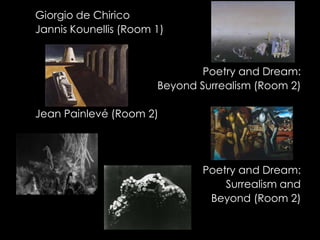
Giorgio de Chirico
Jannis Kounellis (Room 1)


                               Poetry and Dream:
                       Beyond Surrealism (Room 2)

Jean Painlevé (Room 2)


                               Poetry and Dream:
                                   Surrealism and
                                Beyond (Room 2)
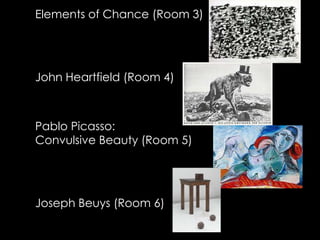
Elements of Chance (Room 3)


John Heartfield (Room 4)


Pablo Picasso:
Convulsive Beauty (Room 5)


Joseph Beuys (Room 6)
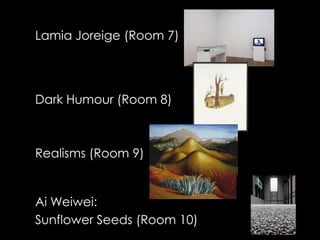
Lamia Joreige (Room 7)


Dark Humour (Room 8)


Realisms (Room 9)


Ai Weiwei:
Sunflower Seeds (Room 10)
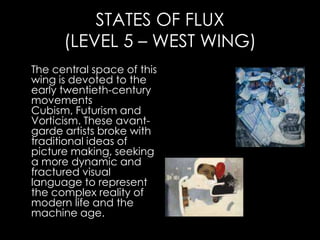
STATES OF FLUX
      (LEVEL 5 – WEST WING)
The central space of this
wing is devoted to the
early twentieth-century
movements
Cubism, Futurism and
Vorticism. These avant-
garde artists broke with
traditional ideas of
picture making, seeking
a more dynamic and
fractured visual
language to represent
the complex reality of
modern life and the
machine age.
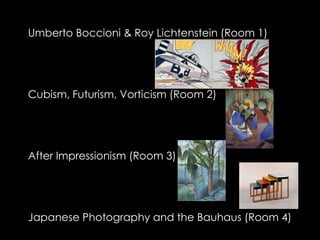
Umberto Boccioni & Roy Lichtenstein (Room 1)


Cubism, Futurism, Vorticism (Room 2)


After Impressionism (Room 3)


Japanese Photography and the Bauhaus (Room 4)
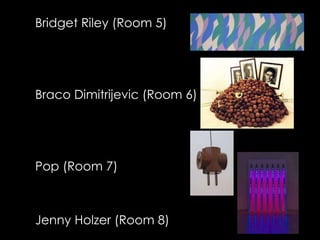
Bridget Riley (Room 5)


Braco Dimitrijevic (Room 6)


Pop (Room 7)


Jenny Holzer (Room 8)
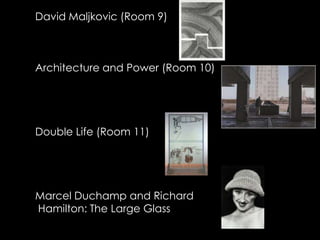
David Maljkovic (Room 9)


Architecture and Power (Room 10)


Double Life (Room 11)


Marcel Duchamp and Richard
Hamilton: The Large Glass
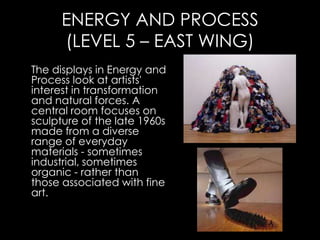
ENERGY AND PROCESS
      (LEVEL 5 – EAST WING)
The displays in Energy and
Process look at artists'
interest in transformation
and natural forces. A
central room focuses on
sculpture of the late 1960s
made from a diverse
range of everyday
materials - sometimes
industrial, sometimes
organic - rather than
those associated with fine
art.
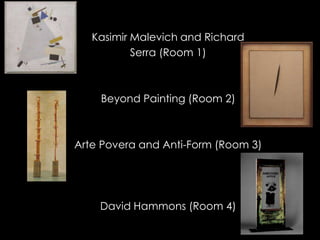
Kasimir Malevich and Richard
           Serra (Room 1)


    Beyond Painting (Room 2)


Arte Povera and Anti-Form (Room 3)


    David Hammons (Room 4)
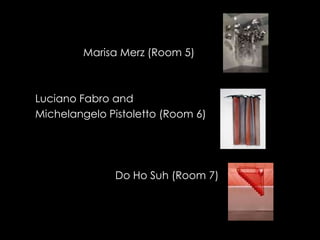
Marisa Merz (Room 5)


Luciano Fabro and
Michelangelo Pistoletto (Room 6)


              Do Ho Suh (Room 7)
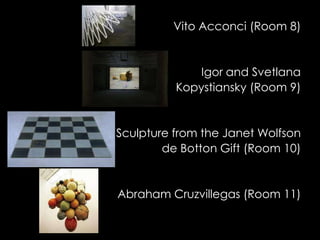
Vito Acconci (Room 8)


              Igor and Svetlana
          Kopystiansky (Room 9)


Sculpture from the Janet Wolfson
        de Botton Gift (Room 10)


Abraham Cruzvillegas (Room 11)
ON THE INTERNET
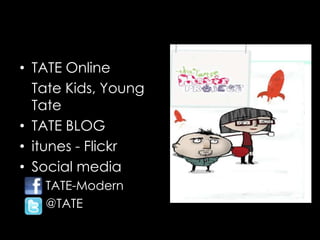
• TATE Online
  Tate Kids, Young
  Tate
• TATE BLOG
• itunes - Flickr
• Social media
  – TATE-Modern
  – @TATE
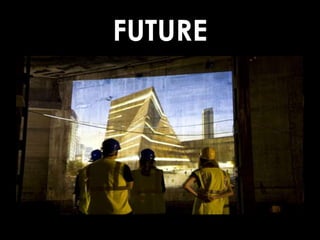
FUTURE
THANK YOU

Tate Modern

  • 2.
    The Tate Modernis the most important gallery of modern art in the United Kindong Located in Bankwing London, the gallery counts with a permanent collection of international modern art, and includes works of some of the most important artist form the twentieth century
  • 3.
    OPENING HOURS
  • 4.
    Free entrance • Sunday– Thursday, 10.00–18.00 • Friday and Saturday, 10.00–22.00 • Christmas closures – Closed 24, 25 and 26 December – Closing at 18.00 on 31 December – Open as normal on 1 January
  • 5.
  • 6.
    • Tate Modern Bankside • By boat – Tate Boat runs every 40 min along the Thames between Tate Britain and Tate Modern. • By Underground – Southwark, Mansion House and St Pauls • By bus – Routes 344 & 381 stop on Southwark Street • By train – Blackfriars (800 metres approx.) • By bike • By taxi or car
  • 7.
  • 8.
    • Level 1:Main Entrance – Turbine hall • Level 2: River Thames Entrance – Café • Level 3: Collection displays – Poetry and Dream – Material Gestures • Level 4: Exhibition – Espresso bar • Level 5: Collection displays – States of Flux – Energy and Process • Level 6: Members Level • Level 7 – Tate Modern Restaurant
  • 9.
  • 10.
    MATERIAL GESTURES (LEVEL 3 – EAST WING) At the heart of this wing is a room devoted to painting and sculpture from the 1940s and 1950s, showing how new forms of abstraction and expressive figuration emerged in post-war Europe and America. The surrounding displays suggest affinities between the radical innovations of this era and the work of earlier artists, but also show the legacy of those ideas among contemporary practitioners who have continued to develop the language of art in new and unexpected ways. On display until 23 October 2011
  • 11.
    • Francis Baconand Anish Kapoor (Room 1) • Material Gestures (Room 2) • Rothko (Room 3) Francis Bacon: Estate Pace Borza Montattico
  • 12.
    • Expressionism (Room4) • Evoke moods or ideas avant-garde artists • Distinguished Voices (Room 5) • Artists condemned to the shadows avant-garde artists Henri Matisse: Luxembourg Gardens (1901) Edvard Munch: The Scream El Greco: View of Toledo (1596 (1893) and 1600) Henri Matisse: The Snail (1953)
  • 13.
    • Claude Monetand Abstract Expressionism (Room 7) • Cy Twombly (Room 8) • KwieKulik (Room 10)
  • 14.
    POETRY AND DREAM (LEVEL 3 – WEST WING) The displays in Poetry and Dream show how contemporary art grows from, reconnects with, and can provide fresh insights into the art of the past. The large room at the heart of the wing is devoted to Surrealism, while the surrounding displays look at other artists who, in different ways, have responded to or diverged from Surrealism, or explored related themes such as the world of dreams, the unconscious and archetypal myth.
  • 15.
    Giorgio de Chirico JannisKounellis (Room 1) Poetry and Dream: Beyond Surrealism (Room 2) Jean Painlevé (Room 2) Poetry and Dream: Surrealism and Beyond (Room 2)
  • 16.
    Elements of Chance(Room 3) John Heartfield (Room 4) Pablo Picasso: Convulsive Beauty (Room 5) Joseph Beuys (Room 6)
  • 17.
    Lamia Joreige (Room7) Dark Humour (Room 8) Realisms (Room 9) Ai Weiwei: Sunflower Seeds (Room 10)
  • 18.
    STATES OF FLUX (LEVEL 5 – WEST WING) The central space of this wing is devoted to the early twentieth-century movements Cubism, Futurism and Vorticism. These avant- garde artists broke with traditional ideas of picture making, seeking a more dynamic and fractured visual language to represent the complex reality of modern life and the machine age.
  • 19.
    Umberto Boccioni &Roy Lichtenstein (Room 1) Cubism, Futurism, Vorticism (Room 2) After Impressionism (Room 3) Japanese Photography and the Bauhaus (Room 4)
  • 20.
    Bridget Riley (Room5) Braco Dimitrijevic (Room 6) Pop (Room 7) Jenny Holzer (Room 8)
  • 21.
    David Maljkovic (Room9) Architecture and Power (Room 10) Double Life (Room 11) Marcel Duchamp and Richard Hamilton: The Large Glass
  • 22.
    ENERGY AND PROCESS (LEVEL 5 – EAST WING) The displays in Energy and Process look at artists' interest in transformation and natural forces. A central room focuses on sculpture of the late 1960s made from a diverse range of everyday materials - sometimes industrial, sometimes organic - rather than those associated with fine art.
  • 23.
    Kasimir Malevich andRichard Serra (Room 1) Beyond Painting (Room 2) Arte Povera and Anti-Form (Room 3) David Hammons (Room 4)
  • 24.
    Marisa Merz (Room5) Luciano Fabro and Michelangelo Pistoletto (Room 6) Do Ho Suh (Room 7)
  • 25.
    Vito Acconci (Room8) Igor and Svetlana Kopystiansky (Room 9) Sculpture from the Janet Wolfson de Botton Gift (Room 10) Abraham Cruzvillegas (Room 11)
  • 26.
  • 27.
    • TATE Online Tate Kids, Young Tate • TATE BLOG • itunes - Flickr • Social media – TATE-Modern – @TATE
  • 28.
  • 29.