Open Education in Health
Professional Programs:
conceptualization and
applications from an
Undergraduate Nursing Program
Ruth Chen RN, PhD
McMaster University School of Nursing

Lisa-Anne Hagerman RN, Ed.D
Conestoga College Institute of Technology and
Advanced Learning
Education “is the kindling of a
flame, not the filling of a vessel”
(Socrates).
OVERVIEW
• Driving forces for “Open” Education within
Health Professional Education (HPE)
Programs
• Models that help to facilitate Open
Education within HPE Programs

• Undergraduate Program research
• Discussion
Driving Forces
• WHY is open education in HPE
important?
• WHAT would it look like in HPE?
• HOW to do it?
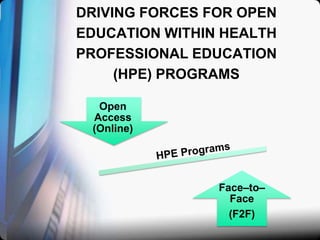
DRIVING FORCES FOR OPEN
EDUCATION WITHIN HEALTH
PROFESSIONAL EDUCATION
(HPE) PROGRAMS
Open
Access
(Online)

Face–to–
Face
(F2F)
WHY ?

• Ministry of Training, Colleges &
Universities
• Higher Education Quality Council
of Ontario
• Canadian Association of Schools
of Nursing (CASN)
• College of Nurses of Ontario
(CNO)
MODELS THAT HELP TO
FACILITATE OPEN
EDUCATION WITHIN HPE
PROGRAMS
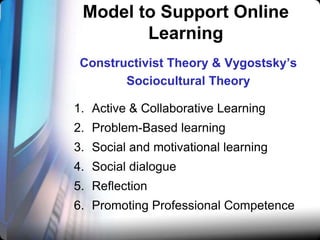
Model to Support Online
Learning
Constructivist Theory & Vygostsky’s
Sociocultural Theory
1. Active & Collaborative Learning
2. Problem-Based learning
3. Social and motivational learning
4. Social dialogue
5. Reflection
6. Promoting Professional Competence
ONE UNDERGRADUATE
PROGRAM EXAMPLE
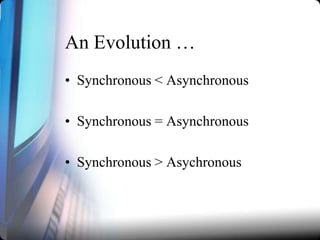
An Evolution …
• Synchronous < Asynchronous
• Synchronous = Asynchronous
• Synchronous > Asychronous
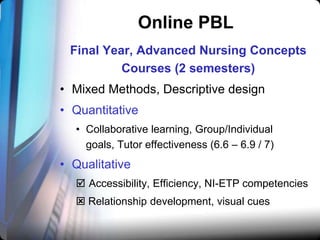
Online PBL
Final Year, Advanced Nursing Concepts
Courses (2 semesters)
• Mixed Methods, Descriptive design
• Quantitative
• Collaborative learning, Group/Individual
goals, Tutor effectiveness (6.6 – 6.9 / 7)

• Qualitative
 Accessibility, Efficiency, NI-ETP competencies
 Relationship development, visual cues
Discussion
• Examples from participants’
departments
• Implementation strategies, challenges
• New developments in distributed
learning (e.g. Web 3.0)

Chen & Hagerman

  • 1.
    Open Education inHealth Professional Programs: conceptualization and applications from an Undergraduate Nursing Program Ruth Chen RN, PhD McMaster University School of Nursing Lisa-Anne Hagerman RN, Ed.D Conestoga College Institute of Technology and Advanced Learning
  • 2.
    Education “is thekindling of a flame, not the filling of a vessel” (Socrates).
  • 3.
    OVERVIEW • Driving forcesfor “Open” Education within Health Professional Education (HPE) Programs • Models that help to facilitate Open Education within HPE Programs • Undergraduate Program research • Discussion
  • 4.
    Driving Forces • WHYis open education in HPE important? • WHAT would it look like in HPE? • HOW to do it?
  • 5.
    DRIVING FORCES FOROPEN EDUCATION WITHIN HEALTH PROFESSIONAL EDUCATION (HPE) PROGRAMS Open Access (Online) Face–to– Face (F2F)
  • 6.
    WHY ? • Ministryof Training, Colleges & Universities • Higher Education Quality Council of Ontario • Canadian Association of Schools of Nursing (CASN) • College of Nurses of Ontario (CNO)
  • 7.
    MODELS THAT HELPTO FACILITATE OPEN EDUCATION WITHIN HPE PROGRAMS
  • 8.
    Model to SupportOnline Learning Constructivist Theory & Vygostsky’s Sociocultural Theory 1. Active & Collaborative Learning 2. Problem-Based learning 3. Social and motivational learning 4. Social dialogue 5. Reflection 6. Promoting Professional Competence
  • 9.
  • 10.
    An Evolution … •Synchronous < Asynchronous • Synchronous = Asynchronous • Synchronous > Asychronous
  • 11.
    Online PBL Final Year,Advanced Nursing Concepts Courses (2 semesters) • Mixed Methods, Descriptive design • Quantitative • Collaborative learning, Group/Individual goals, Tutor effectiveness (6.6 – 6.9 / 7) • Qualitative  Accessibility, Efficiency, NI-ETP competencies  Relationship development, visual cues
  • 12.
    Discussion • Examples fromparticipants’ departments • Implementation strategies, challenges • New developments in distributed learning (e.g. Web 3.0)