Educational Futures:
The Challenges of MOOCs
Rebecca Ferguson
Institute of Educational Technology
The Open University, UK
Rethinking Education: Stockholm
The Open University (UK)
•
•
•
•
•

Supported distance education at scale
Largest university in the UK
More than 240,000 students
8,700,000 iTunes downloads in 2013
5,100,000 YouTube views in 2013
What are MOOCs?
Massive
thousands may sign up
Open
no payment is required
Online
resources on the Internet
Courses
time-bounded cohorts
Inspiring learning for life by
•Telling stories
•Provoking conversations
•Celebrating progress
Launched September 2013
29 partners; 26 universities
Nearly 400,000 course sign-ups
Over 200,000 registered users
Six of the first eight courses hit
their cap of 10,000
Nearly 30,000 learners joining
some of this year’s courses
http://about.futurelearn.com/blog/
Advantages of massive
for teaching and for life by
learning
Inspiring learning
•Telling stories
•Provoking conversations
•Celebrating progress
Advantages of massive for learners
Massive participation offers learners
•support from a wide range of other learners
•resources provided by those learners in the
form of discussion and links
•a range of diverse cultural perspectives.

Advantages of MOOCs
Support, resources and a
variety of perspectives

Improving Your Image:
Dental Photography
University of Birmingham
Elias Adan Gimenez Feliu

I'm one of the very few photographers in an area trice as
big as Scotland (the Paraguayan Chaco), where 8
different cultures live together. There's no recordkeeping or proper research done with regards of dental
treatment, specially among the most remote areas on
the country. I believe there's huge opportunities to
enhance the dental service through the powerful medium
that photography provides, by providing material for
research and education. Mainly to inform central and
local government and other decision makers, about the
realities the region faces, but specially to educate
patients (elderly and children) dental workers and other
professionals, that sometimes have to travel hundreds of
kilometres on very bad roads, in order to reach a small
town with no proper facilities but where people in need of
proper treatment live.

Advantages of MOOCs
Advantages of massive for educators
Massive participation offers educators
•affective benefits
•potentially increased access to resources
•motivation to develop teaching practices

Advantages of MOOCs
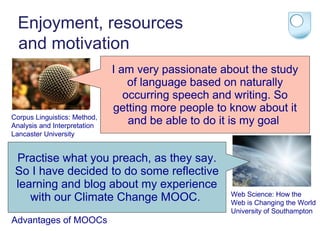
Enjoyment, resources
and motivation

Corpus Linguistics: Method,
Analysis and Interpretation
Lancaster University

I am very passionate about the study
of language based on naturally
occurring speech and writing. So
getting more people to know about it
and be able to do it is my goal

Practise what you preach, as they say.
So I have decided to do some reflective
learning and blog about my experience
with our Climate Change MOOC.
Advantages of MOOCs

Web Science: How the
Web is Changing the World
University of Southampton
Advantages of massive for society
Massive participation offers society
•potential to develop tools and resources
•potential to develop professional practice
•increased access to higher education
•potential for global impact

Advantages of MOOCs
FutureLearn launch event
[UK] Universities and Science
Minister David Willetts said: ‘I
encourage all our institutions to
explore the opportunities offered by
new modes of technology, such as
Moocs. This will keep the UK ahead
in the global race to deliver
education in worldwide markets.’
http://www.bbc.co.uk/news/business-24109190

Advantages of MOOCs
Challenges of massive
for teaching and learning
Inspiring learning for life by
•Telling stories
•Provoking conversations
•Celebrating progress
Access for all – supporting
inexperienced learners
We have provided a short video to
highlight a few points to help make
your learning experience effective
and enjoyable. The video includes:
Preparing to learn […]
Listening and reflecting […]
Making notes […]
Communicating with others

Challenges of MOOCs

Fairness and Nature:
When Worlds Collide
University of Leeds
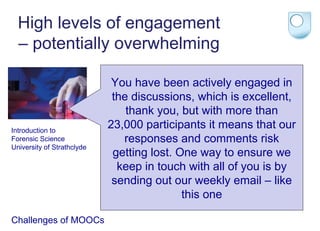
High levels of engagement
– potentially overwhelming

Introduction to
Forensic Science
University of Strathclyde

Challenges of MOOCs

You have been actively engaged in
the discussions, which is excellent,
thank you, but with more than
23,000 participants it means that our
responses and comments risk
getting lost. One way to ensure we
keep in touch with all of you is by
sending out our weekly email – like
this one
No prior qualifications required
– getting the level right
This will be primary school material for
some of you and exactly the opposite for
others. It is just not possible to tailor the
material to each of you […] If it appears
too technical, forget the detail and
concentrate on the higher level principles;
if you think ‘yes I know all about that’
we’d encourage you to be an active
participant in the learning community
Challenges of MOOCs

Introduction to
Forensic Science
University of Strathclyde
Providing education for all
– improving accessibility

Challenges of MOOCs
What does success look like…
…for learners?
…for educators?
…for the institutions?
…for society?

increasing global reach
increasing employability
having a worldwide impact
showcasing research

developing new teaching methods accrediting learning
increasing alumni numbers
earning certificates making a profit
widening access

learning a little
learning a lot

being seen as innovative
keeping up with others
attracting investment
Rethinking education

Rethinking education

  • 1.
    Educational Futures: The Challengesof MOOCs Rebecca Ferguson Institute of Educational Technology The Open University, UK Rethinking Education: Stockholm
  • 2.
    The Open University(UK) • • • • • Supported distance education at scale Largest university in the UK More than 240,000 students 8,700,000 iTunes downloads in 2013 5,100,000 YouTube views in 2013
  • 3.
    What are MOOCs? Massive thousandsmay sign up Open no payment is required Online resources on the Internet Courses time-bounded cohorts
  • 4.
    Inspiring learning forlife by •Telling stories •Provoking conversations •Celebrating progress
  • 5.
    Launched September 2013 29partners; 26 universities Nearly 400,000 course sign-ups Over 200,000 registered users Six of the first eight courses hit their cap of 10,000 Nearly 30,000 learners joining some of this year’s courses http://about.futurelearn.com/blog/
  • 6.
    Advantages of massive forteaching and for life by learning Inspiring learning •Telling stories •Provoking conversations •Celebrating progress
  • 7.
    Advantages of massivefor learners Massive participation offers learners •support from a wide range of other learners •resources provided by those learners in the form of discussion and links •a range of diverse cultural perspectives. Advantages of MOOCs
  • 8.
    Support, resources anda variety of perspectives Improving Your Image: Dental Photography University of Birmingham Elias Adan Gimenez Feliu I'm one of the very few photographers in an area trice as big as Scotland (the Paraguayan Chaco), where 8 different cultures live together. There's no recordkeeping or proper research done with regards of dental treatment, specially among the most remote areas on the country. I believe there's huge opportunities to enhance the dental service through the powerful medium that photography provides, by providing material for research and education. Mainly to inform central and local government and other decision makers, about the realities the region faces, but specially to educate patients (elderly and children) dental workers and other professionals, that sometimes have to travel hundreds of kilometres on very bad roads, in order to reach a small town with no proper facilities but where people in need of proper treatment live. Advantages of MOOCs
  • 9.
    Advantages of massivefor educators Massive participation offers educators •affective benefits •potentially increased access to resources •motivation to develop teaching practices Advantages of MOOCs
  • 10.
    Enjoyment, resources and motivation CorpusLinguistics: Method, Analysis and Interpretation Lancaster University I am very passionate about the study of language based on naturally occurring speech and writing. So getting more people to know about it and be able to do it is my goal Practise what you preach, as they say. So I have decided to do some reflective learning and blog about my experience with our Climate Change MOOC. Advantages of MOOCs Web Science: How the Web is Changing the World University of Southampton
  • 11.
    Advantages of massivefor society Massive participation offers society •potential to develop tools and resources •potential to develop professional practice •increased access to higher education •potential for global impact Advantages of MOOCs
  • 12.
    FutureLearn launch event [UK]Universities and Science Minister David Willetts said: ‘I encourage all our institutions to explore the opportunities offered by new modes of technology, such as Moocs. This will keep the UK ahead in the global race to deliver education in worldwide markets.’ http://www.bbc.co.uk/news/business-24109190 Advantages of MOOCs
  • 13.
    Challenges of massive forteaching and learning Inspiring learning for life by •Telling stories •Provoking conversations •Celebrating progress
  • 14.
    Access for all– supporting inexperienced learners We have provided a short video to highlight a few points to help make your learning experience effective and enjoyable. The video includes: Preparing to learn […] Listening and reflecting […] Making notes […] Communicating with others Challenges of MOOCs Fairness and Nature: When Worlds Collide University of Leeds
  • 15.
    High levels ofengagement – potentially overwhelming Introduction to Forensic Science University of Strathclyde Challenges of MOOCs You have been actively engaged in the discussions, which is excellent, thank you, but with more than 23,000 participants it means that our responses and comments risk getting lost. One way to ensure we keep in touch with all of you is by sending out our weekly email – like this one
  • 16.
    No prior qualificationsrequired – getting the level right This will be primary school material for some of you and exactly the opposite for others. It is just not possible to tailor the material to each of you […] If it appears too technical, forget the detail and concentrate on the higher level principles; if you think ‘yes I know all about that’ we’d encourage you to be an active participant in the learning community Challenges of MOOCs Introduction to Forensic Science University of Strathclyde
  • 17.
    Providing education forall – improving accessibility Challenges of MOOCs
  • 18.
    What does successlook like… …for learners? …for educators? …for the institutions? …for society? increasing global reach increasing employability having a worldwide impact showcasing research developing new teaching methods accrediting learning increasing alumni numbers earning certificates making a profit widening access learning a little learning a lot being seen as innovative keeping up with others attracting investment

Editor's Notes

  • #2 Title page
  • #3 I’m from the UK’s largest University. Over 40 years old Runs its own courses and awards its own degrees 342 undergraduate modules, 60 CPD modules and 141 post-grad modules 43% have 1 A level or lower at entry
  • #4 My subject today is MOOCs For those coming new to the area – this is what it stands for Names you may have heard of include the US platforms Coursera, Udacity and edX You may also hear of xMOOCs and cMOOCs. Time cover points to some of the expected benefits
  • #5 The Open University initiated FutureLearn, as a UK-based platform First courses ran in September last year, so this is a new platform, just coming out of Beta Draws on the OU’s experience of open and distance learning We know it is not enough to put resources and videos online FutureLearn is based on a pedagogy of social learning – where you have the opportunity to learn from the comments of other learners as well as from educators
  • #6 Some figures here To put them in context – Stockholm University has around 66,000 students Uppsala University has around 25,000 students You can see that this isn’t a gradual scaling up – universities are having to deal with massive numbers from the start
  • #7 I’m going to look at some of the advantages and challenge of MOOCs. In the time available I need to be selective, so I will focus on the benefits and challenges from a teaching perspective This means looking beyond the big numbers of registrations to think about what we actually gain or lose by having so many students enrolled on a course I will present them from the perspective of FutureLearn.
  • #8 We can look at the advantages of MOOC from three perspectives: learners, educators and society as a whole. We know that the economies of scale mean that students can access short university courses free of charge. However, once they are enrolled, what are the benefits of massive for them? We have seen three main benefits on FutureLearn
  • #9 I am going to illustrate those benefits with just one example. This quote came from a course on Dental Photography run by the University of Birmingham. The participants, as you would expect, were mainly dentists and staff working in dental practices. In this particular discussion they were asked why they used dental photography in their practice. Most of the uses were similar – before and after shots, providing evidence of what had been done, discussing treatment. This quotation, I think forms part of a conversation that develops the worldwide dental photography community and extends what it can achieve It gives a powerful sense that this is a skill that can be life changing for individuals and communities. It provides a new perspective, it widens what is possible, it helps to change the view of a profession.
  • #10 Massive numbers of students are challenging for educators – but we found that, while teaching the courses, they identified a lot of benefits. They were proud to be involved and excited by the scale of their courses. They were able to access experts and resources due to the size of their audience And they were interested in extending their practice and finding out what works in such environments
  • #11 Two quotations to illustrate thes points. The first is typical of many – the lead educator talking about his excitement about the course and his passion for engaging people with the subject. The second shows the MOOC prompting a change in professional practice. Not only reflecting, but also modelling good learner behaviour. And, in so doing, showing that the MOOC extends beyond a single online platform. Across the MOOCs, you repeatedly see the course extending beyond the platform, with face-to-face events, Google Hangouts, blogs, Facebook groups and Twitter discussions.
  • #12 Finally, advantages from the point of view of society. These begin with the relatively small scale – making and sharing resources that can be used elsewhere. There is the potential to develop professional practice, as on the FL courses related to Teaching Programming and to Dental photography. There is the wider benefit of increased access to higher education And the more ambitious view that this is a way of changing how and what people learn worldwide
  • #13 That last point relates to the speech the UK Universites and Science Minister gave at the launch of FutureLearn. He was pleased to see the potential for teaching and learning, and to see the UK moving ahead in this respect – but he also presented this as a national endeavour, that extended beyond individual institutions, to the country as a whole and to the UK’s place in the world.
  • #14 That was a brief overview of the advantages of massive from a teaching and learning perspective. I’ll now turn to the challenges. There are three big challenges of MOOCs that I won’t discuss here because you see them debated extensively elsewhere: (1) how to develop an effective and sustainable business model (2) how to keep learners on board (3) how to handle assessment. Instead, I am going to highlight a few of the challenges for teaching and learning. These challenges are closely allied to the advantages, so we need to consider both when we are developing for MOOCs.
  • #15 The first challenge is to be aware that most MOOC learners are new to online learning We are used to students who come to university with at least ten years experience of learning face to face. They know what is expected of them in the classroom. They know when to attend where to focus their attention, who to listen to They arrive in an online learning situation and they are thrown in at the deep end. So some guidance in learning how to learn at this level can help them to settle in.
  • #16 The second challenge is to be aware of what you are taking on. There is more to a MOOC than simply producing resources and putting them somewhere for people to work through Students are hugely enthusiastic – particularly if you encourage discussion and give them opportunities for meaningful discussion If you encourage students to compare different perspectives, to challenge and think through ideas, then there is an active role for the educator This doesn’t mean one-to-one discussions with 23,000 students, but it might mean weekly emails, or short videos answering some queries, or blogging, or tweeting.
  • #17 A third challenge is deciding how to pitch your MOOC. People are coming to MOOCs for lots of reasons. They may be complete beginners. They may be teachers, looking for new resources. They may be students who want to improve their English, or Swedish. They may be young teenagers, just beginning to explore higher education, or senior citizens who want to keep their minds active
  • #18 A final challenge is one we have always faced at the OU, but which is even clearer within MOOCs. Above are some figures from a start-of-course survey. Just one survey, so I can’t tell you they are representative – but they are indicative. People with a disability are likely to find it easier to enrol for a MOOC than for a face-to-face university, and so we do see a significant percentage of learners with a disability. If these figures were scaled up to a course of 10,000, we could expect about 1380 students to be living with a disability We could expect about 145 to be deaf or hard of hearing We could expect around 40 to be blind or partially sighted. This means that we need to consider accessibility from the start. We need to provide transcripts for video and audio files, we need our PDFs to be accessible by screen readers, and we need to think about how we make ourpictures and our graphs and our exam papers accessible to people who cannot see them
  • #19 Overall, we need to look at these advantages and these challenges in the context of what we are trying to achieve. In the past, I have spoken to people developing MOOCs and have asked them what success would look like. They are not always sure. They haven’t always thought about it. So, in order to think about the advantages and challenges for you and the people you work with, I encourage you to think about what success would look like.